
Research article · 2021 · Full text
International Journal of Biology SciencesChromosome studies on some aphid species from two tehsils in Himachal Pradesh's Kangra district
Volume 3(2) · Pages 17–23 · DOI: 10.33545/26649926.2021.v3.i2a.31 ↗
Research areasChromosomal and Genetic VariationsInsect Resistance and GeneticsPlant Virus Research Studies
Abstract
Author-writtenChromosomes of aphids infesting different host plants from two tehsils namely; Jawali and Kangra in Kangra district of Himachal Pradesh were studied. These aphids species are, zAcyrthosiphon gossypii Mordvilko (2n=6), Aphis punicae Passerini (2n=8), Brachycaudushelichrysi (Kaltenbach) (2n=12), Hyperomyzuslactuae (Linnaeus) (2n=12), Macrosiphoniella sanborni (Gillette) (2n=12), Macrosiphum euphorbiae (Thomas) (2n=10), Myzusascalonicus Doncaster (2n=12), M. ornatus Liang (2n=12), Toxopteraaurantii (Boyer de Fonscolombe) (2n=8), Toxopteraodinae (van der Goot) (2n=8), Uroleuconambrosiae (Linnaeus) (2n=12). The actual lengths, relative lengths and total complement length (TCL) of chromosomes were measured at metaphase. Karyotypes were prepared and idiograms were constructed based on relative lengths data.
Summary
Source-checkedPlain-language reading of the full paper, prepared with AI and checked against the text. Each point links to the authors' own words.
Why it matters
- Aphids are harmful pests that damage agricultural and horticultural crops by feeding on sap and transmitting viral infections. View evidence ↗
- Studying aphid cytogenetics is useful for identifying species-specific chromosomal markers, simplifying otherwise difficult identification work. View evidence ↗
- Because aphid species often show karyotype variations, the authors decided to investigate chromosomes of species found on various host plants in the Jawali and Kangra tehsils of Himachal Pradesh. View evidence ↗
The question
- The study aimed to examine the chromosomes of various aphid species infesting different host plants in the Jawali and Kangra tehsils of Himachal Pradesh. View evidence ↗
What they did
- The researchers collected apterous, viviparous, parthenogenetic female aphids from the twigs, leaves, and inflorescences of several host plants. View evidence ↗
- Somatic embryonic tissue from parthenogenetic females was used for the chromosomal analysis. View evidence ↗
- Chromosome slides and coverslips were stained with 2% Giemsa for a duration of 20 to 30 minutes. View evidence ↗
- Chromosome lengths were measured using an ocular micrometre. View evidence ↗
What they found
- Acyrthosiphon gossypii was found to have a diploid chromosome number of 2n=6. View evidence ↗
- Three species, Aphis punicae, Toxoptera odinae, and Toxoptera aurantii, were found to have a diploid chromosome number of 2n=8. View evidence ↗
- Macrosiphum euphorbiae was identified as having a diploid chromosome number of 2n=10. View evidence ↗
- Six species, Brachycaudus helichrysi, Hyperomyzus lactuae, Macrosiphoniella sanborni, Myzus ascalonicus, Myzus ornatus, and Uroleucon ambrosiae, were found to have a diploid chromosome number of 2n=12. View evidence ↗
- For Acyrthosiphon gossypii, the average total complement length (TCL) of chromosomes was 16.90 µm ±0.30. View evidence ↗
- Aphis punicae exhibited an average total complement length (TCL) of 17.78 µm ±0.55. View evidence ↗
- Myzus ornatus had a total complement length of 32.18 µm ±0.70. View evidence ↗
What it means
- The authors conclude that their findings for Aphis punicae (2n=8) are consistent with previous chromosomal reports. View evidence ↗
Figures & tables
From the original paper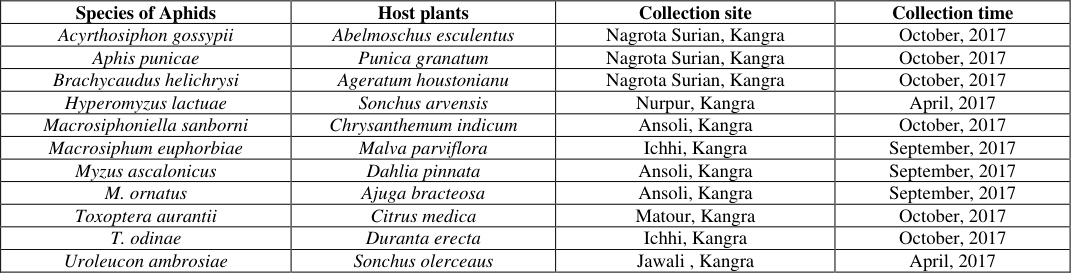 Table 1
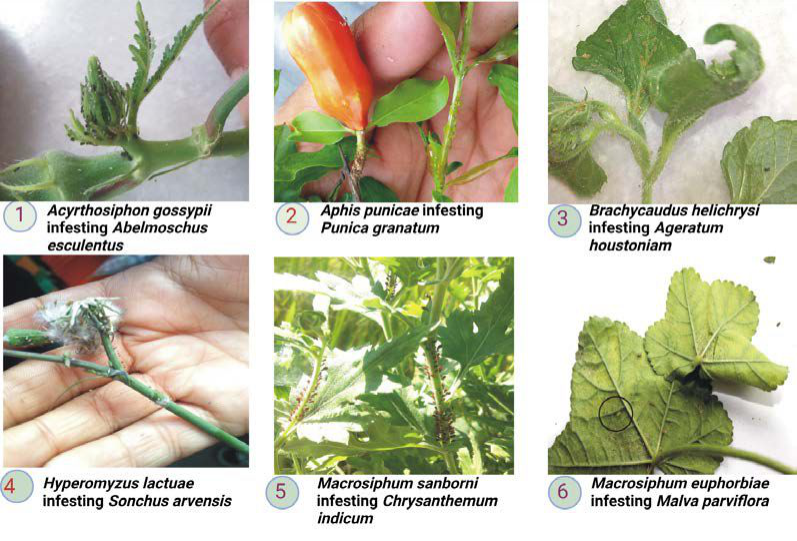 Figure 1
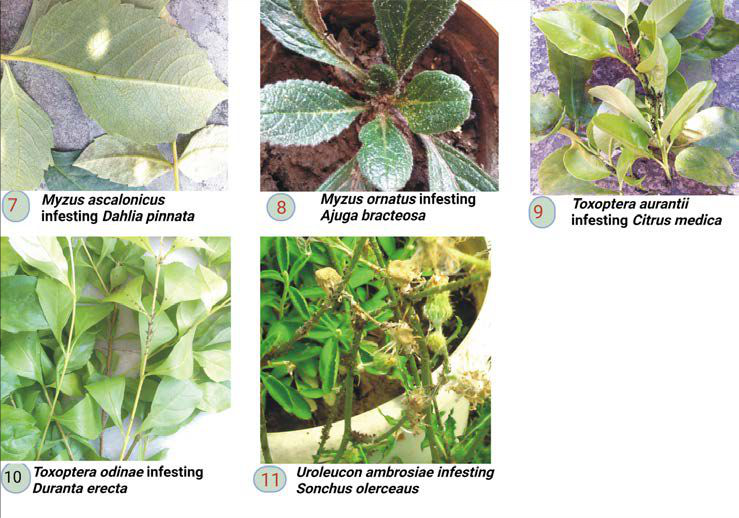 Figure 2
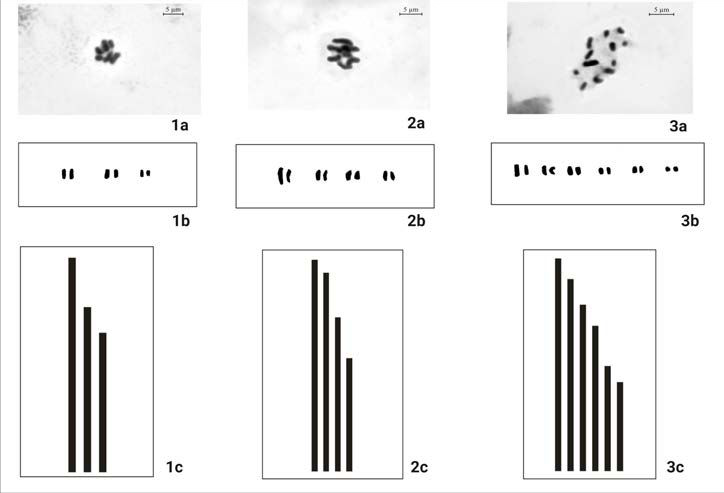 Figure 3
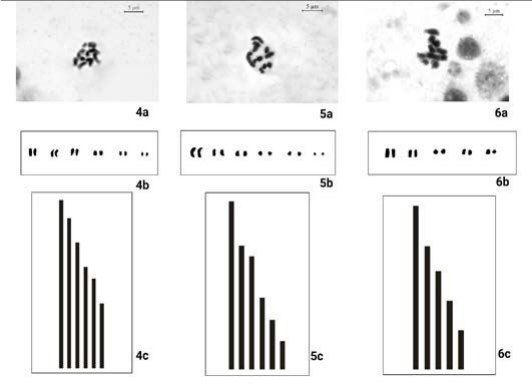 Figure 4
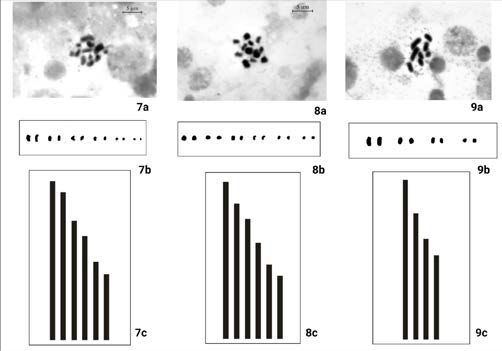 Figure 5
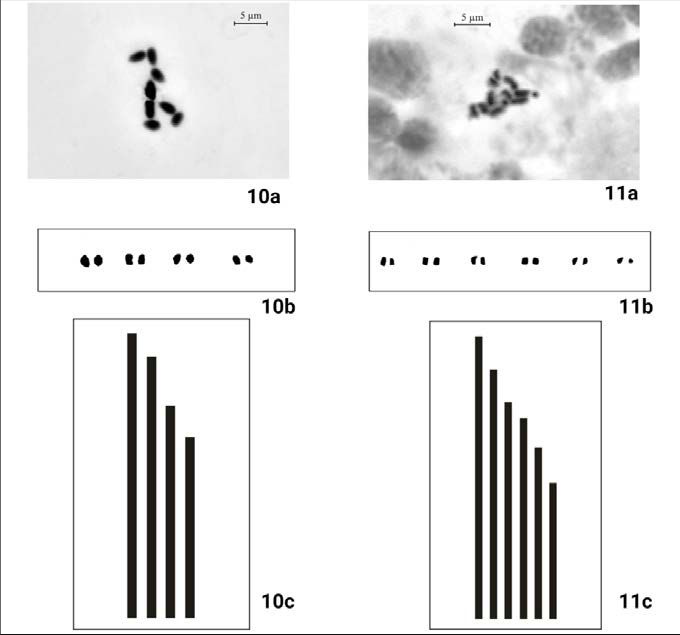 Figure 6
Introduction
Aphids inflict significant harm to a variety of agricultural and horticultural crops by feeding on plant sap and spreading viral infections to various parts of plant (Kennedy et al., 1962) [13] . This group of plant sap sucking insects contains approximately 5000 species described worldwide in about 510 genera infesting about 300 plant families (R L Blackman & Eastop, 2006; Roger L Blackman & Eastop, 2000; Gavrilov-Zimin et al., 2015) [1,2,9] . Aphids have a number of peculiar phenomenon in their life cycle such as polymorphism, viviparity, telescoping of generation, host alternation and holocentric chromosomes. Most of the aphids are heteroecious, exploiting both primary and secondary host plants. Holocyclic aphids have a sequence of parthenogenesis in few generations followed by a single sexual generation, whereas in anholocyclic aphids sexual portion of life cycle lost (Moran, 1992) [20] . In aphids, the XX-XO type of sex determination is used. Aphid X chromosomes have received a lot of interest since they contain a lot of structural limitations (Manicardi et al., 2002) [19] . All fertilized eggs of sexual females produce parthenogenetic females only. To generate a male, an egg must lose half of the sex chromatin of the parent female during a single maturation division. To produce a male, an egg must shed 50% of the parent female's sex chromatin during a single maturation division. During development of the male oocyte, the X chromosomes are coupled end-to-end to create a condensed C-shaped bivalent, according to (Orlando, 1965). When the pairing products split, one X chromosome proceeds to the spindle's end while the other divides equationally with autosomes, leaving just one chromatid of the original X bivalent in the developing male egg. The X chromosomes in presumptive male oocytes form a looping structure and then in middle, a nucleolus like spherical body develops which maintains cohesion between two X chromosomes Blackman (1986). In female developing oocytes, there occurs no such association of X chromosomes. According to scientist (Jaquiéry et al., 2012), evolutionary pressures have a significant influence in evolution of X chromosome in aphids, which have an XO system in which males are hemizygous (XO) and females are homozygous (XX). Aphid cytogenetic investigation is beneficial because it aids in the discovery of species-specific chromosomal markers, which makes a work that is now deemed tough much easier (Rakauskas, 1998) [23] . Classical and molecular cytogenetics work together to investigate the structure and evolutionary history of aphid holocentric chromosomes (Mandrioli & Carlo Manicardi, 2012) [18] . Kangra in Himachal Pradesh is rich in diverse type of vegetation. Keeping this in view the frequent karyotype variations in many species of aphids, it was considered worth to investigate the chromosomes of some species take over different host plants in Jawali and Kangra tehsils of Kangra district of Himachal Pradesh.
Research Materials and Techniques Identification
Female aphids infesting twigs, leaves, and influorescence of several host plants were gathered from various locations as apterous, viviparous, parthenogenetic female aphids. Key developed by Blackman & Eastop (1984) was used for identification of different aphids species. The detail of aphid species along with host plants, place & collection time are given in Table I. For the chromosomal study, somatic embryonic tissue of parthenogenetic females was used. The aphids dissected by puncturing the posterior part (end) of the abdomen and then processed for 25-30 minutes with a 0.7 percent trisodium citrate solution. For 15 to 20 minutes, these embryos were preserved in a 1:3 acetic-ethanol solution. After stabilising the embryos, they were put for 3 to 5 minutes on a glass slide in a drop of 45 percent acetic acid. A coverslip was placed on the slide. The slide and coverslip then lightly tapped with the blunt end of the forcep between two layers of blotting sheets. With a sharp jerk, the coverslip was thrown off the slide. After that, both the coverslips and the slides were dried in a dustfree environment. 20-30 minutes were spent staining chromosome coverslips and slides with 2% Giemsa. Dipped slides in xylene and mounting them in DPX made them permanent. Photomicrographs were obtained, while the slides were being inspected using a binocular microscop. Using an ocular micrometre, the lengths of the chromosomes were determined.
Actual chromosomal lengths, the total complement lengths, and relative chromosome lengths were determined. Data about relative lengths was used to create the idiograms.
Results
In the current study, the most common diploid chromosomal numbers reported are 8 and 12.
Acyrthosiphon gossypii Mordvilko
Green aphids with bands were discovered infesting the lower side of leaves and flowers, with six diploid chromosomes (2n=6) (Figs. 1a,1b). The mean actual length of chromosomes measured on well dispersed metaphase plates ranged from 2.34 m 0.09 to 3.60 m 0.05. The total complement length (TCL) was 16.90 µm ±0.30 on average. The chromosomes' relative lengths ranged from 11.32µm ±0.30 to 0000. This species' idiogram revealed two pairs of lengthy and two pairs of increasingly shrinking chromosomes (Fig. 1c).
Aphis punicae Passerini
Aphis punicae, a green-colored aphid, was collected from the immature leaves and stem of Punica granatum. The number of chromosomes was discovered to be eight (2n=8) (Figs. 2a,2b). The mean actual length of chromosomes measured on metaphase plates ranged from 1.29 µm ±0.74 to 2.97 µm ±0.05. Total complement length (TCL) was 17.78 µm ±0.55 on average. The chromosomes' relative lengths ranged from 6.87µm ±0.40 to 16.77µm ±0.35. This species' idiogram revealed a pair of lengthy chromosomes and three pairs of increasingly decreasing chromosomes (Fig. 2c).
Hyperomyzus lactuae (Linnaeus)
Hyperomyzus lactuae aphids were collected from the stems, leaves, and flowers of the host plant Sonchus arvensis. The number of diploid chromosomes (2n=12) was discovered to be twelve (Figs. 4a,4b). Chromosome lengths ranged from 1.21 µm ±0.06 to 2.90 µm ±0.05. The length of the total complement was 24.90 µm ±0.52. Chromosome relative lengths varied from 4.87µm ±0.19 to 11.67µm ±0.02. The idiogram revealed a progressive decrease in the length of chromosomes (Fig. 4c).
Macrosiphoniella sanborni (Gillete)
This species of aphid was found on immature apical shoots and stems of plants and was dark reddish brown in colour. Twelve (2n=12) diploid chromosomes were discovered (Figs. 5a,5b). The actual length of chromosomes ranged from 0.45 µm ±0.05 to 2.69 µm ±0.05, according to measurements of well scattered metaphase plates. TCL was 17.60 µm ±0.42. Chromosome relative lengths varied between 2.55 µm ±0.23 to 15.36 µm ±0.49. A pair of long, two pairs of medium, and three pairs of short chromosomes were displayed in the idiogram (Fig. 5c).
Macrosiphum euphorbiae (Thomas)
This species' aphids had a light green colour to them. This species had a total of ten (2n=10) diploid chromosomes (Figs. 6a,6b). Chromosome lengths varied between 0.94 µm ±0.14 and 3.79 µm ±0.29. 23.05 µm ±0.82 was the total complement length. Chromosomes ranged in relative length from 3.97 µm ±0.36 to 16.57µm ±0.52. This species idiogram revealed a pair of chromosomes that is long, a pair of medium-sized chromosomes, and three pairs of short chromosomes that steadily decreased in size (Fig. 6c).
Myzus ascalonicus Doncaster
This species' aphids ranged in colour from pale yellow to dark green. The number of diploid chromosomes in these aphids is twelve (2n=12) (Figs. 7a,7b). The actual length of chromosomes in these aphids ranged from 1.47 µm ±0.07 to 3.46 µm ±0.08. The length of the total complement was 29.54 µm ±0.66. The chromosomes' relative lengths ranged from 4.88 µm ±0.21 to 11.76 µm ±0.14. This species' idiogram revealed a progressive decrease in chromosomal length (Fig. 7c).
M. ornatus Laing
This kind of aphid is tiny and light green to pale yellow in colour. The number of diploid chromosomes in these aphids is twelve (2n=12) (Figs. 8a,8b). Actual chromosome lengths ranged from 1.57µm ±0.06 in the shortest chromosome to 3.89 µm ±0.04 in the longest chromosome. The length of the total complement was 32.18 µm ±0.70. The chromosomes' relative lengths ranged from 4.89 µm ±0.09 to 12.14 µm ±0.24. This species' idiogram revealed a progressive decrease in chromosomal length (Fig. 8c).
Toxoptera aurantii (Boyer de Fonscolombe)
Aphids had black and white banded antennae, as well as black siphunculi and cauda, and were tiny, round, shiny, brownish red. The number of diploid chromosomes in this group is eight (2n = 8). (Figs. 9a,9b). Actual chromosomal lengths ranged from 1.82 µm ±0.04 to 3.46 µm ±0.07. The length of the total complement was 20.37 µm ±0.22. The chromosomes' relative lengths ranged from 8.92 µm ±0.12 to 16.98 µm ±0.18. This species' idiogram revealed a pair of long, a pair of medium, and two pairs of short chromosomes (Fig. 9c).
T. odinae (van der Goot)
These were little to medium in size, ant-attended and greenish dull or grey brown in colour. The abdomen of alatae is reddish-brown to dark brown in colour. The number of diploid chromosomes in these aphids is eight (2n = 8). (Figs. 10a,10b). Actual chromosomal lengths ranged from 1.82 µm ±0.04 to 2.87 µm ±0.08. The length of the total complement was 18.90 µm ±0.30. The chromosomes' relative lengths varied from 9.64µm ±0.24 to 15.16µm ±0.25. This species' idiogram revealed a progressive reduction in chromosomal length (Fig. 10c).
Uroleucon ambrosiae (Linnaeus)
Uroleucon ambrosiae ranges in colour from dark reddish brown to nearly black. These were taken from the stem leaves and near the flower bud of Sonchus olerceaus, the host plant. The number of diploid chromosomes was discovered to be twelve (2n=12) (Figs. 11a,11b). The mean actual length of chromosomes measured on well dispersed metaphase plates ranged from 1.47µ m ±0.09 to 3.71 µm ±0.06. Total complement length (TCL) was 29.01µm ±2.20 on average. The chromosomes' relative lengths ranged from 4.63µm ±0.09 to 11.99µm ±0.78. This species' idiogram revealed a progressive decrease in chromosomal length (Fig. 11c).
Discussion
The chromosome number 2n=8 was found in three species in this investigation, while 2n=12 was found in six species. In addition, 2n=10 and 2n=6 were identified in one species each. In the current study, Acrythosiphon gossypii with the lowest chromosome number 2n=6 was found in Abelmoschus esculentus. However, earlier variations have been recorded in this species with 2n=6, 8, 10, 12, 14 and 16. Many workers reported 2n=8 in A. gossypii but from different host plants (Kulkarni & Kacker, 1979; Kurl, 1978) [14,15] . Gautam reported karyotypes of 21 species of aphids and various chromosomes were studied (Gautam, 2002, 2003) [7] . Gautam and Kumar reported karyotypes of aphids infesting Quercus and Rhododendron (Gautam, 2006) [8] . The chromosome number (2n=8) was reported in 3 species of present study, Aphispunicae (Passerini) collected from Punica granatum, Toxoptera aurantii and T. odinae collected from Citrus medica and Duranta erecta. The diploid chromosome number 2n=8 in A. punicae was in confirmity with earlier chromosomal accounts given by (Panigrahy & Patnaik, 1987) [22] . (Samkaria et al., 2010) [25] Same diploid chromosome number in T. aurantii also reported. T. odinae had the same diploid chromosomal number (2n = 8) as Kurl (1980) [15] . Macrosiphum euphorbiae has the diploid chromosomal number 2n=10. Macrosiphum is a polyphagous North American species that eats up to 200 different plant species from 20 different families (Le Roux et al., 2010) [17] . In the present investigation, M. euphorbiae was collected from Malva parviflora revealed the diploid chromosome number as 2n=10.
In present investigation chromosome number as 2n=12 was observed in six species namely; Brachycaudus helichrysi (Kaltenbach) collected from Ageratum sp., Hyperomyzus lactuae collected from host plant Sonchus, Macrosiphoniella sanborni was collected from Chrysanthemum, Myzus ascalonicus collected from Dahlia pinnata, M. ornatus collected from Ajuga bracteosa and Uroleucon ambrosiae collected from host plant Sonchus olerceaus. 2n=12 in B. helichrysi confirmed by earlier reports of (Dutta, 1993) [5] from Artemisia vestita, (Kuznetsova, 1968) reported 2n + 10 in aphids from Prunus sp. While (Raychaudhuri & Das, 1987) [24] reported 2n=10 in B. helichrysi collected from Brassica napus. In M. sanborni, the same diploid chromosomal number (2n=12) was reported by (R L Blackman & Eastop, 2006; Boschetti, 1963; Dutta, 1993) [1,3,5] . 2n=10 has also been found in M. sanborni by (Chen, 1985) [4] . The number of diploid chromosomes in the genus Myzus ranges from 8 to 20 in different species. Here, two species of Myzus has been investigated. M. ascalonicus collected from Dahlia pinnata and M. ornates collected from Ajuga bracteosa. Uroleucon ambrosiae collected from host plant Sonchus olerceaus. Diverse researchers have counted the number of diploid chromosomes in this genus's diverse member (Gut, 1976; Kar et al., 1990) [10] .
Acknowledgement
AcknowledgmentsKanika Choudhary acknowledges CSIR-JRF New Delhi, Council of Scientific & Industrial Research. Authors duly acknowled Professor of Department of Biosciences, Himachal Pradesh University for providing facilities to carry out the work. This research did not receive any specific grant from funding agencies in the public, commercial, or not-for-profit sectors.
Figures and tables from the paper
| Species of Aphids | Host plants | Collection site | Collection time |
|---|---|---|---|
| Acyrthosiphon gossypii | Abelmoschus esculentus | Nagrota Surian, Kangra | October, 2017 |
| Aphis punicae | Punica granatum | Nagrota Surian, Kangra | October, 2017 |
| Brachycaudus helichrysi | Ageratum houstonianu | Nagrota Surian, Kangra | October, 2017 |
| Hyperomyzus lactuae | Sonchus arvensis | Nurpur, Kangra | April, 2017 |
| Macrosiphoniella sanborni | Chrysanthemum indicum | Ansoli, Kangra | October, 2017 |
| Macrosiphum euphorbiae | Malva parviflora | Ichhi, Kangra | September, 2017 |
| Myzus ascalonicus | Dahlia pinnata | Ansoli, Kangra | September, 2017 |
| M. ornatus | Ajuga bracteosa | Ansoli, Kangra | September, 2017 |
| Toxoptera aurantii | Citrus medica | Matour, Kangra | October, 2017 |
| T. odinae | Duranta erecta | Ichhi, Kangra | October, 2017 |
| Uroleucon ambrosiae | Sonchus olerceaus | Jawali , Kangra | April, 2017 |
Table text extracted from the original PDF; superscript letters are shown inline. The original table image is below.
View original table image
References
24 in the original paper- Blackman RL, Eastop VF. Aphids on the World, s Herbaceous Plants and Shrubs, (John Wiley & Sons: Chichester, UK.), 2006.
- Blackman, Roger L, Eastop VF. Aphids on the world's crops: an identification and information guide. (Issue Ed. 2). John Wiley & Sons Ltd, 2000.
- Boschetti MA. L'ovogenesi partenogenetica in Macrosiphoniella sanborni Gill.:(Homoptera Aphididae). Italian Journal of Zoology,1963:30(1):91-94.
- Chen XS. The karyotypes of 51 species of aphids (Homoptera: Aphidoidea) in Beijing area. Acta Zool. Sin,1985:31:12-19.
- Dutta J. Chromosomes of aphid fauna from Northwestern Himalayas, India. Cytologia,1993:58(4):367-375.
- Gautam DC. Karyotype of Aphis pomi-First report from India. Journal of Cytology and Genetics,2003:4:95-96.
- Gautam DC. Karyotypic studies on aphids of Quercus and Rhododendron. Perspectives in Cytology and Genetics, 2006:12:211-216.
- Comparative Cytogenetics,2015:9(3):335.
- Gut J. Chromosome numbers of parthenogenetic females of fifty-five species of Aphididae (Homoptera) new to cytology. Genetica,1976:46(3):279-285.
- Jaquiéry J, Stoeckel S, Rispe C, Mieuzet L, Legeai F, Simon J-C. Accelerated evolution of sex chromosomes in aphids, an X0 system. Molecular Biology and Evolution,2012:29(2):837-847.
- Kar I, Basu G, Khuda-Bukhsh AR. A check-list of chromosomes of aphids (Homoptera: Aphididae) worked out in India along with the names and families of their host plants. Environment and Ecology,1990:8(1B):414428.
- Kennedy JS, Day MF, Eastop VF. A conspectus of aphids as vectors of plant viruses. A Conspectus of Aphids as Vectors of Plant Viruses, 1962.
- Kulkarni PP, Kacker RK. Chromosomes of four species of aphids (Homoptera: Aphididae) from India. I. Karyomorphology of eight species of Aphis. Entomon,1979:10:171:177.
- Kurl SP. Chromosome numbers of ten species of Indian aphids. Chromosome Information Service,1978:25:17-18.
- Kuznetsova VG. Aphid karyotypes of the subtribe Anuraphidina (Aphididae) and the possible paths of their evolution. Entomologicheskoe Obozrenie,1968:47(4), 767-781.
- Le Roux V, Dugravot S, Brunissen L, Vincent C, Pelletier Y, Giordanengo P. Antixenosis phloem-based resistance to aphids: is it the rule? Ecological Entomology,2010:35(4):407-416.
- Mandrioli M, Carlo Manicardi G. Unlocking holocentric chromosomes: new perspectives from comparative and functional genomics? Current Genomics,2012:13(5):343349.
- Manicardi GC, Mandrioli M, Bizzaro D, Bianchi U. Cytogenetic and molecular analysis of heterochromatic areas in the holocentric chromosomes of different aphid species. In Some Aspects of Chromosome Structure and Functions, 2002, 47-56. Springer.
- Moran NA. The evolution of aphid life cycles. Annual Review of Entomology,1992:37(1):321-348.
- Orlando E. Due tipi di ovari parteenogenetici in Aphis fabae Scop. Italian Journal of Zoology,1965:32(2):27-31.
- Panigrahy CB, Patnaik SC. Chromosomal studies in four species of Indian aphids. Journal of Aphidology,1987:1(1-2):29-34.
- Rakauskas R. What is the (aphid) species. Aphids in Natural and Managed Ecosystems. Universidad de Leon, Leon, 1998, 447-451.
- Raychaudhuri D, Das PL. Importance of karyology in aphid taxonomy. Proceedings: Animal Sciences,1987:96(5):461-467.
- Samkaria R, Bala J, Gautam DC. Karyotype studies on some commonly occurring aphid species. The Nucleus,2010:53(1):55-59.