
Research article · 2021 · Full text
International Journal of Agriculture and NutritionAssessment of youths’ participation in activities of value chain development programme in Anambra state, Nigeria
Volume 3(1) · Pages 08–13 · DOI: 10.33545/26646064.2021.v3.i1a.39 ↗
Research areasInnovation and Socioeconomic Development
Abstract
Author-writtenThe study assessed youths’ participation in activities of Value Chain Development Programme (VCDP) in Anambra State, Nigeria. A multi-stage sampling procedure was used to select 100 respondents. Data were collected from primary source through the use of validated questionnaire. Data were analysed using percentage, mean score and multiple linear regression. The findings showed that youths were mostly involved in rice production (M=2.88), rice processing (M= 2.72), cassava production (M= 2.68) and rice marketing (M= 2.05). Age, educational level, programme experience and annual income had positive significant influence on the extent of youth participation in the programme’s activities at 5% level. The VCDP beneficiaries had very high benefits in increased access to improved rice/cassava varieties, provision of agro-chemicals, increase in income, provision of all-weather feeder roads, adequate trainings on the improved technologies, increase in yield, and ease in marketing of produce. The major challenges identified were late/ untimely distribution of inputs, difficulty in payment of counterpart fund, poor monitoring and evaluation, high cost of production, fluctuation in prices of products, corruption and materialism among staff and poor off-taker implementation. The need for timely and adequate supply of agro-inputs and credits at subsidized rate by the service providers was one of the recommendations made.
Summary
Source-checkedPlain-language reading of the full paper, prepared with AI and checked against the text. Each point links to the authors' own words.
Why it matters
- Youth participation in agriculture is considered a critical strategy for reducing unemployment and generating sustainable income in Nigeria. View evidence ↗
- The Value Chain Development Programme (VCDP) was created to improve the profitability and productivity of small-scale actors in the rice and cassava value chains. View evidence ↗
The question
- The study aimed to determine the level of youth participation in the production, processing, and marketing activities of the VCDP in Anambra State. View evidence ↗
What they did
- The researchers used a multi-stage sampling procedure to select a total of 100 respondents for the study. View evidence ↗
- Primary data were gathered using a validated structured questionnaire. View evidence ↗
- The analysis employed frequencies, percentages, mean scores, and multiple linear regression. View evidence ↗
What they found
- Youths showed high participation in rice production (M=2.88), rice processing (M=2.72), cassava production (M=2.68), and rice marketing (M=2.05), among other activities. View evidence ↗
- Youths were less involved in infrastructure activities, specifically road construction (M=1.22) and land development (M=1.33). View evidence ↗
- Age, educational level, annual income, and programme experience were found to significantly influence the extent of youth participation at the 5% level. View evidence ↗
- Participants reported very high benefits from the programme, including 100% access to improved varieties, 92% access to agro-chemicals, and 88% increase in income. View evidence ↗
- The programme provided low benefits in terms of value addition (43%), storage facilities (35%), and take-off funds (22%). View evidence ↗
- Major challenges identified included the untimely distribution of inputs (M=2.84), difficulty paying counterpart funds (M=2.76), and poor monitoring and evaluation (M=2.68). View evidence ↗
What it means
- The authors conclude that while youths participated actively and benefited greatly from the VCDP, significant challenges still hinder their effective involvement. View evidence ↗
- The authors recommend that service providers ensure the timely and adequate supply of subsidized credits and agro-inputs before the farming season begins. View evidence ↗
Visual summary
2 visualsIllustrations explain the paper; charts are replotted from the paper's own table values.
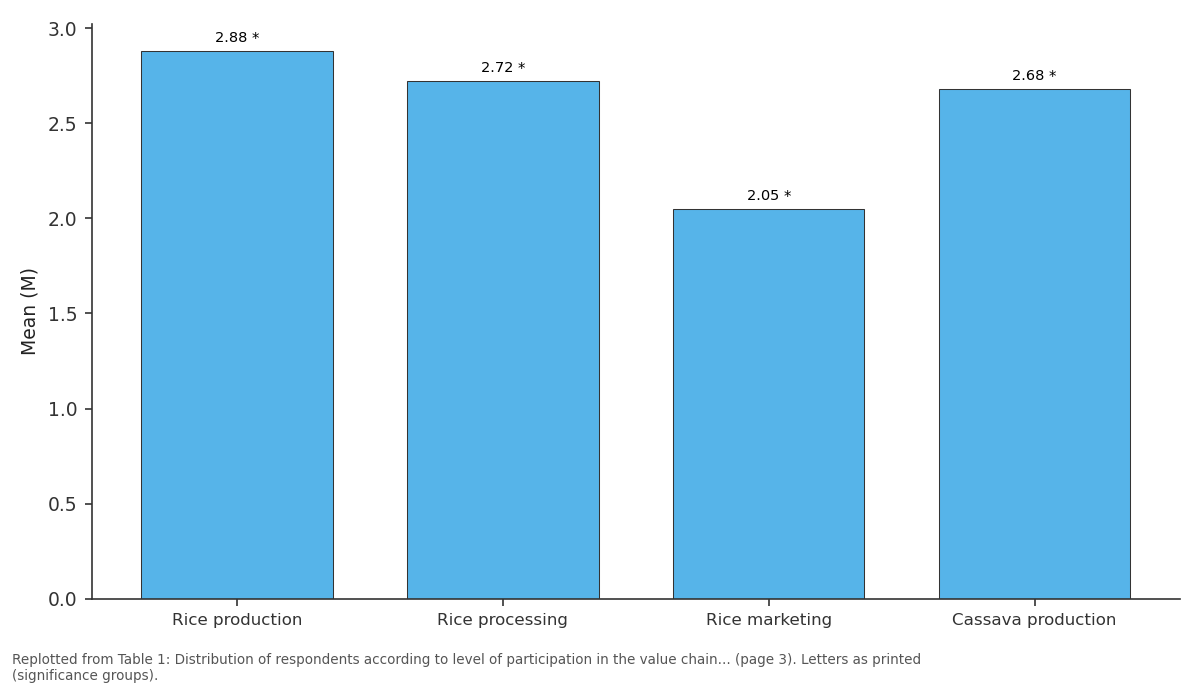
Mean (M): Rice production vs Rice processing vs Rice marketing vs Cassava production
Replotted from Table 1 (page 3) of the original paper. Every bar is the paper's own table value.
View source evidence ↗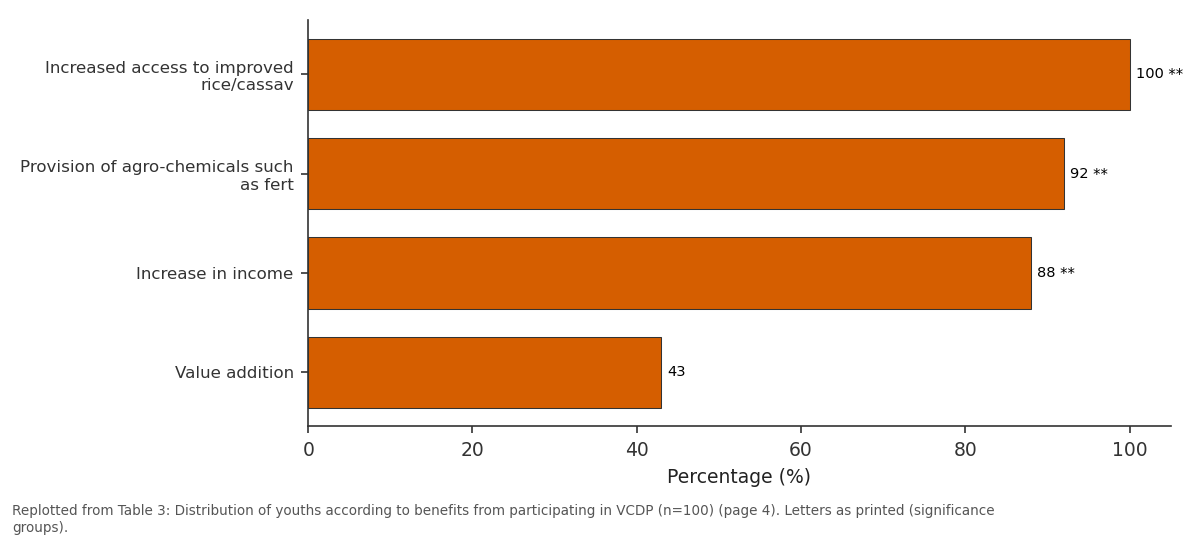
Percentage (%): Increased access to... vs Provision of... vs Increase in income vs Value addition
Replotted from Table 3 (page 4) of the original paper. Every bar is the paper's own table value.
View source evidence ↗Figures & tables
From the original paper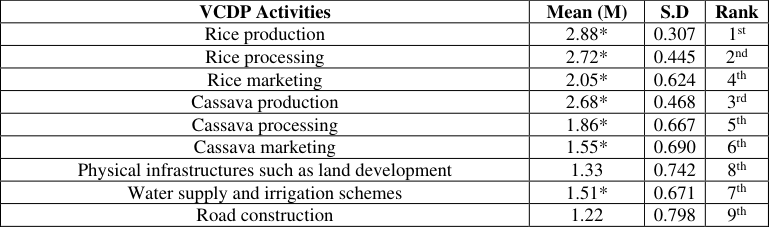 Table 1
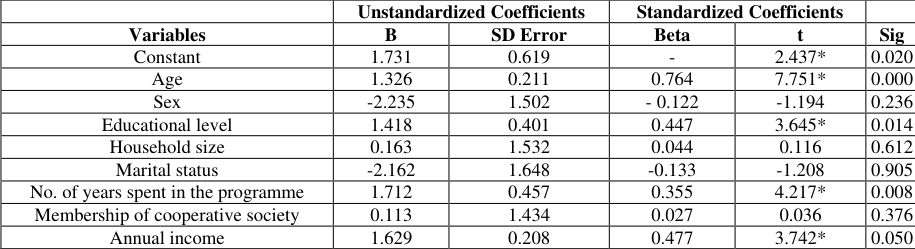 Table 2
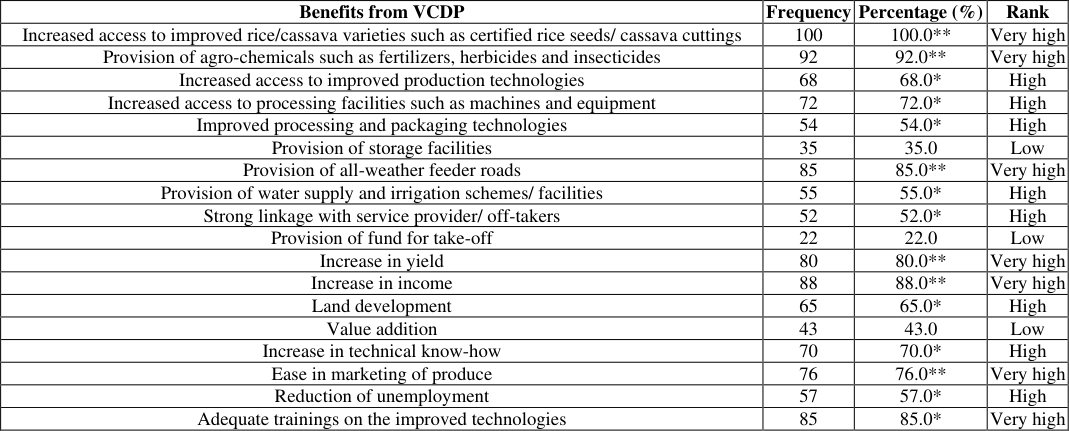 Table 3
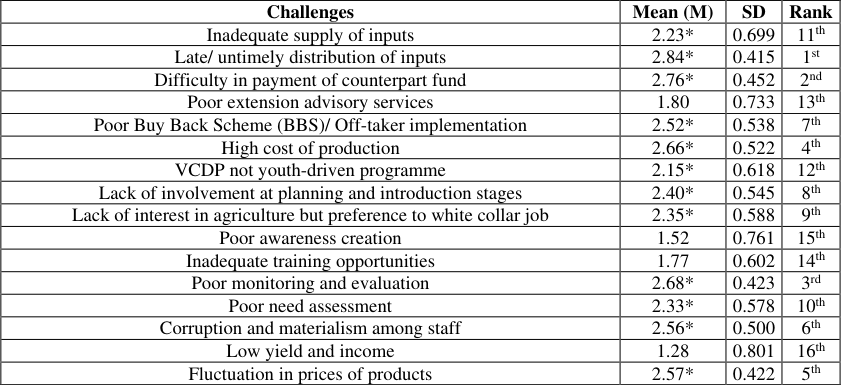 Table 4
Introduction
Youth is referred to as young women and men, in all their diversity of experiences and contexts. The age range may be 15-24 or 25-30 (and even beyond through age 35), based on contextual realities and regional and national youth policy directives. Flexibility in defining youth allows for country specific policies and programming, considering the heterogeneous nature of the youth population, and recognizing that different age groups within the younger population may have different needs in different contexts (United Nations Development Programme (UNDP), 2014) [21] . Mac-Ikemenjima (2020) [14] in his study defined youth as any individual between the ages of 15 and 30. This definition derives primarily from the age range of the students in the study cohort, rather than convention or theory, and is, however, used with the cognizance that youth is a contested concept and lacks a common definition. According to National Youth Policy of Nigeria, the youth comprises all males and females aged 18 -35 years, who are citizens of the Federal Republic of Nigeria. Young people in this age group require social, economic and political support to realize their full potentials. They are characterized by energy, enthusiasm, ambition, creativity, and promise; they are also faced with high levels of socio-economic uncertainty and volatility thereby becoming the most vulnerable segment of the population. They also represent the most active, the most volatile, and yet the most vulnerable segment of the nation's population (Federal Ministry of Youth Development, 2009) [11] . Generally, within the life span of person, the transition period from childhood to absolute adult capable of independent living is referred to as youth. There is therefore no clear cut age range. However, most resource persons and researchers lay emphasis on the age range or group from 18 years of age to 35 years and this incidentally make up the working labour force. With respect to geographical location, definitional variation exists (Federal Republic of Nigeria (FRN), 2001) [12] . Participation refers to the involvement of the target group in programmes. According to Ataneh (2012) [9] , participation entails the ability of individuals to have an input in the decision making process and to play a role in measures aimed at improving their quality of life. Mohammed (2016) [16] stressed that development scholars are of the opinion that participation is a pre-requisite to successful implementation of any programme. Youth participation is the involving of youth in responsible, challenging action that meets genuine needs, with opportunities for planning and/or decision-making affecting others in an activity whose impact or consequence is extended to others. Youth participation is the active engagement of young people throughout their own communities. It is often used as shorthand for youth participation in many forms, including decision-making, sports, schools and any activity where young people are not historically engaged (Olusola, 2017) [19] . Adekoya (2016) [1] noted that youth participation in agriculture is definitely the only means to reduce unemployment rate in Nigeria. Agriculture is no doubt a viable means of generating sustainable income in a developing nation like Nigeria. However, to enhance involvement of youths in agriculture, the Federal government of Nigeria in collaboration with Foreign Agencies or private sectors came up with different agricultural projects, policies and programmes which supposedly to have involved youths (Nwalieji, Okeke, Uzuegbunam and Udemezue, 2018) [18] . The International Fund for Agricultural Development (IFAD)-Value Chain Development Programme (VCDP) was one of these programmes initiated. The Federal Government of Nigeria (hereafter called the Borrower) received a credit from the International Fund for Agricultural Development (IFAD) (hereafter called loan) and has since 2014 been implementing a six years FGN/IFAD assisted Value Chain Development Programme (FGN/IFAD/VCDP) in six states of Anambra, Benue, Ebonyi, Niger, Ogun, Taraba, and in five Local Government Areas each in all the states. The VCDP was initiated to enhance the productivity and profitability of smallholder producers, processors and marketers in the crops' (especially rice and cassava) value chain. Government targets to achieve this objective by increasing access of the actors in the rice and cassava value chain to improved inputs, modern technologies, machines and equipment, road, irrigation, water, processing and marketing infrastructure, and finance. The primary target groups are; (i) poor rural household engaged in the cassava and rice value chain (VCs) who cultivate not more than 5 hectares of land under rice/cassava); and (ii) small-scale processors (processing capacity of an average of 2MT/day for cassava and 4MT/day for rice) and traders, with emphasis on women and youth (Anambra State Value Chain Development Programme (ANSVCDP), 2016) [6] . However, since youth is one of the primary target groups of the value chain development programme (VCDP) in Anambra State, the need to ascertain their level of participation in the various activities (rice and cassava production, processing and marketing) of the programme becomes imperative. This will portray the extent of achievement of the programme in youths' involvement towards reducing unemployment rate and enhancing the productivity and profitability in rice and cassava value chains. It is therefore against this backdrop that this research work is undertaken to assess youths' participation in the activities of value chain development programme in Anambra State, Nigeria.
The study specifically determined level of youths' participation in the value chain development programme activities, examined relationship between socio-economic characteristics of youths and their level of participation in the programme, ascertained youths' perception of the benefits for participation in the programme, and identified challenges to effective youths' participation in the programme.
Methodology The Study Area
The study area was Anambra State, Nigeria. The State consists of twenty one (21) Local Government Areas (LGAs), 177 autonomous communities and four (4) agricultural zones namely, Onitsha, Aguata, Awka and Anambra agricultural zones. The State is located between latitude 6 0 45 1 and 5 0 44 1 N and longitude 6 0 36 1 and 7 0 29 1 E. It has an estimated population of 4,182,032 with the male population of 50.9% and female 49.1% (National Population Commission (NPC), 2006) [17] . It has a total land area of about 4,415.54 square kilometer, 70% which is suitable for agricultural production. The Value Chain Development Programme (VCDP) pilot project covered five LGAs and their environs in Anambra State. These include Anambra East, Anambra West, Awka North, Ayamelum and Orumba North
LGAs. The VCDP was initiated to enhance the productivity and profitability of smallholder producers, processors and marketers in the crops' (especially rice & cassava) value chain (ANSVCDP, 2015) [5] .
Population, Sampling Procedure and Method of Data Collection
The population of the study comprised all the VCDP beneficiaries below the age of 50 years in Anambra State. A multistage sampling procedure was used to select 100 respondents. In Stage I, all the five VCDP beneficiary LGAs in Anambra State were used. These include Anambra East, Anambra West, Awka North, Ayamelum and Orumba North
LGAs. Stage 2 involved random selection of two town communities from each of the selected LGAs. This gave a total of 10 communities. Stage 3 involved selection of 10 participants each from the selected town communities using simple random sampling technique. This gave a total of 100 respondents that were used for the study. Data for the study were collected from primary source through the use of validated structured questionnaire.
Measurement of Variables
To determine level of youths' participation in the programme, the respondents were asked to indicate on a 4 point-Likert-type scale, the extent they participated in each of the various shortlisted programme activities in the area. Their response categories were: to a great extent (TGE) = 3; to some extent (TSE) = 2; to little extent (TLE) = 1 and to no extent (TNE) = 0. These values were added to obtain a value of 6 which was divided by 4 to get a mean score (M) of 1.5. The respondents' mean was obtained on each of the items. Any mean score ≥ 1.5 was regarded as active/high participation, while any mean score < 1.5 was regarded as a low participation. To ascertain youths' benefits from participation in the programme, the respondents were asked to indicate in multiple responses the various benefits obtained for joining the VCDP. The respondent's percentage was obtained on each of the items. Any percentage ≥ 50 < 75 was regarded as high benefit and any percentage ≥ 75 was regarded as very high benefit, while any percentage < 50 was regarded as low benefit. To identify challenges of youths' participation in the programme the respondents were asked to indicate on a 3 point-Likert-type scale, how each of the various listed problems militates against effective youths' participation in the VCDP in the area. Their response categories were: very serious (VS) = 3; serious (S) = 2; and not serious (NS) = 1. These values were added to obtain a value of 6 which was divided by 3 to get a mean score of 2.0. The respondents' mean was obtained on each of the items. Any mean score ≥ 2.0 was regarded as a major challenge, while any mean score < 2.0 was regarded as a minor challenge.
Data Analysis
The Statistical Product and Service Solution (SPSS) software Version 23 was used for data analysis. Data were analysed using frequency, percentage and mean and multiple linear regression analysis. The multiple linear regression analysis to examine the relationship between the socio-economic characteristics of youths and their level of participation in the value chain development programme is given below as recommended by Akinbile (2014) [3] to determine relationship between a set of independent variables and a dependent variable. The socioeconomic factors of the respondents considered included age (AGE), marital status (MS), household size (HS), sex (SEX), educational level (EDU), annual income (INCOME), programme experience (PEXP), and membership of cooperative society (MCS).Then the multiple regression equation is given as follows: 1 show that youths were highly involved in rice production (M=2.88), rice processing (M= 2.72), cassava production (M= 2.68), rice marketing (M= 2.05), cassava processing (M=1.86), cassava marketing (M=1.55) and water supply and irrigation schemes (M=1.51), but less involved in physical infrastructures such as land development (M=1.33) and road construction (M=1.22). These imply that youths are involved in both rice and cassava value chains but at varying degree of interest. The finding is in line with Olusola (2017) [19] who noted that desirable features of youth participation are provision for critical reflection on the participatory activity and the opportunity for group effort toward a common goal. The finding also agrees with Nwalieji et. al (2018) [18} who noted that the involvement of youth in the agricultural programmes and projects in the implementation level involve carrying out a number of project related activities. According to Aphunu and Atoma (2010) 8 , agriculture has huge and diverse opportunities potentials that cannot only transform the national economy but also tremendously impact the personal lives of the farmers particularly the youths.
Relationship between Socio-Economic Characteristics of Youths and their Level of Participation in the VCDP
Table 2 shows the result of regression analysis of the relationship between the independent variables (age, sex, educational level, household size, marital status, programme experience, membership of cooperative society and annual income) of youth beneficiaries and level of participation in VCDP activities in Anambra State. The result of the independent variables significantly influenced the dependent variables given R and R 2 of 0.643 and 0.557, respectively. These variables were able to explain 55.7% of the variation in youth participation in VCDP activities (R 2 = 0.557). Out of the eight variables investigated, four (4) variables, age, educational level, programme experience (number of years spent in the programme) and annual income were found to be statistically significant at 5% level (P≤0.05), while sex, household size, marital status and membership of cooperative society were not significant. Age of the respondents exerted positive and significant influence on extent of participation in VCDP activities. This implies that any increase in age leads to a corresponding increase in the participation in VCDP activities. Education level attained by youth showed a positive relationship with participation in VCDP activities. This implies that a unit increase in the level of education increases the probability of the participation in VCDP activities. Participants are more disposed to understand package introduced by the programme and other informants. This underlines the importance of human capital development in increasing the level of participation in VCDP activities. This agrees with Aniedu and Aniedu (2013) [7] who pointed that education is very essential in the development process. Number of years spent in the programme by respondents significantly influenced their participation in the VCDP activities positively. This implies that the more experience a participant acquired in a programme, the higher the productivity and participation in the programme's activities. This is in line with the findings of Adesina and Eforuoku (2016) [2] which noted relationship between the selected socioeconomic characteristics and participation in Youth-in-Agriculture Programme (YAIP) that there was significant relationship between years of farming experience (r= 0.532 P≤0.05) and participation in YIAP. Annual income realized from joining the VCDP had a positive and significant influence on their extent of participation in the programme's activities. This implies that the more income/gain realized by the participant, the higher their level of participation in the programme's activities. This agrees with Alinor (2002) [4] which noted that capital increases the scales of production and being enlarged, translates to more increase in output. However, Augustine, Angba and Paul (2012) [10] identified economic and social reasons as basic motivating factors for participation in social organizations. Youths' Perception of the Benefits for Participation in the VCDP Table 3 shows that the respondents had very high benefits from the VCDP in the areas of increased access to improved rice/cassava varieties such as certified rice seeds/ cassava cuttings (100.0%), provision of agro-chemicals such as fertilizers, herbicides and insecticides (92.0%), increase in income (88.0%), provision of all-weather feeder roads (85.0%), adequate trainings on the improved technologies (85.0%), increase in yield (80.0%), and ease in marketing of produce (76.0%). Table 3 further reveals high benefits realized by youths from participating in the VCDP such as increased access to processing facilities such as machines and equipment (72.0%), increase in technical know-how (70.0%) among others. However, provision of storage facilities (35.0%), provision of fund for take-off (22.0%), and value addition (43.0%) were not benefited by the participants. The findings imply that the VCDP really benefited the participants immensely by providing them with increased access to improved rice/cassava varieties such as certified rice seeds/ cassava cuttings; agro-chemicals such as fertilizers; herbicides and insecticides; increase in income; all weather feeder roads; adequate trainings on the improved technologies; increase in yield; and ease in marketing of produce. The finding agrees with Adesina and Eforuoku (2016) [2] who observed that attitudes of participants towards Youth-in-Agriculture Programme (YAIP) was in favour of the statements that, YAIP could be a means of introducing new techniques and practices in crop production, help improve the income of youths and raise the production efficiency and productivity of the beneficiaries. Also, the finding agrees with Adekoya (2016) [1] who asserted that youth participation in agriculture is definitely the only means to reduce unemployment rate in Nigeria, and agriculture is no doubt a viable means of generating sustainable income in a developing nation like Nigeria. Challenges of Effective Youths' Participation in the VCDP Table 4 shows the mean distribution of identified challenges of effective youths' participation in the VCDP in the study area. The results reveal that the major challenges included late/ untimely distribution of inputs (M=2.84), difficulty in payment of counterpart fund (M=2.76), poor monitoring and evaluation (M=2.68), high cost of production (M=2.66), fluctuation in prices of products (M=2.57), corruption and materialism among staff (M=2.56), poor Buy Back Scheme (BBS)/ Off-taker implementation (M=2.52), lack of involvement at planning and introduction stages (M=2.40) among others. However, poor extension advisory services (M=1.80), inadequate training opportunities (M=1.77), poor awareness creation (M=1.52), and low yield and income (M=1.28) were minor challenges faced by the respondents. The findings imply that the programme is being faced with numerous challenges, although it made some remarkable positive effects on the lives of beneficiaries. The findings agree with Onuekwusi (2005) [20] who noted that lack of infrastructure and essential input hinder youth's participation in agricultural and rural development activities. This may be due to inadequate or lack of continuous funding by government; followed by, inadequate credit facilities. The findings are also in line with Nwalieji et al (2018) [18] who identified major challenges of youth involvement to include lack of involvement at planning and introduction stages, poor access to land and other farm inputs, politics and inadequate information about the existence of the programmes. Kgoisiamang and Oladele (2012) [13] noted that major constraints that affect farmers participation in agricultural projects were unavailability of land, insufficiency of fund to farm productivity, insufficiency to technical knowledge, high input costs, insufficiency of commitment by extension agent, insufficiency of leadership skills, insufficiency of sense of ownership, and farmers' under development or insufficiency in farms infrastructure and human resources. The YISA (2013) [22] concluded that the youths want white-collar jobs, thereby neglecting agriculture which is the basic thing. They believe that agricultural production is only for the adults. In addition, McLean (2020) [15] recalled that these young people lack educational access and credentials and need multiple income-generating activities in order to survive.
| Challenges | Mean (M) | SD | Rank |
|---|---|---|---|
| Inadequate supply of inputs | 2.23* | 0.699 | 11th |
| Late/ untimely distribution of inputs | 2.84* | 0.415 | 1st |
| Difficulty in payment of counterpart fund | 2.76* | 0.452 | 2nd |
| Poor extension advisory services | 1.80 | 0.733 | 13th |
| Poor Buy Back Scheme (BBS)/ Off-taker implementation | 2.52* | 0.538 | 7th |
| High cost of production | 2.66* | 0.522 | 4th |
| VCDP not youth-driven programme | 2.15* | 0.618 | 12th |
| Lack of involvement at planning and introduction stages | 2.40* | 0.545 | 8th |
| Lack of interest in agriculture but preference to white collar job | 2.35* | 0.588 | 9th |
| Poor awareness creation | 1.52 | 0.761 | 15th |
| Inadequate training opportunities | 1.77 | 0.602 | 14th |
| Poor monitoring and evaluation | 2.68* | 0.423 | 3rd |
| Poor need assessment | 2.33* | 0.578 | 10th |
| Corruption and materialism among staff | 2.56* | 0.500 | 6th |
| Low yield and income | 1.28 | 0.801 | 16th |
| Fluctuation in prices of products | 2.57* | 0.422 | 5th |
Table text extracted from the original PDF; superscript letters are shown inline. The original table image is below.
View original table image
| Benefits from VCDP | Frequency | Percentage (%) | Rank |
|---|---|---|---|
| Increased access to improved rice/cassava varieties such as certified rice seeds/ cassava cuttings | 100 | 100.0** | Very high |
| Provision of agro-chemicals such as fertilizers, herbicides and insecticides | 92 | 92.0** | Very high |
| Increased access to improved production technologies | 68 | 68.0* | High |
| Increased access to processing facilities such as machines and equipment | 72 | 72.0* | High |
| Improved processing and packaging technologies | 54 | 54.0* | High |
| Provision of storage facilities | 35 | 35.0 | Low |
| Provision of all-weather feeder roads | 85 | 85.0** | Very high |
| Provision of water supply and irrigation schemes/ facilities | 55 | 55.0* | High |
| Strong linkage with service provider/ off-takers | 52 | 52.0* | High |
| Provision of fund for take-off | 22 | 22.0 | Low |
| Increase in yield | 80 | 80.0** | Very high |
| Increase in income | 88 | 88.0** | Very high |
| Land development | 65 | 65.0* | High |
| Value addition | 43 | 43.0 | Low |
| Increase in technical know-how | 70 | 70.0* | High |
| Ease in marketing of produce | 76 | 76.0** | Very high |
| Reduction of unemployment | 57 | 57.0* | High |
| Adequate trainings on the improved technologies | 85 | 85.0* | Very high |
Table text extracted from the original PDF; superscript letters are shown inline. The original table image is below.
View original table image
| — | Unstandardized Coefficients | — | Standardized Coefficients | — | — |
|---|---|---|---|---|---|
| Variables | B | SD Error | Beta | t | Sig |
| Constant | 1.731 | 0.619 | - | 2.437* | 0.020 |
| Age | 1.326 | 0.211 | 0.764 | 7.751* | 0.000 |
| Sex | -2.235 | 1.502 | - 0.122 | -1.194 | 0.236 |
| Educational level | 1.418 | 0.401 | 0.447 | 3.645* | 0.014 |
| Household size | 0.163 | 1.532 | 0.044 | 0.116 | 0.612 |
| Marital status | -2.162 | 1.648 | -0.133 | -1.208 | 0.905 |
| No. of years spent in the programme | 1.712 | 0.457 | 0.355 | 4.217* | 0.008 |
| Membership of cooperative society | 0.113 | 1.434 | 0.027 | 0.036 | 0.376 |
| Annual income | 1.629 | 0.208 | 0.477 | 3.742* | 0.050 |
Table text extracted from the original PDF; superscript letters are shown inline. The original table image is below.
View original table image
Conclusion and Recommendations Conclusion
Youths benefited immensely and participated actively in activities of the Value Chain Development Programme (VCDP) in Anambra State, but challenges abound that militate against effective youths' involvement in the programme. The urgent attention to tackle these challenges would boost the interest of youths to take agriculture as lucrative and quick-yielding business venture/ enterprise for food security and poverty reduction toward national development.
Recommendations
1. Since late/ untimely distribution of inputs was the prominent challenges, there should be timely (before the farming season kicks off) and adequate supply of agro-inputs and credits at subsidized rate by the service providers. This will address issues on delays in credit/agro-input disbursement and in the approval of work plans, budgets and procurements. This would encourage farmers start field operations timely.
2. Government should create an initiative to improve the opportunities for young people to take part in agricultural work in order to provide larger benefits/ dividend. 3. Planning, monitoring, supervision and evaluation aspect of the programme should be taken seriously by the programme management in which the beneficiaries should be involved from onset. This will serve as a check against corrupt practices among staff and beneficiaries. 4. Buy Back Scheme (BBS)/ Off-taker aspect of the programme should be well-implemented in order to strengthen linkages among the actors and as well encourage massive participation of the beneficiaries.
Figures and tables from the paper
| VCDP Activities | Mean (M) | S.D | Rank |
|---|---|---|---|
| Rice production | 2.88* | 0.307 | 1st |
| Rice processing | 2.72* | 0.445 | 2nd |
| Rice marketing | 2.05* | 0.624 | 4th |
| Cassava production | 2.68* | 0.468 | 3rd |
| Cassava processing | 1.86* | 0.667 | 5th |
| Cassava marketing | 1.55* | 0.690 | 6th |
| Physical infrastructures such as land development | 1.33 | 0.742 | 8th |
| Water supply and irrigation schemes | 1.51* | 0.671 | 7th |
| Road construction | 1.22 | 0.798 | 9th |
Table text extracted from the original PDF; superscript letters are shown inline. The original table image is below.
View original table image
References
20 in the original paper- Adekoya A. 7 ways to encourage youth participation in agriculture; a panacea to youth unemployment in Nigeria. Info Guide Nigeria, May 30, 2016. https://infoguidenigeria.com/. 19 October, 2019.
- Adesina TK, Eforuoku F. Determinants of participation in Youth-in-Agriculture Programme in Ondo State, Nigeria. J. Agric. Ext. 2016: 20(2):104-117.
- Akinbile LA. Use of Linear Regression Analysis in Agricultural Extension Research. In: A Guide to Research in Agricultural Extension, Agricultural Extension Society of Nigeria, 2014, 311-319.
- Alinor AN. Economic study of cassava processing in Nsukka agricultural zone of Enugu State. Unpublished M.Sc. Thesis, Department of Agricultural Economics, University of Nigeria, Nsukka, 2002.
- Anambra State Value Chain Development Programme (ANSVCDP). Report on participatory rural appraisal of VCDP participating LGAs, 2015.
- Anambra State Value Chain Development Programme (ANSVCDP). IFAD VCDP infrastructure needs assessment study -study approach, 2016.
- Aniedu C, Aniedu OC. Gender mainstreaming in agricultural development in Nigeria. In agricultural extension and rural development. Nwachukwu. I (ed). Lamb House Publication Umuahia. J. Community and Communication Res.2013; 2(1):68-69.
- Aphunu A, Atoma CN. Rural youths' involvement in agricultural production in Delta Central Agricultural Zone: Challenge to agricultural extension development in Delta State. J. Agric. Ext. 2010; 14(2):46-51.
- Ataneh OS. Participation of Members of Youth Association in Rural Community Development in Edo State Nigeria. Unpublished M.Sc Project, Department of Agricultural Extension and Rural Development, University of Ibadan, Ibadan, 2012.
- Augustine O, Angba I, Paul I. Socio-economic factors influencing farmers' participation in community development organizations in Obubra local government area of Cross River State, Nigeria. Canadian Soc. Sc. 2012; 8(1):54-59.
- Federal Republic of Nigeria (FRN). National Youth Development Policy, Programmes and Implementation Strategies, Abuja Nigeria, 2001.
- Kgosiemang DT, Oladele OI. Factors affecting farmers" participation in agricultural projects: In Mkhondo Municipality of Mpiimalagh Province, South Africa. J. Human Ecol. 2012; 37(1):19-27.
- Mac-Ikemenjima D. "To Become Somebody in the Future": Exploring the Content of University Students' Goals in Nigeria. McLean ML (ed.), West African Youth Challenges and Opportunity Pathways, Gender and Cultural Studies in Africa and the Diaspora. 2020, 103-28.
- McLean ML. Introduction. M. L. McLean (ed.), West African Youth Challenges and Opportunity Pathways, Gender and Cultural Studies in Africa and the Diaspora, 2020, 1-24.
- Mohammed KY. Launching of the Youth Employment in Agriculture Program (YEAP) and the Fund for Agricultural Finance in Nigeria, 2016. http://fmard.gov.ng, 2019. 17. National Population Commission (NPC). 2006 census results, 2006. http://www.npc.gov, 2018.
- Nwalieji HU, Okeke MN, Uzuegbunam CO, Udemezue JC. Extent of Youths' Involvement in Agricultural Programmes and Projects in South Eastern Nigeria. International J. Agric. Sc., Res. & Tech. in Ext. & Edu. Sys. 2018; 8(2):95-102.
- Olusola O. Encouraging Youths Participation in Agriculture, 2017. http://www.nairaland.com/2519868/encouragingyouths-participation-in-agriculture, 2018.
- Onuekwusi GC. Youth Programme in Extension and Rural Development: Agricultural Extension and Rural Sociology. Enugu, Snaap Press, 2005, 191-214.
- United Nations Development Programme (UNDP). UNDP youth strategy 2014-2017. Empowered Youth, Sustainable Future. UNDP, New York, 2014, 1-51.
- Youth Initiative for Sustainable Agriculture (YISA). YISA Partners with Lake Chad Research Institute (LCRI) on Youth Empowerment through Local Production of Wheat. Archive for, 2013.