
Research article · 2022 · Full text
International Journal of Biology SciencesPromotory effects of IAA and GA3 on seed germination, survival and mortality percentage of the Phaseolus vulgaris and Abelmoschus esculentus over the control
Volume 4(1) · Pages 20–25 · DOI: 10.33545/26649926.2022.v4.i1a.37 ↗
Research areasSeed Germination and PhysiologyAgronomic Practices and Intercropping SystemsAgricultural pest management studies
Abstract
Author-writtenThe experiment was conducted in the field with and without treatments of two concentrations of plant growth hormones, were treated daily on the germinating seeds of Phaseolus vulgaris & Abelmoschus esculentus respectively. After seven days, the germinating seeds were counted till to ten days and observed germination, survival and mortality percentages of the both crops. The efficiency of plant growth hormones such as IAA & GA3 in their physiological ranges were studied and compared to the control. In the control condition, observed seed germination, survival and mortality percentages of the Phaseolus vulgaris. When growth regulator was given to the germinating seeds, the germination, survival and mortality percentages were amounted with IAA (10-2 M) concentration, but best germination percentage, survival and less mortality percentages were recorded with the concentration of IAA (10-3M) as compared to control. In control condition of Abelmoschus esculentus, observed seed germination, survival and mortality percentage. When the plant hormone concentration was given to the germinating seeds, the germination, survival & mortality percentages were amounted with the GA3 (10-2) concentration, but best germination percentage, survival and less mortality percentage were recorded with the concentration of GA3 (10-3) as compared to the control.
Summary
Source-checkedPlain-language reading of the full paper, prepared with AI and checked against the text. Each point links to the authors' own words.
Why it matters
- Phaseolus vulgaris and Abelmoschus esculentus are important crop species because they offer nutritional and potential therapeutic benefits to humans. View evidence ↗
- Plant growth regulators are chemical substances known to influence plant development by coordinating growth across different plant parts and biochemical processes. View evidence ↗
- Gibberellins are typically used to break seed dormancy and promote flowering and stem elongation. View evidence ↗
The question
- The study aimed to evaluate how IAA and GA3 hormones at concentrations of 10-2 M and 10-3 M affect the germination, survival, and mortality of Phaseolus vulgaris and Abelmoschus esculentus compared to a control group. View evidence ↗
What they did
- The research was conducted in the field at R.C.U. Govt. P.G. College Uttarkashi, India, between 2021 and 2022. View evidence ↗
- Control seeds were soaked in distilled water for 24 hours to filter out low-quality seeds, sterilized with 0.1% HgCl2, and then sown in field plots. View evidence ↗
- Treated seeds were soaked for 24 hours in either 10-2 M or 10-3 M concentrations of plant growth hormones before being sown. View evidence ↗
- Seed germination was defined and recorded when the radicle reached a length of 2 mm. View evidence ↗
What they found
- In the control group for Phaseolus vulgaris, the germination, survival, and mortality percentages were approximately 77.5%, 88.70%, and 11.29%, respectively. View evidence ↗
- For Phaseolus vulgaris, the 10-3 M concentration of IAA produced the best results, with germination at 91.25%, survival at 95.89%, and mortality at 4.10%. View evidence ↗
- The control group for Abelmoschus esculentus showed a germination rate of 62.5%, survival of 90%, and mortality of 10%. View evidence ↗
- For Abelmoschus esculentus, the 10-3 M concentration of GA3 was most effective, resulting in 81.25% germination, 96.92% survival, and 3% mortality. View evidence ↗
- In Phaseolus vulgaris, the 10-2 M IAA treatment resulted in a lower germination rate (69.12%) and survival rate (75.25%) compared to the control. View evidence ↗
What it means
- The authors conclude that 10-3 M concentrations of IAA for Phaseolus vulgaris and GA3 for Abelmoschus esculentus are the most effective for increasing germination and survival while reducing mortality. View evidence ↗
Visual summary
3 visualsIllustrations explain the paper; charts are replotted from the paper's own table values.
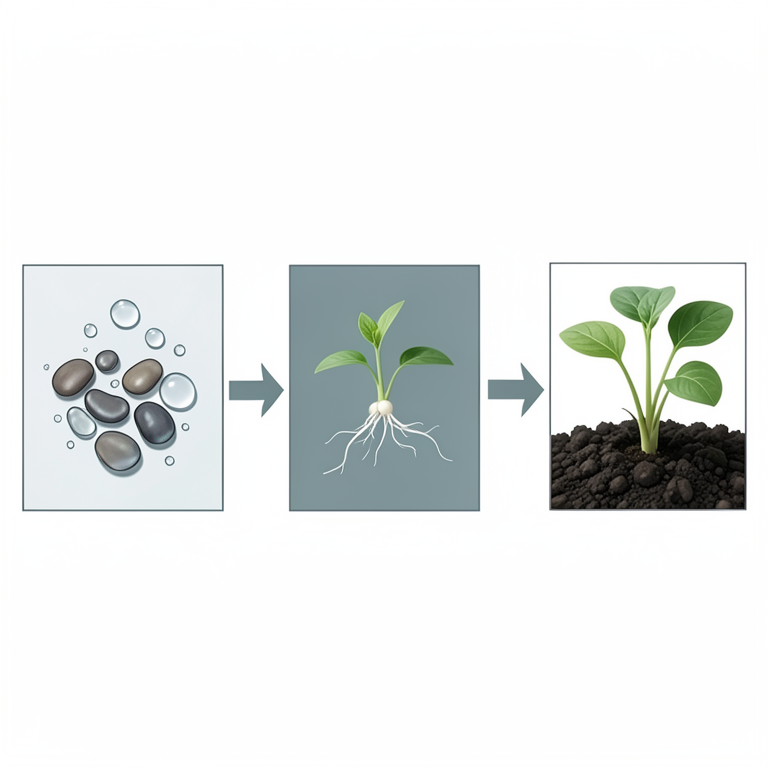
Experimental Setup Overview
AI-generated conceptual illustration (Phaseolus vulgaris (common bean) and Abelmoschus esculentus (okra) seeds). It explains the idea and does not show study data.
View source evidence ↗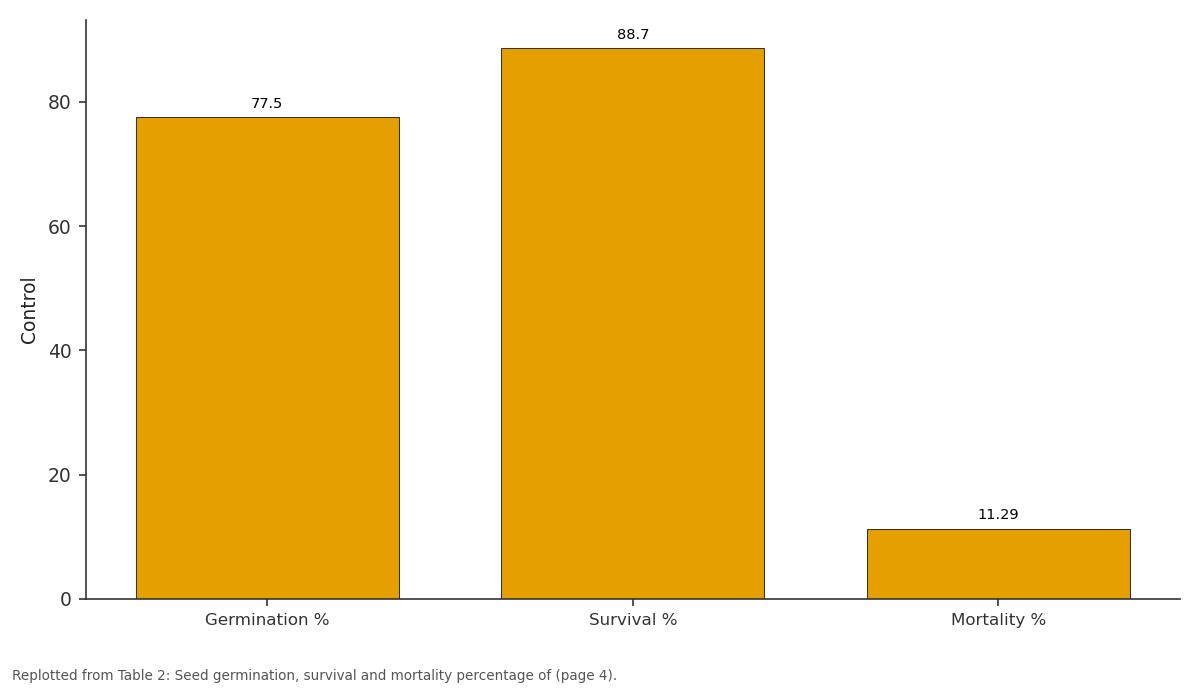
Control: Germination % vs Survival % vs Mortality %
Replotted from Table 2 (page 4) of the original paper. Every bar is the paper's own table value.
View source evidence ↗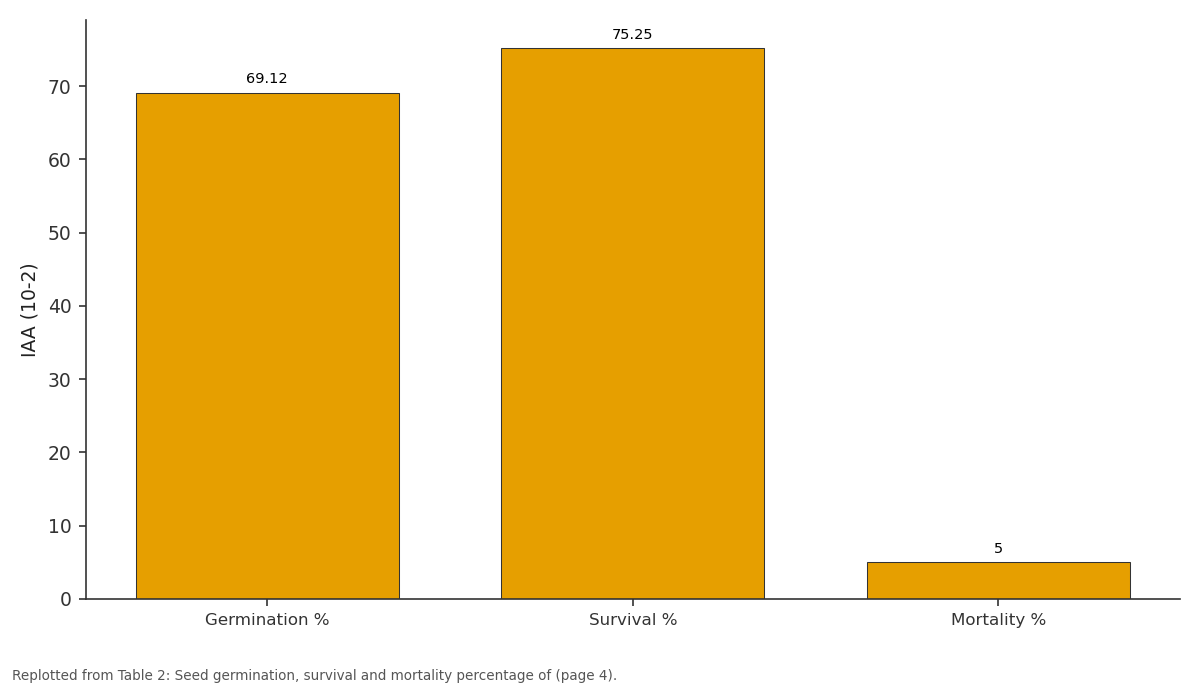
IAA (10-2): Germination % vs Survival % vs Mortality %
Replotted from Table 2 (page 4) of the original paper. Every bar is the paper's own table value.
View source evidence ↗Figures & tables
From the original paper Table 1
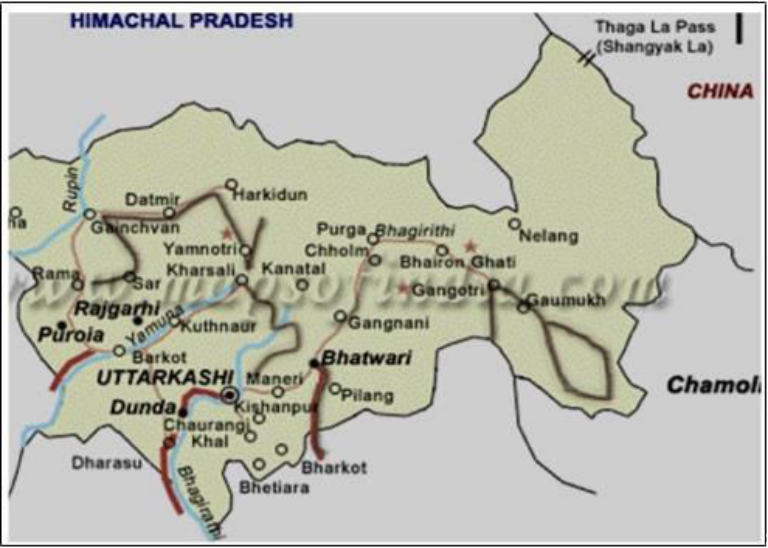 Figure 1
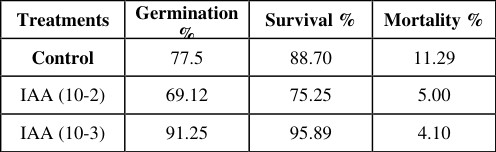 Table 2
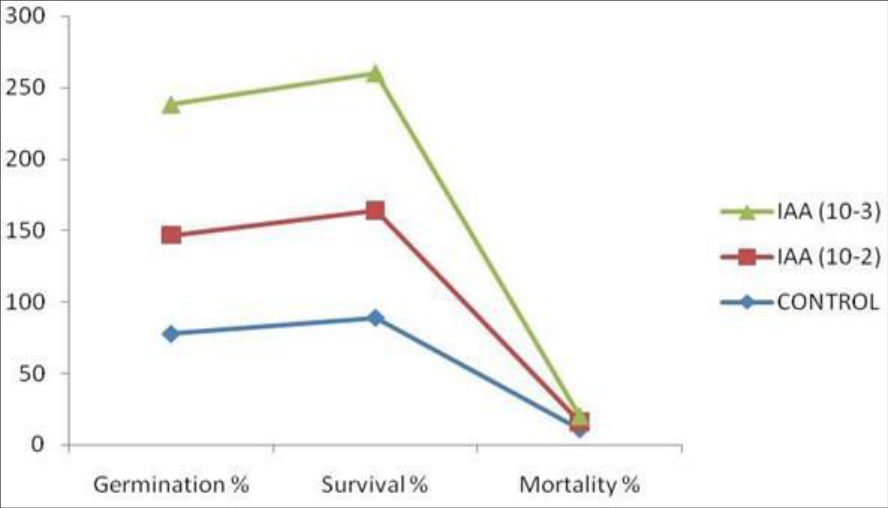 Figure 2
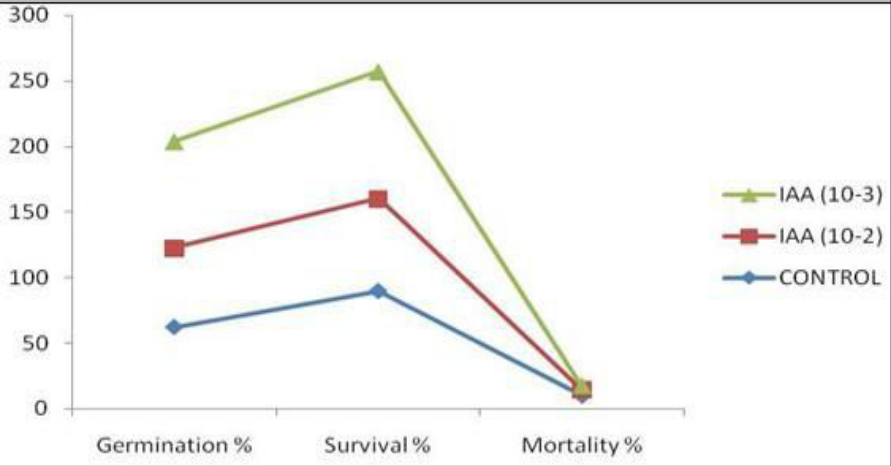 Figure 3
 Table 3
Introduction
The present study was based on two crop plant species such as Phaseolus vulgaris & Abelmoschus esculents, because these provide not only the good nutrition, but also possible therapeutic benefits for the human kind. It has been well established that the plant growth regulators influence the growth and development of plants. These chemical substances are able to coordinate growth among different plant parts or different physiological & biochemical processes. The main naturally occurring plant growth hormones viz. IAA, Kn and GA3 are able to control many physiological processes that involved in the plant development. Plant growth regulators have been tried to improve growth and ultimately yield (Ram et al., (1973) [22] ; Patil et al., (1987) [21] and Kumar et al., (1996) [11] , tried to various growth regulators to obtain better yield of good quality heads in cabbage and obtained encouraging results. The maturity of the vegetable crops is enhanced due to the application of plant growth regulators (Buckovac & Wittwer, (1957) [2] & Chnonkar & Jha, (1963) [36] . Auxins are generally also used in plant cell culture. When added in the appropriate concentrations they may regulate cell elongation, tissue swelling and cell division, formation of adventitious roots and inhibition of adventitious and axillary shoot formation, callus initiation, growth & induction of embryogenesis. Gibberellins are generally used to promote stem elongation, flowering and breaking dormancy of seeds, buds & bulbs. There are over 90 forms of gibberellins, but GA3 is the most commonly used form. Hormones such as Cytokinins, Gibberellins & Auxins are chemicals that regulate and stimulate the plant growth. As such, they shape the plant and affect seed growth, time of flowering, sex of flowers and the senescence of leaves and fruits. Also, they affect the tissues that grow upward and downward, the formation of the leaf and the growth of the stem (Helgi-opik and Stephen, 2005) [8] . [26] . The concentration of hormones required for plant responses at the very low concentrations (Srivastava et al., 2002) [26] . Phytohormones play a regulatory role in the imposition of seed dormancy, in the release of seed from dormancy and in the reserve mobilizations during seed germination and in the subsequent development.
The overall growth of plant was improved by the plant growth regulator treatments, when it was compared to the control, because these treatments significantly, increase all plant growth parameters. [6] . There are numerous studies on the effect of growth hormones on plants (Jawanda et al., (1979) [10] ; Mishra et al., (1986) [15] and Reis et al., (2000) [23] . Some of these studies have shown physiological and the morphological parameters have found promotion in these traits in response to increased growth hormone treatments. Mahmud et al., (1983) [14] evaluated that the effect of various growth regulators on growth, development and yield of various varieties of oil-seed crops well documented. The treatments of different growth substances have given remarkably encouraging results in promoting seed germination in tomato, radish, lettuce, watermelon, brinjal, carrot and a number of other vegetables have been studied by Swaminathan et al., (1987) [35] . Auxins in particular are implicated in developmental processes like elongation growth, photo and gravitropism, apical dominance and lateral root initiation (Normanly et al., 1997) [18] . Both IAA & GA3 are produced by the apical bud (Jones & Phillips (1996) [9] & White et al., 1975) [29] . Thus, it is conceivable that internode elongation is modulated by the apex by way of the effects of GA3 and IAA on cell division on one hand and by their synergistic effects on cell elongation on the other. The effects of GA3 and IAA in dwarf pea, enhanced internode elongation, when applied separately, but when applied simultaneously, IAA did not alter and even promoted the elongation elicited by GA3 (Arney & Mancinelli et al., 1967) [1] . The role of gibberillic acid in the seed germination is also well established. Exogenous GA3 stimulates amylase activity. GA3 also cause release of enzyme amylase and protease. Thus both oxygen and GA3 enhance seed germination.The similar effects of GA3 and IAA on the internode elongation have been reported by Lockhart (1964) [13] and Phillips (1972) [19] . In the dwarf pea (Brian & Hemming et al., (1958) [3] and in cucumber (Sandhu & Kasper Baver et al., (1974) were observed that the IAA and GA3, both hormones are promoted internode elongation. Gibberellin has the characteristics property to improve the yield, plant height and flower induction in the chrysanthemum (Mohariya et al., 2003) [17] . Pharis and King et al., (1985) [20] observed that the gibberellins (GA3) play a major role in the development of fruit set. Morever, Yuda et al., (1984) [1] and Zhang et al., (2007) [34] were also reported that the fruit expansion in Japanese pear. Crops like bananas, plantain, ornamentals and tree crops can be multiplied and these will be made available for farmers.
The plant height was increased by GA3, while branch number per plant was increased by all growth regulators. The interaction of plant growth regulators has significant Promontory effect on shoot morphogenesis as reported by Baraldi et al., (1988) [4] . Plant growth regulators play a significant role in the regulation of shoot growth and tuber formation in potato the certain evidences that the IAA promote GA3 biosynthesis in Barley (Wolbang et al., 2004) [30] . During field study, it has been demonstrated that by Yadav et al., (2005) [33] the growth promoters significantly improved growth and yield of rice. Gonge et al., (2005) [7] reported that due to the treatment of growth regulators, production and quality characters like seed yield and germination percentage of Okra seeds were significantly influenced. The similar findings were also reported by Sajjan et al., (2003) [27] . Shah and Samiullah (2006) studied the effect of plant growth regulators on growth and yield of black cumin found to be more effective in promoting shoot length, dry weight, leaf number and seed yield. There are also some reports which indicate that kinetin in combination with GA3 enhanced germination and seedling growth in Chick pea (Kaur et al., 1998) [12] . Moe & Anderson (1987) [16] observed that the variations in irradiance, light quality, photoperiod and radiant exposure, produced changes in the production of endogenous growth factors. The many of these factors are necessary for the success of plant life. On this basis, we have evaluated
Materials and Methods General Experimental Design
Control: Seeds of Phaseolus vulgaris and Abelmoschus esculentus were soaked for 24hrs. in the distilled water in order to check the good quality of seeds. Those seeds, which floated in water, they are bad quality seeds. Then put the seeds in 0.1% of HgCl2 for sterilization and placed in the petridishes for the sowing in the field plots.
Plant growth hormone: Test solution of IAA and GA were prepared in (10-2) & (10-3) M concentration respectively. The seeds of both species were soaked for 24hrs. in (10-2) & (10-3) M concentration of plant growth gormone and soaked seeds were placed in petridishes for the sowing in the field plots. For the studies of seed germination and seed ling growth patterns, the uniform seeds of Phaseolus vulgaris (Kidney beans) and Abelmoschus (Okra) were selected and sterilized
by absolute ethyl alcohol and then 0.1% HgCl2 for the one minute each thoroughly rinsed with distilled water. The seeds of Phaseolus vulgaris were soaked in IAA solution of (10-2 M) & (10-3 M) concentration as compared to control. Seeds of Abelmoschus esculentus were soaked in GA3 solution of (10-2 M) & (10-3 M) concentration as compared to control. In the field study, the seeds of both plants were supplied with appropriate concentrations ofplant growth hormone daily. The germination percentage was recorded on the basis of radical emergence as 2 mm in length and it is considered as germinated.
Germination percentage: The present study was showed to determine the effect of plant growth hormone on the seed germination. It is an estimate of the viability of a population of seeds and a measure of the time course of seed germination. After an interval of 24 hrs. the seeds were counted and at the end of seven daysthe total numbers of seeds were added for the calculation of germination percentage as follows:
Survival percentage: Survival is the struggle to remain alive and living. Survival rate is a part of survival analysis, indicated the percentage of seeds in a study group, who are alive for a given period of time after germination.
Mortality percentage: Mortality is an estimated to account for seed that germinates, but fails to develop in to viable plants. These are many reasons for seedling mortality including diseases, insects and excessive fertilizer into the seed row, improper seedling depth, light, temperature, frost and drought due to seedling mortality can vary greatly.
Study Site
Study Site
Conclusions
The present investigation was investigated the Promontory effects of Indole Acetic acid & gibberellic acid with apprpriate concentrations of IAA 10-3 (M) and GA 10-3 (M) were noted on the seed germinatin, survival and mortalty percentages of Phaseolus vulgaris and Abelmoschus esculentus in the field study. In the field study, when germinating seedlings were subjected to plant growth hormone such as IAA and GA3 in its physiological range i.e. (10-2 to 10-3 M) concentrations, the maximum germination and survival percentages were increased & mortality percentage was reduced in the appropriate concentrations of the IAA (10-3 M) on the Phaseolus vulgaris and GA (10-3) on the Abelmoschus esculentus as compared to the control.
Figures and tables from the paper
| Treatments | Germination % | Survival % | Mortality % |
|---|---|---|---|
| Control | 77.5 | 88.70 | 11.29 |
| IAA (10-2) | 69.12 | 75.25 | 5.00 |
| IAA (10-3) | 91.25 | 95.89 | 4.10 |
Table text extracted from the original PDF; superscript letters are shown inline. The original table image is below.
View original table image
| Treatments | Germinatio | Survival % | Mortality % |
|---|---|---|---|
| Control | 62.5 | 90 | 10 |
| IAA (10-2) | 60 | 70.25 | 4.25 |
| IAA (10-3) | 81.25 | 96.92 | 3.07 |
Table text extracted from the original PDF; superscript letters are shown inline. The original table image is below.
View original table image
References
29 in the original paper- Arney SE, Mancinelli PA. Surgical investigations of the role of IAA and GA in elongation of "Meteor" pea internodes. New phytol,1967:66:271-283.
- Buckovac MJ, Wittwer SH. GA and higher plants, III induction of flowering in biennials. Quart Bull. Mich. Agric expt. Sta. 1957:39:650-660.
- Brian PW, Hemming HG. Complementary action of gibberellic acid and auxins in pea internodes extension. Ann. Bot. 1958:22:1-17.
- Baraldi RF, Rossi, Lercari B. In vitro shoot development of prunus GF6652: interaction between light and benzyl adenine. Plant Physiol,1988:74:440443.
- Begna T, Asrat Z. Evaluation of improved common bean (Phaseolus vulgaris L.) Varieties for yield and yield components at West Hararghe, Eastern Ethiopia. Int. J Res. Agron. 2021;4(2):50-54.
- Gonge VS, Birjees Hameed SG, Bharad AD. Warade, Kale SN. Effect to plant growth regulators on yield and quality of Okra Seed. PKV Res. J. 2005:29(1):7-9.
- Jones RL, Phillips IDJ. Organs of gibberellins synthesis in light grown sun-flower plants. Plant physiol. 1966:43:1381-1386.
- Jawanda JS, Josan JS, Singh SN. Propagation of Prunus Species by cuttings. I. Effect of IBA and the type of 11. Peach cutting on rooting. Journal of Research, India. 1979:16:408-412.
- Kumar DKD, Paliwar R, Kumar D. Yield and yield attributes of cabbage as influenced by GA and NAA. Crop Res. Hisar. 1996:12(1):120-122.
- Kaur SAK, Gupta, Kaur N. Gibberillic acid and Kinetin partially reverse the effect of water stress on the germination and seedling growth in chick pea. Plant growth Requlators. 1998:25(1):29-33.
- Lockhart JA. Physiological studies on the light sensitive stem growth. Planta. 1964:62:97-115.
- Mishra RS, Tewari JP, Joshi KR. Effect of IBA, Boron and Catechol of the rooting of commercial cultivars of Plum Grown in U.P. Hills. Prog. Hort. 1986:18:24-28.
- Mohariya AD, Patil BN, Wankhede SG, Band PE, Reena K. Effect of GA3 and TIBA on growth, flowering and yield of different varieties of Chrysanthemum. Ad. Plant Sci. 2003:16(1):143-146.
- Normanly J. Auxin metabolism, Physiol. Plant. 1997:100:431-442.
- Phillips IDJ. Endogenous gibberellin transport and biosynthesis in relation to geotropic induction of excised sun-flower shoot-tip. Planta. 1972:105:234-224. International Journal of Biology Sciences https://www.biologyjournal.net/
- Pharis RP, King RW. Gibberellins and reproductive development in seed plants. Ann Rev Plant Physiology. 1985:36:517-568.
- Patil AA, Manipur SM, Nalwadi UG. Effects of GA and NAA on growth and yield of cabbage. South Indian Hort. 1987:35:393-394.
- Ram K, Varma AN, Sharma PK. Effect of NAA on growth, protein and ascorbic acid content of cabbage. Plant science. 1973:5:150-153.
- Reis JMR, Chalfum NNJ, Lima Lc-De-O LC. Effect of etiolation and Indole-Butyric-Acid on the rooting of cuttings from the rootstock Pyrus (Alleryana Dcne). Ciencia-E-Agrotechnologia. 2000:24:931-938.
- Sandhu MS, RG, Kasperbauer MJ. Localization of stem elongation control in Cucumis sativas. Plant physiol. 1974:53:942-943.
- Marajan WA, Idris BEM, Ali KS, Abdalrahman A Muhamud. Effect of different NaCl concentrations on seed germination and early seedling growth of sugar beet (Beta vulgaris L). Int J Res Agron 2021;4(1):4146. DOI: 10.33545/2618060X.2021.v4.i1a.47
- White JCGC, Medlow JR, Hillman, Wilkins MB. Correlative inhibition of lateral bud-growth in Phaseolus-vulgaris. Isolation of IAA from the inhibitory region. J. Exp. Bot. 1975:26:419-424.
- Wolbang Carla M, Peter M, Chandler, Jennifer J, Smith, John J Ross. Auxin from the development inflorescence is required for the biosynthesis of active Gibberellins in Barley stems. Plant Physiol. 2004:134:769-776.
- Yuda E, Matsui H, Nakagawa S, Yukimoto M, Wada K. Effect of 15-β-OH gibberellins on the fruit set and the development of three pear species. J Jpn Soc. Hort. Sci. 1984:53:235-241.
- Zhang Z, Zhou WLIH. The role of GA, IAA and BAP in the regulation of in vitro shoot growth and micro tuberization in potato. Acta Physiol Plant. 2005:27:317323.
- Yadav PI, Poornima, Babu Mathew P. Plant growth promoters for sustainable rice (Oryza sativa L.) Production. Indian J. Bot. Res. 2005:1(1):73-78.
- Zhang C, Tanabe K, Tamura F, Itai A, Yoshida M. Role of gibberellins in increasing sink demand in Japanese pear fruit during rapid fruit growth. Plant Growth Regul. 2007:52:161-172.
- Chhonkar VS, Jha RN. The use of plant growth regulators in transplanting of cabbage and their response on growth & yield. Indian. Hort. 1963:20:123128.
- Sajjan AS, Shekhargouda M, Pawar KN. Effect of regulatory chemicals on growth, yield attributes and seed yield of Okra. The Orissa J Hort. Sci, 2003:31(2):37-41.