
Research article · 2022 · Full text
International Journal of Agriculture and Food ScienceAnalysis of determinants and profitability of cassava production in Enugu state, Nigeria
Volume 4(2) · Pages 17–22 · DOI: 10.33545/2664844x.2022.v4.i2a.86 ↗
Research areasCassava research and cyanide
Abstract
Author-writtenThis study assessed the determinant and profitability of cassava production in Enugu State of Nigeria. Multi-stage random sampling technique was used to 120 respondents for the study. A structured questionnaires, was used to collect the primary data. Percentage response and gross margin analysis were used to capture the objectives of the study. Results of Table 1showed that most respondents are aged, well-educated and had poor extension contact. Also, cassava farming is profitable in the study area. The determinants to the profitability of cassava in the study area were household size, extension services and farming experience. Major constraints to cassava production were access to credit, poor access to extension contact and high cost of labour. The need to enhance farmers’ access to credit, extension and labour saving devices should be encouraged.
Summary
Source-checkedPlain-language reading of the full paper, prepared with AI and checked against the text. Each point links to the authors' own words.
Why it matters
- Cassava is a critical staple and cash crop in Nigeria, especially in the Southern region. View evidence ↗
- Beyond food for humans and livestock, cassava derivatives are used as industrial by-products. View evidence ↗
- Nigeria currently imports cassava derivatives because domestic production cannot meet demand, which negatively impacts foreign reserves. View evidence ↗
The question
- The study aimed to describe farmer socioeconomic characteristics, estimate cassava production profitability, and identify the determinants and constraints of profitability in Enugu State. View evidence ↗
What they did
- Primary data were collected using structured questionnaires and informal or oral interviews. View evidence ↗
- Data analysis was performed using percentage responses, multiple regression, gross margin analysis, and principal component analysis. View evidence ↗
What they found
- Most of the respondents were aged, with 68.33% being over 41 years old. View evidence ↗
- Using the Cobb-Douglas model, 82.67% of the variation in profitability was explained by the included variables. View evidence ↗
- Household size had a positive and statistically significant effect on profitability at the 1.0% level. View evidence ↗
- Farming experience was positively correlated with profitability and significant at the 5% level. View evidence ↗
- Access to extension services significantly and positively influenced profitability at the 10% alpha level. View evidence ↗
- The most significant constraint to cassava production was poor access to credit, which ranked first with an Eigen-value of 3.6732. View evidence ↗
- The second most important constraint was the high cost of labour, with an Eigen-value of 3.4311. View evidence ↗
What it means
- The authors recommend making credit available to farmers via micro-finance and commercial banks with reduced interest rates and affordable collateral. View evidence ↗
- To reduce high labour costs, the authors suggest that farmers use improved inputs like herbicides. View evidence ↗
Figures & tables
From the original paper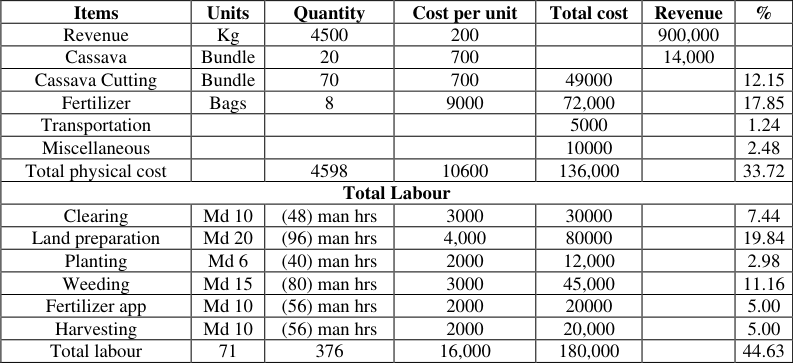 Table 2
 Table 3
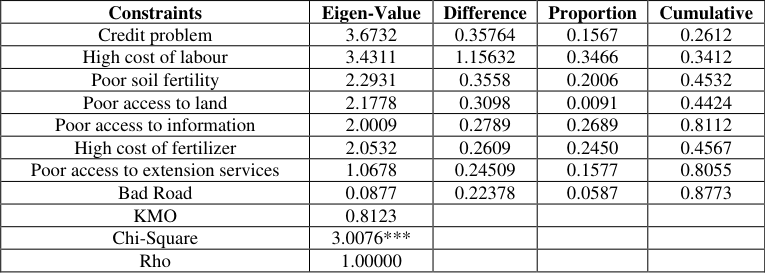 Table 4
Introduction
Cassava is among important staple and cash crops grown in Nigeria, particularly in the Southern part in terms of area devoted to it and the number of farmers growing it (FAO, 2019) [3] . Apart from for human and livestock consumptions, cassava and its derivatives are used as by-product in industrial manufacturing of finished products (Ano, 2015) [1] and it contributes positively to poverty alleviation through income generation (Nzeakor and Ume, 2021) [7] . Africa is the largest producer of cassava, with Nigeria leading the world with about 47,274,320 metric tons per annum in total land area of about 3.60 million hectares and of which south east agricultural zone accounts for more than 37% of the nation's production (Okoye, Okoye and Ume, 2021) [12] . In Nigeria, cassava production is mainly produced by small holder farmers that constitute more than 80 -90% of the farming population (Onunka, et al; 2021) [13] . Cassava production is endeared to this farming class because of certain attributes according to Anon, (2015) [1] , included thrives in marginal soil, ease of cultivation and high multiplication of the stem cutting and tolerant to drought. The other intrinsic features are survival under marginal rain fall, ability to store well in the soil for several months and relative ease of growing cassava with otheryd crops (Anyanwu, 2014, Ume, et al, 2022) [2,14] . The production feat of cassava in Nigeria, could be attributed to notably promulgation of law mandatory bakers to include at least 10% of cassava flour into their bakery, cassava multiplication projects (CMP), root and tuber expansion programme (r-tep), presidential initiative on cassava production, processing and exporting and partnership initiatives in the Niger Delta (PIND) sponsored by chevron (FAO, 2005) Furthermore, the efforts of Agricultural Development Programmes (ADPs) Ministries of Agriculture and Natural Resources (MANRS), United State Agency for International Development (USAID) in collaboration with National Root Crop Research Institute (NRCRI) Umudike -Abia State, Nigeria, and international institute for tropical agriculture (IITA) help in cassava genetic improvement and many improved cultivars currently in use by farmers in the country (Okonkwo, et al; 2017; NRCRI, 2021) [8] . In recent time, cassava production can no longer meet up with domestic demand, in effect, the nation spends millions of Dollars importing some cassava derivatives to the detriment of the nation dwindling foreign reserved (FAO, 2021). The low production of cassava can be related to high cost of fertilizer and labour, poor soil fertility, use of local cassava varieties, pests and diseases problem, storage problem of cassava tubers, processing problem and land fragmentation which do not encourage mechanization (NRCRI, 2021) [8] . Therefore, it becomes paramount to determine factors that affect their performance in farming and their productivity in terms of profit accruing from the crop production in the study area. Literatures show that determinant factors can classified into socioeconomic characteristics and other factors (non-socioeconomics). Studies (Ugwumba and Omojola, 2012, Anyanwu, 2014; Ume and Kaine, 2021) [16,2,15] show stated among the socioeconomic determinants to profitability of crop production, included source of age of the farmer, labour source, household size, educational level, farming experience, farm size and production objectives. Others are documented significant influence of labour in manday, area planted, planting material, fertilizer and manure (FAO, 2019) [3] . This could lead to formulation and implementation of polices that would enable them to improve on their performances. However, to the best knowledge of the researchers, no known published work in the study area, hence the need for this work to bridge the gap is imperative. Specifically, the objectives of the study are to describe the socioeconomic characteristics of the farmers, estimate the profitability of cassava production, determinant to the profitability and constraints to cassava production in the study area.
Material and Methods
Material and Methods
Study Area
Enugu State is the study area and is located between latitudes 6°30' N and 7°10'N of Equator and longitudes 6°35/ E and 7°30'E of Greenwich Meridian. Enugu State has eighteen Local Government Areas with an estimated population of about 4, 1671 million people (NPC, 2006) [6] . The state has a land area of 16,727 square km 2
Sampling Technique and Sampling Size
Multi-stage random sampling technique was used to select communities' villages and respondents. In stage 1, 10 communities were randomly selected out of fifteen. Secondly, 6 villages were randomly selected from each of the communities. This brought to a total of sixty villages. Finally, two cassava farmers were selected from each of the sixty villages and this brought to a total of one hundred and twenty farmers for detailed studied.
Method of Data Collection
Structured questionnaires and informal or oral interview were used to collect primary data, while secondary ada were derived from journals, proceedings, the internet and other related iteratures.
Method of Data Analysis
The objectives of the study were addressed using percentage responses, multiple regression, gross margin analysis and principal component analysis were used to address the objectives of the study.
Model Specification Gross margin analysis.
Gross margin =g.m.=tr -tvc……………………………… (1) i.e.G.m=
……………………………. 2
The Net farm income can be calculated by gross margin less fixed input. The net farm income can be expressed as thus:
……...……………3
Where Gm = Gross Margin (n), NFI = Net farm income (n), p1 = market (unit) price of output (n), q = quantity of output (kg), Ri = unit price of the variable input (kg), xi = quantity of the variable input (kg), k = annual fixed cost (depreciation) (n), I = 1 2 3 …….. N, J = 1 2 3
Ordinary Least Squared Regressions Method, Four functional forms of the multiple regressions were employed in order to select the one that has provided the best fit. The functional forms tried were: x 1x 5 = coefficient of the parameters to be estimated, while e 1 was the error term and b 0 was the coefficient.
Principal Component Analysis (PCA)
The Model of Principal Component (PCA) is stated thus:
x= 𝑥 1,2 ,𝑥 3 ,…,𝑥𝑝…………………………………………..( 8) ………( 9) ………………… (10) is maximum (11) Maximise subject to ………………………………………..( 12)
The Variance of each of the Principal Component:
…………………….……….( 14) …………………( 15 1 indicates that75% of the respondents were females, while only 25%, females. This is in line with the finding of Anyanwu, (2014) [2] , who reported that cassava production is gender stereotyped. However, in recent times, men are diving into the business because of economic depression in the country and economic gain accruing from its sales (Okonkwo, et al; 2017). Further, 68.33% of the respondents were above 41 years old, 31.67% were below 41 years in the study area. This infers that most respondents were aged, thus could translate to be more years of farming experience to enhance their farm profit through efficient resource utilization. Also, majority (71.93%) of the respondents attained various forms of formal education, while 29.17% had no formal education. Education attainment enhances individual's resource prudency and risk averse in adopting improved technologies to boost their outputs (Ume and Kaine, 2021) [15] . Moreover, 83.33% of the populations studied were members of different cooperative organizations, while only 18.67% were not. Interaction by the way of exchange of ideas in agricultural technologies among cooperative members could facilitate in boosting their income through enhancing their outputs (Onunka, el al; 2021) [13] . Besides, 69.16% of the sampled farmers had farming experience of 21-40 years, while the least (30.84%) had experience of 1 -20 years. Years of farming experience aids farmers in surmounting intricacies in farming, leading to high profit accruing from high productivity (Nnadozie, et a; 2015) [9] . More so, the result of household size showed that majority (29.2%) of the farmers had household size of 6 -10 people, while the least (14.2%) had household size range of 16 -20. Large household members of labour age are often engaged by poorer households into hired labour in order to generate income for improvement of family welfare through improvement in farm work (Ogisi, Begho and Alimeke, 2013) [10] . More so, only 16.7% of the sampled cassava farmers had access to credit through any of the lending institutions. The vast majority of the farmers (83.3%) did not have access Nzeakor and Ume, (2021) [7] reported that scarcity of fund for adoption of technology had been a persistent problem adoption process, leading to low farm profit as farm outputs decline Table 1 explained that only 35.3% of the respondents had contacts with extension agents, while the greater majority (66.7%) had no extension contact. The indication was poor extension outreach, which adversely affected innovation adoption, leading to low crop profitability. The work of Kingley, Eucharia and Emmanuel, (2014) [5] is in consonance with the above statement. They posited that through extension services, the potential gains of improved agricultural technology are inculcated into the farmers for high farm output to accrue. The physical input used in cassava production as contained in Table 2 included cassava cutting, fertilizer (NPK), transportation and other miscellaneous. Among all the physical inputs, the cost of fertilizer (N72,000) constituted the highest proportion, constituting about 5.0% of total cost of production. Fertilizer constituted the highest cost of physical inputs used in cassava production as contained in Table 2. The high cost of the resource could be ascribed to withdrawal of fertilizer subsidy programme by Federal government of Nigeria and as well as the diversion of fertilizers main for the farmers' use to the neighbouring states and countries where it commands higher price (Ume, et al; 2022) [14] . The cost of transportation (N 5000) was the least. The total cost of the physical inputs was N 136,000, which constituted 33.72% of the total cost. Among the labour items considered in Table 2, cost of labour for land preparation (N80, 000) was highest and constituted about 19.84% of the total cost of production, the least cost was cost of planting, N 12000, (2.98%). The total number of man days of labour employed in cassava production in the study area was 376 with total variable costs of N 401320 (99.50%). Furthermore, Table 2 revealed that the total revenue for cassava production per hectare was N 914,000 with the total cost of N 403, 340 with Benefit cost ratio of 1:2.27. Because of high statistical and econometric criteria, Cobb -Douglas was chosen as lead equation. The coefficient of multiple determination, R 2 was 0.8267 implying that 82.67% of the variation in the dependent variable were accounted by the variables included in the model, while the remaining 17.33% were due to error term. The coefficient of the age of the farmer was positive and significant at 5%level. The implication is most farmers were youthful, dynamic and actively productive working class. The aged cassava farmer would not easily adopt productivity enhancing technology and modern farming practices which are needed for transformation in cassava production (FAO, 2020) [4] . The finding of Kingley, et al; (2014) [5] agreed with above assertion. They asserted that aged farmers are usually embodiment of knowledge acquired through years of observations and experimentation, leading to high far output The extension services coefficient more-so had a positive significant influence on the profitability of cassava at 10% alpha level. Extension services aids in enhancing the farmers' profit by increasing output through motivation, information dissemination, education on method of farming, introduction of modern farm, practices supply of Inputs, technical assistance and advise and prompt delivery of inputs (Okoye, Okoye and Ume, 2021) [12] . Also, the estimated coefficient of household size was positive in line with apriori expectation and significant at 1.0% risk level. Owing to the intensiveness and subsistence farming landscape of most countries in sub-Saharan, Africa, Nigerian inclusive, use of manual labour being prominent, then, importance of household' size in that zone cannot be overstressed. As farming in that zone requires more human efforts, it is anticipated that, a farming household with larger household size is likely to have more helping hands on the family farm. This could impact positively to the farmers' profitability, since cost of labour constitutes more than 45% of total cost of production (Nzeakor and Ume, 2021) [7] . Further, the coefficient for farming experience had positive correlation with the dependent variable and significant at 5% level. Experienced farmers are well acknowledged to have better understanding and process new farming information from extension agents and other sources. With the aforesaid attributes, such farmer's capability of improves their farm profitability likelihood through enhanced efficiency in resource use is certainly (Okoye et al. 2021) [12] . The result in Table …. shows that the number of principal components retained using the Kaiser Meyer criterion were four in line with Eigen-values greater than 1. The retained components explained 0.8123% of the differences of the components integrated in the model. The Kaiser-Meyer-Olkin which measures sampling adequacy (KMO) contributed a value of 0.8123 and the Bartlett test of sphericity of 3.0076*** was perceived to be significant at 1% alpha level. This suggests the important of utilizing the set of information for factor analysis. The problem of credit access had an Eigen-value of 3.6732 and was ranked 1st in the order of importance as reported by respondents. The poor access to credit may be corrected with high interest rate and high collateral as demanded by lending agencies (Ume, et al; 2020) [14] . This is followed by high cost of labour with Eigen value -value of 3.4311 The high cost of labour could be related to urban drift of most able-bodied youths in search of greener pasture, thus making labour scare and expensive (Ume and Kaine, 2021) [15] . The least of importance among the factors considered was order of importance was bad road with Eigen-values of 0.0877 and ranked 8 th . This could be related to the fact that most rural roads lining to urban and rural markets are in very deplorable conditions, leading to fewer vehicles plying the roads during rainy season (Nnadozie, et al, 2015) [9] .
| Items | Units | Quantity | Cost per unit | Total cost | Revenue | % |
|---|---|---|---|---|---|---|
| Revenue | Kg | 4500 | 200 | 900,000 | ||
| Cassava | Bundle | 20 | 700 | 14,000 | ||
| Cassava Cutting | Bundle | 70 | 700 | 49000 | 12.15 | |
| Fertilizer | Bags | 8 | 9000 | 72,000 | 17.85 | |
| Transportation | 5000 | 1.24 | ||||
| Miscellaneous | 10000 | 2.48 | ||||
| Total physical cost | 4598 | 10600 | 136,000 | 33.72 | ||
| Total Labour | ||||||
| Clearing | Md 10 | (48) man hrs | 3000 | 30000 | 7.44 | |
| Land preparation | Md 20 | (96) man hrs | 4,000 | 80000 | 19.84 | |
| Planting | Md 6 | (40) man hrs | 2000 | 12,000 | 2.98 | |
| Weeding | Md 15 | (80) man hrs | 3000 | 45,000 | 11.16 | |
| Fertilizer app | Md 10 | (56) man hrs | 2000 | 20000 | 5.00 | |
| Harvesting | Md 10 | (56) man hrs | 2000 | 20,000 | 5.00 | |
| Total labour | 71 | 376 | 16,000 | 180,000 | 44.63 |
Table text extracted from the original PDF; superscript letters are shown inline. The original table image is below.
View original table image
Results and Discussion
Results and Discussion
Cost and Return of Cassava Production
Cost and Return of Cassava Production
Determinants to profitability of Cassava Farmers
Determinants to profitability of Cassava Farmers
Constraints to Cassava Production
Constraints to Cassava Production
Figures and tables from the paper
| Variable | Linear | Exponential | Double Log + (Cobb Douglas) | Semi Log |
|---|---|---|---|---|
| Constant | 9.864(4.744)*** | 6.5064(3.229)*** | 6.001(3.511)*** | 4.109(3.288)*** |
| Gender | 1.564(0.137)** | 0.241(0.442) | 0.275(1.191) | 0.612(0.097) |
| Age | 0.670(0.617) | 0.623(0.441) | 0.901(2.171)** | 1.311(-0.109) |
| Education | 0.553(-1.666) | 0.337(2.007)** | 0.476(0.991) | -2.104(2.314)** |
Table text extracted from the original PDF; superscript letters are shown inline. The original table image is below.
View original table image
| Constraints | Eigen-Value | Difference | Proportion | Cumulative |
|---|---|---|---|---|
| Credit problem | 3.6732 | 0.35764 | 0.1567 | 0.2612 |
| High cost of labour | 3.4311 | 1.15632 | 0.3466 | 0.3412 |
| Poor soil fertility | 2.2931 | 0.3558 | 0.2006 | 0.4532 |
| Poor access to land | 2.1778 | 0.3098 | 0.0091 | 0.4424 |
| Poor access to information | 2.0009 | 0.2789 | 0.2689 | 0.8112 |
| High cost of fertilizer | 2.0532 | 0.2609 | 0.2450 | 0.4567 |
| Poor access to extension services | 1.0678 | 0.24509 | 0.1577 | 0.8055 |
| Bad Road | 0.0877 | 0.22378 | 0.0587 | 0.8773 |
| KMO | 0.8123 | |||
| Chi-Square | 3.0076*** | |||
| Rho | 1.00000 |
Table text extracted from the original PDF; superscript letters are shown inline. The original table image is below.
View original table image
References
12 in the original paper- FAO. Food and Agricultural Organization of the United Nation. An Assessment on the productivity of cassava in Africa. 2019;11:17.
- FAO. 2020. statistical data htt//www/fao.org.
- Kingley OH, Eucharia AA, Emmanuel EA. Analysis of Determinants of Cassava Production and Profitability in Akpabuyo Local Government Area of Cross River State, Nigeria. International Business Research. 2014;7(12):128-135.
- Nzeakor FC, Ume SI. Analysis of Profitability and Adoption of Nr 8082 Cassava Technology Among Adopters and Non-Adopter in Abia State, Nigeria. AKSU Journal of Agriculture and Food Sciences. 2021;5(3):98-116.
- Bassim Haleem Kshash, Hayat Kadhum Oda. Challenges facing extension agents in Iraq. Int. J Agric. Extension Social Dev. 2021;4(1):58-65.
- Nnadozie AKO, Ume SI, Isiocha S, Njoku IA. Nigerian cassava potentials in National Economic Development. Science Journal of Business Management. 2015;3(51):47-49. Available at;
- Okoronkwo MO, Ume SI, Ahaiwe MO, Nwagwu Alex C, Okoro Sunday F. Determinants of Cassava Production and Marketing in Obubura Local Government Area of Cross Rivers State, Nigeria. International Journal of Management and Technology. 2017;1(1):40-46.
- Okoye FU, Okoye AC, Umeh SI. Consumption behavior analyses of cassava products among rural households in Ebonyi State, Nigeria. Agro-Science Journal of Tropical Agriculture, Food, Environment and Extension. 2021;20(2):14-19.
- Onunka BN, Ume SI, Okoroafor IB, Edeh ON. Determinant Factors to Decision to Adopt Pro-Vitamin a Cassava Varieties by Farmers in Abia State of Nigeria. International Journal of Research and Scientific Innovation (IJRSI). 2020;7(10):148. ISSN 2321-2705 www.rsisinternational.org
- Ume SI, Edeh ON, Udefi OI. Socio-economic Determinants to Adoption of Tropical Mosaic Selection (TMS) Cassava Varieties by Small-holder Farmers in Abia State, Nigeria International Journal of Research and Innovation in Social Science (IJRISS). 2022;6(1):582.
- Ume SI, Kaine AIN. Technical Efficiencies of TMS Cassava Varieties by Farmers in Ebonyi State, Nigeria. AKSU Journal of Agriculture and Food Science. 2021;5(3):141-159.
- Ugwumba COA, Omojola JT. Socio-Economic Determinants and Profitability of Yam Production in Ipao-Ekiti, Nigeria. J Sci. Multidiscipl. Res. 2012 December 4. Cenres in Publications. www.cenresinpub.org
Cited by 1
From OpenAlex, OpenCitations and reference lists read by Scinovex
- Determinants of farm profit among cassava-based farming households in Osun State Nigeria: robust estimation approach ↗
Ayodeji Ogunleye, Adewale Folaranmi Lukman, Hassan Seun Ogunwemimo, Victoria Adeyemi Tanimonure, Emad Ismail, Fuad A. A. Awwad et al. · Cogent Food & Agriculture · 2025
The Ordinary Least Squares (OLS) method is widely adopted in studies estimating net profit generation among farmers, despite its strong tendency to produce misleading estimates, particularly when one or more fundamental assumptions are violated. This study examined the determinants of farm income among smallholder cassava farmers in Osun State, Nigeria correcting for various assumptions violations of the classical regression model.…
❝ 2PDF