
Research article · 2022 · Full text
International Journal of Agriculture and NutritionThe effect of NPK mutiara fertilizer and kayabio biofertilizer on the growth and yield of chilli plants (Capsicum frustescens L) the dewata 43 F1 variety
Volume 4(1) · Pages 39–43 · DOI: 10.33545/26646064.2022.v4.i1a.52 ↗
Research areasShallot Cultivation and AnalysisPineapple and bromelain studiesPlant Growth and Agriculture Techniques
Abstract
Author-writtenThe aims of this study were: (1) to determine the effect of NPK Mutiara fertilizer and Kayabio biofertilizer and their interactions on the growth and yield of chilli plants and (2) to obtain the appropriate dose of NPK Mutiara fertilizer and Kayabio biofertilizer for growth and yield of chilli, Dewata 43 F1 variety. The research was carried out from March to May 2020, the research site was on Jl. Toyyib Hadi Wijaya SPP/SPMA Complex, East Sempaja urban Village, North Samarinda sub District, East Kalimantan Province. The study used a Completely Randomized Design (CRD) with 4x4 factorial analysis which was repeated 3 times. The first factor was the dose of NPK Mutiata fertilizer (M) which consisted of 4 levels, namely: no NPK Mutiara application (m0), 5 g polybag-1 (m1); 10 g polybag-1 (m2), and 15 g polybag-1 (m3). The second factor is Kayabio biofertilizers (K), which consists of 4 levels, namely: no Kayabio Hayati Fertilizer application (k0), 15 g polybag-1 (k1), 30 g polybag-1 (k2), and 45 g polybag-1 (k3). Research activities include: preparation of planting media, seed sowing, planting, fertilizing NPK Mutiara, fertilizing Kayabio, plant maintenance (installation of stakes, watering, weeding, pest and disease control), and harvesting and data collection. Data analysis used variance and BNT test at 5% level. The results showed that: (1) NPK Mutiara fertilizer had a significant to very significant effect on plant height at 15, 30 and 45 days after planting, age at flowering, age at harvest, number of fruits and fruit weight per plant. The highest fruit production was produced in the treatment of 10 g polybag-1 (m2), namely 21.33 g; (2) Kayabio biofertilizer had a very significant effect on plant height at 15, 30 and 45 days after planting, age at flowering, age at harvest, number of fruits and fruit weight per plant. The highest fruit production was produced in the treatment of 30 g polybag-1 (k2), namely 20.33 g; and (3) there is no interaction between NPK Mutiara fertilizer and Kayabio biofertilizer on the all observation parameters.
Summary
Source-checkedPlain-language reading of the full paper, prepared with AI and checked against the text. Each point links to the authors' own words.
Why it matters
- Chilli is a critical vegetable crop in Indonesia due to its importance in meeting the local dietary preference for spicy flavors. View evidence ↗
- In East Kalimantan, chilli production is hindered by low soil fertility, as the region is dominated by Ultisols. View evidence ↗
- The prolonged and excessive use of inorganic fertilizers can harm soil health by reducing the population of beneficial microorganisms. View evidence ↗
The question
- The study aimed to determine how NPK Mutiara fertilizer, Kayabio biofertilizer, and their interaction affect the growth and yield of the Dewata 43 F1 chilli variety, and to identify the optimal doses for each. View evidence ↗
What they did
- The experiment took place from March to May 2020 in North Samarinda, East Kalimantan Province. View evidence ↗
- The researchers used a completely randomized design (CRD) with a 4x4 factorial analysis, repeated three times. View evidence ↗
- Measured parameters included plant height at 15, 30, and 45 days after planting, as well as the age of flowering, age of harvest, number of fruits, and fruit weight per plant. View evidence ↗
What they found
- NPK Mutiara fertilizer significantly influenced plant height (at 15, 30, and 45 days), flowering and harvest timing, and the quantity and weight of fruits. View evidence ↗
- The highest fruit weight per plant was 21.33 g using 10 g of NPK Mutiara per polybag, compared to 16.75 g for the control group without NPK Mutiara. View evidence ↗
- Kayabio biofertilizer had a very significant effect on plant height, flowering and harvest ages, and fruit yield. View evidence ↗
- There was no significant interaction between NPK Mutiara and Kayabio biofertilizer across any of the measured parameters, indicating the two factors act independently. View evidence ↗
- Increasing the NPK Mutiara dose to 15 g per polybag led to a decrease in fruit number and weight compared to the 10 g dose, suggesting that excessive application is detrimental. View evidence ↗
- Similarly, applying 45 g of Kayabio biofertilizer per polybag resulted in lower fruit yield and weight than the 30 g dose. View evidence ↗
What it means
- The authors recommend using 10 g of NPK Mutiara and 30 g of Kayabio biofertilizer per polybag for cultivating the Dewata 43 F1 chilli variety. View evidence ↗
- The authors suggest that future research should be conducted in the field and include soil analysis data to supplement the observation parameters. View evidence ↗
Visual summary
3 visualsIllustrations explain the paper; charts are replotted from the paper's own table values.
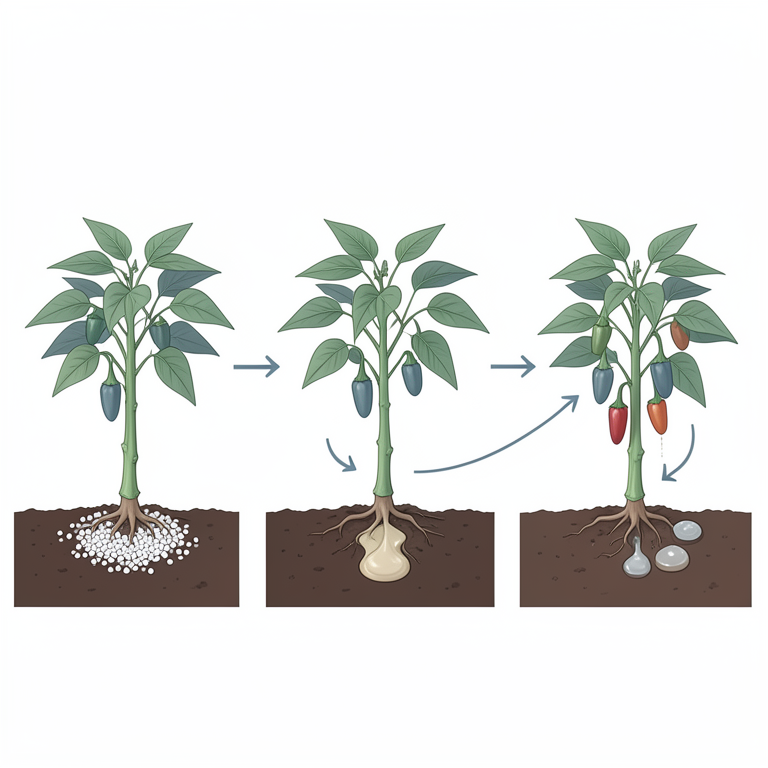
Independent Action of Fertilizers
AI-generated conceptual illustration (chilli plants (Capsicum frustescens L) Dewata 43 F1 variety). It explains the idea and does not show study data.
View source evidence ↗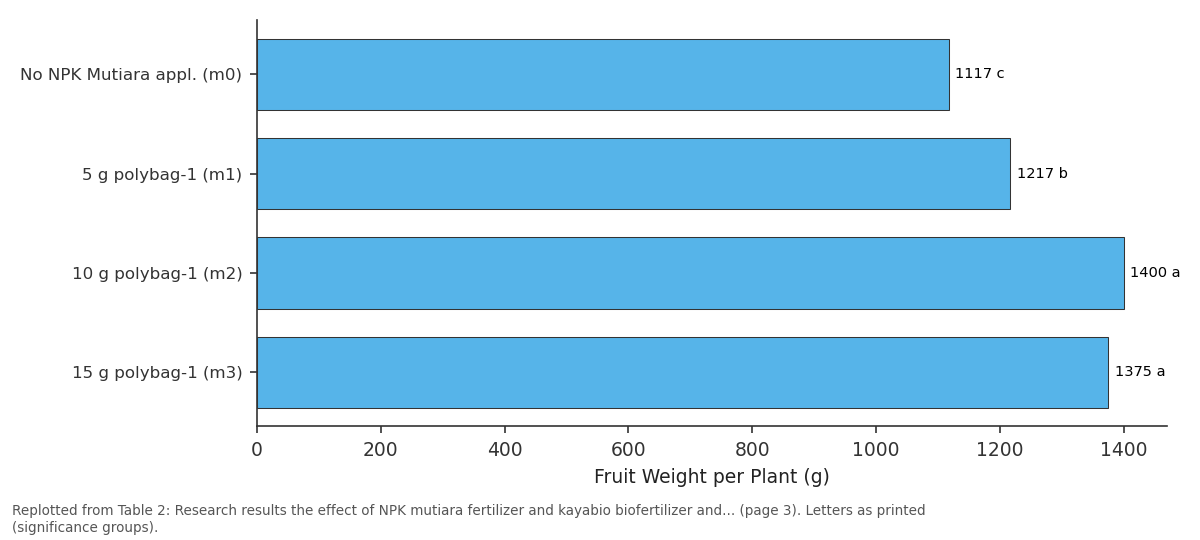
Number of Fruits per Plant (fruit) / **: No NPK Mutiara appl.... vs 5 g polybag-1 (m1) vs 10 g polybag-1 (m2) vs 15 g polybag-1 (m3)
Replotted from Table 2 (page 3) of the original paper. Every bar is the paper's own table value.
View source evidence ↗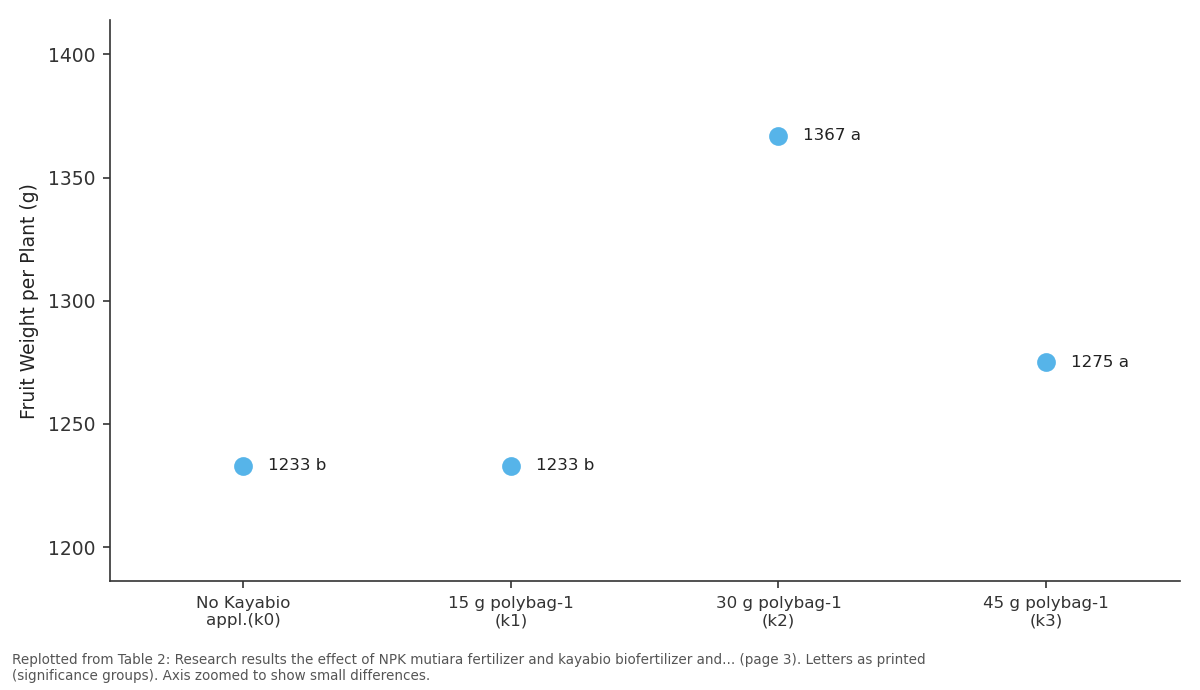
Number of Fruits per Plant (fruit) / **: No Kayabio appl.(k0) vs 15 g polybag-1 (k1) vs 30 g polybag-1 (k2) vs 45 g polybag-1 (k3)
Replotted from Table 2 (page 3) of the original paper. Every bar is the paper's own table value.
View source evidence ↗Figures & tables
From the original paper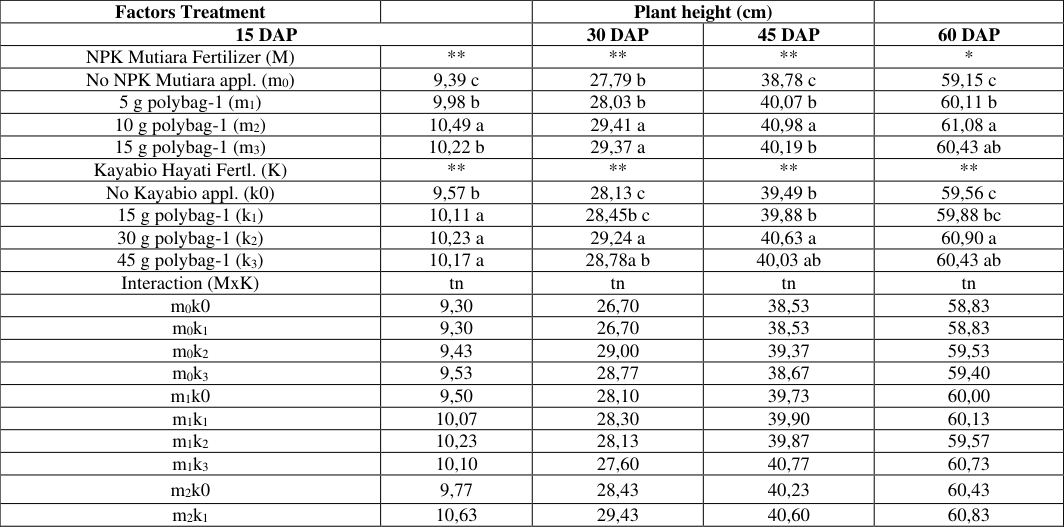 Table 1
 Table 2
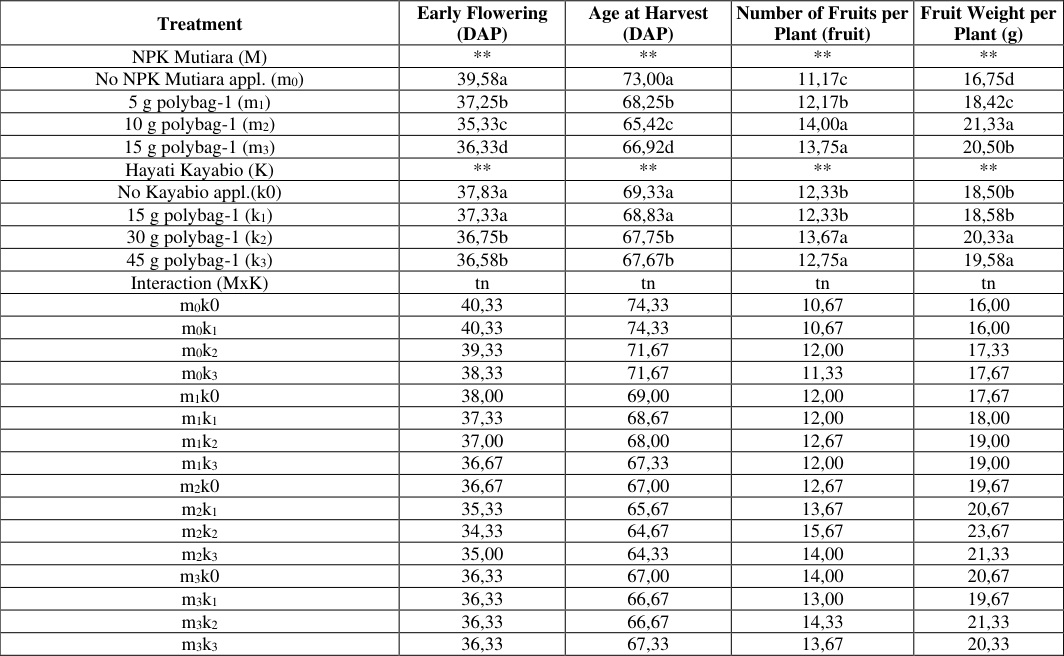 Table 2
Introduction
Chilli is one of the important vegetable crops in Indonesia, because it is able to meet the typical needs of the Indonesian people for the spicy taste of a dish. Chilli also provides color and taste that can arouse appetite, contains lots of vitamins and can also be used as medicine, food mix and animal husbandry. The need for chilli continues to increase in line with the increasing population and the development of the food industry which requires chili raw materials. This causes this commodity to become a commodity that is most often discussed in all levels of society because the price can soar very high at certain times (Andoko, 2004) [1] . Chilli commodities that have genetic advantages and privileges and resistance to environmental changes need to be supported by good cultivation techniques to achieve maximum results (Harpenas and Dermawan, 2010) [7] . Obstacles to increasing chilli production in East Kalimantan include the low level of soil fertility, because it is dominated by Ultisols (Red Yellow Podsolik). Therefore, it is necessary to make various efforts to increase the level of soil fertility in order to optimize the yield and productivity of agricultural land. One of them is fertilizing. Fertilization is an effort to meet the nutrient needs of plants, the goal is to add nutrients needed by plants, so as to get maximum results (Lingga and Marsono, 2013) [9] . Mutiara Fertilizer is a compound fertilizer containing elements of Nitrogen (N), Phosphorus (P) and Potassium (K), this fertilizer is widely available in various agricultural shops/kiosks and the price is relatively affordable. Provision of sufficient and balanced elements of N, P and K plays an important role in overall plant growth and development, both vegetative and generative. Continuous and excessive use of inorganic fertilizers can damage the soil, reduce and suppress the population of beneficial soil microorganisms. To overcome this problem, in addition to the provision of inorganic fertilizers, it is necessary to accompany the provision of biological fertilizers. According to Havlin et al. (2005) [8] , continuous use of inorganic fertilizers can reduce soil fertility and damage soil properties, one of which is soil biology which will have an impact on the activity of microorganisms in the supply of nutrients which will affect crop production. Therefore, the use of inorganic fertilizers must be balanced with the provision of biological fertilizers that can increase soil biological fertility and provide nutrients for plants
Experimental design
This study used a completely randomized design (CRD) with 4x4 factorial analysis which was repeated 3 times. The first factor was the dose of NPK Mutiara fertilizer (M) which consisted of 4 levels, namely: without NPK Mutiara (m 0 ), 5 g polybag-1 (m 1 ); 10 g polybag-1 (m 2 ), and 15 g polybag-1 (m 3 ). The second factor is Kayabio biofertilizer (K), which consists of 4 levels, namely: without Kayabio biofertilizer (k0), 15 g polybag-1 (k 1 ), 30 g polybag-1 (k 2 ), and 45 g polybag-1 (k 3 ).
Research procedure
Research activities include: preparation of planting media, sowing seeds, planting, fertilizing NPK Mutiara, fertilizing Kayabio, plant maintenance (installation of stakes, watering, weeding weeds, controlling pests and diseases), and harvesting.
Data retrieval: Data collection included: plant height at the age of 15, 30, and 45 days after planting, age at flowering, age at harvest, number of fruit per plant, and fruit weight per plant.
Data analysis
The data were analyzed using analysis of variance, if there was a significant effect, then a further test was carried out with a 5% Least Significant Difference level.
Results and Discussion
The results of the research on the effect of NPK Mutiara fertilizer and Kayabio biofertilizers and their interactions on the growth and yield of chilli plant Dewata 43 F1 are variety presented in Table 1 and Table 2.
| Treatment | Early Flowering (DAP) | Age at Harvest (DAP) | Number of Fruits per Plant (fruit) | Fruit Weight per Plant (g) |
|---|---|---|---|---|
| NPK Mutiara (M) | ** | ** | ** | ** |
| No NPK Mutiara appl. (m0) | 39,58a | 73,00a | 11,17c | 16,75d |
| 5 g polybag-1 (m1) | 37,25b | 68,25b | 12,17b | 18,42c |
| 10 g polybag-1 (m2) | 35,33c | 65,42c | 14,00a | 21,33a |
| 15 g polybag-1 (m3) | 36,33d | 66,92d | 13,75a | 20,50b |
| Hayati Kayabio (K) | ** | ** | ** | ** |
| No Kayabio appl.(k0) | 37,83a | 69,33a | 12,33b | 18,50b |
| 15 g polybag-1 (k1) | 37,33a | 68,83a | 12,33b | 18,58b |
| 30 g polybag-1 (k2) | 36,75b | 67,75b | 13,67a | 20,33a |
| 45 g polybag-1 (k3) | 36,58b | 67,67b | 12,75a | 19,58a |
| Interaction (MxK) | tn | tn | tn | tn |
| m0k0 | 40,33 | 74,33 | 10,67 | 16,00 |
| m0k1 | 40,33 | 74,33 | 10,67 | 16,00 |
| m0k2 | 39,33 | 71,67 | 12,00 | 17,33 |
| m0k3 | 38,33 | 71,67 | 11,33 | 17,67 |
| m1k0 | 38,00 | 69,00 | 12,00 | 17,67 |
| m1k1 | 37,33 | 68,67 | 12,00 | 18,00 |
| m1k2 | 37,00 | 68,00 | 12,67 | 19,00 |
| m1k3 | 36,67 | 67,33 | 12,00 | 19,00 |
| m2k0 | 36,67 | 67,00 | 12,67 | 19,67 |
| m2k1 | 35,33 | 65,67 | 13,67 | 20,67 |
| m2k2 | 34,33 | 64,67 | 15,67 | 23,67 |
| m2k3 | 35,00 | 64,33 | 14,00 | 21,33 |
| m3k0 | 36,33 | 67,00 | 14,00 | 20,67 |
| m3k1 | 36,33 | 66,67 | 13,00 | 19,67 |
| m3k2 | 36,33 | 66,67 | 14,33 | 21,33 |
| m3k3 | 36,33 | 67,33 | 13,67 | 20,33 |
Table text extracted from the original PDF; superscript letters are shown inline. The original table image is below.
View original table image
| m2k2 | 10,90 | 30,30 | 42,50 | 62,87 |
|---|---|---|---|---|
| m2k3 | 10,67 | 29,47 | 40,60 | 60,17 |
| m3k0 | 9,70 | 29,27 | 39,47 | 58,97 |
| m3k1 | 10,43 | 29,37 | 40,47 | 59,70 |
| m3k2 | 10,37 | 29,53 | 40,77 | 61,63 |
| m3k3 | 10,37 | 29,30 | 40,07 | 61,40 |
Table text extracted from the original PDF; superscript letters are shown inline. The original table image is below.
View original table image
| Factors Treatment | — | Plant height (cm) | — | — |
|---|---|---|---|---|
| 15 DAP | 30 DAP | 45 DAP | 60 DAP | |
| NPK Mutiara Fertilizer (M) | ** | ** | ** | * |
| No NPK Mutiara appl. (m0) | 9,39 c | 27,79 b | 38,78 c | 59,15 c |
| 5 g polybag-1 (m1) | 9,98 b | 28,03 b | 40,07 b | 60,11 b |
| 10 g polybag-1 (m2) | 10,49 a | 29,41 a | 40,98 a | 61,08 a |
| 15 g polybag-1 (m3) | 10,22 b | 29,37 a | 40,19 b | 60,43 ab |
| Kayabio Hayati Fertl. (K) | ** | ** | ** | ** |
| No Kayabio appl. (k0) | 9,57 b | 28,13 c | 39,49 b | 59,56 c |
| 15 g polybag-1 (k1) | 10,11 a | 28,45b c | 39,88 b | 59,88 bc |
| 30 g polybag-1 (k2) | 10,23 a | 29,24 a | 40,63 a | 60,90 a |
| 45 g polybag-1 (k3) | 10,17 a | 28,78a b | 40,03 ab | 60,43 ab |
| Interaction (MxK) | tn | tn | tn | tn |
| m0k0 | 9,30 | 26,70 | 38,53 | 58,83 |
| m0k1 | 9,30 | 26,70 | 38,53 | 58,83 |
| m0k2 | 9,43 | 29,00 | 39,37 | 59,53 |
| m0k3 | 9,53 | 28,77 | 38,67 | 59,40 |
| m1k0 | 9,50 | 28,10 | 39,73 | 60,00 |
| m1k1 | 10,07 | 28,30 | 39,90 | 60,13 |
| m1k2 | 10,23 | 28,13 | 39,87 | 59,57 |
| m1k3 | 10,10 | 27,60 | 40,77 | 60,73 |
| m2k0 | 9,77 | 28,43 | 40,23 | 60,43 |
| m2k1 | 10,63 | 29,43 | 40,60 | 60,83 |
Table text extracted from the original PDF; superscript letters are shown inline. The original table image is below.
View original table image
Effect of NPK mutiara fertilizer application
The results of the scan showed that the effect of NPK Mutiara fertilizer was significantly to very significant on plant height at 15, 30 and 45 days after planting. The results of the study (Table 1) showed that the application of various doses of NPK Mutiara fertilizer resulted in higher chilli plants than the treatment without NPK Mutiara fertilizer (m 0 ). This is due to the provision of NPK Mutiara fertilizer can increase the availability and absorption of nutrients by plants, especially N, so that it can stimulate plant height growth. As stated by Munawar (2011) [12] , adequate supply of N elements can improve plant vegetative growth. Furthermore, it was stated by Gardner, et al. (1991) [5] that N deficiency limits cell enlargement and division and further stated by Winarso (2005) [16] that if the plant lacks N, the leaves will turn yellow, and plant growth will be slow and stunted. The results of the scan showed that the effect of NPK Mutiara was significantly different on plant age at flowering and plant age at harvest. Table 2 shows that the age of plants at flowering and at harvest in various treatments of NPK Mutiara fertilizer doses was faster than the treatment without NPK Mutiara fertilizer (m 0 ). This situation is caused by the application of NPK Mutiara fertilizer can increase the availability of nutrients, especially P which is needed for the flowering process and fruit ripening. As stated by Darjanto and Satifah (2002) [3] that for the growth of flowers and fruit, nutrients are needed, especially N, P and K, a lack of these nutrients can interfere with the flowering process and the formation of plant fruit. The results of variance showed that the effect of NPK Mutiara was very significantly different on the number of fruits and fruit weight of chilli plants. The results (Table 2) showed that the application of various doses of NPK Mutiara fertilizer (m 1 , m 2 , and m 3 ) resulted in a higher number of fruits and a higher fruit weight than the treatment without NPK Mutiara (m 0 ). The application of NPK fertilizer of 10 g polybag-1 (m 2 ) resulted in the highest fruit weight per plant, which was 21.33 g plant -1 , and the lowest was in the treatment without NPK Mutiara (m 0 ), which was 16.75 g plant-1. This situation is caused by the application of NPK fertilizer can increase the availability and absorption of nutrients N, P, and K by cayenne pepper plants; With the availability of these nutrients, it can stimulate plant growth and development which can then provide high yields. As stated by Dwidjoseputro (1998) [4] that plants will thrive if the elements (nutrients) they need are available in sufficient quantities and these nutrients are available in a form that can be absorbed by plants. The results also showed that the treatment of 15 g polybag-1 (m 3 ) resulted in the number of fruits and fruit weight per plant which tended to decrease compared to the results in the treatment of 10 g polybag-1 (m 2 ). This means that excessive fertilizer application will have a negative effect on plants. As stated by Marsono and Lingga (2013) [9] that the dose/concentration of fertilizer is a very vital factor and has a great influence on the success of fertilization. Therefore, to get optimal growth and results, you must pay attention to the right dose and concentration.
Effect of application of kayabio biofertilizer
The results of variance showed that the effect of Kayabio biofertilizer was significantly different on plant height at 15, 30 and 45 days after planting, plant age at flowering, plant age at harvest, number of fruits per plant and fruit weight per plant. The results (Tables 1 and2) showed that the application of various doses of Kayabio biofertilizer (15, 30 and 45 g polybag-1) resulted in higher cayenne pepper plants, faster flowering and harvesting ages, higher number of fruits per plant. more, and higher fruit weight per plant compared to treatment without Kayabio biofertilizer (k0).
The highest fruit weight per plant was produced in the treatment of 30 g polybag-1 (k 2 ), which was 20.33 g, while the lowest was produced in the treatment without Kayabio biofertilizer (k0), which was 18.50 g. The better growth and yield of cayenne pepper that was given Kayabio biofertilizer was due to KayaBio biofertilizer containing beneficial microorganisms such as Pantoea sp., Azospirilium sp., Aspergillus niger and Penicillum sp. This biological fertilizer works to decompose soil organic matter, improve soil aggregates, increase the population of microorganisms in the soil so that it can increase fertility and improve soil physical, chemical and biological properties. As stated by Suwahyono (2011) [15] that biological fertilizers are useful for increasing the population of microorganisms in the soil so as to increase fertility and improve soil physical, chemical and biological properties. The application of biofertilizers either as a single or mixed inoculant (several types of microbes as a combined inoculant) resulted in a significantly different growth compared to the control (without biofertilizer).
The results also showed that the 45 g polybag-1 (k 3 ) treatment tended to produce fewer fruits and lower fruit weight per plant compared to the 30 g polybag-1 (k 2 ) treatment. This shows that the excessive application of Kayabio biofertilizer is not good for plants. As stated by Mulyani Sutejo and Kartasapoetra (2008) [18] that fertilization should not be done at any time, the type of fertilizer and the dose.
The interaction effect of pearl NPK fertilizer treatment and kayabio biofertilizers
The results of variance showed that the interaction of NPK Mutiara and Kayabio fertilizers was not significantly different for all research parameters. There is no significant difference/influence because there is no relationship between the dose of Mutiara NPK fertilizer and Kayabio biological fertilizer treatment, the two factors act independently of each other. As stated by Steel and Torie (1991) that if the interaction between one treatment and another has no significant effect, it can be concluded that these factors act independently of each other, the simple effect of one factor is the same at all levels of other factors.
Added by Hanafiah (2003) , that if the first factor and the second factor have a significant effect, while the interaction has no significant effect, the recommendation from the experimental results suggests that the application of the two factors separately or only one of them. Although the interaction was not significant, the research results presented in Tables 1 and2 show a tendency that at each level of treatment with NPK Mutiara fertilizer combined with each level of Kayabio biofertilizer, higher plants, flowering age and faster harvesting age, higher number of fruits per plant and higher fruit weight per plant.
Similarly, at each level of treatment with Kayabio biofertilizer, combined with each level of NPK Mutiara, higher plants, faster flowering and harvesting ages, higher number of fruits per plant and higher fruit weight per plant. This shows that the NPK Mutiara fertilizer and KayaBio biological fertilizer can complement each other to meet the nutrient needs of plants. As stated by Prihmantoro (2003) [13] that nutrients through fertilization should be given regularly through fertilization so that plants can grow and give good results. Further explained by Dwidjoseputro (1998) [4] , that plants will thrive and give good results if the nutrients they need are available in sufficient and balanced quantities.
Conclusions and suggestions A. Conclusion
1. The treatment of NPK Mutiara fertilizer had a significant to very significant effect on plant height at 15, 30 and 45 days after planting, age at flowering, age at harvest, number of fruits and fruit weight per plant. The highest fruit production was produced in the treatment of 10 g polybag-1 (m 2 ), namely 21.33 g; 2. The treatment of Kayabio biofertilizer had a very significant effect on plant height at 15, 30 and 45 days after planting, age at flowering, age at harvest, number of fruits and fruit weight per plant. The highest fruit production was produced in the treatment of 30 g polybag-1 (k 2 ), namely 20.33 g; and 3. There is no interaction between the treatment of NPK Mutiara and Kayabio biological fertilizers on all observation parameters.
B. Suggestion 1. For the cultivation of chilli (C. frustescens L.) Dewata 43 F1 variety in polybags, it is recommended to provide 10 g plybag-1 of NPK Mutiara fertilizer and 30 g polybag-1 of Kayabio biofertilizer. 2. It is necessary to continue similar research in the field. 3. Observation parameters need to be supplemented with data from soil analysis.
References
3 in the original paper- Darjanto, Satifah S. Flower Biology and Artificial Cross Pollination Techniques. Gramedia, Jakarta, 2002.
- Tanzeela Yaseen, FU Khan, Irfan Gani, Mohd Abass, Iqra gazi. Response of globe amaranth (Gomphrena globosa L.) to pinching and biofertilizer application. Int. J Hortic Food Sci. 2021;3(1):01-05.
- Mavuso B, Nxumalo KA, Oseni TO, Masarirambi MT. Effects of shading material on the growth, yield and quality of green pepper (Capsicum annum L.) grown under hot and humid climatic conditions. Int. J Agric. Food Sci. 2020;2(2):25-31. DOI: 10.33545/2664844X.2020.v2.i2a.39