
Research article · 2022 · Full text
International Journal of Agriculture and NutritionExploration study of proximate and mineral composition of raw and boiled storage scale leaf samples of Borassus flabellifer L.
Volume 4(1) · Pages 53–55 · DOI: 10.33545/26646064.2022.v4.i1a.83 ↗
Research areasCoconut Research and ApplicationsPhytochemical Studies and BioactivitiesPlant-Derived Bioactive Compounds
Abstract
Author-writtenDioecious Palm is known as Borassus flabellifer L. Every part of the plant has been used by the people for various purposes, right from as a source of food, medicine to handicrafts made from palm leaves. The edible part of the seedling is scale leaf or cataphyll which is enclosed by cotyledonous sheath (seed shoot). The present study aimed at analysing the storage scale leaf for understanding its comparative proximate and mineral values of raw and boiled scale leaf for establishing its nutritive use. The crude protein content is lower in the raw scale leaf sample (5.84%) than the boiled scale leaf (6.40%). The boiled sample had higher crude carbohydrate content (16.53%) than the raw scale leaf sample (11.59%), which shows that the boiled scale leaf is a good source of carbohydrates. The crude lipid content of raw scale leaf (1.72%) is significantly lower than the boiled scale leaf (4.39%). Crude fibre content ranged from 1.98% in raw scale leaf to 2.11% in the boiled scale leaf. The moisture content lowered in the boiled scale leaf (57.31%) than the raw scale leaf (58.93%). The calorific value was higher in the boiled scale leaf sample (131.23 cal/100 g) than the raw scale leaf sample (85.2 cal/100 g). The amount of minerals were also analysed and compared between the boiled and raw samples (g/100 g), viz; Magnesium (raw 0.202 and boiled 0.163), Potassium (raw 1.336 and boiled 1.203), Calcium (raw 0.709 and boiled 0.667), Iron (raw 0.101 and boiled 0.106) and Zinc (raw 0.006 and boiled 0.034). Significant differences (p
Summary
Source-checkedPlain-language reading of the full paper, prepared with AI and checked against the text. Each point links to the authors' own words.
Why it matters
- Borassus flabellifer L., a dioecious palm, is utilized by people for various purposes including medicine, handicrafts, and food. View evidence ↗
- The scale leaf (or cataphyll) of the seedling is the edible part of the plant and is consumed as a seasonal food when it is 2 to 4 months old. View evidence ↗
- The consumption of Palmyra scale leaf flour has been associated with toxic effects, such as neurotoxicity and hepatotoxicity, caused by the presence of flabelliferins. View evidence ↗
The question
- The study aimed to compare the proximate and mineral values of raw and boiled storage scale leaves to establish their nutritional utility. View evidence ↗
What they did
- Samples of 100 g each of raw and boiled B. flabellifer scale leaves were obtained from a local market in Tamil Nadu, India, and processed into pastes. View evidence ↗
- Proximate analysis for protein, carbohydrates, lipids, fiber, moisture, and calorific value was conducted using standard AOAC (2003) methods. View evidence ↗
- Magnesium, Potassium, Calcium, Iron, and Zinc were measured using an atomic absorption spectrophotometer (AAS) after digestion in 3M hydrochloric acid. View evidence ↗
- Data were analyzed using an Independent Sample T-test in SPSS version 15, with significance set at p < 0.05. View evidence ↗
What they found
- The boiled scale leaf had a significantly higher crude protein content (6.40%) compared to the raw sample (5.84%) (p=0.000). View evidence ↗
- Crude carbohydrate content increased significantly from 11.59% in raw samples to 16.53% in boiled samples (p=0.000). View evidence ↗
- The crude lipid content was significantly higher in the boiled sample (4.39%) than in the raw sample (1.72%) (p=0.000). View evidence ↗
- Crude fiber content was slightly but significantly higher in the boiled sample (2.11%) compared to the raw sample (1.98%) (p=0.001). View evidence ↗
- Moisture content was significantly lower in the boiled sample (57.31%) than in the raw sample (58.93%) (p=0.000). View evidence ↗
What it means
- The authors conclude that the Palmyra scale leaf is a good food source in both states, providing more storage food substances when boiled and more nutrients when raw. View evidence ↗
Visual summary
3 visualsIllustrations explain the paper; charts are replotted from the paper's own table values.
Comparison Framework
AI-generated conceptual illustration (Borassus flabellifer (Palmyra palm) storage scale leaves). It explains the idea and does not show study data.
View source evidence ↗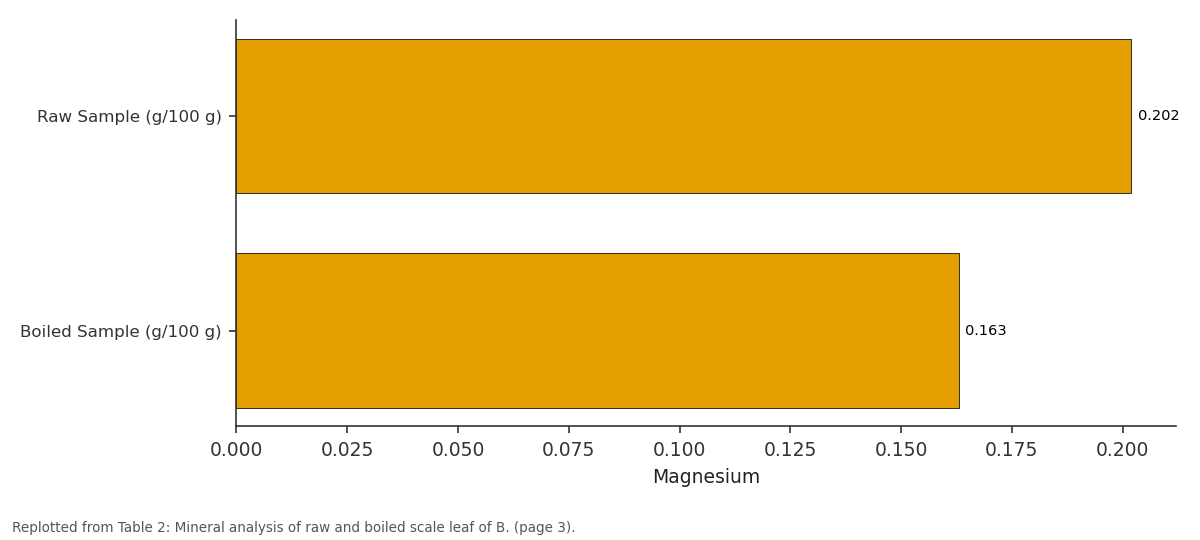
Magnesium: Raw Sample (g/100 g) vs Boiled Sample (g/100 g)
Replotted from Table 2 (page 3) of the original paper. Every bar is the paper's own table value.
View source evidence ↗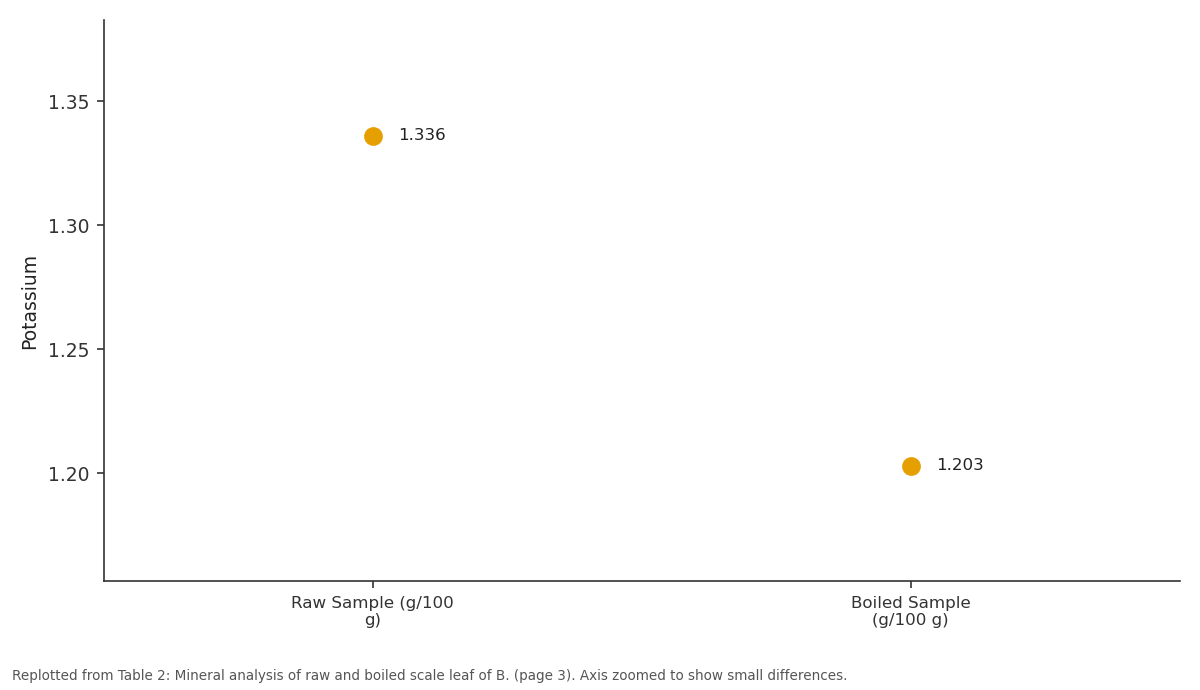
Potassium: Raw Sample (g/100 g) vs Boiled Sample (g/100 g)
Replotted from Table 2 (page 3) of the original paper. Every bar is the paper's own table value.
View source evidence ↗Figures & tables
From the original paper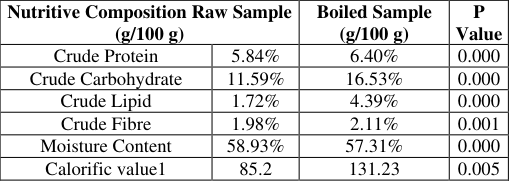 Table 1
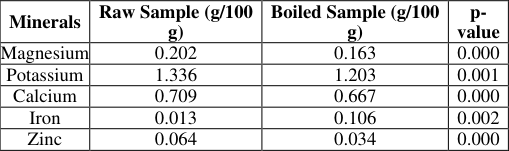 Table 2
Introduction
Palmyra palm (Borassus flabellifer L.) is a well-known widely distributed tropical palm belonging to the family Arecaceae. Borassus in Greek means "leathery covering of fruit"; flabellifer means "fan-bearer" (Small, 2011) [14] . The tree was named so because for the resemblance of the leaf to the palm of the hand. The other local names of the palm includes Toddy palm, wine palm, Cambodian Palm, Panai Maram, Pana, Taalimara, Tal, Tad and it is the state tree of Tamil Nadu. It is the national fruit of Cambodia and it is well distributed in the Indian subcontinent and South East Asian countries as it requires dry, tropical weather. It is a dioecious palm which grows slowly and the sex of the tree cannot be identified until it starts to produce flowers. It usually flowers only after 12-15 years of growth. Fruits start to appear from May to August. The tender fruits contain a soft, sweet, jelly-like endosperm with sap and embryo. These fruits are relished during summer and they are a cooling, delicious and filling food, the gelatinous light golden fibrous, luscious, semisaccharine, farinaceous matter known as Palmyra pulp. Seed germination is of remotive tubular type. The cotyledonary sheath encompasses the plumule and the radicle at its tip growing downwards into the soil. The cotyledonary sheath develops into a solid cylindrical structure, often marked externally by pneumathodes. The seedling produces a single scale leaf or cataphyll which contains abundant storage starch. The cotyledon and scale leaf become firm and hard and the latter grows to a thickness of about 1 cm by the growth and enlargement of its cells. The fully grown scale leaf has enlarged to a size of about 30-40 cm in length and about 3-4 cm in breadth at its broadest part. This scale leaf is the edible part of the seedling, locally known as "Panam Kizhangu". This edible part (scale leaf) is removed and eaten as favourite seasonal food when it is 2-4 months old (Mitra, 1988, Dassanayake and Sivakadachchan, 1973) [11,6] .
In Sri Lanka, locals used to consume Palmyra scale leaf flour for many centuries and toxic effects have been reported by them, viz; neurotoxicity, hepatotoxicity, immunosuppression, clastogenic and mutagenic effects (Jansz et al., 2002) [9] . The toxicity is due to the presence of flabelliferins. The present study is carried out to investigate the comparative proximate analysis and mineral analysis of raw and boiled scale leaf, since the palmyra scale leaf flour is used for various food preparations and consumed in both raw and boiled states.
Materials and Methods
The raw scale leaf of B. flabellifer were procured from the local market of Tambar am West, Tamil Nadu, India. A known quantity (100 g) of raw and boiled scale leaf samples were made into a paste and both the pastes were stored in two different air tight containers, labelled separately subjected to further analysis.
Proximate analysis:
The following proximate analysis (crude protein, crude carbohydrate, crude lipid, crude fibre, moisture content and calorific value) were performed in the raw and boiled scale leafs and the results were determined by using standard methods (AOAC, 2003) [2] .
Mineral analysis
Minerals were determined by digesting the scale leaf paste of both raw and boiled sample separately in 3M hydrochloric acid. The five inorganic elements; Magnesium, Potassium, Calcium, Iron and Zinc were determined using the atomic absorption spectrophotometer (AAS) method outlined in (AOAC, 2003) [2] .
Data analysis
Results obtained in all tests have been subjected to Independent Sample T-test Analysis using SPSS version 15 to ascertain the significant values. P-values of less than 0.05 (p<0.05) showed significant difference among raw and boiled scale leaf samples.
Results and Discussion proximate analysis
The proximate analysis of food is done mainly to analyse moisture, ash, lipid, protein and carbohydrate contents. These parameters play an important role in the food industry for product development, quality control (QC) or regulatory purposes. Proximate analysis can also help the common people outside the food industry to know about the nutritional aspects and the quality of the food they are eating. The scale leaf samples were subjected for proximate analysis and the values were analysed (Table 1). The crude protein was analysed for the raw and boiled sample, the boiled sample had 6.40% of crude protein and the raw sample had 5.84% of crude protein. From the results, it is clearly shown that the protein level is more in the boiled sample. In another study, conducted on the palmyra scale leaf flour it was found that the protein content of the flour was lower than that of cereals but higher than that of other tuber samples (Jansz et al., 2002) [9] . The crude protein content of Borassus aethiopum scale leaf flour is 0.017±0.00 g/100 g dry matter (Ali et al., 2010) [1] , comparing this value with the present study B. flabellifer scale leaf flour has more crude protein content. Protein in the diet contributes for the growth and repair of worn-out tissues (Ayoola et al., 2012) [4] . The crude carbohydrate value for boiled sample is 16.53% and for raw sample is 11.59%. The result shows that crude carbohydrate content has increased after boiling the raw scale leaf sample. In another report, the carbohydrate content of B. flabellifer sample is 25.53 g/100 g of dry matter (Sahni et al., 2014) [13] , showing variation in the crude carbohydrate content. Starch is the main carbohydrate content of the scale leaf, it has low gelatinization temperature and viscosity but has a good setting property due to which it exhibits as a good source of food starch (Balasubramanium et al., 1999) [5] . It was also found that the starch of the scale leaf flour is devoid of bitterness (Jansz et al., 1992) [15] . The crude lipid content of boiled sample is 4.39% and that of raw sample is 1.72% which shows that crude lipid content has increased after boiling the raw sample. The result of the present study showed higher crude lipid content compared to the previous analysis (Sahni et al., 2014) [13] . However, the flour of B. aethiopum has even more lipid content (10.73±0.00 g/100 g) than the crude lipid content of B. flabellifer (Ali et al., 2010) [1] . The crude lipid is composed of triglycerides of palmitate, oleate and linolinate. The crude lipid content of samples is comparatively less than that of lipids of cereals and tubers (Jeyarartnam, 1986) [10] . Lipids also play an important role in human diet because it helps in absorption of lipid soluble vitamins (Atasie et al., 2009) [3] . The crude fibre content in the boiled sample is 2.11% and in raw sample is 1.98%, this shows that the crude fibre content has increased after boiling the sample. Since there is a considerable amount of fibre it may have low glycaemic index (Jansz et al., 2002) [9] . The crude fibre content of B. flabellifer flour is 7.29 g/ 100 g in another study, which indicates that the scale leaf is a rich source of dietary crude fibre (Sahni et al., 2014) [13]. Low fibre content in diet may also lead to constipation, cancer and piles (Atasie et al., 2009) [3] . The moisture content of raw sample is 58.93% and for the boiled sample is 57.31%. The results reveal that both raw and boiled samples have significant increase in moisture content. The moisture content has lowered down slightly in the boiled sample due to boiling. The moisture content in previous study also showed higher value. The calorific value has increased drastically (131.23 cal/100 g) in the boiled sample than that of the raw sample (85.2 cal/100 g). In previous report on the dried scale leaf flour of B. flabellifer, the calorific value is also higher. In another study on the scale leaf flour, it was found that the calorific value content is similar to that of cereals and grains (Jansz et al., 2002) [9] . From the above results for proximate analysis it is clear that all the values in proximate composition has increased in the scale leaf after boiling except for moisture content.
| Nutritive Composition Raw Sample (g/100 g) | — | Boiled Sample (g/100 g) | P Value |
|---|---|---|---|
| Crude Protein | 5.84% | 6.40% | 0.000 |
| Crude Carbohydrate | 11.59% | 16.53% | 0.000 |
| Crude Lipid | 1.72% | 4.39% | 0.000 |
| Crude Fibre | 1.98% | 2.11% | 0.001 |
| Moisture Content | 58.93% | 57.31% | 0.000 |
| Calorific value1 | 85.2 | 131.23 | 0.005 |
Table text extracted from the original PDF; superscript letters are shown inline. The original table image is below.
View original table image
Figures and tables from the paper
| Minerals | Raw Sample (g/100 g) | Boiled Sample (g/100 g) | p- value |
|---|---|---|---|
| Magnesium | 0.202 | 0.163 | 0.000 |
| Potassium | 1.336 | 1.203 | 0.001 |
| Calcium | 0.709 | 0.667 | 0.000 |
| Iron | 0.013 | 0.106 | 0.002 |
| Zinc | 0.064 | 0.034 | 0.000 |
Table text extracted from the original PDF; superscript letters are shown inline. The original table image is below.
View original table image
References
10 in the original paper- Ali A, Fadimatou B, Tchiegang C, Saidou C, Adji MB. Physico-chemical and functional properties of Bâtchi or hypocotyle axes of Borassus aethiopum Mart. African Journal of Food Science. 2010;4(10):635-641.
- Atasie VN, Akinhanmi TF, Ojiodu CC. Proximate analysis and physico-chemical properties of ground nut (Arachis hypogaea L.). Pakistan Journal of Nutrition. 2009;8:194-197.
- Ayoola PB, Adeyeye A, Onawumi O. Chemical evaluation of food value of groundnut (Arachis hypogaea) seeds. American Journal of Food and Nutrition. 2012;2:55-57.
- Dassanayake MD, Sivakadachchan B. Germination and Seedling Structure of Borassus fiabellifer L. Ceylon Journal of Science (Biological Sciences). 1973;10(2):10-15.
- Deshmukh, Rathod V. Nutritional evaluation of some wild edible tuberous plants. Asian Journal of Pharmaceutical and Clinical Research. 2013;6(2):58-60.
- Dr. Akka KK, Dr. Reddy P. Lipid profile in patients of type 2 diabetes mellitus with myocardial infarction. Int. J Adv. Biochem Res 2021;5(1):14-19. DOI:10.33545/26174693.2021.v5.i1a.59
- Jansz ER, Wickremasekara NT, Sumuduni KAV. A review of the chemistry and biochemistry of seed shoot flour and fruit pulp of the Palmyra Palm. Journal of the National Science Foundation, Sri Lanka. 2002;30(1 & 2):61-87.
- Park S, Kang TS, Kim CK, Han JS, Kim S, Smith RH, et al. Genetic Manipulation for Enhancing Calcium Content in Potato tuber. Journal of Agricultural and Food Chemistry. 2005;53(14):5598-5603.
- Sahni C, Shakil NA, Jha V, Gupta RK. Screening of Nutritional, Phytochemical, Antioxidant and Antibacterial activity of the roots of Borassus flabellifer (Asian Palmyra Palm). Journal of Pharmacognosy and Phytochemistry. 2014;3(4):58-68.
- Subramanian NK, White PJ, Broadley MR, Ramsay G. The three-dimensional distribution of minerals in Potato tubers. Annals of Botany. 2011;107:681-691.