
Research article · 2022 · Full text
International Journal of Agriculture and Food ScienceAn augmented Cobb-Douglas production functional modeling of the impact of climate change on Teff yields in Ethiopia
Volume 4(2) · Pages 101–108 · DOI: 10.33545/2664844x.2022.v4.i2b.101 ↗
Research areasSustainable Agricultural Systems AnalysisAgriculture and Rural Development ResearchAgronomic Practices and Intercropping Systems
Abstract
Author-writtenThe study analyzed the impacts of climate change and related factors on yields of teff crop in Ethiopia using quantitative time series data for the period 1981 – 2018. The study adopted Augmented Cobb-Douglas Production Functional model to examine the impact of climate and non-climatic factors on yield of teff in the country. The study confirmed that long-season rainfall has negative and significant impact on yields of teff. The results indicate that an increase in rainfall during long-rainfall season, the period when crop vegetative and reproductive growth is high (J-S), revealed harmful impact on the yield of teff. This witnesses that excessive rainfall affects the yield of teff crop negatively. Conversely, the regression coefficient for maximum temperature and CO2 during crop growing season in teff growing areas portrayed positive and significant (at 5 percent) impact on yield of teff, implying that a rise in maximum temperature and CO2 concentration in teff growing areas would increase the yield of teff per unit area, i.e., would affect teff yield positively. Furthermore, the estimated coefficients for land area under teff crop production has positive and significant impact on teff yields. In general, based on the validating proofs of the current study, the hypothesis stating there is ‘‘no impact of rainfall and temperature variables’’ on yield of cereal crop is rejected, signifying that changes in climate adversely affects yields of teff, wheat and maize crops.
Summary
Source-checkedPlain-language reading of the full paper, prepared with AI and checked against the text. Each point links to the authors' own words.
Why it matters
- Teff is the most produced and consumed cereal crop in Ethiopia. View evidence ↗
- Climate change, including floods and droughts, has negatively impacted teff production and yields. View evidence ↗
- Rising temperatures and variable rainfall patterns directly affect food security and crop production. View evidence ↗
The question
- The study aimed to analyze how climate change and other related factors impact the production and yield of teff. View evidence ↗
What they did
- The researchers used quantitative time series data from 1981 to 2018 to analyze teff yields in Ethiopia. View evidence ↗
- An Augmented Cobb-Douglas Production Functional model was used to examine the effects of climatic and non-climatic factors. View evidence ↗
- Weather data were collected from 12 representative stations located in the primary teff-growing regions of Amhara and Oromia. View evidence ↗
- The study measured mean minimum and maximum temperatures from February to September, as well as rainfall during the short (FMAM) and long (JJAS) seasons. View evidence ↗
What they found
- Long-season rainfall had a significant negative impact, where a 1% increase in precipitation reduced teff yield by 0.35%. View evidence ↗
- A 10% increase in maximum temperature and CO2 concentration was found to increase teff yield by 3.72% and 0.56%, respectively. View evidence ↗
- Expanding the land area allocated for teff production had a significant positive effect, with a 1% increase in area leading to a 6.88% increase in yield. View evidence ↗
- Fertilizer use had a significant negative impact, where a 10% increase in the quantity used reduced teff yield by 0.354%. View evidence ↗
- The model's adjusted R-squared of 0.995 indicates that 99.5% of the variation in teff yield is explained by the included climatic and non-climatic variables. View evidence ↗
What it means
- The authors concluded that climate changes adversely affect the yields of teff, wheat, and maize, rejecting the hypothesis that rainfall and temperature have no impact. View evidence ↗
- The authors recommend that fertilizer should only be used up to an optimum level to avoid reducing teff yields. View evidence ↗
Visual summary
1 visualsIllustrations explain the paper; they do not show study data.
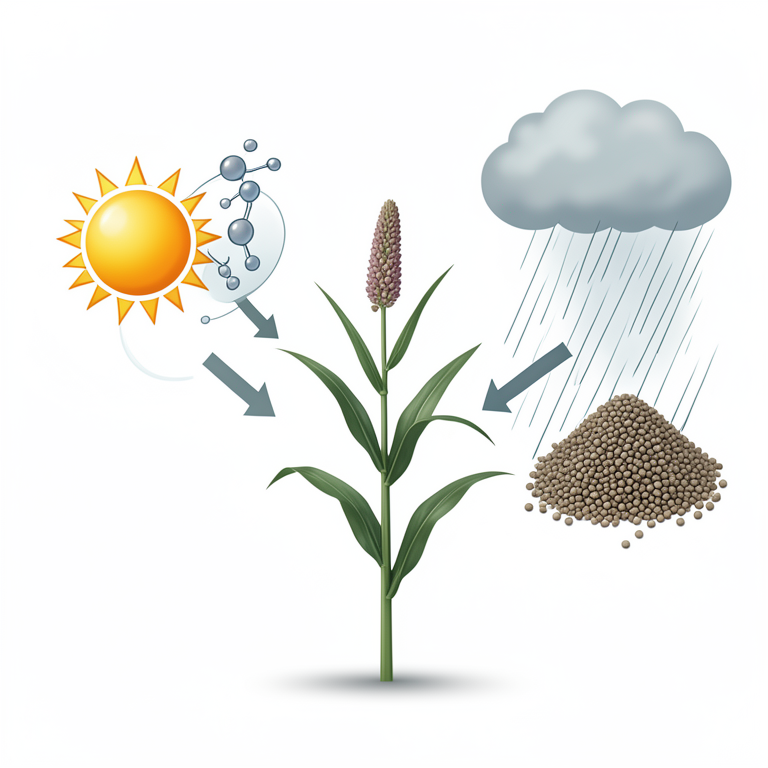
Factors Influencing Teff Yield
AI-generated conceptual illustration (Teff plants (Eragrostis tef) in an Ethiopian highland field). It explains the idea and does not show study data.
View source evidence ↗Figures & tables
From the original paper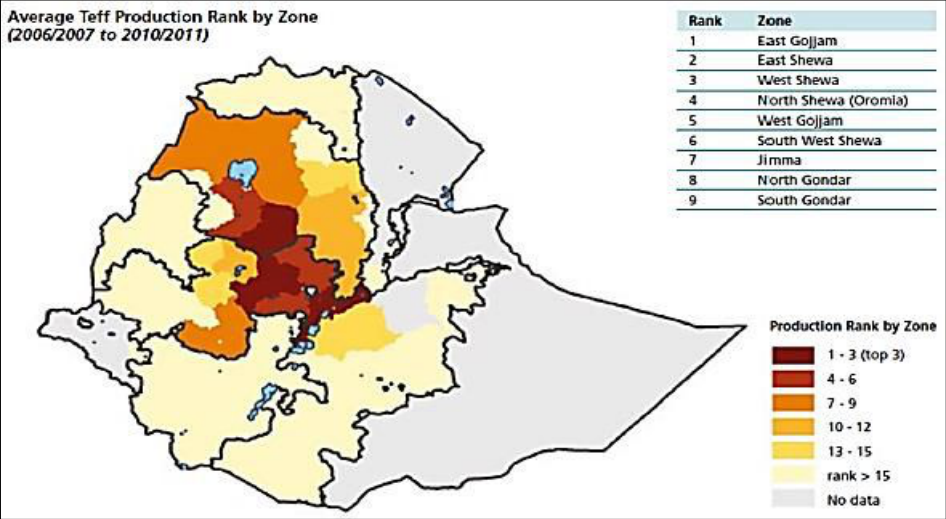 Figure 1
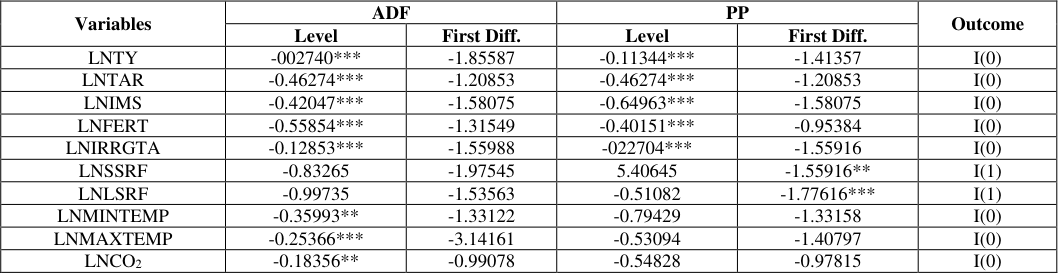 Table 1
 Table 2
 Table 3
 Table 4
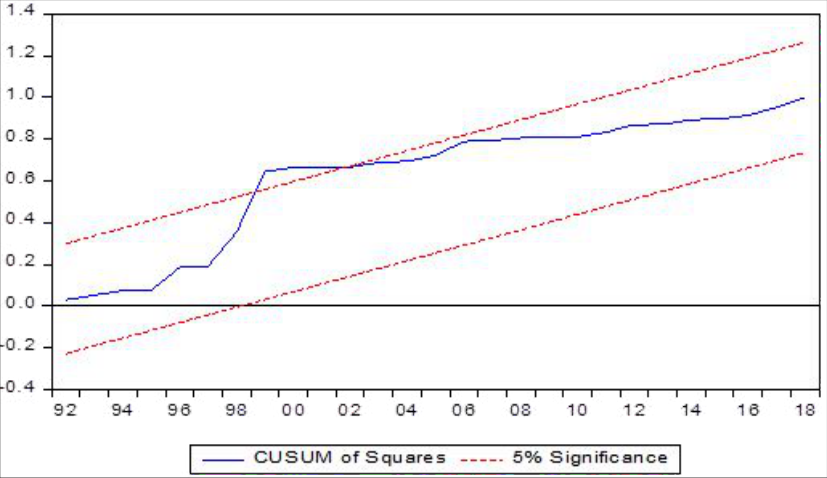 Figure 1
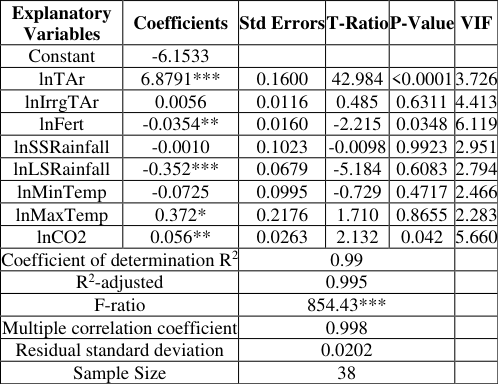 Table 5
Introduction
The production and consumption of teff ranks the highest among all the cereal crops in Ethiopia; it is also cultivated as food grain in Eritrea (FAO, 2015). Teff (Eragrostis Teff) is a nutritious small grained cereal, which can be likened to millet. It is believed that teff came into existence in Ethiopia and was subsequently adapted as a domestic staple food crop by Ethiopian farmers between 3 and 6 millennia ago (Samuel and Sharp, 2008) [21] . Virtually, it is estimated that half of farming households in Ethiopia grow teff, and even more in the highlands. Teff accounts for 23 percent of all cultivated land during 2017 and 2018. Though teff is primarily grown in mid-highlands (Weyna Dega Zone) and upperlowlands of the country, it can also be cultivated under a wide-range of agro-climatic environments of the country. In terms of altitude, teff can be grown up to elevations ranging from 0 -2,800 meters above sea level (masl), but under an equally extensive diversity of humidity, temperature, and soil situations. Besides, there exists a concurrence between its optimum growing conditions and its conventional production vicinities or belts: 1,800-2,100 masl, with mean annual precipitation of 750-1,000mm, and mean annual temperature of 10-27 0 C. The two major regions of the country where teff is primarily grown are Amhara and Oromia regions, both places contributed to the total cultivated area and production of an aggregate of 85.4 and 87.5 percents between 2017 and 2018, respectively. In Ethiopia, East and West Gojam zones of Amhara and East and West Shoa zones of Oromia are specifically recognized as the highest teff growing production belts. However, climate change induced challenges coupled with other factors such as drought, extreme events like floods have adversely reduced the production and yield of teff (Tembo, 2018) [24] . It is shown by periodical extreme events in form of frequent droughts of previous years (1974, 1983/1984, 1987, 1990, 1991, 1999, 2000, 2002 and 2011). Therefore, annual climatic factors have had critical influence on teff (Eragrostis teff) yields, one of the major food crops for Ethiopia. According to FAO (2010), the rising temperature and variability in rainfall pattern have direct impact on crop production and food security. Despite increased frequency and intensity of climate risks in the country empirical studies on climate change impacts on teff yield are lacking. Therefore, an in-depth investigation of the impacts of climate change becomes essential to provide information that may give directions for future coping and adaptation strategies for the country (Deressa et al. 2014) [4] .
The main objective of the study was to analyze the impacts of climate change and related factors on teff production and yield. The information generated will be used to inform policy makers, scientists, development workers and rural communities on the likely effects of climate change using teff as a case study.
Materials and Methods
Materials and Methods
Description of the study area
According to Library of Congress (2005), Ethiopia is located in Eastern Africa. It borders Sudan on the west, Eritrea on the north, Djibouti and Somalia on the east, Kenya on the south, and South Sudan on the south west.
Geographically, Ethiopia lies between the Equator and Tropic of Cancer, between the 3 0 N and 15 0 N Latitude or 33 0 E and 48 0 E Longitude. The country has a total area of about 1.127 million square kilometers. Based on United Nations (2020) [25] population projection, the current population of Ethiopia is about 114.44 million with an annual growth rate of 2.7 percent.
The major cereal crops including teff are mainly grown in the traditional climatic zones of Ethiopia (Dessie, 2018) [5] . Teff primarily grows in elevations ranging from 0 -2,800 meters above sea level (masl). Besides, there exists a concurrence between its optimum growing conditions and its conventional production vicinities or belts: 1,800-2,100 masl, with mean annual precipitation of 750-1,000mm, and mean annual temperature of 10-27 0 C. Geographically, East and West Gojam zones of Amhara and East and West Shoa zones of Oromia are specifically recognized as the highest teff growing production belts of the country (see Figure 1 for the Map). The two major teff growing regions (Amhara and Oromia) of the country contribute to the total cultivated area and production of an aggregate of 85.4 and 87.5 percents between the years 2017 and 2018, respectively. Teff is primarily cultivated and grown by smallholder farmers in the central, eastern and northern highlands of the country on fragmented lands under rain-fed conditions in both, Long-rainfall and Short-rainfall, seasons (Engdawork, 2009) [8] . According to FAO (2015), teff is considered as a crop relatively resistant to many biotic and abiotic stresses.
It can be grown under different agro-ecological conditions of the country, ranging from lowland to highland areas. Although teff crop is primarily grown during the long-rainy season, it also grows during short-rainy season, particularly in North, SouthWest and EastShew Zones of Oromia Region as well as North and South Wollo Zones of Amhara regions where short-rany season (Belg) normally prevails. These zones usually receive bimodal type of rainfall during short-and long-rainy seasons. According CSA and MoA (2005) [19] , short-rain season contributes about 10 percent of the total grain production while long-rain season contributes about 90 pecent of the total grain production in the country.
Data type and method of collection
In this study, the researcher used time series secondary data of all the variables. The type of data considered in this study included: climate variables, aggregate yield and cropped area under teff, fertilizer and improved seed used in teff crop production. Data on weather conditions (temperature and precipitation) for the period from1981 to 2018 were mainly taken from the National Meteorological Agency (NMA) of Ethiopia. Data for 12 representative weather stations based in major teff growing belts were selected from Oromia and Amhara Regional States, as these two regions accounted for 85.8% of the total cultivated area and 87.9% of production of wheat during 2017/18 production year (CSA, 2019). For precipitation, average monthly data for Short-Season (F-M) and Long-season/ Kiremt/ main crop season, (J-S) were taken as recorded in NMA database. For temperature, crop growing season (February -September) mean minimum and maximum temperatures were taken as recorded in NMA database.
For teff crop data, nationally aggregated data on area cultivated, yield per hectare, fertilizer and improved seed applied, and area irrigated under teff crop were compiled from CSA subsequent publications or website covering the period from 1981 to 2018. Any gap in these variables was complemented from Food and Agriculture Organization (FAOSTAT) database.
Empirical Model Specification
In order to address the objective of this study, augmented Cobb-Douglas Production Functional model has been employed to estimate the regression coefficient for the mean yield function, f(x).
In line with the production theory, it is more likely that the relationship between climate and non-climate variables and crop yield takes non-linear form (Mahmood, et al., 2012; Chen, et al., 2004 [16,3] and Just and Pope, 1978) [15] . According to Chen, et al. (2004) [3] and Just and Pope (1979) [15] , the model provides more significant results compared to linear functional form. The model assumes that crop productivity (yield) is a function of endogenous variables like irrigated area under crops, application of fertilizers, utilization of labours and use of tractors; and exogenous factors like literacy rate, farm harvest price of specific crops. Furthermore, model assumes that agricultural production is a function of many endogenous and exogenous variables like cultivated area, irrigated area, fertilizers, improved seed, etc. The Cobb-Douglas production function, in its stochastic form (Gujarati, 2004), can be expressed as:
Where, Y t is a dependent variable (yield of teff), X s' are vectors of independent variables included in the regression analysis and β s' are parameters to be estimated. A is constant term, e is base of natural logarithm and ɛ is the error term with zero mean and constant variance. This non-linear form of Cobb Douglas production function can be estimated through ordinary least squares by taking natural log on both sides of equation ( 1), which becomes log-linear form.
Estimates of this form of production function give direct elasticities of variables. The log-linear form of Cobb Douglas production function in this regard is expressed as:
Where lnY t shows wheat yield (kilogram per hectare) at time t, X i is vector of farm inputs including cropped land area, fertilizer, improved seed, irrigated area, etc. However, time series data were unavailable for some of the farm inputs like farm machinery, oxen power, and laborers. In its functional form, the Cobb-Douglas production function under equation ( 2) is specified as:
Methods of Estimation and Test for Time Series Properties
Teff crop yield model selected for this study has been estimated by ordinary least squares method. The models have been estimated consistently by Ordinary Least Squares (OLS) if the error term (ε j ) is a white noise process or more generally, if the error term has a zero mean, constant variance and uncorrelated with the explanatory variables and its previous realizations. The models have been estimated using annual time series data for the period between 1981 and 2018. Prior to model estimation, the data series have been subjected to various tests to confirm various properties required for OLS to give results that are efficient and consistent. Since this study uses time series data, it was necessary that, before estimation of the equations, the series be tested for satationarity/ unit root and existence of co-integration using appropriate methods and tools. In this study, two widely used methods were chosen: Augmented Dickey-Fuller (ADF) test (Dickey and Fuller, 1979) [6] and Phillips-Perron (PP) test (Phillips and Perron, 1988) [20] to check the presence of unit roots in the data series. The ADF test for stationarity in a series y involved estimating the equation:
Where μ is the drift (intercept), t is the trend, i is equal the number of lags in Δy t-i , p is the maximum number of lags determined using Akaike Information Criterion (AIC) and Schwartz Criterion (SC) and ε t is the random error term. The null hypothesis 𝐻𝑂: γ = 0 (unit root) was tested against the alternative hypothesis 𝐻𝐴: γ < 0 (no unit root). If the computed test statistic was found greater than the critical value then the null hypothesis was not rejected. If 𝐻𝑂 could not be rejected, then the time series variable contained a unit root and hence non stationary, otherwise it was stationary. If its first difference is then tested and found stationary, the series was concluded to be an I(1) (Green, 2008; Gujarati, 2004; Dickey and Fuller, 1979) [6] . Time series were also subjected to a Phillips -Perron (PP) test which has a higher power.
The PP test took the form:
Where ∆Y t was the first difference of the dependent variable; i is the number of truncation lags, where i=1, 2,…, m; 𝜃 and 𝛿 are coefficients and ɛ t is the error term. The null hypothesis of, 𝐻 0 : 𝛿𝑖 = 0 (unit root) was tested against the alternative, 𝐻𝐴: 𝛿𝑖< 0 (no unit root). If the computed test statistic was found greater than the critical value at 5% level of significance then the null hypothesis could not be rejected. If 𝐻𝑂 could not be rejected, then the time series variable contained a unit root and hence non stationary, otherwise it was stationary. [22] and Dushko, et al. 2011) [7] . In order to employ ARDL approach, bounds test of integration, model stability test and variance error correction model (VECM) should be conducted to test presence of long-term cointegration (Sharma and Singh, 2019) [22] . In case of Cobb-Douglas production model similar tests are conducted as ARDL model (Dushko, et al. 2011) [7] . Cobb-Douglas model further needs VAR stability, serial correlation (LM), multicolinearity, Heteroscedasticity, Wald F-statistic, stability and RESET Tests. [17] variables with I(1) must be differenced first before estimation. Since most of the variables are not integrated at the same order under the models, a multiple regression analysis using OLS method with the differenced variables was performed (Gujrati, 2004) [12] . The test for cointegration involved running a regression of log wheat yield. Residual series were obtained from the estimated equations and tested for the presence of unit root. The null hypothesis of existence of a unit root, which implies there is no cointegration, was rejected at 5% level of significance for the estimated residuals. The cointegration test results are shown in Table 2. The results show that linear combination of the variables in the regression was stationary. The results indicate existence of a long-run relationship among variables in the models. 1. It can be seen that the plots do not diverge significantly from the zero line and the residuals lie within the standard error band suggesting stability in the parameters of the equation. As can be observed from Table 5, the elasticity estimates of climatic variables showed mixed impacts on yield of teff crop. The elasticity estimates of rainfall (crop growing season and long-rainfall season) and minimum temperature showed negative impact on yield of teff. However, only long-season rainfall was found statistically significant at 1% level. This suggests that a 1% increase in the amount of precipitation (mm) reduces yield of teff by 0.35%. This result implies that increases in rainfall during the long-rain season will highly affect production and yield of teff crop if it exceeds the optimum level. In practice and theory, as rainfall increases beyond the optimum level, extreme events like flooding, landslide, crop lodging, and erosion of top soil would be contributing to reduction of yield and production of teff crop. In reality and normal cases, teff crop needs high and optimum amount of rainfall during the long-rainy season, the period when seedbed preparation, seed sowing, weeding, as well as crop vegetative growth takes place. It is the long-season rainfall that is important for growing of teff crop as all the agronomic practices take place during this season. For teff, land preparations take place in the month of June, seed sowing and first fertilization from July to mid-August, second fertilization and weeding from mid-August to September, and harvesting and threshing operations from October to December. The negative and significant impact on yield of teff crop was assumed to be induced by extreme rainfall events, particularly an excessive rainfall during long-season rainfall. In agronomic terms, such events would damage crop, in addition to leading to crop failure posed by over flooding of teff fields, lodging of crops, and favored weeding and pests, which leads to decline in teff yields.
| Explanatory Variables | Coefficients | Std Errors | T-Ratio | P-Value | VIF |
|---|---|---|---|---|---|
| Constant | -6.1533 | ||||
| lnTAr | 6.8791*** | 0.1600 | 42.984 | <0.0001 | 3.726 |
| lnIrrgTAr | 0.0056 | 0.0116 | 0.485 | 0.6311 | 4.413 |
| lnFert | -0.0354** | 0.0160 | -2.215 | 0.0348 | 6.119 |
| lnSSRainfall | -0.0010 | 0.1023 | -0.0098 | 0.9923 | 2.951 |
| lnLSRainfall | -0.352*** | 0.0679 | -5.184 | 0.6083 | 2.794 |
| lnMinTemp | -0.0725 | 0.0995 | -0.729 | 0.4717 | 2.466 |
| lnMaxTemp | 0.372* | 0.2176 | 1.710 | 0.8655 | 2.283 |
| lnCO2 | 0.056** | 0.0263 | 2.132 | 0.042 | 5.660 |
| Coefficient of determination R2 | 0.99 | ||||
| R2-adjusted | 0.995 | ||||
| F-ratio | 854.43*** | ||||
| Multiple correlation coefficient | 0.998 | ||||
| Residual standard deviation | 0.0202 | ||||
| Sample Size | 38 |
Table text extracted from the original PDF; superscript letters are shown inline. The original table image is below.
View original table image
Results and Discussion
Results and Discussion
Results of the
This finding corroborates with theory that suggests an increase in rainfall during crop development phase will reduce the yield and production of crop under consideration.
The results of this study correspond with the study results of Ademe (2017) [1] , Menya (2011) [18] , Mahmood et al. (2012) [16] and Singh (2017) [23] . Ademe (2017) [1] assessed the impact of variability in climate variables on yield of cereal crops in Ethiopia and found that crop growing season precipitation has negative and considerable effect on yield of wheat. The result revealed that a 1% increase in the crop growing season rainfall reduces wheat yield by 0.124% . Similarly, Menya (2011) [18] studied rainfall variation due to climate change in Ethiopia. The investigation reported negative and significant effect of the long-season rainfall on crop yield. Essentially, the result of the study portrayed that a 10% increase in long-season rainfall also reduces crop yield by 0.01%. Equally, Mahmood et al. (2012) [16] recorded negative and significant coefficient of rainfall variable and further observed that a rise in rainfall during months of crop reproductive and harvesting period decreases crop yield. Correspondingly, Singh (2017) [23] found that the regression coefficient estimate for crop growing season rainfall has negative, but insignificant impact on yield of wheat during Rabi season in Gujarat, India.
In contrast, the elasticity estimates for maximum temperature and CO 2 emission exhibited positive and significant (10 percent and 5 percent level re respectively) impact on yield of teff. The result signifies that a 10% raise in the maximum temperature and CO 2 concentration would increase teff yield by 3.72% and 0.56%, respectively. However, this finding is in contrast with the theory proposition which state an increase in temperature will reduce the yield and production of crops under consideration. The result implies that an increase in maximum temperature during crop growing season would lead to increase in yield of teff crop, which is of benefit to the crops. It cannot be gainsaid that temperature is a determinant factor in the speed of crop development and consequently, it can affect the length of crop growing period including teff. Accordingly, crop vegetative growth would increase as temperatures rises to optimum level. For most crop species, vegetative growth usually has a higher optimum temperature than for the reproductive development process. In the same vein, teff crop needs relatively warmer temperature during grain ripening cycle. In general, as temperature increases, the rate of teff plant growth likewise increases until an optimum temperature is reached. Nonetheless, an extreme temperature such as higher temperature during crop sowing period will necessarily affect seed germination and development of vigor seedling. Besides, it can even bring about failure or drying of seedling. Equally, very cool temperature particularly during nighttime will result in frost which severely shrinks grains of the crop (Hatfield and Prueger, 2015) [13] . The findings of this study is found similar to the submission of Ademe (2017) [1] , who in their study on impacts of variability in climate on the cereal crops in Ethiopia reported that crop growing period temperature revealed positive and significant (at 1% level) impact on yields of wheat and barley. The result actually indicated that a 1% increase in crop growing season temperature increases wheat and barley yield by 0.984% and 0.564%, respectively. Mahmood et al.'s (2012) [16] carried out a study in Pakistan and discovered that average minimum temperature during crop growing period was positively associated with the yield of rice crop. Regarding socio-economic variables, the elasticity estimates of area cultivated under teff crop and irrigated area under teff crop showed positive impact on yield of teff, although only area harvested under teff crop was found significant at 1% level. The result evinces that a 1% increase in area allocated for teff crop increases teff yield by 6.88%. The result implies that any area expansion and allocation under teff production would contribute to the growth of teff production, particularly in terms of volume. This finding is in consonance with the results of Byishimo (2017) [2] on the impacts of climate change on crop yields in Rwanda. Byishimo (2017) [2] asserted that area harvested under teff crop has positive and significant impact on teff yield, denoting that a 10% increase in area harvested under teff crop increases yield of teff by 3.31%. On the contrary, the study results showed that the quantity of fertilizer applied on teff farms has negative and significant (at 5% level) impact on yield of teff. It follows that a 10% increase in quantity of fertilizer used reduces teff yield by 0.354%. Therefore, it means that any increase in quantity of fertilizer used under teff cultivated area will lead to a reduction in the yield of teff, which consequently necessitates the use of fertilizer only up to optimum level. This result is similar to the results submitted by Issahaku (2014) [14] , who studied the impact of climate change on productivity of agriculture and poverty in Ghana. The results showed a negative effect of fertilizer on productivity of Cassava, but statistically insignificant. The elasticities estimated for the explanatory variables included in the Cobb-Douglas production model for teff yield totaled to 6.798, and this affirms an increasing return to scale. This implies that there is an increasing return to scale in teff production business.
Conclusion
The main objective of this study was to analyze the impacts of climate change and related factors on yields of teff crop in Ethiopia using quantitative time series data for the period 1981 -2018. The study adopted Augmented Cobb-Douglas Production Functional model to examine the impact of climate and non-climatic factors on yield of teff in the country. The findings of the study from teff yield regression model revealed that the coefficients of rainfall variables during crop growing (F-S) and long-rainfall (J-S) seasons were both negative; but only long-rainfall season was significant at 1 percent significance level. The results indicate that an increase in rainfall during long-rainfall season, the period when crop vegetative and reproductive growth is high (J-S), revealed harmful impact on the yield of teff. This witnesses that excessive rainfall affects the yield of teff crop negatively. The coefficient of minimum temperature during crop growing period in teff growing areas also revealed negative impact, but statistically insignificant. Conversely, the estimated regression coefficient for maximum temperature during crop growing season (F-S) in teff growing areas is positive and significant at 5 percent significance level, implying that a rise in maximum temperature in teff growing areas would increase the yield of teff per unit area, i.e., would affect teff yield positively. Further, CO 2 showed positive and significant (5 percent level) impact on teff yield per unit area. Furthermore, the estimated coefficients for land area under and irrigated area under teff crop production are positive, but only land area under teff cropping system is found significant at 1 percent level, implying that use of land for teff production has vital role in increasing yield of teff crop. However, use of fertilizer has resulted in negative impact, although non-significant. The current study revealed that teff yield has a log-linear relationship with short-and long-season rainfall as well as mean temperature during crop growing period. The result revealed that higher temperatures may be helpful to teff crop up to the level favorable for the growth and development of the crop. The combined impact of higher temperatures and erratic rains affects teff crop during crop vegetative growth and flowering period as well. Furthermore, these noted variations as a matter of course associated with temperature and rainfall could make land presently assigned for teff crops unsuitable for growing (Yumbya, et al., 2014) [26] . These conditions invariably would lead producer farmers to extreme climate risks as it activates a shift in crop production that eventually reduce the quantity and quality of teff output. Thus, this study revealed that long-seasons rainfall (J-S) have negative impact on teff yield, which is significant (at 1% level). In general, based on the validating proofs of the current study, the hypothesis stating there is ''no impact of rainfall and temperature variables'' on yield of cereal crop is rejected, signifying that changes in climate adversely affects yields of teff, wheat and maize crops.
Acknowledgement
AcknowledgementThe authors are grateful to the different Institutions that made available the dataset used in this study.
Figures and tables from the paper
| Variables | ADF | — | PP | — | Outcome |
|---|---|---|---|---|---|
| Level | First Diff. | Level | First Diff. | ||
| LNTY | -002740*** | -1.85587 | -0.11344*** | -1.41357 | I(0) |
| LNTAR | -0.46274*** | -1.20853 | -0.46274*** | -1.20853 | I(0) |
| LNIMS | -0.42047*** | -1.58075 | -0.64963*** | -1.58075 | I(0) |
| LNFERT | -0.55854*** | -1.31549 | -0.40151*** | -0.95384 | I(0) |
| LNIRRGTA | -0.12853*** | -1.55988 | -022704*** | -1.55916 | I(0) |
| LNSSRF | -0.83265 | -1.97545 | 5.40645 | -1.55916** | I(1) |
| LNLSRF | -0.99735 | -1.53563 | -0.51082 | -1.77616*** | I(1) |
| LNMINTEMP | -0.35993** | -1.33122 | -0.79429 | -1.33158 | I(0) |
| LNMAXTEMP | -0.25366*** | -3.14161 | -0.53094 | -1.40797 | I(0) |
| LNCO2 | -0.18356** | -0.99078 | -0.54828 | -0.97815 | I(0) |
Table text extracted from the original PDF; superscript letters are shown inline. The original table image is below.
View original table image
| Type of test | Test statistic | Test statistic value | Probability |
|---|---|---|---|
| Normality test-histogram | Jarque Berra | 46.59 | 0.000 |
| Breusch-Godfrey Serial Correlation LM Test | Obs*R-squared | 4.4867 | 0.106 |
| Heteroskedasticity Test: ARCH | Obs*R-squared | 0.01746 | 0.895 |
Table text extracted from the original PDF; superscript letters are shown inline. The original table image is below.
View original table image
References
16 in the original paper- Chen CC, et al. Yield variability as influenced by climate: A statistical investigation, Climatic Change. 2004;66:239-261.
- Deressa T, Yehualashet H, Rajan D. Climate change adaptations of smallholder farmers in South Eastern Ethiopia. Journal of Agricultural Extension and Rural Development. 2014;6(11):354-366.
- Dessie A. Cereal Crops Research Achievements and Challenges in Ethiopia, International Journal of Research Studies in Agricultural Sciences. 2018;4(6):23-29.
- Dickey DA, Fuller WA. Distribution of the Estimators for Autoregressive Time Series With a Unit Root. Journal of the American Statistical Association. 1979;74(366):427-431.
- Dushko J, Darko L, Cane K. Cobb-Douglas production function revisited, VAR and VECM analysis and a note on Fischer/Cobb-Douglass paradox, Munich Personal RePEc Archive, 2011. available at: https://mpra.ub.unimuenchen.de/33576/.
- FAO (Food and Agriculture Organization), 2010; Food Security Policy Brief; http://www.fao.org/es/esa//.
- Accessed November 09, 2015.
- Hatfield JL, Prueger JH. Temperature extremes: Effect on plant growth and development, Weather and Climate Extremes. 2015;10:4-10.
- Just RE, Pope RD. Stochastic specification of production functions and economic implications, Journal of Econometrics. 1978;7(1):67-86.
- Mahmood N, Ahmad B, Hassan S, Bakhsh K. Impact of temperature and precipitation on rice productivity in rice-wheat cropping system of Punjab province, The Journal of Animal & Plant Sciences. 2012;22(4):993997.
- McCarl BA, et al. Climate Change and future analysis: is stationarity dying? Am. J. Agric. Econ. 2008;90:1241-1247.
- Phillips PCB, Perron P. Testing for Unit Roots in Time Series Regression, Biometrika. 1988;75:335-346.
- Samuel G, Sharp K. Commercialisation Of Smallholder Agriculture in Selected Teff-Growing Areas Of Ethiopia, Journal of Economics. 2008;16(1):1-28.
- Singh R, et al. Impact of Rainfall and Temperature on the Yield of Major Crops in Gujarat State of India: A Panel Data Analysis (1980-2011), Journal of Applied Science and Technology. 2017; 24(5):1-9.
- Tembo FM. The Impact of Climate Change on Teff Production in Southeast Tigray, Ethiopia, Journal of Agricultural Economics and Rural Development. 2018;4(1):389-396.
- Yumbya J, et al. Assessing the effects of climate change on teff in Ethiopia: Implications for food security, Technical Report, African Biodiversity Conservation and Innovations Centre (ABCIC), 2014, 1-39.