
Research article · 2022 · Full text
International Journal of Agriculture and Food ScienceAnalytical study on phytochemical screening and antifungal activity of certain species of Hydrogonium (C. Muell.) Jaeg. A Moss
Volume 4(2) · Pages 23–25 · DOI: 10.33545/2664844x.2022.v4.i2a.94 ↗
Research areasBryophyte Studies and RecordsMoringa oleifera research and applicationsPhytochemistry and Biological Activities
Abstract
Author-writtenThe purpose of the present research paper was to determine the presence of bioactive phytochemicals and its antifungal activity of aqueous crude extracts of Hydrogonium arcuatum (Griff.) Wijk. Marg. and Hydrogonium consanguineum (Thwait. & Mitt.) Hilp. against fungus Alternaria solani. Phytochemical screening of crude extracts of both the plants revealed the presence of Flavonoids, terpenoids, cardiac glycosides and sterols. Antifungal study showed to reduce colony diameter with increasing concentration of aqueous crude extracts from 10 to 100 per cent. H. consanguineum extract was more potent than H. arcuatum to inhibit the fungal growth. Further this study also suggested that the presence of naturally occurring compounds in both the plants can be used treat various phytopathogenic fungal diseases.
Summary
Source-checkedPlain-language reading of the full paper, prepared with AI and checked against the text. Each point links to the authors' own words.
Why it matters
- Lower plants are known to possess antimicrobial properties, which are attributed to their phytochemical components such as lunularin, norpiquisone, and polygonal. View evidence ↗
- Previous research has demonstrated that certain mosses, like Bryum argenteum, have antifungal activity against phytopathogenic fungi that cause leaf spot disease in maize. View evidence ↗
The question
- The study aimed to identify bioactive phytochemicals in aqueous crude extracts of Hydrogonium arcuatum and Hydrogonium consanguineum and evaluate their antifungal activity against Alternaria solani. View evidence ↗
What they did
- The plant materials used in the study were collected from Mt. Abu, Rajasthan, during the rainy season. View evidence ↗
- Aqueous extracts were prepared by grinding 10 g of dried plant powder with 100 ml of double distilled water, followed by centrifugation at 2500 rpm for 20 minutes and filtration. View evidence ↗
- Antifungal activity was tested using the agar pour plate method, where 10 ml of plant extract was mixed with 10 ml of molten Potato Dextrose Agar (PDA) in Petri plates. View evidence ↗
- The fungus Alternaria solani was introduced via a 5 mm mycelial disc into agar containing extract concentrations ranging from 10% to 100%, and incubated for 72 hours. View evidence ↗
What they found
- Phytochemical screening confirmed that both H. arcuatum and H. consanguineum contain sterols, cardiac glycosides, terpenoids, and flavonoids. View evidence ↗
- The presence of secondary metabolites appeared to be more pronounced in H. consanguineum than in H. arcuatum, based on more intense colors and precipitation during screening. View evidence ↗
- H. consanguineum at 100% concentration significantly reduced the colony diameter of A. solani to 3.612 mm compared to 51.467 mm in the control group. View evidence ↗
- H. arcuatum at 100% concentration reduced the colony diameter of A. solani to 4.210 mm, compared to 49.150 mm in the control. View evidence ↗
- H. consanguineum was found to be more potent than H. arcuatum in inhibiting the mycelial growth of A. solani. View evidence ↗
- The antifungal effect was dose-dependent, with colony diameters decreasing as the concentration of the aqueous crude extracts increased from 10% to 100%. View evidence ↗
What it means
- The authors conclude that bryophytes are rich sources of bioactive compounds and can be utilized as biocontrol agents against phytopathogenic fungal diseases. View evidence ↗
Visual summary
2 visualsIllustrations explain the paper; charts are replotted from the paper's own table values.
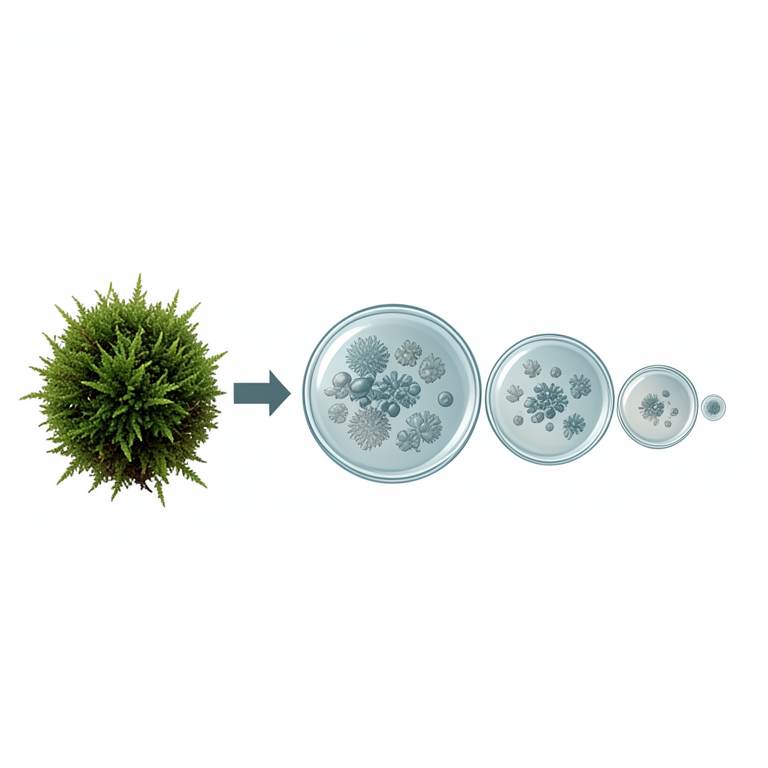
Dose-Response Relationship
AI-generated conceptual illustration (Hydrogonium moss and fungal colonies in petri dishes). It explains the idea and does not show study data.
View source evidence ↗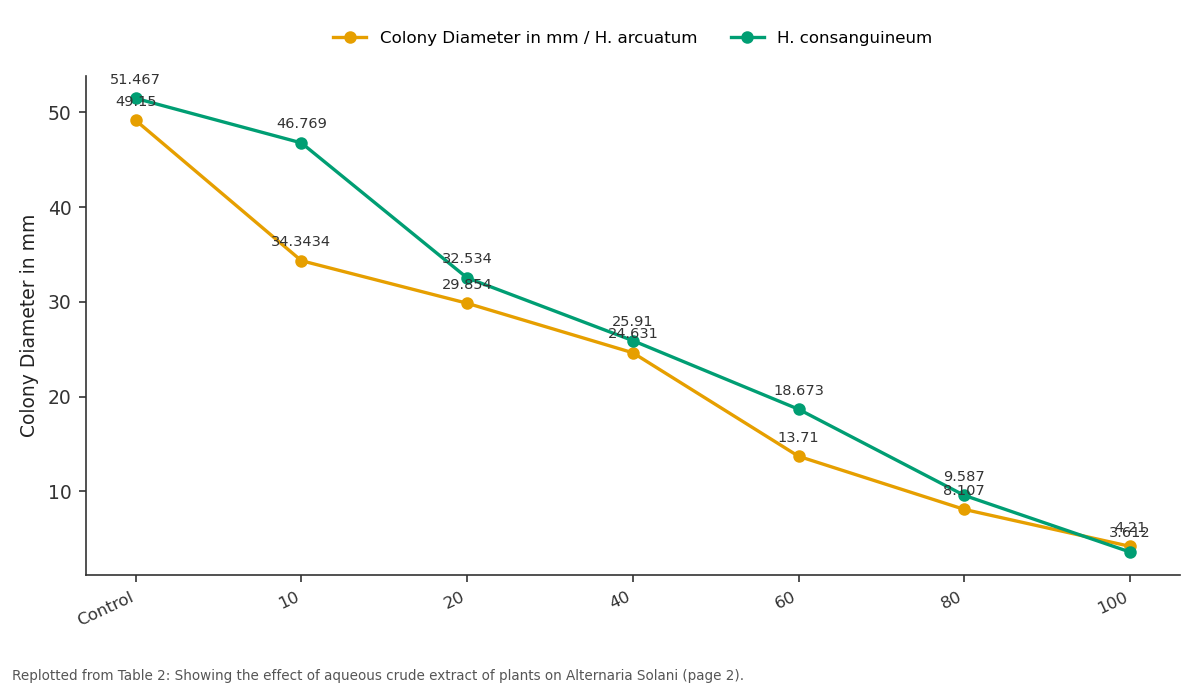
Colony Diameter in mm / H. arcuatum and H. consanguineum: Control vs 10 vs 20 vs 40 vs 60
Replotted from Table 2 (page 2) of the original paper. Every bar is the paper's own table value.
View source evidence ↗Figures & tables
From the original paper Table 1
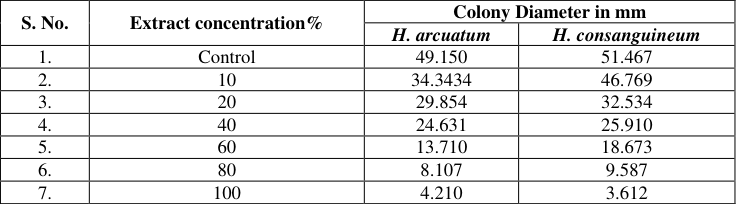 Table 2
Introduction
Lower plants possesses antimicrobial properties which could be attributed to chemicals including polygonal, norpiquisone and lunularin which constitute to phytochemical component of the lower plant (Smith and Reyanard, 1992) [5] . Toyota and Asakawa (1999) [6] screened the extract of Plagiochasma appendiculata and evaluated that it possesses antimicrobial activity which was due to the presence of terpenoids. Deora et al. (2007) [1] carried out studies on antibacterial effect of aqueous crude extracts of Plagiochasma articulatum, Anthoceros longi and Fissidens bryoides against test fungi Xanthomonas citri in vitro and suggested that P. articulatum extract was more active than A. longi and F. bryoieds. Antifungal activity of Bryum argenteum was reported against phytopathogenic fungus Curvularia lunata, a causal organism of leaf spot disease of Zea mays (Deora and Guhil, 2014) [8] . Deora and Guhil (2015) [2] studied the antifungal potential of Bryum celluiare against mycelial growth of fungi Curvularia lunata and Drechslera maydis causal organisms of leaf spot of wheat and leaf spot of Zea mays respectively and suggested that higher concentrations (100%) completely inhibited mycelial growth of Curvularia lunata and partial in case of Drechslera maydis.
Materials and Methods Plant Material and Extract Preparation
Plant material was collected from Mt. Abu (Rajasthan) in rainy season. Collected material was thoroughly washed and kept in an oven at 50 ºC for 24 hrs. The dried material then blended into powder by pastel and mortar. 10 gm dried powder plant material was grinded in pastel and mortar with 100 ml double distilled water. Then centrifugation was done at 2500 rpm for 20 minutes and filtered with Whattman filter paper no. 1. This filtrate was used for phytochemical screening and antifungal activity.
Test Organism
The test fungi Alternaria solani was cultured and sub cultured in the laboratory to obtain its pure isolates at 30 ºC temperature.
Phytochemical Screening
Qualitative phytochemical screening was done by the standard method suggested by Trease and Evans (2002) [7] .
Screening of Antimicrobial Activity
Antifungal activity of both the plant material fractions was determined by using agar pour plate method. 10 ml plant extract was first poured into Petri plates. Then 10 ml molten PDA was poured aseptically on the plant extract in the Petri plates and swirled round for even dispersion of the extract into agar. The extract was incorporated with different concentrations of 10 to 100 and control. A 5 mm mycelial agar disc of Alternaria solani was released into the poisoned agar. Incubation period was 72 hrs. The average diameter of mycelial colony was measured after incubation. The growth of test fungus without extract was used as control. The per cent inhibition of mycelial growth was calculated by using the formula given by Vincent (1927) [9] .
Results and Discussion
Phytochemical screening of present study showed the presence of terpenoids, flavonoids, cardiac glycosides, saponins and sterols in the aqueous extracts of both H. arcuatum and H. consanguineum. Colors, precipitation formed and other parameters to determine the presence of secondary metabolites were comparatively more intense in H. consanguineum extract than H. arcuatum suggested that the possibility of presence of these secondary metabolites was more in H. consanguineum. (Table 1) Results of antifungal activity against test fungus Alternaria solani (Table 2) suggested that H. consanguineum extract was more potent than H. arcuatum against the mycelial growth of A. solani. Minimum colony diameter (3.612 mm) was reported in 100 per cent concentration of H. consanguineum in comparison to the control (51.467 mm). As concentration increased colony diameter decreased gradually. In case of H. arcuatum minimum colony diameter(4.210 mm) was reported in 100 per cent concentration of the extract where as it was maximum (49.150 mm) in the control. Maridas et al., (2008) [4] reported that plants and plant part have been provided a good source of valuable bioactive compounds of antioxidant, anti inflammatory, antimutagenic and antibacterial activity. Deora and Guhil (2016) [3] reported the presence of flavonoids, terpenoids, cardiac glycosides and saponins fromcrude methanolic extract of two liverworts and suggested that all these secondary metabolites showed antifungal activity against selected test fungi. The results of the present study and the comparison with the previous literature suggested that bryophytes are the rich store house of bioactive compounds and they have potent against phytopathogenic fungi therefore these plant can be used as biocontrol for phytopathogenic diseases.
| S. No. | Extract concentration% | Colony Diameter in mm | — |
|---|---|---|---|
| H. arcuatum | H. consanguineum | ||
| 1. | Control | 49.150 | 51.467 |
| 2. | 10 | 34.3434 | 46.769 |
| 3. | 20 | 29.854 | 32.534 |
| 4. | 40 | 24.631 | 25.910 |
| 5. | 60 | 13.710 | 18.673 |
| 6. | 80 | 8.107 | 9.587 |
| 7. | 100 | 4.210 | 3.612 |
Table text extracted from the original PDF; superscript letters are shown inline. The original table image is below.
View original table image
| Active Compounds | Phytochemical Tests | Observations | Results | — |
|---|---|---|---|---|
| Ha | Hc | |||
| Alkaloids | Mayers test | No precipitation | - | - |
| Hagers test | No precipitation | |||
| Anthroquinin | Borntragers test | No layer formation | - | - |
| Cardia glycocides | Keller Killeni test | Brown ring | ++ | + |
| Flavanoids | Ferric chloride test | Green colour | ++ | + |
| Lead acetate | Yellow precipitate | ++ | ++ |
Table text extracted from the original PDF; superscript letters are shown inline. The original table image is below.
View original table image
References
9 in the original paper- Deora GS, Bhati D, Jain N. In vitro studies on antibacterial activity of aqueous crude extract of bryophytes on Xanthomonas citri. Journal of Current Sciences. 2007;10(2):803-808.
- Deora GS, Guhil N. Phytochemical analysis and antifungal activity of moss Bryum cellulare against some phytopathogenic fungi. International Journal of Pharmaceutical Sciences and Research. 2015;6(2):688691.
- Deora GS, Guhil N. Studies on antifungal potential of Bryum cellulare against spore germination of fungus Curvularia lunata. International Journal of Pharmaceutical Sciences and Research. 2016;7(1):353357.
- Maridas M, Ghandhikumar S, Raju G. Preliminary phytochemical analysis of Diospyros species. Ethnobotanical leaflets. 2008;12:868-872.
- Smith CM, Reyanard AM. Text book of Pharmacology. Saunders, Philadelphia. 1992, 362-365.
- Toyota M, Asakawa Y. Sesquiterpenoids and cyclic bis (bibenzyls) from the Pakistani liverwort, Plagiochasma appendiculatum. Journal of Hattori Botanical Laboratory. 1999;86:161-167.
- Trease G, Evans SM. Pharmacognosy. Tindal, London. 2002;3:23-67.
- Deora GS, Guhil N. In vitro antifungal activity of Bryum capillare (a moss) extract against Drechslera maydis. International Journal of Pharmaceutical Research and Bio-Science. 2014;3(5):268-75.
- Vincent S, Curtis FR. Adrenin and the splanchnic nerve. The Journal of Physiology. 1927 Jul 7;63(2):151.