
Research article · 2023 · Full text
International Journal of Biology SciencesStudy on growth performance of freshwater prawn (Macrobrachium lamarrei) reared in two feed sources (Tilapia meat and CP 30%)
Volume 5(1) · Pages 152–155 · DOI: 10.33545/26649926.2023.v5.i1c.158 ↗
Research areasAquaculture Nutrition and Growth
Abstract
Author-writtenThe study was organized to investigate the impact of two diets to check out the effectiveness of feed on growth performance of freshwater prawn (Macrobrachium lamarrei) at the Saline Water Aquaculture Research Center (SWARC), Muzaffargarh. Two feeding treatments were designed: first treatment group, feed on tilapia meat, initial body weight was 3.73±0.06g and after 60 days final body weight was 5.48±0.14g while second treatment group was commercial diet CP 30% at Laboratory conditions. Initial body weight was 3.61±0.06g and after the end of experiment final body weight was 5.20±0.14g. The water quality parameters were maintained throughout the experiment: temperature 25.5°C, dissolved oxygen 5.93 mg/l, pH 7.4, TDS 3.4 g/l and EC 3.64 µs/cm. The growth performance was compared in both treatments, results of tilapia meat indicate high growth performance as compared to commercial diet CP 30%. In this study concluded that locally available freshwater prawn M. lamarrei is a small size species, gain low body weight and rearing in aquaculture is beneficial if used as live feeds.
Summary
Source-checkedPlain-language reading of the full paper, prepared with AI and checked against the text. Each point links to the authors' own words.
Why it matters
- Freshwater crustaceans, including prawns, are essential components of the universal ecosystem and play a key role in the food web. View evidence ↗
- Freshwater prawns are suitable for aquaculture because they provide a reliable source of proteins, amino acids, and vitamins A and D. View evidence ↗
- The freshwater prawn species M. lamarrei is omnivorous and tends to prefer cannibalism over prepared feeds. View evidence ↗
The question
- The study aimed to evaluate the efficacy of two different diets, tilapia meat and a 30% crude protein (CP) commercial diet, on the growth of M. lamarrei. View evidence ↗
What they did
- M. lamarrei prawns were collected from the Indus River at Taunsa Headworks and transported to the Saline Water Aquaculture Research Centre (SWARC). View evidence ↗
- The experiment used two feeding treatments (tilapia meat and CP 30% commercial diet) with a stocking density of 20 prawns per aquarium. View evidence ↗
- To reduce cannibalism, PVC tubes and calcium carbonate stones were provided as shelter, and the prawns were fed twice daily. View evidence ↗
- The researchers used Analysis of Variance (ANOVA) to determine if there were significant differences in growth performance between the two diets. View evidence ↗
What they found
- The percentage of weight gain was higher for the tilapia meat group (46%) compared to the commercial diet group (44%). View evidence ↗
- The tilapia meat diet resulted in a significantly higher percentage of length gain (56%) than the commercial diet (36.3%). View evidence ↗
- Water quality was maintained at a temperature of 25.5 °C, pH 7.4, dissolved oxygen 5.93 mg/l, TDS 3.4 g/l, and electrical conductivity 3.64 mS/cm. View evidence ↗
What it means
- The authors concluded that tilapia meat is a more effective diet for growth and can help mitigate the cannibalistic nature of M. lamarrei. View evidence ↗
- Because M. lamarrei is a small species, the authors suggest it is most commercially viable if produced on a large scale to be used as live feed. View evidence ↗
Visual summary
3 visualsIllustrations explain the paper; charts are replotted from the paper's own table values.
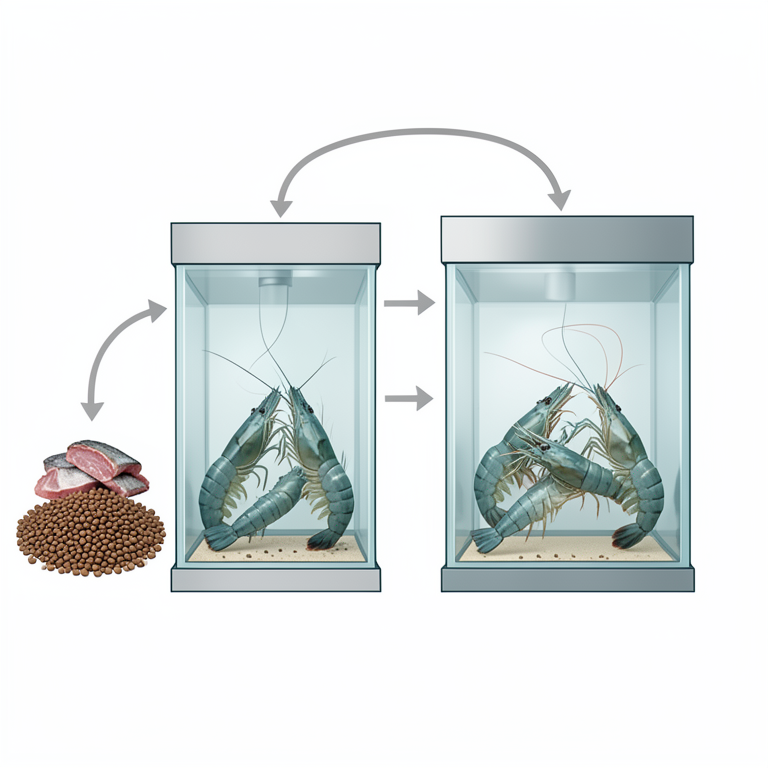
Experimental Setup
AI-generated conceptual illustration (freshwater prawn (Macrobrachium lamarrei)). It explains the idea and does not show study data.
View source evidence ↗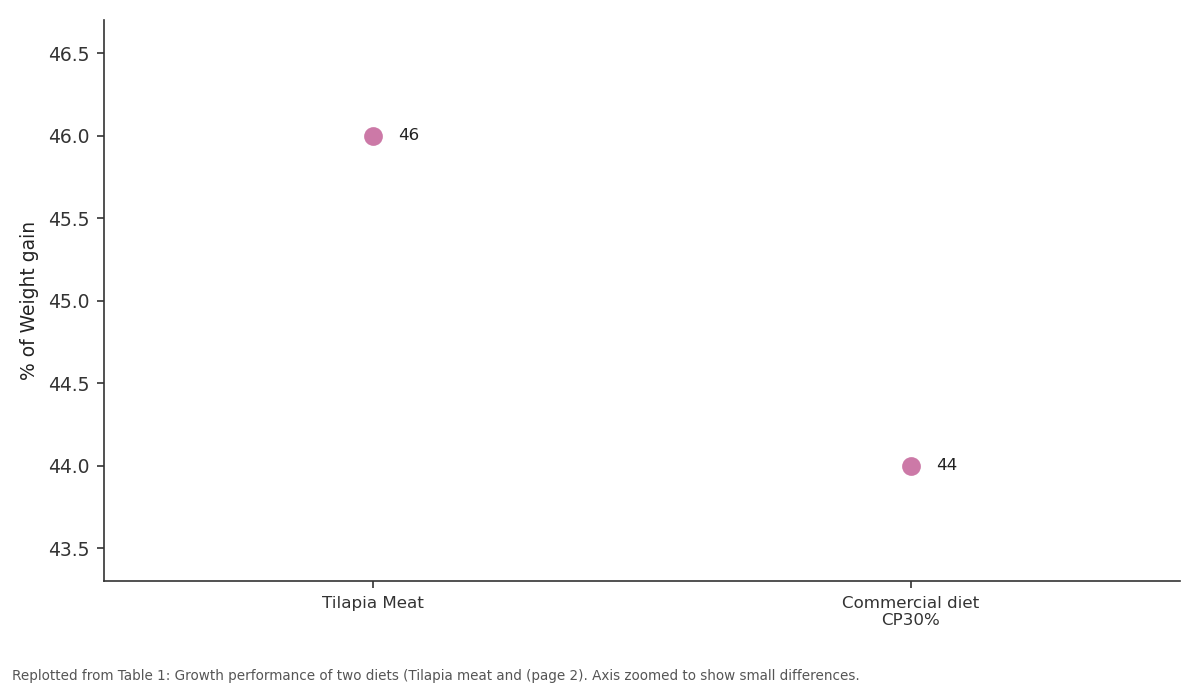
% of Weight gain: Tilapia Meat vs Commercial diet CP30%
Replotted from Table 1 (page 2) of the original paper. Every bar is the paper's own table value.
View source evidence ↗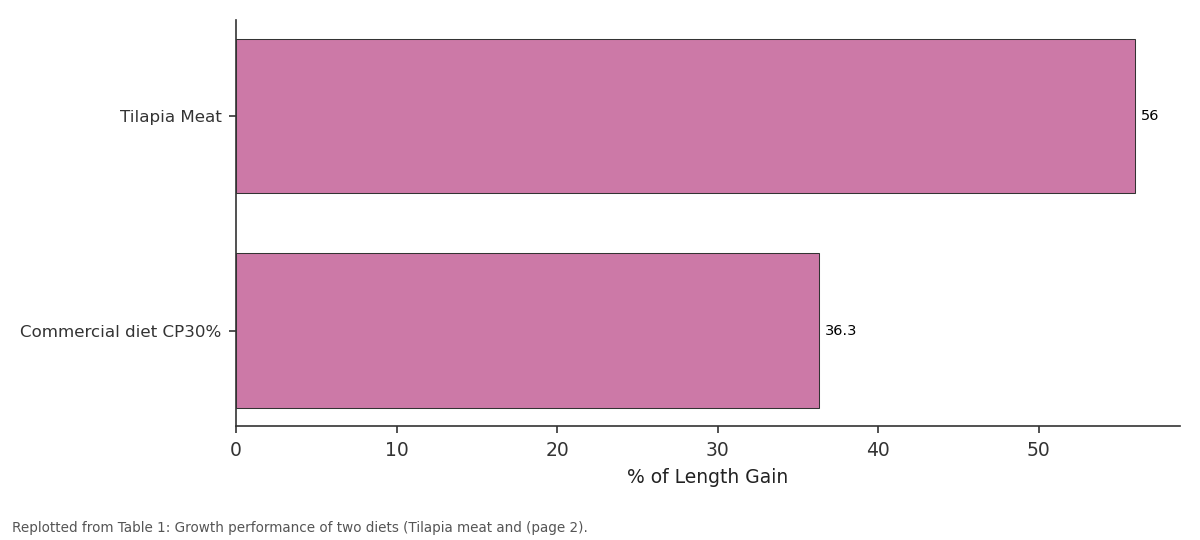
% of Length Gain: Tilapia Meat vs Commercial diet CP30%
Replotted from Table 1 (page 2) of the original paper. Every bar is the paper's own table value.
View source evidence ↗Figures & tables
From the original paper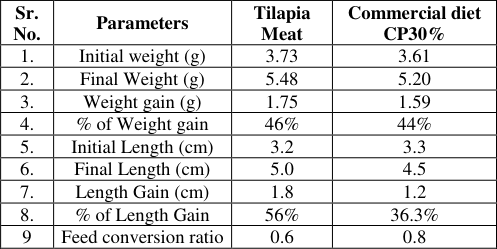 Table 1
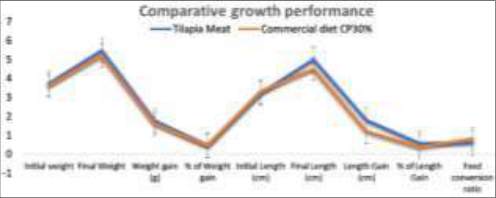 Figure 1
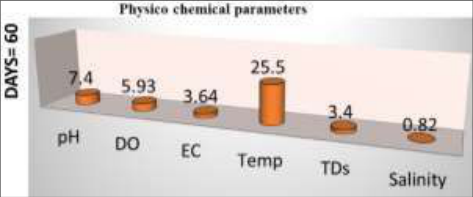 Figure 2
Introduction
Crustaceans includes numerous freshwater species of large arthropods including crayfish, lobster, shrimp and prawns which are essential for universal ecosystem provide a key role in food web. Prawns feed on flora and fauna, play a vital role in food chain and frequently used as a delicious feed for carnivorous taxa (Carnevali et al., 2012) [6] . Prawn farming demands on local and International markets, South-east Asia provides 5% production, takes significant impact in aquaculture (Soundarapandian et al., 2009; Tongmee et al., 2021) [21,24] . Freshwater prawns are potential candidate for aquaculture and are reliable source for vitamin A & D, amino acids and proteins. Macrobrachium is a most diverse freshwater prawn belongs to Family Palaemonidae, regarded as a massively important commercial resource of feed in the crustacean fisheries (Mantelatto and Barbosa, 2005; De Grave and Fransen, 2011; Molina et al., 2020) [15,8,16] . M. lamarrei is known as "Kuncho river prawn" feed on planktons, algae, fish flesh, decaying plants, and animals, commonly found in freshwater rivers of Pakistan, India, Bangladesh and Nepal (Sharma and Subba, 2005; Ara et al., 2014) [20,3] . M. lamarrei is omnivorous, feeding behavior prefer to cannibalism (feed on dead prawns) as compared to prepared feeds (Kawamura et al., 2018) [11] . The health and growth of farm shrimp's have beneficial effect to ensure profitability, water quality, efficient feed use (Tilapia meat), feed quality and cost, which are important factors that influence growth performance of prawn (Ayisi et al., 2017; Hussain et al., 2017; Lalramchhani et al., 2020) [4,10,12] . This study was designed to assess quality of diets and efficacy of two diets (Tilapia meat and Commercial diet 30%) in terms of their effective growth on cultured freshwater prawn (M. lamarrei). The aim of this study to provide an efficient feed that is cost-effective and rich of protein, which is necessary component of prawn feed (Sankar et al., 2011; Ahmed et al., 2021) [18,1] .
Materials and Methods
Freshwater prawn (M. lamarrei) were collected from Indus River, Taunsa Headworks, District Muzaffargarh and transported in plastic bags with supplied oxygen to Saline Water Aquaculture Research Centre (SWARC). The experiment was designed in freshwater glass aquarium to acclimatized for 7 days. Two feeding treatments were designed, one group fed with tilapia meat and other was on commercial diet CP 30%. Prawns were stocked with density of 20 prawns as per aquarium, various shelter substances (PVC tubes and calcium carbonate stones) were placed in the bottom of the glass aquariums to prevent from cannibalism and fed twice in a day (Sukri et al., 2016) [22] . Waste was siphoned from the tank and water was also regularly changed after every two days during the trial period (Soundarapandian et al., 2009) [21] .
Maintenance of Physico chemical parameters
Physico-chemical parameters viz; pH (Apera 8500 pH meter), Temperature, DO (Peak P-512 dissolved oxygen meter), Salinity, TDS and conductivity (Apera 8500 EC meter) were maintained on daily basis. 2017) [10]
Growth Measurements
Growth Measurements
Statistical analysis
To understand the significant difference between two different diets on growth performance of prawn and data was statistically analyzed by using ANOVA (Analysis of Variance).
Results and discussion
This experiment is specially designed to assess growth performance of prawn in terms of weight gain (g) % of weight gain, length gain, % of length gain and feed conversion ratio. The initial length and weight of prawns ranged from 3.0±0.1-20±0.2 cm and 3.61±0.06 g-3.73±0.06 g respectively. Average initial weight on tilapia meat treatment was 3.73±0.06 g, after sixty days was 5.48±0.14 g. Similarly, other CP 30% treatment average initial weight was 3.61±0.06 g, at end of experiment final body weight was 5.20±0.14 g. At the end of study, average length is 5.0±3.4 cm observed in the prawn, fed with tilapia meat and 4.5±03.1 cm length by commercial diet. Feed conversion ratio was minimum 0.6±0.014 with tilapia meat treatment and was maximum 0.8±0.023 with CP 30% as shown in table.1 and Figure 1. There is small significant difference among FCR found during the experiment and lack of previous data available on growth performance of M. lamarrei. Average water qualities were maintained to culture freshwater Prawn (M. lamarrei) as temperature 25.5 °C, pH 7.4, dissolved oxygen 5.93 mg/l, total dissolved solid 3.4 g/l and electrical conductivity 3.64 mS/cm under suitable range as shown in Figure 2. Bhatnagar et al., (2013) [5] describe optimum temperature is 25-30 °C while mortality occurs at 14-15 °C, and on 36 °C (Valencia et al., 2018) [25] . Santos et al. (2019) [19] described optimum water quality parameters as pH 7 to 8.5 is usually optimum for prawn culture, pH less than 7 to 5 effect on growth and development, pH less than 5.0 cause mortality and pH greater than 9.5 dangerous to growth and survival. The levels of protein in feed and aeration also effect on the water quality of the culture system (Anand et al., 2014) [2] . Gomez-Jimenez et al. (2005) [9] concluded that there is no change in water parameters in tank-based culture system of L. vannamei was fed with 30%, CP proteins. Langer et al., (2011) [14] studies on M. dyanum and described similar results that preferred animal protein for growth as compared to plant protein. Lalrinsanga et al., (2012) [13] also supported similar results on length and weight relationship of giant freshwater prawn M. rosenbergii. Ayisi et al., (2017) [4] also supported to current studies on M. lamarrei provides direct comparison of two diet sources (Tilapia meat and
International Journal of Biology Sciences https://www.biologyjournal.net commercial CP 30%) and preferred Tilapia meat for better growth performance. Tendulkar and Kulkarni, (2011) [23] studies on Banana prawn Fenneropenaeus merguiensisfed with dietary protein: CP 60% and CP 40%, FCR value was 0.31 and 1.274 respectively. FCR values were also reported in Penaeus indicus 1.63 to 2.12 (Cuzon and Aquacop, 1998) [7] . The cannibalistic nature of M. lamarrei prefers to feed on tilapia meat and parts of exoskeleton after molting of prawns searched by olfactory appendages (Antennules and antennae). Similar behaviors have been observed in M. rosenbergii (Patwardhan, 1937; Kuwamara et al., 2018) [17,11] . In present study best growth performance was observed in the prawns fed with tilapia meat shown best growth as compared to commercial diet CP-30%.
Conclusion
A comparative study on growth performance of M. lamarrei freshwater prawn was conducted to evaluate the effect of two diets: tilapia meat and commercial diet CP 30%. The result of this study concluded that tilapia meat as culture diet is more effective in growth performance and can compensate in cannibalistic nature in diet. However, M. lamarrei is very small freshwater prawn species and commercially crucial in aquaculture if massive production will be used as a live feed in aquaculture.
Acknowledgement
Acknowledgement
Figures and tables from the paper
| Sr. No. | Parameters | Tilapia Meat | Commercial diet CP30% |
|---|---|---|---|
| 1. | Initial weight (g) | 3.73 | 3.61 |
| 2. | Final Weight (g) | 5.48 | 5.20 |
| 3. | Weight gain (g) | 1.75 | 1.59 |
| 4. | % of Weight gain | 46% | 44% |
| 5. | Initial Length (cm) | 3.2 | 3.3 |
| 6. | Final Length (cm) | 5.0 | 4.5 |
| 7. | Length Gain (cm) | 1.8 | 1.2 |
| 8. | % of Length Gain | 56% | 36.3% |
| 9 | Feed conversion ratio | 0.6 | 0.8 |
Table text extracted from the original PDF; superscript letters are shown inline. The original table image is below.
View original table image
References
20 in the original paper- Bhatnagar A, Devi P. Water quality guidelines for the management of pond fish culture. International journal of environmental sciences. 2013;3(6):1980-2009.
- Carnevali RP, Collins PA, Poi de Neiff ASG. Trophic ecology of the freshwater prawn, Pseudopalaemon bouvieri (Decapoda: Palamonidae) in Northeastern Argentina, with remarks on population structure. Revista de Biología Tropical. 2012;60(1):305-316.
- Cuzon Aquacop G. Nutritional review of Penaeus stylirostris. Reviews in Fisheries Science. 1998;6(12):129-141.
- Gomez-Jimenez S, Gonzalez-Felix ML, Velazquez MP, Barraza-Guardado R. Effect of dieraty protein level on growth, survival and ammonia efflux rate of Litopenaeus vannamei (Boone) raised in a zero-water exchange culture system. Aquaculture Research. 2005;36(9):834-840. DOI: https://doi.org/10.1111/j.1365-2109.2005.01287.x.
- Hussain S, Ramteke N, Manohar S. Growth performance of Freshwater prawn Macrobrachium lamarrei lamarrei (HM Edward 1837) fed with commercial, supplementary plant and animal feeds. Journal of Entomology and Zoology Studies. 2017;5(2):28-31.
- Kawamura G, Bagarinao TU, Seniman NS, Yong ASK, Lim LS. Comparative morphology and function of feeding appendages in food intake behaviour of the whiteleg shrimp, Litopenaeus vannamei, and the giant freshwater prawn, Macrobrachium rosenbergii. Borneo Journal of Marine Science and Aquaculture. 2018;2(1):26-39.
- Lalramchhani C, Panigrahi A, Anand PS, Das S, Ghoshal TK, Ambasankar K, et al. Effect of varying levels of dietary protein on the growth performances of Indian white shrimp Penaeus indicus. Aquaculture. 2020;519(2):734-736.
- Lalrinsanga PL, Pillai BR, Patra G, Mohanty S, Naik NK, Sahu S. Length weight relationship and condition factor of giant freshwater prawn Macrobrachium rosenbergii (De Man, 1879) based on developmental stages and sex. Turkish Journal of Fisheries and Aquatic Science. 2012;12(4):917-924.
- Langer S, Bakhtiyar Y, Lakhnotra R. Replacement of fishmeal with locally available ingredients in diet composition of Macrobrachium dayanum. African Journal of Agricultural Research. 2011;6(5):1080-1084.
- Mantelatto FLM, Barbosa LR. Population structure and relative growth of freshwater prawn Macrobrachium brasiliense (Decapoda, Palaemonidae) from São Paulo State, Brazil. Acta Limnologica Brasiliensia. 2005;17(3):245-255.
- Molina WF, Costa GW, Cunha IM, Bertollo LA, Ezaz T, Liehr T, et al. Molecular cytogenetic analysis in freshwater prawns of the genus Macrobrachium (Crustacea: Decapoda: Palaemonidae). International Journal of Molecular Sciences. 2020;21(7):25-99.
- Patwardhan SS. Palaemon. Indian Zoo. Mem. 1937;6:1120.
- Sankar G, Elavarasi A, Sakkaravarthi K, Ramamoorthy K. Biochemical changes and growth performance of Black tiger Shrimp larvae after using Ricinus communis extracts as feed additive. International Journal of Pharm Tech Research. 2011;3(1):201-208.
- Wireless Sensor Technology. Test Engineering and Management. 2019;81(11-12):5043-5052.
- of Biratnagar, Nepal. Our Nature. 2005;3(1):31-41.
- Soundarapandian P, Prakash KS, Dinakaran GK. Simple technology for the hatchery seed production of giant palaemonid prawn Macrobrachium rosenbergii (De Man). International Journal of Animal and Veterinary Advances. 2009;1(2):49-53.
- Sukri SAM, Saad CR, Kamarudin MS, Yasin ISM. Effect of different levels of chlorella meal on growth and survival of freshwater prawns Macrobrachium rosenbergii juvenile. Energy. 2016;3970(3993):4017.
- Tendulkar M, Kulkarni AS. Effect of different dietary protein levels on growth, survival and biochemical aspects of banana prawn, Fenneropenaeus merguiensis (De Man, 1888). International Journal of Biological & Medical Research. 2011;2(4):1140-1143.
- Tongmee B, Mukdajaturaphak N, Unpaprom Y, Ramaraj R, Pimpimol T, Whangchai N. Waste to wealth: a sustainable circular bioeconomy approach of chicken manure powder for increasing productivity of Lanchester's freshwater prawn (Macrobrachium lanchesteri). Maejo International Journal of Energy and Environmental Communication. 2021;3(1):15-19.
- Valencia-Castañeda G, Frías-Espericueta MG, Vanegas-Pérez RC, Pérez-Ramírez JA, ChávezSánchez MC, Páez-Osuna F. Acute toxicity of ammonia, nitrite and nitrate to shrimp Litopenaeus vannamei postlarvae in low-salinity water. Bulletin of Environmental Contamination and Toxicology. 2018;101(2):229-234.
Cited by 9
From OpenAlex, OpenCitations and reference lists read by Scinovex
- Larviculture of the freshwater prawn Macrobrachium spp. Spence Bate, 1868 (Decapoda, Palaemonidae): a comprehensive review ↗
Riyad Taguemount · Crustaceana · 2025
Abstract The freshwater prawns of the genus Macrobrachium Spence Bate, 1868, hold major potential for sustainable aquaculture intensification and diversification. Beyond the dominant giant river prawn M. rosenbergii (De Man, 1879), successful larviculture and domestication of additional species could boost production. However, inconsistent hatchery results have hampered the wider application and commercialization of cultivation protocols. This comprehensive review aims to…
❝ 1 - Proximate chemical composition of tilapia meat and commercial feed (CP 30%) and their nutritional efficacy in freshwater prawn aquaculture ↗
Pedro Augusto Fonseca, Carla Beatriz Monteiro, Jorge Henrique Cavalcante · Journal of Research in Chemistry · 2026
Tilapia (Oreochromis niloticus) meat and CP 30% commercial pellet feed represent two contrasting dietary inputs widely used in small-scale freshwater prawn culture across tropical aquaculture systems. The present study investigated the proximate chemical composition of both feed types and evaluated their nutritional efficacy in supporting growth, biochemical tissue development, and survival of Macrobrachium lamarrei over a 90-day controlled rearing trial.
- Chemical characterization of dietary inputs and their influence on biomass accumulation in Macrobrachium lamarrei under laboratory rearing conditions ↗
Oluwaseun Adeyemi Fashola, Temitope Blessing Ogunleye · International Journal of Chemical Studies · 2026
Biomass accumulation in farmed freshwater prawns is a primary indicator of aquaculture productivity and is critically dependent on the chemical composition of dietary inputs and their utilisation efficiency. The present study characterised the chemical composition of tilapia fish meat (TM) and CP 30% commercial pellet feed and evaluated their influence on biomass accumulation and growth performance in Macrobrachium lamarrei under
- Comparative biological and chemical analysis of feed ingredients and their effect on growth parameters of freshwater prawn Macrobrachium lamarrei ↗
Habiba Rashid Sultana, Moniruzzaman Hossain Talukder · International Journal of Chemical and Biological Sciences · 2026
Freshwater prawns of the species Macrobrachium lamarrei constitute an important component of aquatic biodiversity and subsistence fisheries across South and Southeast Asia, yet the comparative biological and chemical analysis of dietary inputs governing their growth remains insufficiently characterised. The present investigation conducted a systematic comparative evaluation of two feed types tilapia fish meat (TM) and CP 30% commercial pellet feed
- Comparative evaluation of growth performance, survival rate and feed conversion ratio of freshwater prawn Macrobrachium lamarrei reared on tilapia meat and CP 30% feed ↗
Diego Alejandro Herrera, Claudia Patricia Ramírez, Andres Felipe Vargas · International Journal of Fisheries and Aquatic Studies · 2026
Comparative evaluation of dietary inputs is fundamental to developing cost-effective and biologically efficient feeding strategies for freshwater prawn aquaculture. The present study evaluated growth performance, survival rate, and feed conversion ratio (FCR) of the freshwater prawn Macrobrachium lamarrei reared on tilapia fish meat (TM) and CP 30% commercial pellet feed under controlled laboratory conditions over a 90-day trial. Juvenile prawns
- Comparative taxonomy and toxicity study of freshwater species Macrobrachium rosenbergii and teleost fish in the river Ganga & River Sai ↗
R. K. Brojen Singh, Manoj Kumar · Zoological and Entomological Letters · 2025
A current study investigating the comparative taxonomy and toxicity of the prawn Macrobrachium rosenbergii and teleost fish in the River Ganga & River Sai highlight relevant information on the general biology of the giant freshwater prawn (M. rosenbergii), its aquaculture, the biodiversity of Ganga River fish, and studies on aquatic species toxicity. one would combine taxonomic information on M. rosenbergii
- Nutritional quality assessment of freshwater prawn Macrobrachium lamarrei reared on alternative protein sources: Health and dietary implications ↗
Padma Lakshmi Venkatesh, Mohan Das Krishnaswamy, Savitha Rani Gopalakrishnan · International Journal of Advanced Research in Medicine · 2025
The nutritional quality of freshwater prawns is directly influenced by the composition of their dietary inputs, with significant implications for the health and dietary value of the harvested product for human consumption. The present study assessed the nutritional quality of Macrobrachium lamarrei reared on two protein sources tilapia fish meat (TM) and CP 30% commercial pellet feed under controlled laboratory
- Feed source optimization for freshwater prawn (macrobrachium lamarrei) culture: a multidisciplinary assessment of growth, economics and nutritional outcomes ↗
Hoang Tuan Phuoc, Thi Lan Anh Vo · International Journal of Multidisciplinary Trends · 2025
Feed source optimisation in freshwater prawn aquaculture requires a multidisciplinary assessment framework that simultaneously evaluates biological growth outcomes, nutritional quality of the cultured product, and economic efficiency of the dietary input. The present study undertook a multidisciplinary assessment of the suitability of tilapia fish meat (TM) and CP 30% commercial pellet feed as dietary inputs for Macrobrachium lamarrei aquaculture, evaluating
- The effect of dietary Aloe vera Aloe barbadensis supplementation on growth performance and survival of rainbow trout Oncorhynchus mykiss ↗
Ishori Singh Mahato, Krishna Prasad Paudel · International Journal of Fauna and Biological Studies · 2024
Considering the increasing need for sustainable growth enhancers in aquaculture, we aimed to evaluate the effects of various levels of Aloe vera (Aloe barbadensis) powder on growth performance, feed utilization, and survival of rainbow trout (Oncorhynchus mykiss). The experiment lasted 90 days, involving 600 fish (Average weight 8.35±0.33 g) distributed into 12 cement raceways with four dietary treatments: 0%, 0.5%,