
Research article · 2023 · Full text
International Journal of Biology SciencesA critical study on field efficacy of insecticides and biopesticides against major insect pests in Okra
Volume 5(1) · Pages 123–126 · DOI: 10.33545/26649926.2023.v5.i1b.157 ↗
Research areasAgricultural Practices and Plant GeneticsAgricultural pest management studiesAgricultural Economics and Practices
Abstract
Author-writtenMonitoring insect activity through routine surveys is one of the pathologist's key goals. Since the pest management system cannot function without precise estimates of pests and natural enemies or without accurate assessments of plant damage and its impact on yield, the knowledge about insect activity acquired through these surveys is essential. Insect resistance, insect resurgence, toxicity, and environmental pollution are only a few of the issues that have been brought on by the indiscriminate use of chemical pesticides without consideration for the financial harm to the crops. In order to determine whether to implement control measures, it is important to regularly check on the number of pests and their state in the crop. Laboratory tests were performed to assess the effectiveness of various botanicals and to determine the development threshold and duration against okra pest insects. Field studies were conducted to examine the succession of pests, seasonal incidence of various insect pests in relation to weather variables, spatial distribution, sequential sampling, and the effectiveness of various insecticides and biopesticides against the most significant insect pests of okra.
Summary
Source-checkedPlain-language reading of the full paper, prepared with AI and checked against the text. Each point links to the authors' own words.
Why it matters
- Vegetables are essential for human nutrition as they provide necessary micronutrients, antioxidants, and free radicals. View evidence ↗
- Okra is an economically important vegetable primarily cultivated in subtropical and tropical regions. View evidence ↗
- The indiscriminate use of chemical pesticides has led to environmental pollution, toxicity, insect resurgence, and the development of insect resistance. View evidence ↗
The question
- The study aimed to evaluate the effectiveness of various biopesticides and insecticides against major okra pests, while also examining pest succession, spatial distribution, and the impact of weather variables. View evidence ↗
What they did
- The field experiment utilized a randomized block design with triple replication. View evidence ↗
- To measure the incidence of E. vitella, the percentage of fruit damage was calculated by counting damaged and undamaged fruits from three randomly selected plants. View evidence ↗
What they found
- The shoot and fruit borer (E. vitella) first appeared on May 27 and reached a peak population of 0.78 larvae per five picked fruits/plots on July 8. View evidence ↗
- One day after treatment (DAT), OzoNeem Trishul (26.23%) and Emamectin benzoate (22.70%) resulted in the lowest percentages of fruit damage. View evidence ↗
- Between 1 and 14 days after treatment, the greatest reduction in fruit damage occurred with cypermethrin (59.00%), followed by Carbaryl (52.32%), Spinosad (42.25%), and Pyridalyl (35.67%). View evidence ↗
- Several treatments, including OzoNeem Trishul, Neem excel, and various chemical pesticides like Permethrin and Fipronil, showed declining effectiveness as fruit damage increased over time. View evidence ↗
What it means
- The author recommends supplementing chemical pesticides with biopesticides or plant-based botanicals to manage pests. View evidence ↗
- To prevent the development of pesticide resistance, the author concludes that pesticides from different chemical families should be rotated within an integrated pest management program. View evidence ↗
Visual summary
1 visualsIllustrations explain the paper; they do not show study data.
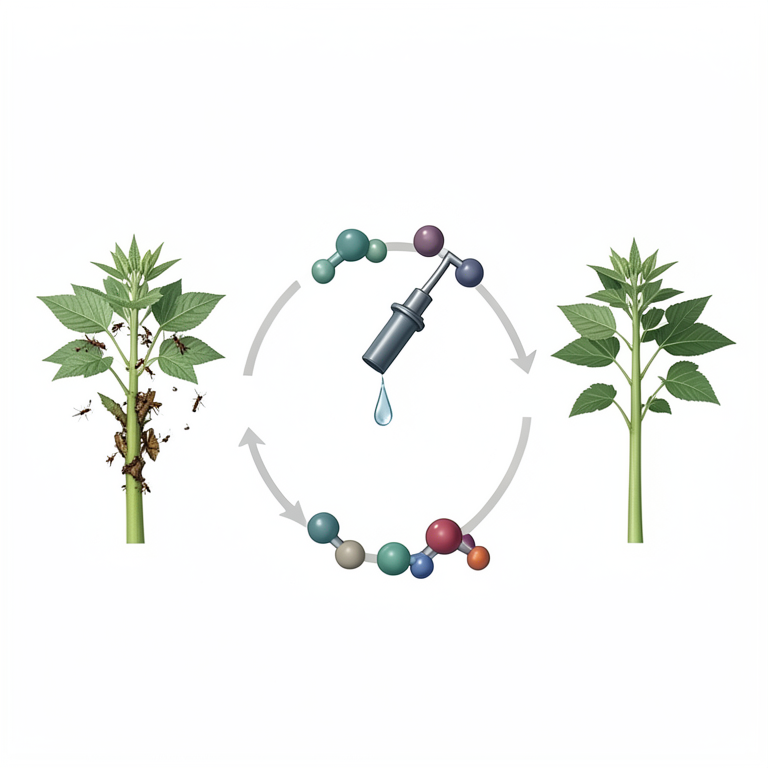
Pesticide Rotation Concept
AI-generated conceptual illustration (Okra plants and insect pests). It explains the idea and does not show study data.
View source evidence ↗Figures & tables
From the original paper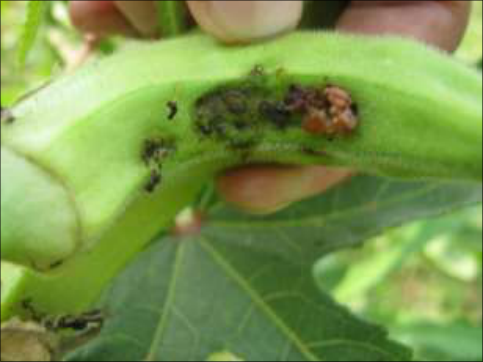 Figure 1
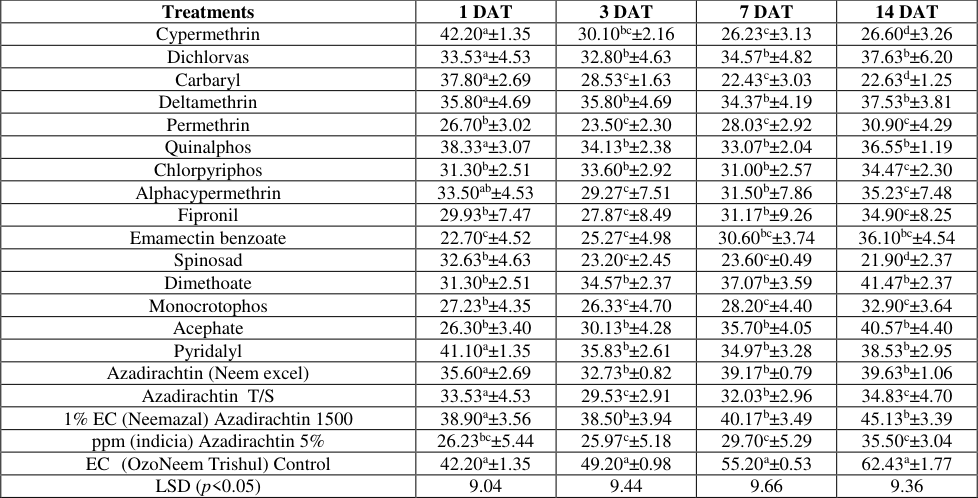 Table 1
Introduction
In order to deliver an adequate number of free radicals, antioxidants, and micronutrients to the body, vegetables serve a crucial role in human nutrition. This is because they are a rich source of carbs, proteins, lipids, minerals, vitamins, and dietary fiber. India, which accounts On the other hand, according to the okra crop is devastated during its growing phase by up to 45 species of insect pests. These include the shoot and fruit borer (Earias vitella), cotton Jassid (Amrasca devastans), red cotton bug (Dysdercus cingulatus), and cotton Jassid (Amrasca devastans), all of which are quite serious and major barriers to its cultivation. These significantly reduce yield by infesting the crop both during the vegetative and reproductive phases. Along with these, other significant pests observed on okra at different growth stages include the cotton aphid, Aphis gossypii; whitefly, Bemisia tabaci; mite, Tetranychus telarius, blister beetle, Mylabris pustulata. It takes a lot of time and careful field and lab data collection to forecast pest incidence. However, because of the sudden changes in environmental factors, particularly the temperature, rainfall, and humidity, as well as keeping topography in mind, it has become desirable to conduct short-term quantitative studies to forecast weather in a timely manner. This is because better weather predictions are now available, and changes in these factors have a significant impact on pest infestations within a season. Insect population dynamics have been shown to be strongly influenced by environmental variability and erratic resources. Development of early prediction models that aid in forecasting pest occurrence in any location is facilitated by the connection between pests and climatic conditions. In addition to being crop and location-specific, the pest occurrence and damage vary from year to year due to variations in the prevailing environmental conditions, as was also seen over the course of this study. Therefore, it is important to regularly monitor local insect pests and their natural enemies in the field in order to forecast epidemic outbreaks in a timely manner, prevent them, and recommend the most effective pest management strategy.
Research Methodology
A. Esculentus (L.) Moench was the subject of the current research, which was conducted on it in controlled settings at the Department of Plant Protection in an experimental field during the summer (Kharif) seasons. A laboratory investigation of various plant extracts' effectiveness against okra insect pests was done. In order to identify highly effective products against specific insect pests and prevent sole dependence on chemicals, the best botanical in terms of causing mortality in the insect pests obtained in the study was further evaluated in the field alongside the other chemical insecticides and biopesticides throughout the year. The most successful pesticides were also those with the fewest negative side effects after testing a variety of pesticides from various chemical families. Additionally, a backup pesticide was tried in case one ran into issues with resistance or pesticide residue. There have recently been problems all around the country with people not knowing enough about label claims and usage. The registration committee of India approved the use of all pesticides in this study. The safe handling of pesticides as well as the crucial national problem of "label claim" have been addressed in the hopes that this study will promote norms for the responsible use of pesticides in agriculture with the least possible negative effects on the environment. Okra is referred to by a variety of regional names throughout the world. In addition to being known as lady's finger in India and England, this dish is also known as gumbo in the United States, guano-gombo in Spain, and guibeiro in Portugal. Different names have been given in various regional languages even within India. Due to its simple cultivation, consistent yield, adaptability to varying moisture conditions, and potential as a source of income for marginal and small farmers in the local market, it is quite well-liked in India. The green, non-fibrous, mucilaginous fruits or pods of okra are grown for their seeds. The fruits are picked before they fully ripen and cooked in a variety of ways before being consumed as vegetables. When making gur or brown sugar from sugarcane juice, the roots and stems are used to clarify the juice. While mature fruits and stems containing crude fiber are used in the paper industry, its ripe seeds are roasted, ground, and used as a substitute for coffee in some nations. An alternative source of edible oil is extracts from okra seeds. Unsaturated fats like oleic acid and linoleic acid are abundant in the greenish-yellow edible oil, which also has a good flavor and aroma. Vitamins, calcium, potassium, and other minerals that are frequently missing in the diets of underdeveloped nations are found in significant quantities in okra. The "Arka Anamica" cultivar of okra was used in the current investigations. It was created at the Indian Institute of Horticultural Research in Bengaluru as a backcross between A. esculentus and A. Tetraphyllus. Around Aligarh, this variety is quite popular. The plant is robust, annual, upright, and well-branched, standing around 100 cm tall. Both sides of the petal base have purple pigment. Fruit is a long, fragile, dark green pod with five noticeable ridges.
Field efficacy of insecticides and biopesticides against major insect pests
Field tests were carried out to evaluate various insecticides and biopesticides on insect pests that were identified as important pests throughout the cropping season in my study. The experiment was triple-replicated and set up using a randomized block design. In order to record the incidence of E. vitella, damaged and undamaged fruits from three randomly selected plants were counted and per cent fruit damage was calculated.
Results and Discussion
Based on their relative abundance, these were classified as major, minor, and infrequent. Insects that appeared frequently over a long period of time and caused noticeable damage were classified as major pests, whereas those that appeared briefly and in relatively small numbers were regarded as minor pests and those that were occasionally noted were classified as occasional pests. The leaves, branches, shoots, flowers, and pods were all affected by the insect pests. Some of the species attacked the crop and bit and chewed it, while others pierced it and drank the sap from the parts they attacked.
Shoot and fruit borer, E. vittella
Table provides information on the growth in shoot and fruit borer larval populations during the course of the year. On May 27, the bug first started to appear. Later, it grew and peaked on July 8 with a population of 0.78 larvae for every five picked fruits/plots. When the pest population was at its highest, the corresponding means of maximum temperature, minimum temperature, and humidity were 33.50 o C, 27.02 o C, and 75.35%, respectively, with 1.80 mm of precipitation. The population then started to fall and continued to work the harvest until the 12th of August. The month of July saw the greatest pest infestation, whereas August and September's second half saw no insect activity. Emamectin benzoate (22.70%) and OzoNeem Trishul (26.23%) both showed minimal damage percentages one day after treatment, demonstrating the applicability of biopesticides. It was followed by equally potent compounds such as Permethrin, chlorpyriphos, alphacypermethrin, Fipronil, Spinosad, dimethoate, monocrotophos, and acephate. At this point, the remaining pesticides were comparable, demonstrating the applicability of biopesticides once more. Cypermethrin, Carbaryl, Permethrin, alphacypermethrin, Fipronil, Emamectin benzoate, Spinosad, and monocrotophos all reduced the percentage of fruit damage by the borer three days after treatment. Surprisingly, OzoNeem Trishul and Neemazal 5% both showed equal results. Comparing indicia and Neem excel against dichlorvas, deltamethrin, quinalphos, chlorpyriphos, dimethoate, acephate, and Pyridalyl did not affect indicia and Neem excels ability to minimize damage to okra fruits. The effectiveness of the pesticides varied slightly seven days after treatment; only OzoNeem Trishul, cypermethrin, Carbaryl, Permethrin, Emamectin benzoate, Spinosad, and monocrotophos had statistically equivalent effects. It should be highlighted that all insecticides, with the exception of the control, had an equivalent effect, along with Neem Excel, indicia, and Neemazal 5%, demonstrating the value of biopesticides in managing pest control. After fourteen days of treatment, the pattern altered as chemical pesticides began to outperform biopesticides in terms of effectiveness. In this context, it can be seen that Spinosad, Carbaryl, and Cypermethrin were comparable to one another and showed the least amount of fruit damage from the borer. Permethrin, chlorpyriphos, alpha-Cypermethrin, Fipronil, Emamectin benzoate, monocrotophos, and Neemazal 5% and OzoNeem Trishul, which provided par values, followed the first three. It should be noted that over time (1 DAT to 14 DAT), the percentage of fruit damage decreased at a maximum rate in cypermethrin (59.00%), followed by Carbaryl (52.32%), Spinosad (42.25%), and Pyridalyl (35.67%), as well as quinalphos (32.32%), deltamethrin (24.71%), and Neemazal 5% (23.69%), demonstrating the pesticides' longevity. However, damage increased over time in the cases of dichlorvas, Permethrin, chlorpyriphos, alphacypermethrin, Fipronil, Emamectin benzoate, dimethoate, monocrotophos, acephate, Neem excel, indicia, and OzoNeem Trishul, which showed a decline in effectiveness due to an increase in fruit damage percentage. Permethrin, quinalphos, chlorpyriphos, and Spinosad were found to be more effective even up to 14 days after treatment when pesticide effectiveness and longevity were examined. Contrarily, when fruit damage increased over time (1 DAT to 14 DAT), the remaining pesticides and biopesticides comparatively decreased their efficacy.
Conclusion
The research conducted for this thesis started with an examination and identification of several insect pests that affect okra. After that, studies on their seasonal incidence, life cycles at various temperature regimes, distribution, and management using chemical and non-chemical methods were conducted. I have made an effort to go through the fundamentals of integrated pest control, such as monitoring, forecasting, and decision-making. Therefore, my thesis can be seen as an effort to develop an IPM module, specifically to control the insect pests of okra. Any insecticide's effectiveness is largely dependent on how it is applied, which is determined by the insecticide's characteristics, the type of pest or pest complex that needs to be controlled, and the time or stage at which the application is to be made. However, a number of issues, such as bioaccumulation and biological magnification, are connected to their use. Their negative effects were foreseen as early as 1962 by Rachel Carson in her facts-revealing book "The Silent Spring". She tried to speak, but no one could hear her. It's imperative that we use pesticides sparingly and strive to reduce the number of times we apply them. In my opinion, these chemical pesticides should be supplemented with plant-based botanicals or biopesticides, much as how Indian farmers employ organic manures in addition to inorganic fertilizers to maintain the fertility of the land. It might be a supplement to existing techniques like mechanical, physical, cultural, biological, hormonal, pheromone, and even sterilization control. The same group of pesticides will probably control pests in the same manner. Pesticide resistance is more likely to develop when pesticides that control pests in the same way are used repeatedly. Therefore, the chemical group to which a specific pesticide belongs must be known to pesticide applicators. Utilizing these from multiple chemical classes lowers the possibility of developing resistance to them. When using pesticides in an integrated pest management program, it's important to rotate between pesticides from various chemical families. Research on the succession of pests in okra provided the best opportunity to identify a new pest shortly after it arrived, to determine the number of pests present in the crop and their status, and to choose the appropriate time to implement control measures. In addition to affecting the status of the insect pests, weather variations also had an impact on their dynamics, dispersion, and abundance.
Figures and tables from the paper
| Treatments | 1 DAT | 3 DAT | 7 DAT | 14 DAT |
|---|---|---|---|---|
| Cypermethrin | 42.20a±1.35 | 30.10bc±2.16 | 26.23c±3.13 | 26.60d±3.26 |
| Dichlorvas | 33.53a±4.53 | 32.80b±4.63 | 34.57b±4.82 | 37.63b±6.20 |
| Carbaryl | 37.80a±2.69 | 28.53c±1.63 | 22.43c±3.03 | 22.63d±1.25 |
| Deltamethrin | 35.80a±4.69 | 35.80b±4.69 | 34.37b±4.19 | 37.53b±3.81 |
| Permethrin | 26.70b±3.02 | 23.50c±2.30 | 28.03c±2.92 | 30.90c±4.29 |
| Quinalphos | 38.33a±3.07 | 34.13b±2.38 | 33.07b±2.04 | 36.55b±1.19 |
| Chlorpyriphos | 31.30b±2.51 | 33.60b±2.92 | 31.00b±2.57 | 34.47c±2.30 |
| Alphacypermethrin | 33.50ab±4.53 | 29.27c±7.51 | 31.50b±7.86 | 35.23c±7.48 |
| Fipronil | 29.93b±7.47 | 27.87c±8.49 | 31.17b±9.26 | 34.90c±8.25 |
| Emamectin benzoate | 22.70c±4.52 | 25.27c±4.98 | 30.60bc±3.74 | 36.10bc±4.54 |
| Spinosad | 32.63b±4.63 | 23.20c±2.45 | 23.60c±0.49 | 21.90d±2.37 |
| Dimethoate | 31.30b±2.51 | 34.57b±2.37 | 37.07b±3.59 | 41.47b±2.37 |
| Monocrotophos | 27.23b±4.35 | 26.33c±4.70 | 28.20c±4.40 | 32.90c±3.64 |
| Acephate | 26.30b±3.40 | 30.13b±4.28 | 35.70b±4.05 | 40.57b±4.40 |
| Pyridalyl | 41.10a±1.35 | 35.83b±2.61 | 34.97b±3.28 | 38.53b±2.95 |
| Azadirachtin (Neem excel) | 35.60a±2.69 | 32.73b±0.82 | 39.17b±0.79 | 39.63b±1.06 |
| Azadirachtin T/S | 33.53a±4.53 | 29.53c±2.91 | 32.03b±2.96 | 34.83c±4.70 |
| 1% EC (Neemazal) Azadirachtin 1500 | 38.90a±3.56 | 38.50b±3.94 | 40.17b±3.49 | 45.13b±3.39 |
| ppm (indicia) Azadirachtin 5% | 26.23bc±5.44 | 25.97c±5.18 | 29.70c±5.29 | 35.50c±3.04 |
| EC (OzoNeem Trishul) Control | 42.20a±1.35 | 49.20a±0.98 | 55.20a±0.53 | 62.43a±1.77 |
| LSD (p<0.05) | 9.04 | 9.44 | 9.66 | 9.36 |
Table text extracted from the original PDF; superscript letters are shown inline. The original table image is below.
View original table image
References
13 in the original paper- Agsaoay MV, Briones RC. Population correlates and critical pest level (CPL) of the leafhopper, Amrasca biguttula, and associated insect pests attacking okra, Hibiscus esculentus (L.). Journal of the International Society for Southeast Asian Agricultural Sciences. 2012;18(2):83-95.
- Ahmad F, Akram W, Sajjad A, Imran AU. Management practices against cotton mealy bug, Phenacoccus solenopsis (Hemiptera: Pseudococcidae). International Journal of Agriculture and Biology. 2011;13(4):547552.
- Ahmad S, Gupta SC, Prakash N, Nandal SK. Weather factors and larval population of Earias vittella Fabr. In summer okra (Abelmoschus esculentus L.). Journal of Research Birsa Agricultural University. 2000;12(2):215-217.
- Benchasri S. Preliminary studies on incidence of insect pests on okra (Abelmoschus esculentus (L.) Moench) in Thailand. Bulgarian Journal of Agricultural Science. 2013;19(2):209-215.
- Benkeblia N. Antimicrobial activity of essential oil extracts of various onions (Allium cepa) and garlic (Allium sativum). Lebensmittel-Wissenschaft & Technologie Food Science and Technology. 2004 Mar 1;37(2):263-268.
- Caboni P, Sarais G, Angioni A, Garcia AJ, Lai F, Dedola F, et al. Residues and persistence of Neem formulations on strawberry after field treatment. Journal of Agricultural and Food Chemistry. 2006 Dec 27;54(26):10026-10032.
- Sonwani A, Choudhary AS, Raj S, Paswan A, Sonloi P. Effect of nutrient management on growth parameters of okra. International Journal of Agriculture and Nutrition. 2022;4(1):28-33. DOI: 10.33545/26646064.2022.v4.i1a.50
- Davies TGE, Field LM, Usher wood PNR, Williamson MS. DDT, pyrethroids and insect sodium channels. Life. 2007;59(3):151-162.
- Durairaj C, Ganapathy N. Host range and host preference of blister beetles. Madras Agricultural Journal. 2003;90(1/3):108-114.
- Echereobia CO, Okerere CS, Emeaso KC. Determination of repellence potentials of some aqueous plant extracts against okra flea beetles Podagrica uniform a. Journal of Biopesticides. 2010 May 1;3(2):505-507.
- Echezona BC, Asiegbu JE, Izugba AA. Flea beetle populations and economic yield of okra as influenced by nitrogen and 2, 3-dihydro-2, 2-dimethyl benzofuran. African Crop Science Journal. 2010;18(3):97-105.
- Ekborm BS. Spatial distribution of Rhopalosiphum padi (L.) in spring cereals in Sweden and its importance for sampling. Environmental Entomology. 1985 Jul 1;14:312-316.
- El-Dessouki SA, El-Awady SM, Ata TE. Effect of different constant temperatures and two preferred vegetable host plants on certain biological aspects of cotton aphid, Aphis gossypii Glover, (Homoptera, Aphidian). Annals of Agricultural Sciences. 2004;42(4):2055-2059.