
Research article · 2022 · Full text
International Journal of Biology SciencesBiodiversity and prevalence of helminthes parasites of Nalganga dam fishes of Buldana district (M. S.)
Volume 4(1) · Pages 16–19 · DOI: 10.33545/26649926.2022.v4.i1a.36 ↗
Research areasParasite Biology and Host InteractionsFish Biology and Ecology Studies
Abstract
Author-writtenThe present study will be helpful for biodiversity status of helminthes parasites found in Nalganga Dam. A total of 300 fishes were examined from which about 50% fishes were infected with cestode parasites and 50% with nematode parasites. Present study suggest that cestodes mainly Circumoncobothrium spp, Senga spp., Lytocestus spp., Polyoncobothrium spp., and nematodes mainly Eustrongylides spp., Rhabdochona spp., Syphaciella spp., Contracaecum spp., Ascardia spp.,and Trichuris spp., are the main intestinal parasites of Nalganga dam fishes (viz. Mastacem bellusarmatus, Wallago attu, Ophiocephalus punctatus, and Clarius batrachus) are the main intestinal parasites of Nalganga dam fishes. The incidence of parasite infection was higher in winter season whereas intensity of infection was higher in Mansoon.This report summarizes the data of incidence, intensity, and index of incidence in fresh water fishes in relation to environmental factor. Present study is carried out during July 2019 to June 2020.
Summary
Source-checkedPlain-language reading of the full paper, prepared with AI and checked against the text. Each point links to the authors' own words.
Why it matters
- Helminth parasites are a significant concern because they cause economic losses in the fishing industry. View evidence ↗
- These parasites are problematic as they reduce the nutritional and food value of the host fish. View evidence ↗
- Rapid increases in parasite populations can lead to fish mortality through Parasite induced host mortality (PIHM). View evidence ↗
The question
- The study aimed to investigate and evaluate the prevalence of helminth parasites in four freshwater fish species: Mastacem bellusarmatus, Wallago attu, Ophiocephalus punctatus, and Clarius batrachus. View evidence ↗
What they did
- Freshwater fish were collected from the Nalganga dam between July 2019 and June 2020. View evidence ↗
- The researchers examined a total sample size of 300 fishes. View evidence ↗
- Internal organs, including the stomach, liver, intestine, and skin, were examined via dorso-ventral opening of the fish. View evidence ↗
- Parasite identification was conducted using the 'Systema Helminthum' by Yamaguti (1961). View evidence ↗
What they found
- Approximately 50% of the examined fishes were infected with cestode parasites and 50% with nematode parasites. View evidence ↗
- Among the species studied, Mastacembalus armatus was found to be one of the most heavily infected fish species compared to Clarius batrachus, Wallago attu, and Channa punctatus. View evidence ↗
- Circumoncobothrium sp. was the most frequent parasite found, infecting 62 hosts in the intestine. View evidence ↗
- Eustrongylides spp. was the least frequent parasite identified, infecting only 7 hosts in the skin and intestine. View evidence ↗
- For Ascardia spp. in Wallago attu, the highest infection prevalence occurred in summer (84.6%), followed by winter (63.3%) and monsoon (31.8%). View evidence ↗
- For Molnaria spp. in Wallago attu, the maximum infection prevalence was in winter (66.7%), followed by summer (64.3%) and monsoon (52.4%). View evidence ↗
- The recovery of Lytocestus specifically from the stomach of C. batrachus suggests that these worms are site-specific. View evidence ↗
What it means
- The authors conclude that environmental factors and feeding habitats directly or indirectly influence the seasonality of parasitic infections. View evidence ↗
- The authors state that the study would be more complete if it investigated variations in parasite fauna relative to host diet and habitat type over a full season. View evidence ↗
Visual summary
3 visualsIllustrations explain the paper; charts are replotted from the paper's own table values.
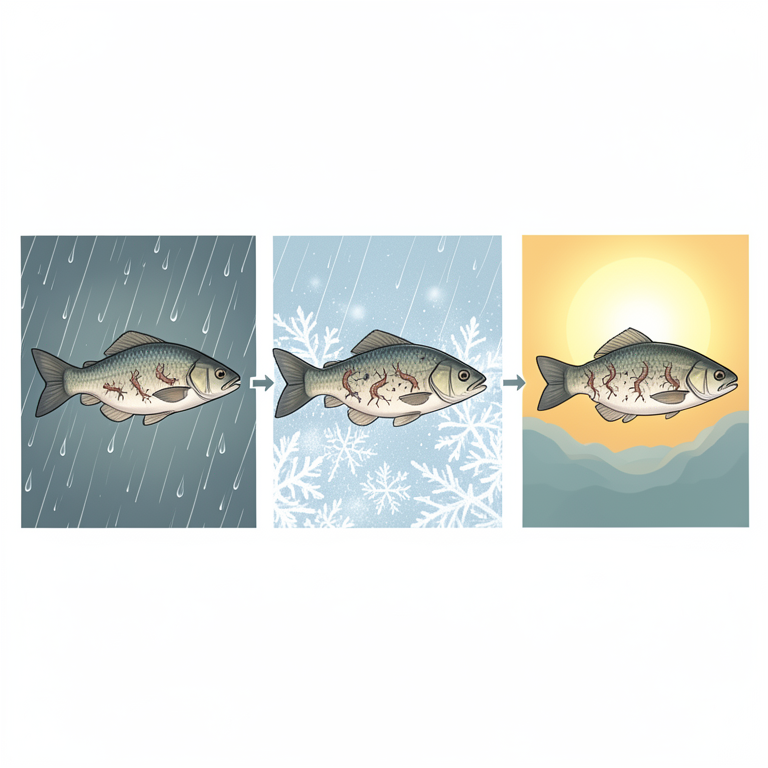
Seasonal Infection Trends
AI-generated conceptual illustration (Wallago attu fish). It explains the idea and does not show study data.
View source evidence ↗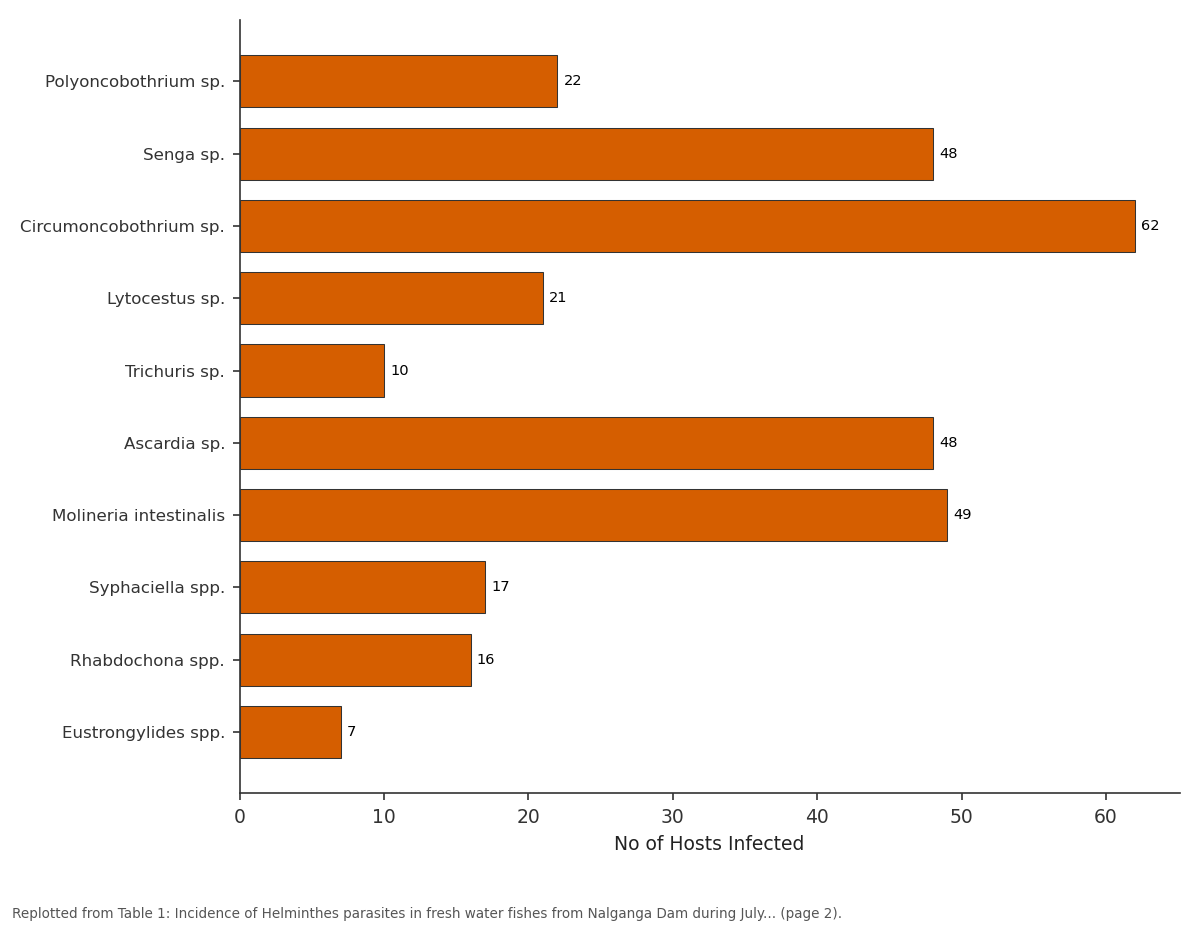
No of Hosts Infected: Polyoncobothrium sp. vs Senga sp. vs Circumoncobothrium sp. vs Lytocestus sp. vs Trichuris sp.
Replotted from Table 1 (page 2) of the original paper. Every bar is the paper's own table value.
View source evidence ↗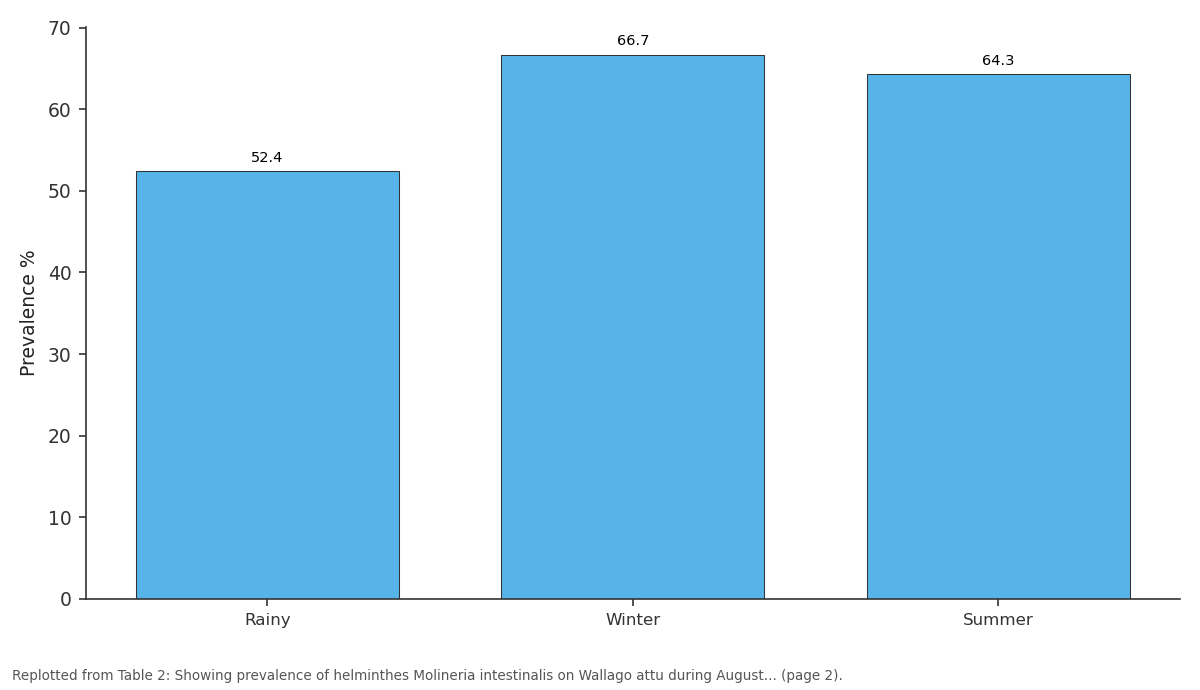
Prevalence %: Rainy vs Winter vs Summer
Replotted from Table 2 (page 2) of the original paper. Every bar is the paper's own table value.
View source evidence ↗Figures & tables
From the original paper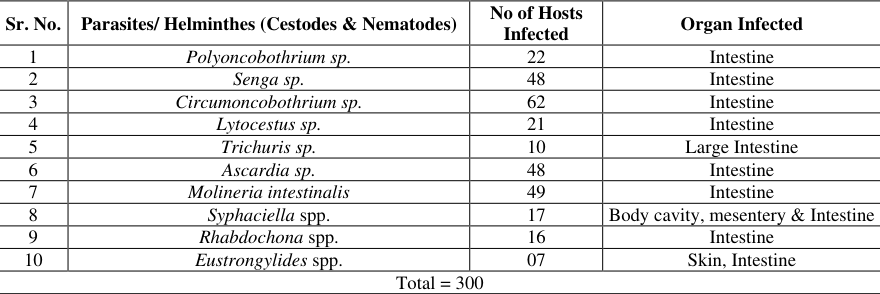 Table 1
 Table 2
 Table 3
Introduction
The survey of helminth parasites in freshwater fishes was undertaken to investigate the internal helminth parasitic environment of the host and the environmental factor such asseason, temperature, humidity, age of the host. The common parasites of fishes causing the Economic losses includes the helminth parasites. One objective of this study was to determine monthly incidence of infection to various organ of the host body. Parasites are extremely abundant and diverse in nature, representing a substantial portion of global biodiversity. Fishes are important components of ecosystem from ecological, medicinal, nutritional and economical point of view. These fishes are parasitized by helminthes parasites, which reduce the food value of host fish. Study of helminthes parasites is therefore an urgent necessity of today. Helminthes infections are very common in people who consume improperly un-cooked meat, unhygienic habits and poor sanitation. These helminthic infection leads to various disorders i.e. anemia. Population dynamics of parasite increases rapidly and results in fish mortality because of PIHM (Parasite induced host mortality) and thus fish population infected firstly (Arora 2010) [11] . The parasitic infections are sometimes very fatal and cause high mortalities when their life cycles are well supported by Intermediate hosts. (Shakir, 2006) [14] . Survey of seasonal infection of fish infected with Caryophyllids has been done in other countries by different workers Hanley, Anderson (1976) [1] , in carps, The current study will expect to helpful for futuristic researchers on helminthes infection on fresh water fishes in Buldana region. Keeping
Materials and Methods
The fresh water fish collected from Nalganaga dam during July 2019 to June 2020. Fishes were opened up dorso-ventrally and the internal organs examined. The various organs of the viscera such as stomach, liver, intestine and Skin. All these organs which are infected by helminthes placed under separate petridish containing normal saline water. Infection of each group of parasites was treated as follows: Collected cestodes and Nematode were first relaxed and then fixed in hot 4%formalin and stained using Harris haematoxyline. Stained parasites were washed in distilled water, dehydrated in ascending grades of alcohol, cleared in xylene, mounted in D.P.X. Nematodes were fixed in hot 10% Glycerol and cleared in lacto phenol. Drawings were made using a camera lucida. The identification is made with the help of "Systema Helminthum" by Yamaguti (1961).
Then organs are examined and recorded the data of infected and normal host. After that separating and counting the data of helminthes and fresh water fishes, the collected helminthes parasites preserved in separate bottle. Few of helminthes parasites might be useful for taxonomic study.
Results and Discussion
The study has established that the Mastacembalus armatus fish is one of the most heavily infected fish species as compare to Clarius batrachus, Wallago attu and Channa punctatus In Buldana region the fishes were heavily infected with the cestode and nematode while the other parasites occurred in low quantity. The current investigation suggests in given table no. 1 and 2. There were twohelminthes parasites were recorded as Molnaria intestinals &Ascardia spp. High incidence of infection found from that species of helminthes over fresh water fishes and recorded data season wise, in Summer (64.30% -84.60%) followed by winter (66.70% -63.3%) whereas infection was recorded low in Monsoon (52.40%-31.8%). Through the seasonal analysis the highest rate of infection occurred in summer as compared to rainy and winter season (Krishna and Shreeramalu (1996); Laxma Reddy et al. (2006); Laxma Reddy and Bannergii (2008, 2012).
According to the Kennedy (1970, 1974 and 1977) [5,3,4] the temp, humidity and rainfall, feeding habits of host, availability of infective host and parasite maturation, and such factors are responsible for influencing the parasitic infections. Experimental studies by Kennedy (1971) have shown that the cestode Caryophyllaeus lattices can establish in fish and survive for longer period at low temperature. Hence he explained the temperature is major controlling seasonal periodicity of infection and the parasitization. He explained the infections are more in warm seas than in old ones. Jadhav, Bhure (2006) [2] explained the development of parasites should be needed high temperature, low rainfall and sufficient moisture. Hence the high prevalence occurs in summer followed by other season. Pennuyuick (1973), reported fishes and other animals were infected with large number of parasites in late winter to end of summer months, as environmental conditions are favorable in these months. Jadhav and Bhure, (2006) [2] reported high temperature, low rainfall and sufficient moisture are necessary for development of parasite. The parasites causes depletion of the nutritional contents in host's body and results in the low productivity & loss of weight in fish industry (Satish Saraf 2019) [13] .
Conclusion
After the analysis of data the present study can be concluded that the high infection of Molnaria spp. Helminthes parasites &Ascardia spp. are occurred in summer season followed by winter where as low in monsoon season. This type of results indicated that environmental factors and feeding habitat are influencing the seasonality of parasitic infection either directly or indirectly. However, the above study can only be complete if it covers a whole season to investigate the variation in parasite fauna with the diet of the host and variation in infection with habitat type.
Regarding the parasitic diversity and population study cestode and Nematode indicates abundance population as compare to nematode parasites.
Figures and tables from the paper
| Sr. No. | Parasites/ Helminthes (Cestodes & Nematodes) | No of Hosts Infected | Organ Infected |
|---|---|---|---|
| 1 | Polyoncobothrium sp. | 22 | Intestine |
| 2 | Senga sp. | 48 | Intestine |
| 3 | Circumoncobothrium sp. | 62 | Intestine |
| 4 | Lytocestus sp. | 21 | Intestine |
| 5 | Trichuris sp. | 10 | Large Intestine |
| 6 | Ascardia sp. | 48 | Intestine |
| 7 | Molineria intestinalis | 49 | Intestine |
| 8 | Syphaciella spp. | 17 | Body cavity, mesentery & Intestine |
| 9 | Rhabdochona spp. | 16 | Intestine |
| 10 | Eustrongylides spp. | 07 | Skin, Intestine |
| Total = 300 |
Table text extracted from the original PDF; superscript letters are shown inline. The original table image is below.
View original table image
| Season | No. of hosts examined | No. of Hosts infected | No. of parasites collected | Prevalence % |
|---|---|---|---|---|
| Rainy | 21 | 11 | 13 | 52.40% |
| Winter | 30 | 20 | 22 | 66.70% |
| Summer | 28 | 18 | 31 | 64.30% |
Table text extracted from the original PDF; superscript letters are shown inline. The original table image is below.
View original table image
| Season | No. of hosts examined | No. of Hosts infected | No. of parasites collected | Prevalence % |
|---|---|---|---|---|
| Rainy | 22 | 7 | 10 | 31.8% |
| Winter | 30 | 19 | 16 | 63.3% |
| Summer | 26 | 22 | 09 | 84.6% |
Table text extracted from the original PDF; superscript letters are shown inline. The original table image is below.
View original table image
References
14 in the original paper- Anderson RM. Seasonal variation in the population dynamics of Caryophyllacus lacticeps. Parasitology. 1976:72:281-395.
- Jadhav BV, Bhure DB. Population dynamics of Helminth parasites in freshwaterfishes from Marathwada region (M. S.) India. Flora and Fauna an International Research Journal. 2006:12(2):143-148.
- Kennedy CR. A checklist of British and Irish freshwater fish parasites with noteson their distribution. J fish Biol. 1974:6(5):613-644.
- Kennedy CR. The regulation of fish parasite populations. In regulation of parasitepopulation. 1977:(a):61-109.
- Kennedy CR, Hine DM. Population biology of the cestode Proteocephalus torulisus (Bat Sch) in dace Leucisus leucisus (L) of the river Avon. Jr. Fish Biol. 1970:1(3):209-219.
- Kennedy CR. Ecological aspects of Parasitology. North Holland publishing company. Amsterdam 10x ford, 1976.
- Krishna, Sreeramulu K. The Prevalance and Intensity of Infection with Didymoziod parasite in Priacanthus hamrur, Waltair Coast, India, U P. J. Zool,1996:16(1):19-22.
- Laxma Reddy, Bannergii G, Rajender G. Biostastical Indexes on the occurance of cestode parasite, Lytocestus indicus infection in the freshwater catfish, Clarius batracus at the Warangal region A P J. Natcon. 2006:18(2):343-348.
- Laxma Reddy, Banarjee G. Population Dynamics of cestode parasite found in the freshwater fish,Channa punctatus, J Eco boil. 2008:22(4):349-355.
- Laxma Reddy, Banarjee G. Histopathological Changes induced by cestode parasite in fresh water murrel, Biolife J. 2012;2:324-328
- Nidhi Arora. Population dynamics of caryophyllid cestode Lytocestus fossilisi from Clarias batrachus in Meerut (U.P.).J. Env. Bio-Sci,2010:24(1):99-101.
- Gasterosteusaculeatus L. Parasitology. 1973:63:373388.
- Saraf Satish. Studies on prevalence of Cestode parasites of freshwater fish Mastecembalus armatus (l.) In jayakwadi dam, paithan,2019:9(10):9-10.
- Shakir. The prevalence of cestode infection in a freshwater catfish, Sperata sarwari Punjab Univ. J. Zool,2006:21(1-2):41-47.