
Research article · 2023 · Full text
International Journal of Advanced Biochemistry ResearchResponse of growth and yield linseed (Linum usitatissimum L.) as influenced in cropping system, irrigation and phosphorous
Volume 7(1S) · Pages 10–13 · DOI: 10.33545/26174693.2023.v7.i1sa.165 ↗
Research areasAgricultural Science and FertilizationAgronomic Practices and Intercropping SystemsSoybean genetics and cultivation
Abstract
Author-writtenA field investigation was conducted at Agronomy research farm A. S. (P.G) College, Lakhaoti, Bulandshahr during rabi seasons of 2006 and 2007. The treatments consisted of combination of four cropping systems viz. chickpea sole (M1), linseed sole (M2), chickpea+ linseed 2:1 ratio (M3) and pigeonpea + linseed 4:2 ratio (M4) in main plots; two irrigations viz. two irrigations at vegetative stages (30-40 days) and flowering stage (70-75 days) (S1) and one irrigation at flowering stage (70-75 days) (S2) in sub plots and three levels of phosphorous viz. control (L1), 30 kg P2O5/ha (L2) and 60 kg P2O5/ha (L3) in sub-sub plots in split plots design replicated thrice during the rabi season. The chickpea variety BG-362 and linseed variety neelam were used in the cropping systems during rabi season. The soil of the experimental site was low in organic carbon (0.47 and 0.48 kg/ha) and total nitrogen (154.0 and 155.1 kg/ha). It was low in available phosphorus (9.2 and 9.24 kg/ha) and medium in available potassium (203.0 and 203.6 kg/ha) and sandy loam in texture having alkaline reaction (pH 7.5). The weather during the both years of the experiment was by and large normal and devoid of any extreme conditions. The net return was found to be maximum under chickpea: linseed in 4:2 row ratio with two irrigations and 60 kg P2O5/ha. (Rs. 21,632 and Rs. 22,128) followed by sole chickpea with two irrigation and 60 kg P2O5/ha. Due to relatively higher gross return. The maximum B:C ratio of 1.87 and 1.91 was obtained from chickpea: linseed in 4:2 with one irrigation at flowering and 60 kg P2O5/ha, because of reduced cost of on irrigation and higher gross return of the system.
Summary
Source-checkedPlain-language reading of the full paper, prepared with AI and checked against the text. Each point links to the authors' own words.
Why it matters
- Linseed is recognized as a globally important oilseed crop with a history of use dating back to the start of human civilization. View evidence ↗
- Phosphorus is a critical nutrient for pulse crops like chickpea, and its deficiency is often a primary cause of poor yields. View evidence ↗
- Intercropping oilseed crops with legumes is considered a viable technique for increasing overall production. View evidence ↗
The question
- The study aimed to evaluate how different cropping systems, irrigation schedules, and phosphorus levels influence the growth and yield of linseed. View evidence ↗
What they did
- The field investigation took place at the Agronomy research farm of A. S. (P.G) College in Lakhaoti, Bulandshahr, during the 2006 and 2007 rabi seasons. View evidence ↗
- The study utilized the BG-362 variety of chickpea and the Neelam variety of linseed. View evidence ↗
What they found
- Sole linseed crops achieved the maximum plant height, while the 2:1 intercropping ratio resulted in the minimum height. View evidence ↗
- Irrigation at both vegetative and flowering stages produced significantly taller plants at harvest (up to 49.73) compared to irrigation only at the flowering stage (up to 39.87). View evidence ↗
- Seed yield of linseed was highest in sole crops (12.76-13.06 q/ha) and significantly lower in intercropping systems (5.35-5.75 q/ha). View evidence ↗
- The highest net returns (Rs. 21,632 and Rs. 22,128) were achieved using a 4:2 chickpea:linseed ratio with two irrigations and 60 kg P2O5/ha. View evidence ↗
- The best benefit-cost (B:C) ratio (1.87 and 1.91) was found in the 4:2 chickpea:linseed system with one irrigation at flowering and 60 kg P2O5/ha. View evidence ↗
What it means
- The authors conclude that irrigating at both the vegetative and flowering stages optimizes yield attributes, including capsules per plant and seed yield per plant. View evidence ↗
Visual summary
2 visualsIllustrations explain the paper; charts are replotted from the paper's own table values.
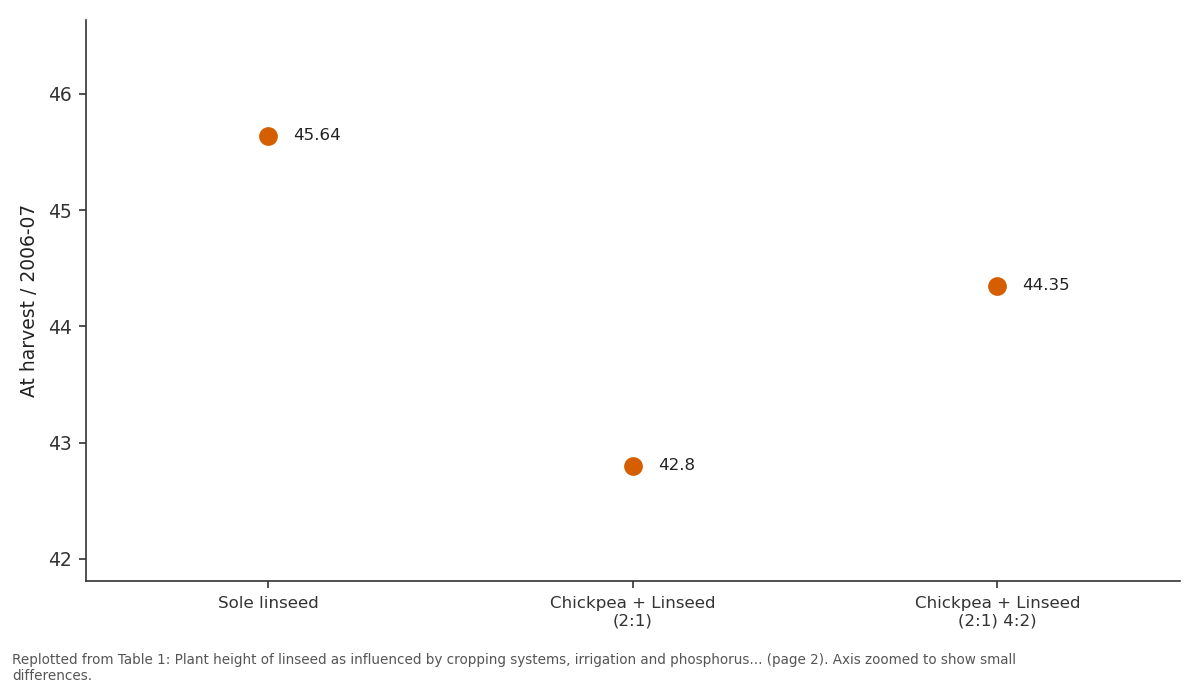
At harvest / 2006-07: Sole linseed vs Chickpea + Linseed (2:1) vs Chickpea + Linseed...
Replotted from Table 1 (page 2) of the original paper. Every bar is the paper's own table value.
View source evidence ↗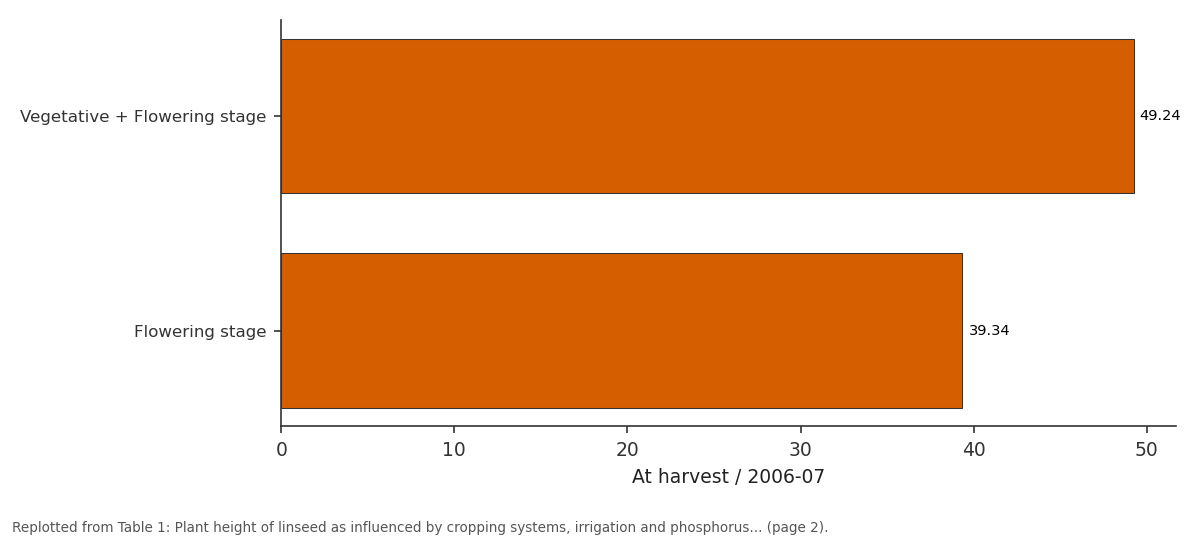
At harvest / 2006-07: Vegetative + Flowering... vs Flowering stage
Replotted from Table 1 (page 2) of the original paper. Every bar is the paper's own table value.
View source evidence ↗Figures & tables
From the original paper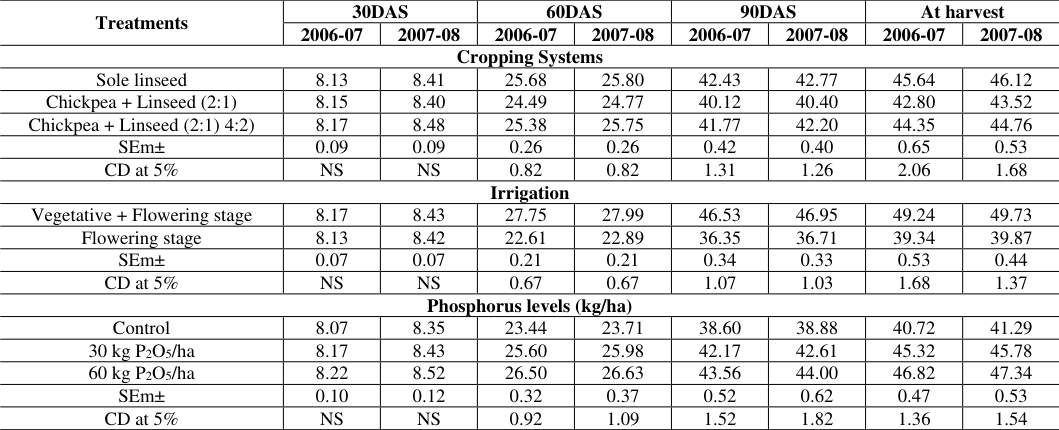 Table 1
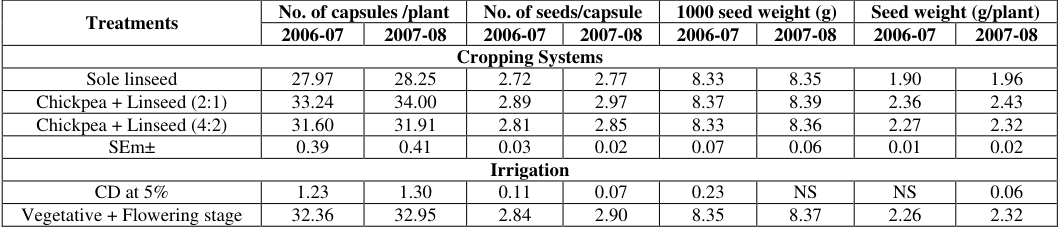 Table 2
 Table 3
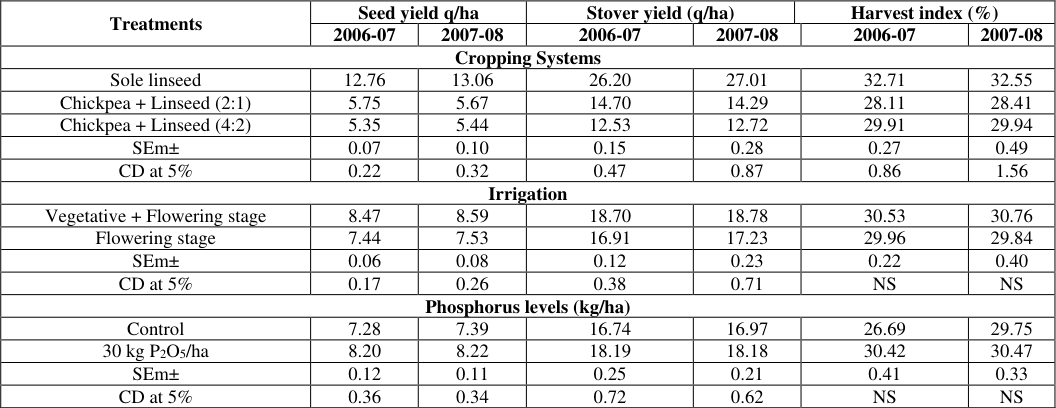 Table 3
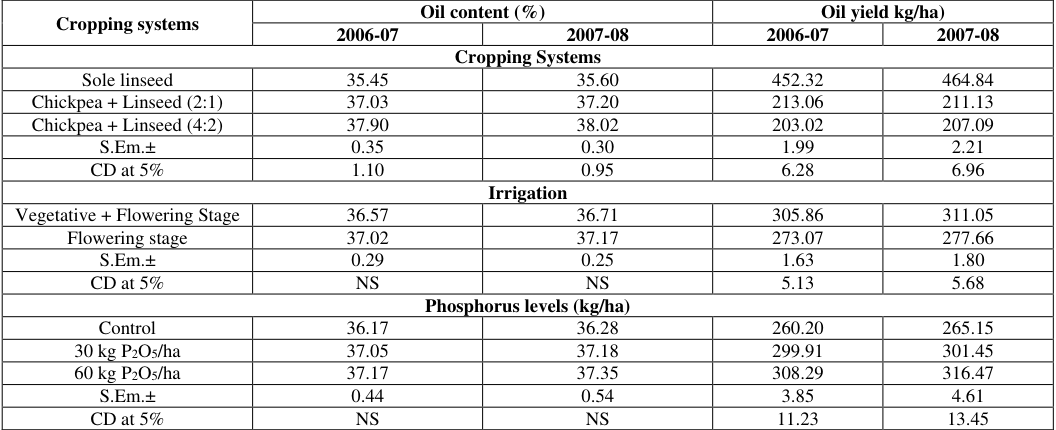 Table 4
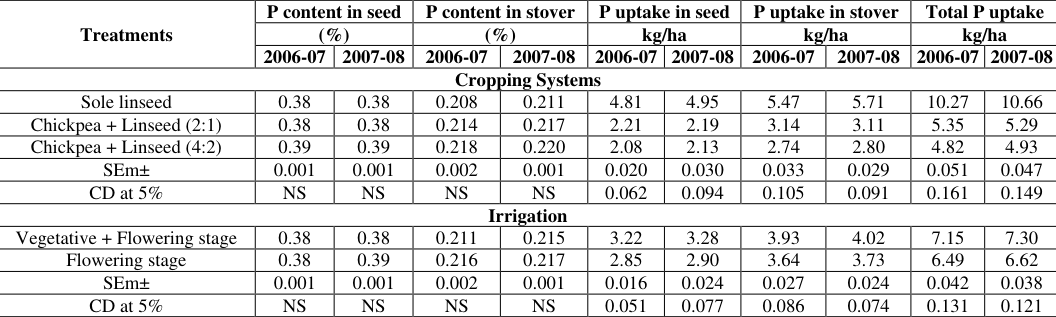 Table 5
Introduction
Linseed (Linum usitatissimum L.) is one of the important oilseed crop of the world from very beginning of the human civilization. It belongs to the genus Linum of the family Linaceae, having 13 genera, but only Linum usitatissimum (with diploid chromosome 2n = 30) is the only cultivated species of genus Linum. It is believed that this crop species originated from Linum angustifolium Huds native to the Mediterranean region [1] . The name Linum was derived from Latin lin or "thread" and the species name usitatissimum meaning "most useful". The word 'flax' is used when it is grown for fibre, 'linseed' is used when it is grown for oil purpose and 'dual purpose flax' when grown for both oil and fibre. It is also popularly known as Alsi, Tisi, Jawas, Aksebija in Indian languages. Linseed is currently cultivated in Russia, U.S.A., Argentina, Uruguay, India, Pakistan, China, Japan, Morocco, Australia, Ireland, Scotland, Poland, and a few other European countries. The family is cosmopolitan, and includes about 250 species in 14 genera, classified into two subfamilies: the Linoideae and Hugonioideae (often recognized as a distinct family, the Hugoniaceae). Leaves of the Linaceae are always simple; arrangement varies from alternate (most species) to opposite (in Sclerolinon and some Linum) or whorled (in some Hesperolinon and Linum species). In the Linoideae, the largest genus is Linum, the flaxes, with 180-200 species including the cultivated flax, Linum usitatissimum. Members of the Linoideae include herbaceous annuals and perennials, as well as woody subshrubs, shrubs, and small trees (Tirpitzia) inhabiting temperate and tropical latitudes of Eurasia, Africa, Australia, and the Americas. The largest genus of the Hugonioideae is Hugonia (about 40 species); the Hugonioideae are woody vines, shrubs, and trees, and are almost entirely tropical in distribution. In addition to their growth habits and geographic distributions, the Linoideae and Hugonioideae can be differentiated by the number of fertile stamens (five in the Linoideae, 10 in the Hugonioideae) and fruit type. lntercropping is an agronomic refinement of the old practice of crop mixture, where in the crop components, usually two are sown in separate rows, their population ratios are know and they can be harvested singly and produce recorded separately. The crop components often have. different growth period and growth habits, statistical analysis and interpretation of the total and individual products is, thus, possible and valid, for drawing conclusion of the propriety or otherwise of the system in a given region. Among various measures adopted for improving the productivity of oil seed crops, one technique may be to grow these crops with legumes. It has been observed that intercropping of oil seed with cereals, pulses and fibers is one of the best techniques to increase production. Phosphorus is the most vital nutrient, which contributes directly to both yield and quality of chickpea. It plays an important role to various physiological processes. Moreover, it is constituent of ADP, ATP, nucleic acids and nucleo proteins and several co-enzymes, which are of great importance in energy transformation and metabolic activities of the plant. Phosphorus deficiency is usually the key factor for poor yield of pulses on most of the soils. In absence of inadequate supply of phosphorus sometimes, other nutrient elements also become ineffective for plant use. A good supply of phosphorus to the plants helps in better root development and hastens maturity. Optimum levels of phosphorus increases growth, nodulation and nitrogen fixation in legumes. There is a considerable variation in its requirement, which need careful study before making any recommendation for getting economical yield. The chickpea variety BG-362 and linseed variety neelam were used in the cropping systems during rabi season. The soil of the experimental site was low in organic carbon (0.47 and 0.48 kg/ha) and total nitrogen (154.0 and 155.1 kg/ha). It was low in available phosphorus (9.2 and 9.24 kg/ha) and medium in available potassium (203.0 and 203.6 kg/ha) and sandy loam in texture having alkaline reaction (pH 7.5). The weather during the both years of the experiment was by and large normal and devoid of any extreme conditions. The experiment was conducted as per the standard procedures and all the pre and post harvest observations were recorded and analyzed as per the prescribed statistical procedures. The experimental data pertaining to each character were subjected to statistical analysis by using the technique of analysis of variance (ANOVA) and their significance was tested by "F" test (Cochran and Cox, 1957). Standard error of means (SEm+) and least significant difference (LSD) at 0.05 probabilities were worked out for each character studied to evaluate differences between treatment means. The influence of cropping systems on plant height was markedly observed 60 DAS onwards in both the seasons. The maximum plant height was recorded in sole linseed while minimum in 2:1 row ratio. This might be due to the variation in row spacing, which might have caused differences in competition for light. Dry matter accumulation in linseed 30 DAS remained unaffected due to inter-cropping. It might be too early for plants to compete for growth resources. However, at later stages, linseed grown in 2:1 ratio of inter-cropping recorded higher dry matter than that of it sole stand. Single row (2:1) spacing of linseed and double (4.2) row ratio of inter-cropping might have affected the availability of growth resources to the individual plants which finally led to differences in accumulation of photosynthates. These results are in close conformity with those of Malik et al. (2001) [3] and Kumar et al. (2002) [2] . The significant variation in the yield attributes (number of capsules per plant, number of seeds per capsule and yield per plant) were recorded in cropping systems over sole linseed. Greater availability of growth resources and comparatively lesser competition from source to sink, consequently resulting in development of yield attributes.
Materials and Methods
Poor development of yield attributes in 4:2 (chickpea + linseed) row ratio might be due to poor plant growth with reduced dry matter accumulation compared with 2:1 row ratio. The ratio 2:1 might have resulted in relatively greater competition effect and would have adversely affected the positioning of photosynthates in yield attributes. The growth and development of linseed is affected by plant density and geometry also plays important role. These result are in close conformity with those of kumar et al. (2002) [2] , Panwar and Grag (2004) [5] and Ahlawat et al. (2005) [1] . The seed and stover yield of linseed were adversely affected in 2:1 and 4:2 planting patterns. This might be due to reduced plant density of linseed. The harvest index also was reduced in intercropping system. This may be due to partitioning of photosynthates in the seed. The linseed in 2:1 and 4:2 planting pattern gave 54.93% and 56.58% and 58.07 and 58.38% lesser yield over sole crop during 2006-07 and 2007-08. This yield advantages under these two planting pattern was due to less composition under reduced density. Inter-cropping systems did not affect NPK content in seed and stalk. However, marked reduction in uptake of these nutrients was noted in 2:1 and 4:2 planting pattern compared with sole crop. It might be due to reduced seed and stalk yield owing to lower plant density in these planting patterns as the uptake of nutrients being the function of nutrient content in plant and total biomass/hectare. The oil content in seed of linseed was not improved by different planting patterns in inter-cropping systems. The higher seed yield in sole crop resulted in maximum oil yield in sole crop than 2:1 and 4:2 ratio which recorded lower seed yield.
Irrigation
Crop irrigated at vegetative and flowering stages significantly improved the growth of linseed in both the years. Two (vegetative + flowering) produced taller plants and higher dry matter accumulation as compared to irrigation at sowing stage in both the years. This could be attributed to availability of more water in the root zone and favourable effect of cell formation and enlargement of plants on the other hand, supply of irrigation water induced proper plant growth and helped development of yield attributes and yield. This observation is supported by Malik et al. (2001) [3] .
Phosphorus application
Growth attributes of linseed i.e. plant height and dry matter production were favourably improved upto 60 kg P2O5/ha except initial stage of crop during both the years. The improvement in growth by phosphorus application might be due to greater availability of phosphorus in soil and its effect on metabolism of growing plants. Similar results were reported by Parihar and Tripathi (1989) [4] and Sune et al.
Conclusion
The higher values of yield attributes viz. maximum number of capsules per plant, higher number of seeds per capsule and seed yield per plant was recorded when crop irrigated at vegetative + flowering stage.
Figures and tables from the paper
| Treatments | 30DAS | — | 60DAS | — | 90DAS | — | At harvest | — |
|---|---|---|---|---|---|---|---|---|
| 2006-07 | 2007-08 | 2006-07 | 2007-08 | 2006-07 | 2007-08 | 2006-07 | 2007-08 | |
| Cropping Systems | ||||||||
| Sole linseed | 8.13 | 8.41 | 25.68 | 25.80 | 42.43 | 42.77 | 45.64 | 46.12 |
| Chickpea + Linseed (2:1) | 8.15 | 8.40 | 24.49 | 24.77 | 40.12 | 40.40 | 42.80 | 43.52 |
| Chickpea + Linseed (2:1) 4:2) | 8.17 | 8.48 | 25.38 | 25.75 | 41.77 | 42.20 | 44.35 | 44.76 |
| SEm± | 0.09 | 0.09 | 0.26 | 0.26 | 0.42 | 0.40 | 0.65 | 0.53 |
| CD at 5% | NS | NS | 0.82 | 0.82 | 1.31 | 1.26 | 2.06 | 1.68 |
| Irrigation | ||||||||
| Vegetative + Flowering stage | 8.17 | 8.43 | 27.75 | 27.99 | 46.53 | 46.95 | 49.24 | 49.73 |
| Flowering stage | 8.13 | 8.42 | 22.61 | 22.89 | 36.35 | 36.71 | 39.34 | 39.87 |
| SEm± | 0.07 | 0.07 | 0.21 | 0.21 | 0.34 | 0.33 | 0.53 | 0.44 |
| CD at 5% | NS | NS | 0.67 | 0.67 | 1.07 | 1.03 | 1.68 | 1.37 |
| Phosphorus levels (kg/ha) | ||||||||
| Control | 8.07 | 8.35 | 23.44 | 23.71 | 38.60 | 38.88 | 40.72 | 41.29 |
| 30 kg P2O5/ha | 8.17 | 8.43 | 25.60 | 25.98 | 42.17 | 42.61 | 45.32 | 45.78 |
| 60 kg P2O5/ha | 8.22 | 8.52 | 26.50 | 26.63 | 43.56 | 44.00 | 46.82 | 47.34 |
| SEm± | 0.10 | 0.12 | 0.32 | 0.37 | 0.52 | 0.62 | 0.47 | 0.53 |
| CD at 5% | NS | NS | 0.92 | 1.09 | 1.52 | 1.82 | 1.36 | 1.54 |
Table text extracted from the original PDF; superscript letters are shown inline. The original table image is below.
View original table image
| Treatments | No. of capsules /plant | — | No. of seeds/capsule | — | 1000 seed weight (g) | — | Seed weight (g/plant) | — |
|---|---|---|---|---|---|---|---|---|
| 2006-07 | 2007-08 | 2006-07 | 2007-08 | 2006-07 | 2007-08 | 2006-07 | 2007-08 | |
| Cropping Systems | ||||||||
| Sole linseed | 27.97 | 28.25 | 2.72 | 2.77 | 8.33 | 8.35 | 1.90 | 1.96 |
| Chickpea + Linseed (2:1) | 33.24 | 34.00 | 2.89 | 2.97 | 8.37 | 8.39 | 2.36 | 2.43 |
| Chickpea + Linseed (4:2) | 31.60 | 31.91 | 2.81 | 2.85 | 8.33 | 8.36 | 2.27 | 2.32 |
| SEm± | 0.39 | 0.41 | 0.03 | 0.02 | 0.07 | 0.06 | 0.01 | 0.02 |
| Irrigation | ||||||||
| CD at 5% | 1.23 | 1.30 | 0.11 | 0.07 | 0.23 | NS | NS | 0.06 |
| Vegetative + Flowering stage | 32.36 | 32.95 | 2.84 | 2.90 | 8.35 | 8.37 | 2.26 | 2.32 |
Table text extracted from the original PDF; superscript letters are shown inline. The original table image is below.
View original table image
| Flowering stage | 29.51 | 29.83 | 2.78 | 2.83 | 8.34 | 8.37 | 2.09 | 2.15 |
|---|---|---|---|---|---|---|---|---|
| SEm± | 0.32 | 0.34 | 0.03 | 0.02 | 0.06 | 0.05 | 0.01 | 0.02 |
| CD at 5% | 1.00 | 1.06 | 0.09 | 0.06 | 0.19 | NS | NS | 0.05 |
| Phosphorus levels (kg/ha) | ||||||||
| Control | 26.71 | 27.26 | 2.49 | 2.51 | 8.24 | 8.27 | 1.60 | 1.65 |
| 30 kg P2O5/ha | 32.75 | 33.22 | 2.93 | 2.97 | 8.38 | 8.40 | 2.43 | 2.49 |
| 60 kg P2O5/ha | 33.35 | 33.68 | 3.00 | 3.11 | 8.41 | 8.43 | 2.51 | 2.57 |
| SEm± | 0.39 | 0.39 | 0.04 | 0.04 | 0.10 | 0.12 | 0.03 | 0.03 |
| CD at 5% | 1.17 | 1.17 | 0.10 | 0.10 | 0.31 | NS | NS | 0.08 |
Table text extracted from the original PDF; superscript letters are shown inline. The original table image is below.
View original table image
| Treatments | Seed yield q/ha | — | Stover yield (q/ha) | — | Harvest index (%) | — | — |
|---|---|---|---|---|---|---|---|
| 2006-07 | 2007-08 | 2006-07 | 2007-08 | 2006-07 | 2007-08 | ||
| Cropping Systems | |||||||
| Sole linseed | 12.76 | 13.06 | 26.20 | 27.01 | 32.71 | 32.55 | |
| Chickpea + Linseed (2:1) | 5.75 | 5.67 | 14.70 | 14.29 | 28.11 | 28.41 | |
| Chickpea + Linseed (4:2) | 5.35 | 5.44 | 12.53 | 12.72 | 29.91 | 29.94 | |
| SEm± | 0.07 | 0.10 | 0.15 | 0.28 | 0.27 | 0.49 | |
| CD at 5% | 0.22 | 0.32 | 0.47 | 0.87 | 0.86 | 1.56 | |
| Irrigation | |||||||
| Vegetative + Flowering stage | 8.47 | 8.59 | 18.70 | 18.78 | 30.53 | 30.76 | |
| Flowering stage | 7.44 | 7.53 | 16.91 | 17.23 | 29.96 | 29.84 | |
| SEm± | 0.06 | 0.08 | 0.12 | 0.23 | 0.22 | 0.40 | |
| CD at 5% | 0.17 | 0.26 | 0.38 | 0.71 | NS | NS | |
| Phosphorus levels (kg/ha) | |||||||
| Control | 7.28 | 7.39 | 16.74 | 16.97 | 26.69 | 29.75 | |
| 30 kg P2O5/ha | 8.20 | 8.22 | 18.19 | 18.18 | 30.42 | 30.47 | |
| SEm± | 0.12 | 0.11 | 0.25 | 0.21 | 0.41 | 0.33 | |
| CD at 5% | 0.36 | 0.34 | 0.72 | 0.62 | NS | NS |
Table text extracted from the original PDF; superscript letters are shown inline. The original table image is below.
View original table image
| Cropping systems | Oil content (%) | — | Oil yield kg/ha) | — |
|---|---|---|---|---|
| 2006-07 | 2007-08 | 2006-07 | 2007-08 | |
| Cropping Systems | ||||
| Sole linseed | 35.45 | 35.60 | 452.32 | 464.84 |
| Chickpea + Linseed (2:1) | 37.03 | 37.20 | 213.06 | 211.13 |
| Chickpea + Linseed (4:2) | 37.90 | 38.02 | 203.02 | 207.09 |
| S.Em.± | 0.35 | 0.30 | 1.99 | 2.21 |
| CD at 5% | 1.10 | 0.95 | 6.28 | 6.96 |
| Irrigation | ||||
| Vegetative + Flowering Stage | 36.57 | 36.71 | 305.86 | 311.05 |
| Flowering stage | 37.02 | 37.17 | 273.07 | 277.66 |
| S.Em.± | 0.29 | 0.25 | 1.63 | 1.80 |
| CD at 5% | NS | NS | 5.13 | 5.68 |
| Phosphorus levels (kg/ha) | ||||
| Control | 36.17 | 36.28 | 260.20 | 265.15 |
| 30 kg P2O5/ha | 37.05 | 37.18 | 299.91 | 301.45 |
| 60 kg P2O5/ha | 37.17 | 37.35 | 308.29 | 316.47 |
| S.Em.± | 0.44 | 0.54 | 3.85 | 4.61 |
| CD at 5% | NS | NS | 11.23 | 13.45 |
Table text extracted from the original PDF; superscript letters are shown inline. The original table image is below.
View original table image
| Treatments | P content in seed | — | P content in stover | — | P uptake in seed | — | P uptake in stover | — | Total P uptake | — |
|---|---|---|---|---|---|---|---|---|---|---|
| (%) | (%) | kg/ha | kg/ha | kg/ha | ||||||
| 2006-07 | 2007-08 | 2006-07 | 2007-08 | 2006-07 | 2007-08 | 2006-07 | 2007-08 | 2006-07 | 2007-08 | |
| Cropping Systems | ||||||||||
| Sole linseed | 0.38 | 0.38 | 0.208 | 0.211 | 4.81 | 4.95 | 5.47 | 5.71 | 10.27 | 10.66 |
| Chickpea + Linseed (2:1) | 0.38 | 0.38 | 0.214 | 0.217 | 2.21 | 2.19 | 3.14 | 3.11 | 5.35 | 5.29 |
| Chickpea + Linseed (4:2) | 0.39 | 0.39 | 0.218 | 0.220 | 2.08 | 2.13 | 2.74 | 2.80 | 4.82 | 4.93 |
| SEm± | 0.001 | 0.001 | 0.002 | 0.001 | 0.020 | 0.030 | 0.033 | 0.029 | 0.051 | 0.047 |
| CD at 5% | NS | NS | NS | NS | 0.062 | 0.094 | 0.105 | 0.091 | 0.161 | 0.149 |
| Irrigation | ||||||||||
| Vegetative + Flowering stage | 0.38 | 0.38 | 0.211 | 0.215 | 3.22 | 3.28 | 3.93 | 4.02 | 7.15 | 7.30 |
| Flowering stage | 0.38 | 0.39 | 0.216 | 0.217 | 2.85 | 2.90 | 3.64 | 3.73 | 6.49 | 6.62 |
| SEm± | 0.001 | 0.001 | 0.002 | 0.001 | 0.016 | 0.024 | 0.027 | 0.024 | 0.042 | 0.038 |
| CD at 5% | NS | NS | NS | NS | 0.051 | 0.077 | 0.086 | 0.074 | 0.131 | 0.121 |
Table text extracted from the original PDF; superscript letters are shown inline. The original table image is below.
View original table image
References
6 in the original paper- Ahlawat IPS, Gangaiah B, Singh O. Irrigation requirement in gram (Cicer arietinum)+Indian mustard (Brassica junea) intercropping system. Indian J Agric. Sci. 2005;75(1):23-26.
- Kumar P, Rathi KS, Prasad K. Effect of component crops in intercropping of linseed + mustard under increasing rates of nitrogen. Crop Res. Hisar. 2002;23(2):283-286.
- Malik MR, Khan HR, Haqqani AM, Zahid MA, Malik BA. Production potential and economic viability of different chickpea-based cropping system. Sarhad J.f Agric. 2001;17(1):111-117.
- Parihar SS, Tripathi RS. Dry matter, nodulation and nutrient uptake in chickpea (Cicer arietinum) as influenced by irrigation and phosphorus. Experimental Agric. 1989;25(3):349-355.
- Panwar KS, Garg R. Studies on the intercropping of pulses and oilseeds in Brassica napus L. Ann. Agric. Bio. Res. 2004;9(2):193-196.
- Maine MA, Sune N, Hadad H, Sánchez G, Bonetto C. Nutrient and metal removal in a constructed wetland for wastewater treatment from a metallurgic industry. ecological engineering. 2006 Jul 31;26(4):341-7.