
Research article · 2022 · Full text
International Journal of Agriculture and Food ScienceEconomic efficiency of introduced peach varieties
Volume 4(1) · Pages 1–3 · DOI: 10.33545/2664844x.2022.v4.i1a.57 ↗
Research areasAgricultural and Rural Development ResearchPlant Physiology and Cultivation Studies
Abstract
Author-writtenThe article contains information on the productivity indicators of introduced peach varieties, cost per hectare, cost per hectare, net income per hectare, cost per quintal of product, profitability and economic evaluation. Melox-26, Melox-31, Melox-37, Netix-25, Netix-28, Netix-30, Netix-34, Redix-25, Redix-27, Redix-30, Redix-2-110, Malix-25, Malix-36, introduced in the conditions of Guba-Khachmaz region It was carried out on Malix-145, Guayox-30, Guayox-35, Gartairo, Gardeta peach varieties. The study envisages the study of agrobiological characteristics, development indicators and adaptation of these varieties to soil and climatic conditions of the region. In the study, the productivity indicators of the varieties were compared using the Fadai variety taken as a control variety. The cost of cultivating 1 ha of garden of introduced peach and nectarine varieties varied between 1868-1900 AZN, the cost of one quintal of product varied between 19.0-27.3 AZN. The yield on the research varieties ranged from 229 to 372%. From the varieties Netix-25 (348%), Redix-25 (339%), Netix-30 (330%), Melox-31 (372%), Guayox-35 (328%) and Gardeta (342%) control variety for yield It was significantly higher compared to Fadai (285%).
Summary
Source-checkedPlain-language reading of the full paper, prepared with AI and checked against the text. Each point links to the authors' own words.
Why it matters
- Studying new fruit crop varieties that are productive, profitable, and resistant to pests, diseases, and frost is essential for the dynamic development of fruit growing and meeting market requirements. View evidence ↗
- The lack of desired export levels is primarily attributed to low fruit quality and a failure to produce varieties that meet foreign market requirements. View evidence ↗
- Increasing productivity per hectare is a critical condition for improving net income, profitability, and overall economic efficiency in fruit growing. View evidence ↗
The question
- The study aimed to examine the agrobiological features and development phases of newly introduced peach varieties in the Guba-Khachmaz region to select high-efficiency, productive varieties adapted to local soil and climate. View evidence ↗
What they did
- The research involved 18 peach and nectarine varieties introduced from Spain, planted in a 0.17 ha area using a 5x3m sowing scheme. View evidence ↗
- Economic efficiency indicators were identified and recorded for the newly introduced peach varieties. View evidence ↗
What they found
- The average productivity across the research years ranged from 68.37 to 99.67 centners per hectare. View evidence ↗
- Cultivation costs for 1 hectare of the introduced varieties ranged from 1868 to 1900 AZN, while the cost per quintal of product ranged from 19.0 to 27.3 AZN. View evidence ↗
- Profitability ranged from 229% to 372%, with Melox-31 (372%), Gardeta (342%), Netix-25 (348%), Redix-25 (339%), Netix-30 (330%), and Guayox-35 (328%) all performing significantly better than the Fadai control (285%). View evidence ↗
- Net income per hectare for selected introduced varieties was higher than the Fadai control (5371 AZN), with Melox-31 reaching the highest at 7070 AZN, followed by Netix-25 (6596 AZN), Gardeta (6477 AZN), Redix-25 (6419 AZN), Netix-30 (6241 AZN), and Guayox-35 (6201 AZN). View evidence ↗
- The cost per quintal for high-productivity varieties was lower than the Fadai control (23.3 AZN), with Melox-31 being the lowest at 19.0 AZN. View evidence ↗
- Economic efficiency of the research varieties ranged from 80.4% to 130.5%, with Melox-31 showing the highest relative efficiency increase of 30.5% compared to Fadai. View evidence ↗
What it means
- The authors conclude that Netix-25, Redix-25, Netix-30, Melox-31, Guayox-35, and Gardeta varieties exhibit relatively high average productivity compared to the Fadai variety. View evidence ↗
- The authors identify Melox-31, Gardeta, Netix-25, Redix-25, Netix-30, and Guayox-35 as the varieties with the highest levels of profitability relative to the control. View evidence ↗
Visual summary
2 visualsIllustrations explain the paper; charts are replotted from the paper's own table values.
Comparison of Introduced Varieties vs Control
AI-generated conceptual illustration (peach trees). It explains the idea and does not show study data.
View source evidence ↗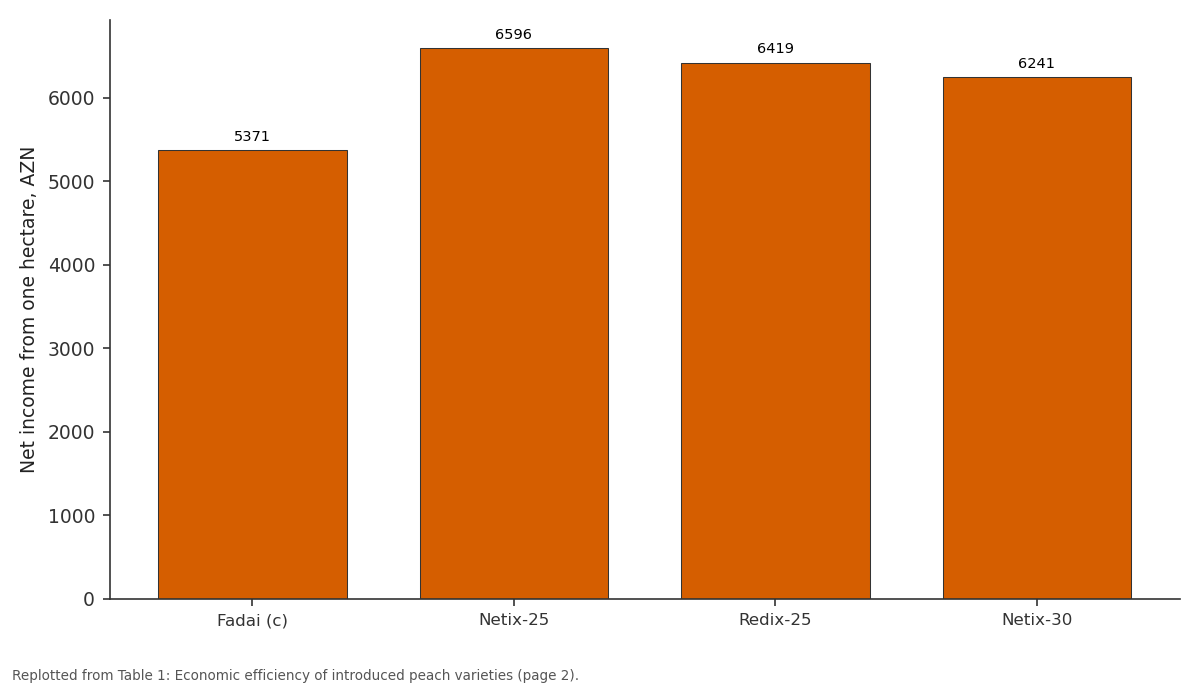
Net income from one hectare, AZN: Fadai (c) vs Netix-25 vs Redix-25 vs Netix-30
Replotted from Table 1 (page 2) of the original paper. Every bar is the paper's own table value.
View source evidence ↗Figures & tables
From the original paper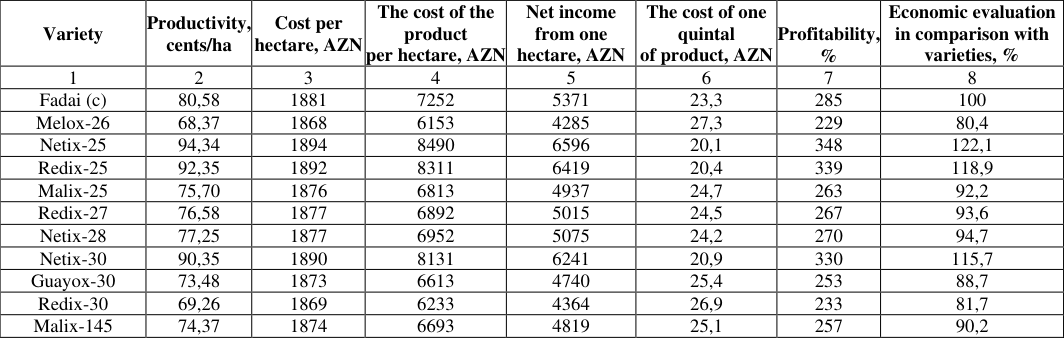 Table 1
Introduction
Ensuring the dynamic development of fruit growing, increasing the interest of farmers and productivity per hectare, the main direction of growing fruit in accordance with market requirements is the study of new, more productive, profitable, disease and pest, as well as frost-resistant varieties of fruit crops. The study of these features facilitates the implementation of all necessary agro-technical measures to obtain a regular, abundant harvest. Low quality of fruits, non-production of varieties that meet the requirements of foreign markets, shortcomings in the period from production to consumption, are considered to be the main reasons for the lack of exports at the desired level [1. s.35] . For this reason, the creation and introduction of new fruit varieties that meet modern market requirements is an important issue. The study, increase of agrobiological properties of newly introduced peach varieties, their use in fruit growing and the acquisition of competitive varieties, their introduction to the world market is a very important issue today. In the field of fruit growing, as in other agricultural sectors, one of the important conditions is to increase productivity per hectare and the resulting net income, profitability and high economic efficiency. To this end, many agricultural breeders, farmers and farm managers have for many years been able to obtain varieties that meet modern market requirements, have high agrobiological characteristics, are profitable and cost-effective, including planting schemes that increase productivity per hectare. worked on shaping and pruning methods. Thus, A.V. Provorchenko and Y.V. Kolcheva note the high yield of chlorophyll in the leaves of trees planted with 5 × 2.5m and 5 × 2m planting schemes and 7.3-8.4 kg of wood. According to its productivity, a higher yield was obtained from the garden planted with a 5 × 1.5 m planting scheme and using VVA-1 seedlings [4 p. 51, 3 p. 61]. A. Trofanyuk and L. Yershov (1974) confirm that the most ideal peach plant for light, aerated soils in the south of Ukraine are Polesskiy, Salvey and Zafran. As a result of the use of almond x peach hybrids, they noted the high development and productivity of peach varieties planted on these hybrids.
As a result of research conducted by N.Y. Smagin in 2007-2018, peach varieties with more high-quality and promising, productive, high-quality fruits -Medin Red, Early Blou, Redhaven, Larisa, Summerset, etc. selected varieties [6 p. 344]. A.J. Rajabli notes that 7 varieties of peach plants were studied and 5 varieties were selected from them. The fruits of the selected varieties ripened on August 24-25. In terms of productivity, Salami took the first place with a productivity of 30 kg/ha. In the book "Fruit plants of Azerbaijan" A.J. Rajabli gave the characteristics of widespread and promising varieties. These varieties include Salami, Amber, White Coy, Orange and others includes. Cansu Dolek (2014) studied the effect of Sunfire nectarine variety on productivity and quality of pruning and breeding systems in greenhouses. The pomological features of the variety indicate that thinning of fruits, winter and summer pruning are carried out, and the conditions give the best results in each of the V and Y breeding systems. Evaluation of orchards is calculated by some experts for fruit trees, while others include the assessment of soil characteristics of the area. Many experts estimate the productivity of orchards in terms of annual net income [2 p. 145]. Important varieties of fruit crops for industrial horticulture are selected as a result of a comprehensive assessment of key economic indicators. The study of economic and biological characteristics of the newly introduced peach varieties in the Guba-Khachmaz economic region has resulted in the selection of several varieties that are better adapted to the soil-climatic characteristics due to one or another feature.
Materials and Methodology
The research work is carried out on 18 peach and nectarine varieties planted in a 5x3m sowing scheme in an area of 0.17 ha, introduced from Spain in the ETB named after Zardabi of MCHETI. Under observation Melox-26, Melox-31, Melox-37, Netix-25, Netix-28, Netix-30, Netix-34, Redix-25, Redix-27, Redix-30, Redix-2-110, Malix-25, Maliks-36, Malix-145, Guayox-30, Guayox-35, Gartairo, Gardeta varieties. The research was carried out on the basis of "Program and methodology of fruit, berry and berry crops" (1999) [5] . The selection of the institute's "Fadai" variety was used as a control in the comparative study of the pomological characteristics of the varieties introduced in the research work.
The purpose of the study Study of agrobiological features of newly introduced peach varieties in Guba-Khachmaz region, as well as active development phases of varieties and selection of highefficiency and productive varieties adapted to the soil and climatic conditions of the region.
Experimental part
We have identified indicators of economic efficiency of newly introduced peach varieties, and these indicators are reflected in Table 1. The average productivity for the research years was 68.37-99.67 sen/ha. As can be seen from the table, Netix-25 (94.34 cent/ha), Redix-25 (92.35 cent/ha), Netix-30 (90, 35 cent/ha), Melox-31 (99.67 cent/ha), Guayox-35 (89.91 cent/ha) and Gardeta (93.01 cent/ha). The cost of 1 quintal of varieties selected for high productivity compared to Fadai (23.3 AZN) varieties Netix-25 (20.1 AZN), Redix-25 (20.4 AZN), Netix-30 (20.9 AZN), Melox-31 (19.0 AZN), Guayox-35 (21.0 AZN) and Gardeta (20.3 AZN) were relatively low (-2.3… -4.3 AZN). The main indicators of economic efficiency are the net income and profitability of 1 hectare of peach orchard. It is clear from Table 1 that the level of profitability by varieties and the net income from 1 ha of garden are different. Compared to the control variety Fadai (5371 AZN), the net income from 1 ha of newly introduced varieties selected for their economic and biological characteristics is Netix-25 (6596 AZN), Redix-25 (6419 AZN), Netix-30 (6241 AZN), Melox-31 (7070 AZN), Guayox-35 (6201 AZN) and Gardeta (6477 AZN). The cost of cultivating 1 ha of garden of introduced peach and nectarine varieties varied between 1868-1900 AZN, the cost of one quintal of product varied between 19.0-27.3 AZN. The level of profitability of research varieties fluctuated between 229-372%. From the varieties Netix-25 (348%), Redix-25 (339%), Netix-30 (330%), Melox-31 (372%), Guayox-35 (328%) and Gardeta (342%) control variety for yield It was significantly higher compared to Fadai (285%). The lowest yield was recorded in Melox-26 with 229%, and the highest in Melox-31 with 372%. Based on the results of the research, economic evaluation of the varieties was conducted. Thus, the economic efficiency of research varieties varies between 80.4% -130.5%, compared to the Fadai (c) variety Netiks-25 (22.1%), Redix-25 (18.9%), Netiks-30 (15.7%), Melox-31 (30.5%), Guayox-35 (15.0%) and Gardeta (20.0%) varieties had relatively high economic efficiency, while other varieties were relatively low.
| Variety | Productivity, cents/ha | Cost per hectare, AZN | The cost of the product per hectare, AZN | Net income from one hectare, AZN | The cost of one quintal of product, AZN | Profitability, % | Economic evaluation in comparison with varieties, % |
|---|---|---|---|---|---|---|---|
| 1 | 2 | 3 | 4 | 5 | 6 | 7 | 8 |
| Fadai (c) | 80,58 | 1881 | 7252 | 5371 | 23,3 | 285 | 100 |
| Melox-26 | 68,37 | 1868 | 6153 | 4285 | 27,3 | 229 | 80,4 |
| Netix-25 | 94,34 | 1894 | 8490 | 6596 | 20,1 | 348 | 122,1 |
| Redix-25 | 92,35 | 1892 | 8311 | 6419 | 20,4 | 339 | 118,9 |
| Malix-25 | 75,70 | 1876 | 6813 | 4937 | 24,7 | 263 | 92,2 |
| Redix-27 | 76,58 | 1877 | 6892 | 5015 | 24,5 | 267 | 93,6 |
| Netix-28 | 77,25 | 1877 | 6952 | 5075 | 24,2 | 270 | 94,7 |
| Netix-30 | 90,35 | 1890 | 8131 | 6241 | 20,9 | 330 | 115,7 |
| Guayox-30 | 73,48 | 1873 | 6613 | 4740 | 25,4 | 253 | 88,7 |
| Redix-30 | 69,26 | 1869 | 6233 | 4364 | 26,9 | 233 | 81,7 |
| Malix-145 | 74,37 | 1874 | 6693 | 4819 | 25,1 | 257 | 90,2 |
Table text extracted from the original PDF; superscript letters are shown inline. The original table image is below.
View original table image
References
2 in the original paper- Okan N. A Study on the Income Valuation of Peach Gardens in Selcuk District of Izmir / Nazli Okan Sait Engindeniz//Ege. Üniv. Ziraat. Fak. Derg. 2016:53(2):139-146. DOI: 10.20289 / zfdergi.388861
- Smagin NE. Analysis of the most productive varieties of peaches in the collection of Vniitsisk//Scientific support of sustainable development of fruit growing and ornamental horticulture Materials of the International Scientific-Practical Conference of September. 2014:23V:342-345.
Cited by 1
From OpenAlex, OpenCitations and reference lists read by Scinovex
- Assessing the mechanical properties of cement-based composite material with partial replacement of cement by sundried cashew nut powder ↗
Wasiu Olabamiji Ajagbe, Tirimisiy Adeniyi Wasiu, John Igeimokhia Braimah · Discover Civil Engineering · 2025
Abstract This study investigates the ability of sun-dried cashew-nut powder (CNP) to serve as a renewable partial replacement for cement in concrete manufacturing. The objective of this research is to examine the mechanical properties and longevity of cement-based composites enhanced with different amounts of CNP. Specific objectives are: to define the chemical, mineralogical and physical attributes of CNP, to measure…
❝ 0PDF