
Research article · 2020 · Full text
International Journal of Agriculture and Food ScienceProfitability and constraints analysis of pulses production in some selected areas of Sirajganj Districtin Bangladesh
Volume 2(1) · Pages 05–10 · DOI: 10.33545/2664844x.2020.v2.i1a.28 ↗
Research areasAgricultural Economics and Practices
Abstract
Author-writtenThe study was conducted in three upazilas of Sirajganj district to estimate profitability of different pulses crops (Kheshari, Lentil and Mung) production and to identify the constraints associated with production of those pulses. To achieve the objectives of the study primary data were collected from 90 farmers through well-developed questionnaire. The sample farmers were selected through purposive sampling technique. Per hectare production cost and returns were determined to analyze profitability of growing pulses from the viewpoints of individual farmers. Profitability was measured in terms of gross return, gross margin, net return and benefit cost ratio (BCR). Results of the study revealed that the highest total cost of production was found in Mung (42476 Tk.. ha-1) and the lowest in kheshari (21818 Tk.. ha-1). Estimated Gross Return of kheshari, lentil and mung was Tk. 46800, Tk. 62280 and Tk. 60250 per ha, respectively. The highest net return was found from lentil cultivation (26906 Tk. ha-1) and the lowest from mung cultivation (17774 Tk. ha-1). The highest BCR was obtained from cultivation of kheshari (2.15) followed by lentil (1.76) and mung (1.42). The results of the study indicated that among the pulses, kheshari production was more profitable. The result of the study also find out some major constraints in producing pulses those were as Lack of technical knowledge, Non availability of good quality seed, High price of input, Low output price, Labour scarcity and high cost, Lack of subsidy for inputs, Weak research and extension linkages, Non availability of suitable literature, Environmental constraints. The results of the study clearly indicated that pulses production is profitable and if government should take some appropriate measure for solving the constraints in pulses production that will enhance increase production of pulses. As a result, the increased production of pulses will contribute to fulfil the per capita plant protein requirement in many respects and the country will able to attain self-sufficiency in pulses production.
Summary
Source-checkedPlain-language reading of the full paper, prepared with AI and checked against the text. Each point links to the authors' own words.
Why it matters
- Bangladesh faces a pulse shortage due to population growth and a significant decrease in cultivation area, which dropped from 7.35 lakh hectares in 1988-89 to 3.57 lakh hectares in 2014-15. View evidence ↗
- Beyond nutrition, pulse crops benefit the environment by fixing nitrogen and adding organic matter to improve soil fertility. View evidence ↗
The question
- The study aimed to estimate the profitability of producing Kheshari, Lentil, and Mung pulses and to identify the constraints farmers face in the Sirajganj district. View evidence ↗
What they did
- The researchers used purposive sampling to select 90 farmers (30 for each pulse type) from the Kazipur, Belkuchi, and Sadar Upazilas of Sirajganj. View evidence ↗
- Primary data were collected through personal interviews using a structured questionnaire. View evidence ↗
- Profitability was analyzed using four metrics: gross return, gross margin, net return, and the benefit-cost ratio (BCR). View evidence ↗
What they found
- Mung had the highest total production cost at 42,476 Tk. ha-1, while Kheshari had the lowest at 21,818 Tk. ha-1. View evidence ↗
- Lentil cultivation yielded the highest gross return at 62,280 Tk. ha-1, followed by Mung (60,250 Tk. ha-1) and Kheshari (46,800 Tk. ha-1). View evidence ↗
- Lentil production provided the highest net return (26,906 Tk. ha-1), whereas Mung production provided the lowest (17,774 Tk. ha-1). View evidence ↗
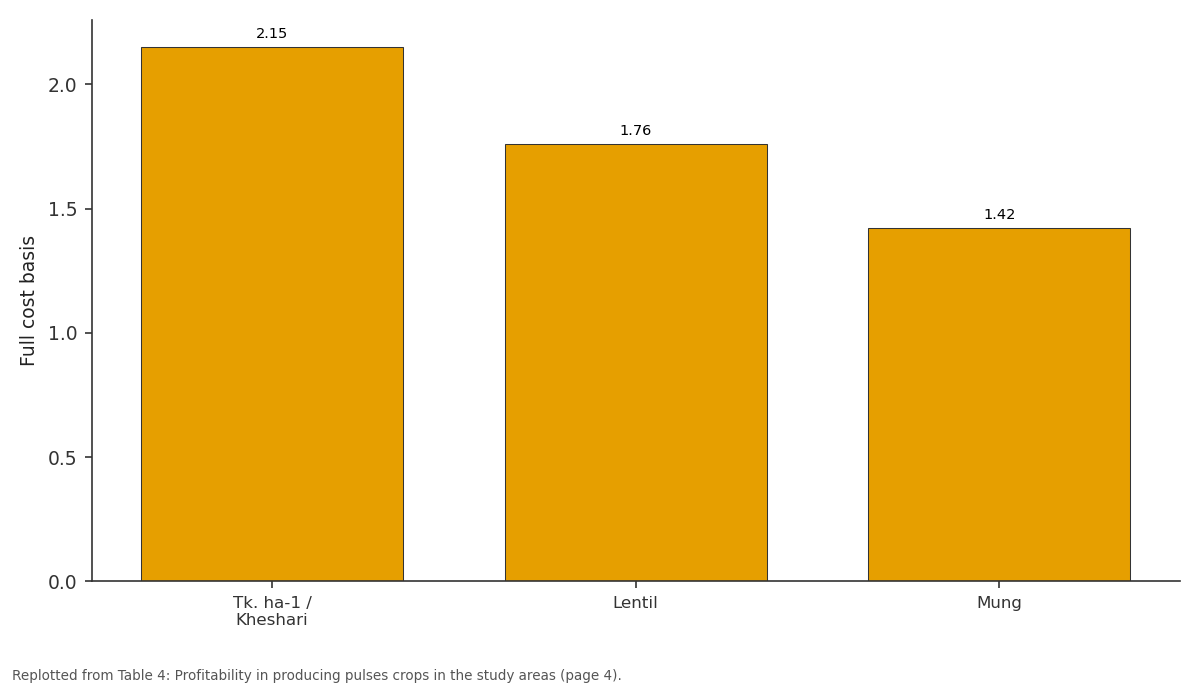
- Kheshari was the most profitable pulse based on the benefit-cost ratio (2.15), while Mung was the least (1.42). View evidence ↗
What it means
- The authors conclude that the government must take initiatives to solve production constraints and motivate farmers to increase national pulse production. View evidence ↗
- Increasing pulse production is recommended to help Bangladesh meet per capita plant protein requirements and achieve self-sufficiency. View evidence ↗
Visual summary
1 visualsIllustrations explain the paper; charts are replotted from the paper's own table values.
Full cost basis: Tk. ha-1 / Kheshari vs Lentil vs Mung
Replotted from Table 4 (page 4) of the original paper. Every bar is the paper's own table value.
View source evidence ↗Figures & tables
From the original paper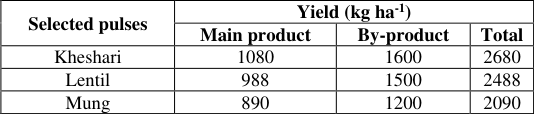 Table 2
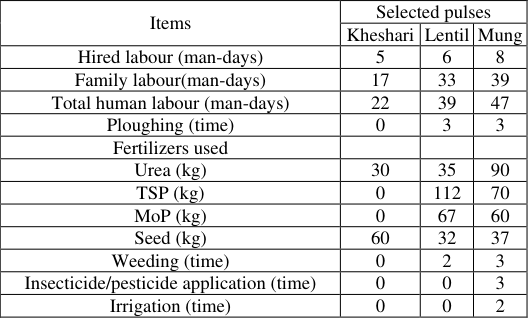 Table 1
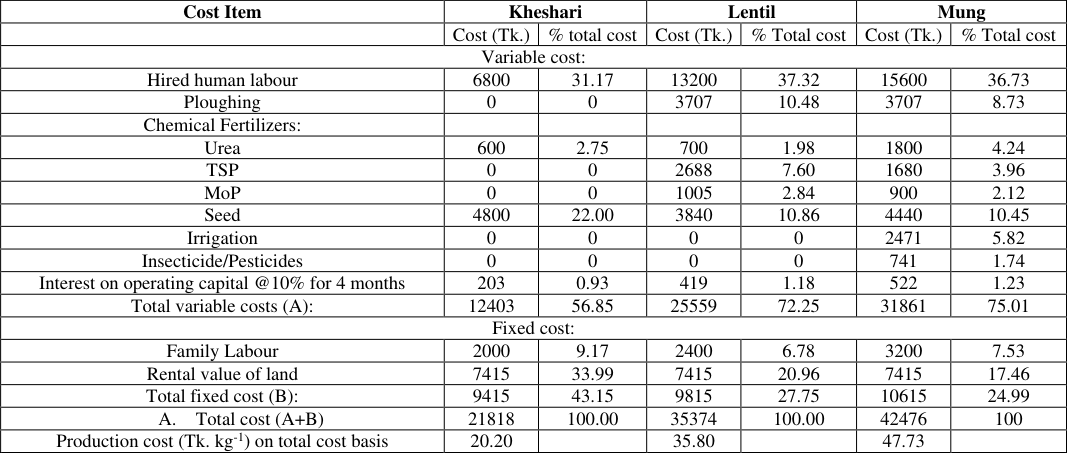 Table 3
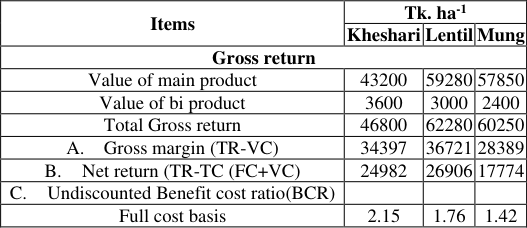 Table 4
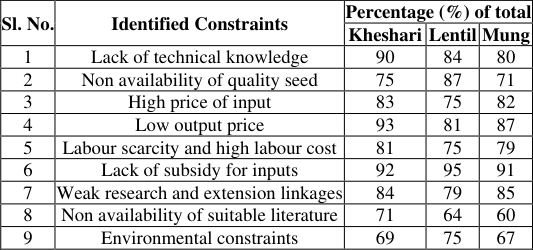 Table 5
Introduction
Bangladesh predominantly is an agricultural country, every place diverse crops viz. cereals, pulses, oilseeds, vegetables and fruits are grown (Salam et al., 2012) [18] . Bangladesh as suitable agroecological conditions for production of a number of pulses and is one of the major potential pulse growing countries of the world, but it has not yet been able to attain self-sufficiency in pulse production. The country is facing acute shortage of pulses due to accelerated increase of requirements with its rapid growth of population. Pulses area decreased from 7.35 lakh hectares in 1988-89 to 3.57 lakh hectares in 2014-15 (BBS, 2015) [2] . Pulses contribute 2.3% value added to agriculture in Bangladesh (Niaz et al., 2013) [17] . Pulses constitute an integral part of human diet and are potential source of protein for the millions of people of Bangladesh. Pulses provide significant nutritional and health benefits, and are known to reduce several non-communicable diseases such as colon cancer and cardiovascular diseases (Yude et al, 1993 [20] ; Jukanti et al, 2012) [13] . Pulses are one of the good sources of high quality oils, proteins, minerals and energy in human diet. They provide the major cheap source of vegetable proteins. They also contain the amino acid lysine; which is generally deficient in food grains (Elias et al., 1986) [6] . Legume crops, especially pulses, play a vital role in rain fed agriculture in Bangladesh. The major pulses are kheshari, lentil, chickpea, black gram, mung bean and cow pea and these are contributed more than 95% of total pulses production in Bangladesh (BBS, 2016) [3] . In Bangladesh, pulse is the great source of protein of diet and it comprises much protein as about twice other than cereals. Apart from these, the crop is capable to fix nitrogen and addition of organic matter to improve soil fertility (Senanayake et al., 1987 [19] ; Zapata et al., 1987) [21] . Animal protein and fish protein are not sufficient to meet up the demand for total population according to their per capita requirement; pulse plays a significant role in this case (Das et al., 2016) [4] . Pulses are considered as ''the meat of the poor'' because still pulses are the cheapest source of protein (Hamjah, 2014) [8] . Pulses are popular and common food, people take this food almost alternate a day, so, this can play an important role to reduce the malnutrition for the poor people of the country if it becomes available to that type of people. The per capita consumption of pulse in Bangladesh is only 14.3 g day -1 , which is much lower than WHO recommendation of 45 g day -1 and Indian Council of Medical Research recommendation of 60 g day -1 (HIES, 2010 [22] ; Afzal et al., 1999) [1] . With the development of irrigation facilities, the area of production of cereal crops has improved significantly, while pulses have been pushed to secondary lands of low yield. The area under pulse crops has declined while the area under rice production has increased (Das and Kabir, 2016) [5] . The average yield of pulses is 1.01 t ha -1 , which is low compared to other neighbouring countries (BBS, 2016) [3] . In the existing farming systems, pulse crops fit well due to its short duration, drought tolerance, less care and minimum input requirement. Cultivation of different pulses is decreasing day by day. The excellent nutrition value of pulses is highly complementary to a cereals-based diet in developing countries. In Bangladesh, a large number of people are suffering from malnutrition. For alleviating human malnutrition for the poorest segment of the country's population, pulses have been identified as crops with exceptional potential. Though, pulses are excellent sources of proteins, but they are treated as minor crops and receive little attention from farmers and policy makers. So the decrease in pulse production is a major concern to the government. Considering the above circumstances, pulse production should be increased rapidly to improve the national nutritional status along with less outflow of precious foreign currency. Many studies (Miah et al., 2004 [16] ; Islam et al., 2011 [12] , 2013 [11] and 2015 [10] ; Kumar et al., 2009 & 2010 [14] ; Gowda et al., 2013 [7] ; Kumar and Bourai, 2012 [15] ; Hamjah, 2014 [8] ; Niaz et al., 2013) [17] . focusing on different pulse crop have been conducted earlier in Bangladesh and India are very general and consider the problem from national or regional points of view while no work has been done on comparative profitably analysis of pulses production as well as constraints associated with pulses production in Sirajganj district. To fulfil the increasing demand of pulses in the country, it is necessary to increase the production of by increasing productivity and increasing total area. Thus, agricultural scientists should come forward to develop good variety of pulses in adverse (unfavourable) weather to meet the increasing demand. If we fail to provide farmers weather suitable and high yielding variety, the production of pulse cannot be increased. But there is a lack of sufficient research in this field. So this study may be helpful for the policy makers, researchers and farmers to deal the comparative profitably of pulses production and problems associated with production of pulses in Bangladesh and their probable solutions.
Materials and Methods
The pulses growing farmers were considered as the population for the study. Keeping in view the objectives the study, altogether 90 farmers were purposively selected taking 30 khesari producing farmers, 30 lentil producing farmers and 30 mung producing farmers from Kazipur, Belkuchi and Sadar Upazila of Sirajganj district. Data were collected both primary and secondary sources to fulfil the objectives of the study. A draft questionnaire was Developed in accordance with the objectives of the present study. Then the draft questionnaire was pretested in the field to verify the accuracy of the questionnaire in the field contest. The draft questionnaire was finalized with required modification after completion of pre-testing in the field. Personal interview method was used to collect data from the pulse producing farmers using structured finalized interview schedule. Utmost care and caution was taken during data collection to get correct information to attain accuracy and reliability of data. The data for the present study covered four months of time. The cost of production is a cumulative result of fixed and variable costs obtained in crop production. Hired labour, ploughing, chemical fertilizers, irrigation, insecticides/pesticides, interest on operating capital (IOC) costs were deliberate as variable cost. All the costs, except IOC were calculated by taking into actual amount of costs incurred by the farmers. Interest on operating capital was computed by taking all variable expenses incurred for various operations throughout the time in pulses production. Interest rate was assumed to be 10 per cent per annum (Interest rate of saving accounts of commercial banks, 2018). The following formula was used to estimate the interest on operating capital:
On the other hand, family supply labour and rental value of land was considered as fixed cost. To calculate the cost of family labour and rental value of land, the opportunity cost principle was applied. Per hectare profitability of growing pulses from the view points of individual farmers was measured in terms of gross return, gross margin and net return. The undiscounted benefit cost ratio (BCR) is a relative measure which was used to compare benefit per unit of cost. It was used to measure relative profitability of pulses production. All the collected data for the study were sorted, scrutinized and analyzed to achieve the objectives of the study. MS excel software was used to analyse the data. Tabular method was used to describe the findings of the study. The following are the some equations for calculating total cost, gross return, gross margin, net return and benefit cost ration:
Total cost (TC)
Total cost was calculated all the cost incurred with the production of pulses. Total production cost was estimated as: Total cost (TC) = Total Fixed cost (TFC) +Total variable cost (TVC)
Gross return (GR)
Gross return was calculated by multiplying the total volume of output (product and by product) of an enterprise by the average price (product and by product) in the harvesting period (Dillion and Hardaker, 1993). The following equation was used to estimate GR:
Where, GR=Gross return from i-th product; Q i = Quantity of the i-th product; P i = Average price of the i-th product; and i = 1, 2, 3................n.
Gross margin (GM)
Gross margin was calculated by the difference between gross return and total variable costs. Thus GM = GR-TVC Where, GM = Gross margin; GR = Gross return; and TVC = Total variable cost
Net return
Net return was calculated by deducting total costs (Variable and Fixed) from gross return. NR = GR-TC (TVC +TFC) Where, NR = Net return; GR = Gross return; TVC = Total variable cost; TFC =Total fixed cost
Benefit cost ratio (BCR)
Benefit cost ratio (BCR) was estimated as a ratio of gross returns and total costs. The formula for calculating BCR was used: BCR =GR/TC Where, GR =Gross return; TC = Total cost
Results and Discussion
Results and Discussion
Pattern of Input Use for Selected Pulses
Farmers used different level of inputs for pulse cultivation. An attempt was made to determine the level of inputs used by the farmers for the selected pulses production (Table 1). Farmers employed on an average 22 man-days (both family & hired) per hectare for kheshari cultivation, which were 39 man-days for lentil cultivation and 47 man-days for mung cultivation. The farmers practiced ploughing three times in both lentil and mung cultivation, but kheshari was cultivated without ploughing and weeding. On an average 35 kg ha -1 Urea, 112 kg ha -1 TSP and 67 kg ha -1 MoP were used for lentil cultivation, whereas it was 90 kg ha -1 , 70 kg ha -1 and 60 kg ha -1 for mung cultivation, respectively. Farmers applied only Urea 30 kg ha -1 for kheshari cultivation in the study areas. It was observed that Urea was common fertilizer that was used in all selected pulses production. Farmers practiced weeding two times for lentil production and three times for mung production whereas no weeding was done in kheshari production. In the study areas pesticides and irrigation were applied only for mung cultivation.
| Items | Selected pulses | — | — |
|---|---|---|---|
| Kheshari | Lentil | Mung | |
| Hired labour (man-days) | 5 | 6 | 8 |
| Family labour(man-days) | 17 | 33 | 39 |
| Total human labour (man-days) | 22 | 39 | 47 |
| Ploughing (time) | 0 | 3 | 3 |
| Fertilizers used | |||
| Urea (kg) | 30 | 35 | 90 |
| TSP (kg) | 0 | 112 | 70 |
| MoP (kg) | 0 | 67 | 60 |
| Seed (kg) | 60 | 32 | 37 |
| Weeding (time) | 0 | 2 | 3 |
| Insecticide/pesticide application (time) | 0 | 0 | 3 |
| Irrigation (time) | 0 | 0 | 2 |
Table text extracted from the original PDF; superscript letters are shown inline. The original table image is below.
View original table image
Yield performance
The average yields of main product (kheshari, lentil, and mung) were 1080 kg, 988 kg and 890 kg per hectare, respectively in the study areas (Table 2). The by-product was produced 1600 kg, 1500 kg and 1200 kg from kheshari, lentil and mung cultivation. Among the selected pulses highest yield was found from kheshari (1080 kg ha -1 ) followed by lentil (988 kg ha -1 ) and mung (890 kg ha -1 ). The farmers mainly used the by-product of the pulses as cattle feed and fuel.
| Selected pulses | Yield (kg ha-1) | — | — |
|---|---|---|---|
| Main product | By-product | Total | |
| Kheshari | 1080 | 1600 | 2680 |
| Lentil | 988 | 1500 | 2488 |
| Mung | 890 | 1200 | 2090 |
Table text extracted from the original PDF; superscript letters are shown inline. The original table image is below.
View original table image
Cost of Cultivation for Selected Pulses
Both variable and fixed cost was estimated in production of pulses. The estimated total variable costs were Tk. 12403, Tk. 25559 and Tk. 31861 per hectare for kheshari, lentil, and mung cultivation, respectively and those were 56.85%, 72.25% and 75.01% of the total cost of production, respectively (Table 3). Among the cost items, hired human labour was the major cost item which shared 31.17%, 37.32% and 36.73% of the total cost, respectively for kheshari, lentil and mung production. Ploughing cost was accounted 10.48% of total cost for lentil cultivation and 8.73% for mung cultivation. No ploughing cost was found in case of kheshari cultivation in the study area. Fertilizer cost for kheshari was estimated 2.75% of total cost. Fertilizer costs were calculated as 1.98% of total cost for urea, 7.60% for TSP and 2.84% for MoP in lentil production and those were 4.24%, 3.96% and 2.12%, respectively for mung production. Seed cost was estimated 22.00% of total cost for kheshari, 10.86% for lentil and 10.45% for mung cultivation. Rental value of land and family supplied labour were considered as fixed cost of production for selected pulses. Calculated family labour costs were 9.17% of total cost for kheshari, 6.78% for lentil and 7.53% for mung production. Rental value of land costs were estimated 33.99% of total cost for kheshari, 20.96% for lentil and 17.46% for mung cultivation. On an average per hectare total cost of production was Tk. 21818 for kheshari cultivation, Tk. 35374 for lentil cultivation and Tk. 42476 for mung cultivation. It was observed that the total cost for mung cultivation was highest (81,268 Tk. ha -1 ) compared to other two selected pulses due to use of high amount of inputs, especially human labour and chemical fertilizers. The cost of production per kilogram kheshari was Tk. 20.20, lentil was Tk. 35.80 and mung was Tk. 47.73.
| Cost Item | Kheshari | — | Lentil | — | Mung | — |
|---|---|---|---|---|---|---|
| Cost (Tk.) | % total cost | Cost (Tk.) | % Total cost | Cost (Tk.) | % Total cost | |
| Variable cost: | ||||||
| Hired human labour | 6800 | 31.17 | 13200 | 37.32 | 15600 | 36.73 |
| Ploughing | 0 | 0 | 3707 | 10.48 | 3707 | 8.73 |
| Chemical Fertilizers: | ||||||
| Urea | 600 | 2.75 | 700 | 1.98 | 1800 | 4.24 |
| TSP | 0 | 0 | 2688 | 7.60 | 1680 | 3.96 |
| MoP | 0 | 0 | 1005 | 2.84 | 900 | 2.12 |
| Seed | 4800 | 22.00 | 3840 | 10.86 | 4440 | 10.45 |
| Irrigation | 0 | 0 | 0 | 0 | 2471 | 5.82 |
| Insecticide/Pesticides | 0 | 0 | 0 | 0 | 741 | 1.74 |
| Interest on operating capital @10% for 4 months | 203 | 0.93 | 419 | 1.18 | 522 | 1.23 |
| Total variable costs (A): | 12403 | 56.85 | 25559 | 72.25 | 31861 | 75.01 |
| Fixed cost: | ||||||
| Family Labour | 2000 | 9.17 | 2400 | 6.78 | 3200 | 7.53 |
| Rental value of land | 7415 | 33.99 | 7415 | 20.96 | 7415 | 17.46 |
| Total fixed cost (B): | 9415 | 43.15 | 9815 | 27.75 | 10615 | 24.99 |
| A. Total cost (A+B) | 21818 | 100.00 | 35374 | 100.00 | 42476 | 100 |
| Production cost (Tk. kg-1) on total cost basis | 20.20 | 35.80 | 47.73 |
Table text extracted from the original PDF; superscript letters are shown inline. The original table image is below.
View original table image
Profitability of pulses Crop
Value of main product and value of by-product were considered in calculating gross return from production of kheshari, lentil and mung. On an average estimated gross return were 46800 Tk. ha -1 for kheshari, Tk. 62280 for lentil and Tk. 60250 for mung cultivation (Table 4). The highest gross return was obtained from lentil cultivation (62280 Tk. ha -1 ) compared to other two pulses. Gross margin was estimated 36721 Tk. ha -1 for lentil production which was the highest compare to Gross margin of kheshari (34397 Tk. ha -1 ) and mung (28389 Tk. ha -1 ). The highest net return was found 26906 Tk. ha -1 for lentil production and was the lowest for mung cultivation (17774 Tk. ha -1 ). The highest (2.15) undiscounted benefit cost ratio (BCR) was found from khesari cultivation and the lowest (1.42) from mung cultivation because of comparative higher production cost for mung and lentil cultivation.
| Items | Tk. ha-1 | — | — |
|---|---|---|---|
| Kheshari | Lentil | Mung | |
| Gross return | |||
| Value of main product | 43200 | 59280 | 57850 |
| Value of bi product | 3600 | 3000 | 2400 |
| Total Gross return | 46800 | 62280 | 60250 |
| A. Gross margin (TR-VC) | 34397 | 36721 | 28389 |
| B. Net return (TR-TC (FC+VC) | 24982 | 26906 | 17774 |
| C. Undiscounted Benefit cost ratio(BCR) | |||
| Full cost basis | 2.15 | 1.76 | 1.42 |
Table text extracted from the original PDF; superscript letters are shown inline. The original table image is below.
View original table image
Constraints in pulses production 3.5.1. Lack of technical knowledge
Ninety per cent of kheshari producing farmers, eighty four per cent of lentil producing farmers and eighty per cent of mung producing farmers expressed that lack of technical knowledge about improved varieties, seed rate, spacing, sowing date, knowledge about fertilizer dosage and time of application, knowledge about insect pest and diseases management were the constraints in production of pulses in the study areas (Table 5).
| Sl. No. | Identified Constraints | Percentage (%) of total | — | — |
|---|---|---|---|---|
| Kheshari | Lentil | Mung | ||
| 1 | Lack of technical knowledge | 90 | 84 | 80 |
| 2 | Non availability of quality seed | 75 | 87 | 71 |
| 3 | High price of input | 83 | 75 | 82 |
| 4 | Low output price | 93 | 81 | 87 |
| 5 | Labour scarcity and high labour cost | 81 | 75 | 79 |
| 6 | Lack of subsidy for inputs | 92 | 95 | 91 |
| 7 | Weak research and extension linkages | 84 | 79 | 85 |
| 8 | Non availability of suitable literature | 71 | 64 | 60 |
| 9 | Environmental constraints | 69 | 75 | 67 |
Table text extracted from the original PDF; superscript letters are shown inline. The original table image is below.
View original table image
Non availability of quality seed
Seventy five per cent of kheshari producing farmers, eighty seven per cent of lentil producing farmers and seventy one per cent of mung producing farmers identified non-availability of quality seed as a constraint in pulses production. They do not have access to high yielding varieties of pulses.
High price of input
Eighty three per cent of kheshari producing farmers, seventy five per cent of lentil producing farmers and eighty two per cent of mung producing farmers mentioned that high price of input was a constraint in pulses production.
Low output price
Ninety three per cent of kheshari producing farmers, eighty one per cent of lentil producing farmers and eighty seven per cent of mung producing farmers stated that low output price was a constraint in pulses production.
Labour scarcity and high labour cost
Eighty one per cent of kheshari producing farmers, seventy five per cent of lentil producing farmers and seventy nine per cent of mung producing farmers indicated that labour scarcity and high labour cost was a another constraint in pulses cultivation.
Lack of subsidy for inputs
Ninety two per cent of kheshari producing farmers, ninety five per cent of lentil producing farmers and ninety one per cent of mung producing farmers mentioned lack of subsidy for inputs was a constraint in pulses farming. As a result the production cost of the pulses increased and net return reduced.
Weak research and extension linkages
Eighty four per cent of kheshari producing farmers, seventy nine per cent of lentil producing farmers and eighty five per cent of mung producing farmers explained that weak research and extension linkage was a constraint for pulses production. They stated that they do not know the updated information of improved technologies due to weak research -extension linkage.
Non availability of suitable literature
Seventy one per cent of kheshari producing farmers, sixty four per cent of lentil producing farmers and sixty per cent of mung producing farmers described that non-availability of suitable literature for pulse crops production was a constraint in producing pulses. They argued that if they have available material related to production, preservation and marketing of pulses they might be more benefited.
Environmental constraints
Sixty nine per cent of kheshari producing farmers, seventy five per cent of lentil producing farmers and sixty seven per cent of mung producing farmers stated some environmental related constraints such as excessive rain after flowering, terminal draught and low soil moisture at the time of sowing and fruiting that hampered pulses production.
References
22 in the original paper- Afzal MA, Baker MA, Rahman ML. Lentil cultivation in Bangladesh. Lentil, Blackgram and Mungbean Development Pilot project, Pulses Research Station, BARI, Gazipur, 1999, 1701.
- BBS. Bangladesh Bureau of Statistics, Statistical Year book of Bangladesh, Statistics Division, Ministry of Planning, GOB, 2015.
- BBS. Bangladesh Bureau of Statistics, Statistical Year book of Bangladesh, Statistics Division, Ministry of Planning, GOB, 2016.
- Das KR, Sarker JR, Akhter S. Measurement of inconsistency between area and production of pulse in Bangladesh. International Journal of Statictics and Applications. 2016; 6:89-95.
- Das S, Kabir W. Pulses production in Bangladesh: status and drivers for enhancement, 2016. A poster: https://doi.org/10.7490/f1000research. 113388.1
- Elias SM, Hossain MS, Sikder FS, Ahmed J, Karim MR. Identification of contrains to pulse production with special reference to present farming systems. Annual Report of the Agricultural Economic Division, BARI, Joydebpur, 1986, 1.
- Gowda CL, Laxmipathi S, Srinivasan P, Gaur M, Saxena KB. Enhancing the Productivity and Production of Pulses in India. Indian Society of Pulses Research and Development, IIPR, Kanpur, India, 2013.
- Hamjah MA. Climatic Effects on Major Pulse Crops Production in Bangladesh: An Application of Box-Jenkins ARIMAX Model, J. Economics and Sustainable Development, 2014, 5(15).
- Mengistu Meresa. The role of agricultural extension service on agricultural development: The case of Walayta Sodo Zuria District, Ethiopia. Int. J Agric. Extension Social Dev. 2020;3(1):07-13.
- Islam QMS, Firuz JM, Mohiuddin M, Choudhury MAR. Financial analysis of lentil production-benefits and constraints: case for mid-western parts of Bangladesh. Bangladesh Journal of Progressive Science and Technology (BJPST). 2015; 13(1):044-049.
- Islam QMS, Miah MAM, Rahman MS, Hossain MS. Adoption of BARI mung varieties and its constraints to higher production in southern region of Bangladesh. Bangladesh Journal of Agricultural Research. 2013; 38(1):85-96.
- Islam QMS, Rahman MS, Hossain MA, Hossain MS. Economic analysis of mungbean (Vigna radiata) cultivation in some coastal areas of Bangladesh. Bangladesh Journal of Agricultural Research. 2011; 36(1):29-40.
- Jukanti AK, Gaur PM, Gowda CLL, Chibbar RN. Nutritional quality and health benefits of chickpea (Cicer arietinum L.): a review. British Journal of Nutrition. 2012; 108:11-26.
- Kumar P, Peshin R, Nain MS, Manhas JS. Constraints in pulses cultivation as perceived by the farmers. Rajsthan Journal of Extension Education. 2009; 17(18): 33-36.
- Kumar S, Bourai VA. Economic Analysis of Pulses Production Their Benefits and Constraints (A Case Study of Sample Villages of Assan Valley of Uttarakhand, India). IOSR Journal of Humanities and Social Science (IOSRJHSS). 2012; 1(4):41-53.
- Miah MAM, Akter MS, Bak MA. Status of pulses varieties adoption in Bangladesh: a farm level study. Bangladesh Journal of Agricultural Economics. 2004; 27(2):107-122
- Australian Journal of Basic & Applied Sciences. 2013; 7(2):819-824.
- Salam MA, Rashid MA, Muktadir MA. Economic assessment of mustard and groundnut production in selected areas of Bangladesh. Bangladesh Journal of Agriculture, 2012; 37:1-10.
- Senanayake L, Knievel DP, Stevena SE. Nodulation and symbiosis nitrogen fixation of cowpea (Vigna unguiculata L.). Plant Soil. 1987; 99:435-439.
- Yude C, Kaiwei H, Fuji L, Jie Y. The potential and utilization prospects of kinds of wood fodder resources in Yunnan. Forestry Research. 1993; 6:346-350.
- Zapata F, Danso SKA, Hardarson G, Fried M. Nitrogen fixation and translocation in field-grown fababean. Agronomy Journal. 1987; 79:505-509.
- HIES. Preliminary report of Household Income and Expenditure Survey. Bangladesh Bureau of Statistics, Ministry of Planning, GoB, Dhaka, 2010.