
Research article · 2020 · Full text
International Journal of Agriculture and Food ScienceAssessment of determinants to choice of informal credit sources by broiler farmers in Enugu state, Nigeria
Volume 2(1) · Pages 55–60 · DOI: 10.33545/2664844x.2020.v2.i1a.79 ↗
Research areasLivestock and Poultry Management
Abstract
Author-writtenOne hundred and twenty livestock farmers selected using multi-stage random sampling techniques were used for the study. Structured questionnaire and oral interview were used to collect information for the study. Percentage responses and multinomial logistics regression analysis were used to capture the objectives. The results show that the major informal institutional loan sources by the respondents were Rotating Savings and Credit Associations (ROSCAs) and personal savings. Also, the determinant factors to choice of informal sources of credit access were age of the farmer, educational level, land holding, membership of organization, flock size and rearing status. There is need to enhance farmers’ access to credit facility, educational program and to encourage farmers to form or join cooperative society.
Summary
Source-checkedPlain-language reading of the full paper, prepared with AI and checked against the text. Each point links to the authors' own words.
Why it matters
- Broiler production is seen as a way to address inadequate animal protein intake in Sub-Saharan Africa, including Nigeria. View evidence ↗
- Broiler farming requires significant capital and labor, making it difficult for farmers to improve productivity without financial support. View evidence ↗
- Many farmers in Nigeria rely more on informal credit sources than formal ones to finance their agricultural businesses. View evidence ↗
The question
- The study aims to identify the factors that determine which informal credit sources broiler farmers in Enugu State, Nigeria, choose. View evidence ↗
What they did
- Primary data were collected using oral interviews and structured questionnaires. View evidence ↗
- The study analyzed the data using percentage responses and a multinomial logit (MNL) regression model. View evidence ↗
What they found
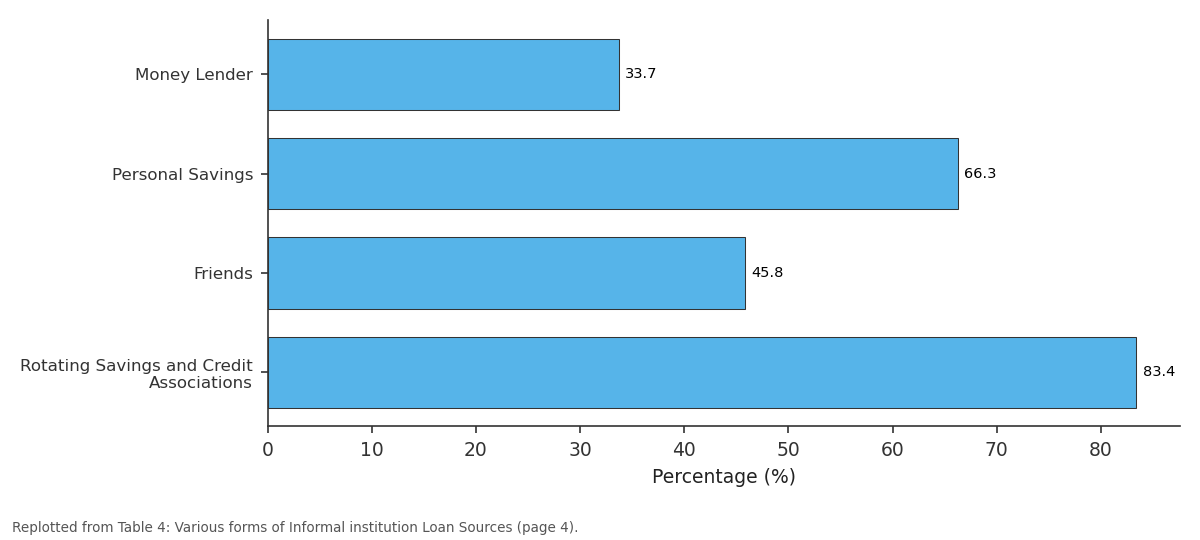
- The most common informal credit sources were Rotating Savings and Credit Associations (ROSCAs), used by 83.4% of farmers, and personal savings, used by 66.3%. View evidence ↗
- Money lenders were the least preferred informal credit source, used by only 33.7% of the respondents. View evidence ↗
- The age of the farmer significantly and positively influenced the choice of informal credit sources, except for money lenders. View evidence ↗
- Educational level had a positive and significant effect on the choice of all informal credit sources. View evidence ↗
- Landholding acquired through purchase or inheritance significantly affected the ability to access informal credit. View evidence ↗
- Flock size significantly influenced the choice of using personal savings as a credit source. View evidence ↗
- Membership in an organization, particularly cooperatives, increased the likelihood of accessing credit from ROSCAs and friends. View evidence ↗
- Part-time farmers were more likely to use all types of informal credit sources compared to full-time farmers. View evidence ↗
What it means
- The authors conclude that ROSCAs and personal savings are the primary informal credit sources, and that choice is determined by age, education, farm size, organization membership, flock size, and rearing status. View evidence ↗
- The authors recommend encouraging farmers to join cooperatives to improve their access to loans and production inputs. View evidence ↗
Visual summary
1 visualsIllustrations explain the paper; charts are replotted from the paper's own table values.
Frequency: Money Lender vs Personal Savings vs Friends vs Rotating Savings and...
Replotted from Table 4 (page 4) of the original paper. Every bar is the paper's own table value.
View source evidence ↗Figures & tables
From the original paper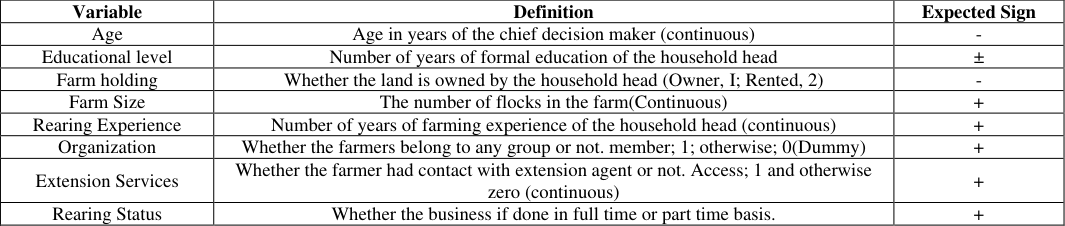 Table 1
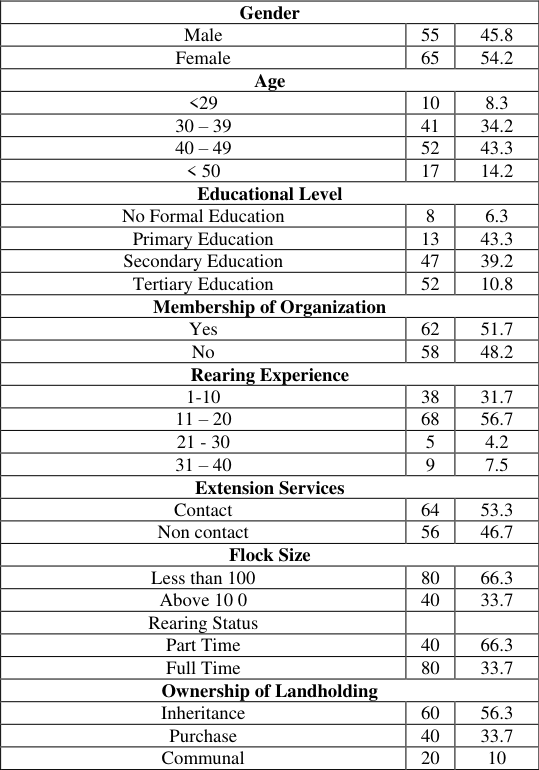 Table 2
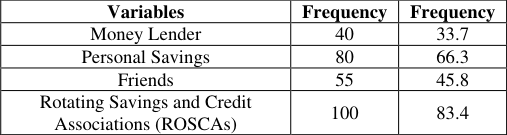 Table 4
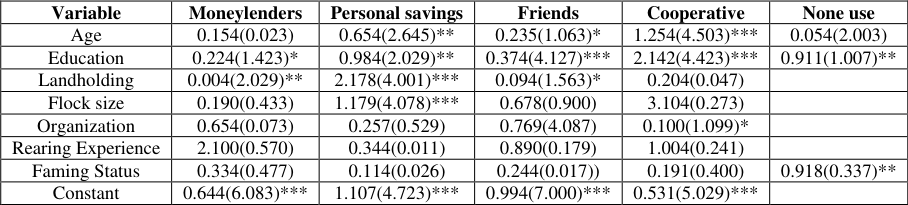 Table 5
Introduction
Food and Agriculture Organization (FAO) recommended that 35g out of the required minimum of 65-72g of reference protein should be obtained from animal products. However, it is well documented that the protein intake per capita per day among many countries in Sub-Saharan Africa, Nigeria is inadequate. The statistics stood between 7.6 and 13.26g (FAO 2011) [5] . Poultry, particularly broiler because of its huge potentials can be explored to bridge the animal protein inadequacy. A broiler is any chicken (Gallus gallus domesticus) that is bred and raised specifically for meat production (Abiola, Omotosho, Adeniyi and Ayoade, 2015) [1] . Also, apart from its aforesaid important feature, other characteristics are; has white feathers and yellowish skin with a flexible breast bone cartilage, pliable and tender meat (FAO, 2011) [5] , and reaches slaughter weight between four and seven weeks of age, although slower growing breeds reach slaughter weight at approximately 14 weeks of age ( FAO, 2012) [6] . Broiler production is both capital and labour intensives, hence improving on the production and productivity of the enterprise becomes an uphill task, judging from the intrinsic features of the farming (rearing) population. Davido, (2012) reported that the farmers have low savings capacity, poorly developed rural financial markets and limited low adoption of improved technologies whose adoption is limited by dearth of funds. Therefore, the need to seek financial assistance inform of credit to sustain the business is very imperative, either from informal or informal sources or both. In Nigeria and many countries in Africa, the role of informal sector in financing the poor resource farmers is well documented. Literatures show that most of the farmers access loans for agricultural business from non-formal sector compare to formal sector (Ijere, 1999; Ogbe, 2004; FAO, 2012; Davdo, 2012) [6, 9, 4,, 13] .The reasons often deduced, included unregulated money supply, easy accessibility, easy liquidity, low administrative and procedural costs, little or no collateral, and flexibility in interest rates and repayment schedules flexibility in times of unexpected income distress (Ijere, 1999; Davdo, 2012) [9,4] . According to Anozie, Ume, Okelola, Anozie, Ubani, (2014) [3] , the informal sources available to the farmers in Nigeria are money lenders, personal savings, friends and Rotating Savings and Credit Associations (ROSCAs). Nevertheless, the choice of any of the informal lending agencies depends on a number of factors, including socioeconomic, environmental and non-institutional factors (Rahji, 2000) [18] . Several studies have identified specific variables which may positively or negatively affect the choice of particular informal sector. For instance, Abiola, et al; (2015) [1] identified some of them to include; farmers' education level, age, membership of organization, farming status, flock size and land holding. Furthermore, the other informal institutional factors that could influence the choice of the informal sector type included, nature of collateral demanded, interest rate, volume of the loan demanded, time of loan disbursement, credit terms (grace period, moratorium and modalities of loan repayment (Ogbe, 2004; Davdo, 2012) [4,13] . Therefore, there is need to explore the determinants to choice of credit sources by farmers in the study area. This is imperative given the fact that no known published work to the best knowledge of the researcher in the subject area. This research may possibly be of immense gains to researchers and policy planners in policy making on how best to boost the performances of the informal loan source. The study could further serve as source of research information for scholars for further studies in related subjects and to also provide useful information for agricultural extension agents for effective dissemination to farmers. Specifically, the objectives of the study are to: 1. describe the socioeconomic characteristics of the farmers;
Sampling procedure and sampling size
A multi-stage random sampling technique was used to select Local Government Areas (LGAs), towns and broiler farmers. First, ten (10) out of sixteen (16) LGAs were randomly selected. Secondly, three communities were randomly selected from each
LGAs. This brought to a total of thirty (30) communities. Thirdly, four (4) broiler farmers were randomly selected from each of the communities. This brought to a total of one hundred and twenty farmers for detailed study.
Method of data collection
Structured questionnaire and oral interview were used to collect primary data, while secondary data were obtained through journals, proceedings, conference paper, published and unpublished papers and other periodicals.
Analytical techniques
The percentage responses and multinomial logit regression analysiswere used to address the objectives of the study.
Model specification Multinomial logit regression
The Multinomial Logit (MNL) model is used to analyse the factors influencing choice of the factors influencing farmers' choice of informal sources of credit among livestock farmers in South East. The model was favored because it allows the analysis of decisions across more than two groups in the dependent variable; therefore it becomes possible to determine choice probabilities for the different informal credit sources. On the contrary, the binary probit or logit models are limited to a maximum of two choice categories (Maddala, 1983). The MNL was chosen for this study because it is simple to compute than its counterpart, the multinomial probit model (Hassan and Nhemachena, 2008) [7] .
The MNL model is expressed as follows:
Where y denotes a random variable taking on the values {1, 2, …, J} for a positive integer J and x denote a set of conditioning variables. X is a 1xK vector with first element unity and βj is a K×1 vector with j = 2, …, J. In this case, y denotes informal credit sources, while x denotes socioeconomic characteristics of the livestock farmer. The question is how changes in the householdss' characteristics influence the answer probabilities P(y = j/x), j = 1, 2, …, J. Since the likelihoods should be sum to unity, P(y = j/x) is determined once the probabilities for j = 1, 2, …, J are identified. In this research, the choice of informal credit employed in the study area were considered, after which the utmost shared techniques desired by farmers (or decision categories) were acknowledged. These methods embraced the decision categories for the multinomial Logit model. To ensure for the parameter estimates of the MNL model in Eq. ( 1) to be impartial and reliable, the Independence of Irrelevant Alternatives (IIA) is expected to happen (Deressa et al., 2008).
The IIA postulation entails that the chance of using one informal credit source by a specific livestock farmer should be independent of the prospects of selecting another souces of informal credit (that is, Pj/Pk is independent of the remaining probabilities). The basis of this assumption is the independent and homoscedastic disturbance terms of the basic model in Eq. ( 1). The parameter estimates of the MNL model merely afford the course of the influence of the independent variables on the dependent (choice) variable; thus the estimates symbolize neither the real importance of change nor the odds. Instead, the marginal effects are employed to determine the likely variation in prospect of a specific method being chosen with respect to a unit change in an independent variable from the mean (Greene, 2000) [14] . To obtain the marginal effects for the model, Eq. ( 1) is differentiated with respect to the explanatory variables as shown in Eq. ( 2):
It has also been noted that the signs of the marginal effects and respective coefficients may be different (Hassan and Nhemachena, 2008) [7] , since the former depends on the sign and magnitude of all other coefficients.The empirical specification for examining the influence of explanatory variables which are described in Table 1 on the choice of credit from informal sources could be represented as thus;
| Variable | Definition | Expected Sign |
|---|---|---|
| Age | Age in years of the chief decision maker (continuous) | - |
| Educational level | Number of years of formal education of the household head | ± |
| Farm holding | Whether the land is owned by the household head (Owner, I; Rented, 2) | - |
| Farm Size | The number of flocks in the farm(Continuous) | + |
| Rearing Experience | Number of years of farming experience of the household head (continuous) | + |
| Organization | Whether the farmers belong to any group or not. member; 1; otherwise; 0(Dummy) | + |
| Extension Services | Whether the farmer had contact with extension agent or not. Access; 1 and otherwise zero (continuous) | + |
| Rearing Status | Whether the business if done in full time or part time basis. | + |
Table text extracted from the original PDF; superscript letters are shown inline. The original table image is below.
View original table image
Where This was in line with a prior expectation that most of the broiler farmers were females. This could be attested to the fact that broiler keeping is regarded as females business in Nigeria and as a means of getting income to support their families (Okorie 1998; Anozie; et al. 2014) [3] . However, males, nowadays according to Nnana, (2004) are closing up the gap because of importance of protein especially animal protein to households' welfare in terms of provision of food, generation of employment and income. Furthermore, 42.5% of the farmers in the study area fell below 40 years. This age group is usually innovative and motivational, hence could access loan from any of the informal sources such as friends, family etc to enhance their production and productivity (FAO, 2011) [5] . Further, 93.7% of the total respondents had formal education; while 6.3 % did not. Education and training are important factors that could enhance farmers' ability to understand, accept and evaluate new innovations for high output. This scenario could propel the farmers seek for loan from any of taahe noinstitutional sector to actualize their goal (s) (Anozie, et al. 2014) [3] More so, 51.7% of the sampled farmers were members of organization such as cooperatives society young farmers' club, etc, whereas 48.2 % were not. Farmers' cooperative society aids in capacity building of the her members, procuring of inputs and in giving technical assistants in given a technology, hence inducing such farmer in procuring loan to better his/ he welfare through improved farm output ( Nwaru, 2004) [12] . As well, 56.7% of the farmers studied had between 11 -20 years rearing experience, 31.7%; 1 -5 years, and 7.5%; 31 -40 years and 4.2%; 21 -30 year. The numbers of years of rearing experience a farmer has, the more he /she could seek loan, since they can competently transcend certain precincts to animal rearing for high production to result (Nwaru, 2004) [12] . Also, 53.3% of the sampled farmers had access to extension services, while 46.7 % did not. Extension services boosts farmers' moral in borrowing credit by enhancing their access to improved production technologies and technical assistant to that affect (Okunade, 2010) [17] . Moreover, 66.3% of the farming households had flock size of 100 birds and above, while, 33.7% had below100.birds. Flock size played an important role in farm success because it reflects the availability of capital, access to credit and even good management ability (Ume,; et al. 2018) [19] As well, most (66.3%) of the respondents were part time farmers, while 33.7% were full timed. Part time farmers have other major self-sources (multi-stream of income) to rely upon for the broiler business. (Ume, et al. 2017) [21] . Besides, 56.3% of the respondents acquired their landholding through inheritance, 33.7%; purchase and the least (10%); communally. Ume, et al. (2016) opined that land acquired through inheritance and purchase could be used as collateral to source credit from the lending agencies and as well for long time development programs compare to those farmers without personal holding.
Results and Discussion
Results and Discussion
Informal loan sources and determinant factors to the choice of informal sector loan sources
The source of informal sector loan access as reported in Table 7a revealed that most (83.4%) of the respondents sourced their credits from Rotating Savings and Credit Associations (ROSCAs). The preference for this credit source could be linked to low interest rates and the ability of the informal sector type to meet the volume of funds as demanded by the borrowers (Ijere, 1990; Nnanna, 2004) [8] . This was seconded by use of personal saving, as shown in the Table by 66.3% of the total respondents. Here, most of the farmers (borrowers) use personal saving to avoid risks associated with loan repayment and as result of inability to produce mandatory collaterals as demanded by lending agencies (Ume, et al; 2018) [19] . The least (33.7%) among the informal sector lending agency consider was money lender. The disapproval of the use of money lender as avenue of accessing credit for business by more borrowers may perhaps not be unconnected to the high interest charged by them and as well, their insensitive to loan repayment modalities(Ijere and Mbanasor, 1998) [8] .
Result of Multinomial Logit Model
The coefficient of age of farmer was statistical significant as shown in Table 5 and had a positive correlation with the choice of credit from informal sector sources with exemption of money lenders, which often involved high interest rate and short grace period that most aged persons may not be proficient to cope with. The finding of Adebayo and Adeola, (2010) [2] did not complement to the aforesaid statement. They opined that aged farmers are usually experienced through years of experimentation to circumvent production difficulties and this translate to high income to upset the principal loan amount accessed from lending agencies and interest rate accruing at the appointed time frame. As well, the coefficient of the educational level of the respondents had a positive and significant effect to all the choice of informal sources of credit access as shown in Table 6b. This may perhaps be due to the fact that educated farmers could source their credits from friends made through social interactions and may possibly also engage in well paid off-farm employment to generate income to shoulder livestock business from accumulations of his/her savings, without course of borrowing from any informal source (Davdo, 2012) [4] . Furthermore, the coefficient of landholding particularly that acquired through inheritance and purchases had significant effect on access to credit from informal sector. A unit increase in the farm holding of the respondents may possibly synonymous to an increase in the likelihood of accessing credit from informal sources such as money lenders, personal savings and friends in order to establish or manage their livestock business. Osondu , Ogbonna, and Emerole, (2015) [16] findings agreed with the aforementioned statement. They reported that farmers that own large farm holdings could use it as collateral to secure loan from informal sector sources, and as well, might sell part of it and start livestock business with the accruing finances. In contrast, Ume; et al. (2018) [19] reported that many farm holdings in South East, Nigeria are fragmented, scattered and not contiguous, that generating fund through their sales may be farfetched. More so, the coefficient of flock size had a significant effect in accessing credit by influencing the choice of personal saving as source of credit for his/her livestock business. Literatures inferred that flock size could serve as source of wealth creation and in many traditional societies in sub Saharan Africa as source of saving which could be disposed off to prevail over financial challenges (Osondu , et al, 2015) [16] . In addition, the coefficient of membership of organization was positive signed, which implies that farmers who are members of cooperative have more odds of having access to credit, especially where it is savings and credit Association than none member and from friends. Literatures show that farmers who are members of cooperative have adequate access to credit and at lower interest rate and from personal friends made as cooperator (Ijere and Mbanasor, 1998; Ogbonna and Osondu; 2015) [8,16] . The coefficient of rearing status of the livestock farmers was significant and had negative effect on access to credit from informal lending sector, implying that farmers that are into part time in livestock production, have greater propensity of using all the informal sources of credit acquisition in procuring credits for their business. Part-time farmers as reported by Rahji, (2000) [18] . devotes about three quarter, 75% of their working hours to activities other than farming, hence could have mandatory asserts as collateral for loan procurement as demanded by informal lending agencies Moreover, part time farmers have substantial savings ensuing from other business indulgence and this can be plug into the broiler business, for example compares to full time ones who spends about three quarter, 75% of his working hours in farming (Rahij, 2000) Conclusion and Recommendation: The major informal institutional loan sources by the respondent were through Rotating Savings and Credit Associations (ROSCAs) and personal savings. As well, the determinant factors to choice of informal sources of credit access were age of the farmer, educational level, farm size, membership of organization, flock size and rearing status Based on the findings of this research, the following recommendations were made 1. Extension agents should be encouraged to be active in their duties through provision of incentives and adequate training in the subject area, for ease of dissemination of agricultural innovations and their technical assistants to the farmers. 2. Farmers should be encouraged to form or to join cooperatives in order to have access to production inputs at reduced prices and to harness farmers' skills through training in the chosen vocation for ease of access to loan. 3. There is need to enhance farmers' educational status through adult education, workshops, seminars and conferences, since the level of education of the farmers could affect their access to loan. 4. Farmers are always advised to keep large flock size, as this could serve as source of income when some of them are disposed off in trying to off-set some financial difficulties in the farm instead of seeking for shylock loans from many informal sources. 5. Farmers are encouraged to engage in off-farm employment in order to augment their farm income in overcoming their farm financial limitations in bids to expand their farming frontier, payment of labour and procuring of production inputs.
| Variable | Moneylenders | Personal savings | Friends | Cooperative | None use |
|---|---|---|---|---|---|
| Age | 0.154(0.023) | 0.654(2.645)** | 0.235(1.063)* | 1.254(4.503)*** | 0.054(2.003) |
| Education | 0.224(1.423)* | 0.984(2.029)** | 0.374(4.127)*** | 2.142(4.423)*** | 0.911(1.007)** |
| Landholding | 0.004(2.029)** | 2.178(4.001)*** | 0.094(1.563)* | 0.204(0.047) | |
| Flock size | 0.190(0.433) | 1.179(4.078)*** | 0.678(0.900) | 3.104(0.273) | |
| Organization | 0.654(0.073) | 0.257(0.529) | 0.769(4.087) | 0.100(1.099)* | |
| Rearing Experience | 2.100(0.570) | 0.344(0.011) | 0.890(0.179) | 1.004(0.241) | |
| Faming Status | 0.334(0.477) | 0.114(0.026) | 0.244(0.017)) | 0.191(0.400) | 0.918(0.337)** |
| Constant | 0.644(6.083)*** | 1.107(4.723)*** | 0.994(7.000)*** | 0.531(5.029)*** |
Table text extracted from the original PDF; superscript letters are shown inline. The original table image is below.
View original table image
Figures and tables from the paper
| Gender | — | — |
|---|---|---|
| Male | 55 | 45.8 |
| Female | 65 | 54.2 |
| Age | ||
| <29 | 10 | 8.3 |
| 30 – 39 | 41 | 34.2 |
| 40 – 49 | 52 | 43.3 |
| < 50 | 17 | 14.2 |
| Educational Level | ||
| No Formal Education | 8 | 6.3 |
| Primary Education | 13 | 43.3 |
| Secondary Education | 47 | 39.2 |
| Tertiary Education | 52 | 10.8 |
| Membership of Organization | ||
| Yes | 62 | 51.7 |
| No | 58 | 48.2 |
| Rearing Experience | ||
| 1-10 | 38 | 31.7 |
| 11 – 20 | 68 | 56.7 |
| 21 - 30 | 5 | 4.2 |
| 31 – 40 | 9 | 7.5 |
| Extension Services | ||
| Contact | 64 | 53.3 |
| Non contact | 56 | 46.7 |
| Flock Size | ||
| Less than 100 | 80 | 66.3 |
| Above 10 0 | 40 | 33.7 |
| Rearing Status | ||
| Part Time | 40 | 66.3 |
| Full Time | 80 | 33.7 |
| Ownership of Landholding | ||
| Inheritance | 60 | 56.3 |
| Purchase | 40 | 33.7 |
| Communal | 20 | 10 |
Table text extracted from the original PDF; superscript letters are shown inline. The original table image is below.
View original table image
| Variables | Frequency | Frequency |
|---|---|---|
| Money Lender | 40 | 33.7 |
| Personal Savings | 80 | 66.3 |
| Friends | 55 | 45.8 |
| Rotating Savings and Credit Associations (ROSCAs) | 100 | 83.4 |
Table text extracted from the original PDF; superscript letters are shown inline. The original table image is below.
View original table image
References
23 in the original paper- Abiola JO, Omotosho OO, Adeniyi OM, Ayoade GO. Socio-demographic Characteristics of poultry producers and poultry management Practices in Ibadan, Oyo State, Nigeria. Alexandria Journal of,Veterinary Sciences. 2015;47(1):18-23.
- Adebayo OO, Adeola RG. Sources and uses of agricultural credit by small scale farmer in Sumcere L.G.A of Cross River State. Journal of anthropology. 2008;(10):313 -316.
- Anozie RO, Ume SI, Okelola OE, Anozie SN, Ubani SI. Determinant factors in loan disbursement to yam (Discorea spp) farmers in Ehime Mbano, ImoState. A case study of Nsu Micro finance Bank. Taraba Journal of Agricultural Research. 2014;3:14-18. [email protected]
- Davdo J. Informal finance in Africa. A survey of group lending schemes draft paper. U.K. 2012, p24-26.
- FAO. Livestock development for food security. Food security through sustainable crop production and livestock development. Final technical report on livestock fodder production activities in Afghanistan Rome, 2011.
- FAO. Food and Agricultural Organization production year book. Rome, 2012.
- Hassan R, Nhemachena C. Determinants of African farmers' strategies for adapting to climate change: Multinomial choice analysis. AfJARE. 2008;2:1.
- Ijere MO. Rural informal financial intermediaries in Nigeria an FAO/World Bank Survey Report. Department of Agricultural Economics, University of Nigeria Nsukka, 1990.
- Ijere MO, Mbanasor JA. Access to credit and its impact on welfare in Malawi. Research report No 116. International for policy research institution. (IFPOC) Washington D.C, 1999.
- Nnanna AH. Determinants of microcredit repayment in Malaysia. The case of Agrobank humanity and social sciences journals. 2004;4(1):45-52.
- National Population Commission (NPC). Statistical Bulletin of Nigeria Population census, 2006.
- Nwaru JC. Determinants of information credit demand and supply among food crop farmers in Akwa Ibom State Nigeria. Journal of rural and community development. 2004;6(1):129-139.
- Ogbe CO. Poverty, micro-finance and cooperative promotion in Nigeria. Nigerian Journal of Cooperative studies. 2004;1:83-90.
- Ogbonna SI, Osondu CK. Determinants of supply of funds to agricultural sector from sources in Nigeria from1992 to 2012. Greener Journal of Agricultural Sciences ISSN: 2276-7770 ICV. 2015;6:15.
- Osondu CK, Ogbonna SI, Emerole CO. () Level and determinants of women farmers access to informal credit in Abia State, Nigeria. Asian Journal of Agricultural Extension, Economics & Sociology 2015;7(1):1-10. 2015; Article no. AJAEES, 18105 ISSN2320-7027.
- Osondu CK, Obike KC, Ogbonna SI. Savings, income and investment patterns and its determinants among small holder arable crop farmers in Umuahia Capital Territory, Abia State, Nigeria. European Journal of Business and Inovation Research. 2015;3(1):51-70.
- Okunade EO. Gender analysis of the effect of institutional credits on the cassava farmers in Iberapa, East L.G.A of Oyo State. Proceeding of the 44 th Annual conference of Agricultural Society of Nigeria, AUTECH, 2010, p 515522.
- Rahji AS. Agricultural credit in Africa: Nigeria experience. West African journal of Agricultural Administration. 2000, p 12-44.
- Ume SI, Ezeano CI, Obiekwe JN, Gbughemobi BO. Socio Economic Determinant factors to Access to credit by Livestock farmers in Ivo Local Government Area of Ebonyi State, Nigeria.Case Studies journal 2018;7(5). http://www.casestudiesjournal.com
- Ume SI, Ezeano CI, Obiekwe NJ. Analysis of Determinant Factors to loan repayment among broiler farmers in Enugu State, Nigeria. International Journal of Environmental & Agriculture Research (IJOEAR). 2018;4(6):1-10.
- Ume SI, Ezeano CI, Dauda Elisha Edeh ON. Analysis of Socio Economic Determinants to Broiler Production by Rural Women in Imo State of Nigeria International Journal of Environment, Agriculture and Biotechnology (IJEAB). 2016;1(4):1046-1056.
- Ume SI. Ezeano CI, Onwujiariri EB. Effect of Climate Change on Rabbit Production and Choice of Adaptation Coping Strategies by Smallholder Farmers in Anambra tate, Nigeria. 2018;2;(2);161-173. Available onlineat ww.jpsscientificpublications.com.
- Ume SI, Jiwuba PC, Obi JI, Dauda E. Economics of Broiler Production among Rural Women in Ahiazu Mbaise L.G.A of Imo State, Nigeria. Asian Research Journal of Agriculture. 2016;2(4):300-306.