
Research article · 2019 · Full text
International Journal of Agriculture and Food ScienceConstraints to use of Agrochemical among arable crop farmers in Osun State
Volume 1(2) · Pages 01–04 · DOI: 10.33545/2664844x.2019.v1.i2a.6 ↗
Research areasAgricultural Economics and PracticesAgricultural Innovations and Practices
Abstract
Author-writtenDue to the potential health and environmental hazards posed by the use agrochemicals mainly pesticides, various methods have also been developed for the determination of their residues in various environmental matrices notably soils, plants/foodstuffs and water. Constraints to use of Agrochemical among arable crop farmers in Osun State were therefore investigated. A multi-stage sampling procedure was used through questionnaire and interviews to collect information from 150 arable crop farmers. Data were analyzed using descriptive statistics of frequency counts, percentage and means, Chi-square and Pearson Product Moment Correlation (PPMC) at 0.05% level of significance. Results of analysis revealed that majority of the respondents fell within the age range of 50years to 59 years and most respondents (88.7%) were males. Over 30.7% had secondary and below as their educational qualification with most (70.0%) married, with fairly large household size of 6-10 persons. Majority (100.0%) of the respondents used fertilizer, 96.0% used Herbicides, 92.0% used Fungicide and 89.3% used Insecticides as Agrochemical. also, inadequate access to capital (92.0%) as respondents minor constraints militating against to use of Agrochemical in the study area. The results further revealed that there was significant relationship between constraints (r= 0.253, p= 0.002) and respondents’ use of Agrochemical. The study concludes that respondents could not use agrochemical to ease their production activities due to high constraints. It is therefore recommended that Government should make extension service available for the farmers to carry them along on the use of Agrochemical and also enlighten them on the misuse of agrochemical.
Summary
Source-checkedPlain-language reading of the full paper, prepared with AI and checked against the text. Each point links to the authors' own words.
Why it matters
- Pesticides are critical for preventing significant crop losses; without them, losses for fruits, vegetables, and cereals could reach 78%, 54%, and 32% respectively. View evidence ↗
- Because agrochemicals, particularly pesticides, pose potential hazards to health and the environment, methods have been developed to detect their residues in water, soil, and food. View evidence ↗
The question
- The study aimed to investigate the constraints that arable crop farmers in Osun State face when using agrochemicals. View evidence ↗
What they did
- Researchers used a multi-stage sampling procedure, employing interviews and questionnaires to gather data from 150 arable crop farmers. View evidence ↗
- Data analysis involved descriptive statistics (means, percentages, frequency counts) and inferential statistics, including Chi-square and Pearson Product Moment Correlation (PPMC) at a 0.05% significance level. View evidence ↗
What they found
- The vast majority of the surveyed farmers were male (88.7%). View evidence ↗
- Most respondents were middle-aged, with 67.3% falling between 40 and 59 years old. View evidence ↗
- Fertilizers were used by all respondents (100%), followed by herbicides (96.0%), fungicides (92.0%), and insecticides (89.3%), while only 8.7% used rodenticides. View evidence ↗
- Inadequate access to capital for purchasing agrochemicals was identified as a minor constraint by 92.0% of the respondents. View evidence ↗
- Most farmers reported that lack of safety measures (80.7%), poor extension services (80.0%), inadequate knowledge of use (79.3%), and unavailability of chemicals (64.0%) were not constraints. View evidence ↗
- A significant relationship was found between the constraints faced by farmers and the effect of agrochemical usage (r = 0.253, p < 0.05). View evidence ↗
What it means
- The authors conclude that high constraints prevented respondents from fully utilizing agrochemicals to improve their production activities. View evidence ↗
- The authors recommend that the government provide extension services to guide farmers on the proper use of agrochemicals and educate them on avoiding misuse. View evidence ↗
Figures & tables
From the original paper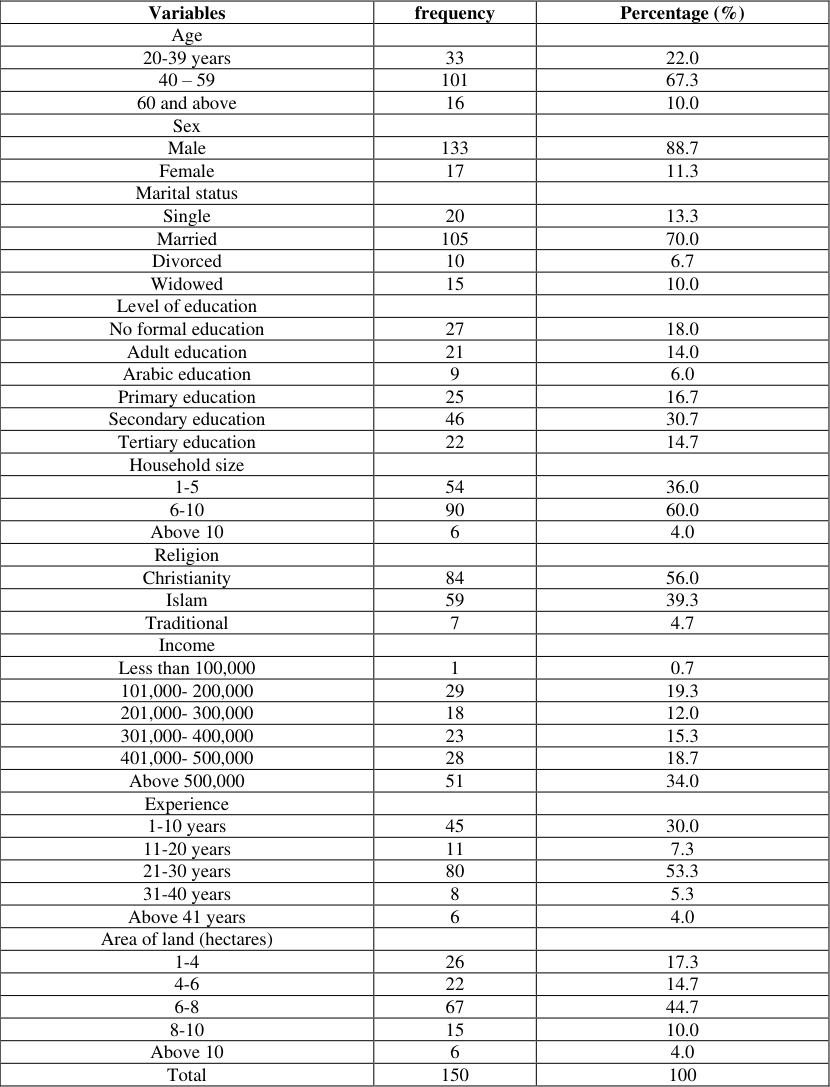 Table 1
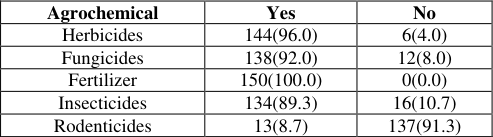 Table 2
 Table 3
 Table 4
Introduction
Many important benefits are achieved by the use of agrochemicals in agricultural production and have made important contributions to the successes of the "green revolution‖ (Briggs et al., 1989) [2] and increase in food supply. Use of agrochemicals mainly associated with increased crop yields, animal production and reduced post-harvest losses and makes a significant difference in food production particularly in countries that struggle periodically with famines (Muller, 2000) [5] . Without pesticide application the loss of fruits, vegetables and cereals from pest injury would reach 78%, 54% and 32% respectively (CAI, 2008). Organic fertilizers nearly always have much lower concentrations of plant nutrients and have the problems of economical collection, treatment, transportation. Synthetic fertilizers are commonly used for growing all crops, with application rates depending on the soil fertility, usually as measured by a soil test and according to the particular crop. Major nutrients supplied include Nitrogen, Phosphorus and Potassium by soil application whereas micronutrients such as Zinc, Boron and Manganese are applied mainly through foliar sprays. Phosphatic fertilizers include Diammonium phosphate, triple superphosphate and Monoammonium phosphate. Nitrogen fertilizers include Calcium Ammonium nitrate and Urea while Potassium fertilizers include Potassium chloride and Potassium sulphate (Vitosh , 2005) [9] . Major pesticides classes are organochlorines, Organophosphates and carbamates. When a pesticide is released into the environment many things happen to it. Sometimes, the leaching of some herbicides into the root zone can result in better weed control and at times releasing pesticides into the environment can be harmful, as not the entire applied chemical reaches the target site (Cesna et al., 2005). It is against this backdrop that this research investigated the extent of constraints to use of Agrochemical among arable crop farmers in Osun State.
Hypothesis of the study
The hypothesis stated in the null form is tested: Ho 1 -There is no significant relationship between constraints faced by the respondents and their use of Agrochemical in the study area.
Materials and Methods
The study was carried out in Osun State. The state covers approximately 14,875 square kilometers in land area (NPC, 2006). Agriculture is the major source of income for the larger number of the people of the State (about 256,000 Farming Families). The state lies in the equatorial rainforest belt and the rainfall around this area varies from 155mm to 1800mm per annum. The forest zone with high humidity favours the cultivation of tree crops such as Cocoa, Kola, Mango, Citrus and oil palm as well as arable crops like maize, cassava, Yam and Rice.
Sampling Procedure and Sample size
A Multi-stage sampling procedure was used to select respondents for the study. Purposive sampling Technique was used to select International Journal of Agriculture and Food Science blocks from ADP zone that are predominantly noted for arable crop farmers that always use agrochemicals for farming in the study area: (Iwo, Ayedire, Ola-Oluwa blocks). Systematic sampling techniques was used to select 10 respondents in each village of the blocks and this gives a total of one hundred and seventy six (150) respondents for the study.
Analysis of data
Data Collected were subjected to descriptive and inferential Statistical analysis using Statistical Package for the Social Sciences (SPSS). Descriptive statistical tools used included frequency counts, mean and percentage while inferential statistical used is Chi-square. Result of analysis in table 1 shows that majority (40.0%) of the respondent fell within the age range of 50-59 years This means that most of the farmers in the study area are middle aged which may be due to less involvement of youths in farming activities. The result also reveals that 88.7% of the respondents are male and 11.3% were female. This means that males are into farming than females in the study area. This is in line with Sokoya et al., (2012) [8] who stated that agriculture is generally regarded in Africa as an occupation for men. The result also revealed that 70.0% of the respondents were married. This is corresponding with Akinbile (2007) [1] who stated that marriage confers responsibility, which send a signal that they are matured and versatile even responsible. The results further revealed that the level of education of the respondents in the study area with majority (30.7%) had secondary education. This implies that the farmer has ability to require knowledge when information is made available. This is in line with Oladele (2005) [7] who found out that exposure of farmers to education will increased the farmer's ability to adopt change.
| Variables | frequency | Percentage (%) |
|---|---|---|
| Age | ||
| 20-39 years | 33 | 22.0 |
| 40 – 59 | 101 | 67.3 |
| 60 and above | 16 | 10.0 |
| Sex | ||
| Male | 133 | 88.7 |
| Female | 17 | 11.3 |
| Marital status | ||
| Single | 20 | 13.3 |
| Married | 105 | 70.0 |
| Divorced | 10 | 6.7 |
| Widowed | 15 | 10.0 |
| Level of education | ||
| No formal education | 27 | 18.0 |
| Adult education | 21 | 14.0 |
| Arabic education | 9 | 6.0 |
| Primary education | 25 | 16.7 |
| Secondary education | 46 | 30.7 |
| Tertiary education | 22 | 14.7 |
| Household size | ||
| 1-5 | 54 | 36.0 |
| 6-10 | 90 | 60.0 |
| Above 10 | 6 | 4.0 |
| Religion | ||
| Christianity | 84 | 56.0 |
| Islam | 59 | 39.3 |
| Traditional | 7 | 4.7 |
| Income | ||
| Less than 100,000 | 1 | 0.7 |
| 101,000- 200,000 | 29 | 19.3 |
| 201,000- 300,000 | 18 | 12.0 |
| 301,000- 400,000 | 23 | 15.3 |
| 401,000- 500,000 | 28 | 18.7 |
| Above 500,000 | 51 | 34.0 |
| Experience | ||
| 1-10 years | 45 | 30.0 |
| 11-20 years | 11 | 7.3 |
| 21-30 years | 80 | 53.3 |
| 31-40 years | 8 | 5.3 |
| Above 41 years | 6 | 4.0 |
| Area of land (hectares) | ||
| 1-4 | 26 | 17.3 |
| 4-6 | 22 | 14.7 |
| 6-8 | 67 | 44.7 |
| 8-10 | 15 | 10.0 |
| Above 10 | 6 | 4.0 |
| Total | 150 | 100 |
Table text extracted from the original PDF; superscript letters are shown inline. The original table image is below.
View original table image
Results and Discussion
Results and Discussion
Socio-economic characteristics of respondents
The result further shows that majority of the respondents had number of household range of 6-10 persons with majority of the respondents were Christians 56.0% and Islam 39.3% while 4.7% were Traditionalist. The result also shows that income earned per annum of the respondents, majority earned above 500,000 (34.0%), followed by 100,000-200,000 with 19.3%, 401,000-500,000 with 18.7%, 301,000-400,000 with 15.3% and 201,000-300,000 with 12.0% while less than 100,000 have 0.7% The result also indicate that, majority (53.3%) of the respondents had farming experience ranges from 21-30years with the Area of land (44.7%) had 6-8 hectare. The implication of this was based on the criteria set by Fayinde et al as cited by Ogunjimi and Farinde (2012) [6] that all farmers who operate on land less than 10 hectares are small-scale farmers. Result of analysis in table 2 revealed that majority of the respondents (100.0%) used Fertilizers, followed by Herbicides with 96.0%, Fungicides with 92.0% and Insecticides with 89.3% while 8.7% were using Rodenticides. This implies that Fertilizers is commonly used by the respondents in the study area than other Agrochemicals. Result of analysis in table 3 shows that majority (92.0%) of the respondents had inadequate access to capital in purchasing agrochemicals as minor constraint, and also majority (80.7%, 80.0%, 79.3% and 64.0%) of the respondents claimed that lack of safety measures, Poor extension services, Inadequate know how to use agrochemical and Unavailability of Agrochemicals respectively were not a constraint in the study area.
| Constraints | Major Constraints | Minor Constraints | Not a Constraints |
|---|---|---|---|
| Inadequate access to capital | 3(2.0) | 138(92.0) | 9(6.0) |
| Unavailability of Agrochemicals | 1(0.7) | 53(35.3) | 96(64.0) |
| Inadequate know how to use agrochemical | 3(2.0) | 28(18.7) | 119(79.3) |
| Poor extension services | 7(4.7) | 23(15.3) | 120(80.0) |
| Lack of safety measures | 2(1.3) | 27(18.0) | 121(80.7) |
Table text extracted from the original PDF; superscript letters are shown inline. The original table image is below.
View original table image
| Agrochemical | Yes | No |
|---|---|---|
| Herbicides | 144(96.0) | 6(4.0) |
| Fungicides | 138(92.0) | 12(8.0) |
| Fertilizer | 150(100.0) | 0(0.0) |
| Insecticides | 134(89.3) | 16(10.7) |
| Rodenticides | 13(8.7) | 137(91.3) |
Table text extracted from the original PDF; superscript letters are shown inline. The original table image is below.
View original table image
Ho1: There is no significant relationship between effect of agrochemical and their constraints 4 revealed that there is significant relationship between effect of agrochemical usage (r = 0.253, p<0.05) and their constraint. This means that the constraints faced in the use of agrochemical have effect on the effect of agrochemical usage in the study area.
Result of analysis in Table
Result of analysis in Table
Conclusion and Recommendations
This study revealed that most of the respondents are males and they are in their active age, married with majority secondary education. The respondents' constraint to use of agrochemical were low but only access to capital in purchasing agrochemicals was minor constraint. Also Rodenticides were not used regularly by the respondents in the study area. Thus, in order to promote or increase use of agrochemical; Government should make extension service available for the farmers to carry them along on the use of Agrochemical. Also there should be developed proper and effective information dissemination channels to ensure that farmers have adequate sources of technical information available on the safe use of the agrochemicals with regard to their recommended usage, human health and the environment.
Figures and tables from the paper
References
9 in the original paper- Akinbile LA Social Impact of limestone Exploitation in Yewa North Local Government Area of Ogun State, Nigeria. Pakistan Journal of Social Science. 2007; 1(107):111.
- Briggs DJ, Courtney FM. Agriculture and Environment. New York: Longman. 1989; 1:26-37.
- Cai DW. Understand the role of chemical pesticides and prevent misuses of pesticides. Bulletin of Agricultural Science and Technology. 2008; 1:36-38.
- Cessna AJ, Wolf TM, Stephenson GR, Brown RB. Pesticide movement to field margins: routes, impacts and mitigation. Field boundary habitats: implications for weed. Insect and Disease Management. 2005; 1:69-112.
- Muller Franz. Agrochemicals: Composition, Production, Toxicology, Applications. New York: VCH Publishing, 2000.
- Ogunjimi SI, Farinde AJ. Farmers' Knowledge Level of Precautionary Measures in Agro-Chemicals Usage on Cocoa Production in Osun and Edo States, Nigeria. International Journal of Agriculture and Forestry.p-ISSN: 2165-882X eISSN: 2165-8846. 2012; 2(4):186-194. doi: 10.5923/j.ijaf.20120204.10
- Oladele OI. A Tobit Analysis of Propensity to Discontinue Adoption of Agricultural Technology among Farmers in South Western Nigeria. Journal of Central European Agriculture. 2005; 6(3):250-255.
- Sokoya AA, Onifade FN, Alabi AO. Establishing connection and Networking; The Role of Social Media in Agricultural Research in Nigeria. World Library and Information Congress, 2012. http://conference.ifla. org/ifla78 Retrieve 20th July, 2017
- Vitosh M. Agricultural Extension Bulletin (MSUE,2005)