
Research article · 2019 · Full text
International Journal of Agriculture and Food ScienceThe effect of IPA glyphosate herbicide on weed pressure in palm oil planting
Volume 1(2) · Pages 16–20 · DOI: 10.33545/2664844x.2019.v1.i2a.15 ↗
Research areasOil Palm Production and Sustainability
Abstract
Author-writtenPalm oil is one of the plantation crops in Indonesia that has a pretty bright future. Palm oil is a reliable export commodity in Indonesia, the domestic market share is quite large and the export market is always open. Oil palm plantations are faced with the presence of plant-disturbing organisms as a limiting factor. One of the plant pests that often interfere with oil palm cultivation is weeds. The presence of weeds can cause many losses including reducing the ability of production, polluting the quality of production, and disrupt the smooth work of farmers. This study aims to determine the effectiveness of IPA Glyphosate herbicide for controlling common weeds in oil palm plants. The study was conducted at PTPN VIII Sukamaju, Sukabumi Regency, Indonesia from June 2016 to September 2016 The experiment used an experimental method with a Randomized Block Design consisting of 7 treatments and 4 replications. The treatments consisted of IPA Glyphosate herbicide at a dose of 546.75 g/ha; 729 g/ha; 911.25 g/ha; 1093.5 g/ha; 1275.75 g/ha; weeding manually and Control. The results showed that the IPA Glyphosate herbicide dose 546.75-1275.75 g/ha was an effective herbicide in controlling broadleaf weeds such as Synedrella nodiflora, Ageratum conyzoides and Peperomia pellucida and grass weeds such as Setaria palmifolia in oil palm plantations. IPA Glyphosate herbicide dose 546.75-1275.75 g/ha until observation 3 weeks after application does not show symptoms of poisoning in oil palm plants.
Summary
Source-checkedPlain-language reading of the full paper, prepared with AI and checked against the text. Each point links to the authors' own words.
Why it matters
- Palm oil is a critical export commodity for Indonesia with significant domestic and international market demand. View evidence ↗
- Weeds are a major limiting factor in oil palm cultivation, as they can reduce production capacity and quality while hindering farming operations. View evidence ↗
- Chemical weed control via herbicides is often preferred over other methods because it is faster, more economical, and more effective while saving time and labor. View evidence ↗
The question
- The study aimed to evaluate how effective IPA Glyphosate herbicide is at controlling common weeds found in oil palm plantations. View evidence ↗
What they did
- The research was conducted between June and September 2016 at the PTPN VIII Sukamaju plantation in Sukabumi, Indonesia. View evidence ↗
- The study used a Randomized Block Design with four replications across seven treatments: five different doses of IPA Glyphosate (546.75, 729, 911.25, 1093.5, and 1275.75 g/ha), manual weeding, and a control group. View evidence ↗
- Phytotoxicity (plant poisoning) was visually assessed in oil palm plants at 1, 2, and 3 weeks after application. View evidence ↗
What they found
- All tested doses of IPA Glyphosate effectively controlled the broadleaf weed Ageratum conyzoides, significantly reducing its dry weight compared to the control. View evidence ↗
- Total weed dry weight was significantly lower in all IPA Glyphosate treatment groups compared to the control group across the 4-8 week observation period. View evidence ↗
- No phytotoxicity symptoms (poisoning level 0) were observed in the oil palm plants up to 3 weeks after the application of any IPA Glyphosate dose. View evidence ↗
Visual summary
3 visualsIllustrations explain the paper; charts are replotted from the paper's own table values.
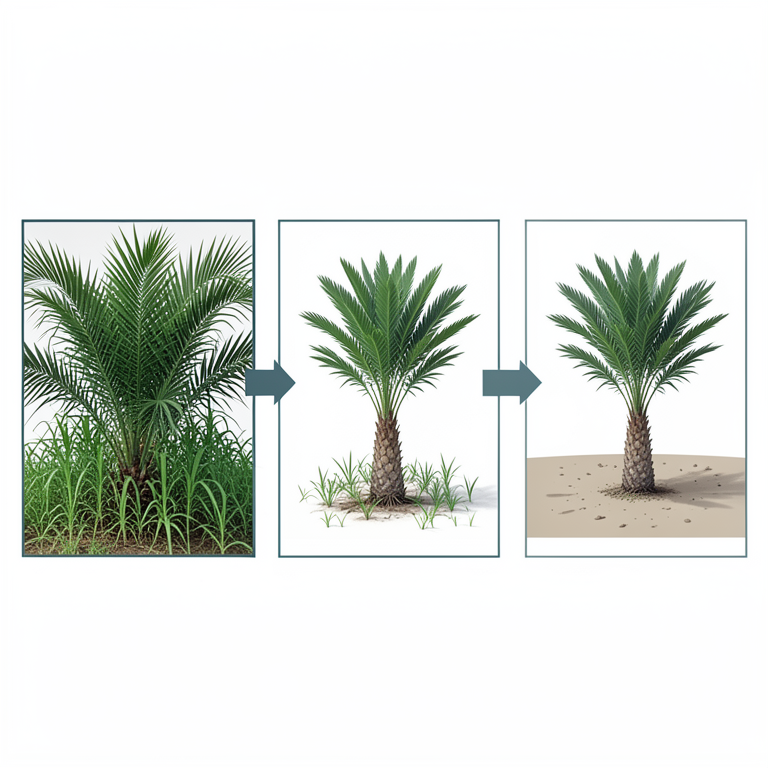
Experimental Treatment Comparison
AI-generated conceptual illustration (Oil palm seedlings and surrounding ground weeds). It explains the idea and does not show study data.
View source evidence ↗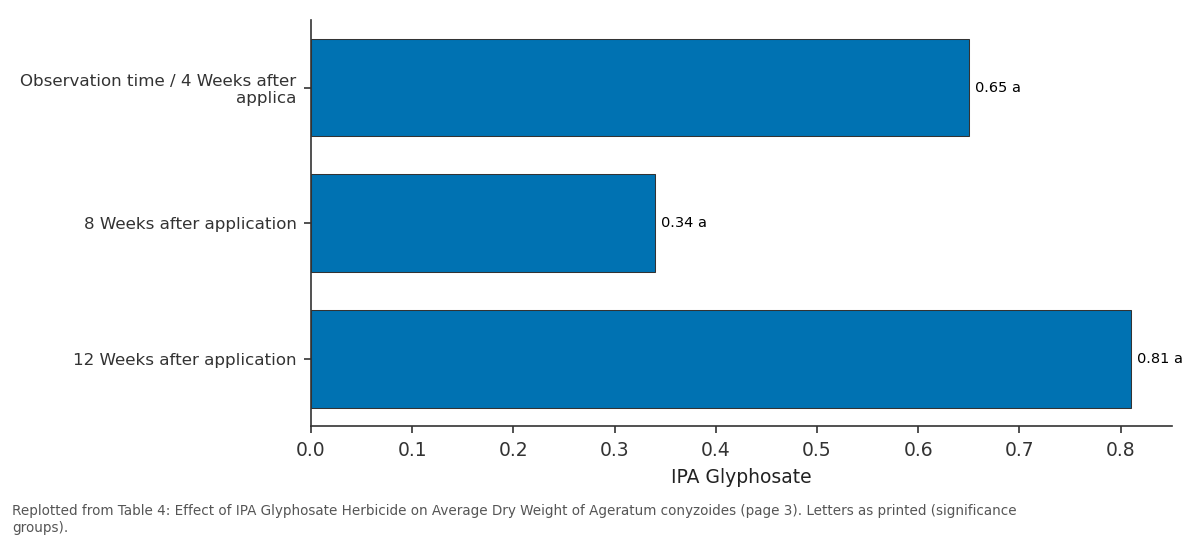
IPA Glyphosate: Observation time / 4... vs 8 Weeks after... vs 12 Weeks after...
Replotted from Table 4 (page 3) of the original paper. Every bar is the paper's own table value.
View source evidence ↗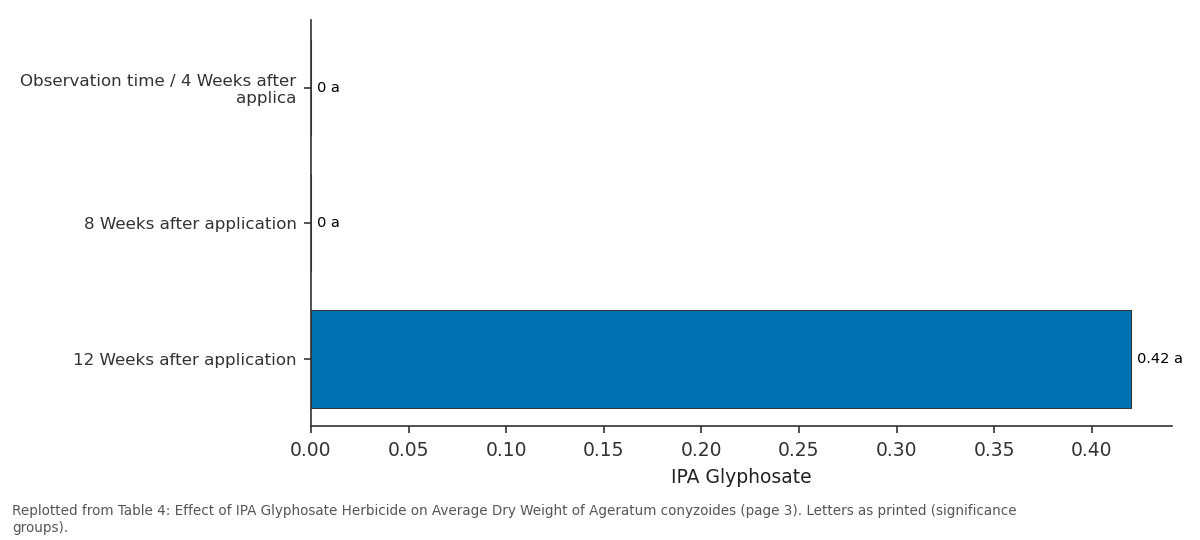
IPA Glyphosate: Observation time / 4... vs 8 Weeks after... vs 12 Weeks after...
Replotted from Table 4 (page 3) of the original paper. Every bar is the paper's own table value.
View source evidence ↗Figures & tables
From the original paper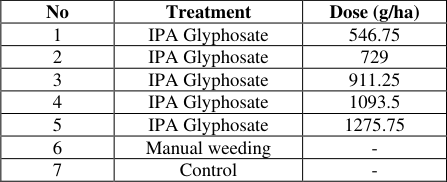 Table 1
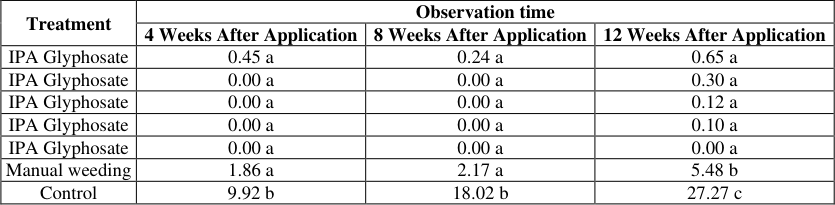 Table 2
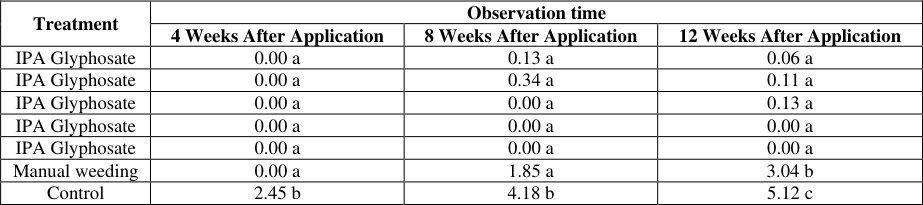 Table 3
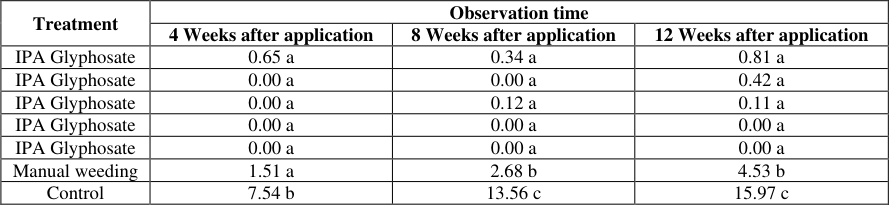 Table 4
 Table 5
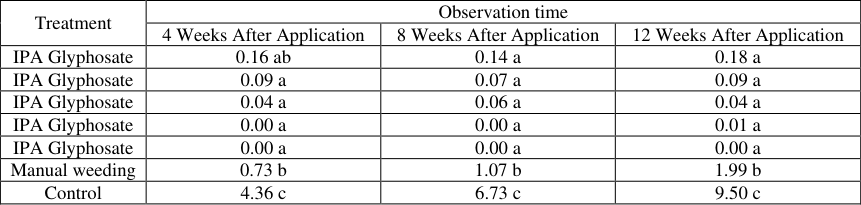 Table 6
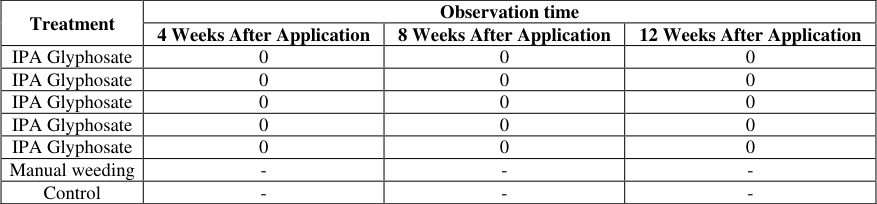 Table 7
Introduction
Oil palm (Elaeis guineensis Jacq.) Is one of the plantation crops in Indonesia that has a bright future. Palm oil is not a native plant of Indonesia, but the arrival of oil palm to Indonesia actually adds export commodities in Indonesia. Palm oil is a reliable export commodity in Indonesia, the domestic market share is quite large and the export market is always open. Oil palm plants originating from Nigeria, including the family Palmae, genus Elaeis guineensis species name comes from the word Guinea, which is a place where an expert named Jacquin planted oil palms first on the coast of Guinea (Ketaren, 2005) [7] . Palm oil can grow well in tropical climates with rainfall 2000 mm / year and a temperature range of 22-320 C. One of the production of palm oil is crude palm oil or often called CPO (Crude Plam Oil) (Agrotechnology, 2015). The Indonesian Ministry of Agriculture in 2010 noted that the total area of Indonesian oil palm plantations was 7,824,623 ha and the area of oil palm plantations in West Sumatra was 325,206 ha with a total of 26 palm oil mills. Plantation Statistics also recorded Indonesia's CPO production of 19,844,900 tons with West Sumatra CPO production of 928,456 tons. The extent of oil palm plantations in Indonesia, especially in West Sumatra, and the relatively high CPO production make it easy to find raw materials for the refining process of palm oil (Sipayung, 2012) [10] . The need for the availability of quality palm oil seeds with a quantity that continues to increase in line with the increasing needs of the world population for palm oil. Good care of seedlings in the initial nurseries and the main nurseries through the appropriate fertilization dose is one of the efforts to achieve optimal results in the development of oil palm cultivation (Santi and Goenadi, 2008) [9] . Efforts to increase palm oil productivity continue to be made from various aspects both in the field and at the factory in order to increase the value of exports that can increase the country's foreign exchange. One of the aspects of oil palm cultivation that needs serious handling is controlling weeds. Hill (1997) [5] states that weeds can be associated with crops and cause interactions, in the form of competition in the struggle for nutrients and sunlight. To avoid losses due to the presence of weeds in crop cultivation, it is necessary to control weeds. There are several ways to control weeds, namely: (1) technically, culturally, (2) mechanically, (3) biologically, and (4) chemically. Weed control is often done chemically using herbicides. The use of herbicides has several advantages when compared to other control techniques. The advantages of using herbicides are: (1) faster suppressing weed growth, (2) more economical, (3) more effective, and (4) saving labor and time (Hadi, 2011) [3] . Herbicides that can be used to control weeds in oil palm plants are herbicides with active ingredients such as dichloride, sulfatate, glyphosate, ammonium glufosinat, 2,4-D, and others. According to Riadi's research (2011) [8] one type of herbicide that can be used is glyphosate-based herbicide because it is effective in controlling various types of weeds, including grass, broadleaf weeds and woody weeds. Glyphosate herbicides are systemic in controlling weeds and are non-selective herbicides that can control various types of weeds. Symptoms of poisoning by glyphosate herbicides are weed leaves wither, turn yellow, turn brown, dry out and then die. Metabolism or degradation of glyphosate herbicides in plants is very slow and small, but degradation in the soil by microbes is very important (Sriyani, 2012) [11] . To find out the extent of the effectiveness of IPA Glyphosate herbicide in suppressing the growth of weeds in oil palm plantations, research is needed.
Materials and Methods
The experiment was carried out from June 2016 to September 2016 at PTPN VIII Sukamaju plantation, Sukabumi, Indonesia. The research material used was immature oil palm plants, water, and IPA Glyphosate herbicide with the trade name PLASMA 486 SL. The tools used include a semi-automatic sprayer knapsack and T-jet nozzles with a pressure of 1 kg / cm² (15-20 psi), measuring cups, analytical scales, ovens, hoes, plastic bags, rapia ropes, plastic trays, buckets, gauges, bamboo stakes, iron squares measuring 0.5 mx 0.5 m, and stationery. The experimental design used in this study was a Randomized Block Design with 7 treatments and 4 replications as presented in Table 1. To test the mean values of different treatments Duncan's continued test was used at a 95% confidence level.
| No | Treatment | Dose (g/ha) |
|---|---|---|
| 1 | IPA Glyphosate | 546.75 |
| 2 | IPA Glyphosate | 729 |
| 3 | IPA Glyphosate | 911.25 |
| 4 | IPA Glyphosate | 1093.5 |
| 5 | IPA Glyphosate | 1275.75 |
| 6 | Manual weeding | - |
| 7 | Control | - |
Table text extracted from the original PDF; superscript letters are shown inline. The original table image is below.
View original table image
Observations made in this study include 1. Weed dry weight
Data of weed dry weight samples in each treatment plot were observed in three sample plots (one sample plot from each dish) using the quadratic method measuring 0.5 m x 0.5 m. Then weed sampling method for dry weight data is done at 4, 8 and 12 weeks after application. Examples of weeds taken are target weeds namely weed species found in coffee plantations after the application of glyphosate herbicides. Fresh weeds are cut exactly up to the ground level, then separated by each type, then the weeds are dried at 80 ° C for 48 hours or until they reach a constant dry weight, then weighed.
Phytotoxicity
The number of coffee plant samples for phytotoxicity observations was three plants in each experimental unit and was determined randomly. The application shows a significantly different average compared to control and manual weeding. This shows that the use of all dosages of IPA Glyphosate herbicide is effective in controlling Synedrella nodiflora weeds. In line with Hill's (1997) [5] opinion that systemic active ingredients of glyphosate are very effective in controlling grass weeds. Systemic herbicide poisons will enter plant tissue and are transplanted, so systemic herbicides are very effective for controlling weeds that have rhizome or stolons.
Dry Weight of Setaria palmifolia
Statistical analysis results of the influence of IPA Glyphosate herbicide on the average dry weight of Setaria palmifolia weed are presented in Table 3. Based on Table 3, it can be seen that the treatment of IPA Glyphosate herbicide dose 546.75-1275.75 g / ha to the dry weight of weeds Setaria palmifolia at observations 4-8 weeks after The application shows a significantly different average rate compared to control treatments. This shows that the use of all dosages of IPA Glyphosate herbicide effectively controls the Setaria palmifolia. This indicates that glyphosate has been transplanted to all parts of the weed, especially the roots which can cause more effective weed death (Johal and Huber, 2009) [6] .
| Treatment | Observation time | — | — |
|---|---|---|---|
| 4 Weeks After Application | 8 Weeks After Application | 12 Weeks After Application | |
| IPA Glyphosate | 0.00 a | 0.13 a | 0.06 a |
| IPA Glyphosate | 0.00 a | 0.34 a | 0.11 a |
| IPA Glyphosate | 0.00 a | 0.00 a | 0.13 a |
| IPA Glyphosate | 0.00 a | 0.00 a | 0.00 a |
| IPA Glyphosate | 0.00 a | 0.00 a | 0.00 a |
| Manual weeding | 0.00 a | 1.85 a | 3.04 b |
| Control | 2.45 b | 4.18 b | 5.12 c |
Table text extracted from the original PDF; superscript letters are shown inline. The original table image is below.
View original table image
Dry weight of Ageratum conyzoides
Ageratum conyzoides are often found as disturbing plants in dry paddy fields, fields, plots, yards, embankments, water banks, and scrub areas. Found up to a height of 3,000 m, this plant blooms throughout the year and can produce up to 40,000 seeds per individual. Therefore, weeds are felt quite disturbing for plantation crops. The results of statistical analysis of the effect of IPA Glyphosate herbicide on the average dry weight of Ageratum conyzoides weeds are presented in Table 4. Based on Table 4, it can be seen that the treatment of IPA Glyphosate herbicide dose 546.75-1275.75 g/ha to the dry weight of weed Ageratum conyzoides is presented in Table 4. The application shows a significantly different average rate compared to control treatments. This shows that the use of all dosages of IPA Glyphosate herbicide is effective in controlling the weed Ageratum conyzoides. This is in accordance with the opinion of Riadi (2011) [8] which states that the glyphosate herbicide is effective in controlling various weeds including broadleaf weeds. The average value marked with the same letter in the same column shows no significant difference at the 5% level according to the Duncan Test.
| Treatment | Observation time | — | — |
|---|---|---|---|
| 4 Weeks after application | 8 Weeks after application | 12 Weeks after application | |
| IPA Glyphosate | 0.65 a | 0.34 a | 0.81 a |
| IPA Glyphosate | 0.00 a | 0.00 a | 0.42 a |
| IPA Glyphosate | 0.00 a | 0.12 a | 0.11 a |
| IPA Glyphosate | 0.00 a | 0.00 a | 0.00 a |
| IPA Glyphosate | 0.00 a | 0.00 a | 0.00 a |
| Manual weeding | 1.51 a | 2.68 b | 4.53 b |
| Control | 7.54 b | 13.56 c | 15.97 c |
Table text extracted from the original PDF; superscript letters are shown inline. The original table image is below.
View original table image
Dry Weight of Peperomia pellucida
Peperomia pellucida is a type of broadleaf weed that is easy to grow in areas that are slightly damp and somewhat protected. The results of the statistical analysis of the effect of the IPA Glyphosate herbicide on the average dry weight of Peperomia pellucida are presented in Table 5. Based on Table 5, it can be seen that the treatment of IPA Glyphosate herbicide with a dose of 546.75-1275.75 g / ha on the dry weight of Peperomia pellucida at 4-8 weeks after application showed a significantly different average compared to the control treatment. This shows that glyphosate herbicides are able to control Peperomia pellucida. According to Nurjannah (2003), glyphosate herbicides that have been transplanted throughout all parts of the weed, especially at the root that can cause more effective weed death. In addition, glyphosate herbicides can last a long time in the soil and remain active so that they can suppress the growth of weeds for longer (Hermawan at al., 1995) [4] .
| Treatment | Observation time | — | — |
|---|---|---|---|
| 4 Weeks After Application | 8 Weeks After Application | 12 Weeks After Application | |
| IPA Glyphosate | 0.13 a | 0.14 a | 0.00 a |
| IPA Glyphosate | 0.00 a | 0.16 a | 0.00 a |
| IPA Glyphosate | 0.00 a | 0.27 a | 0.00 a |
Table text extracted from the original PDF; superscript letters are shown inline. The original table image is below.
View original table image
Total Weed Dry Weight
Total weed dry weight is the dry weight of all weed species found in the experimental plot at the time of observation. The results of the statistical analysis of the effect of the Isopropylamine glyphosate herbicide on the average total weed dry weight are presented in Table 6. Based on Table 6 it can be seen that the treatment of isopropylamine glyphosate herbicide with a dose of 546.75-1275.75 g / ha on the total weed dry weight observed 4-8 weeks after application shows a significantly different average compared to the control treatment. This shows that the use of glyphosate isopropylamine herbicide is able to control total weeds. According to Ariyani and Junaedi (2007) [2] glyphosate herbicide is an active herbicide, not selective, absorbed through the leaves and transplanted into growing areas, is effective in eradicating annual and chronic weeds but is intended to eradicate chronic weeds that have deep roots, especially grasses that grow rooted rhizome. This herbicide is systemic and not selective with the mechanism of action affecting the synthesis of essential amino acids. The average value marked with the same letter in the same column shows no significant difference at the 5% level according to the Duncan Test.
| Treatment | Observation time | — | — |
|---|---|---|---|
| 4 Weeks After Application | 8 Weeks After Application | 12 Weeks After Application | |
| IPA Glyphosate | 0.16 ab | 0.14 a | 0.18 a |
| IPA Glyphosate | 0.09 a | 0.07 a | 0.09 a |
| IPA Glyphosate | 0.04 a | 0.06 a | 0.04 a |
| IPA Glyphosate | 0.00 a | 0.00 a | 0.01 a |
| IPA Glyphosate | 0.00 a | 0.00 a | 0.00 a |
| Manual weeding | 0.73 b | 1.07 b | 1.99 b |
| Control | 4.36 c | 6.73 c | 9.50 c |
Table text extracted from the original PDF; superscript letters are shown inline. The original table image is below.
View original table image
Phytotoxicity
Phytotoxicity is an observation made on oil palm plants to determine the response of plants arising from exposure to herbicides. Plants that experience poisoning will show symptoms such as chlorosis, necrosis, abnormal growth or in a further stage the plant will die. Observation of the level of plant poisoning is done at 1, 2 and 3 weeks after application, this is done to determine the effect of the dose of herbicide on plant phytotoxicity.
Figures and tables from the paper
| Treatment | Observation time | — | — |
|---|---|---|---|
| 4 Weeks After Application | 8 Weeks After Application | 12 Weeks After Application | |
| IPA Glyphosate | 0.45 a | 0.24 a | 0.65 a |
| IPA Glyphosate | 0.00 a | 0.00 a | 0.30 a |
| IPA Glyphosate | 0.00 a | 0.00 a | 0.12 a |
| IPA Glyphosate | 0.00 a | 0.00 a | 0.10 a |
| IPA Glyphosate | 0.00 a | 0.00 a | 0.00 a |
| Manual weeding | 1.86 a | 2.17 a | 5.48 b |
| Control | 9.92 b | 18.02 b | 27.27 c |
Table text extracted from the original PDF; superscript letters are shown inline. The original table image is below.
View original table image
| Treatment | Observation time | — | — |
|---|---|---|---|
| 4 Weeks After Application | 8 Weeks After Application | 12 Weeks After Application | |
| IPA Glyphosate | 0 | 0 | 0 |
| IPA Glyphosate | 0 | 0 | 0 |
| IPA Glyphosate | 0 | 0 | 0 |
| IPA Glyphosate | 0 | 0 | 0 |
| IPA Glyphosate | 0 | 0 | 0 |
| Manual weeding | - | - | - |
| Control | - | - | - |
Table text extracted from the original PDF; superscript letters are shown inline. The original table image is below.
View original table image
References
11 in the original paper- Agroteknologi. Klasifikasi dan Morfologi Tanaman Kelapa Sawit. Available online at, 2015. http://agroteknologi.web.id/klasifikasi-dan-morfologitanaman-kelapa-sawit/ (accessed May 13, 2016)
- Ariyani D dan Junaedi AB. Kuantifikasi Toksisitas Glifosat terhadap Pertumbuhan Fitopl Nkton Berdasarkan Konsentrasi Klorofil dan Cacaselnya, 2007.
- Hadi Yaupan. Efikasi herbisida pendimethalin untuk mengendalikan gulma pada budidaya bawang merah (Allium ascalonicum), 2011. http://repository.unila.ac.id:8180/dspace/handle/123456789 /2755 accessed on May 5, 2012.
- Hermawan W, Djulkarnain W, Pasaribu A, dan Tuharto. Efikasi beberapa campuran antara herbisida glifosat 18 % dengan herbisida selektif lainnya terhdap pengendalian gulma pada padi sawah tanpa olah tanah. Prosiding Seminar Nasional V. Budidaya Pertanian Tanpa Olah Tanah. 8-9 Mei 1995. Bandar Lampung. Hlm, 1995, 1-4.
- Hill TA. The Biology of Weed. Edward, Arnold. London, 1997.
- Johal GS, Huber DM. Glyphosate effects on diseases of plants. Europ. J Agronomy. 2009; 31(1):144-152.
- Ketaren S. Minyak dan Lemak Pangan. Jakarta; Penerbit Universitas Indonesia. Halaman, 2005, 284.
- Riadi M. Mata Kuliah: Herbisida dan Aplikasinya. Bahan Ajar. Universitas Hasanuddin. 138 hlm, 2011.
- Santi LP, dan DH Goenadi. Pupuk Organo Kimia Untuk Pemupukan Bibit Kelapa Sawit. Available online at, 2008. http://id.wikipedia.org/wiki/ (accessed May 13, 2016).
- Sipayung T. Ekonomi Agribisnis Minyak Sawit. PT. Penerbit IPB Press. Bogor, 2012.
- Sriyani N. Herbisida dalam Tumbuhan. Bahan Ajar. Universitas Lampung. 50 hlm, 2012.