
Research article · 2023 · Full text
International Journal of Agriculture and NutritionDevelopment and organoleptic evaluation of value added products from gogu seeds (Hibiscus cannabinus L.)
Volume 5(1) · Pages 15–18 · DOI: 10.33545/26646064.2023.v5.i1a.93 ↗
Research areasHibiscus Plant Research Studies
Abstract
Author-writtenGogu (Hibiscus cannabinus L.) belongs to Malvaceae family identified for both its economic, horticultural and industrial importance. Gogu Seeds are rich source of protein and crude fibre. The seeds are bitter in taste, resembles cotton seed oil may use as a source of edible oil. It has high antioxidant content related to the presence of anthocyanins with potent antioxidant activity. With this concern the present research study was undertaken to develop and evaluate the value added products from gogu seeds for its organoleptic parameters along with Phenolic content and Antioxidant activity. The experimental results revealed that phenolic content of the Gogu seed was 16.4 mg GAE/100 g, The antioxidant activity was 23.7, 19 vitamin C Eq. µg/g per 100 gm. Gogu seed chikki was prepared by incorporating 20 percent of seed was best accepted in terms of appearance 7.40, texture 7.55, colour 7.85, flavour 7.25, taste 7.25 and overall acceptability. The best accepted product was kept for shelf life study by storing in aluminum foil pouch in an ambient temperature. Sensory attributes and microbial load were observed for gogu seeds chikki at the interval of initial, 10th, 20th and 30th day, revealed that from initial day to 30th, the overall acceptability scores of gogu seeds chikki decreased from 8.05 to 5.80, having the total bacterial count of 10.33 CFU 104 /g. The products can be kept for 30 days and can be safely used. The study concludes that incorporation of Gogu parts like seeds was well accepted. Hence commercialization of the products and creation of awareness is needed to avail the nutritional benefit from Gogu. It need to be encouraged for vulnerable population because of rich in protein, energy and fat.
Summary
Source-checkedPlain-language reading of the full paper, prepared with AI and checked against the text. Each point links to the authors' own words.
Why it matters
- Gogu (Hibiscus cannabinus L.) is a plant of the Malvaceae family that is valued for its industrial, horticultural, and economic significance. View evidence ↗
- Gogu seeds are a nutrient-dense source of protein, fat, calcium, and crude fiber. View evidence ↗
- The plant contains anthocyanins, which provide potent antioxidant activity. View evidence ↗
The question
- The study aimed to develop value-added products from gogu seeds and evaluate their antioxidant activity, phenolic content, and sensory (organoleptic) properties. View evidence ↗
What they did
- The researchers used home-grown gogu seeds combined with jaggery, ghee, and groundnuts to develop the products. View evidence ↗
- A panel of 20 semi-trained members used a 9-point hedonic scale to evaluate the sensory characteristics of the products. View evidence ↗
- The shelf life of the best-accepted chikki was monitored over 30 days, measuring sensory attributes and total bacterial count. View evidence ↗
What they found
- Analysis of the gogu seeds showed they contain 28.9g protein, 18.8g fat, 558mg calcium, and 437 Kcal of energy per 100g. View evidence ↗
- The gogu seeds were found to have a phenolic content of 4.6 mg GAE/100 g and an antioxidant activity of 0.52 µg (vitC Eq µg/g). View evidence ↗
- During the shelf life study, the overall acceptability of the chikki dropped from 8.05 on the initial day to 5.80 by the 30th day. View evidence ↗
What it means
- The authors conclude that gogu seeds are well-accepted in food products and recommend commercialization to make their nutritional benefits available. View evidence ↗
- The authors suggest that gogu-based products should be encouraged for vulnerable populations due to their high protein, energy, and fat content. View evidence ↗
Visual summary
2 visualsIllustrations explain the paper; charts are replotted from the paper's own table values.
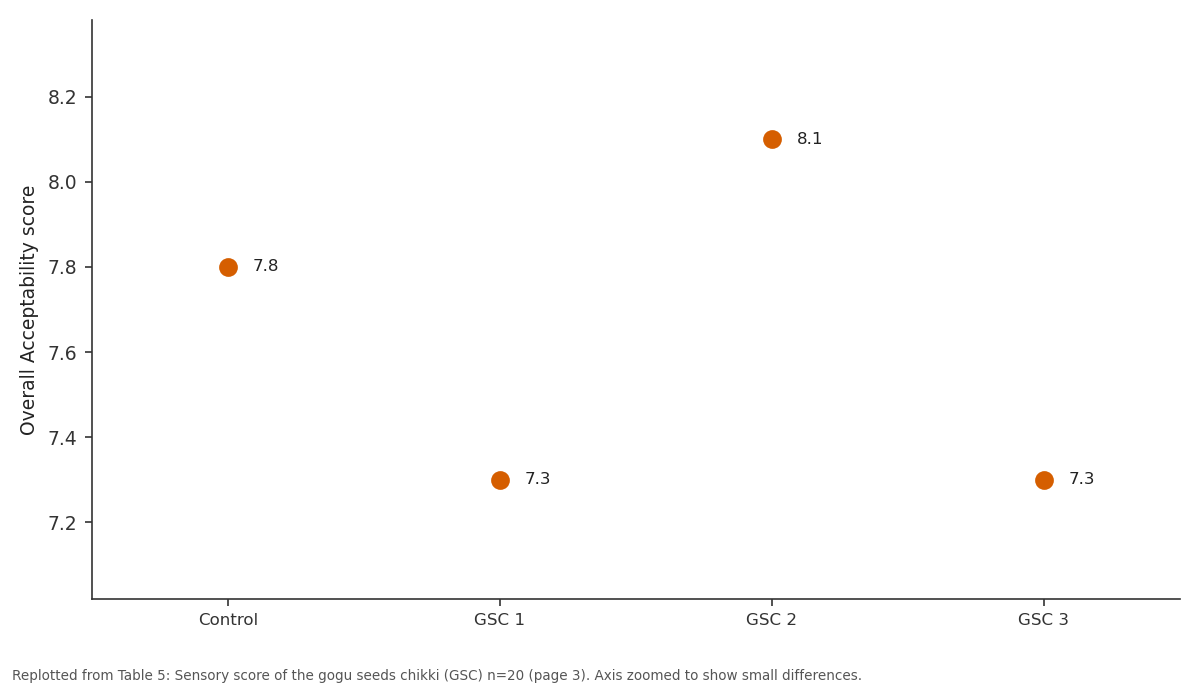
Taste: Control vs GSC 1 vs GSC 2 vs GSC 3
Replotted from Table 5 (page 3) of the original paper. Every bar is the paper's own table value.
View source evidence ↗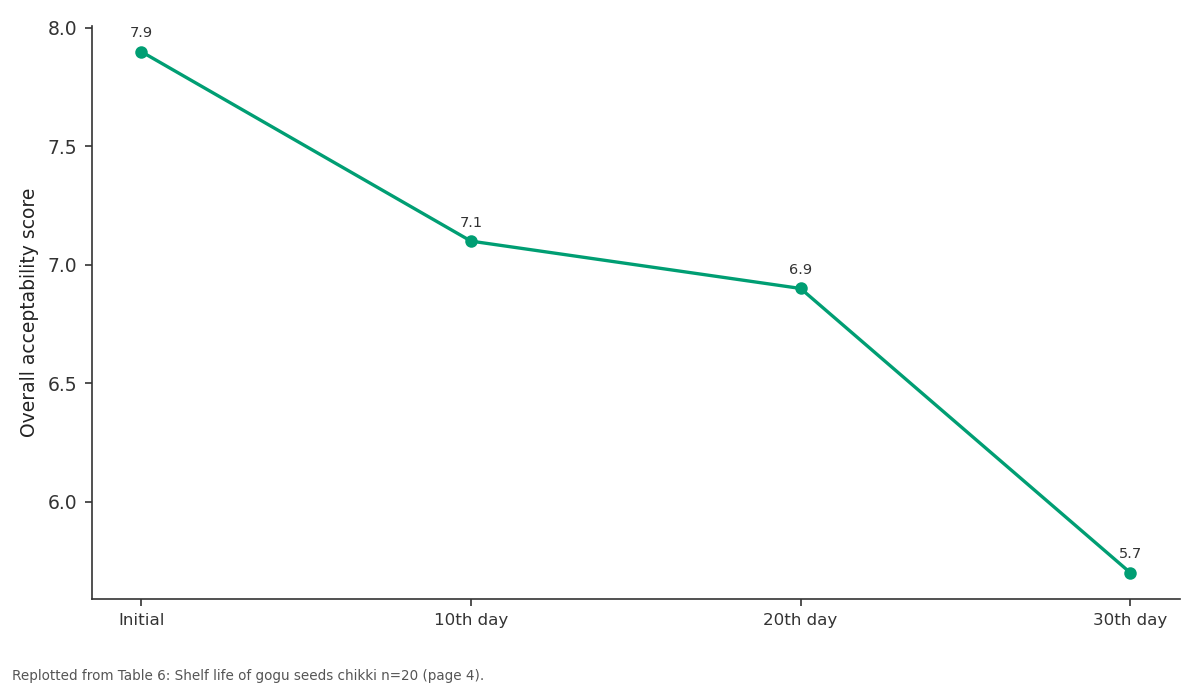
Taste: Initial vs 10th day vs 20th day vs 30th day
Replotted from Table 6 (page 4) of the original paper. Every bar is the paper's own table value.
View source evidence ↗Figures & tables
From the original paper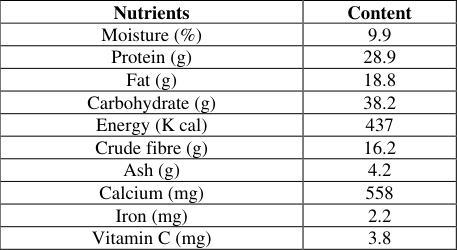 Table 1
 Table 2
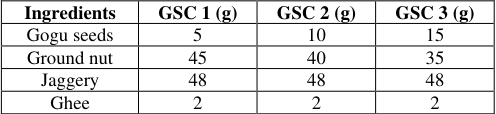 Table 3
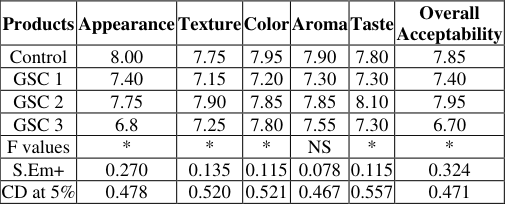 Table 5
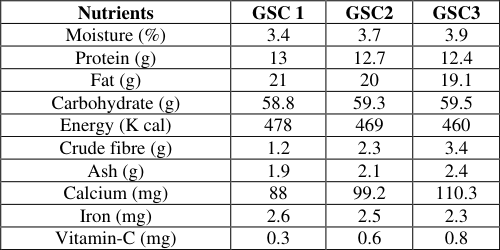 Table 4
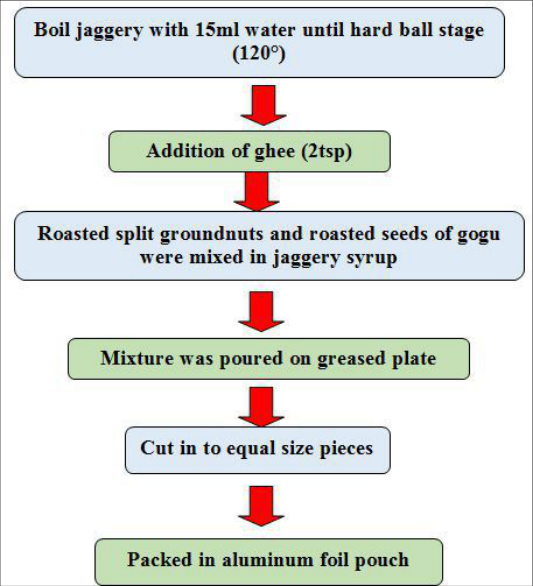 Figure 1
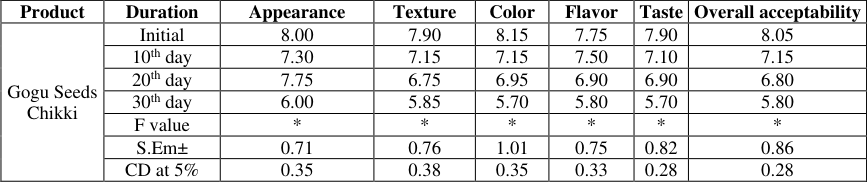 Table 6
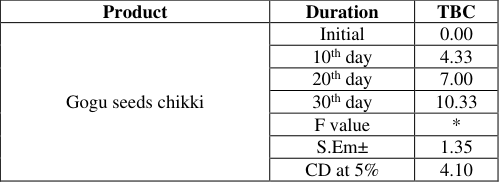 Table 7
Introduction
Gogu (Hibiscus cannabinus L.) is an annual or biennial herbaceous plant belongs to Malvaceae family originated in Africa, and is identified for both its economic, horticultural and industrial importance. Intercropping of the Gogu is being practiced in India along with Jowar and Ragi in Karnataka and Andhra Pradesh. It has high antioxidant content related to the presence of anthocyanins with potent antioxidant activity (Bechoff et al., 2014) [3] . Many parts of gogu including seeds, leaves, fruits and roots, are used in various foods. Gogu is used in many folk medicines. It is valued for its mild laxative effect and for its ability to treat certain diseases. Gogu Seeds are rich in protein (20.9 g), fat (21.3 g), crude fibre (15.5 g) and calcium (300 mg) per 100 g. The protein yield of a gogu crop is in estimated as 400 to 500 kg ha -1 . The seeds are bitter in taste but are eaten in some parts of Africa. They contain oil, which resembles cotton seed oil suggest that the seed oil may be used as a source of edible oil. Seeds have been used an aphrodisiac coffee substitute (Watt and Breyer, 1962) [14] . Gogu seeds yield an edible vegetable oil. The gogu seed oil is also used for cosmetics, industrial lubricants and biofuel production. Gogu oil is high in omega polyunsaturated fatty acids (PUFAs) which are now known to help in keeping humans healthy. Gogu seed contains percent of 9.6 moisture, 6.4 ash, 20.4 oil, 21.4 nitrogenous matters and 12.9 crude fiber. Palmitic, oleic, and linoleic acids were reported as major fatty acid (Zawawi et al., 2014) [16] . With this concern the present research study was undertaken to develop and evaluate the value added products from gogu seeds for its organoleptic parameters, shelf life along with Phenolic content and Antioxidant activity of the gogu seeds (Hibiscus cannabinus L.).
Materials and Methods
Materials and Methods
Procurement of the Materials
The fresh Gogu seeds were collected from plants grown at Home for study purpose. Other ingredients for product development includes jaggery, ground nut and ghee for product development were procured from local market, of Bengaluru, Karnataka, India.
Chemical and nutrient analysis of fresh Gogu seeds and developed product
The following nutrients namely Moisture (%), Protein (g), Fat (g), Carbohydrate (g), Energy (K cal), Dietary fibre (g), Ash (g), Iron (mg), β-carotene (µg), Vitamin C (mg), and Calcium (mg) and Phenolic content was analyzed by standard procedures described by AOAC, 1995. All samples were worked in triplicate. Antioxidant activity of the gogu leaf was estimated by DPPH method, expressed in terms of ascorbic acid equivalents. (RANGANNA, S., 1996) [12] .
Pre-treatments
Gogu seeds were cleaned, dried in hot air oven at 60 °C and stored at ambient temperature used for further analysis.
Formulation of the products
The products were prepared by incorporating the ingredients with different variations to standardize the final product.
Organoleptic evaluation of the products
The prepared products were analysed for the sensory characteristics. The sensory characteristics were carried out by a panel of 20 semi-trained members using a 9 point hedonic scale, for the evaluation of their appearance, texture, colour, aroma/flavour, taste and overall acceptability.
Shelf life stability of the products
After sensory evaluation, the best accepted gogu seeds chikki was kept for shelf life studies. The products were stored at ambient temperature and were packed in aluminum foil pouch. The Gogu seed chikki was evaluated on initial 10 th , 20 th and 30 th days for sensory attributes and microbial load using nutrient agar for total bacterial count.
Statistical analysis
All the analysis was performed in triplicates and values were used for statistical analysis. The data was tabulated keeping in the view the objectives of the study. Analysis of variance (F-Test) was done with three replications. Difference were declared statistically significant when p≤0.05.
Results and Discussion
Results and Discussion
Nutrient composition of Gogu seeds
Gogu seeds were analysed for its nutrient compositions by standardized experimental procedures and findings are depicted in Table 1. Gogu seeds contain 9.9 percent moisture, protein (28.9 g), fat (18.8 g), carbohydrate (38.2 g), energy (437 Kcal), dietary fibre (16.2 g), ash (4.2 g), calcium (558 mg), iron (2.2 mg) and vitamin C (3.8 mg) per 100 g of seeds. Lower values are reported by Olawepo et al., (2014) [11] reported that, Gogu seeds had 4.65 g of moisture, 25.12 g crude protein, 18.89 g of crude fat 4.40 g of ash content, 251 mg of calcium and 2.99 mg of iron respectively. Which might be due to difference in variety and climatic conditions.
| Nutrients | Content |
|---|---|
| Moisture (%) | 9.9 |
| Protein (g) | 28.9 |
| Fat (g) | 18.8 |
| Carbohydrate (g) | 38.2 |
| Energy (K cal) | 437 |
| Crude fibre (g) | 16.2 |
| Ash (g) | 4.2 |
| Calcium (mg) | 558 |
| Iron (mg) | 2.2 |
| Vitamin C (mg) | 3.8 |
Table text extracted from the original PDF; superscript letters are shown inline. The original table image is below.
View original table image
Phenolic content and Antioxidant activity of the gogu
Table 2 reveals the total polyphenolic and antioxidant content of gogu seeds. Findings showed it has phenolic content 4.6 mg GAE/100 g seeds, The antioxidant activity in seeds was 0.52 µg (vitC Eq µg/g) respectively. The values reported by Yusri et al., (2012) [15] was higher than the present values that is Gogu seeds had 5.36 mg GAE/100 g of phenolic content and 0.62 μg ATE/g of antioxidant activity. Bors et al., (2014) [5] reported that, the various types of radish and mustard seeds were evaluated on the basis of the total phenolic content (TPC) ranged between 260 and 516 mg GAE/ 100 g of fresh weight. This may be due to varietal differences.
| Components | Seed |
|---|---|
| Total Polyphenolics (mg GAE/100 g) | 4.6 |
| Antioxidant activity (Vit-C Eq. µg/g) | 0.52 |
Table text extracted from the original PDF; superscript letters are shown inline. The original table image is below.
View original table image
GSC-Gogu Seed Chikki
All the ingredients were weighed accurately by using digital weighing balance. The experimental GSC was prepared by incorporating different levels of gogu seeds at different concentrations of 5, 10, 15% for all the variations to standardize (table -3). The methodology used for preparing the GSC was depicted in fig ( 1).
Nutrient composition of gogu seeds chikki (GSC)
Nutrient composition of gogu seeds chikki was depicted in the Table 4. The moisture content of GSC 1, 2 and 3 was 3.4, 3.7 and 3.9 percent respectively. Protein was high in GSC 1 i.e, 13 and low in GSC 3(12.4 g). GSC1 has high fat (21) compared to other two variations. High Carbohydrate, Energy, crude fibre, calcium and iron was recorded in GSC3 (59.5 g), GSC 1(478 Kcal) and GSC 3(3.4 g), GSC 3(110.3 mg) and 2.6mg in GSC1 respectively. Hirdyani and Charak., (2015) [7] reported that, peanuts with flax seed chikki at 50% and 100% revealed that moisture (%) 3.4, ash (%) 1.3, fat (%) 24.5, fiber (%) 2.3, protein (%) 12.92, carbohydrate(%) 58.78 and calorific value (kcal) 479..80 per 100 g respectively.
| Nutrients | GSC 1 | GSC2 | GSC3 |
|---|---|---|---|
| Moisture (%) | 3.4 | 3.7 | 3.9 |
| Protein (g) | 13 | 12.7 | 12.4 |
| Fat (g) | 21 | 20 | 19.1 |
| Carbohydrate (g) | 58.8 | 59.3 | 59.5 |
| Energy (K cal) | 478 | 469 | 460 |
| Crude fibre (g) | 1.2 | 2.3 | 3.4 |
| Ash (g) | 1.9 | 2.1 | 2.4 |
| Calcium (mg) | 88 | 99.2 | 110.3 |
| Iron (mg) | 2.6 | 2.5 | 2.3 |
| Vitamin-C (mg) | 0.3 | 0.6 | 0.8 |
Table text extracted from the original PDF; superscript letters are shown inline. The original table image is below.
View original table image
Sensory score of the gogu seeds chikki
Table 5 presents the sensory scores of gogu seeds chikki. GSC 2 scored highest in the all the sensory attributes with appearance 7.75, texture 7.90, colour 7.85, aroma 7.85, taste 8.10, and overall acceptability 7.95 and lowest was in GSC 3 appearance 6.8, texture 7.25, colour 7.80, aroma 7.55, taste 7.30 and overall acceptability 6.70. The significant differences were found in appearance, texture, colour, taste, overall acceptability and non-significant difference in aroma. Mala et al., (2015) [10] reported that, the initial sensory scores of pumpkin seeds chikki and pumpkin chocolate chikki were appearance 8.1±0.73, colour 8.3±0.67, texture 8.0±0.66, flavour 7.2±0.42, taste 8.1±0.73, overall acceptability 8.1±0.73 respectively. Gaggat et al., (2014) [6] reported that standardization and organoleptic evaluation of recipes using oats and flax seed namely daliya, poha, toast and pancake. The general acceptability of most of the recipes was very good. Most of them scored between good and very good in all parameter.
| Products | Appearance | Texture | Color | Aroma | Taste | Overall Acceptability |
|---|---|---|---|---|---|---|
| Control | 8.00 | 7.75 | 7.95 | 7.90 | 7.80 | 7.85 |
| GSC 1 | 7.40 | 7.15 | 7.20 | 7.30 | 7.30 | 7.40 |
| GSC 2 | 7.75 | 7.90 | 7.85 | 7.85 | 8.10 | 7.95 |
| GSC 3 | 6.8 | 7.25 | 7.80 | 7.55 | 7.30 | 6.70 |
| F values | * | * | * | NS | * | * |
| S.Em+ | 0.270 | 0.135 | 0.115 | 0.078 | 0.115 | 0.324 |
| CD at 5% | 0.478 | 0.520 | 0.521 | 0.467 | 0.557 | 0.471 |
Table text extracted from the original PDF; superscript letters are shown inline. The original table image is below.
View original table image
Shelf life of Gogu seeds chikki
Results of storage on sensory characteristics of Gogu seeds chikki was depicted in table 6.Results revealed that there was no significant difference in appearance. Significant difference was found in texture, colour and taste. The overall acceptability decreased by 8.05 to 5.80 from initial to 30 th day respectively.
| Product | Duration | Appearance | Texture | Color | Flavor | Taste | Overall acceptability |
|---|---|---|---|---|---|---|---|
| Gogu Seeds Chikki | Initial | 8.00 | 7.90 | 8.15 | 7.75 | 7.90 | 8.05 |
| 10th day | 7.30 | 7.15 | 7.15 | 7.50 | 7.10 | 7.15 | |
| 20th day | 7.75 | 6.75 | 6.95 | 6.90 | 6.90 | 6.80 | |
| 30th day | 6.00 | 5.85 | 5.70 | 5.80 | 5.70 | 5.80 | |
| F value | * | * | * | * | * | * | |
| S.Em± | 0.71 | 0.76 | 1.01 | 0.75 | 0.82 | 0.86 | |
| CD at 5% | 0.35 | 0.38 | 0.35 | 0.33 | 0.28 | 0.28 |
Table text extracted from the original PDF; superscript letters are shown inline. The original table image is below.
View original table image
Microbial study of the Gogu seeds chikki
Total bacterial population in Gogu seeds chikki was presented in in Table 7.The total bacterial count at initial 10 th , 20 th , 30 th days of storage was 0.00, 4.33, 7.00 and 10.33 CFU 10 4 /g respectively.
| Product | Duration | TBC |
|---|---|---|
| Gogu seeds chikki | Initial | 0.00 |
| 10th day | 4.33 | |
| 20th day | 7.00 | |
| 30th day | 10.33 | |
| F value | * | |
| S.Em± | 1.35 | |
| CD at 5% | 4.10 |
Table text extracted from the original PDF; superscript letters are shown inline. The original table image is below.
View original table image
Conclusion
From the above findings it could be concluded that, Gogu is a rich source of vitamin C, β-carotene and antioxidant like phenolic compounds. Incorporation of Gogu parts like seeds was well accepted. Hence commercialization of the products and creation of awareness is needed to avail the nutritional benefit from Gogu. It need to be encouraged for vulnerable population because of rich in protein, energy and fat.
Figures and tables from the paper
| Ingredients | GSC 1 (g) | GSC 2 (g) | GSC 3 (g) |
|---|---|---|---|
| Gogu seeds | 5 | 10 | 15 |
| Ground nut | 45 | 40 | 35 |
| Jaggery | 48 | 48 | 48 |
| Ghee | 2 | 2 | 2 |
Table text extracted from the original PDF; superscript letters are shown inline. The original table image is below.
View original table image
References
9 in the original paper- Gaggat U, Sethi N, Singh K, Standardization, organoleptic evaluation and biochemical evaluation of recipes using oats and flax seed. International Journal of Food and Nutritional Sciences. 2014;3:47-58.
- Hirdyani H, Charak B. Nutritional, organoleptic evaluation and storage study of peanut chikki supplemented with flaxseeds. International Journal of Home Science. 2015;1(3):40-43.
- Karabacak SL, Bozkurt HS. Effects of Urtica dioica and Hibiscus sabdariffa on the quality and safety of sucuk (Turkish dry-fermented sausage). Meat Science. 2008;78(3):288-296.
- Kubmarawa D, Andenyang IFH, Magomya AM. Proximate composition and amino acid profile of two non-conventional leafy vegetables (Hibiscus cannabinus and Haematostaphis barteri). African Journal of Food Science. 2009;3(9):233-236.
- Mala KS, Rao PP, Rao GN, Satyanarayana A. Nutritional quality and storage stability of chikki prepared using pumpkin seed, flax seed, oats and peanuts. International Journal of Traditional Knowledge. 2015;1(1):118-123.
- Olawepo KD, Banji OT, Jimoh WA, Fawole WO, Orisasona O, Daniel AHO. Effect of cooking and roasting on nutritional and anti-nutritional factors in kenaf (Hibiscus cannabinus L.) seed meal. Food Science and Quality Management. 2014;24:2224-6088.
- Watt, Breyer BJM. The Medicinal and Poisonous Plants of Southern and Eastern Africa. African Journal of Biotechnology. 1962;7(4):242-251.
- Yusri NM, Iqbal KWCS, Ismail M. Phenolic Content and Antioxidant Activity of Hibiscus cannabinus L. Seed Extracts after Sequential Solvent Extraction. Molecules. 2012;17(11):12612-12621.
- Zawawi N, Gangadharan P, Ahma RZ, Samsudin MG, Karim R, Maznah I. Nutritional values and cooking quality of defatted Kenaf seeds yellow (DKSY) noodles. International Food Research Journal. 2014;21(2):603-608.