
Research article · 2023 · Full text
International Journal of Agriculture and Food ScienceIndia’s agriculture: Issues and priorities
Volume 5(1) · Pages 133–136 · DOI: 10.33545/2664844x.2023.v5.i1b.132 ↗
Research areasAgricultural Economics and PracticesAgricultural risk and resilience
Abstract
Author-writtenIndian agriculture employs the largest share of the workforce – about 42 percent in 2019 – though its share in overall gross domestic product (GDP) is only 16.5 percent. India is still largely a rural economy with 66 percent of the country’s population living in rural areas (World Bank, 2019) and agriculture continues to be the mainstay of a large segment of this section of the population. Agriculture is also important for consumers, as an average Indian household spends about 45 percent of its expenditure on food. 1 Moreover, given that India is going to be the most populous country, surpassing China, by 2027 (according to United Nations population projections, 2019), it would be a major challenge for Indian agriculture to feed this large population especially in the wake of the emerging challenges of climate change and the degradation of natural resources such as air, water and land, etc. This challenge becomes more serious with the expected rise in per capita incomes2 as well as increasing urbanization – the urban population is estimated to be 600 million by 2030 – both of which are likely to increase the demand for food, feed and fiber. Moreover, not only will there be more mouths to feed, but, as per capita income grows, there will be much higher demand for high value agriculture products such as meat, fish, dairy, fruits and vegetables (OECD/FAO, 2019). This would be very much in line with Bennett’s Law of food consumption, which states. The paper is organized as follows: Section 1 presents the backdrop of Indian agriculture within the context of the Indian economy. Section 2 critically examines the Challenges in agriculture sector raising agricultural productivity per unit of land: Reducing rural poverty. Ensuring that agricultural growth responds to food security needs. Section 3 mainly focuses on priority areas in agriculture which includes Promoting new technologies and reforming agricultural research and extension: Water Resources and Irrigation/Drainage Management Facilitating agricultural diversification to higher-value commodities. Poverty alleviation Sustaining the environment and future agricultural productivity Finally It also highlights the intervention of World Bank Support to achieve sustainable agricultural growth.
Summary
Source-checkedPlain-language reading of the full paper, prepared with AI and checked against the text. Each point links to the authors' own words.
Why it matters
- Agriculture is a critical part of India's social fabric, employing approximately 42% of the workforce as of 2019, despite contributing only 16.5% to the GDP. View evidence ↗
- India remains primarily a rural economy, with 66% of its population residing in rural areas where agriculture is the primary livelihood. View evidence ↗
- Feeding the population will be a major challenge as India is projected to become the world's most populous country by 2027, compounded by climate change and resource degradation. View evidence ↗
The question
- The paper aims to examine the challenges of raising agricultural productivity per unit of land, reducing rural poverty, and ensuring food security. View evidence ↗
- The study seeks to identify priority areas for support, including technological reform, water management, crop diversification, and environmental sustainability. View evidence ↗
What they did
- The authors used a descriptive and explorative methodology based on secondary data from government departments and research institutions. View evidence ↗
- The analysis was prepared using a wide range of published sources, including reports, periodicals, and websites. View evidence ↗
What they found
- Of India's 195 million hectares under cultivation, 63% (roughly 125 million ha) are rainfed and 37% (70 million ha) are irrigated. View evidence ↗
- Rural poverty decreased from nearly 40% in the early 1990s to below 30% by the mid-2000s, representing an average annual decline of about 1%. View evidence ↗
- Agricultural growth slowed to an average of 3.5% per annum during the 1990s and 2000s, with cereal yields increasing by only 1.4% per annum in the 2000s. View evidence ↗
- India's rice yields are significantly lower than its neighbors, reaching only one-third of China's yields and about half of those in Indonesia and Vietnam. View evidence ↗
- While milk production has grown at about 4% per annum, this is expected to be outpaced by a future domestic demand growth of at least 5% per annum. View evidence ↗
- Government spending on power, fertilizer, and irrigation subsidies is now four times larger than investment expenditures, which limits funding for research and extension. View evidence ↗
- The World Bank's program in India is its largest globally in absolute dollar terms, with 24 ongoing projects and $5.5 billion in net commitments from IDA and IBRD. View evidence ↗
What it means
- The authors conclude that to address emerging challenges, India must focus on priority areas to ensure agricultural growth is economically, environmentally, and financially sustainable. View evidence ↗
Visual summary
2 visualsIllustrations explain the paper; they do not show study data.
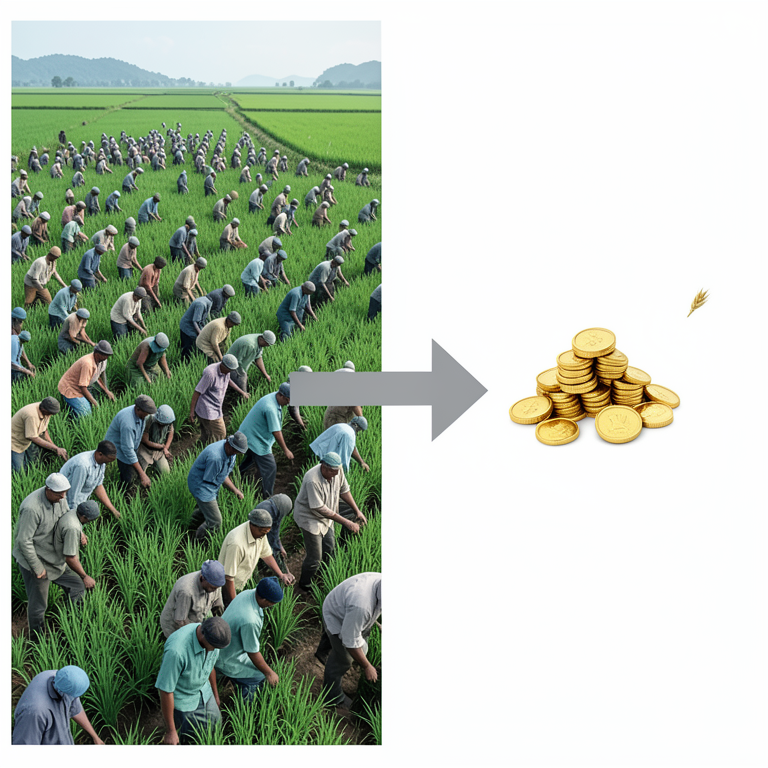
India's Agricultural Economic Paradox
AI-generated conceptual illustration (Indian farmland with rice and wheat crops). It explains the idea and does not show study data.
View source evidence ↗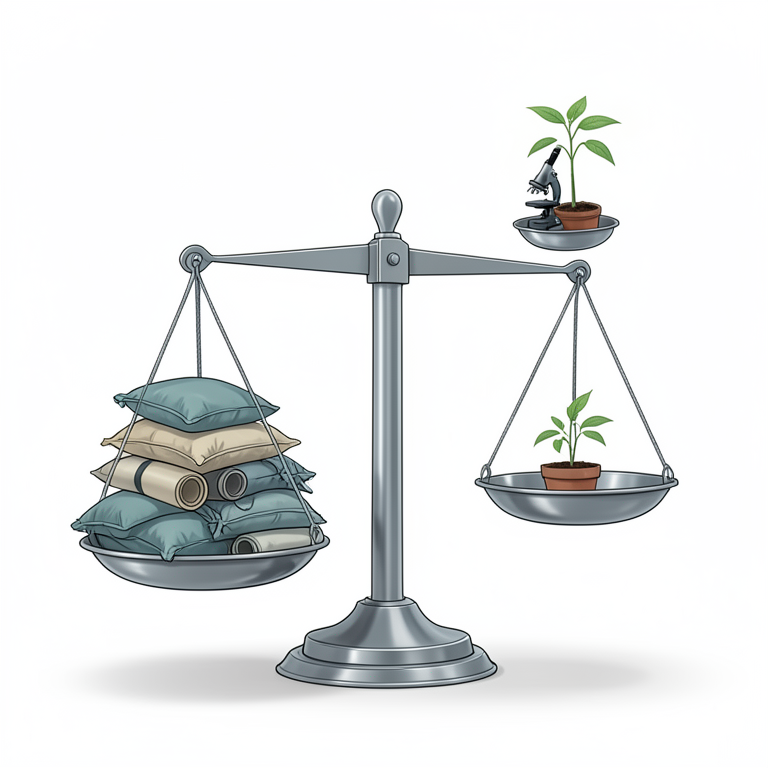
Government Expenditure Imbalance
AI-generated conceptual illustration (Indian agricultural landscape with a balance scale). It explains the idea and does not show study data.
View source evidence ↗Introduction
While agriculture's share in India's economy has progressively declined to less than 15% due to the high growth rates of the industrial and services sectors, the sector's importance in India's economic and social fabric goes well beyond this indicator. First, nearly threequarters of India's families depend on rural incomes. Second, the majority of India's poor (Some 770 million people or about 70 percent) are found in rural areas. And third, India's food security depends on producing cereal crops, as well as increasing its production of fruits, vegetables and milk to meet the demands of a growing population with rising incomes. To do so, a productive, competitive, diversified and sustainable agricultural sector will need to emerge at an accelerated pace. India is a global agricultural powerhouse. It is the world's largest producer of milk, pulses, and spices, and has the world's largest cattle herd (Buffaloes), as well as the largest area under wheat, rice and cotton. It is the second largest producer of rice, wheat, cotton, sugarcane, farmed fish, sheep & goat meat, fruit, vegetables and tea. The country has some 195 m ha under cultivation of which some 63 percent are rainfed (Roughly 125 m ha) while 37 percent are irrigated (70 m ha). In addition, forests cover some 65 m ha of India's land.
Methods and Materials
A descriptive and explorative methodology is followed. The secondary data based on various reports from Govt. depts. and other research institutions.
The published sources such as Web sites, periodicals and Reports are liberally used for the preparation of the paper.
Challenges
Three agriculture sector challenges will be important to India's overall development and the improved welfare of its rural poor.
Raising agricultural productivity per unit of land:
Raising productivity per unit of land will need to be the main engine of agricultural growth as virtually all cultivable land is farmed. Water resources are also limited and water for irrigation must contend with increasing industrial and urban needs. All measures to increase productivity will need exploiting, amongst them: increasing yields, diversification to higher value crops, and developing value chains to reduce marketing costs.
Poverty alleviation and community actions
While agricultural growth will, in itself, provide the base for increasing incomes, for the 170 million or so rural persons that are below the poverty line, additional measures are required to make this growth inclusive. For instance, a rural livelihoods program that empowers communities to become self-reliant has been found to be particularly effective and well-suited for scaling-up. This program promotes the formation of self-help groups, increases community savings, and promotes local initiatives to increase incomes and employment. By federating to become larger entities, these institutions of the poor gain the strength to negotiate better prices and market access for their products, and also gain the political power over local governments to provide them with better technical and social services. These self-help groups are particularly effective at reaching women and impoverished families.
Sustaining the environment and future agricultural productivity
In parts of India, the over-pumping of water for agricultural use is leading to falling groundwater levels. Conversely, water-logging is leading to the build-up of salts in the soils of some irrigated areas. In rain-fed areas on the other hand, where the majority of the rural population live, agricultural practices need adapting to reduce soil erosion and increase the absorption of rainfall. Overexploited and degrading forest land need mitigation measures. There are proven solutions to nearly all of these problems. The most comprehensive is through watershed management programs, where communities engage in land planning and adopt agricultural practices that protect soils, increase water absorption and raise productivity through higher yields and crop diversification. At issue, however, is how to scale up such initiatives to cover larger areas of the country. Climate change must also be considered. More extreme eventsdroughts, floods, erratic rains -are expected and would have greatest impact in rain-fed areas. The watershed program, allied with initiatives from agricultural research and extension, may be the most suited agricultural program for promoting new varieties of crops and improved farm practices. But other thrusts, such as the livelihoods program and development of off-farm employment may also be key.
World Bank Support
World Bank Support
Summing Up
Agriculture in India has witnessed an impressive growth trajectory, taking the country from a food deficit one during the 1960s to a marginally food surplus one. Notwithstanding the economic success, the sector today is at a crossroads with numerous opportunities as well as concerns. On the one hand, the sector has grown and diversified, while, on the other. In order to meet these emerging challenges and mold food and agricultural policies, it is important to focus on the priority areas to boost up the agricultural growth in an economically, environmentally and financially sustainable way.
References
3 in the original paper- ADB, Rural Asia: Beyond the Green Revolution. Asian Development Bank, Manila. 2004. Key Indicators 2004. Asian Development Bank, Manila; c2000.
- Oluwasanya OP, Aihonsu JOY, Akerele EO, Onasanya AS, Yangomodou OD, Ogungbayi GB. Influence of socio-economic characteristics on rural farmers' food consumption in Ogun state. International Journal of Research in Agronomy. 2019;2(1):17-22. DOI: 10.33545/2618060X.2019.v2.i1a.13
- Paudel DP. Knowledge system of natural resource management in Andhikhola Gaunpalika, Syangja, District, Nepal. International Journal of Geography, Geology and Environment. 2020;2(2):04-10.
Cited by 1
From OpenAlex, OpenCitations and reference lists read by Scinovex
- Development and validation of an attitude scale for assessing tribal women’s participation in PradhanMantri Van DhanVikasYojana (PMVDVY): evidence from southern Rajasthan, India ↗
Sanju Meena, Manmeet Kaur, Antima Meghwal, Sumesh Sharma, Anisha, Anita Choudhary et al. · Frontiers in Sustainable Food Systems · 2026
Introduction Tribal women play a pivotal role in the collection, processing and value addition of Minor Forest Produce (MFP) under the PradhanMantri Van DhanVikasYojana (PMVDVY). However, despite the programme’s growing importance, no standardized and context-specific instrument is available to assess tribal women’s attitudes towards PMVDVY. Therefore, the present study aimed to develop and validate a psychometrically sound attitude scale for…
❝ 0PDF