
Research article · 2023 · Full text
International Journal of Veterinary Sciences and Animal HusbandryStudies on socio- economic status of donkey owners and reproductive parameters of jennet in Marathwada region of Maharashtra, India
Volume 8(2) · Pages 88–92 · DOI: 10.22271/veterinary.2023.v8.i2b.496 ↗
Research areasGenetic and phenotypic traits in livestockLivestock Farming and ManagementLivestock Management and Performance Improvement
Abstract
Author-writtenThe present study was conducted in eight district of Marathwada region, Maharashtra, India. The eighty three donkey owners were selected using pre-tested semi-structured interview schedule and socio-economic variables of donkey owners ware studied. The parameters for the study consist of age at puberty (AP), age at first service (AFS), age at first estrus (AFE), estrus cycle duration (ECD), estrus duration (ED), age at first covering (AFC), age at first conception (AFCO), no. of services/conception (NS), age at first foaling (AFF), service period (SP), foaling interval (FI), gestation period (GP), lifetime no. of foaling (LNF) were2.70±0.02 yrs., 2.79±0.02 yrs., 2.77±0.03 yrs., 6.86±0.084 days, 23.80±0.55days, 2.96±0.01yrs, 5.9±0.07yrs., 1.82±0.06, 4.44±0.01 yrs., 1.14±0.01 yrs., 2.25±0.01 yrs., 340.8±0.27 days and 5.98±0.07, respectively. At the end of the study it is concluded that the efforts are needed to improve socio-economic condition of the farmers along with systematically eliminating identified constraints. Hence sincere efforts should be made to increase awareness of the donkey owners for health care, Vaccination and regular medication and Scientific rearing practices.
Summary
Source-checkedPlain-language reading of the full paper, prepared with AI and checked against the text. Each point links to the authors' own words.
Why it matters
- Donkeys play a significant role in Indian agriculture by transporting household materials, agricultural produce, and construction supplies. View evidence ↗
- Despite their utility, donkeys are often neglected and rarely studied, frequently viewed merely as beasts of burden and kept without proper health care or nutrition. View evidence ↗
- In the Marathwada region of Maharashtra, donkeys are traditionally kept by pot makers, the washerman community, and are utilized in brick kilns. View evidence ↗
The question
- The study aimed to evaluate the socio-economic status and sustainability of donkey owners within the Marathwada region of Maharashtra, India. View evidence ↗
What they did
- The research was conducted across eight districts in the Marathwada region of Maharashtra from May to November 2022. View evidence ↗
- The study measured various reproductive parameters, including age at puberty, first service, first estrus, foaling interval, and gestation period. View evidence ↗
What they found
- A majority of the donkey owners (67.5%) were landless, indicating a low socio-economic status. View evidence ↗
- Most respondents (67.50%) fell into the low-income group, with only 20.5% in the high-income group. View evidence ↗
- The vast majority of owners (85.5%) employed a random breeding system rather than a selective one (14.5%). View evidence ↗
- Agricultural work was the primary use for donkeys (43.4%), followed by transporting goods (19.3%) and carrying bricks (18.1%). View evidence ↗
- The average age at puberty for the female donkeys (jennets) was 2.70±0.02 years. View evidence ↗
- The mean gestation period for the studied jennets was 340.8±0.27 days. View evidence ↗
- The lifetime number of foalings for the female donkeys averaged 5.98±0.07. View evidence ↗
What it means
- The authors conclude that increasing owner awareness regarding vaccination, medication, and scientific rearing practices is essential to improve the animals' health and the owners' income. View evidence ↗
- The authors recommend the formulation of specific policies and strategies to ensure the long-term sustainability of donkey owners. View evidence ↗
- The authors state that further research on donkey reproductive systems is necessary to expand the practical application of these findings. View evidence ↗
Visual summary
1 visualsIllustrations explain the paper; they do not show study data.
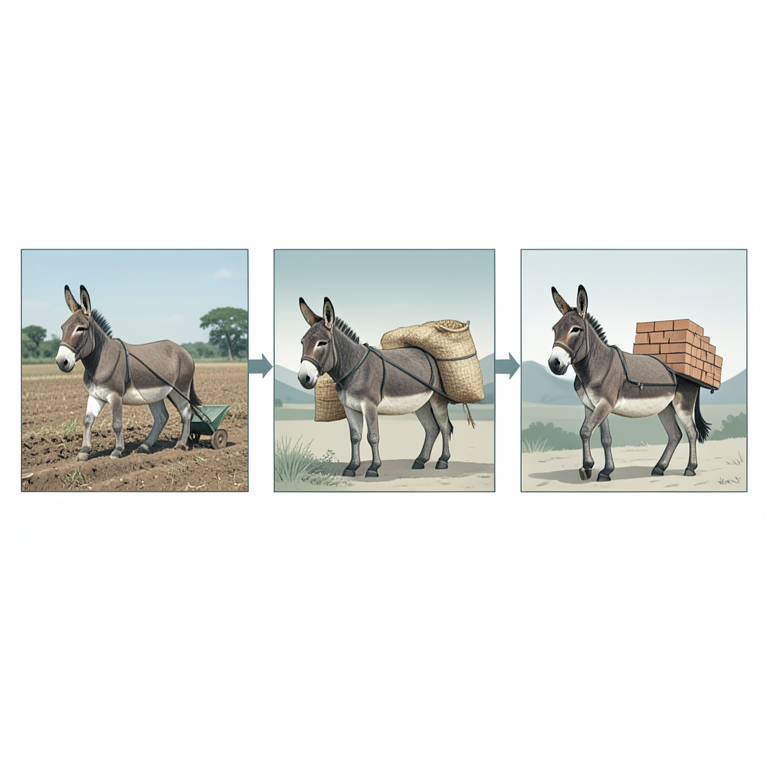
Donkey Utility Distribution
AI-generated conceptual illustration (donkeys in a rural Indian village setting). It explains the idea and does not show study data.
View source evidence ↗Figures & tables
From the original paper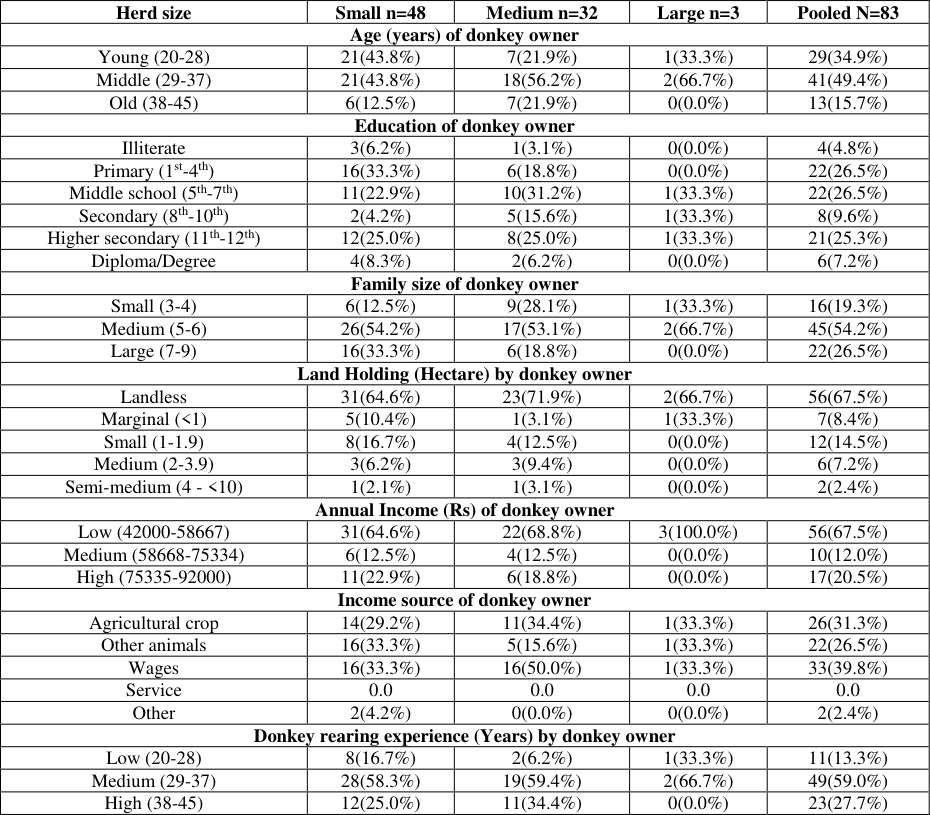 Table 1
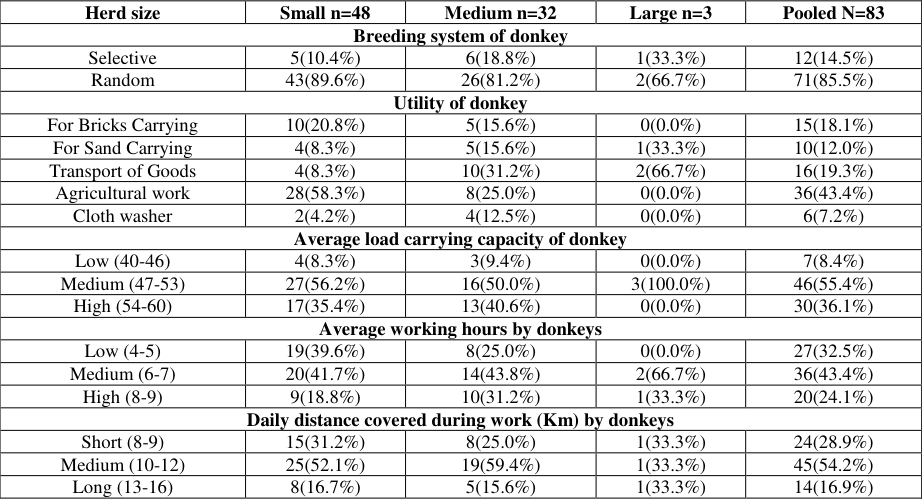 Table 2
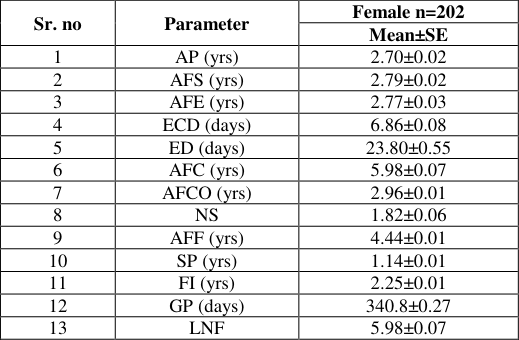 Table 3
Introduction
The donkey has been used as a working animal for at least 5000 years. Out of more than 40 million donkeys in the world, about 96% are in underdeveloped countries, where they are used principally as pack animals or for draught work in transport or agriculture, the donkeys are the cheapest form of agricultural power (Rossel et al. 2008) [13] .The contribution of donkeys has been enormous in Indian agriculture and carrying materials like transportation of agricultural produce, house hold materials and provision as well as materials for building constructions. Although, donkey supports the rural livelihood and low-income of poor farmer's families by providing sustainable income at minimal maintenance cost. Donkeys are neglected and rarely studied, due to their indiscriminate use without any proper feed, fodder and health status etc., these animals are also assumed as beast of burden. (Rattan et al. 1998, Gupta et al. 2017) [12,5] . The donkeys and mules are generally reared by other backward class (obc), schedule castes (sc), minority and landless farmers (Yash pal et al., 2013) [9] . Donkeys have very good draught power, immunity and stress bearing capabilities (Rattan et al. 1998, Gupta et al. 2017) [12,5] . It is believed that donkey can thrive better under difficult environmental conditions such as high temperature, low rainfall and low quality feeds as a result of certain genetic and morphological changes occurred during its domestication (Pearson & Ouassat, 2000; Rossel et al., 2008) [10,13] . Donkey are capable of thriving in hot climate (Pal et al. 2000, Pal et al. 2013) [8,9] and can survive even in adverse conditions such as scarcity of feed (Gupta et al. 2017, Pal and Gupta 2000) [5,8] . Compared to other equidae species, donkey contribute the major proportion of readily available transport needs of poor women and men living in hostile environments. (Swai and Bwanga, 2008) [15] . In developing countries like India though they are largely invisible in development policy and plans as well they often fail to find their place in agricultural and food security plans. They do appear in government statistics, but the information is often unreliable.
Their economic value is hard to articulate and they are not part of the export or trade debates like bovine and ovine animals. (Web link 1). In Marathwada region of Maharashtra, the donkeys are traditionally reared by washer man community and pot makers. These animals are also used in brick kilns. The major utility of these animals is for carrying sand from the river bed and transportation of silted clay soil for preparation of bricks. An adult animal can lift upto 40-80 kgs of weight effortlessly hence they are also used for shipping of bricks, agricultural products and by-products, including grains, straw and roughes etc. Donkeys also find their place in the cultural heritage of Marathwada. There is traditional culture in 'Wida' village of 'Kaij' tehsil of Beed district, on occasion of holi, the newest son-in-law in the village gets a donkey ride and the tradition has been followed for over 90 years (Web link 2). Hence the present experiment is planned to study the socioeconomic status and sustainability of the donkey owners in the Marathwada region of Maharashtra, India.
Materials and Methods
The present study was conducted in eight district of Marathwada region, Maharashtra state, India. Study duration was from May to November 2022.The eighty three donkey owners were selected using pre-tested semi-structured interview schedule. The socio-economic variables for the study were age, gender, education, category, family size, heard size, land holding, annual income, donkey rearing experience, income source, breeding system, utility, average load carrying capacity, average working hours and daily distance covered during work were studied. The parameters for the study consist of age at puberty (AP), age at first service (AFS), age at first estrus (AFE), estrus cycle duration (ECD), estrus duration (ED), age at first covering (AFC), age at first conception (AFCO), no. of services/conception (NS), age at first foaling (AFF), service period (SP), foaling interval (FI), gestation period (GP), lifetime no. of foaling (LNF). The data collected for socio-economic and reproductive parameters was subjected for different statistical analysis. The statistical methods used for obtaining results and data analysis was done with the help of SPSS (2020) statistical package for social science versionV27 IBM Corporation Armonk, NY-USA for analysis of descriptive analysis, the data analysis tools from Microsoft excel. [14] and Swai et al., (2008) [15] reported that average age of donkey owners was 40.36±1.60 and 43.9±12.5years, respectively. Education of the respondents are marginally very low due to lower social status of the donkey owners in the respective societies. Regarding family size the findings corroborate in their respective study areas. Pal et al., (2013) [9] reported average heard size of donkeys 2.86 (range 1 to16). Gupta et al., (2017) [5] . Majority of the donkey owners belonged to landless category. Singh et al., (2007) [14] [9] . For systems of breeding the majority (85.5%) of the respondents used random breeding system and (14.5%) selective breeding system. Regarding utility (43.4%) donkey owners used donkeys for agriculture work, followed by transport of goods (19.3%), bricks carrying (18.1%), sand carrying (12.0%) and cloth washer (7.2%). About average load carrying capacity majority (55.4%) of the donkey had medium load carrying capacity, followed by high (36.1%) and low (8.4%). Average load carrying capacity of donkeys ranged between 40-60 kg. About average working hours the majority (43.4%) of donkey owners practiced medium working hours, followed by low (32.5%) and high (24.1%). Average working hours of donkeys ranged between 4 to 9 hours daily. In continuation for daily distance covered during work by donkey the majority of donkey (54.2%) covered medium daily distance, followed by short (28.9%) and long (16.9%), daily distance covered during work ranged between 8 to 16 km. The results support the findings of Blench et al., (2004) [2] reported in north-central Nigeria donkeys usually breed freely in the bush. Papa et al., (2012) [7] . and Gupta et al., (2017) [5] found that donkeys contributed enormously in agriculture works, carrying materials with migratory herds of cattle, sheep and goats; and transportation of agricultural produce, house hold and construction material. Yilmaz (2012) [17] reported donkey can carry a maximum load of 80 kg and Pal et al., (2013) [9] observed that donkey can carry 60 to 75 kg of load on their back in the plains. Average working hours are in agreement with the findings of (Yilmaz. 2012, Angara et al., 2013 and Pal et al., 2013) [17,1,9] . Studied results are in contrast with the findings of Yilmaz (2012) [17] , [3] worked on reproductive parameter in Spiti breed donkey reported that AP, AFS, ECD, ED, AFCO, NS, AFF, GP and LNF, were1.5-2 (yrs) in male 1.5-2.5 (yrs) in female, 2-2.5 (yrs), 24 (days), 4-10 (days), 2-3 (yrs), 2-3, 3-4 (yrs), 12-12.5 (months) and 12-14, respectively. Pal et al., (2013) [9] studied in Rajasthan i.e. AP, AFS, FI and LNF were 30-36 (months), 3 (yrs), 1.5 (yrs) and 8-10, respectively. Twerda et al., (1997) [16] recorded AFF, FI, GP and LNF were 2-9 (yrs),1-3 (yrs), 11-14 (months) and 2-10, respectively. Fielding (1998) [4] observed AP, AFS, ECD, ED and GP were 2 (yrs), 2-4 (yrs), 24 (days), 8-10 (days) and 374 (days), respectively. Purdy et al., (2010) [11] found that ECD, ED and AP were 21-28 (days), 5-10(days) and 8-12(months), respectively. Galister et al., (2010) [6] studied in Spanish Jennies GP and ECD were 362±15.3 (days) and 20 (days), respectively.
Results and Discussion
Results and Discussion
Conclusions
Present study revealed that the Most of the donkey rearing population belonged to landless or low land holders of other backward communities in the local societies, the respondents under study had medium to high level of experience in donkey rearing, efforts are needed to improve socio-economic condition of the farmers along systematically eliminating identified constraints. Hence sincere efforts should be made to increase awareness of the donkey owners for health care Vaccination, regular medication and Scientific rearing practices which currently leading to poor income. Mass media information and health camps should be organized for effective use of source of information. Moreover, proper policies and strategies are required to be formulated to enhance sustainability of donkey owner.
Acknowledgement
AcknowledgementAuthors expresses special thanks to Associate Dean, College of veterinary and animal sciences, Udgir, MAFSU, Nagpur. For extending supports to carry out the present research work.
Figures and tables from the paper
| Herd size | Small n=48 | Medium n=32 | Large n=3 | Pooled N=83 |
|---|---|---|---|---|
| Age (years) of donkey owner | ||||
| Young (20-28) | 21(43.8%) | 7(21.9%) | 1(33.3%) | 29(34.9%) |
| Middle (29-37) | 21(43.8%) | 18(56.2%) | 2(66.7%) | 41(49.4%) |
| Old (38-45) | 6(12.5%) | 7(21.9%) | 0(0.0%) | 13(15.7%) |
| Education of donkey owner | ||||
| Illiterate | 3(6.2%) | 1(3.1%) | 0(0.0%) | 4(4.8%) |
| Primary (1st-4th) | 16(33.3%) | 6(18.8%) | 0(0.0%) | 22(26.5%) |
| Middle school (5th-7th) | 11(22.9%) | 10(31.2%) | 1(33.3%) | 22(26.5%) |
| Secondary (8th-10th) | 2(4.2%) | 5(15.6%) | 1(33.3%) | 8(9.6%) |
| Higher secondary (11th-12th) | 12(25.0%) | 8(25.0%) | 1(33.3%) | 21(25.3%) |
| Diploma/Degree | 4(8.3%) | 2(6.2%) | 0(0.0%) | 6(7.2%) |
| Family size of donkey owner | ||||
| Small (3-4) | 6(12.5%) | 9(28.1%) | 1(33.3%) | 16(19.3%) |
| Medium (5-6) | 26(54.2%) | 17(53.1%) | 2(66.7%) | 45(54.2%) |
| Large (7-9) | 16(33.3%) | 6(18.8%) | 0(0.0%) | 22(26.5%) |
| Land Holding (Hectare) by donkey owner | ||||
| Landless | 31(64.6%) | 23(71.9%) | 2(66.7%) | 56(67.5%) |
| Marginal (<1) | 5(10.4%) | 1(3.1%) | 1(33.3%) | 7(8.4%) |
| Small (1-1.9) | 8(16.7%) | 4(12.5%) | 0(0.0%) | 12(14.5%) |
| Medium (2-3.9) | 3(6.2%) | 3(9.4%) | 0(0.0%) | 6(7.2%) |
| Semi-medium (4 - <10) | 1(2.1%) | 1(3.1%) | 0(0.0%) | 2(2.4%) |
| Annual Income (Rs) of donkey owner | ||||
| Low (42000-58667) | 31(64.6%) | 22(68.8%) | 3(100.0%) | 56(67.5%) |
| Medium (58668-75334) | 6(12.5%) | 4(12.5%) | 0(0.0%) | 10(12.0%) |
| High (75335-92000) | 11(22.9%) | 6(18.8%) | 0(0.0%) | 17(20.5%) |
| Income source of donkey owner | ||||
| Agricultural crop | 14(29.2%) | 11(34.4%) | 1(33.3%) | 26(31.3%) |
| Other animals | 16(33.3%) | 5(15.6%) | 1(33.3%) | 22(26.5%) |
| Wages | 16(33.3%) | 16(50.0%) | 1(33.3%) | 33(39.8%) |
| Service | 0.0 | 0.0 | 0.0 | 0.0 |
| Other | 2(4.2%) | 0(0.0%) | 0(0.0%) | 2(2.4%) |
| Donkey rearing experience (Years) by donkey owner | ||||
| Low (20-28) | 8(16.7%) | 2(6.2%) | 1(33.3%) | 11(13.3%) |
| Medium (29-37) | 28(58.3%) | 19(59.4%) | 2(66.7%) | 49(59.0%) |
| High (38-45) | 12(25.0%) | 11(34.4%) | 0(0.0%) | 23(27.7%) |
Table text extracted from the original PDF; superscript letters are shown inline. The original table image is below.
View original table image
| Herd size | Small n=48 | Medium n=32 | Large n=3 | Pooled N=83 |
|---|---|---|---|---|
| Breeding system of donkey | ||||
| Selective | 5(10.4%) | 6(18.8%) | 1(33.3%) | 12(14.5%) |
| Random | 43(89.6%) | 26(81.2%) | 2(66.7%) | 71(85.5%) |
| Utility of donkey | ||||
| For Bricks Carrying | 10(20.8%) | 5(15.6%) | 0(0.0%) | 15(18.1%) |
| For Sand Carrying | 4(8.3%) | 5(15.6%) | 1(33.3%) | 10(12.0%) |
| Transport of Goods | 4(8.3%) | 10(31.2%) | 2(66.7%) | 16(19.3%) |
| Agricultural work | 28(58.3%) | 8(25.0%) | 0(0.0%) | 36(43.4%) |
| Cloth washer | 2(4.2%) | 4(12.5%) | 0(0.0%) | 6(7.2%) |
| Average load carrying capacity of donkey | ||||
| Low (40-46) | 4(8.3%) | 3(9.4%) | 0(0.0%) | 7(8.4%) |
| Medium (47-53) | 27(56.2%) | 16(50.0%) | 3(100.0%) | 46(55.4%) |
| High (54-60) | 17(35.4%) | 13(40.6%) | 0(0.0%) | 30(36.1%) |
| Average working hours by donkeys | ||||
| Low (4-5) | 19(39.6%) | 8(25.0%) | 0(0.0%) | 27(32.5%) |
| Medium (6-7) | 20(41.7%) | 14(43.8%) | 2(66.7%) | 36(43.4%) |
| High (8-9) | 9(18.8%) | 10(31.2%) | 1(33.3%) | 20(24.1%) |
| Daily distance covered during work (Km) by donkeys | ||||
| Short (8-9) | 15(31.2%) | 8(25.0%) | 1(33.3%) | 24(28.9%) |
| Medium (10-12) | 25(52.1%) | 19(59.4%) | 1(33.3%) | 45(54.2%) |
| Long (13-16) | 8(16.7%) | 5(15.6%) | 1(33.3%) | 14(16.9%) |
Table text extracted from the original PDF; superscript letters are shown inline. The original table image is below.
View original table image
| Sr. no | Parameter | Female n=202 |
|---|---|---|
| Mean±SE | ||
| 1 | AP (yrs) | 2.70±0.02 |
| 2 | AFS (yrs) | 2.79±0.02 |
| 3 | AFE (yrs) | 2.77±0.03 |
| 4 | ECD (days) | 6.86±0.08 |
| 5 | ED (days) | 23.80±0.55 |
| 6 | AFC (yrs) | 5.98±0.07 |
| 7 | AFCO (yrs) | 2.96±0.01 |
| 8 | NS | 1.82±0.06 |
| 9 | AFF (yrs) | 4.44±0.01 |
| 10 | SP (yrs) | 1.14±0.01 |
| 11 | FI (yrs) | 2.25±0.01 |
| 12 | GP (days) | 340.8±0.27 |
| 13 | LNF | 5.98±0.07 |
Table text extracted from the original PDF; superscript letters are shown inline. The original table image is below.
View original table image
References
13 in the original paper- Angara, Tamador EE, Ismail AA, Ibrahim AM. The role of donkeys in income generation and the impact of endoparasites on their performance. University of Khartoum. Journal of Veterinary Medicine and Animal Production. 2013;2(2):65-89.
- Behl RA, Sadana DK, Behl JY, Banerjee PR, Joshi JY, Vijh RK, et al. Characterization and microsatellite analysis for genetic diversity and bottlenecks of Spiti donkey. Indian Journal of Animal Sciences. 2011;87(10):1221-1225.
- Fielding D. Reproductive characteristics of the jenny donkey -Equusasinus: A review. Tropical Animal Health and Production. 1988;20(3):161-166.
- Gupta AK, Kumar S, Pal Y, Brahmane M, Kumar B, Chauhan M, et al. Phenotypic Clustering of Indian Donkey Population Belonging to Six Agroclimatic Regions. Journal of Biodiversity & Endangered Species. 2017;5(4):201-209.
- Galisteo J, Perez-Marin CC. Factors affecting gestation length and estrus cycle characteristics in Spanish donkey breeds reared in southern Spain. Theriogenology. 2010;74(3):443-50.
- Papa L, Kume K. The results of identification and characterisation of the donkey population in Albania. Poljoprivredai Sumarstvo. 2012;58(3):127-135.
- Pal Y, Gupta AK, Yadav MP. Heat tolerance in donkeys and mules. Annals of Arid Zone. 2000;39(4):461-464.
- Pal Y, Legha RA, Lal N, Bhardwaj A, Chauhan M, Kumar S, et al. Management and phenotypic characterization of donkeys of Rajasthan. Indian Journal of Animal Sciences. 2013;83(8):793-797.
- Rossel S, Marshall F, Peters J, Pilgram T, Adams MD, O'Connor D. Domestication of the donkey: Timing, processes, and indicators. Proceedings of the National Academy of Sciences. 2008;105(10):3715-3720.
- Singh MK, Gupta AK, Yadav MP. Performance evaluation of donkeys in arid zone of India. Indian Journal of Animal Sciences. 2007;77(10):1017-1020.
- Swai E, Bwanga S. Donkey keeping in northern Tanzania: socio-economic roles and reported husbandry and health constraints. Livestock Farming. 2008;20(5):197.
- Twerda M, Fielding D, Field C. Role and management of donkeys in Samburu and Turkana pastoralist societies in Northern Kenya. Tropical Animal Health and Production. 1997;29(1):48-54.
- Yılmaz O, Saim B, Mehmet E. The domesticated donkey: I-species characteristics. Canadian Journal of Applied Sciences. 2012;4(2):339-53.
Cited by 1
From OpenAlex, OpenCitations and reference lists read by Scinovex
- Assessment of load carrying capacity of donkeys under different work types in Beed district of Maharashtra
GB Andhale, PH Pawar, ST Hande, MN Sawant, S. J. Komatwar, NR Karambele · International Journal of Advanced Biochemistry Research · 2026
The present study was conducted to assess the load carrying capacity of donkeys under different work types in Beed district of Maharashtra. A field survey was carried out using a questionnaire involving 50 donkey owners selected from 10 villages to document work patterns, type of load and working practices. The survey results revealed that 100% of donkeys were exclusively used for load carrying on their back, with no involvement in other work types such as carting or agricultural operations. Brick transportation was identified as the sole type of load carried by all the animals. Female donkeys