
Research article · 2022 · Full text
International Journal of Biology SciencesDiversity of avian fauna in the Azmat abad, Thanna Mandi, Rajouri J and K
Volume 4(2) · Pages 251–254 · DOI: 10.33545/26649926.2022.v4.i2d.127 ↗
Research areasMedicinal Plant Research
Abstract
Author-writtenBirds play an important role in the ecosystem as long-distance pollinators, scavengers as well as bio control agents of various crop pests and thus to be considered as bio-indicators. Different birds have different habitats, some are aerial, some are terrestrial, some are aquatic, some lives near the bank of the reservoir. In this survey, the bird diversity has been recorded for the first time as a preliminary checklist purpose of Azmat Abad Village of Thanna Mandi of District Rajouri of J&K. The Field survey was done from March to December 2021. Total 50 species of terrestrial Birds have been recorded. The preliminary checklist is provided for the undertaking of future research and conservation as well as management on the bird’s diversity of Azmat Abad village.
Summary
Source-checkedPlain-language reading of the full paper, prepared with AI and checked against the text. Each point links to the authors' own words.
Why it matters
- Birds are critical to ecosystems because they act as bio-indicators, scavengers, long-distance pollinators, and biological control agents for crop pests. View evidence ↗
- Implementing conservation measures requires detailed knowledge of species diversity, habitat types, and the local abundance of animals in a specific area. View evidence ↗
- Prior to this study, the avian diversity of the investigated area had not been documented. View evidence ↗
The question
- The study aimed to record bird diversity for the first time in Azmat Abad Village, Thanna Mandi, District Rajouri, J&K, to create a preliminary checklist. View evidence ↗
What they did
- Field surveys were conducted between March and December 2021. View evidence ↗
- The researchers used Line Transect and Point Transect methods for bird inventory and density determination, with the latter being more effective in thick forests. View evidence ↗
- Surveys followed specific time windows: 6:30–9:30 am and 4:30–6:30 pm in summer, and 7:30–10:30 am and 3:30–5:30 pm in winter. View evidence ↗
What they found
- The survey recorded a total of 50 species of terrestrial birds in the area. View evidence ↗
- The 50 recorded species belong to 15 families across 8 different avian orders. View evidence ↗
- Bird species richness was higher during the summer months compared to the winter months. View evidence ↗
- The avian community is dynamic, with high-elevation species moving below the snow line in winter and passage migrants using the area as a brief stopover. View evidence ↗
- The distribution patterns of birds in the study area are significantly influenced by climate, topography, elevation, and habitat heterogeneity. View evidence ↗
What it means
- The authors provide this preliminary checklist to facilitate future research, conservation, and management of bird diversity in Azmat Abad village. View evidence ↗
- Based on the first phase of data collection, the authors conclude that Azmat Abad village supports a good level of bird diversity. View evidence ↗
Visual summary
1 visualsIllustrations explain the paper; they do not show study data.
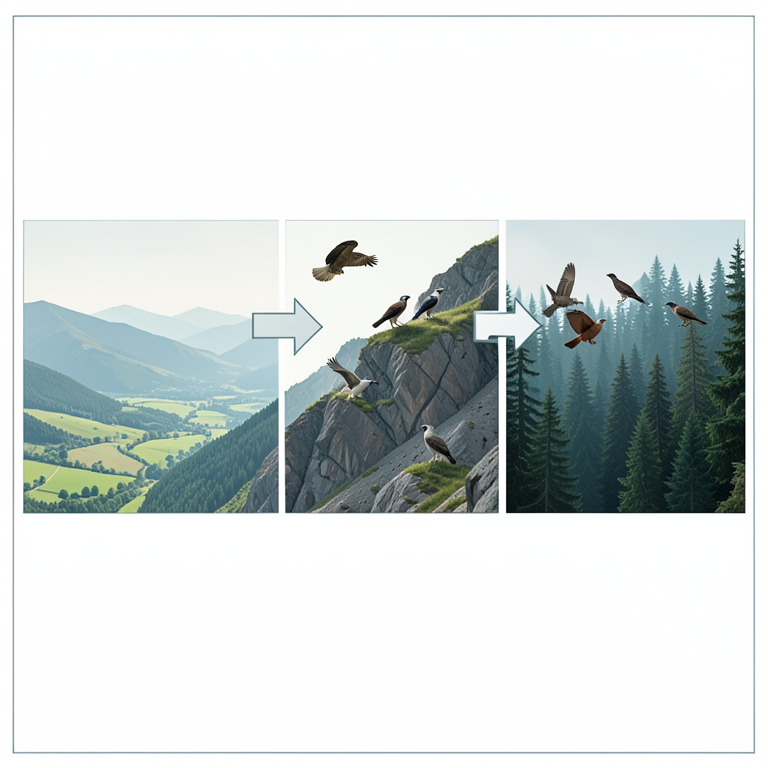
Factors Influencing Bird Distribution
AI-generated conceptual illustration (diverse avian species in a mountainous Himalayan landscape). It explains the idea and does not show study data.
View source evidence ↗Figures & tables
From the original paper Table 1
Introduction
Birds are 'warm-blooded' vertebrates, with fore-limbs modified to wings, and skins covered with feathers. Vertebrates are characterised by having a spinal column and a skull. 'Warm blooded' or homoiothermic (constant temperature) means that their body temperature is kept more or less constant and above that of their surroundings. Typically, the forelimbs as wings give birds the power of flight although there are some flightless birds. In some cases (e.g. penguins and puffins) the wings are used for swimming under water. For conservation measures to be implemented, it becomes necessary to know the species diversity, type of the habitat, they live in and the local abundance status of the animals of the concerned area. Birds form an important component of any natural ecosystem; they play a useful role in the control of insect pests of agricultural crops, as predators of rodents, as scavengers and as pollinating agents. This chapter puts together a complete checklist of the birds found within the geographical limits of Azmat abad village, Thane mandi, Rajouri, J&k. State. Geographically, the area represents heterogeneous landscape with a varied altitudinal range, characterized by enormous diversity in habitats and climatic regimes. Overall 08 orders of avian taxa represented by 15 families have been reported from the area; these includes 50 species classified( Table 1) This paper also tabularizes the distribution (presence or absence) of all the bird species in the regions and presents Azmat abad village, Thane mandi heir status (Resident/Passage Migrant/Summer Visitor/Winter Visitor) in these regions. As far as of avian diversity of India is concerned, many workers have made useful contributions in this regard, these include, Ali (1941), Ali & Ripley (1968-74,) [9] , Grimmett et al. (2011). The area under present investigation remained virgin as for as diversity of avifauna is concerned. All birds reproduce by laying eggs which are fertilised internally before laying. The skull and lower jaw are extended forward into mandibles which make a beak. The bird's legs and toes are covered with overlapping scales.Birds possess a third, transparent eyelid, the nictitating membrane, which can move across the eye.The birds rich Union territory of Jammu and Kashmir (Rahmani et al., 2013) with 28 important bird areas (Islam and Rahmani, 2012) is home to 12 globally threatened bird species and six near-threatened species (Rahmani et al., 2013). Many researchers, young birders and enthusiasts have contributed to the avian baseline for the Union territory which includes the work of Ahmed and Sahi (2005) [13] ; Aggarwal et al. (2008); Choudhary (2010) [16] ; Bhat and Bhat (2012) For conservation measures to be implemented, it turns into necessary to realize the species range, form of the habitat, they stay in and the local abundance repute of the animals of the involved area. Birds shape an essential element of any natural environment; they play a beneficial role in the manage of insect pests of agricultural plants, as predators of rodents, as scavengers and as pollinating retailers. As a ways as of avian range of India is involved, many employees have made beneficial contributions in this regard, those consist of, Ali (1941), Ali & Ripley (1968-seventy four,) [9] , Grimmett et al.
| Scientific name | Common Name | Status | IUNC status |
|---|---|---|---|
| Order: Accipitriformes | |||
| Family: Accipitridae | |||
| Accipiter badius dussumieri | Shikra | C | LC |
| Aquila nipalensis | Steppe Eagle | R | LC |
| Butastur teesa | White-eyed Buzzard | R | NT |
| Buteo rufinus rufinus | Long-legged Buzzard | R | LC |
| Circus aeruginosus | Western Marsh Harrier | R | LC |
Table text extracted from the original PDF; superscript letters are shown inline. The original table image is below.
View original table image
Material and methods
Material and methods
Study area
Azmat abad village of thaana mandi district Rajouri, Jammu and Kashmir, India is situated at a distance of 26 km from district headquarters and is stretched between 33°56,501 latand 74°56ʹ12ʹʹ longitudes. The altitude of the study area ranges from 1968 m. Azmat Abad village is also connected to Mughal road. The upper reaches of the study area receive heavy snowfall from Dec-April and winter is severe there, whereas the lower reaches have a pleasant season throughout the year. The basic floristic composition of the study area varies from that of a sub-tropical to subtemperate forest with 4 distinct seasons a year, spring (March -May), summer (June-August), autumn (September -November) and winter (December-February). The study area is dominated by coniferous forests, although broad leaved, mixed forest and alpine pastures are also found in some higher reaches like D.KG, rattan peer, sukhsar etc The sub-tropical forest is inhabited through exceptional tree species like Olea cuspidate (Khor), Punica granatum (Dhurni), Pinus roxberghii chir (pine) and temperate forest is occupied via Quercus species and Eleagnus species. Temperature of summer season tiers among 30 to 35 °C and of wintry weather among 2 °C to -4.8 °C. In wintry weather its mountain top felt periodic snow fall in which as low mendacity vicinity can also (for one or two days) or may not felt the snowfall. Water assets of this area are springs most effective which might also feed the Azmat abad move for at least 10 months and maximum of them dried up for one or months before monsoon. Crops of this region encompass wheat in iciness, and maize and paddy in summer. This area has very bad horticulture affect with most effective few trees of apple, walnut, akhrot, plumps Depending upon their presence within the limits of the State, the individual species have been grouped into the following four categories: Resident (R): Recorded throughout the year, mostly breeding; Passage Migrant (P): Recorded for a brief period of the year only; Summer Visitor (S): Recorded during summer, mostly breeding; and Winter Visitor (W): Recorded during winter. Species for which the records are either only sparse/isolated or are very old with no recent confirmations have also been enlisted and are suffixed by an asterisk ( * ). The individual species have been assigned conservation status as per the Red List of the International Union for Conservation of Nature (IUCN), which includes the fol-lowing categories: CR= Critically Endangered; EN= Endangered; VU= Vulnerable; NT= Near Threatened; LC= Least Concern.
Methodology
In order to record the avian diversity, periodic surveys were undertaken in the study area by adopting systematic field procedures and techniques for survey.The nomenclature followed in the present work is in accordance with those given in the "Handbook of Birds of India and Pakistan" by Ali and Ripley (1968-74) [9] . The more popular English names in use within India have also been provided. For identification and field diagnosis of birds, colourful plates of Ali and Ripley (1968-74) [9] , Ali (1996) (Verner, 1985) were used. The points transect method was more helpful in thick forest area Surveys were conducted from 6:30 am to 9:30 am in morning and 4:30 pm to 6:30 pm in evening during summers and 7:30 am to 10:30 am in morning and 3:30 pm to 5:30 pm in evening during winters. In addition to these fixed timings of surveys, some irregular visits were also planned and made during other hours of the day Local Abundance status after Srinivasulu and Nagulu (2002) of the recorded bird was established upon the following criteria: Common-recorded 9-10 times out of 10 visits, uncommonrecorded 6 -8 times out of 10 visits, occasional-recorded 3 -5 times out of 10 visits, rare-recorded 0 -2 times out of 10 visits. Observations were carried out with the help of Binoculars (12x50 Super Zenith) whenever found necessary. Photographs were taken with Canon (EOS) fitted with 300mm zoom lens and Sony DV Camera with 40X Zoom and Calls of the birds were recorded by tape recorders and mobile.
Distribution and Status Resident (R)
Species recorded throughout the year. Most of these breed in the area. Populations fluctuate and may get augmented temporarily with migrating indi-viduals from outside.
Mainly include pheasants and partridges many birds of prey (Accipitridae), parakeets (Psittacidae), woodpeckers (Picidae), and a good number of passerine species like crows and magpies (Corvidae), tits (Paridae), bulbuls (Pycnonotidae), prinias and tailorbirds (Cisticolidae), babblers Timalidae, and some redstarts
Passage Migrant (P)
Species recorded for a brief period of the year only. These species are on passage to or from their wintering destinations elsewhere and use the area briefly as a transit in autumn (September to November) and/or in spring (February to April). Mainly includes ducks and geese (Anatidae), some harriers and buzzards (Accipitridae), many waders (Scolopacidae), and a few leaf warblers Summer Visitor (S) Species recorded during summer months (March/April to October/November). Such species mostly breed in the area or include those who overstay their visit (over-summering).
Mainly includes cuckoos (Cuculidae), swifts (Apopidae), swallows and martins, and many leaf warblers
Winter Visitor (W)
Species recorded during winter months (September/October to February / March). Mostly include the waterfowl (Anatidae), falcons (Falconidae), some waders (Scolopacidae), and a few bunting species (Emberizidae)
Acknowledgement
AcknowledgementsThe authors are thankful to the people of Azmatabad for their valuable support during the field study. Special Thanks to D.F.O wildlife Rajouri and eco-tourism Guard for valuable support. Much thanks to my Guide Pragya Shrivastava Department of life science RNTU Bhopal for a proper guide from time to time. A deep sense of Gratitude to co -Guide Dr. Junaid jazib for their valuable support
References
16 in the original paper- Ahmad K. Birds of Dachigam National Park. Newsl Birdwatchers. 1999;39:22-24.
- Ahmad R, Sharma N, Bhatnagar YV, Suhail I, Pacchnanda U, Kaul R. Status of Western. Tragopan Tragopan melanocephalus in Jammu and Kashmir, India. Curr Sci. 2017;112:1948-1953.
- Ahmadullah M. Biodiversity of Jammu & Kashmir. World Wide Fund for Nature-India, New Delhi, 1997.
- Ali S. Indian Hill Birds. Oxford University Press, Bombay. (Reprinted 1979), 1949.
- Ali S. The Book of Indian Birds. Twelfth revised and enlarged centenary edition. BombayNatural History Society, Bombay, 1996.
- Baker, ECS. The Fauna of British India, Including Ceylon and Burma. Birds. 1 (2nd ed.). Taylor and Francis, London. pp. 368-373. Page, WT (1903). "The Himalayan Black Bulbul. Hypsipetespsaroides". Avicultural Magazine. 1924;1(6):209-211.
- Rasmussen PC, Anderton JC. Birds of South Asia. The Ripley Guide. Smithsonian Institution & Lynx Edicions. 2005;2:342-344.
- Raza Rashid H. Sighting of Black Bulbul Hypsipetesmadagascariensis (P.L.S. Muller) in Gaya, Bihar. Journal of the Bombay Natural History Society. 1993;90(2):291.
- Ali S, Ripley SD. Handbook of the Birds of India and Pakistan: together with those of Nepal, Sikkim, Bhutan and Ceylon, Oxford University Press, Oxford. 1968, 380p.
- Hume AO. The nests and eggs of Indian birds. 1 (2nd ed.). R H Porter, London. 1889, pp. 164-168.
- Ali S, Ripley SD. Compact handbook of the birds of Indian Subcontinent. Oxford University Press, Oxford. 1987, 890p
- Aggarwal S, Sahi DN, Wani A. Feeding guilds of avifauna of Nandni Wildlife Sanctuary, Jammu (Jammu and Kashmir). The Ecoscan. 2008;2(2):157-160.
- Ahmed A, Sahi DN. Diversity and status of birds of Tehsil Doda. Journal of Nature and Conservation. 2005;17:135-143.
- Ali S. The book of Indian birds. Thirteenth Edition Published by Bombay Natural History Society, Oxford University Press, Mumbai, India, 2002.
- Bhat BA, Bhat GA. Distribution of avifauna in Yusmarg forest-Jammu and Kashmir, India. International Journal of Current Research. 2012;4(5):52-56.
- Choudhary N. Diversity and Status of wildlife fauna of District Rajouri, J and K. Ph.D Thesis, University of Jammu, 2010.