
Research article · 2022 · Full text
International Journal of Biology SciencesToxicity of deltamethrin on total protein of kidney, liver, testis and ovary of air breathing fish Clarias batrachus (Linn.)
Volume 4(2) · Pages 122–124 · DOI: 10.33545/26649926.2022.v4.i2b.89 ↗
Research areasEnvironmental Toxicology and Ecotoxicology
Abstract
Author-writtenThe present study includes the biochemical, total protein alterations induced by chronic (30 days) exposure of Clarias batrachus to a sublethal concentrations (0.015 ppm conc.) of deltamethrin on the profile of total protein in the liver, kidney, testis and ovary. The liver, kidney, testis and ovary showed significant depletion of total protein amounting. The present study therefore points towards a severe metabolic dysfunction in response to deltamethrin toxicity in the fish Clarias batrachus (Bloch.).
Summary
Source-checkedPlain-language reading of the full paper, prepared with AI and checked against the text. Each point links to the authors' own words.
Why it matters
- Pyrethroid insecticides, such as deltamethrin, are used because they are highly toxic to insects and fish but generally have low toxicity to mammals. View evidence ↗
- These pesticides cause neurotoxicity by interacting with the γ-amino butyric acid (GABA) receptor-ionophore complex. View evidence ↗
- There is a need to investigate the toxic effects of deltamethrin because existing studies are limited, which is important for understanding potential human exposure impacts. View evidence ↗
The question
- The study aimed to illustrate how the pesticide deltamethrin affects the total protein profile of vital organs in the air-breathing fish Clarias batrachus. View evidence ↗
What they did
- The experiment used healthy Clarias batrachus fish with an average length of 9–12 cm and weight of 21–25 g, which were acclimated for 15 days. View evidence ↗
- At the end of the exposure period, the liver, kidney, testis, and ovary were dissected and weighed to estimate total protein using the Varley et al. (1980) method. View evidence ↗
What they found
- The kidney and liver showed the most significant protein declines (p < 0.001), with reductions of 31% and 30%, respectively. View evidence ↗
- Protein levels in the testis declined by 19% (p < 0.05) and in the ovary by 17% (p < 0.01). View evidence ↗
- Control protein levels (mg/g wet tissue) were 103.19±1.80 (liver), 75.05±1.05 (kidney), 80.45±1.45 (testis), and 120.01±1.80 (ovary), which dropped to 50.1±1.95, 45.05±0.10, 60.06±0.05, and 70.05±0.05 in the treated group. View evidence ↗
What it means
- The authors conclude that the decrease in total protein was likely caused by altered lipid and protein metabolism and increased energy demands due to toxicant stress. View evidence ↗
- The study indicates that deltamethrin toxicity leads to severe metabolic dysfunction in Clarias batrachus. View evidence ↗
Visual summary
1 visualsIllustrations explain the paper; they do not show study data.
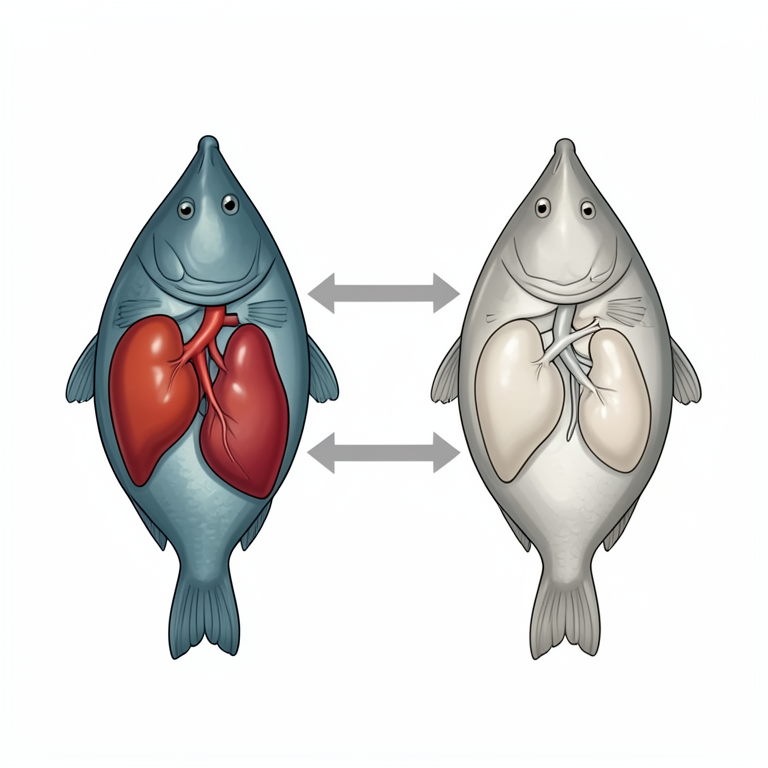
Organ Protein Depletion
AI-generated conceptual illustration (Air-breathing fish Clarias batrachus). It explains the idea and does not show study data.
View source evidence ↗Figures & tables
From the original paper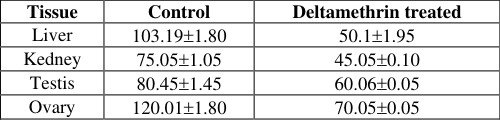 Table 1
Introduction
Deltamethrin belongs to a group of pesticides called synthetic pyrethroids. Pyrethroid insecticides are highly toxic to insects and fish and have generally low toxicity to mammals, forming the basis of their favorable selectivity. Pyrethroid pesticides interact with the γamino butyric acid (GABA) receptorionophore complex to cause neurotoxicity (IPCS, 1990) [7] . Pyrethroids were introduced as replacement for the persistent nature of the organophosphates and chlorinated pesticides. Deltamethrin is considerably less harmful to the environment and most non-target organisms than other insecticides like DDT, pyrethroids are used to spray inside the houses, to impregnate bednets, which protect populations from malarial mosquito bites. They are three times as expensive as DDT, but used in very low amounts for bed net spraying (Rehman, 2014) [14] . In other hand their consequent development of resistance by pests and their harmful effects on non-target organisms, WWF (World Wildlife Fund) does not recommend pyrethroid as a viable alternative to DDT, also the studies on toxic effects of deltamethrin are very less. So, there is a need to investigate deleterious toxic effects of deltamethrin and other pyrethroids to determine their impact in case of human exposure. Hence, in this paper efforts have been made to illustrate the effects of pesticide, deltamethrin on biochemical mainly total protein profile of the vital organs of the experimental fish, Clarias batrachus, locally known as "Mangur", is a freshwater air breathing fish having the presence of suprabranchial accessory respiratory organs.
Materials and Methods
The air-breathing teleost Clarias batrachus procured live from the local fish market were washed with 0.1% KMnO 4 solution to remove dermal infection if any. Healthy fish of average length (9-12cm) and weight (21-25 g) were acclimated for 15 days to laboratory conditions. The fish were fed with chopped goat liver every day adlibitum. Running tap water was used in all the experiments and the fish were adjusted to natural photoperiod and ambient temperature. No aeration was done. Static acute bioassays were performed to determine LC 50 values of deltamethrin for 24, 48, 72 and 96 hours following the methods of APHA, AWWA & WPCF (1985) [2] . The LC 50 values for these periods were 1.5 ppm, 0.85 ppm, 0.45 ppm and 0.15 ppm respectively. The sub-lethal concentration was determined following the formula of Hart et al. (1945) [5] . Twenty acclimated fish were exposed to a sub-lethal concentration (0.015 ppm) of deltamethrin for 30 days. Side by side same number of fish as that of experimental one was maintained as the control group.
On 30 th day at the end of exposure period the fish were anaesthetized with 1:4000 MS 222 (Tricane, methane, sulfonate, sandoz) for two minutes. The liver, kidney, testis and ovary were quickly dissected out, weighed to nearest mg and processed for the quantitative estimation of total protein by the methods of Varley et al. (1980) [18] .
Results
The protein profiles of liver, kidney, testis and ovary in response to deltamethrin exposure showed a significant decline. The liver and kidney showed statistically more significant decline. The liver and kidney showed statistically more significant (p< 0.001) decline i.e. 31% in , while 30% in liver. The testis showed significant (p< 0.05) while ovary showed significant at (p< 0.01). The testis showed decline 19% while ovary 17%. Total protein in the control liver, kidney, testis and ovary was estimated to be 103.191.80, 75.051.05, 80.451.45, and 120.011.80 respectively. As against there, the total protein profiles in the experimental lots were 50.11.95, 45.050.10, 60.060.05 and 70.050.05 respectively (Table-I).
Discussions
The present investigation was undertaken the alteration of protein profiles of some vital organs i.e. liver, kidney, testis and ovary of Clarias batrachus in response to sublethal dose of deltamethrin exposure. The level of tissue protein in control fish recorded in the present study indicates that total proteins are the largest contributors to the wet weight of the tissues after water. Ramalingam and Ramalingam (1982) [12] ; Kumar and Ansari (1984) [8] ; Tripathy and Singh (2003) [17] ; Rita and Milton (2006) [15] ; Rani et al. (2008) [13] ; Pratibha & Kumar, (2013) [11] ; Sunita Rani, et al. (2015) [16] ; Dilip and Vidya (2016) [4] , and Mohan, (2017) [9] have observed similar result under the various toxic chemicals exposure of malathion, Nuvan, fenvalerate, endosulfan, Eklaux and heavy metals in various fresh water fishes. The loss of gonadal proteins may also be associated to the direct action of pyrethroids leading to arrest of vitellogenesis in ovary and loss of germ cells in testis (Jha and Jha, 1995; Chow, et al. 2013) [6,3] . The liver of Clarias gariepinus exposed to the cypermethrin showed hyperplastic hepatic and necrosis of hepatic cells (Andem et al. 2016) [1] . The toxicity was found to increase with pesticide, endosulfan concentration, various structural changes were already induced on the morphology of the vital organs, i.e. gill, liver and kidney even with exposure to low, sublethal endosulfan concentration reported by Nordin, et al. (2018) [10] The toxic effects of surfactant, dodecyl dimethyl benzyl ammonium chloride (1227) on larval locomotors of zebrafish was observed by Yanan, et al. (2015) [19] . Proteins being involved in the architecture and physiology of the cell seem to occupy a key role in the cell metabolism. The observed significant depletion of tissue protein in the present case denotes high catabolic potency of those organs and may be attributed to the intensive proteolysis and utilization of their degradation products for metabolism under the toxic influence of deltamethrin. It is, therefore, conclude that the toxicity of the pesticide deltamethrin depend upon a number of physical, chemical and biological factors. Each of which may be used as a tool for pesticide toxicity to fish.
Conclusion
The test fish Clarias batrachus when exposed to sub lethal concentration of deltamethrin (0.015 ppm) for 30 days, significant decrease in total protein content in the tissue of all four organs, liver, kidney, testis and ovary. The decrease might have occurred mainly due to altered lipid and protein metabolism and energy demand in fishes under stress of toxicants.
Acknowledgement
AcknowledgementThe authors are thankful to the Department of Zoology, R.K. College, Madhubani, LNM University, Darbhanga, for the provision of laboratory facilities used in this study.
Figures and tables from the paper
| Tissue | Control | Deltamethrin treated |
|---|---|---|
| Liver | 103.191.80 | 50.11.95 |
| Kedney | 75.051.05 | 45.050.10 |
| Testis | 80.451.45 | 60.060.05 |
| Ovary | 120.011.80 | 70.050.05 |
Table text extracted from the original PDF; superscript letters are shown inline. The original table image is below.
View original table image
References
18 in the original paper- Andem AB, Ibor OR, Joseph AP, Eyo VO, Edet AA. Toxicological Evaluation and Histopathological Changes of Synthetic Pyrethroid Pesticide (Cypermethrin) Exposed to African Clariid Mud Catfish (Clarias gariepinus) Fingerlings. International Journal of Toxicological and Pharmacological Research. 2016;8(5);360-367.
- APHA. Standard methods for the examination of water and waste water (16 th Ed). American Public Health Assoc., Washington D.C, 1985.
- Chow WS, Chan WK, Chan KM. Toxicity assessment and vitellogenin expression in zebrafish (Danio rerio) embryos and larvae acutely exposed to bisphenol A, endosulfan, heptachlor, methoxychlor and tetrabromobisphenol A. J Appl. Toxicol. 2013;33:670678. 10.1002/jat.v33.7
- Dilip M, Vidya B. Chromium induced changes in biochemical composition and gonado-somatic index of a teleost, Oreochromis mossambicus (peters) The Jour. of Zool. St. 2016;3(5):28-34.
- Hart WB, Dondoroff P, Greenbank J. The evaluation of toxicity of industrial wastes, chemicals and other substances to freshwater fishes. Atlantic Refining Company. Phil. Part. 1945;(1):317-326.
- Jha BS, Jha MM. Biochemical effects of nickel chloride on the liver and gonads of the freshwater climbing perch, Anabas testudineus, (Bloch). Proc. Nat. Acad. Sci. (India). 1995;65B(1):39-46.
- IPCS (International Programme on Chemical Safety). 1990. Environmental health criteria 97. Deltamethrin. Geneva World Health Organization.
- Kumar K, Ansari BA. Malathion toxicity effect on the liver of the fish, Brachydanic reno (Cyprinidae). Ecotoxical Environ. Sal. 1984;23:199-205.
- Mohan K. Study on biochemical changes in Channa punctatus exposed to the pesticide endosulfan. Ph.D. thesis of L.N.M.U. Darbhanga, 2017.
- Nordin1 N, Ibrahim1 SA, Ahmad Nl, Hamidin1 FA, Dahalan, Abd Shukor MY. Endosulfan Toxicity to Anabas testudineus and Histopathological Changes on International Journal of Biology Sciences https://www.biologyjournal.net/ Vital Organs. E3S Web of Conferences. 2018;34:02055.
- Pratibha K. Haematological & bio-chemical effects of mercuric chloride to Heteropneustes fossilis. Ph.D. thesis of L.N.M.U. Darbhanga, 2013.
- Ramalingam K, Ramalingam K. Effects of sublethal levels of DDT, malathion and mercury on tissue proteins of Sarotherodon mossambicus (Peters). Proc. Ind. Acad. Sci. (Anim. Sci.). 1982;91(6):501-505.
- Rani R, Gautam R, Kumar S. Toxicity of Nuvan on kidney cholesterol on Labeo rohita. Ind. J Environ. & Ecoplan. 2008;15(1-2):115-118.
- Rehman H, Thbiani AA, Saggu S, Khurshid ZS, Anand M, Ansari AA. Systematic review on pyrethroid toxicity with special reference to deltamethrin. India Journal of Entomology and Zoology Studies. 2014;2(5):01-06
- Rita JJ, Arockia, Milton MC, John. Effect of Carbamate pesticide (methonyl) on the bio-chemical components of the fresh water Oreochronis mossambicus Pteva) Ind. J Eniron & Ecoplaning. 2006;12(1):1-8.
- Sunita Rani Gupta RK, Manju Rani. Heavy Metal Induced Toxicity in Fish with Special Reference to Zinc and Cadmium. International Journal of Fisheries and Aquatic Studies. 2015;3(2):118-123.
- Tripathi PK, Srivastav VK, Singh A. Toxic effect of dimethoate (Organophosphate) on metabolism and enzyme system of freshwater teleost fish Channa punctatus. Asian Fisheries Science. 2003;16:349-359.
- Varley H, Gowenlock AH, Bell M. Practical clinical Bio-chemistry, General topics and commoner tests. William Heinemann Medical Books Ltd., London, 1980, 1.
Cited by 4
From OpenAlex, OpenCitations and reference lists read by Scinovex
- Investigation of acute toxicity of deltamethrin (2.5% EC) to a Guppy fish, Poecilia reticulata (Peters, 1859) ↗
Divakar Kumar, Nageshwar Wast · International Journal of Fisheries and Aquatic Studies · 2026
An experimental routine static bioassay test (96 hour) has been carried out to investigate the acute toxicity of Deltamethrin 2.5% EC to a freshwater ichthyofaunal species (Guppy), Poecilia reticulata (Peters, 1859) by Probit analysis statistical software method (SPSS, Version-27). The acclimatized test fish of approximately equal sizes, juveniles (1.0±0.3 cm), males (2.6±0.2 cm) and females (3.8±0.4 cm) were selected for
- Effect of organic and inorganic fertilizers on survival and performance of African catfish fry produced under artificial propagation ↗
Belay Abdissa, Haymanot Yenesew, Mohammed Oumer, Alayu Yalew · International Journal of Bioscience and Biochemistry · 2023
This study was conducted to determine the effect of organic and inorganic fertilizers on the survival and performance of African catfish fry produced under artificial propagation in a fish pond for sixty days. Two types of fertilizers chicken manure, di-ammonium phosphate (DAP), and a Control group with no fertilizer were tested in triplicate using nine concrete ponds of 10 m2.
- Impact of chlorpyrifos insecticides on the Haematology of Clarias gariepinus ↗
Sunita Arya, Renu Goel, G. S. Shukla · Zoological and Entomological Letters · 2023
Insecticides' toxic effects on edible fish are an issue of concern on a global scale. The purpose of the current study was to track the toxicity caused by Pyrethroid pesticides. Haematological analysis of blood was done to assess the degree of Pyrethroid toxicity in the exposed Clarias gariepinus. Chlorpyrifos trioxide was administered at a sublethal dose for 30 days. Fish
- Histopathological study of vital organs of Clarias batrachus (Linn.) Induced to deltamethrin ↗
Mala Kumari · International Journal of Fisheries and Aquatic Studies · 2023
Deltamethrin is an insecticide belongs to a group synthetic pyrethroids. The current investigation includes histopathological alteration in the liver, kidney, testis and ovary of Clarias batrachus exposed to a sublethal concentrations (0.015 ppm conc.) of deltamethrin for 30 days. The induced fish showed significant histopathological changes viz. in liver histology showed degeneration, necrosis and hyperemia, testes histology showed spermatogonia cell’s…
❝ 0PDF