
Research article · 2022 · Full text
International Journal of Biology SciencesBaseline information and physiological modification of hill-stream fishes of Mahakali River, Nepal
Volume 4(2) · Pages 104–107 · DOI: 10.33545/26649926.2022.v4.i2b.84 ↗
Research areasFish Biology and Ecology StudiesFish biology, ecology, and behavior
Abstract
Author-writtenThis study was carried on the Mahakali River from October 2007 to October 2008, which flows in western region of Kanchanpur district of Mahakali zone of Nepal. The purpose of this study to provide baseline information of the hill-stream fishes of Mahakali River and physiological modification. The sampling stations were established along the 10 km stretch of this river and dividing into two sections, each sampling station were 10km far from each other. Each sampling station was visited three times during the study period. A total of 16 times samples were collected with the help of cast net, scoop net and hook line. Altogether 44 fish species collected including 19 hill stream fish species recorded from the study site. This includes 5 orders, 12 families, 29 genus which represents the total collected species. Among them, 5 species were exotic and 39 species were collected from Mahakali river and irrigation canal along with other associated area. The family Cyprinidae found to be dominating species with 21 species, followed by family Cobitidae with 5 species, Bagridae represented by 2 species, Clariidae with 2 species, Channidae with 2 species, Mastacembelidae 2 species, Siluridae 1 species, Chandidae 1 species, Nandidae 1 species, Gobiidae 1 species and finally Anguillidae represent 1 species. Among them, altogether 19 species were hill-stream fishes. The hill-stream fishes like Labeo dero, Barilius barna, Barilius bendelisis, Barilius vagra, Raiamas bola, Brachydanio rerio, Esomus danrica, Garra annandalei, Garra gotyla, Tor Crossocheilus latius, Schizothorax plagiostomus, Schizothoraichthys progastus, Botia lohachata, Lepidocephalus guntea, Acanthocobatis botia, Schistura rupecula, Schistura corica and Glossogobius giuris were found.
Summary
Source-checkedPlain-language reading of the full paper, prepared with AI and checked against the text. Each point links to the authors' own words.
Why it matters
- Hill-stream environments are characterized by fast currents, low temperatures, and high oxygen levels, which drive structural modifications in the fish that live there. View evidence ↗
The question
- The study aimed to establish baseline data on the fish species in the Mahakali River and examine their physiological modifications. View evidence ↗
What they did
- The research was conducted in the western region of Nepal's Kanchanpur district along the Mahakali River between October 2007 and October 2008. View evidence ↗
- Sampling occurred across a 10 km stretch of the river divided into two sections, with 16 total collection events using cast nets, scoop nets, and hook lines. View evidence ↗
- To determine seasonal fish stocks, collections were performed during the summer, monsoon, and winter. View evidence ↗
- Fish species were identified using morphometric measurements and a taxonomic reference book by J. Shrestha. View evidence ↗
What they found
- The study identified a total of 44 fish species, 19 of which were classified as hill-stream fishes. View evidence ↗
- Cyprinidae was the most dominant family with 21 species, followed by Cobitidae with 5 species. View evidence ↗
- At the first station, Botia lohachata was most abundant (14.44%) and Raiamas bola bola least abundant (0.18%); at the second station, Garra gotyla was most abundant (14.70%) and Glossogobius giuris least abundant (0.42%). View evidence ↗
- Garra gotyla possesses an adhesive organ on the ventral side of its flattened head, likely used for attaching to rocks. View evidence ↗
- Acanthocobatis botia has modified, swollen lips that form a ring-like sucker to assist in adhesion. View evidence ↗
- Schizothorax plagiostomus and Crossocheilus latius have hard callous plates on their jaws used for scraping food. View evidence ↗
- Scale reduction was observed in hill-stream cyprinids such as Schizothorax plagiostomus, Schizothoraichthys progastus, and Acanthocobatis botia. View evidence ↗
- Fish size varied significantly, with Tor tor reaching over one meter in length and weighing over 20 kg. View evidence ↗
What it means
- The authors conclude that while hill-stream fishes are found throughout the river range, those in the upper reaches exhibit more pronounced body modifications. View evidence ↗
Visual summary
1 visualsIllustrations explain the paper; they do not show study data.
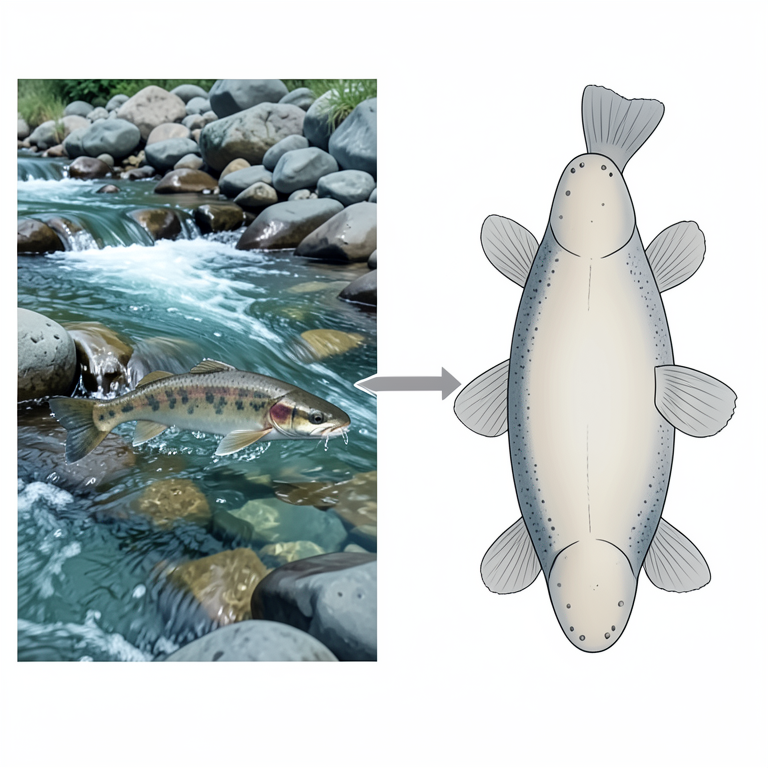
Study overview
AI-generated conceptual illustration (hill-stream loaches and gobies in a rocky riverbed). It explains the idea and does not show study data.
View source evidence ↗Introduction
Nepal is small landlocked country with an area of 1, 47,181-sq km. It lies between India and China and stands between the latitude of 20 0 21' to 30 0 27' north and it's longitude between 80 0 4' to 38 0 12' east. It extends 885 km along the east-west with an average width of 193 km along the north side. Within this limited area exists a remarkable altitudinal variation, varying from the plain in the south with hot tropical climate to the mountain region of temperate climate and a very cold alpine region is found in Himalayan. Nepal has many streams or torrential rivers. The conditions of these hill streams are quite different in comparison to those of the plain rivers. The physico-chemical and biological conditions of water of these torrential rivers play an important role on the fish fauna inhabiting them. The fast flowing current of water (10 m/10sec to10 m/3 sec), the low temperature due to rapid and constant motion of water, plenty of oxygen, shelter rich food in the form of algae and shallow and clear water results in different structural modifications in the hill-stream fishes. On the basis of structural modifications the hill-stream fishes can be divided into three main groups:-1. The first group with small fish like genus Danio and loaches which hide themselves under stone and rocks at the bottom for shelter. 2. The second group includes the migratory fishes like genus Schizothorax, Tor, Neolissochilus, Barilius and Barbus which migrate for feeding and breeding purpose. They live temporarily in hill streams so do not develop any types of adhesive organs for adhesion in the fast flowing water except in genus Schizothorax. 3. The third group comprises all highly specialized hill-stream fishes with different types of structural modifications of their body.eg. Genus Garra, Pseudecheneis, Glyptothorax etc.
Literature Review
After 1951 fish and fisheries were studied by a number of people, e.g. Taft (1955) [9] , DeWitt (1962) [13] , Menon (1962) [14] , Thapa and Rajbanshi (1968) [11] , Bhatt (1970) [15] , and Atkinson (1974). Shrestha, J. (1978) studied the fish fauna of Nepal and reported 118 fish species out of which she described two new species and one sub-species (Barilius jalkapoorei sp. nov., Lepidocephalichthys nepalensis sp. nov., and Pseudeutropius murius batarensis sub sp. nov.). Shrestha TK, (1990) [16] has recorded 69 fish species from the Mahakali. Shrestha TK, (1990) [16] has also stated that 130 species of fish occur in the snow-fed rivers and mountain lakes of the Nepalese highlands. Talwar and Jhingran (1991) [10] have reported 96 fish species representing 19 families and 5 orders from Nepal in their book "Inland Fishes of India and Adjacent Countries". Olmedo et al. (1994) [18] has assessed the hydro biological changes along an altitudinal transect of eighteen to twenty three tributaries in 600-3750 m altitude. In adjacent river systems (six streams of Likhu Khola valley) of central Nepal they reported Neolissochilus hexagonolepis (McClelland), Puntius conchonius (Hamilton), Schistura rupecula (McClelland), Ophiocephalus gachuwa (Hamilton), genus Barilius and Garra. Shrestha, J. (1994) [2] has reported a total of 188 fish species from Nepal, out of which 179 indigenous and 9 exotic. But in 1985 Shrestha, J. listed only 185 species, representing 11 orders. Shrestha, T.K. (1995) [5] records a total of 183 species, out of which 173 indigenous and 10 exotic fish species. Out of the reported exotic fish, two species -Oncorhynchus rhodurus Jordon et Mcgregor and Salmo trutta L. do not exist presently in the country. Shrestha T.K. (1996) [6] , studied the fishes of Kali Gandaki river and reported 57 species. Shrestha J, (1999) [19] , studied on 'Cold Water Fish and Fisheries in Nepal' and reported 59 indigenous and 2 exotic fish species. Rai (2000) [17] reported 13 fish species from West -Seti Hydroelectric Project. Recently, Shrestha, T.K. (2008) [7] enumerate the fishes of Nepal and describe the 232 species of fish in his book entitled "Fish diversity and potentiality of indigenous fishes for the future development of aquaculture".
Materials and Methods
The present investigation was started from the year at 2007 October to 2008 October. A series of collections were made from the Mahakali River mainly near Sarada barrage and suspension bridge of Dodhara and Chadani. Fishes are also collected from ponds, swamplands, ditches and paddy fields which faded by the waters of Mahakali River as the fish species comes in these land from river. Fishes were collected in three seasons namely summer, monsoon and winter to determine fish stocks in these seasons. Fish collection was made with the help of local fishermen using various nets. For fish sampling cast nets and scoop nets were used. Fishes were also collected from local fish markets. The fish identification was done by their morphometric measurement and use of taxonomic book of J. Shrestha.
Study area
The study area was selected a large perennial river which is situated in the west part of Nepal, the Mahakali River. It follows from north to south starting from Darchula district to kanchanpur district adjoining two countries Nepal and India in the west. The river basin has a total drainage area of 15,640 km 2 . The river has three major tributaries; rivers Chamelia, Surnayagad and Rongun Khola (Sharma, 1997) [12] . The study area was divided into the two stations i.e. station I and station II.
Result
Out of total 44 collected fishes, 19 hill stream fishes were identified as hill stream fishes. Though these fishes are collected from the plain area of river and different region such as irrigation canal, rice field, the body shape and organ in these fishes were found less adaptive modification. Some fishes have the adaptive modification in some extent. Otherwise other fishes have normal spindle shaped body. The range of distribution of hill steam fishes would be high hill region to low terai region. The lists of hill stream fishes which are collected during research are as follows: Botia lohachata has the higher percentage in number about 14.44 percent whereas Raiamas bola bola has found in least percent about 0.18 in first station. The higher percentage number of species in second station is Garra gotyla about 14.70 percent whereas least percentage number is 0.42 percent of Glossogobius giuris. From the study on the Mahakali river, there has been collected 44 species among them 19 species are hill streams. The orders which these fish species represents are Cypriniformes, Siluriformes, Synbranchiformes, Perciformes and Anguiliformes. The families were found to be Cyprinidae comprises 21 species, followed by family, Balitoridae with 5 species, Bagridae represented by 2 species, Claridae with 2 species, Channidae with 2 species, Mastacembelidae 2 species, Siluridae 1 species, Chandidae 1 species, Nandidae 1 species, Gobiidae 1 species and finally Anguillidae represent 1 species. In the cold waters of the Mahakali river Labeo dero and Tor are the dominant fish followed by Schizothorax plagiostomus and Schizothoraichthys progastus and the small loaches of Balitoridae group. In the cold waters of high hills the above mentioned fish species are accompanied by the cyprinids Tor tor, Crossocheilus latius and Barilius bendelisis followed by Botia lohachata. Amongst the recorded fish, one species varies from other in shape, size and weight. Some of the fish were small and may weigh a few grames, e.g. Brachydanio rerio, Acanthocobatis botia, Schistura rupecula Schistura corica, Botia lohachata, Lepidocephalus guntia, Garra gotyla and Garra anandalei while the biggest fish range to over one metre, e.g. Tor tor weigh over 20 kg. The fish also show diversity on the basis of their feeding habits, ranging from herbivorous to larvivorous and from insectivorous to omnivorous. Schizothorax plagiostomus, Schizothoraichthys progastus and Tor tor have been found conical or pointed head with slender and strong tail. Raiamas bola found a laterally compressed body to resist the water current. In Garra gotyla, adhesive organ seen on the ventral side of the flattened head which might be used to attach to a rock. The body of fish lives in slow Running River is cylindrical body as Crossocheilus latius, while those inhabiting rapid stream has flattened body. The scales of cyprinid fishes living in the hill streams undergo reduction as found in the Schizothorax plagiostomus, Schizothoraichthys progastus and Acanthocobatis botia. The mouth instead of being a transverse cleft at the anterior end of the snout is shifted towards the rostral side, behind. In Acanthocobatis botia the lips seems to be modified so as to form a sucker with help of mouth. The lips are divided in the middle and are swollen, so that to form a ring like sucker. In Garra gotyla, the gill opening are a little wider, but still separated from each other by a considerable distance. The muscle of mouth has adhesive organ. The snout is not pointed as compared with Garra Annandalei. Simple condition was seen in Acanthocobatis botia, Schistura rupecula and Schistura corica in which mouth aperture was surrounded by thick horny lips which functions as a suckers. In Schizothorax plagiostomus and Crossocheilus latius the jaws were covered by a hard callous plate for scraping the food. Posterior to this callous plate, the skin was thickened and tuberculated. In Garra gotyla, the adhesive organ looks like a disk on the postero-ventral side of mouth openings. The whole structure helps the fish in adhesion to rocks and stones. Lepidocephlus guntea, Macrognathus pancalus and Macrognathus aculeate were collected from the irrigation canal, rice field, and pools of irrigation canal during the rainy season. The flooding during the rainy season had swift way many small fishes and takes these fishes on rice field. During this season, Lepidocephalichthys guntea, Puntious spp, are in abundant in the rice field. The smallest fish Denio rerio was found abundant in irrigation canal, rice field and in the swamp area where water is somewhat greenish in colour due to the phytoplankton.
Conclusion
The research which was oriented in the Mahakali River, situated in the west part of Nepal, consists of wide number of cold water fish species. The fish species varies in their size, abundance, adaptive modification due to the geography of river. The Mahakali River flows in high speed in the hill regions but slows down in the tarai region. Due to this, fishes diversify their body structure physically as well as anatomically and are able to adopt such kinds of environment. Though the meaning of hill stream fishes is those fishes which are found in the fast flowing water the torrential stream of hill, these fishes also found in the lower range of river where water flow in a low speed. So these fishes found tarai region to high hill region. Another factor is they can survive in a certain range of temperature but not high as above the 25 0 C. So, hill stream fishes like Schizothorax spp, Tor spp, Crossocheilus latius, Garra annandalei, Garra gotyla gotyla, Acanthocobatis botia, Schistura spp, Brachydanio rerio, Botia spp mostly collected from the Mahakali River. Other fishes like Labeo spp, Barilius spp, Lepidocephalus spp, Raiamas spp., which lie under the category of hill stream, are found in the irrigation canal, flooding water during monsoon, Ghols and other water bodies present that locality which serves these species. So it may be conclude that hill stream fishes found in low range of Himalayan Water River and modificational characters mostly observed in those fishes which prefer to live in upper riches of river due to the modification in their body organs.
Acknowledgement
AcknowledgementsThis research work carried under the supervision of Prof. Dr Tej Kumar Shrestha, Central Department of Zoology, Kritipur, Kathmandu. I would like to express my deep greatful for his kind guidance, sincere effort, and helpful suggestion during the study period. I am also thankful to Dr. Vinod Kumar Mahaset, Siddhanath Science Campus for helping me at study area. I am thankful to all fisherman specially Min Bahadur which help me to collect fishes from Mahakali river.
References
11 in the original paper- Shrestha J. Fish fauna of Nepal. J Nat. Hist. Mus. 1978;2(1-4):33-43.
- Talwar PK, Jhingran V. Inland fishes of India and adjacent countries. Oxford & IBH publishing Co., New Dehli, India. 1991;(1)2.
- Thapa RB, Rajbanshi KG. Report on few hill-stream fishes in Nepal. Nepal valdiya, K.S. 2001. Himalayan Emergence and Evolution. University presss, India; c1998. p. 139.
- Sharma P, Chrisman JJ, Chua JH. Strategic management of the family business: Past research and future challenges. Family business review. 1997 Mar;10(1):1-35.
- DeWitt BS. Quantum theory without electromagnetic potentials. Physical Review. 1962 Mar 15;125(6):2189.
- Menon MK, Raman K. Observations on the prawn fishery of the Cochin backwaters with special reference to the stake net catches. Indian Journal of Fisheries. 1962;8(1):1-23.
- Bhatt GM. Multivariate analysis approach to selection of parents for hybridization aiming at yield improvement in self-pollinated crops. Australian Journal of Agricultural Research. 1970;21(1):1-7.
- Shrestha TK. Rare fishes of Himalayan waters of Nepal. Journal of Fish Biology. 1990 Dec;37:213-6.
- Rai KR, Peterson BL, Appelbaum FR, Kolitz J, Elias L, Shepherd L, et al. Fludarabine compared with chlorambucil as primary therapy for chronic lymphocytic leukemia. New England Journal of Medicine. 2000 Dec 14;343(24):1750-7.
- Hourquebie P, Olmedo L. Influence of structural parameters of conducting polymers on their microwave properties. Synthetic Metals. 1994 Jul 1;65(1):19-26.
- Boelaert M, El Safi S, Mousa H, Mbati J, Gurubacharya VL, Shrestha J, et al. Multi-centre evaluation of repeatability and reproducibility of the direct agglutination test for visceral leishmaniasis. Tropical Medicine & International Health. 1999 Jan;4(1):31-7.