
Research article · 2022 · Full text
International Journal of Biology SciencesMorphology and their abundance of marine hermit crabs In Zee-Phyu-Thaung coastal areas, Mon state, Myanmar
Volume 4(2) · Pages 229–234 · DOI: 10.33545/26649926.2022.v4.i2d.124 ↗
Research areasCrustacean biology and ecologyFish Biology and Ecology StudiesCoral and Marine Ecosystems Studies
Abstract
Author-writtenThe morphological characters of marine hermit crabs from mangrove forests and rocky and sandy shores around Zee-phyu-thaung and its adjacent coastal areas were conducted from September to November 2018. Consequently, a total of 5 species in 2 genera and 1 family were identified with their distinguished characters including Clibanarius infraspinatus (Hilgendorf, 1869), Clibanarius padavensis De Man, 1888, Clibanarius merguiensis de Man, 1888, Diogenes edwardsii (De Haan, 1849) and Diogenes alias McLaughlin & Holthuis, 2001. Among them, C. padavensis (Bosc, 1802) and D. alias McLaughlin & Holthuis, 2001 were first records for Myanmar’s hermit crabs. Moreover, C. padavensis and D. edwardsii was the most abundance species in Zee-phyu-thaung.
Summary
Source-checkedPlain-language reading of the full paper, prepared with AI and checked against the text. Each point links to the authors' own words.
Why it matters
- Hermit crabs are decapod crustaceans, with approximately 1100 species that typically use scavenged mollusc shells to protect their soft, asymmetrical abdomens from predators. View evidence ↗
- Despite having diverse marine environments and long coastlines, research on hermit crabs in Myanmar is very limited or nonexistent. View evidence ↗
The question
- The study aimed to record hermit crab species in Zee-phyu-thaung, Myanmar, analyze their morphological characteristics, and determine their relative abundance. View evidence ↗
What they did
- The research was conducted from September to November 2018 in the Zee-phyu-thaung coastal areas, specifically including Payarthaung, Kamawkin, and Sitaw. View evidence ↗
- Samples were collected manually along the coast during low tide. View evidence ↗
- Researchers measured body and shell lengths, photographed the specimens, and preserved them in 10% formalin. View evidence ↗
What they found
- The study identified five species of hermit crabs across two genera and one family: C. infraspinatus, C. padavensis, C. merguiensis, D. edwardsii, and D. alias. View evidence ↗
- C. padavensis and D. alias were identified as the first recorded instances of these hermit crab species in Myanmar. View evidence ↗
- The genus Clibanarius was the most abundant, making up more than 60% of the total samples collected. View evidence ↗
- Among the identified species, C. padavensis was the most abundant, accounting for over 38% of the samples. View evidence ↗
- D. edwardsii was the most abundant species within the Diogenes genus, representing over 28% of the samples. View evidence ↗
- Morphological analysis showed that Clibanarius species have longer ocular peduncles than D. edwardsii, and Diogenes species always have a left cheliped larger than the right. View evidence ↗
- Except for C. merguiensis, Clibanarius species exhibit longitudinal stripes on their ambulatory legs, while Diogenes species feature sectional cross color bands. View evidence ↗
What it means
- The authors suggest that the high abundance of Clibanarius in the study area is likely due to the genus's ability to thrive in low-salinity waters, as the site is located near the mouth of the Ye river. View evidence ↗
- The authors noted that some observed colors of the specimens did not align with existing literature. View evidence ↗
Visual summary
1 visualsIllustrations explain the paper; they do not show study data.
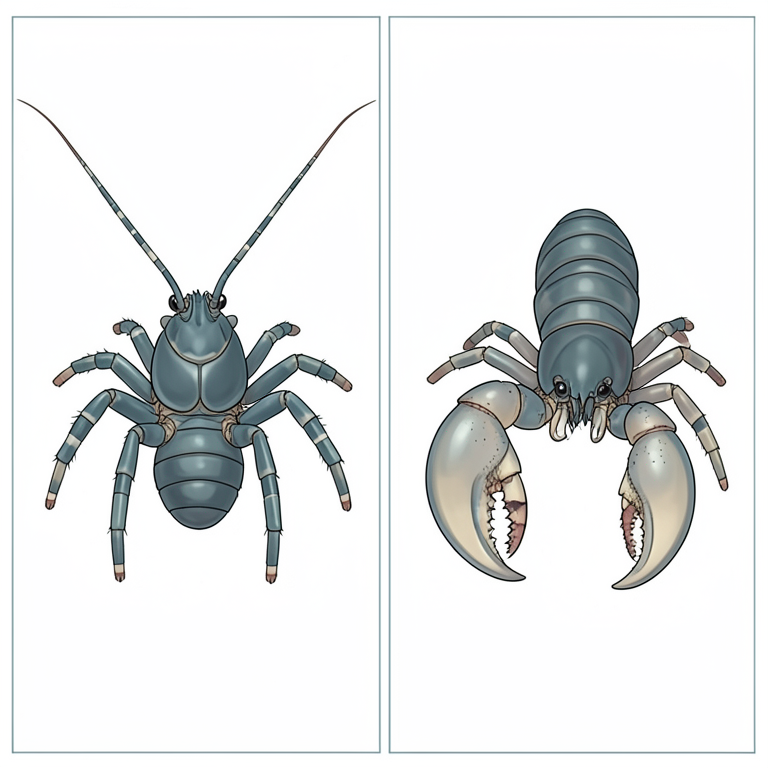
Morphological Comparison
AI-generated conceptual illustration (marine hermit crabs of the genera Clibanarius and Diogenes). It explains the idea and does not show study data.
View source evidence ↗Figures & tables
From the original paper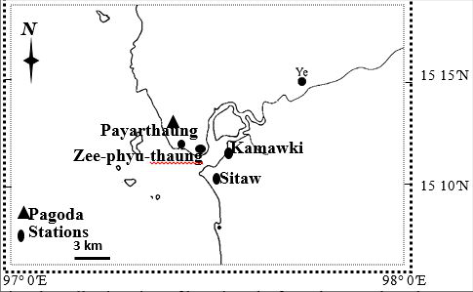 Figure 1
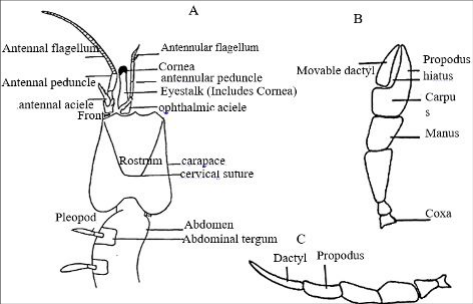 Figure 2
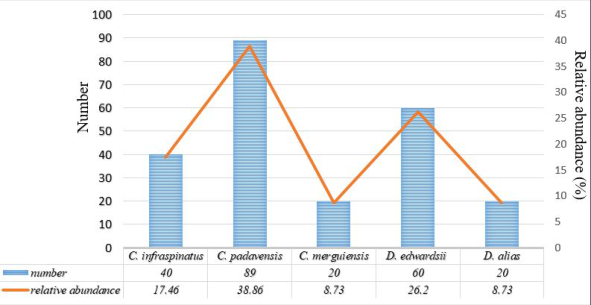 Figure 3
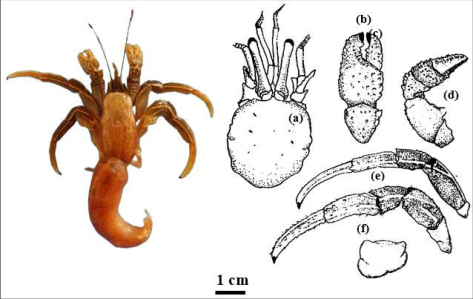 Figure 4
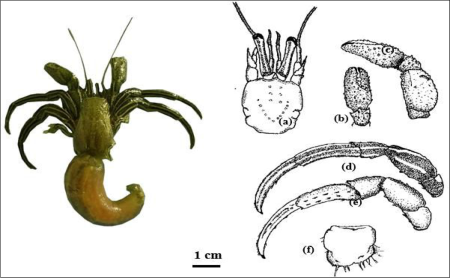 Figure 5
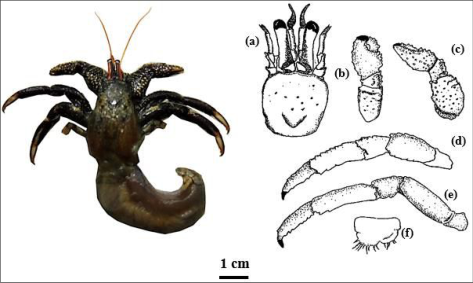 Figure 6
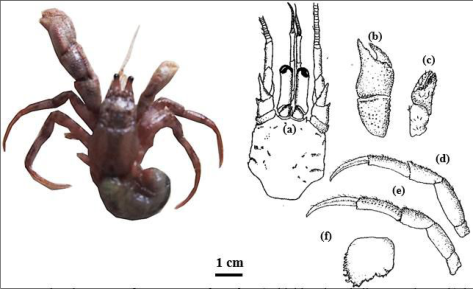 Figure 7
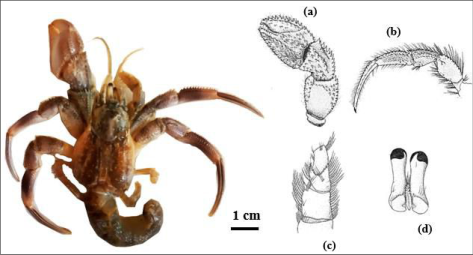 Figure 8
Introduction
Hermit crabs are decapod crustaceans of the superfamily Paguroidea (Patsy McLaughlin & Michael Türkay 2011) [10] . Most of the approximately 1100 species possess an asymmetrical abdomen that is concealed in a scavenged mollusc shell carried around by the hermit crab. Most species have long, spirally curved abdomens, which are soft, unlike the hard, calcified abdomens seen in related crustaceans. The vulnerable abdomen is protected from predators by a salvaged empty seashell carried by the hermit crab, into which its whole body can retract (Ray 1997) [21] . Most frequently, hermit crabs use the shells of sea snails (although the shells of bivalves and scaphopods and even hollow pieces of wood and stone are used by some species). Most hermit crabs are nocturnal. Despite Myanmar have extensively long coastlines and diverse marine environments, the studies of hermit crabs are very rare to absent. The present study is the second record of systematic account on the marine hermit crabs in Myanmar after Yu Yu May 2014 [28] . The aim of the present study is 1. To record the hermit crab species in Zee-phyu-thaung, Myanmar, 2. To study their morphological characters and 3. To know the abundance of their species in Zee-phyu-thaung.
Materials and Methods
The studies on the systematic classification of Anomuran hermit crabs from Zee-phyuthaung coastal areas including Payarthaung, Kamawkin and Sitaw were conducted from September to November 2018. Zee-phyu-thaung is located in Mon State and around the mouth of Ye river, Myanmar. The general morphology and terminology used for identification of the typical hermit crabs were presented. The samples were collected by hand during the low tide along the coast. Most of the samples were collected in plastic vials containing a little amount of seawater and carried to the laboratory for identification work. All samples were preserved with ice and carefully remove the hermit crabs body from the hard shells by crushing the shells using a hammer. Then the bodies of hermit crabs were photographed using digital camera and measure the body length and shell length. After that the samples were preserved in 10% formalin. The samples were then identified under the compound and dissecting microscopes. The distinctive characters of appendages or segments of the body were drawn on the tracing paper by using stereomicroscope with Camera Lucida and dotted or shaded. The sketch drawings showing the taxonomic keys characteristics of each hermit crab were presented. The artificial key to the species of hermit crabs collected from Zee-phyu-thaung coastal area was provided in the present study.
Result Terminology
The following characters were reviewed and used in this study based on Provenzano Jr., Anthony J. 1959 [18] . [12] Key to the species of Anomuran hermit crabs 1a. Left cheliped are larger than right.
Description
Shield longer than broad. Ocular peduncles long, slender, ocular acicles multidenticulate. Antennular peduncles equal to or slightly longer than ocular peduncles; antennal peduncles shorter, not reaching to base of corneas; antennal acicle reaching beyond base of ultimate segment. Chelipeds generally equal, or right slightly smaller, similar in armament; palms each with numerous spiniform tubercles on dorsal surface. Ambulatory legs with dactyls longer than propod; dorsal surfaces each with slightly raised but smooth longitudinal margin; ventral margins each with 7 or 8 corneous spines in distal half; carpi each with row of spines on dorsal surface (second) or single dorsodistal spine (third).
Telson margins each with 5 or 6 prominent, corneous-tipped spines.
Colouration
The cheliped are of brown-orange colouration but has no visible stripes. It is sparsely hairy and has pale white pimples on its entire ventral surface. Pincers (or claws) are coloured towards orange and are lined black. The 2 pairs of walking legs are brown with sparse hair, decorated with orange stripes along both longitudinal margins. Its eye stalks are brown, lined with pale orange stripes along both its longitudinal margins. Its antennae are short orange tips that are feathery. Its long antennules are pale or dark brown and are non-feathery.
Habitats
Low intertidal to shallow subtidal. Associated with sand, especially near river mouths. Inhabits mangrove areas with sandy and muddy substrates.
Distribution
Red Sea, Arabian Sea, Bay of Bengal, Singapore, Tavoy, Philippines, Sydney and Taiwan (McLaughlin 2002) [11] .
Clibanarius padavensis De Man, 1888 figure 5
References.-Alock, 1905 [1] : 42, 44, pl. 4, fig. 2, Southwell 1906 [23] , p. 215; McCulloch, 1913 [9] : 349, 352; Sundara Raj 1927 [24] , p. 130; Dechance, 1964 [6] : 32, text fig. 5; Panikkar and Aiyar 1937 [16] , p. 296; Ball and Haig, 1972 [2] : 95-96, fig 4; Thomas 1989 [25] : 65, FIG. 1 o-q, PI. IC, McLaughlin 2002 [11] ; 402-403; Trivedi 2015 [26] : 37-38, fig
Coloration in life
The shield and carapace off white in color with no stripes, the ocular peduncle off white in color with dark brown stripe in the middle; longitudinal dark brown stripes present on eye stalk with off white background. Cornea jet black in color. Merus and carpus of chelipeds dark green in color and covered by white stripes with dark brown border; the outer surface of the palm dark green in color with dark brown line on upper part; the inner surface of palm off white in color.
Walking leg off white with four or five dark brown longitudinal lines with white border on all the segments; tips of the dactylus black.
Coloration in formalin
Shield pale orange to white, with brownish longitudinal markings tending toward broad, much diffused stripes; in some specimens there are two distinct longitudinal stripes. Eye scales mostly reddish brown. Eyestalks orange-brown to pale orange dorsally, pale on outer and ventral surfaces; a distinct, narrow, longitudinal stripe on mesial surface. Basal segment of antennule white mottled with orange-brown; rest of peduncle orange-brown; flagellum white. Antennal scale and basal segment of peduncle mostly orange-brown; distal segment pale, with a brown longitudinal stripe on each lateral surface; flagellum pale for about half its length, orange-brown in distal half. Chelipeds mottled dark brown and pale orange; two distinct longitudinal stripes on each movable finger. Ground color of walking legs pale orange to nearly white propodus and dactyl with a broad band of white at each end of segment. Merus, carpus, propodus, and dactyl with longitudinal stripes of dark brown or dark orange-red; in some specimens these stripes extend to the ends of the segments, in others they do not cross them white band at either end of the propodus and dactyl.
Habitats
Intertidal areas in muddy substrates and in the mangrove forest.
Distribution
East Coast of Africa from Delagoa Bay northwards and Madagascar, West Coast of India, Bay of Bengal, Singapore and East Indies to Australia. (Ball and Haig, 1972) [2] Clibanarius merguiensis de Man, 1888 figure 6 References Thomas 1989 [25] : 68, Fig. 1, Rahayu 2000 [20] : 384, McLaughlin 2002 [11] : 398, Davie 2002 [5] : 45, Markham 2003 [8] : 72. [11] .
Description
Description
Diogenes edwardsii (De Haan, 1849) figure 7
Vernacular (common) names: Edward's hermit crab References Chou et al., 1999 [4] : 28, Rahayu 2000 [20] ; 389-390, Markham 2003 [8] : 72.
Description
Shield longer than broad. Ocular peduncles moderately sort. Intercalary rostriform process slender, terminally acute, shorter than ocular acicles; antennal peduncles shorter than antennular peduncles. Left cheliped with prominent hiatus between dactyl and fixed finger, upper surface with 1 or 2 rows of spines and long setae; upper outer surface of carpus with rows of acute spines, 2 rows distinct, distal margin with prominent spines. Ambulatory legs long and slender, right longer than left; dactyl longer than propodi. Telson with left lobe larger than right, terminal margins each with 5 or 6 spines, lateral margins with 6-12 spines; lateral and terminal margins also with sparse long setae.
Colouration
Carapace light brown, pale red, brownish-gray or mottled tan and brown. Ocular peduncles yellow, light brown, each with darker band proximally. Left chela white or light reddish-brown to orange; carpus and merus reddish-brown to brownish-gray mottled with white. Ambulatory legs gray, tan to light brown, white pale to dark reddish-brown of bluish-brown bands.
Habitats
Inhabits sandy bottoms at depths of 30 to 40 m.
Distribution
Indo-West Pacific and Atlantic Ocean (www. Sealifebase.org).
Diogenes alias
McLaughlin & Holthuis, 2001 [12] figure 8
Description
Shield broader than long; rostrum weakly developed; lateral projections each with small submarginal spinule. Ocular peduncles equal in length, long and stout cornea not dilated, ocular acicles with straight mesial margins. The intercalary rostral process usually reaching beyond anterior margins of ocular acicles. Antennal flagella sparsely setose. Antennal acicles outer branches reaching to or beyond the last peduncular segment. Chelipeds unequal, left cheliped larger than right, left cheliped with acute spines near the upper margin of dactylus. Fixed finger with outer margin flattened and armed with row of prominent spines. Outer surface of palm convex with five or six row of acute and slightly curved spines, upper margins of palm with two or three irregular row of smaller spines and tufts of moderately long setae Carpus upper margin with row of strong spines. Right cheliped with one or two rows of spines on upper surface with obscured long setae. Carpus with raw of strong spines on upper margin with long setae. Ambulatory legs with dactylus longer than propodus; dactylus with row of prominent spine on the dorsal margin, lateral faces of pereopods second and third with two longitudinal rows of small tubercles; carpus of second and third pereopods with dorsal row of spines, lateral faces of both the pereopods with two or three irregular rows of spinule or tubercles. Median cleft separating asymmetrical posterior lobes is absent in telson, left terminal margin with 5-6 corneous tipped spines noticeably increasing towards posterior margin.
Coloration
Shield cream coloured with a brownish tinge, ocular peduncle with light pink to brown longitudinal lines. Chelipeds with cream base with large brown spots, spines dark brown in color, walking leg with dark brown spines and bands. Specimen color is light cream in formalin preservation.
Shell length: 7.45-10.73 mm Habitats: Inhabits sandy bottoms. Distribution: Indo-West pacific (www. Sealifebase.org).
Discussion
In Myanmar, the studies and literatures about hermit crabs are meager and there has been only one study by Yu Yu May 2014 [28] in which the diversity of Anomuran hermit crabs from Ka Byar wa, Zeephythaung and Phayartaung of Ye coastal area, Mon state were observed. In her study, a total of 8 species in 3 genera and 2 families were identified as coenobita violascens, Clibanarius sp. [28] were not reported this species. On the other hand, morphologically the specimens of C. padavensis in the present study were like to C. sp 2 in Yu Yu May 2014 [28] but she could not identify it up to the species level perhaps due to the lack of literatures available. Moreover, the stripes of C. infraspinatus were orange and the stripes of C. padavensis were white or grey color.
Although hermit crabs colour is determined mostly by its species and colour is a reliable character in saparating species of Clibanarius (Khan and Natarajan 1984) [7] , Wilby et al. 2018 [27] and Briffa and Twyman 2011 [29] asserted that hermit crabs have the potential to change their colouration via choice of shell over relatively short periods of time and shell colour will influence the conspicuousness of hermit crab. Likewise, many authors also described the colour of hermit crab separating the fresh specimens in life and specimens in alcohol or formalin because the specimens have been changed their colour after preservation in alcohol or formalin. The morphological characters of the hermit crab species are showing similarity with the description given by Trivedi et al. 2015 [26] , Alcock 1905 [1] , Khan and Natarajan 1984 [7] , Ball and Haig 1972 [2] and Thomas 1989 [25] . However, it had an exception that their colour was not agreed with some literatures.
In the present study, Clibanarius spp was the most abundant species in the study area representing over 60% of the total sample (figure 3). Mclaughlin et al. 2007 [13] reported that species of Clibanarius, more than any other paguroid genus, are able to live and reproduce in waters of low salinities such as estuarines and around the mouths of river. Since the study area is located near the Ye river mouth. Among them, C. padavensis which was collected over 38% seems to be the most abundance species. Diogenes edwardsii with over 28% was also the most abundant of genus Diogenes.
Figures and tables from the paper
References
25 in the original paper- Alcock A, Anomura Fasc I. Pagurides. Catalogue of the Indian decapod Crustacea in the collections of the Indian Museum, Indian Museum, Calcutta. 1905;2:1197.
- Ball EE Jr, Haig J. Hermit Crabs from Eastern New Guinea. Pac sci. 1972;26(1): -107.
- Briffa M, Haskell P, Wilding C. Behavioural colour change in the hermit crab Pagurus bernhardus: reduced crypticity when the threat of predation is high. Behavior. 2008;145:915-929.
- Chou W-R, Lai S-H, Fang L-S. Benthic crustacean communities in waters of southwestern Taiwan and their relationships to environmental characteristics. Acta Zoologica. 1999;10(1):25-33.
- Davie PJF. Crustacea: Malacostraca: Eucarida (Part 2): Decapoda -Anomura, Brachyura. In A. Wells and W.W.K. Houston (eds.) Zoological Catalogue of Australia. Vol. 19.3B. Melbourne: CSIRO Publishing, Australia. 2002;15:641.
- Dechance Michele. Sur une collection de Crustaces Pagllrides de Madagascaret des Pty. Ltd., Sydney. xiii + 209 pp., 2 frontis., Comores. Cahiers O.R.S.T.O.M., Serie Oce-168 pIs. Anographie. 1964;2:27-45.
- Khan SA, Natarajan R. Hermit crabs of Proto Novo Coast. Records of the Zoological Survey of India, Occasional Paper. 1984;67:1-25.
- Markham JC. A worldwide list of hermit crabs and their relatives (Anomura: Paguroidea) reported as hosts of Isopoda Bopyridae. In R. Lemaitre and C.C. Tudge (eds.) Biology of Anomura. Proceedings of a symposium at the Fifth International Crustacean Congress, Melbourne, Australia, 9-13 July 2001. Memoirs of Museum Victoria. 2003;60(1):71-77.
- Mcculloch AR. Studies in Australian 1905. Decapodi e Isopodi della Nuova Crustacea. No.3. Records of the Australian Guinea Tedesca raccolti dal Sign. 1. Biro. Museum. 1913;9:321-353, pIs. 10-11.
- McLaughlin PA. A review of the hermit-crab (Decapoda: Anomura: Paguridea) fauna of southern thailand, with particular emphasis on the Andaman Sea, And descriptions of three new species. Phuket Marine Biological Center Special Publication. 2002;23(2):385460.
- McLaughlin PA, Holthuis LB. In pursuit of J. F. W. Herbst's species of Diogenes (Anomura: Paguridea: Diogenidae). Journal of Crustacean Biology. 2001;21:249-265.
- McLaunghlin PA, Rahayu dL, Komai T, et al. catalog of the hermit crabs (Paguroidea) of Taiwan. National Taiwan Ocean university, Keelung. 2007;7:365.
- Nirmal T, Jaiswar AK, Chakraborty SK, Pavan Kumar A, Kantharajan G, Nuzaiba PM. New Records of Hermit Crab (Crustacea: Decapoda: Anomura) From Maharashtra Coast of India Int. J Curr. Microbiol. App. Sci. 2017;6(8):2871-2878.
- Osawa M, Yoshida R. Two estuarine hermit crab species of the genus Clibanarius (crustacean: Decapoda: Diogenidae) from the Ryuku Islands, Southern Japan. Japanese Society of Systematic Zology: Species Diversity. 2009;14:267-278.
- Panikkar NK, Aiver RG. The brackishwater fauna of Madras. Proc. Indian Acad. Sci. 1937;6B:284-337.
- Palomares MLD, Pauly D. Editors. SealifeBase. World Wide Web electronic publication; c2018. www. Sealifebase.org, version (02/2018).
- Provenzano Jr, Anthony J. The shallow-water hermit crabs of Florida. Bulletin of Marine Science of the Gulf and Caribbean. 1959;9(4):349-420.
- Rahayu DL. Note on littoral hermit crabs (excluding Coenobitiidae) (Crustacea: Decapoda: Anomura) mainly from Singapore and Peninsula Malaysia. Raffles Bulletin of Zoology. 1996;44(2):335-355.
- Rahayu DL. Hermit crabs from the South China Sea (Crustacea: Decapoda: Anomura: Diogenidae, Paguridae, Parapaguridae). The Raffles Bulletin of Zoology. 2000;8:377-404.
- Siddiqui FA, kazmi QB. A checklist of marine anomurans (Crustacea: Decapoda) of Pakistan, northern Arabian Sea. Memoirs of Museum Victoria. 2003;60:87-89.
- Sundara Raj B. Order Decapoda. Suborder Anomura (Anomala). In the littoral fauna of Krusadai Island in the Gulf of Mannar with appendices on the vertebrates and plants. Bulletin of the Madras Government Museum, n.s. Natural History Section. 1927;1:129-134.
- Thomas MM. On a collection of hermit crabs (sic) from the Indian waters. J mar. biol. Ass. India. 1989;31:5979.
- Trivedi JN, Soni GM, Trivedi DJ, Purohit BD, Vachhrajani KD. On new records of hermit crabs (Anomura; Paguroidea-Diogenidae) from Gujarat state of India. Electronic J Environmental Sciences. 2015;8:33-42.
- Wilby D, Riches S, Daly IIse M, Bird A, Wheelwright. M, Foster JJ. Hermit crabs (Pagurus bernhardus) use visual contrast in self-assessment of camouflage. Journal of Experimental Biology. 2018, 221.
- Briffa M, Twyman C. Do I stand out or blend in? Conspicuousness awareness and consistent behavioural differences in hermit crabs. Biology letters. 2011 Jun 23;7(3):330-2.