
Research article · 2023 · Full text
International Journal of Biology SciencesKnowledge, attitudes and perception on prevention and control of COVID-19 in Obowo local government area Imo state Nigeria
Volume 5(1) · Pages 95–98 · DOI: 10.33545/26649926.2023.v5.i1b.152 ↗
Research areasCOVID-19 epidemiological studies
Abstract
Author-writtenThe study was aimed to ascertain the people’s Knowledge, Attitudes and Perception on the prevention and control of COVID-19 in Obowo Local Government Area Imo State Nigeria. Survey method was adopted using questionnaires for data collection. A total of 200 questionnaire were shared. Also, in-depth interviews (IDIs) observing COVID-19 protocol (Social distancing and putting face mask) were conducted in order to determine the level of participants’ knowledge on transmission, treatment and approaches to control. Results from the distribution showed that more than 200(100.0%) of the respondents have heard about COVID-19 and Health workers 102(51.0) and Radio/TV 50(25.0) were their major source of information. About 123(63.0) optioned Air droplets via breathing, sneezing and coughing as the major mode of transmission while 43(21.5) said touching of contaminated objects and surfaces. The results also showed that 99(49.5) respondents believed Coughing is the major symptoms while 31(15.5) said sneezing, fever 23(11.5), shortness in breath 22(11.0). However, 106(53.0) of the respondents identified Hand washing and social distancing as the major prevention and control, use of face mask 51(25.5), while 31(15.5) identified disinfecting contaminated surface. This study recorded good knowledge and attitudes among participants, however, community-based health campaigns are necessary to hold optimistic attitudes and practice appropriate intervention measures devoid of misconceptions.
Summary
Source-checkedPlain-language reading of the full paper, prepared with AI and checked against the text. Each point links to the authors' own words.
Why it matters
- The World Health Organization designated the COVID-19 outbreak as a public health emergency of international concern in January 2020. View evidence ↗
- COVID-19 first appeared in Nigeria in Lagos on February 27, 2020, with a subsequent increase in cases and deaths. View evidence ↗
- Education and mobilization are necessary for the effectiveness of preventive measures because populations have diverse cultural values. View evidence ↗
The question
- The study aimed to determine the knowledge, attitudes, and perceptions regarding the prevention and control of COVID-19 in the Obowo Local Government Area of Imo State, Nigeria. View evidence ↗
What they did
- The researchers used a survey method, distributing 200 questionnaires for data collection. View evidence ↗
- In-depth interviews were conducted following COVID-19 protocols to assess participants' knowledge of transmission, treatment, and control. View evidence ↗
- Data analysis was performed using percentages and formulas, with values tested using ANOVA. View evidence ↗
What they found
- All 100% of the respondents reported having heard about COVID-19. View evidence ↗
- The primary sources of information were Radio/TV/Media (51.0%) and health workers (25.0%). View evidence ↗
- The most recognized mode of transmission was air droplets via breathing, sneezing, and coughing, cited by 63.0% of respondents. View evidence ↗
- Coughing was identified as the main symptom of COVID-19 by 49.5% of the respondents. View evidence ↗
- Hand washing and social distancing were identified as the primary prevention and control measures by 53.0% of respondents. View evidence ↗
- The least recognized prevention method was the consumption of gins, herbs, and African foods, cited by only 6.0% of respondents. View evidence ↗
What it means
- The authors conclude that Nigerians are highly knowledgeable about COVID-19, primarily relying on traditional media for information. View evidence ↗
- The authors recommend that stakeholders increase public sensitization to ensure compliance with precautionary measures. View evidence ↗
- The authors state a need for intensified efforts to assess knowledge, attitudes, and practices among underprivileged and vulnerable populations using indigenous languages. View evidence ↗
Visual summary
2 visualsIllustrations explain the paper; charts are replotted from the paper's own table values.
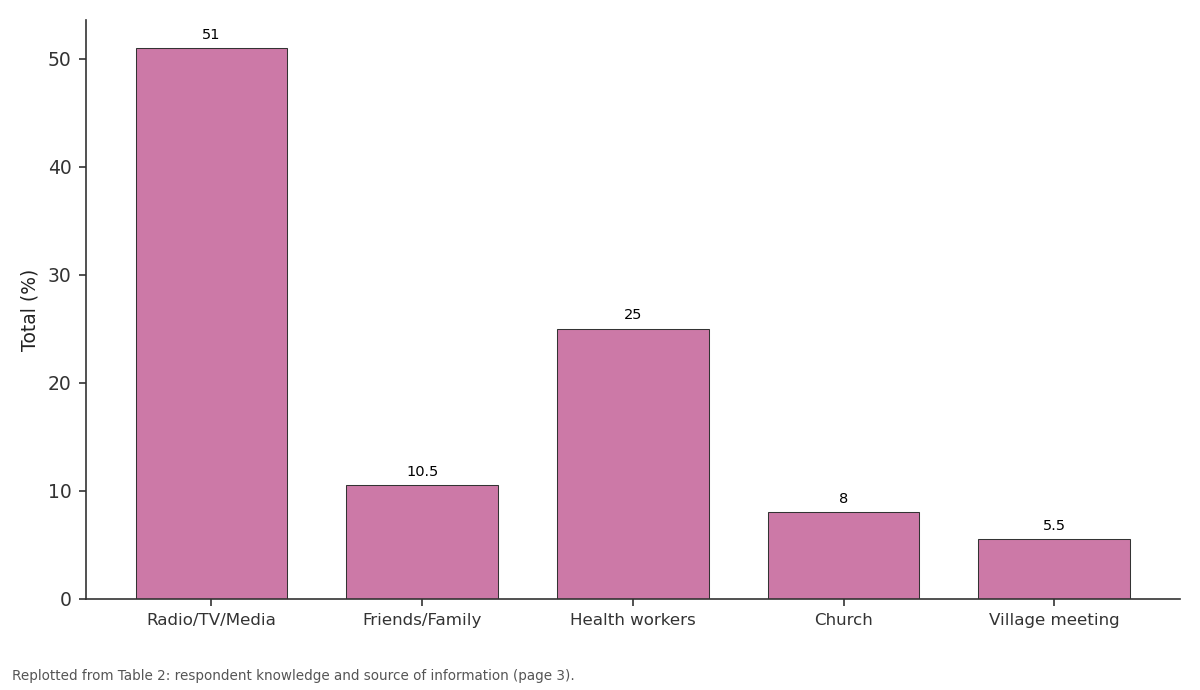
Total (%): Radio/TV/Media vs Friends/Family vs Health workers vs Church vs Village meeting
Replotted from Table 2 (page 3) of the original paper. Every bar is the paper's own table value.
View source evidence ↗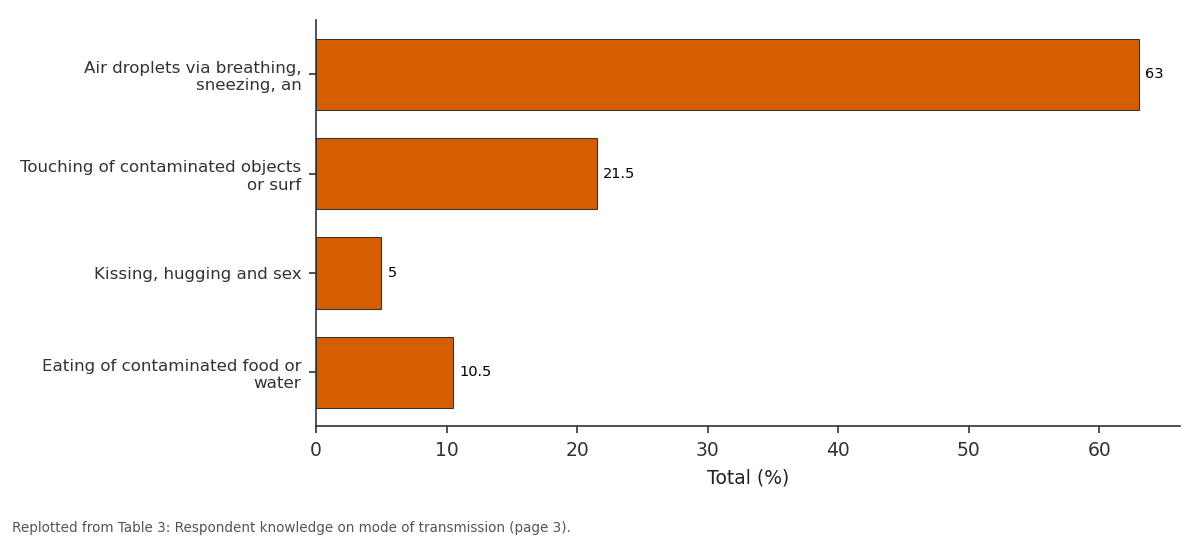
Total (%): Air droplets via... vs Touching of... vs Kissing, hugging and sex vs Eating of contaminated...
Replotted from Table 3 (page 3) of the original paper. Every bar is the paper's own table value.
View source evidence ↗Figures & tables
From the original paper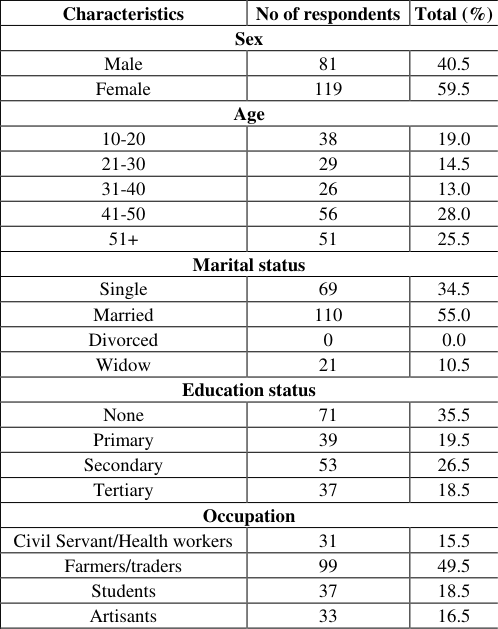 Table 1
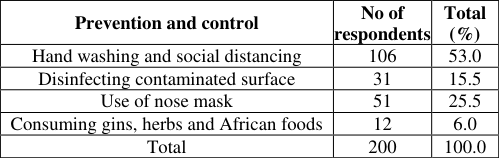 Table 5
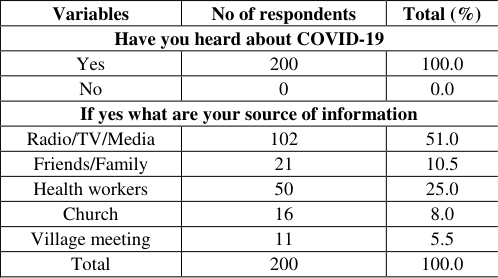 Table 2
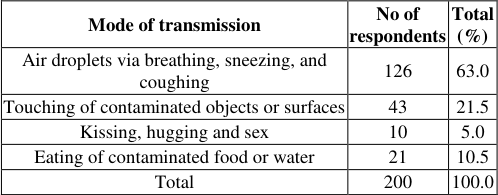 Table 3
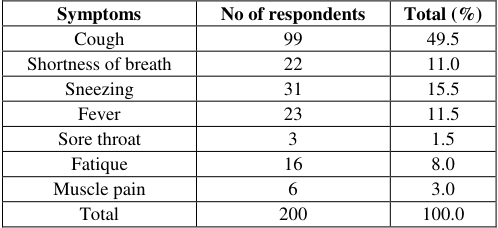 Table 4
Introduction
The World Health Organization declared COVID-19 outbreak a public health emergency of international concern (PHEIC-Pandemic) on January 30, 2020. Currently, COVID-19 has spread to over 200 countries and territories, with over 7.5 million cases and 419,568 deaths globally as of June 2020 (WHO, 2020) [8] . In Nigeria, the first reported COVID-19 case was in Lagos on February 27, 2020, while the number of cases and deaths had gradually increased. As of June 12, 2020, COVID-19 cases in Nigeria have reached 15181 and 399 deaths, including healthcare workers. The virus is transmitted through direct contact with respiratory droplets of an infected person (generated through coughing and sneezing). Individuals can also be infected from and touching surfaces contaminated with the virus and touching their face (e.g., eyes, nose, mouth). The COVID-19 virus may survive on surfaces for several hours, but simple disinfectants can kill it. Based on current knowledge of the situation of the mode of transmission of COVID-19, the WHO, the United States Centres for Disease Control (CDC), the United Kingdom's National Health Service (NHS), the Nigeria Centre for Disease Control (NCDC) and other national CDCs have recommended the most effective ways of preventing its spread. These include frequent hand washing using running water with soap for at least 20 seconds. In the absence of water, frequent use of hand sanitizers (with at least 70% alcohol-base) is advocated. It is also very important to avoid touching the eyes, nose, and mouth with hands as transmission of this virus can occur with the possible transfer of the virus from a contaminated source to gain access into the human body. Other means of possible prevention of transmission of this virus include: maintenance of social distancing (maintaining at least 1 metre distance with anyone) and the practice of respiratory hygiene, making sure that the mouth and nose are covered with the elbow or tissue when coughing or sneezing as well as appropriate disposal of the used tissue immediately.
The use of face mask, minimizing of handshake and other unnecessary body contact, the avoidance of overcrowded places (of more than five people) and regular cleaning of all "high-touch" surfaces every day, such as counters, doorknobs, toilets, phones, etc are other important preventive measures. Other preventive measures include staying at home if one feels unwell until he/she recovers. This is to help protect the person and others from possible COVID-19 viruses. If however, the person develops fever, cough, and difficulty in breathing, he/she is advised to immediately call the number provided by the National or State CDC medical provider who will quickly direct the person to the right health facility. This will also help to prevent a possible spread of the disease. For these preventive measures to be effective, the population need to be educated and mobilized to accept them because they have their different culture and values. For the preventive measures to achieve the desired goal there is need to create strong awareness. Against the background, the main purpose of this KAP study is to explore changes in knowledge, attitude and practices of Imo Communities on the preventive measures against COVID-19 and use the result to provide information for the evaluation of the COVID-19 community prevention approach. The result of this will help to improve the quality of health education material and quick eradication of the disease.
Study Area
Obowo LGA is found between Latitude 5 o 10 1 N-5 o 5 1 N and Longitude 6 o 35 1 E-7 o 28 1 E. The rainy season begins in April and lasts until October, with annual rainfall varying from 1,500 mm to 2,200mm. An average annual temperature above 20 °C (68°F) creates an annual relative humidity of 75% with humidity reaching 90% in the rainy season. The major occupation of the people is farming and this is still done at the subsistence level. Some of the people also embraced small-scale trading and fishing. Garri remains the major staple food of the people, the produce a good quantity of vegetables, they also produce oil, kernel broom (local ones), and baskets. Obowo have a number of markets such as Orie-Alike, Eke-Avutu, Nkwo-Okoronaogele etc. Culturally Obowo have their rich culture Iwa-Akwa festival, which embraces the general Obowo citizen. Other festivals includes Ekpofestival at Umunachi, Umungwa, Umuagu, and Amuzi, Mbomuzo festival at Umulogho and Amanze, Egbe nkwu Avutu. Ntumaka-Alike and Umuariam. Obowo is also a tourist delight with blue Abadaba Lake, isi iyi Umuokoro-Umuariam, Uzii water etc. There are tourist attraction in the area of Umuariam game reserve centre with live monkey.
Study population
The study population included 200 respondents residing in Obowo Local Government Area.
Data collection
Data collection was done by questionnaire method. All COVID-19 protocols wearing of Face mask and social distancing were observed. The researcher administered the questionnaire to the participants by asking them questions and filling it by her self-maintaining social distance and wearing face mask.
Data Analysis
Data obtained from the questionnaire were analyzed using percentages and formula respectively. Values were tested using Anova.
Results
Table 1 shows the demographic characteristics of the respondents. From the table, female respondents (59.5%) were higher than male respondents (40.5%). People of the age 41-50 years had the highest number of respondents (28.0%) followed by 51 and above (25.5%), 10-20 years (19.0%), 21-30 years (14.5%) while 31-40years had the least respondent (13.0%). Marital status showed that people that were married 55.0% had the highest number of respondents followed by Single (34.5%), Widows (10.5%) while people that Divorced was the least (0.0%). On Education status showed that people that had no education (35.5%) had the highest number of respondents followed by ones that had secondary school (26.5%), secondary (26.5%) while tertiary had the least number of respondents (18.5%). Occupational status showed that farmers/traders had the highest number of respondent (49.5%) followed by students (18.5%), Artisants (16.5%) while civil servants/health workers had the least number of respondents (15.5%). Table 2 shows respondent knowledge and source of information. From the tables, when asked have you heard about COVID-19 (100.0%) of the respondents answered yes while (0.0%) said no. On sources of information about COVID-19, the highest respondents (51.0%) had their information from Radio/TV/Media, health workers, (25.0%), (10.5%) from friends/family, (8.0%) from church while the least respondents was (5.5%) that had their source of information from village meetings. Table 3 shows respondent knowledge on mode of transmission. From the table, people that said Air droplets via breathing, sneezing, and coughing (63.0%) had the highest number of respondents followed by Touching of contaminated objects or surfaces (21.5%), Eating of contaminated food or water (10.5%) while the least respondents (5.0%) were people that said Kissing, hugging and sex. Table 4 shows respondent's knowledge of symptoms. From the table, Fourty nine point five percent (49.5%) said the symptoms of COVID-19 are cough, sneezing (15.5%), fever (11.5%), shortness of breath (11.0%), fatigue (8.0%), muscle pain (3.0%) while the least (1.5%) respondent were the ones that said sore throat. Table 5 shows respondents' knowledge of prevention and control. From the tables, the highest number of respondents (53.0%) were Hand washing and social distancing followed by use of a nose mask (25.0%), Disinfecting contaminated surfaces (15.5%) while those that said Consuming gins, herbs, and African foods (6.0%) was the least respondents.
| Symptoms | No of respondents | Total (%) |
|---|---|---|
| Cough | 99 | 49.5 |
| Shortness of breath | 22 | 11.0 |
| Sneezing | 31 | 15.5 |
| Fever | 23 | 11.5 |
| Sore throat | 3 | 1.5 |
| Fatique | 16 | 8.0 |
| Muscle pain | 6 | 3.0 |
| Total | 200 | 100.0 |
Table text extracted from the original PDF; superscript letters are shown inline. The original table image is below.
View original table image
| Mode of transmission | No of respondents | Total (%) |
|---|---|---|
| Air droplets via breathing, sneezing, and coughing | 126 | 63.0 |
| Touching of contaminated objects or surfaces | 43 | 21.5 |
| Kissing, hugging and sex | 10 | 5.0 |
| Eating of contaminated food or water | 21 | 10.5 |
| Total | 200 | 100.0 |
Table text extracted from the original PDF; superscript letters are shown inline. The original table image is below.
View original table image
| Variables | No of respondents | Total (%) |
|---|---|---|
| Have you heard about COVID-19 | ||
| Yes | 200 | 100.0 |
| No | 0 | 0.0 |
| If yes what are your source of information | ||
| Radio/TV/Media | 102 | 51.0 |
| Friends/Family | 21 | 10.5 |
| Health workers | 50 | 25.0 |
| Church | 16 | 8.0 |
| Village meeting | 11 | 5.5 |
| Total | 200 | 100.0 |
Table text extracted from the original PDF; superscript letters are shown inline. The original table image is below.
View original table image
| Prevention and control | No of respondents | Total (%) |
|---|---|---|
| Hand washing and social distancing | 106 | 53.0 |
| Disinfecting contaminated surface | 31 | 15.5 |
| Use of nose mask | 51 | 25.5 |
| Consuming gins, herbs and African foods | 12 | 6.0 |
| Total | 200 | 100.0 |
Table text extracted from the original PDF; superscript letters are shown inline. The original table image is below.
View original table image
| Characteristics | No of respondents | Total (%) |
|---|---|---|
| Sex | ||
| Male | 81 | 40.5 |
| Female | 119 | 59.5 |
| Age | ||
| 10-20 | 38 | 19.0 |
| 21-30 | 29 | 14.5 |
| 31-40 | 26 | 13.0 |
| 41-50 | 56 | 28.0 |
| 51+ | 51 | 25.5 |
| Marital status | ||
| Single | 69 | 34.5 |
| Married | 110 | 55.0 |
| Divorced | 0 | 0.0 |
| Widow | 21 | 10.5 |
| Education status | ||
| None | 71 | 35.5 |
| Primary | 39 | 19.5 |
| Secondary | 53 | 26.5 |
| Tertiary | 37 | 18.5 |
| Occupation | ||
| Civil Servant/Health workers | 31 | 15.5 |
| Farmers/traders | 99 | 49.5 |
| Students | 37 | 18.5 |
| Artisants | 33 | 16.5 |
Table text extracted from the original PDF; superscript letters are shown inline. The original table image is below.
View original table image
Discussion
The emergence of COVID-19 from the city of Wuhan, China in December 2019 and its rapid global spread across over 215 countries and territories has become one of the largest pandemics in recent times with several devastating and significant public health challenges (WHO, 2020) [8] .
Being the most populous African nation and the 7th most populated country in the world, Nigeria's population could undoubtedly be associated with a higher risk of increased morbidity and mortality due to COVID-19. With the infection prevention and control (IPC) strategies adopted by the NCDC and Nigerian government to curtail COVID-19, the adherence of the citizenry depends largely on their level of awareness and knowledge regarding the pandemic (Zhong et al. 2020) [9] . Unconcerned attitudes and adherence to false and superstitious beliefs by the public often arise due to inadequate awareness, which further affects the level of preparedness and the proper implementation of IPC measures at the national or subnational levels. [1] . The knowledge about COVID-19 was gained by respondents mostly through television and social media. The improvement in technology and the ease of accessing information online and television may explain the high level of knowledge of HCWs in this study that relied on these means of communication to obtain information about COVID-19. This result was consistent with previous studies in (Hager et al. 2020; Reuben et al. 2020) [3,6] . The wide media coverage of COVID-19 by WHO, Federal and state governments in Nigeria, and strict preventive and control measures imposed by the government and its agencies (NCDC) may be responsible for the high mean knowledge score by respondents in this study. Also, the practice of posting and reposting of professional information on the social media group page such as WhatsApp, Facebook, and Twitter accounts may be a second reason. Currently, there is no treatment against COVID-19 globally play a vital role in the management, control, and prevention of the spread of the disease. Good knowledge on the transmission and preventive measures against SAR-CoV-2 can help to improve their skills to limit occupational risk and further spread to the community (Hamoud et al. 2014) [4] . However, precautions are necessary when using social media as sources of medical knowledge because of information overload Khan et al. (2014) [5] , lack of peer review, and misleading information. A previous study reported the possibility that there exist dual pandemic, COVID-19 pandemic, and a pandemic of infodemic Saqlain et al.
(2020) [7] , which may seriously jeopardize response efforts to contain the spread of the virus. The result obtained in this study were similar to the previous report in China (Zhong et al. 2020) [9] ; Italy (Dilucca et al. 2020) [10] ; Egypt (Abdelhafiz et al. 2020) [1] . Concerning Symptoms of COVID-19, 49.5% of the respondents had it that coughing was the main symptoms of COVID-19. The majority of the respondents in this study reportedly took different precautionary measures including social distancing, improved personal hygiene, and use of face mask during the lockdown period. This generally indicates the optimism and willingness of the Nigerian population in effecting attitudinal and behavioral changes relevant in the fight against the COVID-19 pandemic.
As expected, because respondents had relatively high knowledge of the COVID-19, even though laden with several misconceptions, their knowledge of precautionary behavior was also high. For instance, a good percentage agreed that a range of WHO approved and global practices such as hand washing and social distancing, disinfecting contaminated surfaces. Only a little percentage agreed relying on consumption of gins, herbs and African foods as precautions to the spread of the pandemic. Consequently, individuals need to be informed about the potential risk of infection (COVID-19) in order to adopt the right precautionary measures. One suggestion for this result is the knowledge factor. That is, Obowo have knowledge of COVID-19 and therefore are better able to adopt precautionary measures.
Conclusion
The knowledge areas include source, transmission, symptoms, sources of information, and preventive behavior toward COVID-19. The findings tentatively affirm that Nigerians are highly knowledgeable about COVID-19, and their premier sources of information about the pandemic are the traditional media. It is therefore recommended that all stakeholders should intensify their efforts in sensitizing the general public to understand and comply with all precautionary measures to curb COVID-19. Efforts toward assessing the KAP of the underprivileged and vulnerable population and the dissemination of health education via indigenous languages among these groups should be intensified. Efforts targeting every group of the Nigerian population would constitute a holistic and viable approach in curtailing COVID-19.
References
5 in the original paper- Hager E, Odetokun IA, Bolarinwa O, Zainab A, Okechukwu O, Al-Mustapha AI. Knowledge, attitude, and perceptions towards the 2019 Coronavirus Pandemic: A bi-national survey in Africa. PLOS One. 2020;15(7):e0236918.
- Homoud AHA. Knowledge, attitudes, and practice of primary healthier physicians concerning the occupational risks of hepatitis B virus in Al Jouf Province, Saudi Arabia. Journal of Infection Public Health. 2014;7(4):257-270.
- Saqiain M, Munir MM, Rehman S, Gulzav A, Naz S, Ahmed Z. Knowledge, attitude, practice and perceived barriers among healthcare professionals regarding COVID-19: A Cross-sectional survey from Pakistan. Journal of Hospital and Infection. 2020;105(3):419-423.
- WHO. Coronavirus disease (COVID-19) Situation Report; c2020, 126. Retrieved May 25, 2020, from: https://www.who.int/docs/defaultsource/coronaviruse/si tuation-reports/20200525-COVID-19-sitrep126.pdf?sfvrsn=887dbd66_2
- Zhong BL, Luo W, Li HM, Zhang QQ, Liu XG, Li WT. Knowledge, attitudes, and practices towards COVID-19 among Chinese residents during the rapid rise period of the COVID-19 outbreak: A quick online cross-sectional survey. International Journal of Biological Science. 2020;16(10):1745-1752.