
Research article · 2023 · Full text
International Journal of Advanced Chemistry ResearchBiologically important 26-32-membered macrocyclic complexes of manganese (II): In situ one pot template synthesis (IOPTS), characterization and bio-efficacy
Volume 5(1) · Pages 06–09 · DOI: 10.33545/26646781.2023.v5.i1a.136 ↗
Research areasComputational Drug Discovery MethodsMetal complexes synthesis and properties
Abstract
Author-writtenTwenty-six to thirty-two membered tetraazamacrocyclic complexes of manganese (II) have been synthesized by template condensation of MnCl2.4H2O with dicarboxylic acid (malonic, succinic, glutaric or adipic acid) and 1, 8-diamino octane in 1:2:2 molar ratios. The new products with octahedral geometry have been characterized by elemental analyses, molecular weight determinations, molar conductance, magnetic moment, and spectral studies viz., infrared and electronic. On the basis of the spectral studies, the binding sites are proposed as the nitrogen atom of the macrocycles. The formulation of the complexes as [Mn(Macn)Cl2] (where n = 1 - 4) has been established on the basis of chemical composition. To assess the growth-inhibiting potential of the manganese (II) complexes biological screening has been undertaken.
Summary
Source-checkedPlain-language reading of the full paper, prepared with AI and checked against the text. Each point links to the authors' own words.
Why it matters
- Macrocyclic ligands and their metal complexes are significant because they are found in many important biological systems. View evidence ↗
- There is significant interest in transition metal complexes with nitrogen donor ligands because they exhibit a wide range of pharmacological activities, which can be enhanced by the metals. View evidence ↗
- These types of compounds are known to act as agents against microbes, malaria, leukemia, and as antifertility agents. View evidence ↗
The question
- The researchers aimed to address a gap in existing literature, as no work had been reported on manganese (II) complexes using this specific type of tetraazamacrocyclic ligands. View evidence ↗
- The study sought to synthesize these compounds and screen them for antibacterial and antifungal activities due to the importance of metal-nitrogen bonding in medicine, industry, and agriculture. View evidence ↗
What they did
- Molar conductance was measured using 10-3 M solutions in dry dimethylformamide at 28 °C. View evidence ↗
- Infrared (IR) spectra were recorded in the range of 4000-200 cm-1 using KBr pellets and Nujol Mulls. View evidence ↗
- Antifungal activity was tested against Colletotrichum capsici, Penicillium notatum, and Sceleratus rolfsii using the Radial Growth Method with concentrations of 50, 100, and 200 ppm. View evidence ↗
What they found
- The complexes were found to be non-electrolytes, with molar conductance values ranging from 9 to 29 ohm-1 cm2 mol-1. View evidence ↗
- The complexes exhibited higher toxicity toward gram-positive bacteria compared to gram-negative bacteria. View evidence ↗
- While complexation increased biological activity, the complexes were less effective than the standard drugs at lower concentrations. View evidence ↗
What it means
- The authors conclude that these manganese (II) macrocyclic complexes have potential utility in materials science and pharmaceuticals, suggesting further study of their mechanisms and therapeutic uses. View evidence ↗
- The authors state that the current studies warrant further investigation. View evidence ↗
Visual summary
2 visualsIllustrations explain the paper; charts are replotted from the paper's own table values.
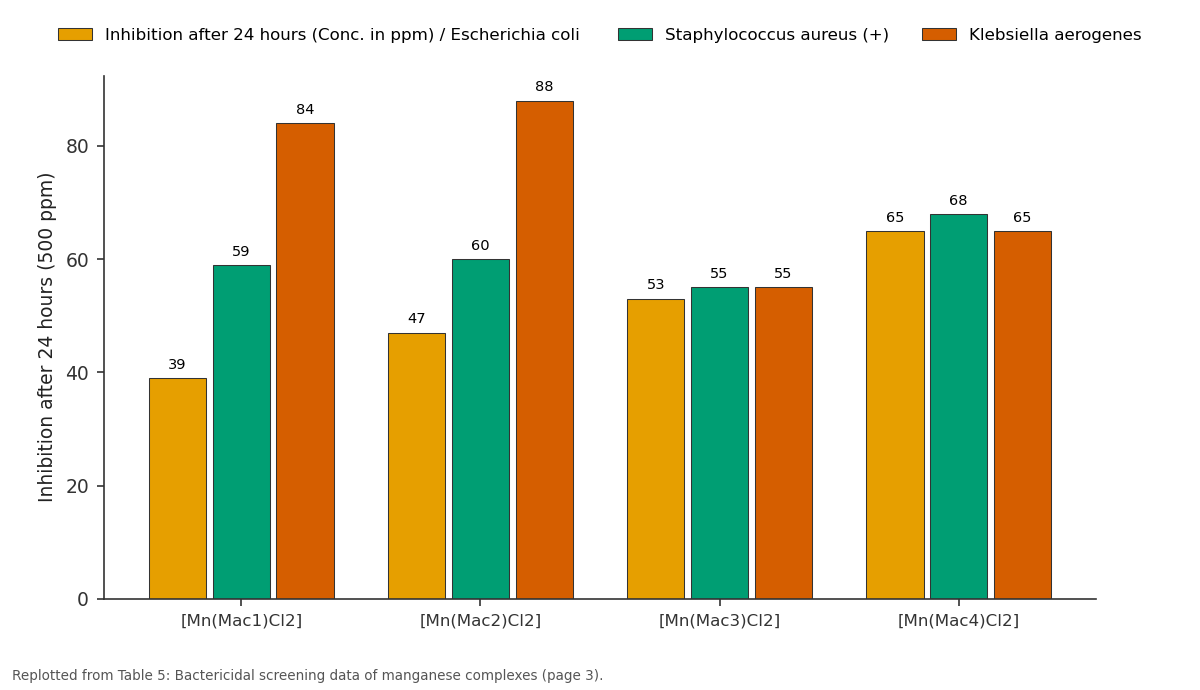
Inhibition after 24 hours (Conc. in ppm) /... and Staphylococcus aureus (+) and more: [Mn(Mac1)Cl2] vs [Mn(Mac2)Cl2] vs [Mn(Mac3)Cl2] vs [Mn(Mac4)Cl2]
Replotted from Table 5 (page 3) of the original paper. Every bar is the paper's own table value.
View source evidence ↗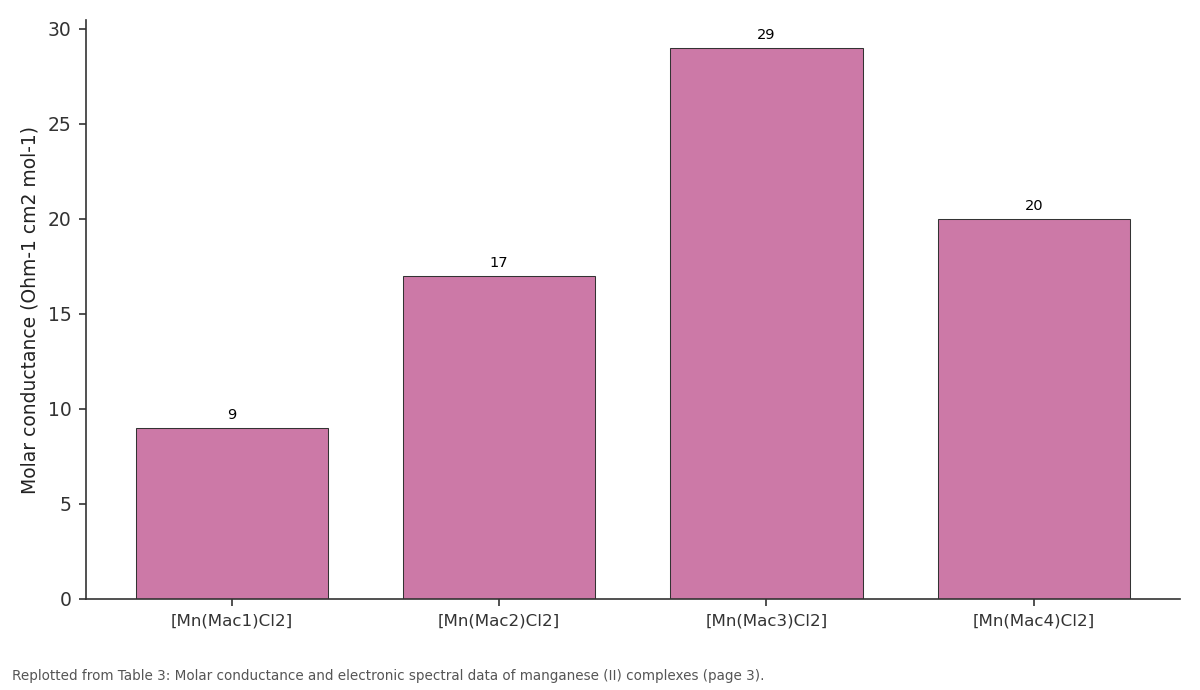
Molar conductance (Ohm-1 cm2 mol-1): [Mn(Mac1)Cl2] vs [Mn(Mac2)Cl2] vs [Mn(Mac3)Cl2] vs [Mn(Mac4)Cl2]
Replotted from Table 3 (page 3) of the original paper. Every bar is the paper's own table value.
View source evidence ↗Figures & tables
From the original paper Table 1
 Table 2
 Table 3
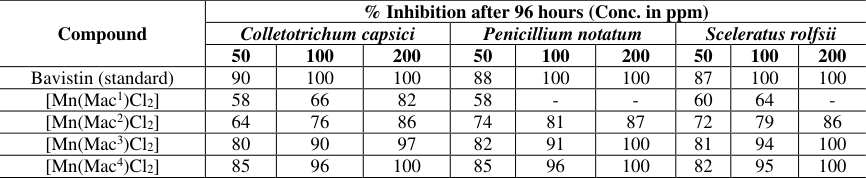 Table 4
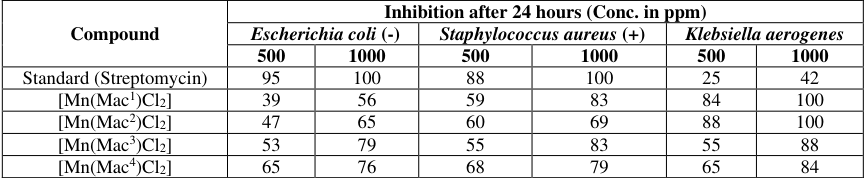 Table 5
Introduction
In the present scenario chemistry of the macrocyclic complexes is becoming a field of larger significance and interest all around the world due to their importance in the field of inorganic chemistry and biology. Macrocyclic ligands and their metal complexes are of much significance being their existence in many important biotic systems [1][2][3][4] . The multifarious role of transition metals in biochemistry suggests that consideration potential exists for the development of new chemistries with these metals in ligand systems specifically designed to serve these roles [5][6][7][8][9] . The enormous interest in the synthesis of the transition metal complexes of the nitrogen donor ligands arises due to the wide range of pharmacological activities of these compounds, which in several cases are known to have been enhanced by the presence of transition metals [10][11] . The synthesis of a series of tetraamide macrocycles which have been designed to afford strongly donating tetraamido-N ligands upon tetrad protonation and to be resistant to oxidative degradation has been described. It is demonstrated by the preparation and characterization of an unprecedented class of squareplanar cobalt compounds with high positive formal reduction potentials that the macrocycles possess the rare property of being compatible with strongly oxidizing coordination environment [12] . The complexes of the metal ions are significant because of their resemblance with many natural systems, such as porphyrins and cobalamines. The biological activity of this class of compounds is associated with the chelation [11] . They are known to function as antimicrobial [13] , antifertility, antimalaria, and antileukemic agents [14] . Many of these transition metal ions in living systems work as enzymes carriers in a macrocyclic ligand field environment. Macrocyclic ligands display a number of features of chemical interest. Research into the synthesis, structure, and properties of transition metal macrocyclic complexes to model a wide variety of metalloprotein active sites or to mimic their chemistry is well established [1516] . Macrocycles have wide applications in medicine, cancer diagnosis, and in the treatment of tumors Macrocyclic complexes of Mn (II) exhibit a broad spectrum of biological activity [1718] . No work has been reported on the manganese (II) complexes with such type of tetraazamacrocyclic ligands. Therefore, the importance of the metal-nitrogen bonding and their prominence in agriculture, medicinal, and industrial activity led us to synthesize and screen these compounds for their antifungal and antibacterial activities.
Experimental:
The chemicals include, malonic acid, succinic acid, glutaric acid and adipic acid (Fluka), 1, 8-Diaminooctane (E. Merck), MnCl 2. 4H 2 O (BDH).
Analytical Methods and Physical Measurements:
Conductivity measurements of 10 -3 M solutions were made with a Systronic Model 305 conductivity bridge in dry dimethylformamide at room temperature (28 o C). Molecular weights were determined by the Rast Camphor Method. IR spectra were obtained as KBr pellets on a Perkin-Elmer 577 grating spectrophotometer in the range 4000-200 cm -1 and far IR spectra were also recorded on the same spectrophotometer in Nujol Mulls using a CsI cell. Electronic spectra in dimethylsulphoxide were recorded on a Hitachi W-2000 spectrophotometer. Magnetic moment of the complexes were determined by the Gouy's method at the room temperature. Carbon and hydrogen analyses were performed at the Central Drug Research Institute, Lucknow.
Synthesis of the complexes [Mn (Mac n )Cl2]:
The reaction is carried out in 1:2:2 molar ratios. For the preparation of metal complexes, an ice cold solution of MnCl 2 .4H 2 O in methanol (50 ml) was reacted with 1, 8diaminooctane at 0 °C and put in magnetically stirred 100ml round-bottom flask. This is followed by the addition of methanolic solution of malonic, succinic, glutaric, or adipic acid). The reaction mixture was stirred continuously at room temperature for 10 h. The resulting solid product was recovered by filtration, washed with methanol, and dried in vacuo. These were recrystallized from a 1:1 solution of methanol and chloroform. The purity of the compounds was checked by TLC on Silica Gel-G using anhydrous tetrahydrofuran as a solvent. Each of the compounds moves as a single spot indicating the presence of only one component and hence their purity.
Results and Discussions
The resulting new macrocyclic complexes are brown solids having sharp melting points. These are soluble in most of the organic solvents. The conductivity measured for 10 -3 M solution in anhydrous DMF are in the range 9-29 ohm -1 cm 2 mol -1 showing them to be non-electrolytes. Elemental analyses agree well with the stoichiometry and chemical formulae of the compounds [Mn(Mac n )Cl 2 ]. The molecular weight determinations indicated that all the complexes are monomers. The physical properties and analytical data of the complexes are given in Table 1.
| Compound | M.P. (oC) and Colour | Analysis, Found (Calcd.) % | — | — | — | — | Mol. Wt. Found (Calcd.) |
|---|---|---|---|---|---|---|---|
| C | H | N | Cl | Mn | |||
| [Mn(Mac1)Cl2] | 168 Brown | 52.16(52.36) | 7.21(7.32) | 9.25(10.18) | 12.27(12.88) | 9.95(9.97) | 527(550.49) |
| [Mn(Mac2)Cl2] | 144 Brown | 53.47(53.98) | 7.60(7.61) | 8.75(9.61) | 11.55(12.16) | 9.01(9.42) | 554(582.88) |
| [Mn(Mac3)Cl2] | 159 Brown | 54.48(54.69) | 7.76(7.87) | 8.22(9.11) | 10.85(11.53) | 8.44(8.93) | 589(614.96) |
| [Mn(Mac4)Cl2] | 162 Brown | 55.58(55.69) | 8.09(8.09) | 7.75(8.66) | 10.29(10.96) | 8.03(8.48) | 619(647.05) |
Table text extracted from the original PDF; superscript letters are shown inline. The original table image is below.
View original table image
IR Spectra
The formation of the complexes has been revealed by the absence of -NH 2 stretching vibrations of 1, 8diaminooctane, and OH groups of the dicarboxylic acids. The amide groups are present at 1665-1680, 1435-1475, 1245-1275, and 590-640 cm -1 in the complexes [19] . It provides a strong evidence for the presence of a closed cyclic product. Strong and sharp absorption bands appearing in the regions 2840-2878 and 1410-1449 cm -1 in the complexes were assigned to the C-H stretching and bending vibrational modes, respectively [20] . A single sharp band observed for the complexes in the region 3280-3292 cm -1 may be assigned to N(N-H) of amide group. This is further substantiated by the fact that all the complexes show a medium-intensity band in the region 425-432 cm -1 which is attributed to the Mn-N stretching vibrations [21] . The characteristic IR frequencies of the synthesized macrocyclic complexes reported in Table 2.
| Compound | Amide bands | — | — | — | (NH) | (Mn-Cl) | (Mn-N) |
|---|---|---|---|---|---|---|---|
| I | II | III | IV | ||||
| [Mn(Mac1)Cl2] | 1665 | 1475 | 1275 | 590 | 3280 | 315 | 425 |
| [Mn(Mac2)Cl2] | 1675 | 1446 | 1252 | 655 | 3288 | 321 | 430 |
| [Mn(Mac3)Cl2] | 1669 | 1457 | 1245 | 640 | 3292 | 325 | 432 |
| [Mn(Mac4)Cl2] | 1680 | 1435 | 1267 | 669 | 3283 | 312 | 428 |
Table text extracted from the original PDF; superscript letters are shown inline. The original table image is below.
View original table image
Electronic Spectra
The electronic spectra of all the complexes display weak absorption bands in the regions 580-595, 420-435, and 380-386 nm for 6 A 1g ® 4 T 1g , 6 A 1g ® 4 T 2g and 6 A 1g ® 4 A 1g , respectively. The values obtained correspond to these compounds reported earlier for the octahedral complexes [22] . The electronic spectral data of manganese (II) complexes are given in Table 3. The µ B values for all the complexes are in the range 5.73-5.90 B.M. and suggest the high spin d 5 configuration for the complexes [23] .
| Compound | Molar conductance (Ohm-1 cm2 mol-1) | Electronic spectral bands (nm) | — | — | Magnetic moment (B.M.) |
|---|---|---|---|---|---|
| 6A1g ® 4T1g | 6A1g ® 4T2g | 6A1g ® 4A1g | |||
| [Mn(Mac1)Cl2] | 9 | 592 | 435 | 382 | 5.73 |
| [Mn(Mac2)Cl2] | 17 | 580 | 432 | 386 | 5.78 |
| [Mn(Mac3)Cl2] | 29 | 587 | 420 | 385 | 5.90 |
| [Mn(Mac4)Cl2] | 20 | 595 | 428 | 380 | 5.80 |
Table text extracted from the original PDF; superscript letters are shown inline. The original table image is below.
View original table image
Based on the said spectral analyses, it is clear that the ligands are acting as tetra dentate chelating agents having four coordination sites. Also since the anions Cl -remain bonded with tin atoms, a hexacoordinated environment for manganes (II) has been proposed.
Figures and tables from the paper
| Compound | % Inhibition after 96 hours (Conc. in ppm) | — | — | — | — | — | — | — | — |
|---|---|---|---|---|---|---|---|---|---|
| Colletotrichum capsici | Penicillium notatum | Sceleratus rolfsii | |||||||
| 50 | 100 | 200 | 50 | 100 | 200 | 50 | 100 | 200 | |
| Bavistin (standard) | 90 | 100 | 100 | 88 | 100 | 100 | 87 | 100 | 100 |
| [Mn(Mac1)Cl2] | 58 | 66 | 82 | 58 | - | - | 60 | 64 | - |
| [Mn(Mac2)Cl2] | 64 | 76 | 86 | 74 | 81 | 87 | 72 | 79 | 86 |
| [Mn(Mac3)Cl2] | 80 | 90 | 97 | 82 | 91 | 100 | 81 | 94 | 100 |
| [Mn(Mac4)Cl2] | 85 | 96 | 100 | 85 | 96 | 100 | 82 | 95 | 100 |
Table text extracted from the original PDF; superscript letters are shown inline. The original table image is below.
View original table image
| Compound | Inhibition after 24 hours (Conc. in ppm) | — | — | — | — | — |
|---|---|---|---|---|---|---|
| Escherichia coli (-) | Staphylococcus aureus (+) | Klebsiella aerogenes | ||||
| 500 | 1000 | 500 | 1000 | 500 | 1000 | |
| Standard (Streptomycin) | 95 | 100 | 88 | 100 | 25 | 42 |
| [Mn(Mac1)Cl2] | 39 | 56 | 59 | 83 | 84 | 100 |
| [Mn(Mac2)Cl2] | 47 | 65 | 60 | 69 | 88 | 100 |
| [Mn(Mac3)Cl2] | 53 | 79 | 55 | 83 | 55 | 88 |
| [Mn(Mac4)Cl2] | 65 | 76 | 68 | 79 | 65 | 84 |
Table text extracted from the original PDF; superscript letters are shown inline. The original table image is below.
View original table image
References
25 in the original paper- Prakash NB. Synthesis and studies of Tetraaza macrocyclic complexes of transition metal ions. Journal of Physics and Applied Chemistry. 2014;1(2):17-21.
- Spectrochimica Acta Part A: Molecular and Biomolecular Spectroscopy. 2015 Feb 25;137:207-219.
- Chandra S, Kumar R. Synthesis and spectral studies on mononuclear complexes of chromium (III) and manganese (II) with 12-membered tetra dentate N 2 O 2 , N2S2 and N4 donor macrocyclic ligands. Transition Metal Chemistry. 2004 Apr;29(3):269-275.
- Sangwan V, Singh DP. Nanosized divalent transition metal ion-prompted macrocyclic complexes: Synthesis, characterization, molecular modelling, and biological studies. Journal of the Chinese Chemical Society; 2020 Apr;67(4):592-602.
- Shankarwar SG, Nagolkar BB, Shelke VA, Chondhekar TK. Synthesis, spectral, thermal, and antimicrobial studies of transition metal complexes of 14-membered tetra aza [N4] macrocyclic ligand. Spectrochimica Acta Part A: Molecular and Biomolecular Spectroscopy. 2015 Jun 15;145:188-193.
- Aidi M, Keypour H, Shooshtari A, Bayat M, Hosseinzadeh L, Rudbari HA, et al. Coordination chemistry of some new Mn(II), Cd(II) and Zn(II) macrocyclic Schiff base complexes containing a homopiperazine head unit. Spectral, X-ray crystal structural, theoretical studies, and anticancer activity. Inorganica Chimica Acta. 2018 May 1;490:294-302.
- Dileepan AGB, Prakash TD, Kumar AG, Rajam PS, Dhayabaran VV, Rajaram R. Isatin based macrocyclic Schiff base ligands as novel candidates for antimicrobial and antioxidant drug design: In vitro DNA binding and biological studies. Journal of Photochemistry and Photobiology B: Biology. 2018 Jun 1;183:191-200.
- Horning KJ, Caito SW, Tipps KG, Bowman AB, Aschner M. Manganese is essential for neuronal health. Annual Review of Nutrition. 2015 Jul 17;35(1):71-108.
- Erdemir US, Gucer S. Assessment of in vitro bioaccessibility of manganese in wheat flour by ICP-MS and on-line coupled with HPLC. Journal of Cereal Science. 2016 May 1;69:199-206.
- Ali B, Iqbal MA. Coordination complexes of manganese and their biomedical applications. Chemistry Select. 2017;2(4):1586-1604.
- Floriani C. The porphyrinogen-porphyrin relationship: The discovery of artificial porphyrins. Chemical Communications. 1996 Jan 1(11):1257-1263.
- Allardyce CS, Dyson PJ. Metal-based drugs that break the rules. Dalton Transactions. 2016;45(8):3201-3209.
- Aston K, Rath N, Naik A, Slomczynska U, Schall OF, Riley DP. Computer-aided design (CAD) of Mn (II) complexes: Superoxide dismutase mimetics with catalytic activity exceeding the native enzyme. Inorganic Chemistry. 2001 Apr 1;40(8):1779-1789.
- Aschner M, Guilarte TR, Schneider JS, Zheng W. Manganese: Recent Advances in Understanding its Transport and Neurotoxicity. Toxicology and Applied Pharmacology. 2007 Jun 1;221(2):131-147.
- Pagadala NS, Syed K, Tuszynski J. Software for molecular docking: A review. Biophysical Reviews. 2017;9:91-102.
- Singh RV, Chaudhary A. Biologically relevant tetraazamacrocyclic complexes of manganese: Synthetic, spectral, antimicrobial, antifertility and antiinflammatory approach. Journal of Inorganic Biochemistry. 2004 Nov 1;98(11):1712-1721.
- Gull P, Malik MA, Dar OA, Hashmi AA. Design, synthesis, and characterization of macrocyclic ligandbased transition metal complexes of Ni(II), Cu(II), and Co(II) with their antimicrobial and antioxidant evaluation. Journal of Molecular Structure. 2017 Apr 15;1134:734-741.
- Rani S, Kumar S, Chandra S. Spectroscopic and biological approach in the characterization of a novel 14-membered [N4] macrocyclic ligand and its Palladium (II), Platinum (II), Ruthenium (III) and Iridium (III) complexes. Spectrochimica Acta Part A: Molecular and Biomolecular Spectroscopy. 2014 Jan 24;118:244-250.
- Singh DP, Kumar K, Sharma C. Antimicrobial active macrocyclic complexes of Cr(III), Mn(III) and Fe(III) with their spectroscopic approach. European Journal of Medicinal Chemistry. 2009 Aug 1;44(8):3299-3304.
- Kumar R, Masih I, Fahmi N. Template synthesis and spectral studies on mononuclear complexes of chromium (III) and manganese(II) with tetradentate N4 donor macrocycles. Spectrochimica Acta Part A: Molecular and Biomolecular Spectroscopy. 2013 Jan 15;101:100-106.
- Khan TA, Hasan SS, Mohamed AK, Islam KS, Shakir M. Metal complexes of 22-membered mononuclear tetramine-tetra amide macro cycles: Synthesis and characterization. Synthetic Communications. 2000 May 1;5(30):815-828.
- Tazin N, Ragole VD, Wankhede DS. Facile one-pot synthesis of tetraamide macrocyclic complexes using malonyldihydrazide and pnitrobenzaldehyde at room temperature. Inorganic and Nano-Metal Chemistry. 2019 Sep 2;49(9):291-296.
- Tyagi M, Chandra S, Tyagi P. Mn(II) and Cu(II) complexes of a bidentate Schiff's base ligand: Spectral, thermal, molecular modeling and mycological studies. Spectrochimica Acta Part A: Molecular and Biomolecular Spectroscopy. 2014 Jan 3;117:1-8.
- Bansal A, Singh RV. Toxicity, spectroscopic characterization and electrochemical behavior of new macrocyclic complexes of lead (II) and Palladium (II) Metals Metal-Based Drugs. 2000;7(4):211-218.
- Sharma K, Joshi SC, Singh RV. Fertility inhibitor Heterobimetallic complexes of platinum (II) and palladium (II): synthetic, spectroscopic and antimicrobial aspects. Metal-Based Drugs. 2000;7(2):105-113.