
Research article · 2023 · Full text
International Journal of Biology SciencesPrevalence of poultry coccidiosis in and around Jimma town, south western Ethiopia
Volume 5(1) · Pages 77–81 · DOI: 10.33545/26649926.2023.v5.i1b.148 ↗
Research areasCoccidia and coccidiosis researchAnimal Nutrition and PhysiologyLivestock and Poultry Management
Abstract
Author-writtenA cross sectional study design was conducted from November, 2014 to April, 2015 to estimate the prevalence of poultry coccidiosis in and around Jimma town, south western Ethiopia and to assess its relationship with different risk factors. Simple random sampling technique was conducted to select birds found in and around the town. Test tube flotation technique was used for qualitative study of coccidial oocyst and descriptive statistics was utilized to summarize the data. The association between the prevalence of the disease and risk factors was assessed by Chi-square. Out of the total 384 chickens examined, 156 (40.62%) were positive for coccidian parasites. The prevalence was significantly different between breed (X2 = 4.48, P = 0.03), management (X2 = 18.00, P = 0.00) and age (X2 = 19.04, P = 0.00). However, no statistically significant difference (X2 = 1.19, P = 0.28) was found in the prevalence of coccidiosis between sex. In conclusion, the present study showed that coccidiosis was an important disease of poultry in the study area with increasing prevalence in younger birds and those kept under intensive management system and therefore, good poultry management systems such as; treating diseased poultry, maintaining cleanness of environment and applying strict biosecurity measures have to be practiced in different poultry production systems.
Summary
Source-checkedPlain-language reading of the full paper, prepared with AI and checked against the text. Each point links to the authors' own words.
Why it matters
- Poultry production is a critical resource in developing countries for providing food to growing populations and income for poor farmers. View evidence ↗
- Disease conditions are a primary constraint to poultry development and can be particularly devastating in intensive production systems. View evidence ↗
- Coccidiosis is a significant parasitic disease in poultry caused by protozoa from the Eimeriidae family. View evidence ↗
What they did
- A cross-sectional study was performed between November 2014 and April 2015 in and around Jimma town, Ethiopia. View evidence ↗
- The study examined a total of 384 chickens to detect the presence of coccidian parasites. View evidence ↗
- The researchers used the test tube flotation technique for the qualitative identification of coccidial oocysts in fecal samples. View evidence ↗
- Chi-square analysis was used to evaluate the association between disease prevalence and various risk factors. View evidence ↗
What they found
- The overall prevalence of poultry coccidiosis in the study area was found to be 40.62%. View evidence ↗
- Exotic breeds had a significantly higher prevalence of infection (46.50%) compared to local breeds (35.85%). View evidence ↗
- Young chickens (2-8 weeks) showed a significantly higher infection rate (53.85%) than adult chickens (above 8 weeks), who had a rate of 31.58%. View evidence ↗
- Birds under intensive management systems had a significantly higher infection rate (54.05%) than those in backyard systems (32.20%). View evidence ↗
- While females had a higher recorded prevalence (43.48%) than males (38%), the difference between sexes was not statistically significant. View evidence ↗
What it means
- The authors conclude that coccidiosis is the most significant parasitic disease in the area, particularly affecting young birds and those in intensive systems. View evidence ↗
- The authors recommend improving management through treating diseased birds, maintaining environmental cleanliness, and applying strict biosecurity. View evidence ↗
- The authors suggest that future efforts should focus on implementing vaccination strategies for highly susceptible groups and systems. View evidence ↗
Visual summary
2 visualsIllustrations explain the paper; charts are replotted from the paper's own table values.
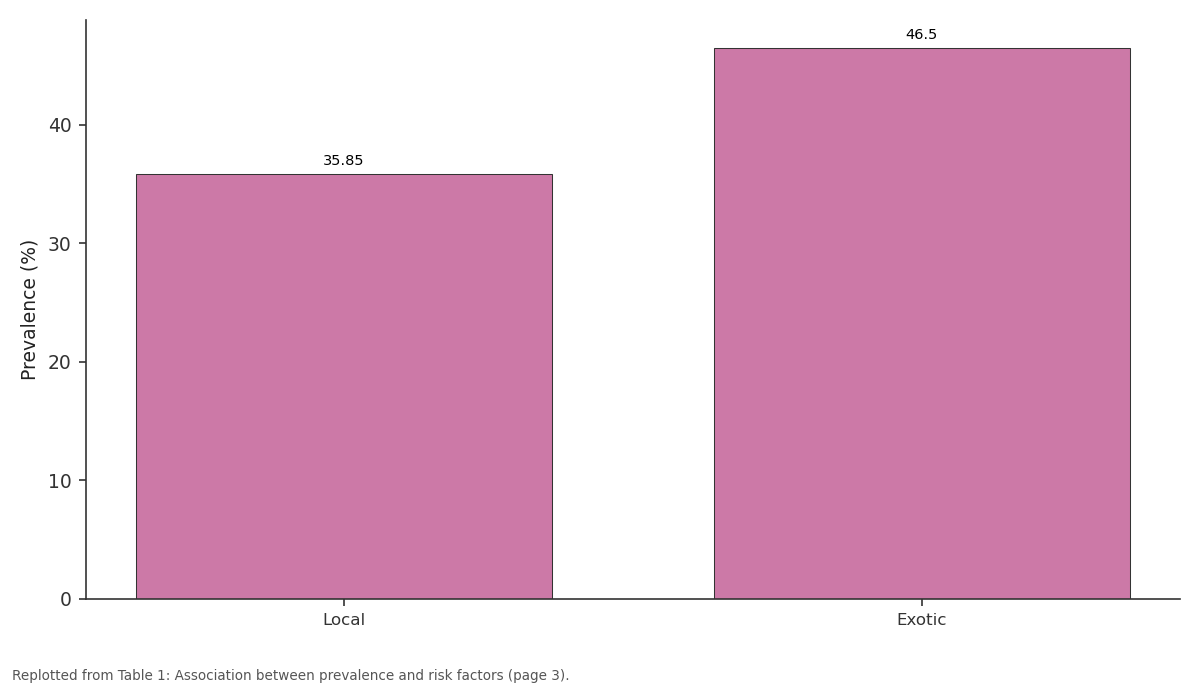
Prevalence (%): Local vs Exotic
Replotted from Table 1 (page 3) of the original paper. Every bar is the paper's own table value.
View source evidence ↗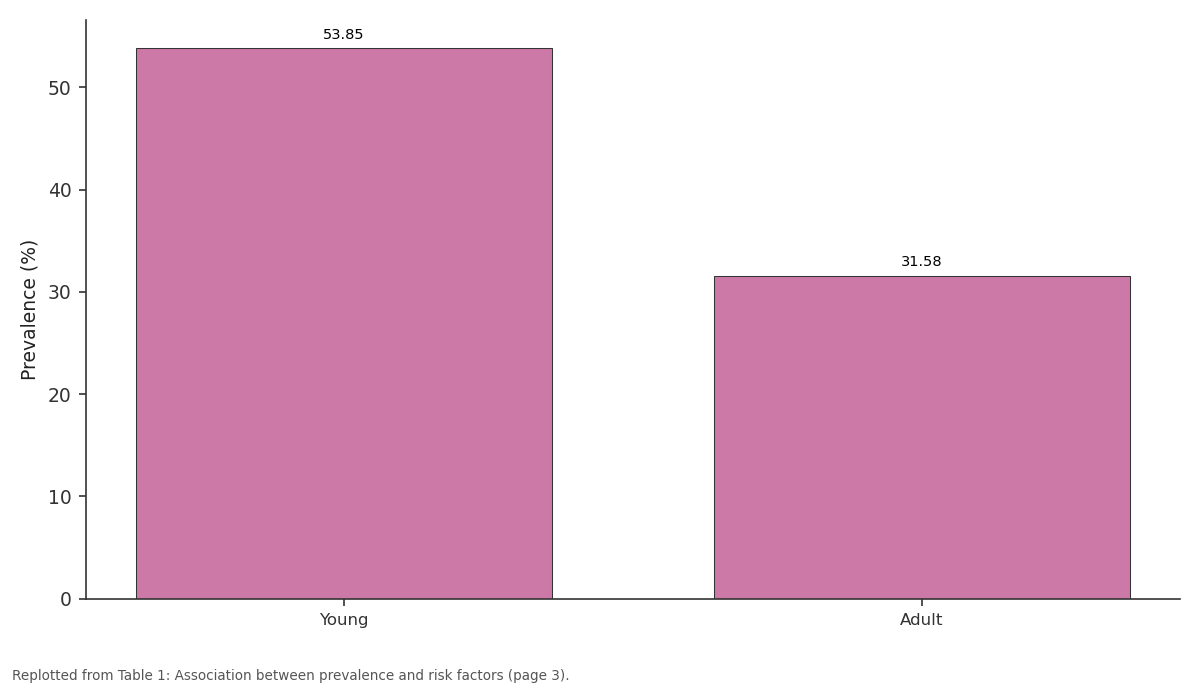
Prevalence (%): Young vs Adult
Replotted from Table 1 (page 3) of the original paper. Every bar is the paper's own table value.
View source evidence ↗Figures & tables
From the original paper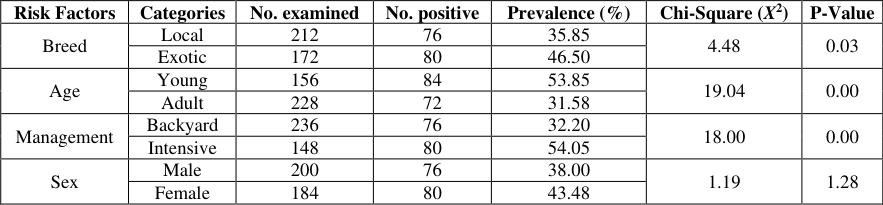 Table 1
Introduction
Poultries are kept in backyards or commercial production system in most areas of the world and survey made by the Food and Agriculture Organization of the United Nations (FAO) put the whole poultry production in the world at approximately 22 billion, with about 75% in the developing countries (FAOSTAT, 2013) [14] . In developing countries poultry production offers an opportunity to feed the fast-growing human population and to provide income for resource-poor farmers (CSA, 2004) [10] . Moreover, poultry in many parts of the modern world is considered as the chief source of not only cheaper protein of animal origin but also of high-quality human food (Jordal et al., 2002) [21] . One of the main constraints for the development of poultry production is the development of disease conditions (Alamargot, 1987) [2] , which can have devastating effects, particularly on intensive production. Poultry is among the important species of livestock kept in Ethiopia. The total poultry population in Ethiopia was estimated to be about 50.38 million (CSA, 2013; Musa, 2022) [10,38] . Mortality rate in the country due to disease is estimated between 20% and 50% but can go as high as 80% during times of epidemic (Yami, 1995) [41] . Different diseases have been diagnosed of suspected in commercial poultry in Ethiopia leading to the economic loss and these are Newcastle disease, coccidiosis, salmonellosis, chronic respiratory disease, and nutritional deficiencies (Nasser, 1998) [30] .
Coccidiosis is an important parasitic disease of poultry caused by protozoa of the phylum Apicomplexa, family Eimeriidae. In poultry, most species belong to the genus Eimerida and infect various sites in the intestine (McDougald, 2003) [42] . The infectious process is rapid (4-7 days) and is characterized by parasites replication in host cells with extensive damage to the intestinal mucosa. Poultry coccidian are strictly host-specific, and the different species parasitize specific parts of the intestine. The life cycle is direct and involves oral ingestion of the infective stage of the sporulatedoocyst. Destruction of host tissue as a result of parasite development and multiplication leads to the various clinical manifestations observed in outbreaks of disease (Allen and Fetterer, 2002) [3] . The macroscopic lesions in the digestive tract are some predisposing factors to many gastrointestinal bacterial poultry diseases such as Clostridiosis, Salmonellosis and Colibacillosis. Certain immunosuppressive viral diseases such as Infectious bursal disease, Mareck's disease and Chick anemia infectious viral disease also exacerbate coccidiosis (Bostvironnois and Zadjian, 2011) [6] . Coccidia which are deep tissue invaders such as Eimeria maxima, E. necatrix and E. tenella cause severe necrosis, hemorrhage of the intestinal mucosa, and bloody diarrhea and may result in death. Signs include watery and bloody droppings, mortality (0-50%) and morbidity (0-100%), depression, poor weight gain and feed conversion, and a drop in egg production. In many farm, 305 birds die annually due to the effect of disease (coccidiosis) which cause retarded growth, poor condition, reduced egg production and low vitality (Ajayi, 1981) [1] . The disease is endemic in most of the tropical and subtropical regions where ecological and management conditions favor an allyear round development and propagation of the causal agent (Obasi et al., 2006) [33] .
In the domestic chickens at least nine species of Eimeria have been recognized to cause the disease (Gari, et al., 2008) [16] . E. brunetti, E. maxima, E. necatrix, and E. tenellaare highly pathogenic; E. acervulina, E. mitis, and E. mivati are rather less pathogenic, and E. praecox and E. haganiare regarded as the least pathogenic (Morris et al., 2007) [27] . Bad management (such as wet litter that encourages oocyst sporulation, contaminated drinkers and feeders, bad ventilation, and high stocking density) can exacerbate the clinical signs (Graat et al., 1994) [17] .
Coccidiosis can be controlled by good management including good ventilation, dry and clean litter, cleaning and decontamination of drinkers and feeders, and proper stocking density in the farm (McDougald, 2003) [42] .
Coccidiosis is endemic in Ethiopia, causing great economic losses, particularly in young growing birds, in different production systems (FAO, 1995) [13] . Qualitative losses due to coccidiosis in Ethiopia were not well documented, but the study conducted by Kinung'hi et al., (2004) [24] showed that coccidiosis contributes to 8.4 and 11.86% losses in profit in large and small-scale farms, respectively. Losses due to mortality following a severe outbreak may be devastating and incidence rates as high as 80% were sometimes observed in the country (Gari et al., 2008) [42] .
The disease contributed to be a problem as reported by Guale (1990) [18] who recorded prevalence rates of 50.8% and 11% in deep litter-intensive system and backyard poultry production systems, respectively. However, the prevalence of the disease and associated risk factors in and around Jimma town were not well addressed yet.
Therefore, the objectives of this study were: To estimate the prevalence of poultry coccidiosis in and around Jimma town and To assess the association of the disease with different risk factors.
Materials and Methods
Materials and Methods
Description of the Study Area
The study was conducted from November, 2014 to April, 2015 in Poultry farms found in and around Jimma town. The town is located at the South western part of Ethiopia in Oromia Regional State at about 352 km away from Addis Ababa. Geographically the town is located at latitude of about 7°13' -8°56' N and longitude of about 35°52' -37°37' E and at elevation ranging 880-3360 meter above sea level.
Ecologically the area lies in wet land ecosystem and area receives a mean annual rainfall of about 1530 ml, which comes from the long and short rainy seasons. The annual minimum and maximum temperature is about 14.4 and 26.7 °C, respectively (JZARDO, 2001) [23] .
Study Population
The study populations were exotic and local breeds of chickens from a poultry farm of JUCAVM (Jimma University College of Agriculture and Veterinary Medicine) and from chickens owned by local farmers in and around the town. Chickens in the study area were kept both under the backyard and intensive husbandry system Musa (2022) [38] . All the chickens were grouped into sex (male and female), breeds (exotic and local), and ages as young (2-8 weeks) and adult (above 8 weeks of age).
Sample Size Determination
The sample size was determined based on the formula recommended by Thrusfield (1995) [39] .
Where N = sample size P exp = expected prevalence d= desired absolute precision. Since the prevalence of poultry Coccidiosis in and around Jimma town has not been reported, sample size was determined based on the assumption that 50% expected prevalence rate, 95% confidence interval, and 5% desired absolute precision (Thrusfield, 2005) [40] . Therefore, the total sample size required was 384.
Study Design and Sampling Methodology
A cross-sectional study design was conducted from November 2014 to April 2015 where a simple random sampling technique was conducted to select the poultries which were brought to the Jimma town market and those found in JUCAVM poultry farm. Breed, age, management, and sex of the studied animals were considered as risk factors.
Fecal Sample Collection and Examination
This study involved qualitative fecal examination to investigate oocyst discharge. Freshly deposited fecal samples of poultry birds of different ages, breed, and sex were collected from the upper surface of the litter or from the ground immediately after drooping of the feces by the birds. Clean spatula was used to collect the fecal sample and it was washed and cleaned again after each collection in order to avoid contamination. [9] .
Data Management and Analysis
The raw data were entered and managed in Microsoft Excel worksheet and descriptive statistic was utilized to summarize the data. The point prevalence was calculated for all data by dividing positive samples by total number of examined samples and multiplying by hundred. The association between the prevalence of the disease and risk factors was assessed by Chi-square. A statically significant association between variables was considered to exist if the computed P value was less than 0.05. All statistical analyses were done using SPSS statistical software version 17.
Results
The overall prevalence of poultry coccidiosis in the study area was 40.62%. The individual prevalence of coccidiosis in exotics and local breeds were 46.51 and 35.85% respectively. There was statistical difference (X 2 = 19.04; P = 0.00) in Coccidia infection between exotic and local breeds (Table 1). Among examined chickens, higher infection (53.85%) rate was observed in chickens under the age category of 2 to 8 weeks (young) than in chickens greater than 8 weeks (adult) (31.58%). There was a statistically significant difference (X 2 = 19.04; P = 0.00) between the two age group. Higher infection rate was detected in intensive birds (54.05%) as compared to birds kept under backyard management system (32.20%). Based on the management system there was a statistical significance difference (X 2 = 18.00; P = 0.00) between the intensive and backyard chickens. The prevalence rate of 38 and 43.48% were also recorded in males and females respectively. Female birds shows a higher infection rate than males; however there was no significant difference (X 2 = 1.19; P = 0.28) in between two sexes (Table 1).
| Risk Factors | Categories | No. examined | No. positive | Prevalence (%) | Chi-Square (X2) | P-Value |
|---|---|---|---|---|---|---|
| Breed | Local | 212 | 76 | 35.85 | 4.48 | 0.03 |
| Exotic | 172 | 80 | 46.50 | |||
| Age | Young | 156 | 84 | 53.85 | 19.04 | 0.00 |
| Adult | 228 | 72 | 31.58 | |||
| Management | Backyard | 236 | 76 | 32.20 | 18.00 | 0.00 |
| Intensive | 148 | 80 | 54.05 | |||
| Sex | Male | 200 | 76 | 38.00 | 1.19 | 1.28 |
| Female | 184 | 80 | 43.48 |
Table text extracted from the original PDF; superscript letters are shown inline. The original table image is below.
View original table image
Discussion
The results of the present study illustrates that, the disease coccidiosis is still prevalent in the study area with the overall prevalence of 40.62%. This result agreed with the findings of Netsanet, 2003 [32] and Mwale and Masika, 2011 [29] who reported a prevalence of coccidiosis as 38.5% and 41.43% in Kombolcha (Ethiopia) and Centane district (South Africa), respectively. Moreover, this result was also in line with the finding of Herve et al., 2013 [20] who reported the prevalence of poultry coccidiosis (42.4%) in litter based high stocking density layer rearing system of Benin. The finding of this research was also very close to the finding of Lobago et al., 2005 [25] who reported a prevalence of 38.34% in grower chicken in Kombolcha farm, North-Eastern Ethiopia. However, the present result was inconsistent with the finding of Garbi et al., 2012 [15] , Diriba et al., 2012 [11] and Gari et al., 2008 [16] who reported a prevalence of 19.5% in Nekemte town, East Wollega, Ethiopia, 20.57% in poultry farm in and around Ambo town, Western Ethiopia and 22.58% in litter system of exotic breed (Rhode Island Red) in Tiyo district, Arsi zone, Ethiopia respectively. This variation in the prevalence of the disease may be due to the epidemiology of coccidian infection and differences in the management systems of the farms. The prevalence of the disease was higher in exotic (46.50%) than in local breeds (35.85%) and there was a statistically significant difference (P = 0.03) between the two breeds. This agreed with the finding of Garbi et al., 2015 [15] who reported higher prevalence in Bovans brown (23.21%) than local breeds (13.61%). It also agreed with the findings of Gari et al., 2008 [16] and Diriba et al., 2012 [11] who reported higher prevalence in exotic breeds. In the present study, higher rate of infection might be due to breed difference. It was also documented that, some indigenous breed of chicken could produce immunity earlier than exotic breeds (Rehman, 1971) [35] . In addition, Calnek et al., 1991 [8] have reported the existence of genetic variation in resistance to coccidiosis among breeds and strains. The current study also revealed that all ages of poultry are susceptible to coccidiosis, but younger birds (53.85%) are more susceptible to infection than adult birds (31.58%). This also agreed with the reports of Julie, 1999 [22] and Garbi et al., 2015 [15] who stated that all ages of poultry are susceptible to coccidial infection. These upshots are in accordance with the conclusion of Omer et al., 2011 [34] and Bachaya et al., 2012 [5] who also observed the same pattern of infection in the Farasan gazelles infected with the single species of Eimeria and susceptibility of younger chickens than adult chickens in layers in Muzafargarh district respectively. The result is in concurrence with the report of Muazu et al., 2008 [28] which stated that, the predominance of coccidial infection among adult chickens were 36.7% and among the younger chickens were 52.9%. The prevalence rate of the disease was significantly different (P = 0.00) between young and adult birds. This was because most coccidial infections occur at the age of 3 to 4 weeks but clinical diseases will be develop one or two weeks later. The disease appears to reach climax at 5 to 7 weeks of age and as the age exceeded 7 weeks, most birds will develop immunity and increase resistance to the disease (Bowman, 2009) [7] . Upon the finding, the prevalence rate of coccidiosis in intensive management (54.05%) was greater than those chickens managed under free ranging (backyard) system (32.20%). This finding is in line with report of Taylor et al., 2007 [37] which reports that, coccidiosis was the most problems to chickens kept under intensive management
especially those on deep litter. However, the current finding was inconsistent with Sharma et al., 2003 [36] who stated high infection rate of backyard chickens with Eimeria species in Jammu region. In the present study, statistically significant difference (P = 0.00) was found between backyard and intensive farms, and the percentage prevalence of infection in intensive chicken may be high due to relatively higher oocyst accumulation in deep litter. In addition, David and Thomas, 2014 [19] reported that, as long as birds are reared in contact with their feces, as when they are raised on built-up litter, then diseases such as coccidiosis will continue to occur. The present study also indicated that the prevalence of coccidiosis was relatively higher in female (43.48%) than male (38.00%) chickens; however, there was no statistically significant difference among sex (P = 0.28). This result is in consistent with the previous studies of Nemattolahi et al., 2009 [31] , and Diriba et al., 2012 [11] . Absence of statistically significant difference between females and males might be due to equal chance of exposure for the parasitic infection.
Conclusion and Recommendations
Coccidiosis is the most important constraint for poultry production in both free-ranging (backyard) and intensive poultry management system, and it is still the most important parasitic disease in the study area with increasing prevalence in younger birds and those kept under intensive management systems. Managerial problems such as high stocking density, poor quality and management of litter, inadequate cleaning, the absence of vaccines, and nonstrategic prophylaxis against Emieria species were the main reasons and predisposing factors for the higher prevalence of poultry coccidiosis in the study area. Hence poultry coccidiosis is demanding a lot of interventions and further research, to develop economical and sustainable prevention and control strategies. The economic incursion by coccidiosis can be minimized through improving management level, which minimizes the predisposing factors at strategic time, will be effective mechanism, particularly in intensive production systems.
Therefore, based on the above conclusion the following recommendations will be forwarded Awareness should be created among poultry producers regarding to the effect of the disease on poultry health. Good poultry management systems such as; treating diseased poultry, maintaining cleanness of environment and applying strict biosecurity measures have to be practiced in different poultry production systems.
Vaccination against coccidiosis should be sought for in the future, particularly for highly susceptible breeds, age groups and in predisposing management systems with appropriate timing. Approximately 3 g feces (weigh out or measure with a pre-calibrated teaspoon) was transferred to plastic container 1 2. 50 ml of flotation fluid was poured into plastic container 1 by means of the measuring cylinder, feces and flotation fluid was mixed thoroughly with a stirring device immediately. 3. The faecal suspension poured through a tea strainer or a single layer of cotton gauze into plastic container 2, the retained faecal debris discarded, and poured the strained faecal suspension from plastic container 2 into a test tube immediately. 4. Test tube was placed in a vertical position in a test tube rack, the test tube was topped up with the faecal suspension, so that it has a convex meniscus at the top and a cover slip was placed on the top of the test tube. 5. The test tube was leaved for about 20 minutes. 6. The coccidian oocysts floated and thus accumulated just beneath the coverslip, the coverslip was lifted off vertically from the tube together with the adhering flotation fluid. 7. Some of the accumulated coccidian oocysts are within the adhering fluid, and the cover slip was transferred very carefully in order to retain as many oocysts as possible. The cover slip was placed on a microscope slide, and the sample was examined microscopically at 40-100 x magnification using a light microscope.
Annex
Source: Conway and McKenzie (2007) [9]
References
26 in the original paper- Ajayi E. Poultry Coccidiosis, its sources, orientation of infection, prevention and control. Nigeria Livestock Farmer. 1981;2(1):3-4.
- Livest lassie S, Kassa A. Prevalence study of poultry coccidiosis in small and large scale farms in Adis Ababa, Ethiopia. Scientific Journal of Crop Science. 2012;1(1):26-31.
- Allen P, Fetterer H. Recent advances in biology and immunology of Eimeria species and in diagnosis and control of infection with coccidian parasites of poultry. Cl. Microbiol. 2002;15(1):58-65.
- Al-Natour Q, Suleiman M, Shehadab AN. Flock-level prevalence of Eimeria species among broiler chicks in northern Jordan. Preventive Veterinary Medicine. 2002;53(4):305-310.
- Bachaya H, Raza M, Khan M, Iqbal Z, Abbas R, Murtaza S, et al. Predominance and detection of different Eimeria species causing coccidiosis in layer chickens. Journal of Animal and Plant Sciences. 2012;22(3):1018-7081.
- Bostvironnois C, Zadjian C. Coccidiosesub cliniques en production de poulet de chair: Bilan et prospectives. Neuvième Journée de Recherche Avicole, Tours. 2011;29:585-588.
- Diriba O, Achenef M, Bazaznew B. Prevalence and risk factors of coccidiosis in poultry farms in and around Ambo town, Western Ethiopia. American-Eurasian Journal of Scientific Research. 2012;7(4):146-149.
- Ethiopia central Statistical Agency (CSA) Report in livestock and livestock characteristics (Private peasant holdings). Agriculture Sample Survey. 2012;2:23-24.
- Garbi F, Tesfaye A, Woyessa M. The study of poultry coccidiosis in Nekemte town, East Wollega, Ethiopia. African Journal of Agricultural Research. 2015;10(5):328-333.
- Gari G, Tilahun G, Dorchies P. Study in poultry coccidiosis in Tiyo district. ARSI International Journal of Poultry Science. 2008;7(3):251-256.
- Graat A, Henken M, Ploeger W, Noordhuizen P, Vertommen H. Rate and course of sporulation of oocysts of Eimeria acervulina under different environmental conditions. Parasitology. 1994 Jun;108(5):497502.
- David C, Thomas K. Vaccination of chickens against coccidiosis ameliorates drug resistance in commercial poultry production. International Journal for International Journal of Biology Sciences https://www.biologyjournal.net Parasitology: Drugs and Drug Resistance. 2014 Dec 1;4(3):214-217.
- Hervé B, Dakpogana H, Sahidou S. Coccidiosis prevalence and intensity in litter based high stocking density layer rearing system of Benin. Journal of Animal and Plant Sciences. 2013;17(2):2522-2526.
- Kinung'hi M, Getachew T, Hafez M, Moges W, Moses K, Mathias G, et al. Assessment of economic impact caused by poultry coccidiosis in small and large poultry farms in Debre Zeit, Ethiopia. International Journal of Poultry Science. 2004;3(11):715-718.
- Lobago F, Worku N, Wossene A. Study on coccidiosis in Kombolcha poultry farm, Ethiopia. Tropical Animal Health and Production. 2005;37(3):245-251.
- Khandait VN, Tiple AV, Dhenge SA. Assessment of the relationship between personal and socio-economic characteristics with the adoption of backyard poultry rearing practices in Bhandara district of Maharashtra. International Journal of Agriculture Extension and Social Development. 2020;3(1):58-62.
- Morris G, Woods W, Richards D, Gasser R. The application of a polymerase chain reaction (PCR)-based capillary electrophoretic technique provides detailed insights into Eimeria populations in intensive poultry establishments. Molecular and Cellular Probes. 2007;21(4):288-294.
- Muazu A, Masdooq A, Ngbede J, Salihu E, Haruna G, Habu A, et al. Prevalence and identification of species of Eimeria causing coccidiosis in poultry with in Vom, plateau state, Nigeria. International Journal of Poultry Science. 2008;7(9):917-918.
- Mwale M, Masika P. Point prevalence study of gastrointestinal parasites in village chickens of Centane district, South Africa. African Journal of Agricultural Research. 2011;6(9):2033-2038.
- Nematollahi A, Gholamali M, Reze F. Prevalence of Eimeria species among broiler chicks in Tabriz, Iran. Munis Entomology and Zoology. 2009;4(1):53-58.
- Obasi L, Ifut O, Offiong E. An outbreak of caecal coccidiosis in a broiler flock post Newcastle disease vaccination. Journal of Animal and Veterinary Advances. 2006;5(12):1239-1241.
- Omer S, Apio A, Wroski T, Mohammad O. A new coccidial parasite (Eimeria farasanii N. sp). Indicates parasitic host-specify in endemic Farasan gazelle. International Journal of Zoological Research. 2011;7:85-92.
- Rehman B. Comparative studies on immune response in Desi and foreign breeds of chicken against Eimeriatenella. Park Science. 1971;23:201-204.
- Sharma S, Iqbal A, Azmi S, Shah H. Study of poultry coccidiosis in organized and backyard farms of Jammu region. Vet World. 2003;6(8):467-469.
- Musa SA. Phenotypic characterization and production systems of indigenous chickens in urban, peri urban and rural area of the west Harerghe zone, Ethiopia. Int J Vet Sci Anim Husbandry. 2022;7(5):13-22. DOI:10.22271/veterinary.2022.v7.i5a.437.
- Yami A. Poultry production in Ethiopia. World's Poultry Science Journal. 1995;52(2):197-201.