
Research article · 2023 · Full text
International Journal of Biology SciencesDevelopment of sericulture in Uganda under commercialization of sericulture technologies and innovations
Volume 5(1) · Pages 41–44 · DOI: 10.33545/26649926.2023.v5.i1a.145 ↗
Research areasSilkworms and Sericulture Research
Abstract
Author-writtenSericulture project was introduced in Uganda in 1971 as a joint venture between the government of Uganda through the ministry of Agriculture and Japan government through Japan International Cooperation Agency (JICA). It started as a research activity at Kawanda research Institute in Uganda where mulberry nursery was established to start an experiment of rearing silkworm using the eggs from Japan. The Commercialization of Sericulture Technologies and Innovations in Uganda started in 2018 which is implemented by Tropical Institute of Development Innovations (TRIDI) and funded by government of Uganda through the Ministry of Science, Technology and Innovations (MOSTI) with the aim of promoting the development of Silk Industry to create gainful employment and improved levels of income in sericulture through utilization of next generation sericulture technologies, innovations and management practices. Currently sericulture project in Uganda is implemented at thirty eight (38) National Sericulture Resources Research Stations country wide in twenty four (24) districts of Sheema, Mbarara, Kiruhura, Bulambuli, Kamuli, Mubende, Gomba, Mukono, Iganga, Luweero, Kayunga, Nakaseke, Nakasongola, Kween, Bukedea, Zombo, Nwoya, Buikwe, Pallisa, Busia, Lira, Amolatar, Otuke, Agago and Pader with total of over 2,300 acres of well-established mulberry gardens and has bought new additional 800 acres of land in Kayunga, Bulambuli, Kween and Nwoya. Employing a total number of 1,539 permanent and temporary workers, the project has installed its first set of Post Cocoon Processing Factories and is almost to be complete in Sheema and Kween district. On 16 December 2022, Uganda sent its first silk yarn brand samples, branded Usilk for testing on the European market and the target was to meet the specifications for Grade 6A which is the best quality silk globally as a basis for commercial production. Despite all the achievements made, sericulture project has suffered number of challenges namely lack of operational funds to pay delayed salaries/wages for workers, many workers have lost their jobs, some workers have their lost their lives due to lack of money to cater for their medical treatment, cannot pay school fees for children, do not have what to eat who were relying on sericulture project for their livelihoods and difficult to maintenance the mulberry gardens.
Summary
Source-checkedPlain-language reading of the full paper, prepared with AI and checked against the text. Each point links to the authors' own words.
Why it matters
- Sericulture is highly productive in Uganda because it can be practiced 4 to 8 times per year, whereas most other crops are only grown once or twice. View evidence ↗
- Research indicates that sericulture generates more annual income on the same piece of land compared to other cash crops. View evidence ↗
- Sericulture is a labor-intensive industry that provides employment opportunities for underemployed people in rural and semi-urban areas. View evidence ↗
The question
- The project aimed to develop the silk industry to create employment and increase income by using next-generation technologies and management practices. View evidence ↗
What they did
- The 'Commercialization of Sericulture Technologies and Innovations in Uganda' project began in 2018, implemented by TRIDI and funded by the Ugandan government via MOSTI. View evidence ↗
- The project is currently implemented across 38 National Sericulture Resources Research Stations located in 24 districts. View evidence ↗
- A feasibility study was conducted to evaluate silkworm races, mulberry varieties, and farmer willingness to engage in commercial sericulture. View evidence ↗
What they found
- The project established over 2,300 acres of mulberry gardens and acquired an additional 800 acres in Kayunga, Bulambuli, Kween, and Nwoya. View evidence ↗
- The project employs 1,539 workers, consisting of 139 full-time technical staff, 1,300 casual workers, 100 builders, and 140 graduate trainees. View evidence ↗
- On December 16, 2022, Uganda sent 'Usilk' brand samples to the European market, targeting the global best quality specification of Grade 6A. View evidence ↗
- On-farm commercialization is currently active on 92 farms. View evidence ↗
- A primary obstacle to the project's success is the absence of well-established government policies for sericulture development. View evidence ↗
- Operational activities have been hindered by delayed salary payments, leading to job losses for many staff and casual workers. View evidence ↗
- Farmers face a lack of available local and international markets for their silk products. View evidence ↗
What it means
- The authors conclude that the sericulture industry is one of the best tools for addressing unemployment among rural women and youth in Uganda. View evidence ↗
- The authors recommend that the government establish clear policies and strategies to promote sericulture activities. View evidence ↗
Visual summary
1 visualsIllustrations explain the paper; they do not show study data.
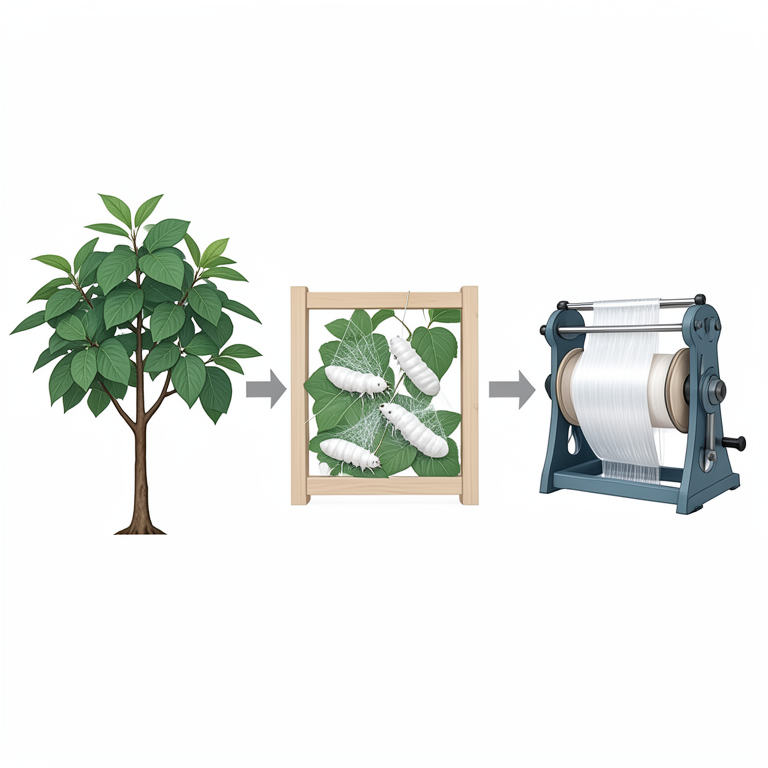
Sericulture Development Cycle
AI-generated conceptual illustration (Bombyx mori silkworms and mulberry plants in a rural Ugandan farm setting). It explains the idea and does not show study data.
View source evidence ↗Introduction
Sericulture is an agro-based industry that mainly focuses at rearing of silkworms with the main objective of silk production. Natural silk fiber is the main product of silk production obtained from domesticated silkworms (Bombyx mori) (Singh et al., 2000) [10] . Sericulture was introduced in Uganda in 1971 as a joint venture between the government of Uganda through the ministry of Agriculture and Japan government under Japan International Cooperation Agency (JICA). It started as a research activity at Kawanda research Institute in Uganda were mulberry nursery was established to start an experiment of rearing silkworm using the eggs from Japan. The mulberry tree Morus alba L. originated from China 4700 years ago (Heuze et al., 2019) [6] . The idea of sericulture industry in Uganda was pointed out by Mr. Gray, a senior officer at United Nation Development Programme (UNDP) in 1986. He led to the formation of Uganda Silk Producers Association (USPA). The rearing of silkworm and production of cocoon began in 1992 with two companies namely; Uganda Silk Industry limited (USIL) and Inuula Silk Estate limited (ISEL) eggs were imported from Japan, hatched and reared them in their own premises up to the third instar and the silk worms were distributed to the farmers to be reared until cocoon production. The farmers sold their fresh cocoons directly to company which were dried up and exported to Japan.
To support sericulture development in Uganda, The Uganda Silk Sector Development Project (SSDP) was formed in 1993 which started operating from 1994 to 1999. European Union (EU) evaluated the (SSDP) and recommended it that the sericulture project is relevant in Uganda because of its good climate conditions which favour the growth mulberry and silkworm rearing throughout the year. Most of the crops in Uganda are grown once or twice in a year but sericulture can be practiced 4-8 times in a year with high returns. The studies on income generation through agriculture crop and sericulture at farmer's level indicate that sericulture generates more income than other cash crops on the same piece of land annually (Trivedi & Sarkar, 2015) [9] . And thus provide regular employment to the farmers and workers enabling them to earn income compared to other crops which ultimately check the migration of population from rural areas to urban areas and hence, it is considered as an essential tool for the rural development for improving the standard of living of farmers (women and youth) at the village level. Sericulture is regarded as best tools for solving the problem of unemployment and underemployment of many youth and women in rural areas. Sericulture is also seen as great potential in creating job opportunity to the poorer farmers and increasing their income of the smallholding farmers.
Achievements under Commercialization of Sericulture technologies and Innovations in Uganda
The sericulture project under Commercialization of Sericulture Technologies and Innovations in Uganda has registered a number of achievements; the project has installed its first set of Post Cocoon Processing Factories and is almost to be complete in Sheema and Kween district. Developed specifications for establishing and operationalizing a complete line of next generation equipment for post cocoon technologies and innovations and completed and contract to manufacture, install and build capacity of Ugandans to operate the processing line finalized. On 16 December 2022, Uganda sent its first silk yarn brand samples, branded Usilk for testing on the European market and the target was to meet the specifications for Grade 6A which is the best quality silk globally as a basis for commercial production in Uganda. Uganda is currently producing raw silk which is divided into 11 grades; 6A, 5A, 4A, 3A, 2A, A, B, C, D, E and F. The sericulture project started with one sericulture research station at Rubare in Sheema district and now it has been spread to more than thirty eight (38) National Sericulture Resources Research Stations in twenty four (24) districts with a total of over 2,300 acres of well-established maintenance mulberry gardens. Development of physical infrastructure such as rearing houses were constructed in Mukono, Nwoya, Gomba, Mubende, Kween, Kitagata, Kiruhura, Busitema/Busia, Nakaseke and Luwero. Egg Production house was also completed in Sheema district and three (3) staff has been trained in egg production. The project had completed construction of two shells for two research stations in Sheema and Mukono. In the year 2021/2022 sericulture project has also bought new additional 800 acres of land, 400 acres in Kayunga, 200 acres in Bulambuli, 100 acres in Kween, and Nwoya 177 acres land for expansion purposes to meet targeted acreage of 50,000 acres of land for sericulture project in Uganda. On-farm commercialization at Farmers Field is already ongoing on 92 farms. Their capacity continued to be enhanced through regular extension services. These farmers will act as Trainer of trainers. Additional 450 farmers who had been silk farmers were followed up and their needs identified. ( have what to eat and some have lost their lives due to lack of money to cater for their medical treatment who were relying on sericulture project for their livelihoods. Some sericulture farmers are now getting discouraged due to lack of funds to support them with training, demonstrations, supply mulberry planting materials and silkworm eggs were farmers had prepared to receive silk worm eggs for rearing. Unfavorable working conditions such as weather changes, scarcity of water which were at times unfavorable to the workers in some stations. There is a challenge of lack of working tools and equipment's faced by workers at the sericulture stations such as garden tools (pangas and hoes), protective garden wear (gumboots, overalls) and any other protective gears. There is lack of local and international markets available for the silk products produced by farmers in different part of the country
Conclusion
Sericulture industry in Uganda is regarded as best tools for solving the problem of unemployment and underemployment of many youth and women in rural areas. Sericulture is also seen as great potential for providing the employment opportunities to more than 1,539 workers who work as technical staffs, causal workers and constructors/builders are employed directly in sericulture field activities and all of workers earn a living in form of salaries and wages. Sericulture can also provide employment to the women and youth trough the year thus controlling rural-urban migration and high crime rates resulting from unemployed youth in Uganda.
Recommendation
Recommendation
References
7 in the original paper- Japan International Cooperation Agency (JICA). Sericulture in East Africa, Available from www.jaicaf.or.jp/publications/report-2007_1_e.pd, Accessed: 23rd April 2013
- Kim KY, Kang PD, Lee KG, Hyung K, Kim MJ, Kim KH. Microsatellite analysis of the silkworm strains (Bombyx mori): high variability and potential markers for strain identification, Genes & Genomics. 2010;32:532-543.
- Oripov Otabek Oripovich, Umarov Shavkat Ramazonovich. Influence of feeding of silkworms in Uzbekistan on cocoon yield and variety. Int. J Agric. Extension Social Dev. 2020;3(2):09-12.
- Heuzé V, Tran G, Bastianelli D, Lebas F. White mulberry (Morus alba). Feedipedia, a programme by INRAE, CIRAD, AFZ and FAO; c2019. https://www.feedipedia.org/node/123 last updated on November 13, 2019, 17:47
- Trivedi S, Sarkar K. Comparative study on income generation through agriculture crop and sericulture at farmer's level in Murshidabad district. Journal of Entomology and zoology Studies. 2015;3(1):242-245.
- Chang SJ, Singh H. Corporate and industry effects on business unit competitive position. Strategic management journal. 2000 Jul;21(7):739-752.
- Tropical institute of Development Innovations (TRIDI) Commercialization of Sericulture Technologies and Innovations in Uganda. Project profile; c2021. www.tridi.org, 2021