
Research article · 2023 · Full text
International Journal of Veterinary Sciences and Animal HusbandryFruitful delivery of a live kid via Schaffer’s method in goat uterine torsion
Volume 8(2) · Pages 08–09 · DOI: 10.22271/veterinary.2023.v8.i2a.481 ↗
Research areasBody Contouring and Surgery
Abstract
Author-writtenUterine torsion can be one of the causes of maternal dystocia and lead to fetal and maternal death if get untreated. This case report focuses on the treatment aspect of uterine torsion by the Plank method. The live delivery was made possible because of the attentive nature of the owner. Both maternal and fetus were in good health and thus a positive outcome is highly related to the early presence of the case to the veterinarian.
Summary
Source-checkedPlain-language reading of the full paper, prepared with AI and checked against the text. Each point links to the authors' own words.
Why it matters
- Uterine torsion is a cause of maternal dystocia that can result in the death of both the mother and the fetus if left untreated. View evidence ↗
- In goats, uterine torsion is an infrequent type of dystocia characterized by the rotation of the uterus on its longitudinal axis. View evidence ↗
- The incidence of uterine torsion in goats is approximately 2% of all dystocia cases originating from the dam. View evidence ↗
The question
- The study aims to report the successful delivery of a live male kid using the Plank method, also known as Sharma’s Modified Schaffer method, to treat uterine torsion. View evidence ↗
What they did
- The subject was a four-year-old non-descript goat in her third parity treated at the Teaching Veterinary Clinical Complex, Nagpur Veterinary College. View evidence ↗
- Clinical examination confirmed a right-sided post cervical torsion of more than 180 degrees, with the fetus palpable behind the twist. View evidence ↗
- Prior to the procedure, the doe received injections of 2 ml dexamethasone and 2 ml Chlorpheniramine maleate. View evidence ↗
- The goat was placed in right lateral recumbency, a wooden plank was fixed to the fetus, and the animal was rolled to the right at full speed. View evidence ↗
What they found
- Immediately following the roll, the water bag appeared and was ruptured, allowing for the manual delivery of a live male kid. View evidence ↗
- The doe recovered without complications after post-delivery treatment with 5% intravenous Dextrose, 500 mg Ceftriaxone, 2 ml Megludyne, and 25 ml Involon twice daily. View evidence ↗
- The authors state that the plank method is superior to manual fixation because it distributes force equally to the fetus, whereas manual fixation may apply unequal force. View evidence ↗
What it means
- The authors recommend the use of the plank method for the successful treatment of uterine torsion in goats. View evidence ↗
- The study concludes that early presentation to a veterinary hospital allows for the successful delivery of a live kid and early recovery of the goat using Schaffer's method. View evidence ↗
Visual summary
1 visualsIllustrations explain the paper; they do not show study data.
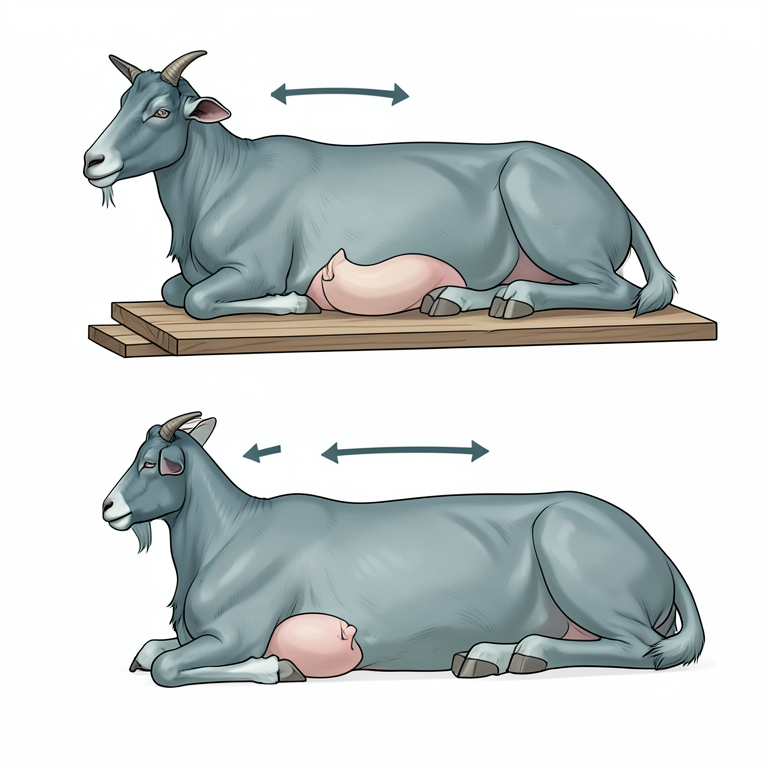
The Plank Method Process
AI-generated conceptual illustration (goat kid and adult goat). It explains the idea and does not show study data.
View source evidence ↗Figures & tables
From the original paper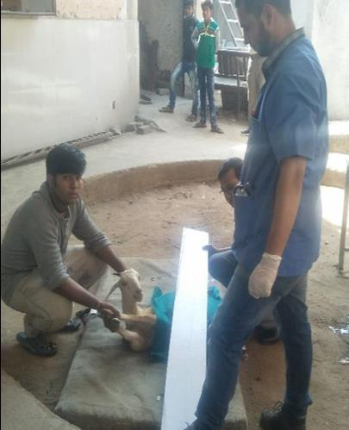 Figure 1
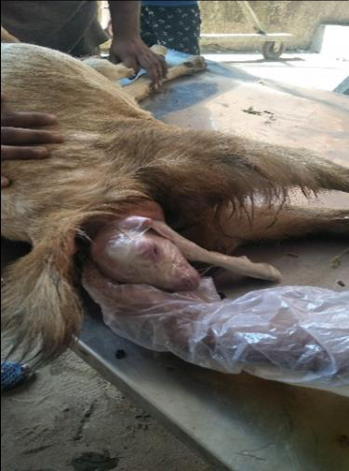 Figure 2
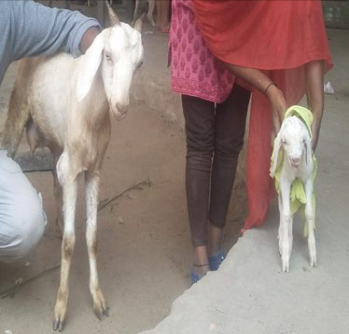 Figure 3
Introduction
Uterine torsion most frequently observed in Bovine and comparatively low in small ruminants and results in partial or complete obstruction of caudal part of uterine body preventing passage of new born (Jackson 2004) [2] . The use of Schaffer's method is regularly used in case of bovines but its application is rarely reported in Sheep and Goats. Uterine torsion, is a kind of dystocia due to uterine displacement which is infrequently noticed in goats and defined by the Noakes et al. 2001 [1] as the rotation of the uterus on its longitudinal axis either from the anterior or posterior portion of the cervix or on the cervix. Incidence rates in goats are around 2% of all dystocia cases from the dam origin (Jackson 2004) [2] . This study reports the delivery of one live male kid after successfully deteriorating with the Plank method/ Sharma's Modified Schaffer method.
Case history and treatment:
A non-descript, four years old goat, in her third parity was presented to the Teaching Veterinary Clinical Complex, Nagpur Veterinary College, Nagpur in the morning hours with the history of excessive bleating from yesterday evening and nondelivery of the fetus even continuous straining from the morning 6:00 A.M. On the clinical examination, the rectal temperature, and mucous membranes were found normal and the animal was apparently healthy. The vulva was washed with a weak potassium permanganate (KMnO4) solution before examination and proper lubrication i. e. soyabean oil was applied. On per vaginal examination, the twisting of the hand toward the right side was felt and the fetus was palpable behind the twist. This was then confirmed as right-sided post cervical torsion of >180 degrees. Before proceeding any further, the doe was administered with 2 ml dexamethasone and 2 ml Chlorpheniramine maleate injection. The goat was restrained on her right lateral recumbency and then a wooden plank was fixed after palpating the fetus with mild force as small ruminants don't require heavy fixation as in cattle and buffaloes (Fig1). Only two persons helped in fixing this from both ends and minimal force was applied. The roll was given towards the right side at full speed by grasping the forelimbs and hind limbs of the dam. As soon as the rolling was over, the first water bag appeared from the vulva immediately (Fig: 2). This was ruptured and the fetus was delivered manually and a live male kid was delivered (Fig: 3. Post-delivery, the doe was treated with intravenous Dextrose 5%, Inj. Ceftriaxone 500 mg and Inj. Megludyne 2 ml Intramuscularly and liq. Involon 25 ml twice daily was advised. The animal was active post-delivery and recovered without any other complications.
Discussion
Although difficult kidding due to uterine torsion in goats has a lower incidence rate, which is as low as 2%. It is a commonly found entity in cattle and buffalo, sometimes in doe and ewe, and extremely rare in mare, bitch, and sow. this lower incidence may be due to sub lumbar attachment of mesometrium (Frazer et al. 1996) [5] as compared to sub ilial in cows. In goats, fixing of the fetus was achieved previously by various obstetricians either by putting pressure using both palms (Sharma et al., 2004) [3] or a hollow iron pipe (Chauhan et al., 2020) [4] and wooden plank (Sharma et al., 2018, Jayaganthan et al., 2020) [7,6] . In this case, a single fetus and a small body of a dam could have contributed to the instability of the fetus and led to the right-side torsion. This plank method is having an edge over the fixing with hands as that may cause unequal force and fix may get disturbed, but Schaffer's method distributes force equally to the fixed fetus. Finally, it can be helpful to the obstetricians, if the owner presents the animal directly and as soon as possible to the nearest veterinary clinics. Thus, we recommend this method for successfully deteriorating uterine torsion in goats.
Conclusion
It was concluded that if a case of uterine torsion is presented early in the veterinary hospital, the successful delivery of live kid is possible by Schaffer's method along with early recovery of goat.
Acknowledgement
Acknowledgement:The authors are very much thankful to the Hospital Superintendent, TVCC, NVC, Nagpur for the facilities provided during the treatment.
Figures and tables from the paper
References
5 in the original paper- Sharma A, Singh M, Thakur S, Mishra S, Vashistha NK. Successful treatment of uterine torsion in goat: A Case Report. Intas Polivet. 2004;5(2):296.
- Chauhan P, Patelia H, Sharma V, Suthar B, Das B, Kalaswa S, et al. Uterine Torsion: A Cause of Dystocia in Doe. International Journal of Livestock Research. 2020;10(2):104-107. DOI:10.5455/ijlr.20200115033211.
- Frazer G, Perkins N. Constable P. Bovine uterine torsion, 164 hospital referral cases. Theriogenology. 1996;46(5):739-58.
- Jayaganthan P, Palanisamy M, Prabaharan V, Rajkumar R, Raja S. Successful management of uterine torsion in a Kodi and goat by modified Schaffer's method. International Journal of Science, Environment and Technology. 2020;9(3):485-498.
- Sharma A, Singh M, Kumar P, Gupta S. Management of Uterine Torsion in a Goat by Modified Schaffer's. Journal of Biological Methods. 2018;7(5):753-755. |ISSN 2277-8330.