
Research article · 2022 · Full text
International Journal of Horticulture and Food ScienceAssessment of different bioregulators on survival and growth of black pepper cuttings (Piper nigrum L.)
Volume 4(2) · Pages 216–218 · DOI: 10.33545/26631067.2022.v4.i2c.139 ↗
Research areasPiperaceae Chemical and Biological Studies
Abstract
Author-writtenThe present investigation entitled “Assessment of different bioregulators on survival and growth of black pepper cuttings (Piper nigrum L.).” was conducted at the Department of Horticulture, College of Horticulture Dapoli, Dist. Ratnagiri during the year 2020-2021. The experiment was conducted in Randomized Block Design (RBD) with seven treatments and three replications. The treatments were T1 – Vermiwash 15%, T2 – Vermiwash 20%, T3 – Vermiwash 25%, T4 – Cattle urine 5%, T5 - Cattle urine 7.5%, T6 - Cattle urine10%, T7 – Control(no drenching). Growth parameters of black pepper cuttings viz. number of days required for initiation of sprouting, number of days required for peak sprouting, number of days required for complete sprouting, length of the shoot, number of leaves, leaf area, girth of sprout, vine length, intermodal length, number of primary roots, root length, number of nodes, dry shoot weight, dry root weight, absolute growth rate, relative growth rate were significantly influenced by bioregulators drenching. In treatment T2 (Vermiwash 20%) high survival per cent (82.67%), less days required for initiation of sprouting (20.67).
Summary
Source-checkedPlain-language reading of the full paper, prepared with AI and checked against the text. Each point links to the authors' own words.
Why it matters
- Black pepper (Piper nigrum L.) is a globally significant spice originating from the Western Ghats of India. View evidence ↗
- Black pepper accounts for approximately 35% of the global spice trade. View evidence ↗
The question
- The study aimed to assess how different bioregulators affect the survival and growth of black pepper cuttings. View evidence ↗
What they did
- The researchers used a Randomized Block Design (RBD) featuring seven treatments, each replicated three times. View evidence ↗
- The experiment took place at the College of Horticulture in Dapoli, Ratnagiri, during 2020-2021. View evidence ↗
- The study measured various growth parameters, including sprouting time, shoot length, leaf area, root characteristics, and growth rates. View evidence ↗
What they found
- At the sixth month, the highest survival success rate of 82.67% was achieved using either 20% Vermiwash (T2) or 7.5% cattle urine (T5). View evidence ↗
- The control group (T7) exhibited the lowest survival success rate at 68.00%. View evidence ↗
- The shortest time for complete sprouting was observed in the 25% Vermiwash treatment (52.33 days), while the control group took the longest (57.33 days). View evidence ↗
- After six months, the 10% cattle urine treatment (T6) produced the longest shoots at 67.51 cm, significantly outperforming all other treatments. View evidence ↗
- The control group (T7) had the shortest shoot length at 36.52 cm after six months. View evidence ↗
What it means
- The authors conclude that 20% Vermiwash and 7.5% cattle urine drenching provide the best overall performance for survival and vegetative growth. View evidence ↗
- The authors recommend monthly drenching of bioregulators to improve the growth, success, and survival of black pepper cuttings. View evidence ↗
- The authors state that further investigation is necessary to confirm the results of this study. View evidence ↗
Visual summary
2 visualsIllustrations explain the paper; charts are replotted from the paper's own table values.
Bioregulator Treatment Comparison
AI-generated conceptual illustration (black pepper cuttings (Piper nigrum L.)). It explains the idea and does not show study data.
View source evidence ↗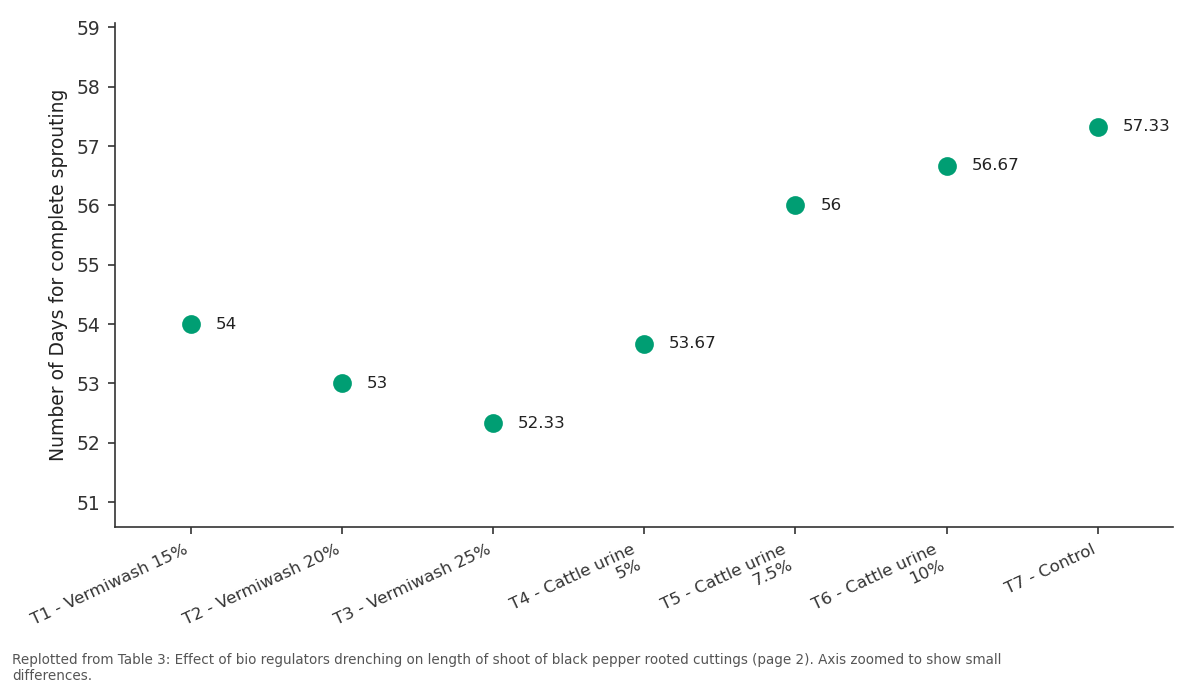
Number of Days for complete sprouting: T1 - Vermiwash 15% vs T2 - Vermiwash 20% vs T3 - Vermiwash 25% vs T4 - Cattle urine 5% vs T5 - Cattle urine 7.5%
Replotted from Table 3 (page 2) of the original paper. Every bar is the paper's own table value.
View source evidence ↗Figures & tables
From the original paper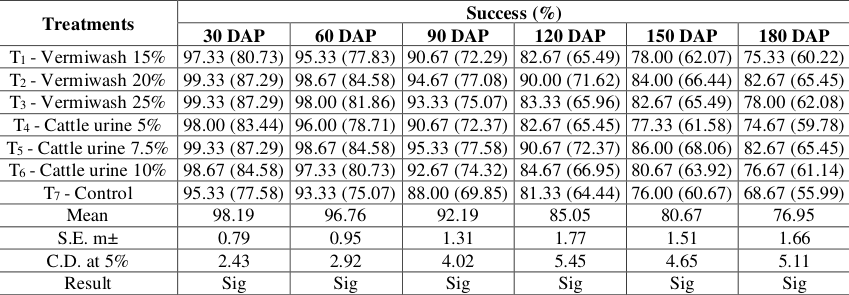 Table 1
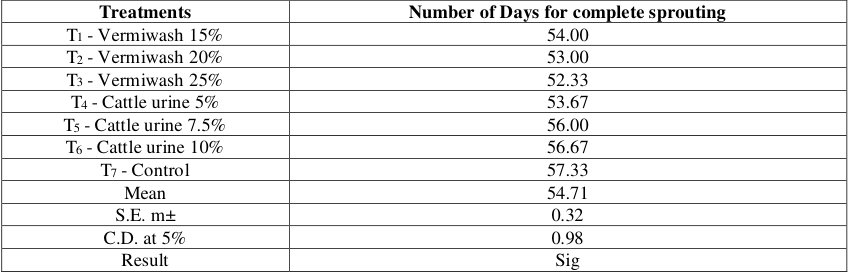 Table 3
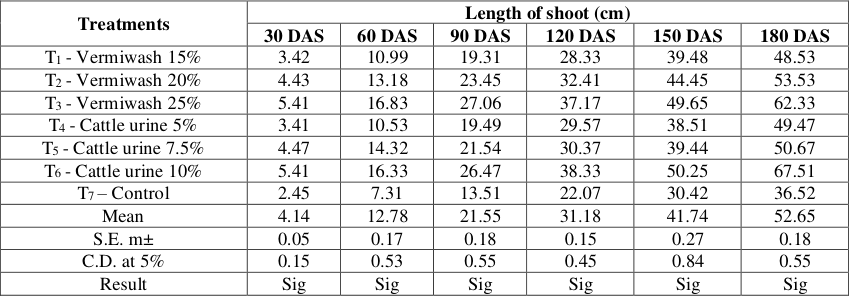 Table 3
Introduction
Black pepper (Piper nigrum L.) is one of the passe spices in the world, belongs to family Piperaceae is originated from Western Ghats of India. Black pepper is usually recognized as Kalimirch in Hindi, Kurumilagu in Tamil, Kurumulaku in Malayalam, Miryalatige in Telugu, Karimenasu in Kannada, Syahmirch in Urdu, Kalomirch in Gujrati, Marich in Sanskrit, and Kali miri or Golmirh in Marathi. In India black pepper was referred as "black gold", due to its high worth as a trade good. Black pepper has been used in different ways in India. There are evidences that it has been associated with Indian cooking since 2000 BC. The primary cultivation of pepper in India was done on the Malabar Coast and repeatedly traded from the Malabar Coast to Middle East, through the Arabian Sea. Black pepper is accounted 35% of the world trade in spices (Ravindran, 2000) [12] . Black pepper grows effectively between 20° North and 20° South of equator and elevation up to 1500 m above MSL in humid tropics. Well distributed annual rainfall of 125-200 cm is considered superlative for black pepper. Rainfall after stress induces bounteous flowering. Black pepper does not bear excessive heat and dryness. The crop endures temperature between 100 to 40 °C. The superlative temperature is 23° to 32 °C. Optimal soil temperature for ideal root growth is 26° to 28 °C. It is well grown in heavy clay to light sandy clays rich in humus soils with fragile nature, well drained, but still with abundant water holding capacity. Soils have neutral pH, content high organic matter and high base saturation with Ca and Mg boosted the productivity.
Material and Methods
The experiment was conducted at the Nursery plot No. 4. Under the field of College of Horticulture, Dapoli, Dr. Balasaheb Sawant Konkan Krishi Vidyapeeth, Dapoli. College of Horticulture, Dapoli, Dist. Ratnagiri in during 2020-21. The experiment was laid out in Randomized Block Design with seven treatments replicated thrice. The treatments applied were T 1 (Vermiwash 15% drenching), T 2 (Vermiwash 20% drenching), T 3 (Vermiwash 25% drenching), T 4 (Cattle urine 5% drenching), T 5 (Cattle urine 7.5% drenching), T 6 (Cattle urine10% drenching), T 7 (control) Statistical analysis of the data was collected during the course studies was carried out by standard method of analysis of variance described by Panse and Sukhatme (1995) [13] .
Result and Discussion 1) Success percentage
It is observed from Table-1 that there was significant difference among all the treatments during sixth month with highest success (82.67%) in treatments T 2 (vermiwash 20%) and T 5 (cattle urine 7.5%) and were at par with treatments T 3 vermiwash 25 per cent (78.00% success) and T 6 i.e cattle urine 10 per cent (76.67% success). The lowest success (68.00%) was observed in T 7 control treatment.
2) Days required for complete sprouting
The data presented on days required for complete sprouting of black pepper rooted cuttings as influenced by bioregulators treatments after planting of cuttings in polythene bag. It was seen from Table-5 that T 3 (Vermiwash 25%) required less no. of days (52.33) for last sprouting which was at par with treatments T 2 (53.00). The maximum days (57.33) required for last sprouting in T 7 (control).
Length of shoot
It was found that the highest length of shoot (67.51 cm) after sixth month was observed in treatment T 6 (cattle urine 10%) which was significantly superior over all rest of the treatments. Treatments T 2 vermiwash 20 per cent (53.53 cm) and T 3 vermiwash 25 per cent (62.33cm) recorded medium shoot length which are above mean value (52.65). The lowest length of shoot (36.52 cm) of the shoot during sixth month was found in T 7 (control).
Conclusion
Thus, from the present investigation, it could be concluded that drenching of bioregulators at monthly interval from planting of cuttings showed more rapid growth, success and survival of black pepper cuttings. Growth parameters such as length of the shoot, number of leaves, girth of the sprout, leaf area, vine length, internodal length, number of primary roots, root length, number of nodes, dry shoot weight, dry root weight, absolute growth rate, and relative growth rate were improved significantly by all bioregulators concentrations. Similarly requires less days for sprouting by various concentrations as compared to control treatment. Vermiwash drenching at 20% and cattle urine drenching at 7.5% concentration showed the best performance in regards to survival of rooted cuttings, vegetative growth parameters and benefit cost ratio. For the confirmation of results further investigation in this regards is necessary.
Figures and tables from the paper
| Treatments | Success (%) | — | — | — | — | — |
|---|---|---|---|---|---|---|
| 30 DAP | 60 DAP | 90 DAP | 120 DAP | 150 DAP | 180 DAP | |
| T1 - Vermiwash 15% | 97.33 (80.73) | 95.33 (77.83) | 90.67 (72.29) | 82.67 (65.49) | 78.00 (62.07) | 75.33 (60.22) |
| T2 - Vermiwash 20% | 99.33 (87.29) | 98.67 (84.58) | 94.67 (77.08) | 90.00 (71.62) | 84.00 (66.44) | 82.67 (65.45) |
| T3 - Vermiwash 25% | 99.33 (87.29) | 98.00 (81.86) | 93.33 (75.07) | 83.33 (65.96) | 82.67 (65.49) | 78.00 (62.08) |
| T4 - Cattle urine 5% | 98.00 (83.44) | 96.00 (78.71) | 90.67 (72.37) | 82.67 (65.45) | 77.33 (61.58) | 74.67 (59.78) |
| T5 - Cattle urine 7.5% | 99.33 (87.29) | 98.67 (84.58) | 95.33 (77.58) | 90.67 (72.37) | 86.00 (68.06) | 82.67 (65.45) |
| T6 - Cattle urine 10% | 98.67 (84.58) | 97.33 (80.73) | 92.67 (74.32) | 84.67 (66.95) | 80.67 (63.92) | 76.67 (61.14) |
| T7 - Control | 95.33 (77.58) | 93.33 (75.07) | 88.00 (69.85) | 81.33 (64.44) | 76.00 (60.67) | 68.67 (55.99) |
| Mean | 98.19 | 96.76 | 92.19 | 85.05 | 80.67 | 76.95 |
| S.E. m± | 0.79 | 0.95 | 1.31 | 1.77 | 1.51 | 1.66 |
| C.D. at 5% | 2.43 | 2.92 | 4.02 | 5.45 | 4.65 | 5.11 |
| Result | Sig | Sig | Sig | Sig | Sig | Sig |
Table text extracted from the original PDF; superscript letters are shown inline. The original table image is below.
View original table image
| Treatments | Number of Days for complete sprouting |
|---|---|
| T1 - Vermiwash 15% | 54.00 |
| T2 - Vermiwash 20% | 53.00 |
| T3 - Vermiwash 25% | 52.33 |
| T4 - Cattle urine 5% | 53.67 |
| T5 - Cattle urine 7.5% | 56.00 |
| T6 - Cattle urine 10% | 56.67 |
| T7 - Control | 57.33 |
| Mean | 54.71 |
| S.E. m± | 0.32 |
| C.D. at 5% | 0.98 |
| Result | Sig |
Table text extracted from the original PDF; superscript letters are shown inline. The original table image is below.
View original table image
| Treatments | Length of shoot (cm) | — | — | — | — | — |
|---|---|---|---|---|---|---|
| 30 DAS | 60 DAS | 90 DAS | 120 DAS | 150 DAS | 180 DAS | |
| T1 - Vermiwash 15% | 3.42 | 10.99 | 19.31 | 28.33 | 39.48 | 48.53 |
| T2 - Vermiwash 20% | 4.43 | 13.18 | 23.45 | 32.41 | 44.45 | 53.53 |
| T3 - Vermiwash 25% | 5.41 | 16.83 | 27.06 | 37.17 | 49.65 | 62.33 |
| T4 - Cattle urine 5% | 3.41 | 10.53 | 19.49 | 29.57 | 38.51 | 49.47 |
| T5 - Cattle urine 7.5% | 4.47 | 14.32 | 21.54 | 30.37 | 39.44 | 50.67 |
| T6 - Cattle urine 10% | 5.41 | 16.33 | 26.47 | 38.33 | 50.25 | 67.51 |
| T7 – Control | 2.45 | 7.31 | 13.51 | 22.07 | 30.42 | 36.52 |
| Mean | 4.14 | 12.78 | 21.55 | 31.18 | 41.74 | 52.65 |
| S.E. m± | 0.05 | 0.17 | 0.18 | 0.15 | 0.27 | 0.18 |
| C.D. at 5% | 0.15 | 0.53 | 0.55 | 0.45 | 0.84 | 0.55 |
| Result | Sig | Sig | Sig | Sig | Sig | Sig |
Table text extracted from the original PDF; superscript letters are shown inline. The original table image is below.
View original table image
References
7 in the original paper- Gunasundari R, Kumar R. Studies on the effect of vermicompost and vermiwash on growth and development of young tea plants, News/.UPASI Tea Res. Foundn. 2009;19(1).
- Gurung N, Swamy GSK, Sarkar SK, Ubale NB. Effect of chemicals and growth regulators on germination, vigour and growth of Passion fruit (Passiflora edulis Sims.), The Bioscan Intl. J of Life Sci. 2014;9(1):155157. India Pvt. Ltd., New Delhi. 134-182.
- Siddappa S, Hegde NK. Effect of foliar spray of vermiwash and nutritional treatments on growth and yield performance of curry leaf var. Suvasini, The Asian J of Hort. 2011;6(1):68-70.
- Sivasubramanian K, Ganeshkumar M. Influence of vermiwash on the biological productivity of Marigold, Madras Agric. J. 2004;91(4-6):221-225.
- Sharma DP, Prajapati JL, Tiwari A. Effect of NPK, vermicompost and vermiwash on growth and yield of Okra var. Kashi Pragati, Intl. J of Basic and Appl. Agril., Res. 2014;12(1):5-8.
- Trivedi H, Kumar A. Response of bio-enhancers on growth and flowering in rose (Rosa hybrida) Cv. Grand Gala, Intl. J of Basic and Appl. Agril Res. 2015;13(1):31-37.
- Ravindran V, Cabahug S, Ravindran G, Selle PH, Bryden WL. Response of broiler chickens to microbial phytase supplementation as influenced by dietary phytic acid and non-phytate phosphorous levels. II. Effects on apparent metabolisable energy, nutrient digestibility and nutrient retention. British Poultry Science. 2000 May 1;41(2):193-200.