
Research article · 2023 · Full text
International Journal of Biology SciencesHaematological alterations in a fresh water fish Anabas testudineus under cypermethrin exposure
Volume 5(1) · Pages 32–35 · DOI: 10.33545/26649926.2023.v5.i1a.143 ↗
Research areasEnvironmental Toxicology and Ecotoxicology
Abstract
Author-writtenCypermethrin, a synthetic pyrethroid is a broad spectrum insecticide used extensively in households and agriculture fields to control the pests. Use of insecticides in agriculture to prevent the crop damage from pests come with a significant cost as they reach to the aquatic systems through irrigation and rain and deteriorates the water quality. It adversely affects the non-target organisms including fishes of the fresh water ecosystem. Pyrethroid insecticide cypermethrin was used for this investigation to study the alterations in blood biochemical of a fresh water fish Anabas testudineus. Acute toxicity of cypermethrin to the fish was determined for 24, 48, 72 and 96 hours. The LC50 value was measured 0.15 ppm, 0.20 ppm, 0.2 ppm and 0.30 ppm respectively by the regression equation. The sublethal concentration determined was 0.106 ppm. After exposure period of 30 days significant changes in the blood biochemical level was reported during the present study. Blood glucose, serum protein and serum cholesterol of cypermethrin treated fish exhibited hyperglycaemic, hypoproteinemic and hypercholesterolemic response. The present investigation come to a conclusion that cypermethrin alters the blood biochemistry of Anabas testudineus and hence, affects the fish health.
Summary
Source-checkedPlain-language reading of the full paper, prepared with AI and checked against the text. Each point links to the authors' own words.
Why it matters
- Cypermethrin is a synthetic pyrethroid insecticide widely used in agricultural and household settings for pest control. View evidence ↗
- Agricultural insecticides can enter aquatic systems via rain and irrigation, degrading water quality and harming non-target freshwater fish. View evidence ↗
- Serum biochemistry and blood parameters serve as critical tools for assessing the health status of animals. View evidence ↗
The question
- The study aimed to investigate how exposure to the insecticide cypermethrin alters the blood biochemistry of the freshwater fish Anabas testudineus. View evidence ↗
What they did
- The experiment used Anabas testudineus fish with an average length of 12-16 cm and weight of 80-100 gm, housed in 40-litre glass aquaria. View evidence ↗
- Acute toxicity tests over 24 to 96 hours established LC50 values ranging from 0.15 to 0.30 ppm, leading to the determination of a sublethal concentration of 0.106 ppm. View evidence ↗
- Blood samples were collected from both control and cypermethrin-exposed fish after a 30-day exposure period. View evidence ↗
- The researchers measured three specific blood biochemical markers: blood glucose, serum protein, and serum cholesterol. View evidence ↗
What they found
- The cypermethrin-exposed fish exhibited a 29.12% increase in blood glucose levels compared to the control group. View evidence ↗
- Serum cholesterol levels in the exposed fish increased by 7.6% relative to the control fish. View evidence ↗
- There was a 21.29% decrease in serum protein levels in the fish exposed to the test chemical compared to the control. View evidence ↗
What it means
- The authors conclude that cypermethrin alters the blood biochemistry of Anabas testudineus, which negatively impacts the health of the fish. View evidence ↗
- The authors recommend preventing pesticide contamination of natural water resources to ensure a safe habitat for fish diversity. View evidence ↗
Visual summary
3 visualsIllustrations explain the paper; charts are replotted from the paper's own table values.
Biochemical Response to Cypermethrin
AI-generated conceptual illustration (Anabas testudineus (climbing perch fish)). It explains the idea and does not show study data.
View source evidence ↗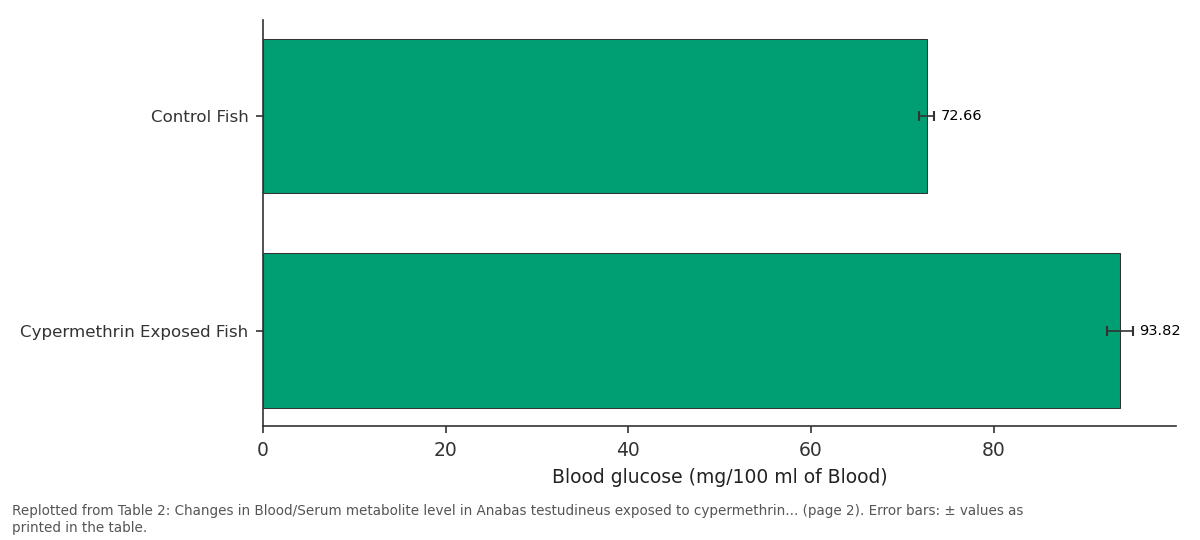
Blood glucose (mg/100 ml of Blood): Control Fish vs Cypermethrin Exposed...
Replotted from Table 2 (page 2) of the original paper. Every bar is the paper's own table value.
View source evidence ↗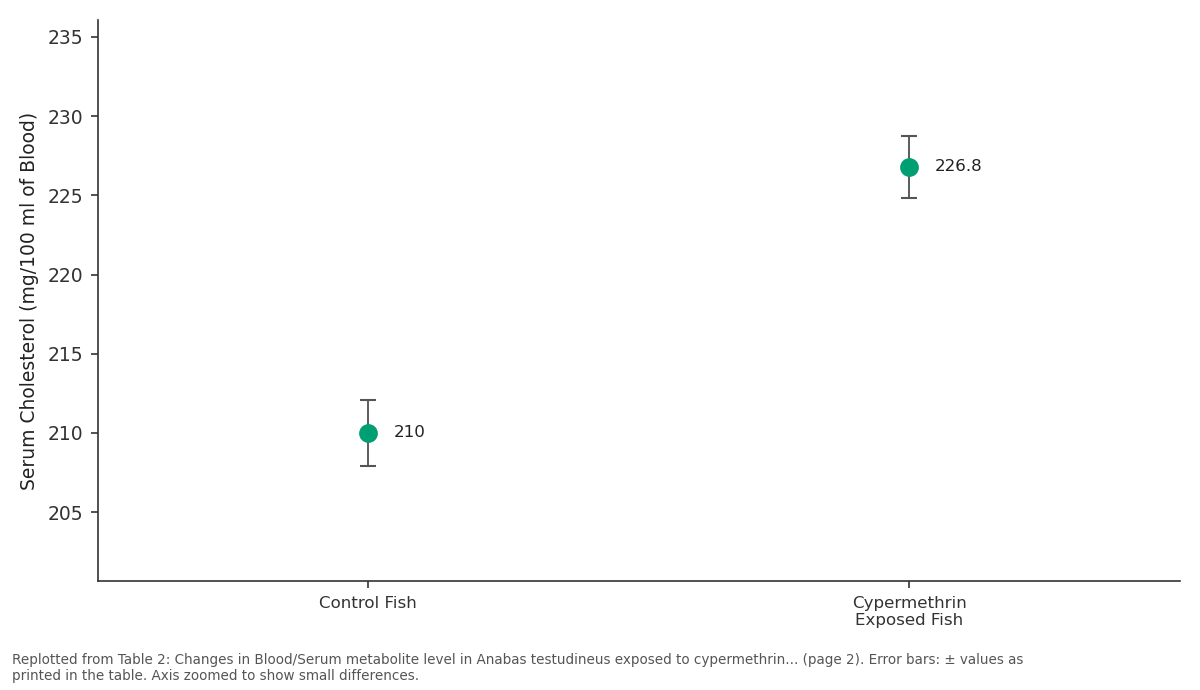
Serum Cholesterol (mg/100 ml of Blood): Control Fish vs Cypermethrin Exposed...
Replotted from Table 2 (page 2) of the original paper. Every bar is the paper's own table value.
View source evidence ↗Figures & tables
From the original paper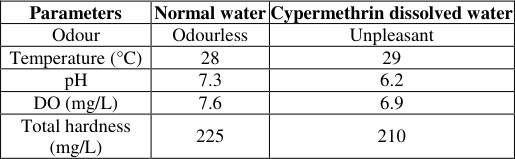 Table 1
 Table 2
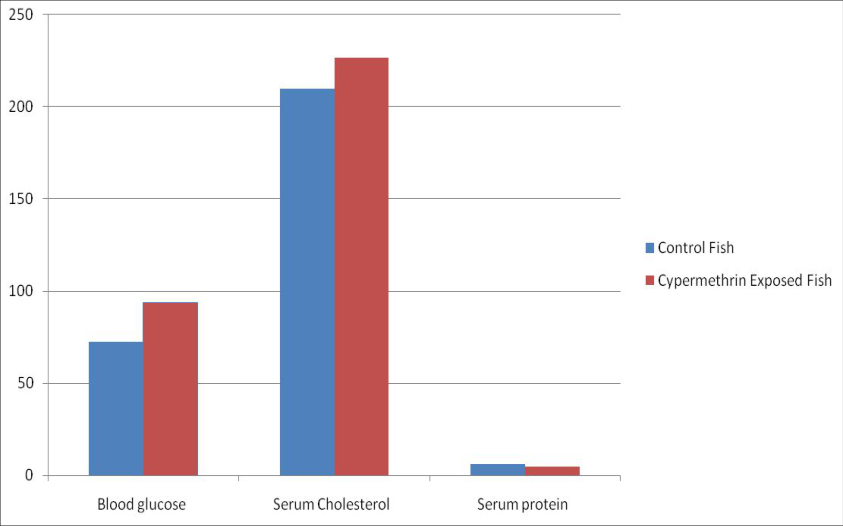 Figure 1
Introduction
Ample food supply to the increasing population is a challenge in underdeveloped and developing countries. To increase the crop yields use of agrochemicals becomes a compulsion. Pesticides are used to prevent the crop damage due to pests. However, their use is hazardous to the environment and can affect the non-target organisms also [1] . Unfortunately, aquatic ecosystems like ponds and rivers are more vulnerable to the pesticide pollution as they are located close to or inside the agricultural areas. The pesticides liberated directly into the aquatic environment or due to surface runoff have adverse effects on fish and subsequently on the human beings [2] . Fishes provide food and livelihood for millions of the people globally. Fishes represent the largest and most diverse group of vertebrates and are excellent experimental models for toxicological research [3] . Fishes are an important component of the food chain, so, any effect of toxicant may have an adverse effect on the nutritive values of fish and on the human beings due to their consumption [4] . The organisms in aquatic environments respond to pesticide pollutants by changing the biochemical composition and by altering physiological phenomena [5,6] . Blood forms a unique compartment between the external and internal environment in fishes and therefore, any physical and chemical change in the environment induces changes in the nature of blood [7] . Blood parameters reflect the health conditions of animals and the serum biochemistry is an important tool for clinical assessment of wildlife and livestock [8][9][10] . Haematological and biochemical parameters in different species have their own suitable range and any change in these parameters reflects their health status and provides information about the surrounding environment also. Some of the notable experiments on biochemical alteration in fishes under pesticide exposure are those of lipid kinetics in relation to the toxicity of three pesticides in climbing perch Anabas testudineus [11] , effects of cypermethrin and carbofuran on haematological indices of Labeo rohita [12] , effects of sewage on the haematological parameters of C. mrighala [13] , alterations in blood biochemical levels in Heteropneustes fossilis under nuvan exposure [14] .
In the present study, an attempt was made to examine the toxic effects of cypermethrin on the blood biochemical levels of a freshwater fish Anabas Testudines as this fish is available throughout the year in wetlands and consumed by the people of this region as their staple diet.
Materials and Methods
Healthy specimens of test fish Anabas testudineus were collected locally and were transported to the laboratory in earthen pots half filled with natural water and covered by a piece of mosquito net. During transportation maximum effort was taken to minimize the stress. The fishes were washed with 0.1% KMnO4 solution to remove dermal infections if any. Fishes of average length 12-16 cm and weight 80-100 gm. were selected for the experiments and transferred into 40-litre rectangular glass aquaria one by one by using a hand net. Fish were kept for a period of two weeks for acclimatization. Dechlorinated tap water was used during the entire process and aquaria were cleaned routinely. Fish were fed with chopped goat liver once every day. Static bioassay was conducted for the determination of LC50 values of cypermethrin for a period of 24, 48, 72, and 96 hours following the methods of APHA, AWWA, and WPCF [15] . The sub-lethal dose determined was 0.106 ppm by the formula of Hart et al. [16] . At the end of the exposure period of 30 days, control and cypermethrin-exposed fishes were first weighed individually and then blood samples were collected in heparinized vials with the help of a 1 ml disposable syringe equipped with a 2-gauge hypodermic needle by puncturing the ventral aorta. Blood obtained from the individual fish was centrifuged at 3500 rpm for 10 minutes and serum was collected in different vials and further stored at 20 °C until analysed [17,18] . After the completion of sampling procedures blood glucose, serum protein, and serum cholesterol of control and cypermethrin exposed fish were estimated [19][20][21] .
Results
The physicochemical characteristics of the normal water and cypermethrin-dissolved water are shown in Table 1. In the present study elevation in blood glucose and serum cholesterol level while a decrease in serum protein level was reported in cypermethrin-exposed fish. In control, fish blood glucose, serum cholesterol, and serum protein content were estimated at 72.66±0.83 mg, 100 ml of blood, 210±2.08 mg, 100 ml of blood, and 6.01±0.37 gm/100 ml of blood respectively while in cypermethrin exposed fish these parameters were 93.82±1.41 mg, 100 ml of blood, 226.8±1.96 mg, 100 ml of blood and 4.73±0.15 gm/100 ml of blood respectively (Table 2 and Figure 1). The increase in blood glucose level and decrease in serum protein level in test chemical-exposed fish was highly significant (p<0.001) while the increase in serum cholesterol level was significant (p<0.05). Haematological parameters are considered as an indicator of fish health. Physiological responses are good sign because they provide information about the internal environment of organisms [22] . Among the biochemical profiles plasma glucose has been extensively used as a sensitive indicator of environmental stress in fish because the carbohydrates are the primary and immediate source of energy [23] . Marked significant increase in glucose level has been reported in present study that clearly exhibits the effect of cypermethrin as the stressful manifestation to the test fish. In present study, increase in blood glucose level was reported 29.12% in the cypermethrin exposed fish as compared to the control. Several reports demonstrated the similar results in various fish species under different pesticide exposure [24,25,26] .
| Parameters | Control Fish | Cypermethrin Exposed Fish | Percent increase (+) and Decrease (-) |
|---|---|---|---|
| Blood glucose (mg/100 ml of Blood) | 72.66±0.83 | 93.82±1.41 | + 29.12 |
| Serum Cholesterol (mg/100 ml of Blood) | 210±2.08 | 226.8±1.96 | +7.6 |
| Serum protein (gm/100 ml of Blood) | 6.01±0.37 | 4.73±0.15 | -21.29 |
Table text extracted from the original PDF; superscript letters are shown inline. The original table image is below.
View original table image
| Parameters | Normal water | Cypermethrin dissolved water |
|---|---|---|
| Odour | Odourless | Unpleasant |
| Temperature (°C) | 28 | 29 |
| pH | 7.3 | 6.2 |
| DO (mg/L) | 7.6 | 6.9 |
| Total hardness (mg/L) | 225 | 210 |
Table text extracted from the original PDF; superscript letters are shown inline. The original table image is below.
View original table image
Stress is an energy-demanding process and the mobilization of energy substrate to cope with the adverse condition is common in animals. The stress hormone cortisol under pesticide exposure increases glucose production in fish by both glycogenolysis and gluconeogenesis [27] .
Serum cholesterol
Serum cholesterol level exhibited hypercholesterolemic response under cypermethrin exposure. In the cypermethrin exposed fish the increase in serum cholesterol level was 7.6% as compared to the control fish. This response was possibly due to accumulation of pesticides in the liver that caused disturbance of lipid metabolism and caused increase in the cholesterol level in serum. Various studies have demonstrated similar patterns of alteration in haematological parameters in fish under different pesticide exposure [28][29][30] .
Serum Protein
In the present study, serum protein levels indicated declining tendency in the fish under the test chemical exposure. The decrease in protein level was reported 21.29% in test fish as compared to the control fish. Pesticide exposure affects the liver adversely thereby reduces the protein synthesis and causing protein deficiency. Hypoproteinemic response in the present investigation is in conformity with the several reports on fish species under different toxicants [31,32] .
Conclusion
Stress-induced haematological alterations in fish was reported in the present investigation. The outcomes of haematological assessment in the cypermethrin exposed fish clearly indicates the hazardous impact of pesticides on aquatic fauna, especially the fish. From the results of the present study it can be concluded that exposure of Anabas testudineus to the sub-lethal concentrations for 30 days caused significant alterations in haematological parameters that is mirror of fish health and their poor nutritional value. Prevention of natural water resources from pesticide contamination is essential to provide a safe and unclouded habitat to the fish diversity.
Competing Interests
Authors have declared that no competing interests exist.
References
27 in the original paper- Indira V, Sivaji S. Metals and organic compounds of sewage and sludges. Journal of Environmental Biology. 2006;27:723-725.
- Law JM. Issues related to the use of fish models in toxologicpatholog: Session introduction. Toxicologic Pathology. 2003;31(1_suppl):49-52.
- Gupta P, Srivastava N. Effects of sublethal concentrations of zinc on histological changes and bioaccumulation of zinc by kidney of fish Channa punctatus (Bloch.). Journal of Environmental Biology. 2006;27(2):211-215.
- Newell RC. Factors affecting the respiration of intertidal invertebrates. American zoologist. 1973;13(2):513-528.
- Mule MB, Lomte VS. Cyperkill (Cypermethrin) toxicity to lipid metabolism in Thiara tuberculata. Proceedings of the Academy of Environmental Biology. 1994;3(2):131-134.
- Wilson, Taylor. The physiological responses of freshwater rainbow trout Oncorhynchus mykiss during acute exposure. The Journal of Comparative Physiology. 1998;1636:38-47.
- Zhu Xhang YG, Ma CB, Wang YY, Jiang S, Sun YM. Determination of physiobiochemical parameters of blood in argali. Progress in Veterinary Medicine. 2010;9:032. [Google Scholar]
- Kral I, Suchy P. Haematological studies in adolescent breeding cocks. Acta Veterinaria Brno. 2000;69(3):189194.
- Amel OB, Mariam SA, Ehsan AS, El-Badwi MAS. Some biochemical values in young and adult Sudanese geese. Anseranser. Journal of Animal Veterinary Advances. 2006;5:24-26.
- Proceedings of the National Academy of Sciences. 1982;1347:670-676.
- Adhikari S, Sarkar B, Chatterjee A, Mahapatra CJ, Ayappan S. Effects of cypermethrin and carbofuran on certain haematological parameters and prediction of their recovery in a freshwater teleost, Labeo rohita (Hamilton). Ecotoxicology and Environmental Safety. 2004;58:220-226.
- Muthalagi S. Effect of different concentrations of sewage on the haematological parameters of C. mirghala. Indian Journal of Environment and Ecoplanning. 2006;12(2):409-412.
- Jha AK. Effect of nuvan an organophosphate on blood biochemistry of Heteropneustes fossilis (Bloch) Physical and Environmental Science Bulletin. (PSEB). 2014;2(1):81-82.
- Hart WB, Doudoroff P, Greenbank J. The evaluation of toxicity of industrial wastes, chemical, and other substances to freshwater fishes. Atlantic Refinery Company, Philadelphia. 1945;317-326.
- Singh AK, Singh TP. Seasonal fluctuation in lipid and cholesterol content of ovary liver and blood serum in relation to annual sexual cycle in H. fossilis (Bloch). Endocrinology. 1979;73(1):47-54.
- Varley H, Gowenlock AH, Bell M. Practical clinical Biochemistry General topics and commoner tests, William Heinmann, Medical Book Ltd. London, 1990, 1.
- Crestani M, Menezes C, Glusczak L, dos Santos Miron D, Lazzari R, Duarte MF, et al. Effects of clomazone herbicide on hematological and some parameters of protein and carbohydrate metabolism of silver catfish Rhamdia queen. Ecotoxicology and Environmental Safety. 2006;65(1):48-55.
- Jaroli DP, Sharma Bl. Effect of organophosphate insecticide on the organic constituents in the liver of Channa punctata. Asian Journal of Experimental Science. 2005;19(1):121-129.
- Naninga P. Effect of bisphenol A on some biochemical parameters of Channa punctatus (Bloch). The Journal of Experimental Zoology India. 2020;23(1):405-408.
- Adhikari S, Sarkar B, Chaterjee A, Mahapatra CJ, Ayyappan S. Effects of cypermethrin and carbofuran on certain haematological parameters and prediction of their recovery in a fresh water teleost, Labeo rohita (Hamilton). Ecotoxicology and Environmental Safety. 2004;58(2):220-226.
- Goel KA, Maya. Haematological anomalies in Clarias batrachus under the stress of Roger. Advanced Bioscience. 1986;5:187-192.
- Iwama GK, Vijayan MM, Forsyth RB, Ackerman PA. Heat shock proteins and physiological stress in fish. American Zoologist. 1999;39(6):901-909.
- Gupta AK, Mani A, Ranjana, Dalela RC. Toxic effects of chlordane and Malathion on certain haematological parameters of a fresh water teleost Notopterus notopterus. Journal of Environmental Biology. 1995;16:219-223.
- Sharma B. Effect of carbaryl on some biochemical constituents of the blood & liver of Clarias batrachus, a freshwater teleost. The Journal of Toxicological Sciences. 1999;24(3):157-164.
- Dar OI, Aslam R, Sharma S, Jia AQ, Kaur A, Faggio C. Biomolecular alterations in the early life stages of four food fish following acute exposure of triclosan. Toxicology and Pharmacology. 2022;91;103820. [Cross ref]
- Svoboda M, Luskova V, Drastichova J, Ziabek V. The effect of diazinon on haematological indices of common carp (Cyrinus carpio L.). Acta Veterinaria Brno. 2001;70(1):457-465.
- Sastry KV, Siddiqui AA, Singh Sk. Alterations in some biochemical and enzymological parameters in the snakehead fish, Channa punctatus exposed clinically to quinalphos. Chemosphere. 1998;11(12):1211-1221.