
Research article · 2023 · Full text
International Journal of Biology SciencesFishes of Cyprinidae family in Gopi Krishna Sagar dam, Guna, Madhya Pradesh
Volume 5(1) · Pages 30–31 · DOI: 10.33545/26649926.2023.v5.i1a.142 ↗
Research areasFish Biology and Ecology StudiesFisheries and Aquaculture Studies
Abstract
Author-writtenThe present study deals with the study of Cyprinidae family fishes of Gopi Krishna Dam of Guna, Madhya Pradesh. This investigation was taken under the period of two year from 2018-2020. Fishes were collected monthly and records were maintained. Result of the present study showed that 44 species of fishes were identified out of which 22 belongs to family Cyprinidae. Among them dominant fishes were Salmostoma bacaila, Catla catla, Labeo rohita, Cirrhinus mrigala. Least was Labeo boggut, Aspidoparia jaya and Tor tor. Water quality of Gopi Krishna Sagar dam is good for the development of Fishes of Cyprinidae family.
Summary
Source-checkedPlain-language reading of the full paper, prepared with AI and checked against the text. Each point links to the authors' own words.
Why it matters
- Fishes are vital for aquatic ecosystems and provide significant economic value. View evidence ↗
- In India, dams and reservoirs serve as the primary sources for inland fisheries resources. View evidence ↗
- The Cyprinidae family is a critical group of vertebrates with high species variety and is a key dietary source in many parts of India. View evidence ↗
The question
- The study aims to understand the current status and diversity of the Cyprinidae fish family in the Gopi Krishna Sagar Dam in Guna, Madhya Pradesh. View evidence ↗
What they did
- Fieldwork was carried out over a two-year period from October 2018 to September 2020. View evidence ↗
- The study utilized three sampling stations: Paanj (dam center line), Dhay, and Bajrangarh. View evidence ↗
- Samples were collected monthly from all three stations using drag nets, cast nets, and hooks with assistance from local fishermen. View evidence ↗
- Collected fish were preserved in a 10% formaldehyde solution and labeled with serial numbers, dates, local names, and station names. View evidence ↗
- Fish identification was based on merimetric and morphometric characteristics. View evidence ↗
What they found
- A total of 44 fish species were recorded at the three stations between October 2018 and September 2020. View evidence ↗
- The Cyprinidae family represented the highest percentage of the total fish species found, at 50%. View evidence ↗
- Among the three sampling sites, Station S2 (Dhay) exhibited the highest level of diversity. View evidence ↗
- The most abundant fish species was Salmostoma bacaila, followed by Catla catla, Labeo gonius, Labeo calbasu, and Labeo bata. View evidence ↗
- The least common species recorded were Labeo boggut, Aspidoparia jaya, and Tor tor. View evidence ↗
What it means
- The authors conclude that the water quality of the Gopi Krishna Sagar dam is suitable for the development of Cyprinidae fish. View evidence ↗
- The authors observed illegal fishing during the monsoon and recommend strict enforcement of fishing bans and heavy fines for violators. View evidence ↗
Visual summary
1 visualsIllustrations explain the paper; they do not show study data.
Sampling Strategy
AI-generated conceptual illustration (Cyprinidae fish in a reservoir dam). It explains the idea and does not show study data.
View source evidence ↗Figures & tables
From the original paper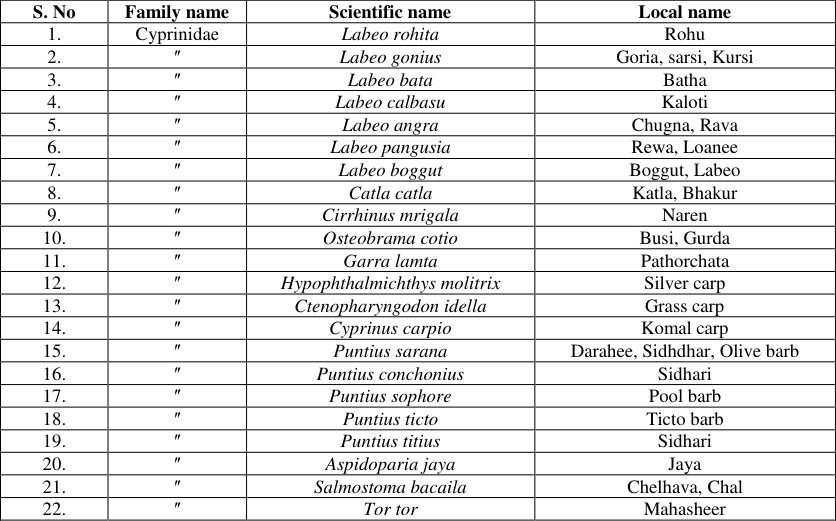 Table 1
Introduction
Fishes are important components of aquatic ecosystem and also have a great economical importance. Fish constitutes almost half of the total number of vertebrates in the world. They live in almost all conceivable aquatic habitats. Fishes exhibit enormous diversity of size, shape. Dams and reservoirs are the major source inland fisheries resources in India. Human activities have a great impact on the decline of inland fish diversity. Fish diversity conservation is a very complex process and need a constant view on their status. Various scientific studies have been made on Ichthyofaunal diversity of various freshwater bodies in India during the last few decades (Jayaram 1981, Jhingran 1983, Dutta et al., 2001, Mishra et al., 2003) [9,2,11,3] . Cyprinidae fishes are the most important group of vertebrates, it have a vast variety of fish species. Cyprinidae family forms the important form of diet in many area of our country (Rafique 2000) [4] . Hence in the present study an attempt has been made up to understand the current status and diversity of fishes belongs to Cyprinidae family in Gopi Krishna Sagar Dam, Guna (Madhya Pradesh).
Materials and Methods
Gopi Krishna Sagar Dam is constructed on river Chopan. It is situated near Ruthyai village at 24.5478ºN and 77.2320ºE latitude and longitude in Guna district, Madhya Pradesh. Field work was conducted for two years from October 2018 to September 2020. Three stations for study were selected at Gopi Krishna Sagar Dam. Station SI-Paanj (Centre line of dam) Station SII-Dhay Station SIII-Bajrangarh. Seasonal variation of water was noted which were correlated to diversity of fishes.
Collection of fishes
Fish samples collection was done with the help of local fisher man. Fish samples were collected during each month at all three stations Drag net, caste net and hooks were used in collecting sample. Fishes were preserved in 10 percent formaldehyde solution and labeled on the spot with specimen serial number, date, local name and name of the collected station. Photographs were taken. Specimens were identified on the basis of morphometric and merimetric characters (Jayaram 1999, Day 1958, Talwar and Jhingaran, 1991) [10,1,6] .
Results and Discussions
In present investigation fishes were identified and 44 species were recorded during our study period of October 2018 to September 2020 at three stations. All species belonged to 14 families, 8 orders and 27 genera were identified. Twenty two species belonged to Cyprinidae family. The geographical conditions and physico-chemical parameters mostly are in favour of developing Cyprinidae family fishes.
ʺ Tor tor Mahasheer
The results showed that the overall highest percentage of Cyprinidae family is 50%. It contains 22 fish species.
Comparative studies of three stations reveals that station S2 Dhay have a maximum number of diversity. The maximum number of fishes found is Salmostoma bacaila followed by Catla catla > Labeo gonius > Labeo calbasu > Labeo bata.
The least was Labeo boggut > Aspidoparia jaya and Tor tor were recorded. Cyprinidae has been described as the most specious containing family (Rafique 2000) [4] . Study on Barchar Dam, Sidhi (M.P.) revealed that Cyprinidae (carps) were the dominant fish and catla was a major contributor among carps (Bunkar and Tiwari 2017) [7] . Similarly in a study conducted on the Harsi reservoir shows that Cyprinidae was the most abundant family with 25 representative species (49.02%) occurring in the study site (Shrotriy 2015) [5] .
Conclusion
Fish production plays a significant role in the human economy. India has vast potential for the development of inland fisheries. In the present study on Gopi Krishna Sagar Dam, it has been concluded that the Cyprinidae family (50%) was found to be most dominant among all groups. It contains 22 fish species. Water of the Gopi Krishna Sagar dam is suitable for the development of Cyprinidae family of fishes. Besides this illegal fishing during monsoon season was found. There should be rigorous implementation of the ban and heavy fines should be imposed on the defaulters.
Figures and tables from the paper
| S. No | Family name | Scientific name | Local name |
|---|---|---|---|
| 1. | Cyprinidae | Labeo rohita | Rohu |
| 2. | ʺ | Labeo gonius | Goria, sarsi, Kursi |
| 3. | ʺ | Labeo bata | Batha |
| 4. | ʺ | Labeo calbasu | Kaloti |
| 5. | ʺ | Labeo angra | Chugna, Rava |
| 6. | ʺ | Labeo pangusia | Rewa, Loanee |
| 7. | ʺ | Labeo boggut | Boggut, Labeo |
| 8. | ʺ | Catla catla | Katla, Bhakur |
| 9. | ʺ | Cirrhinus mrigala | Naren |
| 10. | ʺ | Osteobrama cotio | Busi, Gurda |
| 11. | ʺ | Garra lamta | Pathorchata |
| 12. | ʺ | Hypophthalmichthys molitrix | Silver carp |
| 13. | ʺ | Ctenopharyngodon idella | Grass carp |
| 14. | ʺ | Cyprinus carpio | Komal carp |
| 15. | ʺ | Puntius sarana | Darahee, Sidhdhar, Olive barb |
| 16. | ʺ | Puntius conchonius | Sidhari |
| 17. | ʺ | Puntius sophore | Pool barb |
| 18. | ʺ | Puntius ticto | Ticto barb |
| 19. | ʺ | Puntius titius | Sidhari |
| 20. | ʺ | Aspidoparia jaya | Jaya |
| 21. | ʺ | Salmostoma bacaila | Chelhava, Chal |
| 22. | ʺ | Tor tor | Mahasheer |
Table text extracted from the original PDF; superscript letters are shown inline. The original table image is below.
View original table image
References
5 in the original paper- Mishra S, Pradham P, Kar S, Chakraborthy SK. Ichthyofauna diversity of Midnapore, Bankura and Hooghly districts of South West Bengal. Records of the Zoological Survey of India OCC Paper. 2003;2220:166.
- Rafique M. Fish diversity and distribution in Indus River and its drainage system. Pakistan Journal of Zoology. 2000;32(4);321-332.
- Shrotriy VP. Biodiversity and conservation assessment of freshwater fishes of Harsi Reservoir, Madhya Pradesh, India. International Journal of Life sciences. 2015;3(1):27-35.
- Bunkar SK, Tiwari AK. Studies on fish productivity in Barchar dam, Sidhi (M.P.). International Journal of Fisheries and Aquatic Studies. 2017;5(2):01-04.
- Dutta S, Shimpalee S, Van Zee JW. Numerical prediction of mass exchange between cathode and anode channels in a PEM fuel cell. International Journal of Heat and Mass Transfer. 2001 Jan 1;44(11):20292042.