
Research article · 2022 · Full text
International Journal of Agriculture and Food ScienceEffect of genotypes under varying fertility levels and bio-fertilizer inoculation on productivity and profitability of mustard [Brassica juncea (L.) Czern and Coss.]
Volume 4(2) · Pages 141–144 · DOI: 10.33545/2664844x.2022.v4.i2b.113 ↗
Research areasNitrogen and Sulfur Effects on BrassicaAgricultural Science and FertilizationPlant Micronutrient Interactions and Effects
Abstract
Author-writtenA field experiment “Effect of Genotypes under Varying Fertility Levels and Bio-fertilizer Inoculation on Yield, Yield Attributes and Economics of Mustard {Brassica juncea (L.) Czern & Coss.}’’ was carried out at Instructional Farm of Agronomy, Rajasthan College of Agriculture, Udaipur, Rajasthan during rabi season of 2020-2021 in factorial randomized design (RBD). However, the treatment comprised of four genotypes i.e. Bio-902 (V1), Giriraj (V2), RH-0749 (V3) and NRCHB-101 (V4) and four fertility levels i.e. 75% RDF (F1), 100% RDF (F2), 75% RDF + Bio-fertilizer (F3) and 100% RDF + Bio-fertilizer (F4). Results clearly revealed that the entire yield, yield attributes and ultimately on economics were immensely influenced by genotypes and fertility levels. Yield and yield attributes i.e. seed, straw, biological, harvest index, primary, secondary, tertiary branches/plant, siliqua/plant, seed/siliqua and 1000 seed weight were increased with increasing the fertility levels. In among genotypes, Giriraj (V2) recorded significantly higher value of yield component i.e. seed, straw, biological, harvest index and yield attributes i.e. siliqua/plant and seed/siliqua. Further primary branches, tertiary branches and 1000 seed weight which were statistically at par with NRCHB-101(V4), Bio-902 (V1) and NRCHB-101(V4), respectively and significantly superior to RH-0749.Among the various fertility levels maximum yield and yield attributes were significantly obtained under 100% RDF+ Bio-fertilizer (F4) which was superior over rest of the treatments. However, significantly higher values of all the yield attributes and yield of mustard crop were observed with genotypes ‘Giriraj’ followed by NRCHB-101, Bio-902 and RH-0749 and fertility level 100% RDF + Bio-fertilizer as compare to other treatments. Relative economic analysis for crop cultivation indicated that the maximum gross return (₹/ha103762, 97238), net return (₹/ha83347, 77148) and benefit: cost ratio (4.09, 3.84) was found with Indian mustard variety ‘Giriraj’ with application of 100% RDF+ Bio-fertilizer.
Summary
Source-checkedPlain-language reading of the full paper, prepared with AI and checked against the text. Each point links to the authors' own words.
Why it matters
- Indian mustard is the second most significant edible oil seed crop, following soybean. View evidence ↗
- In India, rapeseed-mustard covers 6.23 million hectares, producing 9.34 million tonnes with a productivity of 1499 kg/ha. View evidence ↗
- Bio-fertilizers are used to improve soil properties and reduce environmental pollution in soil and water. View evidence ↗
The question
- The study aimed to evaluate how different genotypes, fertility levels, and bio-fertilizer inoculation affect the yield, yield attributes, and economics of mustard. View evidence ↗
What they did
- The experiment was conducted during the 2020-2021 rabi season at the Rajasthan College of Agriculture in Udaipur using a factorial randomized block design. View evidence ↗
- The study tested four genotypes (Bio-902, Giriraj, RH-0749, and NRCHB-101) across four fertility levels (75% RDF, 100% RDF, 75% RDF + Bio-fertilizer, and 100% RDF + Bio-fertilizer). View evidence ↗
What they found
- The 'Giriraj' genotype showed significantly higher yield attributes, including primary branches (5.61), secondary branches (10.88), tertiary branches (3.35), siliqua per plant (334.74), seeds per siliqua (15.01), and 1000 seed weight (5.64). View evidence ↗
- The 100% RDF + Bio-fertilizer treatment produced the highest yield attributes, such as 6.15 primary branches and 341.61 siliqua per plant. View evidence ↗
- The 100% RDF + Bio-fertilizer level resulted in the highest seed yield (1694 kg/ha), significantly outperforming the 75% RDF level (1258 kg/ha). View evidence ↗
- The 'Giriraj' genotype achieved the highest economic returns, with a gross return of 103,762 ₹/ha, a net return of 83,347 ₹/ha, and a B:C ratio of 4.09. View evidence ↗
- The 100% RDF + Bio-fertilizer treatment provided the best economic results among fertility levels, with a net return of 77,148 ₹/ha and a B:C ratio of 3.84. View evidence ↗
What it means
- The authors conclude that using the 'Giriraj' genotype combined with 100% RDF and bio-fertilizer is the most economically viable option for mustard crops in Rajasthan's agro-climatic conditions. View evidence ↗
Visual summary
2 visualsIllustrations explain the paper; charts are replotted from the paper's own table values.
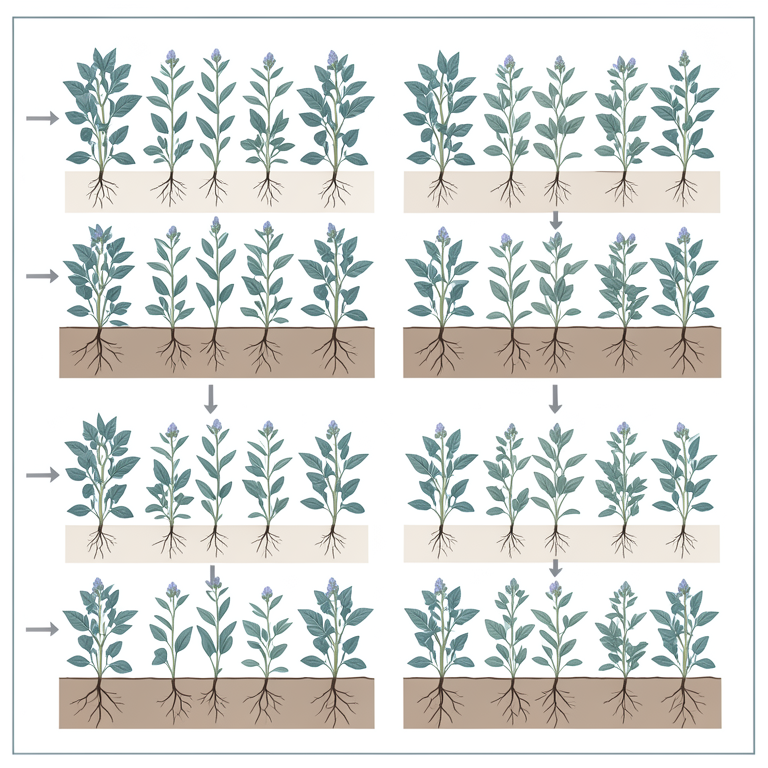
Experimental Factorial Design
AI-generated conceptual illustration (mustard plants (Brassica juncea)). It explains the idea and does not show study data.
View source evidence ↗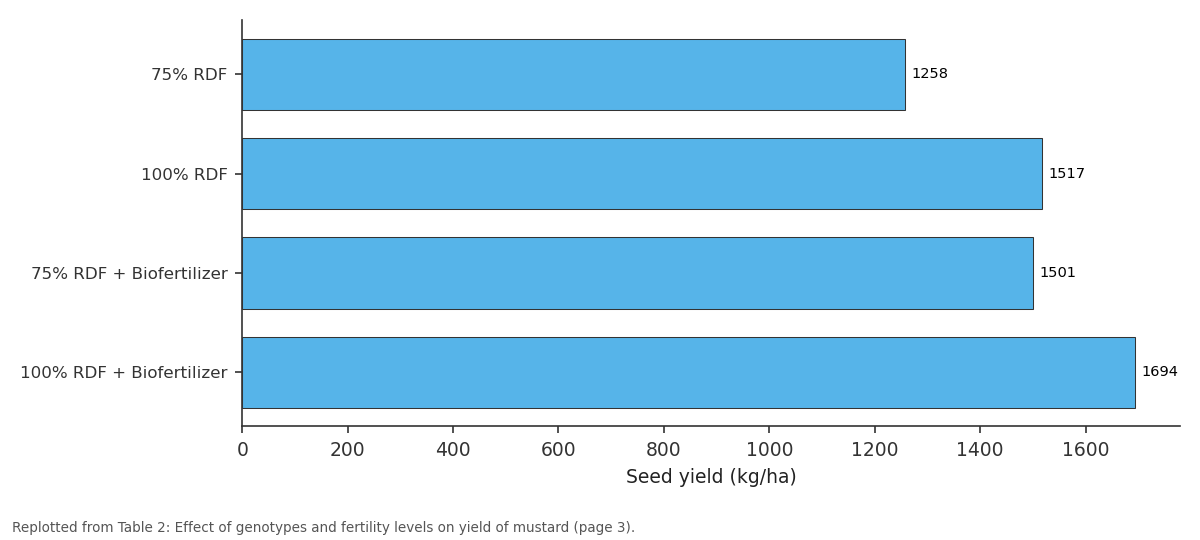
Seed yield (kg/ ha): 75% RDF vs 100% RDF vs 75% RDF + Biofertilizer vs 100% RDF + Biofertilizer
Replotted from Table 2 (page 3) of the original paper. Every bar is the paper's own table value.
View source evidence ↗Figures & tables
From the original paper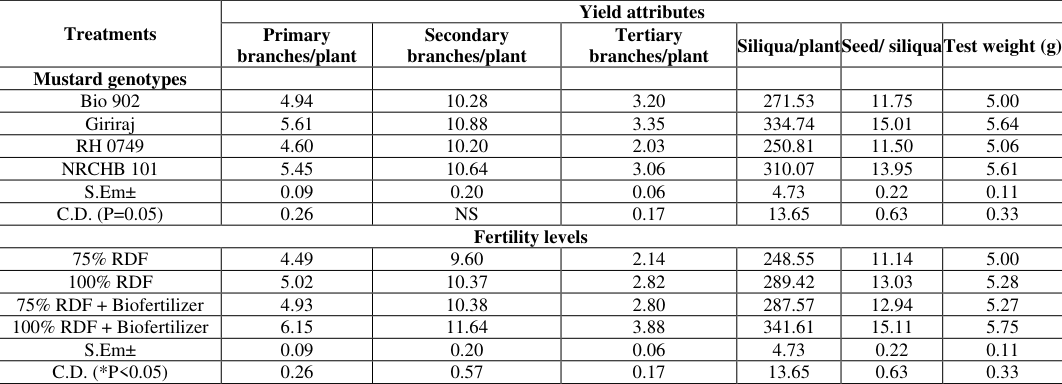 Table 1
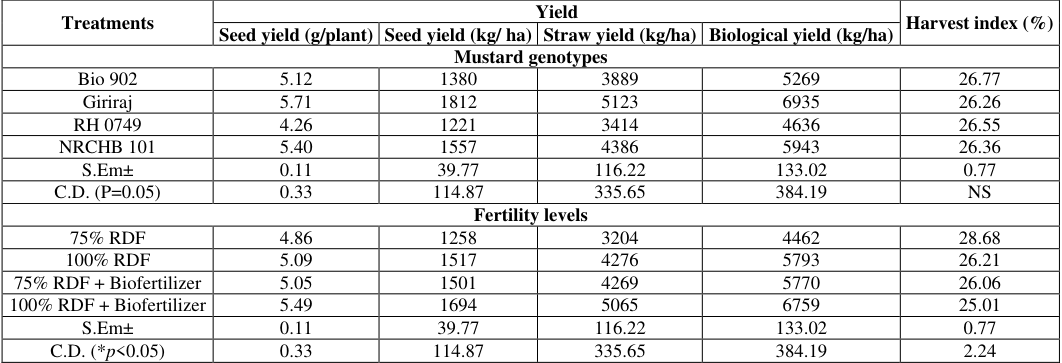 Table 2
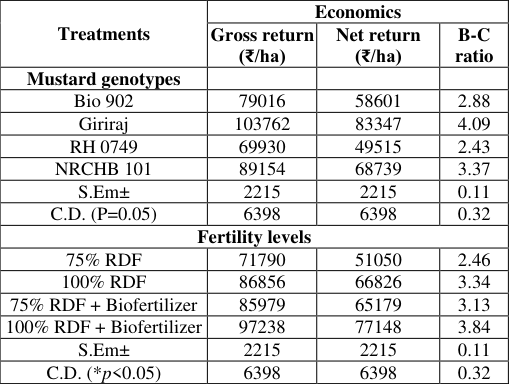 Table 3
Introduction
Mustard is second most important edible oil seed crop after soybean and known by the name of Indian mustard, belongs to the family Brassiceae (Cruciferae), genus Brassica and species juncea. Rapeseed is locally known as Sarson, Toria, Yellow Toria while mustard is named Bharatpur and Eastern districts are contributing about 48 per cent of the total production of the state. Sulphur is an important element for synthesis of oil content in seeds and nitrogen is increase the mustard productivity and effect of fertility levels on seed and straw yield showed that application of 100% RDF found significantly higher seed and straw yield as compared to other treatments. Nitrogen is an integral component of amino and nucleic acids, proteins, nucleotides, chlorophyll, chromosomes, genes, ribosomes and also a constituent of all enzymes. Phosphorus is a constituent of several essential cell components like nucleotides, nucleic acids and phospholipids which promotes root development of the crop. Bio-fertilizers play an important role in the improvement of soil biological, physical and chemical properties. The use of bio fertilizers is also important to reduce the pollution rate in the soil and water. It plays vital role in integrated plant nutrient supply. PSB alone also have prominent effect due to that phosphorus helped in proliferation of root system. Azotobacter is non-symbiotic nitrogen fixing bio fertilizer having potential to fix considerable quantities of atmospheric nitrogen in the rhizosphere of non-legumes.
Materials and Methods
Materials and Methods
Study site
A field investigation was performed in mustard during rabi season during 2020-2021 at the Instructional Farm of Agronomy, Rajasthan College of Agriculture, Udaipur. The region falls under NARP agro-climatic zone IV a (Sub-Humid Southern Plain and Aravalli Hills) of Rajasthan, India. The site is situated at South-Eastern part of Rajasthan at an altitude of 581.13 m above mean sea level, 24°35' N latitude and 73°42' E longitude. The average rainfall of the region is 627.8 mm, most of which is mainly contributed by south west monsoon from June to September. The textural classes of the experimental soil was a clay loam in texture and slightly alkaline in reaction (pH 7.9), calcareous in nature and poor in organic carbon (0.69%). The total available N, P 2 O 5 and K 2 O were 282.3, 21.5 and 294.7 kg/ha, respectively.
Methods of data collection
The treatments were laid out in Factorial Randomized Block Design with three replications. The experiment consisted of four genotypes i.e. Bio-902, Giriraj, RH-0749 and NRCHB-101 and different fertility levels i.e. 75% RDF, 100% RDF, 75% RDF + Bio-fertilizer and 100% RDF + Bio-fertilizer. However, the recommended dose of fertilizer was applied as per treatment needs through Urea, DAP. Half dose of nitrogen and full dose phosphorus with Bio-fertilizer (PSB and Azotobactor) was applied at the time of sowing and remaining half dose of nitrogen was applied in two equal splits at branching and flowering. Mustard crop were raised with the seed rate of 5.0 kg/ha with the spacing of 30 cm x10 cm. Sowing of seeds was done by hand broadcasting method with furrow and cover the soil to ensure moisture loss through evaporation. Plant geometry were maintained by doing thinning and weeding operation at 15 DAS and 25 DAS respectively. Hence, all the other cultural operations were carried out as per the treatment needs. However, two irrigations were given at peak vegetative stage and pod filling stage to maintain optimum soil moisture for better growth & development of mustard and one last irrigation at maturity stage. Finally, plant protection measures were also done to protect the crop from mustard aphid with the application of spray of Imidacloprid 17.8% at 60 DAS at pod formation stage.
Results and Discussion Effect on yield attributes
The higher value of yield attributes i.e. primary, secondary, tertiary branches, Siliqua plant -1 Seeds siliqua -1 and 1000 seed weight were recorded significantly higher under the genotype 'Giriraj' (5.61, 10.88, 3.35 1). But primary branches, tertiary branches and 1000 seed weight which were statistically at par with NRCHB-101, Bio-902 and NRCHB-101 respectively. The magnitude increased in respect of seed siliqua -1 in Giriraj was 27.74, 30.52 and 7.5 per cent, respectively. Enhancement of yield attributes might be due to the differential genetic potential of the genotypes which showed greater photosynthetic efficiency and it translocation to growing points which results faster growth and development. Our results are similarly found with Pachauri et al. (2012) [16] . Among the fertility levels the maximum yield attributes i.e. primary, secondary, tertiary branches, Siliqua/plant, seed/siliqua and 1000 seed weight (6.15, 11.64, 3.88, 341.61, 15.11 and 5.75) are obtained under 100% RDF+ Bio-fertilizer which were significantly higher over, 100% RDF, 75% RDF + Bio-fertilizer and 75% RDF. The increase in the siliqua/plant may be due to increase in branches under higher level of nitrogen and phosphorus application. With the application of higher level of fertilizers, the tissue differentiation from somatic to reproductive, meristematic activity and development of floral primordia. Higher fertility levels induced greater translocation of photosynthates from leaves to sink site. This resulted in bigger siliqua with higher seeds which on maturity become bold with highest test weight. This result is in accordance with the findings of Prem and Kumar, (2004) [11] .
Effect on yields
The maximum seed, straw and biological yield were significantly observed under genotype 'Giriraj' compare to other genotypes. Genotype 'Giriraj' recorded seed yield1812 kg/ha followed byNRCHB-101 (1557kg/ha), Bio-902 (1380 kg/ha) (Table 2). The minimum seed yield was recorded with genotype 'RH-0749' (1221 kg/ha). Genotype 'Giriraj' was enhanced seed yield by means of 31.30, 48.31 and 16.36 per cent, respectively. The maximum straw and biological yield were also significantly obtained under genotype 'Giriraj' (5123 kg/ha and 6935 kg/ha). The magnitude of increased by means of 31.74, 50.05 and 16.81 per cent in straw yield and 31.62, 49.59 and 16.69 per cent in biological yield over Bio-902 (3889 kg/ha and 5269kg/ha), RH-0749 (3414 kg/ha and 4636 kg/ha) and NRCHB 101 (4386 kg/ha and 5943 kg/ha), respectively. Yield variations amongst mustard genotypes might be due to different genetic makeup Solanki et al., 2015. Higher seed and straw yield of 'Giriraj' genotype due to this aggressive growth attributes, better source and sink relationship which ultimately results in high yield. Our results are closely similar with findings of Kumar et al. (2000) [9] . Fertility levels were influenced on seed, straw and biological yield. The maximum seed, straw and biological yield were significantly observed under 100% RDF+ Biofertilizer compare to other fertility levels. 100% RDF+ Biofertilizer observed 1694 kg/ha followed by 100% RDF (1517), 75% RDF + Bio-fertilizer kg/ha (1501 kg/ha). The minimum seed yield was recorded with 75% RDF (1258 kg/ha). The magnitude increase of seed yield by means of 34.60, 11.68 and 12.86 per cent, respectively. The maximum straw and biological yield were also significantly obtained under 100% RDF+ Bio-fertilizer (5065 kg/ha and 6759 kg/ha). 100% RDF+ Bio-fertilizer (5065 kg/ha and 6759 kg/ha) was enhanced straw yield and biological yield by means of 57.17, 18.45 and 18.64 per cent and 51.45, 16.67 and 17.14 per cent, respectively over 100% RDF (4276 kg/ha and 5793 kg/ha) and 75% RDF + Bio-fertilizer (4269 kg/ha and 5770 kg/ha) and 75% RDF (3204 kg/ha and kg/ha 4462). Application of 100% RDF + Bio-fertilizer increase in overall yield might be due to tissue differentiation from somatic to reproductive, meristematic activity and development of floral primordial. Higher fertility levels induced greater translocation of photosynthates from leaves to sink site accordance with the findings of Bhari et al. (2016) [1] and Prem and Kumar. ( 2004) [11] . Similarly, results are found nitrogen application showed substantial increase in seed and straw yield of mustard by Singh and Verma, (2007) [12] . The balanced fertilization of mustard crop may be responsible to the effect of N on root proliferation, energy transformation and metabolic activities of the plant, which in term resulted in greater translocation of photosynthates towards the sink development finely yield increased Dongarkar et al. (2005) [14] .
| Treatments | Yield | — | — | — | Harvest index (%) |
|---|---|---|---|---|---|
| Seed yield (g/plant) | Seed yield (kg/ ha) | Straw yield (kg/ha) | Biological yield (kg/ha) | ||
| Mustard genotypes | |||||
| Bio 902 | 5.12 | 1380 | 3889 | 5269 | 26.77 |
| Giriraj | 5.71 | 1812 | 5123 | 6935 | 26.26 |
| RH 0749 | 4.26 | 1221 | 3414 | 4636 | 26.55 |
| NRCHB 101 | 5.40 | 1557 | 4386 | 5943 | 26.36 |
| S.Em± | 0.11 | 39.77 | 116.22 | 133.02 | 0.77 |
| C.D. (P=0.05) | 0.33 | 114.87 | 335.65 | 384.19 | NS |
| Fertility levels | |||||
| 75% RDF | 4.86 | 1258 | 3204 | 4462 | 28.68 |
| 100% RDF | 5.09 | 1517 | 4276 | 5793 | 26.21 |
| 75% RDF + Biofertilizer | 5.05 | 1501 | 4269 | 5770 | 26.06 |
| 100% RDF + Biofertilizer | 5.49 | 1694 | 5065 | 6759 | 25.01 |
| S.Em± | 0.11 | 39.77 | 116.22 | 133.02 | 0.77 |
| C.D. (*p<0.05) | 0.33 | 114.87 | 335.65 | 384.19 | 2.24 |
Table text extracted from the original PDF; superscript letters are shown inline. The original table image is below.
View original table image
Effect on profitability
The maximum gross return, net return and B:C (103762 ₹ /ha, 83347 ₹/ha and 4.09) were obtained under genotype 'Giriraj' which was significantly higher over NRCHB-101 (89154 ₹/ha 68739 ₹/ha and 3.37), Bio-902 (79016 ₹/ha, 58601 ₹/ha and 2.88) and RH-0749 (69930 ₹/ha,49515 and 2.43) (Table 3). Increment in economics due to increased seed and biological yield of mustard. Fertility levels influenced on profitability with different level of fertilizer. The maximum gross return, net return and B:C (97238 ₹/ha, 77148 ₹/ha,3.84) were observed under 100% RDF + Bio-fertilizer which was significantly higher over 100% RDF (86856 ₹/ha 66826 ₹/ha and 3.34), 75% RDF + Bio-fertilizer (85979 ₹/ha 65179 ₹/ha and 3.13) and 75% RDF (71790 ₹/ha 51050 ₹/ha and 2.46). The increment in economics might be due to application of phosphorus and potassium found higher monetary returns with increasing fertility levels as comparatively lower fertility. The similar results observed by Daulagupu and Thakuria (2016) [4] and Jat et al. (2017) [8] .
| Treatments | Economics | — | — |
|---|---|---|---|
| Gross return (₹/ha) | Net return (₹/ha) | B-C ratio | |
| Mustard genotypes | |||
| Bio 902 | 79016 | 58601 | 2.88 |
| Giriraj | 103762 | 83347 | 4.09 |
| RH 0749 | 69930 | 49515 | 2.43 |
| NRCHB 101 | 89154 | 68739 | 3.37 |
| S.Em± | 2215 | 2215 | 0.11 |
| C.D. (P=0.05) | 6398 | 6398 | 0.32 |
| Fertility levels | |||
| 75% RDF | 71790 | 51050 | 2.46 |
| 100% RDF | 86856 | 66826 | 3.34 |
| 75% RDF + Biofertilizer | 85979 | 65179 | 3.13 |
| 100% RDF + Biofertilizer | 97238 | 77148 | 3.84 |
| S.Em± | 2215 | 2215 | 0.11 |
| C.D. (*p<0.05) | 6398 | 6398 | 0.32 |
Table text extracted from the original PDF; superscript letters are shown inline. The original table image is below.
View original table image
Figures and tables from the paper
| Treatments | Yield attributes | — | — | — | — | — |
|---|---|---|---|---|---|---|
| Primary branches/plant | Secondary branches/plant | Tertiary branches/plant | Siliqua/plant | Seed/ siliqua | Test weight (g) | |
| Mustard genotypes | ||||||
| Bio 902 | 4.94 | 10.28 | 3.20 | 271.53 | 11.75 | 5.00 |
| Giriraj | 5.61 | 10.88 | 3.35 | 334.74 | 15.01 | 5.64 |
| RH 0749 | 4.60 | 10.20 | 2.03 | 250.81 | 11.50 | 5.06 |
| NRCHB 101 | 5.45 | 10.64 | 3.06 | 310.07 | 13.95 | 5.61 |
| S.Em± | 0.09 | 0.20 | 0.06 | 4.73 | 0.22 | 0.11 |
| C.D. (P=0.05) | 0.26 | NS | 0.17 | 13.65 | 0.63 | 0.33 |
| Fertility levels | ||||||
| 75% RDF | 4.49 | 9.60 | 2.14 | 248.55 | 11.14 | 5.00 |
| 100% RDF | 5.02 | 10.37 | 2.82 | 289.42 | 13.03 | 5.28 |
| 75% RDF + Biofertilizer | 4.93 | 10.38 | 2.80 | 287.57 | 12.94 | 5.27 |
| 100% RDF + Biofertilizer | 6.15 | 11.64 | 3.88 | 341.61 | 15.11 | 5.75 |
| S.Em± | 0.09 | 0.20 | 0.06 | 4.73 | 0.22 | 0.11 |
| C.D. (*P<0.05) | 0.26 | 0.57 | 0.17 | 13.65 | 0.63 | 0.33 |
Table text extracted from the original PDF; superscript letters are shown inline. The original table image is below.
View original table image
References
14 in the original paper- Bhari NR, Siaz RK, Mann PS. Response of Indian mustard (Brassica juncea L.) to nitrogen and phosphorus on Torripsamments of North Western Rajasthan. Indian Journal of Agronomy. 2000;45(4):746-751.
- Brar SA, Sindhu SP, Dhillon SG. Response of brown sarson (Brassica campestris var. brown sarson) to integrated nutrient management in mid hill conditions of Himachal Pradesh. International Journal of Agricultural Sciences. 2016;11(2):319-325.
- Yadav SK, Singh RB, Trivedi H, Singh R. Studies on insect-pests complex in mustard (Brassica juncea L.). Int. J Biol. Sci. 2022;4(1):106-109. DOI: 10.33545/26649926.2022.v4.i1b.96
- Daulagupu K, Thakuria K. Effect of planting geometry and fertilizer levels on yellow sarson (Brassica rapa var. trilocularis) under rainfed condition. Journal of Oilseed Brassica. 2016;7(2):169-173.
- Sukhadia V. Photo catalytic degradation of copper surfactant. Int. J Adv. Chem. Res. 2020;2(2):53-55. DOI: 10.33545/26646781.2020.v2.i2a.63
- Jat AL, Prajapati KP, Patel BK, Patel PJ, Patel JR, Shah SK. Influence of N, P, and K levels on performance of Indian mustard (Brassica juncea L.). International Journal of Current Microbiology and Applied Science. 2017;6(9):1986-1990.
- Kumar R, Singh D, Singh H. Growth and yield of Brassica species as influenced by sulphur application and sowing dates. Indian Journal of Agronomy. 2000;47(3):417-421.
- Pandey H, Shukla RK, Pandey TD, Raj S. Effect of different rates of nitrogen and sulphur on growth attributes in Indian mustard. (Brassica juncea L.). Int. J. Agric. Nutr. 2020;2(2):32-34. DOI: 10.33545/26646064.2020.v2.i2a.36
- Prem OP, Kumar M. Response of Indian mustard to different levels of nitrogen and phosphorus under rainfed condition. Indian Journal of Agronomy. 2004;38(1):47-48.
- Singh D, Verma BS. Effect of different source of sulphur on the yield of Indian mustard (Brassica juncea) in Pearl Millet -Mustard cropping system. Annals of Biology. 2007;23(1):17-18.
- Solanki RL, Mahendra S, Sharma SK, Purohit HS, Arvind V. Effect of different level of phosphorus, sulphur and PSB on the yield of Indian mustard (Brassica juncea L.) and soil properties and available macronutrients. Scholarly Journal of Agricultural Sciences. 2015;5(9):305-310.
- Dongarkar KP, Pawar WS, Khawale VS, Khutate NG, Gudadhe NN. Effect of nitrogen and sulphur on growth and yield of mustard (Brassica juncea L.). Journal of Soils and Crops. 2005;15:163-67.
- Budzynski W, Jankowski K. Effect of fertilization with sulphur, magnesium and nitrogen on the growth and yield of white and Indian mustard seeds. RoslinyOleiste. Uniwersytet Mazurski, Olszynie, Poland. 2019;22(1):45-58.
- Pachauri RK, Trivedi SK, Yogendra K. Effect of sulphur levels on growth, yield and quality of Indian mustard genotypes and their economics. Journal of Soils and Crops. 2012;22(2):258-263.