
Research article · 2022 · Full text
International Journal of Veterinary Sciences and Animal HusbandryA Literature on the development of livestock Industries: A perspective of madurese cattle farmers
Volume 7(6) · Pages 17–20 · DOI: 10.22271/veterinary.2022.v7.i6a.448 ↗
Research areasLivestock Farming and Management
Abstract
Author-writtenLivestock business in Indonesia is dominated by small-scale livestock industries. Animal husbandry is not something that is rarely done. It is just that the scale of management is still a sideline that is not balanced with adequate capital and management. We know that beef cattle breeding business is an effort to obtain quality seeds for the provision of beef cattle that will be used as a source of human consumption. Of course, the development of this business requires coordination and synergistic cooperation between the government, relevant stakeholders, and the community/breeders. Therefore, this current study is to offer comprehensive discussion about cattle development strategy in supporting regional cattle farmers. This study analyses this topical issue from a perspective of Madurese cattle farmers.
Summary
Source-checkedPlain-language reading of the full paper, prepared with AI and checked against the text. Each point links to the authors' own words.
Why it matters
- Indonesia faces a growing demand for beef that exceeds domestic production, leading to an increased reliance on meat imports. View evidence ↗
- In East Java, the beef cattle population has declined since the 1997 monetary crisis, partly due to the increased slaughter of productive female cattle. View evidence ↗
- The Indonesian livestock industry is primarily composed of small-scale operations often managed as side businesses lacking sufficient capital and management. View evidence ↗
The question
- The study aims to provide a comprehensive discussion on cattle development strategies to support regional farmers, specifically from the perspective of Madurese cattle farmers. View evidence ↗
What they did
- The analysis focuses specifically on the fattening processes associated with Madurese cattle. View evidence ↗
- The study notes that 95% of beef cattle breeding is managed on small-scale community farms using parent-child production patterns. View evidence ↗
What they found
- Madurese cattle contribute significantly to the region, providing up to 24% of the beef cattle needs for East Java. View evidence ↗
- The cattle population on Madura Island grew from 787,424 heads in 2012 to 806,608 heads. View evidence ↗
- Madurese cattle are local hybrids (crosses with Bos indicus) that are genetically resistant to diseases and tolerant of marginal environments and hot climates. View evidence ↗
- Integrated agriculture creates a 'zero-waste' pattern where livestock waste serves as fertilizer and agricultural waste serves as animal feed. View evidence ↗
- Haymaking technology is used to preserve forage by reducing moisture until the dry matter content reaches 80-85%. View evidence ↗
- In the dry lot fattening system, the ratio of forage to concentrate (by dry matter weight) typically ranges from 40:60 to 20:80. View evidence ↗
- Ideal group cage systems for cattle should house 5-10 heads in 10-20 m2, with at least 10 m between cages and 25 m between cages and waste shelters. View evidence ↗
What it means
- Madurese beef is highly valued by the public and remains in high demand in the market. View evidence ↗
- The success of Madurese cattle production is attributed to the combination of traditional practices and technological advancements. View evidence ↗
Visual summary
1 visualsIllustrations explain the paper; they do not show study data.
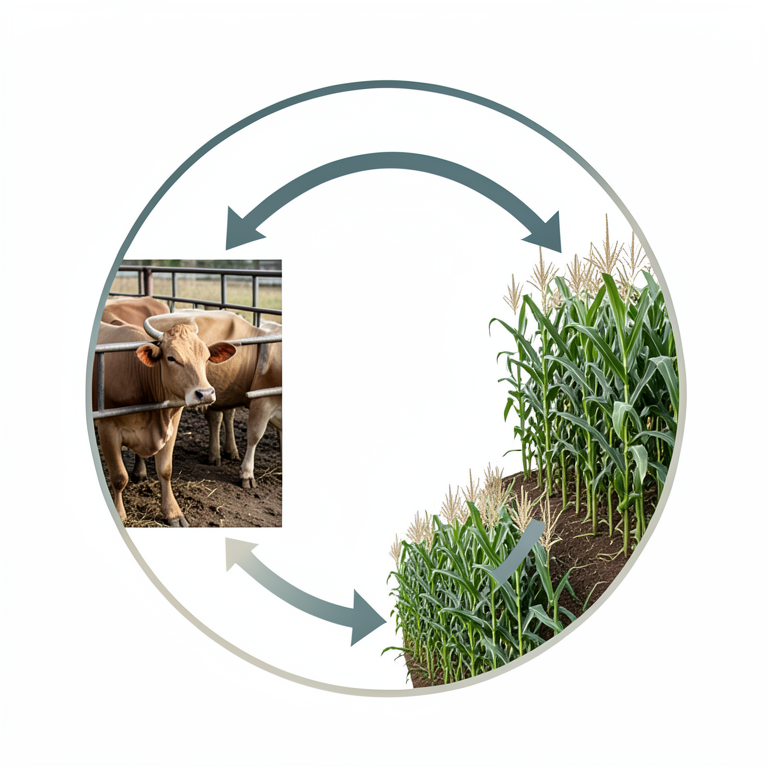
Zero-Waste Integrated Agriculture Cycle
AI-generated conceptual illustration (Madurese cattle and corn crops). It explains the idea and does not show study data.
View source evidence ↗Introduction
The need for beef in Indonesia tends to increase, but the rate of increase in domestic production is slower than the demand, so that Indonesians have to import meat in increasing quantities. Since 1997, the beginning of the monetary crisis, the development of the beef cattle population in East Java Province has experienced a decline, resulting in an increase in the rate of slaughter of productive female cattle and if it is not balanced with an increase in the productivity of the cattle, there will be a drain on the population and other consequences that are unfavorable for the development of livestock in East Java. The fulfillment of meat needs in East Java province is carried out by including beef cattle from outside East Java Province. As we know, the livestock sector is a sector that contributes high in agricultural development. This sector has an excellent market opportunity, where the domestic market will continue to increase along with the rapid growth of the population. The increasing income of the population, the demand for livestock products will increase. This is due to the increase in a person's income, the consumption of carbohydrate sources will decrease and the consumption of various kinds of foods rich in protein will increase. The livestock subsector has an important role in supporting the regional and national economy. This livestock problem cannot be numbered because it will be dominant in determining the survival of a country or nation. To achieve the program to accelerate the achievement of beef self-sufficiency, one of the efforts that can be done is to carry out practice and total assistance to livestock farmer groups regarding technological innovations and institutional management of cattle rearing in an integrated manner. The national meat self-sufficiency program is basically an activity of increasing the domestic livestock population, especially cattle, so that it can eventually meet the national consumption of meat. The success of the program will have implications for decreasing the percentage of cattle imports (either live cattle or frozen meat), so that in the future it will slowly reach the stage of self-sufficiency. Currently, Indonesia is still dependent on imports to meet the need for beef.
The dependence on imports of meat and beef cattle, among others, is due to the inability to meet the needs of meat demand from local beef slaughter caused by the increasing demand for meat. The fulfillment of beef demand if only met through the slaughter of local cattle, it can result in a drain on the local cattle population, because there is a slaughter of young cattle that are still small in size and for productive heifers. Therefore, a national cattle breeding business program is needed as a source of candidates for fattening cattle. The current conditions of beef cattle breeding are very diverse and most (95 %) are managed and developed on community farms with parent-child production patterns on a small business scale and usually integrated with other agricultural businesses. Investors have almost no interest in developing a cow-calf operation business, because a large business capital is required, while high credit interest, complicated marketing chains, transportation facilities and land ownership are limited. Because the role of community farms in the provision of beef cattle seeds is very dominant in the livestock agribusiness system, it is necessary to innovate management based on the Taruna Tani Group. Management of beef cattle breeding based on livestock farming groups, is expected to increase the productivity, efficiency and economic value of the business which in turn can increase the income of members. This effort is directed to the formation of groups of breeders, cooperation between groups so that productive groups are formed that are integrated in one cooperative in the field of animal husbandry. So the purpose of this article is to increase the population and productivity of local livestock to help the government realize the meat self-sufficiency program nationwide. In addition, the purpose of this study is to provide information regarding the potential development of beef cattle in supporting beef self-sufficiency. Because this study focuses on the fattening process of Madurese cows, so the discussion of Madurese cows is very necessary. The discussion will be presented in the following subsection.
Madurese cattle
Madurese cattle are a nation of cows that have a specific meaning because besides being beef cattle, work cattle also function as pleasure cattle, namely as cattle of race and sonok cows for the beauty of body shape. Madura cattle are one of Indonesia's cattle nation that has been selected naturally and maintained authenticity on Madura Island and surrounding small islands. Madura cattle are local hybrid beef cattle native to Indonesia from a cross between a bull and a bos indicus (zebu cow) which is genetically tolerant of hot climates and marginal environments and is resistant to disease attacks. The characteristics of Madurese cows are already very uniform, namely the shape of the body is small, the legs are short and strong, the brick-red fur is slightly yellowish but the abdomen and inner thighs are white with a less pronounced transition. The contribution of Madurese cattle as beef cattle is well developed in East Java, especially on the island of Madura. The contribution of cattle in Madura is quite large up to 24% of the needs of beef cattle from East Java. The Central Statistics Agency of East Java noted that the cattle population in the four districts on the island of Madura every year continues to grow. The results of data collection carried out by the institution showed that the cattle population on Madura Island reached 806,608 heads. This figure has increased compared to 2012 which only reached 787,424 heads with the highest number in the Sumenep Regency area, reaching more than 360,000 heads. Apart from being a beef cow, Madurese cattle are also used as a means of transportation for people in the interior of Madura. Madurese cows of the male sex are used as racing cows in the traditions of the Madurese people. Madurese cattle are not only an asset of Madura but also one of the important assets of national cattle plasma. There are many things that can be developed regarding the great potential of Madura cattle, ranging from breeding, recording, feed management, feed mills, socio-economic, the formation of the Sonok Madura cow community, and to the down streaming of Madura cattle products. Geographically, the Madura Island region is a plain and mountainous area that has the potential for large agricultural land. Technically irrigated land to dry land is a potential to support the development of beef cattle. Such land use shows the availability that this area has a very large potential availability of agricultural waste that can be used for livestock development. Therefore, it is not surprising that the Madura region is a national cattle barn specifically for the Madura Cattle breed. This is what makes the beef cattle development business grow. Thus, it will be able to provide business opportunities and can provide additional income for some people in rural areas who work on it.
Cattle management Development of Livestock and Crop Integration
Sustainable development is the only way to promote the rational use of resources and environmental protection without hindering economic growth and the system of integration of livestock crops (Lovarelli et al., 2020) [5] . It plays a very important role so that nothing is wasted, the products of one system become input for another (Mahmud et al., 2021) [6] . The beef cattle farming business is principally land-based (fodder forage), but the use of land is increasingly competing for various purposes, so in the future its development is directed at an integrated agricultural system between crops and livestock. One of the integration patterns that can be developed is the integration system of crops and cattle. The pattern of integration between crops and livestock or what we often call integrated agriculture, is to combine livestock and agricultural activities. This pattern is very supportive in the provision of manure in agricultural areas, so this pattern is often called a zero-waste livestock pattern because livestock waste is used for fertilizer, and agricultural waste for eating livestock. The integration of animals, livestock and crops is intended to obtain optimal results of effort, and in order to improve the conditions of soil fertility. The integration between livestock and crops must be complementary, supportive and mutually beneficial, so as to encourage increased production efficiency and increase the profits of their farm yields (Muñoz-Ulecia et al., 2021) [ 8] . Basically, integrated farming has been carried out by our farmers. Farmers can use their crop waste (e.g. hay) as animal feed so as to alleviate the provision of feed. In addition, farmers can also use their cattle / buffalo power for processing agricultural land, cattle can also be used as an investment (savings) which at any time can be sold for urgent purposes. This technique is a combination of two commodities that can be developed simultaneously in the same region, each of which needs each other. In addition, the integration system of crops and cattle can also reduce nutrient leakage and improve land conditions (Houessou et al., 2019) [4] .
Provision and Development of Feed Technology and Feed Land
Animal feed has a very important role both from fodder forage and finished feed / concentrates. With the high demand for quality animal feed, it is necessary to develop new technologies and processing techniques to avoid environmental damage or an increase in the price of feed products. Although the need for feed in quantity is increasing, the land for forage fodder available today is decreasing. In this case we offer hay and silage making, which aims to preserve fodder forage as a feed reserve in times of famine. The principle of haymaking is to gradually lower the moisture content of forage but proceed quickly until the dry matter content is 80-85%, but the material remains green and not musty. Silage is animal feed that still has a high water content as a result of preservation through a fermentation process assisted by a mechanical body in anaerobic conditions. The main purpose of making silage is to preserve and reduce the loss of food substances of a forage to be utilized in the future. Fermentation is one of the efforts to increase the benefits of high-fiber feed forage by increasing its digestibility value through biological processing by utilizing microorganisms (Sands & Wall, 2018) [11] . Through the fermentation process, there will be an overhaul of animal feed ingredients from physically, chemically and biologically hard structures of materials from complex structures to simple ones, so that the digestibility of livestock becomes more efficient. The principle of fermentation is the utilization of microbial colonies to help decomposition of feed tissue structures that are difficult to decompose. Urea Multinutrient Molasses Block is a supplement feed in the form of solids composed of nutrient-rich ingredients and forms a balanced nutritional composition (carbohydrates, amino acids, proteins, energy, vitamins and minerals) so that it is beneficial for livestock to complete the food substances needed by the body to produce optimally. This technology is one of the strategies to increase animal feed consumption because it is composed of a combination of nutritious ingredients that can efficiently support the growth, development and activities of microbes efficiently in the rumen. In order for the feed to be safe within a certain period of time with a sufficient amount of supply, a good storage process in the feed shed is needed. Feed storage techniques largely determine the quality of nutrients contained in the feed, whether the storage process is able to maintain the quality of nutrition or even decrease due to contamination with microorganisms. Storage of feed that has been processed or preserved is carried out to maintain the continuity of supply and create buffer stock during feed famine. The presentation of feed in addition to affecting the efficiency of feed use also affects the skin of the feed given, to overcome this is implemented feed bank technology. The feed bank is in the form of a shelf-shaped container that is used to store and serve fiber source feed (dry forage) which is provided in stock. The existence of a feed bank aims to meet the needs of animal feed so that livestock can consume forage throughout the day. So, the implementation of feed forage processing and preservation technology has been able to streamline the use of feed forage in business locations, especially feed ingredients that are hard and difficult to digest both from agricultural waste and local grasses (Pauler et al., 2019) [9] . The efficiency of utilizing local feed potential through the implementation of feed preservation and processing technology is deeply felt by farmers who raise livestock in large quantities and limited labor, especially in the dry season.
Development of Organic Fertilizers and Biogas
Organic farming is based on reducing the use of chemical fertilizers and synthetic pesticides. Reduced chemical fertilizers are usually replaced by the application of organic fertilizers. Organic means that the raw materials for making it are sourced from existing substances and taken from living things. Its use can be directly or through the fermentation or composting process first. Organic farming is the answer to the negative impact of the implementation of the green revolution promoted in the 1960s which caused a reduction in soil fertility and environmental damage due to the excessive use of chemical fertilizers and pesticides. Most organic farming activists choose the ways of making organic fertilizers as an entrance to introduce organic farming. Organic fertilizer as one of the important elements in increasing production and productivity has long been known and utilized by farmers. Besides being able to provide various nutrients for plants, organic fertilizers also play an important role in maintaining the physical, chemical, and biological properties of the soil (Bai et al., 2020) [1] . Along with its development, the opportunity to produce organic fertilizers is wide open because in addition to the abundant and renewable raw materials, this type of fertilizer can be made and produced by various groups including small-to-medium entrepreneurs. The sources of raw materials for organic fertilizers vary greatly, such as from agricultural and non-agricultural wastes with very diverse physical properties and chemical / nutrient content characteristics, so the quality of organic fertilizers produced tends to vary. Therefore, its effect on soil and crop productivity on dry land and paddy fields is also diverse. In practice, the use of organic fertilizer/compost in situ on agricultural land does not require certain supervision and regulation. As for the production of commercial organic fertilizers, it is necessary to supervise and monitor quality standards, in order to avoid the content of heavy metals and other harmful elements. Anticipating the increasing circulation of organic fertilizers in various types, forms and qualities that have not been guaranteed and tested for truth and are feared to be harmful to health and the environment, strict supervision and monitoring of the quality and quality of organic fertilizers is needed. Efforts to develop alternative energy from the government encourage the development of renewable energy, one of the renewable energy developed is biogas. Biogas is another form of biomass gas utilization. Biogas is one of the renewable energy alternatives and is very likely to be decentralized to rural areas, even to homes. The development of beef cattle farming has great potential for the development of renewable energy such as biogas (Wang et al., 2021) [13] . This is evidenced by the waste from cattle farming business has a larger composition than other farms including goats, sheep, poultry. A number of studies have shown that: (1) Cattle farming has great potential in the development of alternative energy, so that in the future it will need to be socialized and developed. The cattle farming business not only produces its main output, namely milk, meat, calves, the waste can also be used to produce biogas and organic fertilizer (compost fertilizer); (2) Biogas is a government program in saving the use of fuel oil, so that the linkage of livestock business in the development of biogas is very large, considering that the potential of this business in the future is very large.
It can be conveyed that bio system integration is a method to connect one bio system with another where the bio system needs each other, with the result of reusing existing resources and minimizing environmental impacts. Each bio system interacts with each other, namely the bio system of beef cattle eating grass and producing manure which is then used to produce biogas and sludge. Biogas as an alternative to overcome the problem of energy scarcity is currently being used by livestock farmers to cook daily needs then sludge is used as organic fertilizer then applied to vegetable crops (Dong et al., 2019) [2] .
Fattening strategies
Some factors that greatly affect the fattening system in cattle are feeding techniques / rations, the area of available land, the age and condition of the cows to be fattened, and the length of fattening. Cattle fattening efforts need to make efforts to increase the weight of cows before they are sold. Many traditional breeders are looking for cows that have puberty, but whose body is still thin. The thin body could be due to improper feeding. In Madura, cattle fattening is known as pasture fattening, dry lot fattening, and a combination of the two. The modern way of fattening cows is carried out using the principle of feedlot, that is, the feeding of cows consists of quality forage and concentrates in the stall. The most efficient way of fattening cows in Madura is fattening cows that are caged in a stall or commonly called the kereman system. Fattening in this way besides being able to increase the selling value of cows will provide added value to the manure or manure produced. The efforts of raising cattle in the kereman system have been carried out by many farmers in Madura, especially in areas that have sufficient forage availability and are close to the market. The following fattening strategy is a way that is often found in Madura.
Dry lot fattening system
The dry lot fattening system is fattening cows by increasing the feeding of concentrates. The amount of forage feeding is only relatively small so that the efficiency of feed use is higher. The ratio of forage and concentrate ranges from 40:60 to 20:80. This comparison is based on the weight of the dry matter. Fattening of this system is carried out in cages. Forage and concentrate feed are given to cows in the stall. So, feed should be provided according to the right portion of time. In this fattening system, forage should always be available. If the cow still looks hungry, forage is given again so that it will have implications for increasing the rate of body weight gain. There is a fattening program with this system that starts from calves that are still suckling (pedet susu). Alternatively, male dairy calves that from birth have been given a highquality feed ration are placed on a special stall.
Pasture fattening system
Pasture fattening system, that is, cows grazed on pastures throughout the day. With this system, there are cattle that are not grounded and some that are grounded after the night or when the sun is shining hot. A good grazing field is that the field is overgrown with forage in the form of grass and legumes (Molossi et al., 2020) [7] . Meanwhile, grazing fields that are only overgrown with grass have a bad impact on the growth rate of cows. Whenever possible, pastures that are only overgrown with grass should be planted with legumes so that the quality of feed in the pastures becomes better. Legumes have the ability to capture nitrogen so that the soil below becomes more fertile and good for grass growth (Stampa et al., 2020) [12] . In addition, legumes also have a high protein content. The thing that must be considered in this system is the grazing method in order to make the best use of forage. Arrangements for the use of forage should not be only in one place. It could be that the forage in one place has run out, while in another place it is still not used. Thus, it is necessary to rotate the utilization to regulate the growth of existing forage. In addition, the availability of water sources must also be sufficient.
Combination system of dry lot and pasture fattening
This system is a combination of dry lot fattening. In this system, if the rainy season is abundant, the cows are grazed in the pasture and do not have to be grounded. While in the dry season, cows are grounded and given full feed. During the day it is grazed on grazing paddocks, while at night the cows are grounded and given concentrates. This fattening system takes longer than the dry lot fattening system, but is shorter than the pasture fattening system (Pauler et al., 2020) [10] . Cows that were originally raised on grazing fields, then a few months before they were sold were given a full concentrated feed, the result was better than cows that from the beginning of rearing were given forage and concentrates in a balanced manner. The emphasis on the use of the combined method of pasture and dry lot in the tropics and subtropics should be carried out based on considerations of the issue fever and feed availability. in tropical regions, in the dominant expression of poly forage or grass production, fattening of cows is carried out using pasture, in certain dominant expressions, for example drought fever, when forage production has greatly decreased, fattening is continued using a dry lot system. The manufacture of beef cattle sheds needs to pay attention to the construction of the stall. Things included in the construction of the cage are the roof of the cage, the height of the building, the frame of the cage, the walls of the cage, the floor of the cage, the feed and drink place, the alley / street, and the sewer. The pen must be made with due regard to several technical requirements, including being made of quality materials, so that it is durable and not easily damaged, the area of the stall must be made according to the number of cows to be fattened, the construction of the stall floor must be made with due regard to the ease of cleaning, bathing, and not slippery. The floor of the stall should be strong, not slippery, and made with a slope of 15 degrees towards the gutter behind the cow to make it easier to collect cow dung and fallen feed.
Kereman system
This system is actually almost the same as dry lot fattening, that is, cattle are given forage and concentrates and cows are grounded during rearing. The difference is that the kereman system is mostly carried out by traditional breeders and the feeding still depends on the conditions. When it is rainy season, cows are given a lot of forage, but during the dry season cows are given more concentrated feed. Concentrates are a mixture of several feed ingredients to supplement the nutritional deficiencies of animal feed forage (Hanrahan et al., 2018) [3] . Concentrate feed ingredients that can be given to cattle include: rice bran, coconut meal, ground corn, peanut meal, tofu pulp, and soy sauce pulp. An ideal stall can provide better growth of beef cattle. One of the ideal indicators of beef cattle sheds is to be able to provide a guarantee of a healthy and comfortable life for cows. So, the stall building should serve to protect the cow from adverse interference. To obtain optimal production results, the pen for the kereman cow business should meet the conditions, namely, first the pen is built according to the number and type of cows. Furthermore, the cage must be strong, meet health requirements, easy to clean, have good drainage, free air exchange, equipped with a place to eat and drink and a disinfectant bath. Thirdly, the group cage system contains 5-10 heads with a space area of 10-20 m2 and finally, the distance between the cages is at least 10 m and the distance between the cages with waste shelters is approximately 25 m. The construction of the cowshed is like a wooden house. The roof of the cage is bud-shaped and one/both sides are sloping. The floor of the cage is made dense, higher than the surrounding soil and slightly tilted towards the gutter outside the cage. The construction material of the cage is logs/boards derived from strong wood. The cowshed should not be tightly closed, but slightly open so that the air circulation inside is smooth. Included in the series of feeding of cows is clean drinking water. Drinking water is given on an ad libitum basis, meaning that it must be available and should not run out at any time. The place of drinking water should be made permanent in the form of a cement bath and slightly higher than the floor surface. Thus dirt and urine are not mixed in it.
Conclusion
The pattern of beef cattle development cannot be separated from the development of agricultural businesses, especially rice fields and fields, because beef cattle which are ruminants are generally crop agricultural waste as a source of feed. This means that in every area of rice fields or large fields, there are many cattle found. In general, the Madurese community in meeting the needs of farmer families does not only depend on one type of business, but involves several businesses, including agriculture, fishing, non-farming and animal husbandry in the broad sense itself. In general, livestock business is a side business that is used as an additional source of economic livelihood. Even though it is a side business, Madurese farmers can produce good quality of beefs. The quality of Madura beef is already widely known by the public, so Madura beef is much sought after in the market and is always sold hard by consumers. In addition, Madura beef is also predicted to be the best beef in East Java, its position is below Bali beef which is indeed the best beef in Indonesia. This achievement is obtained by implementing the combination of traditional and technological advancement to raise the cattle or cows.
References
13 in the original paper- Bai L, Deng Y, Li J, Ji M, Ruan W. Role of the proportion of cattle manure and biogas residue on the degradation of lignocellulose and humification during composting. Bio resource Technology. 2020;307:122941.
- Dong L, Cao G, Guo X, Liu T, Wu J, Ren N. Efficient biogas production from cattle manure in a plug flow reactor: A large scale long term study. Bio resource Technology. 2019;278:450-455.
- Hanrahan L, McHugh N, Hennessy T, Moran B, Kearney R, Wallace M, Shalloo L. Factors associated with profitability in pasture-based systems of milk production. Journal of dairy science. 2018;101(6):5474-5485.
- Houessou SO, Dossa LH, Diogo RV, Houinato M, Buerkert A, Schlecht E. Change and continuity in traditional cattle farming systems of West African Coast countries: A case study from Benin. Agricultural Systems. 2019;168: 112-122.
- Lovarelli D, Bacenetti J, Guarino M. A review on dairy cattle farming: Is precision livestock farming the compromise for an environmental, economic and social sustainable production?. Journal of Cleaner Production. 2020;262:121409.
- Mahmud MS, Zahid A, Das AK, Muzammil M, Khan MU. A systematic literature review on deep learning applications for precision cattle farming. Computers and Electronics in Agriculture. 2021;187:106313.
- Molossi L, Hoshide AK, Pedrosa LM, Oliveira ASD, Abreu DCD. Improve pasture or feed grain? Greenhouse gas emissions, profitability, and resource use for nelore beef cattle in Brazil's Cerrado and Amazon Biomes. Animals. 2020;10(8):1386.
- Muñoz-Ulecia E, Bernués A, Casasús I, Olaizola AM, Lobón S, Martín-Collado D. Drivers of change in mountain agriculture: A thirty-year analysis of trajectories of evolution of cattle farming systems in the Spanish Pyrenees. Agricultural Systems. 2021;186:102983.
- Pauler CM, Isselstein J, Braunbeck T, Schneider MK. Influence of Highland and production-oriented cattle breeds on pasture vegetation: A pairwise assessment across broad environmental gradients. Agriculture, Ecosystems & Environment. 2019;284:106585.
- Pauler CM, Isselstein J, Suter M, Berard J, Braunbeck T, Schneider MK. Choosy grazers: Influence of plant traits on forage selection by three cattle breeds. Functional Ecology. 2020;34(5):980-992.
- Sands B, Wall R. Sustained parasitic ide use in cattle farming affects dung beetle functional assemblages. Agriculture, Ecosystems & Environment. 2018;265:226235.
- Stampa E, Schipmann-Schwarze C, Hamm U. Consumer perceptions, preferences, and behaviour regarding pasture-raised livestock products: A review. Food Quality and Preference. 2020;82:103872.
- Wang K, Yun S, Xing T, Li B, Abbas Y, Liu X. Binary and ternary trace elements to enhance anaerobic digestion of cattle manure: Focusing on kinetic models for biogas production and dig estate utilization. Bio resource Technology. 2021;323:124571.