
Research article · 2022 · Full text
International Journal of Veterinary Sciences and Animal HusbandryPredisposing risk factors to milk quality and safety in smallholder dairy enterprises in Kenya
Volume 7(6) · Pages 04–10 · DOI: 10.22271/veterinary.2022.v7.i6a.446 ↗
Research areasMilk Quality and Mastitis in Dairy CowsAnimal Disease Management and EpidemiologyAgriculture and Farm Safety
Abstract
Author-writtenThe unhygienic milk handling practices along the value chain predispose it to microbial and chemical contamination. This study aimed to investigate the on-farm practices related to animal health management and milk handling predisposing risk factors to milk quality and safety in Githunguri. A cross-sectional survey using a pre-tested questionnaire was administered to randomly selected smallholder dairy farmers (n= 457). Most farmers have enhanced standard measures for clean and safe milk production. However, a portion of them do not adhere to recommended practices such as screening workers for zoonotic diseases (82.8%), striping of milk for mastitis test (47.1%), teat dipping after milking (68%), feeding mouldy feeds to animals (35.2%) and observe withdrawal period after drugs administration (23.3%). The use of untreated water for sanitation and plastic containers for milk storage poses a threat to the quality and safety of milk. Furthermore, variations of farmers' demographic characteristics on milk collection routes influenced hygienic milk handling practices (p
Summary
Source-checkedPlain-language reading of the full paper, prepared with AI and checked against the text. Each point links to the authors' own words.
Why it matters
- Dairy production is a vital source of income, food, and nutrition security for smallholder farmers in low-to-middle-income countries. View evidence ↗
- In Kenya, smallholder farmers are central to the dairy sector, producing approximately 80% of the national output, which is estimated at 4 to 5 billion litres. View evidence ↗
- Maintaining high milk quality is difficult for smallholders because of poor handling practices and failure to follow food safety standards. View evidence ↗
The question
- The study aimed to determine if smallholder dairy enterprises in Githunguri follow recommended standard practices for producing safe, high-quality milk. View evidence ↗
What they did
- Researchers conducted a cross-sectional survey of 457 randomly selected smallholder dairy farmers using a pre-tested questionnaire. View evidence ↗
- The participants were distributed across eight specific milk collection routes in the Githunguri area. View evidence ↗
- The study used Chi-squared analyses and ANOVA to examine how farmer characteristics, such as age, education, and organization membership, related to collection routes and management practices. View evidence ↗
What they found
- The majority of farmers rely on untreated water for sanitation, with 51.68% using boreholes, 28.59% using rain, and 12.75% using rivers, while only 2.28% used tap water. View evidence ↗
- Many farmers follow basic hygiene: 94.7% use a milking parlour, 98.6% clean the milking area, and 90.0% deliver milk within two hours. View evidence ↗
- Some farmers use risky practices, including storing/transporting milk in plastic containers (30.8%), mixing morning and evening milk (19.4%), and milking in sleeping areas (4.6%). View evidence ↗
- Animal health management is often lacking: only 52.9% perform mastitis strip tests, 31.7% use teat dipping, 35.2% have fed cattle mouldy feed, and 82.8% of workers are not screened for zoonotic diseases. View evidence ↗
- Approximately 23.5% of farmers fail to follow the required withdrawal period after giving antibiotics to cows, risking chemical residues in the milk. View evidence ↗
- Higher education levels of the household head are associated with a lower likelihood of feeding mouldy feed to cattle and a lower reliance on natural convective cooling. View evidence ↗
- Older household heads were found to be more likely to feed mouldy feed to their cattle. View evidence ↗
What it means
- The authors conclude that the primary barrier to hygienic milk production is the use of untreated water from rivers and boreholes, highlighting a critical need for treated water in the region. View evidence ↗
Visual summary
1 visualsIllustrations explain the paper; charts are replotted from the paper's own table values.
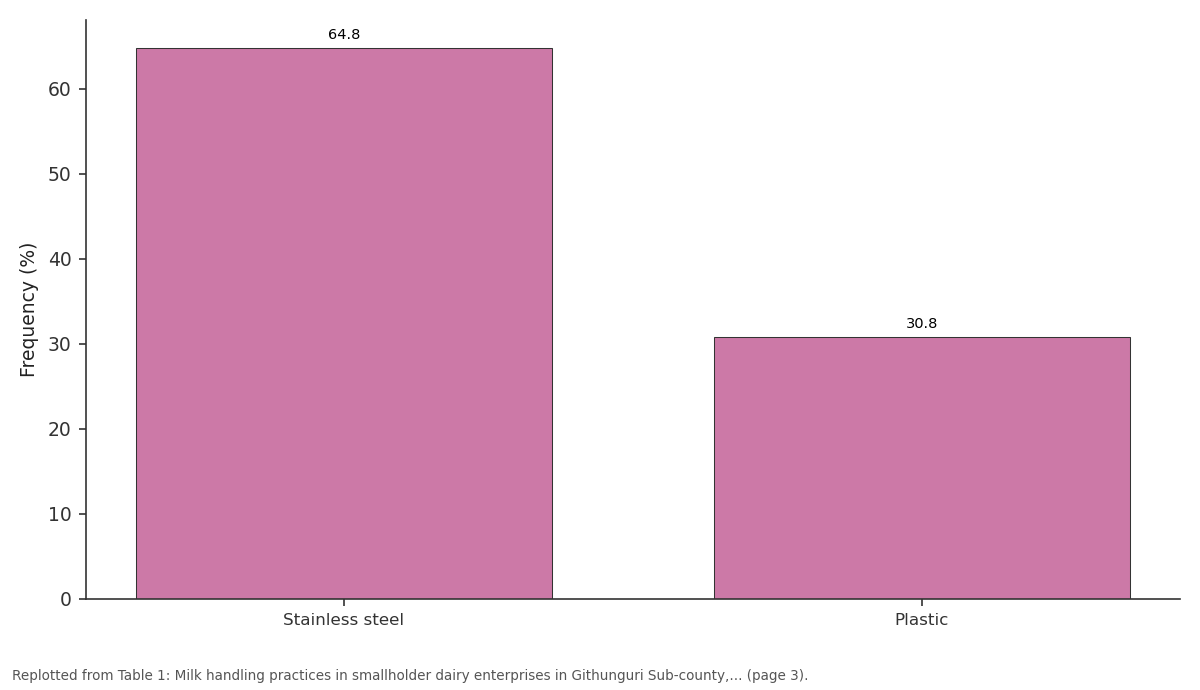
Frequency (%): Stainless steel vs Plastic
Replotted from Table 1 (page 3) of the original paper. Every bar is the paper's own table value.
View source evidence ↗Figures & tables
From the original paper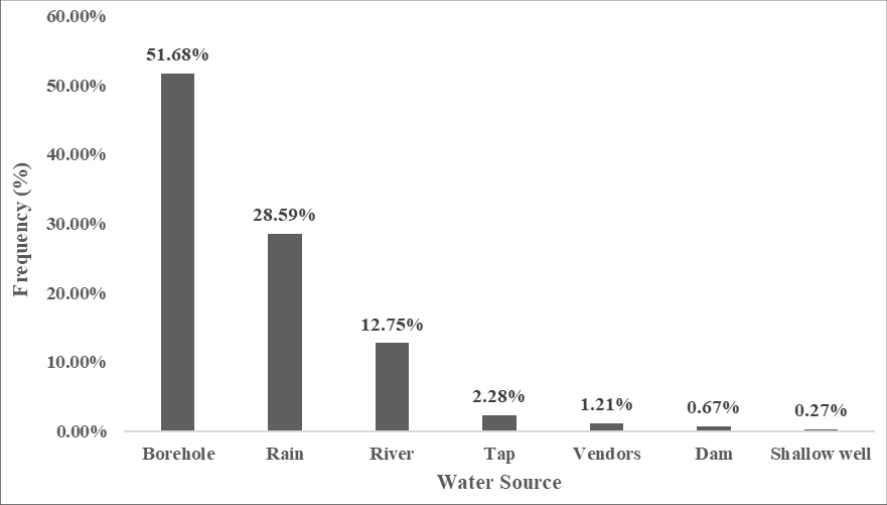 Figure 1
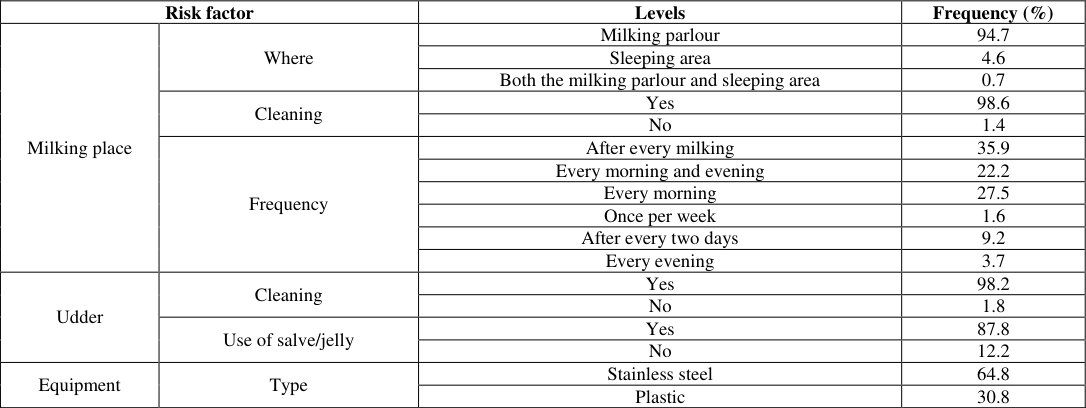 Table 1
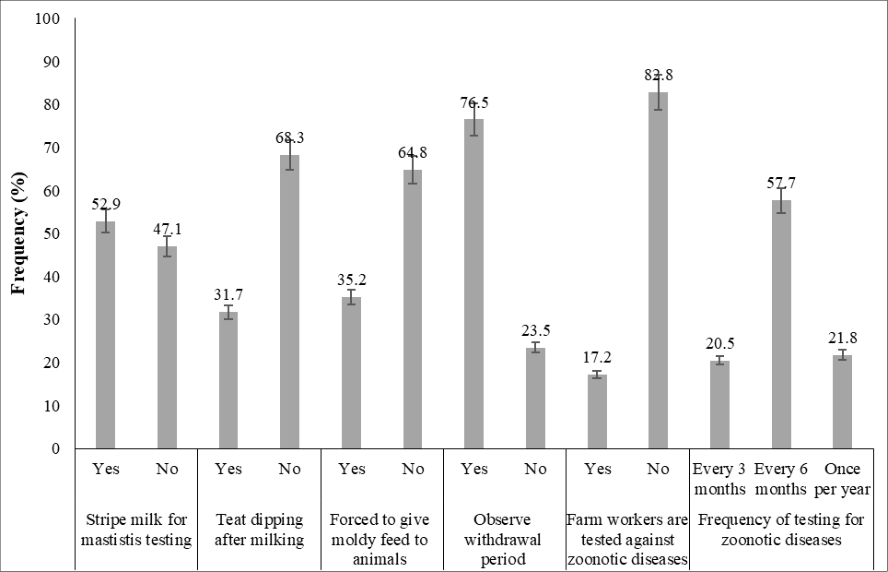 Figure 2
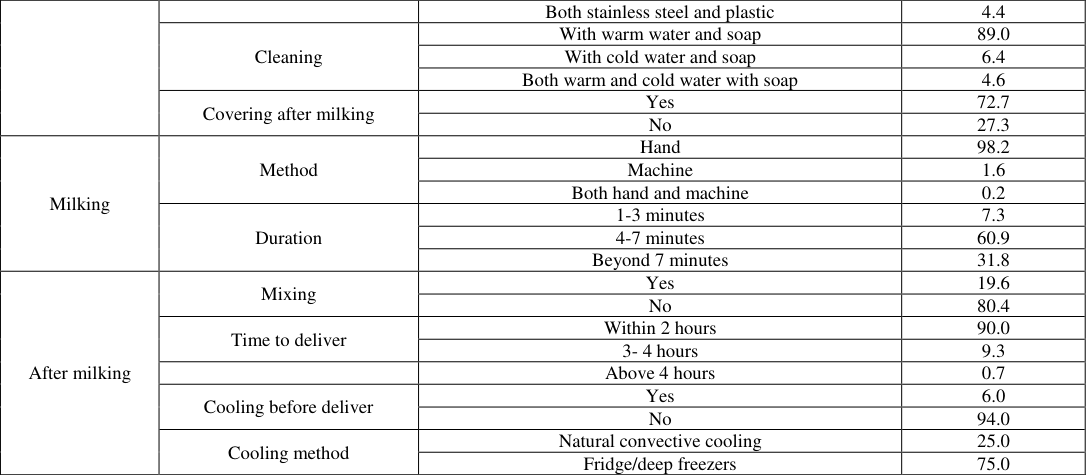 Table 2
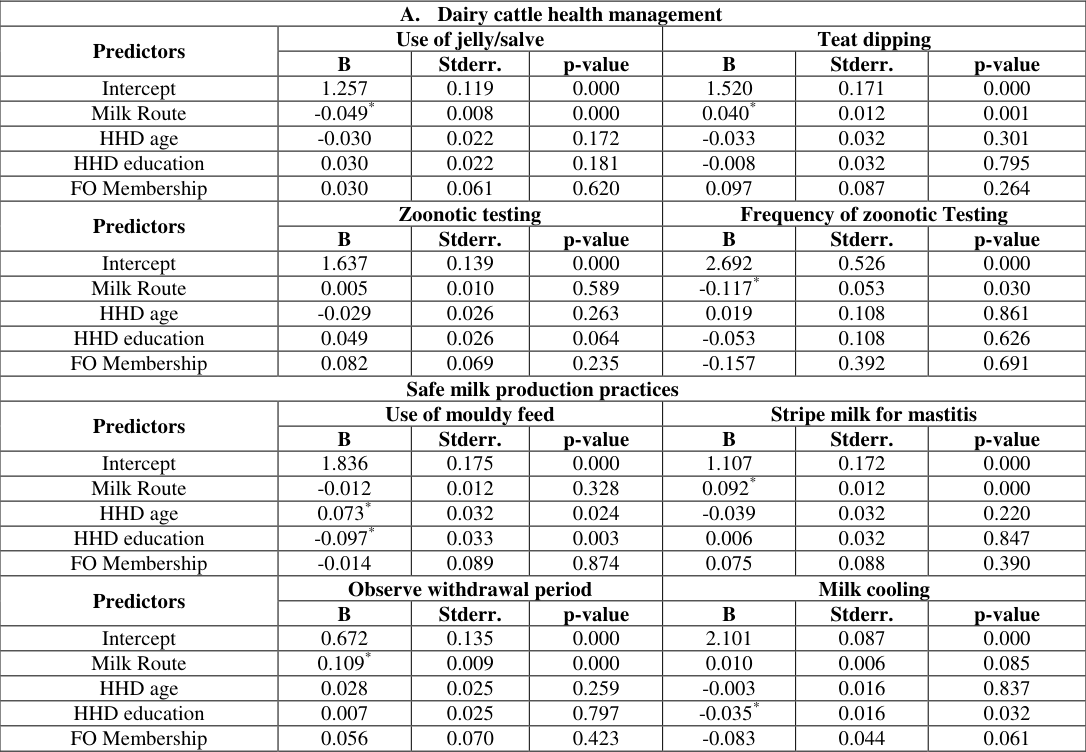 Table 2
Introduction
Smallholder farmers from low-to-middle-income countries have embraced dairy production enterprises as an essential source of livelihood, contributing to food and nutrition security (Grace et al., 2020; Banda et al., 2021) [7,2] . Kenya has one of the most developed dairy sectors in sub-Saharan Africa, whereby smallholder dairy farmers account for 80% of the estimated 4 to 5 billion litres of national milk production (King'ori, 2022) [8] . However, producing good quality milk remains a challenge to smallholder farmers due to unhygienic handling practices and non-adherence to food safety standards (Nyokabi et al., 2021) [13] . Hence, an integrated approach to milk quality and safety is needed to guarantee its integrity from farm to glass. Milk contamination usually begins at the production level; the microbial safety of raw milk in low to middle-income countries originating from small-scale farmers has been a concern for decades (Mogutu et al., 2020). For instance, the report on post-harvest losses at the farm level in Kenya is more than 6% of total production (Ndungi et al., 2021) [12] . Post-harvest losses harm farmers' economic well-being, food security, and national gross domestic product (GDP) (Dudi, 2014) [4] . Lack of efficient monitoring and proper enforcement structures has resulted in processed milk products from smallholder dairy farmers being non-compliant with national, regional, and international quality and safety standards despite the increase in demand (Mogutu et al., 2020). Processing low-quality raw milk results in low-quality products, so there have been attempts to offer monetary premium incentives to dairy farmers that provide high-quality milk to processors (Murphy et al., 2016) [11] . Besides these on-farm practices that cause contamination at the farm level resulting in quantitative and qualitative losses, another concern is the safety of consumers of milk and milk products. Milk has become a vehicle for consumers of foodborne pathogens, antibiotic residues, mycotoxins, and zoonotic diseases.
According to Grace et al. (2020) [7] , harmful microorganisms may originate from the animal, environment, milking equipment, milk handlers or introduction by an adulterant such as contaminated water. Accidentally or deliberately, the feeds and veterinary drugs for animal treatment may lead to chemical contamination. Cattle can act as reservoirs for zoonotic diseases either directly or indirectly. Brucellosis and Campylobacteriosis are transmitted through handling of the animal and environments contaminated with animal manure, respectively. (McDaniel et al., 2014) [10] . Milk quality and safety concerns on consumer health and nutrition need public health surveillance to prevent foodborne diseases, food poisoning and zoonosis risk from raw milk and fresh dairy products (Velázquez-Ordoñez et al., 2019) [18] . The objective of this study was to establish whether smallholder dairy enterprises in the area have embraced the standard practices recommended for producing quality and safe milk.
Methods
Methods
Study area
The study was conducted in the Githunguri sub-county, Central Kenya, about 1600 m above sea level. It lies between latitude 1° 05" and 1° 06" South of the Equator and longitude 36° 53" and 36° 55". The annual average rainfall is 1065 mm, with the mean maximum monthly temperature varying from 22.4 °C to 27.6 °C, while the mean minimum temperature range from 11.3 °C to 14.9°C (Alaru, 2019).
Study design and data collection procedures
Using a structured pre-tested questionnaire, a cross-sectional survey was used to collect data on dairy cattle health management and milk-handling practices. The sample size was determined using a formula by Cochran (1963):
Where: n = sample size; Z 2 = abscissa of the normal curve, which is 1.96 for 95 confidence interval; p= estimated proportion of an attribute; q= (1-p) and e= desired level of precision set at 0.05. A total of 457 households distributed along the eight-milk collection routes: Kiairia, Githunguri town, Ikinu, Komothai, Githinga, Ngewa and Gitiha combined with Kiambaa, were interviews.
Data management and analyses
Descriptive statistics was used to describe sources of water, milk handling practices and dairy cattle health management. Chi-squared analyses assessed the relationship between the farmers' characteristics (Age, education and membership in farmers' organizations) and the milk collection route. Inferential analyses employed analysis of variance (ANOVA) to determine the influence of farmers' characteristics on milk quality and animal health management practices. Post-hoc analysis was performed using Tukey's method to separate means. Linear regression models were used to identify the determinants of farmers' demographic characteristics on farmlevel practices affecting animal health and milk quality. Nonsignificant terms were eliminated from the model. The regression model used is explained as follows:
Where yi in the farm-level indicator is for farmers' i th practice (animal health management and milk handling), β o is the intercept, βi … βn are coefficients to be estimated and Xi … Xn is a vector of farmers' demographic characteristics. Data was collected from the cross-sectional survey using the open data kit (ODK) version 2022.3.6. Data were then coded and analyzed using the statistical package for social sciences (SPSS) statistics software version 26 at a 95% confidence level.
Results
Results
Hygienic milk handling practices
Sources of water used for sanitation are in Figure 1. Most farmers (51.68%) obtained water from boreholes, 28.59% from rain, 12.75% from rivers, 2.28% used tap water and the remaining from vendors, dams and shallow wells. 1. Most farmers implemented standard hygienic milk handling practices; where 94.7% milk their cows in the parlour, 98.6% cleaned the milking area, and 90.0% delivered milk to collection centres within 2 hours. However, a smaller proportion is engaged in unhygienic practices such as mixing morning and evening milk (19.4%), use of plastic containers to store and transport milk (30.8%) and milk in the sleeping area (4.6%), which can compromise on milk quality and safety.
Dairy cattle health management and safe milk production practices
Dairy cattle health management practices are in Figure 2. Only 52.9% of the farmers practice striping of milk for mastitis testing, 31.7% practice teat dipping after milking, 35.2% encountered incidences where they had to feed cattle on mouldy feed, and 82.8% of farm workers are not tested for zoonotic diseases. Among the farmers who practised testing for zoonotic diseases, only 20.5% tested every three months as per the public health guidelines. Furthermore, 23.5% of the farmers did not observe the recommended withdrawal period after administering antibiotics to lactating cows. Influences of the farmers' demographic characteristics that predict farm-level practices affecting animal health and milk quality are in Table 2. From the regression model, the milk collection route was a significant predictor for the use of jelly/salve during milking, teat dipping, frequency of zoonotic disease testing, stripping of milk for mastitis testing and observation of withdrawal period after administering antibiotics to lactating cows. The household head's education level and age influenced the possibility of a farmer giving mouldy feed to cows and milk cooling before delivery to the collection centre. 1 show that farmers obtained water for sanitation from several sources, but boreholes, rain and rivers constituted the bulk source. The treated tap water supplied by the county government has not reached most homesteads. Therefore, the use of untreated water for sanitation is a predisposing risk factor for microbial contamination of milk.
| A. Dairy cattle health management | — | — | — | — | — | — |
|---|---|---|---|---|---|---|
| Predictors | Use of jelly/salve | Teat dipping | ||||
| B | Stderr. | p-value | B | Stderr. | p-value | |
| Intercept | 1.257 | 0.119 | 0.000 | 1.520 | 0.171 | 0.000 |
| Milk Route | -0.049* | 0.008 | 0.000 | 0.040* | 0.012 | 0.001 |
| HHD age | -0.030 | 0.022 | 0.172 | -0.033 | 0.032 | 0.301 |
| HHD education | 0.030 | 0.022 | 0.181 | -0.008 | 0.032 | 0.795 |
| FO Membership | 0.030 | 0.061 | 0.620 | 0.097 | 0.087 | 0.264 |
| Predictors | Zoonotic testing | Frequency of zoonotic Testing | ||||
| B | Stderr. | p-value | B | Stderr. | p-value | |
| Intercept | 1.637 | 0.139 | 0.000 | 2.692 | 0.526 | 0.000 |
| Milk Route | 0.005 | 0.010 | 0.589 | -0.117* | 0.053 | 0.030 |
| HHD age | -0.029 | 0.026 | 0.263 | 0.019 | 0.108 | 0.861 |
| HHD education | 0.049 | 0.026 | 0.064 | -0.053 | 0.108 | 0.626 |
| FO Membership | 0.082 | 0.069 | 0.235 | -0.157 | 0.392 | 0.691 |
| Safe milk production practices | ||||||
| Predictors | Use of mouldy feed | Stripe milk for mastitis | ||||
| B | Stderr. | p-value | B | Stderr. | p-value | |
| Intercept | 1.836 | 0.175 | 0.000 | 1.107 | 0.172 | 0.000 |
| Milk Route | -0.012 | 0.012 | 0.328 | 0.092* | 0.012 | 0.000 |
| HHD age | 0.073* | 0.032 | 0.024 | -0.039 | 0.032 | 0.220 |
| HHD education | -0.097* | 0.033 | 0.003 | 0.006 | 0.032 | 0.847 |
| FO Membership | -0.014 | 0.089 | 0.874 | 0.075 | 0.088 | 0.390 |
| Predictors | Observe withdrawal period | Milk cooling | ||||
| B | Stderr. | p-value | B | Stderr. | p-value | |
| Intercept | 0.672 | 0.135 | 0.000 | 2.101 | 0.087 | 0.000 |
| Milk Route | 0.109* | 0.009 | 0.000 | 0.010 | 0.006 | 0.085 |
| HHD age | 0.028 | 0.025 | 0.259 | -0.003 | 0.016 | 0.837 |
| HHD education | 0.007 | 0.025 | 0.797 | -0.035* | 0.016 | 0.032 |
| FO Membership | 0.056 | 0.070 | 0.423 | -0.083 | 0.044 | 0.061 |
Table text extracted from the original PDF; superscript letters are shown inline. The original table image is below.
View original table image
| — | — | Both stainless steel and plastic | 4.4 |
|---|---|---|---|
| Cleaning | With warm water and soap | 89.0 | |
| With cold water and soap | 6.4 | ||
| Both warm and cold water with soap | 4.6 | ||
| Covering after milking | Yes | 72.7 | |
| No | 27.3 | ||
| Milking | Method | Hand | 98.2 |
| Machine | 1.6 | ||
| Both hand and machine | 0.2 | ||
| Duration | 1-3 minutes | 7.3 | |
| 4-7 minutes | 60.9 | ||
| Beyond 7 minutes | 31.8 | ||
| After milking | Mixing | Yes | 19.6 |
| No | 80.4 | ||
| Time to deliver | Within 2 hours | 90.0 | |
| 3- 4 hours | 9.3 | ||
| Above 4 hours | 0.7 | ||
| Cooling before deliver | Yes | 6.0 | |
| No | 94.0 | ||
| Cooling method | Natural convective cooling | 25.0 | |
| Fridge/deep freezers | 75.0 |
Table text extracted from the original PDF; superscript letters are shown inline. The original table image is below.
View original table image
Table 1 shows that most farmers clean the udder and milking equipment and the milkers' hands, mainly using untreated water, thereby compromising milk quality. Poor hygiene in milking and handling practices could result in microbial milk contamination and pathogens dissemination. In addition, udder contamination may occur at milking time between cows, the hands of milkmen, and machines (Velázquez-Ordoñez et al., 2019) [18] . Considering that some farmers use plastic milking equipment, maximum hygienic conditions cannot be attained by their nature. Plastics are difficult to clean, even after thorough cleaning of plastic jerry cans, mean microbial residual load for TVC and TCC levels were found to be 3.84 ± 0.92 and 3.64 ± 0.80 log 10 CFU/cm 2 respectively (Alaru et al., 2019) [1] . In addition, the scratches on plastic containers harbour bacteria which would contaminate the fresh milk delivered to collection centres. The situation is even worse for the farmers who use cold water to wash equipment and clean the udder. According to Bekuma and Galmessa (2018) [3] , water serves as a primary source of microorganism contamination, and if it is obtained from an open water supply, more care is necessary to prevent drainage that may contain both human and animal waste and other contaminants gaining entry into the source. Besides water that is used in sanitation, the environment is also a predisposing factor for microbial contamination of the milk at the farm. From Table 1, some farmers don't use parlours but sleeping areas for milking. This is a dangerous practice because the cow dung, mud, ammonia gas and dust present in the sleeping area will find their way into the milk. However, even those farmers who use the milking parlour but only clean the place every two days or once per week predispose the milk to environmental contamination. Standard bulking of milk before processing requires dairy farmers to bring all their milk to a common milk collection centre. Any contamination within the milk production unit will compromise on quality and safety of milk at the collection centre. This scenario could negate all the efforts put in by smallholder farmers in ensuring the quality and safety of milk are enhanced. Similarly, a small proportion of farmers in Githunguri do not clean the cows' udder before milking.
| Risk factor | — | Levels | Frequency (%) |
|---|---|---|---|
| Milking place | Where | Milking parlour | 94.7 |
| Sleeping area | 4.6 | ||
| Both the milking parlour and sleeping area | 0.7 | ||
| Cleaning | Yes | 98.6 | |
| No | 1.4 | ||
| Frequency | After every milking | 35.9 | |
| Every morning and evening | 22.2 | ||
| Every morning | 27.5 | ||
| Once per week | 1.6 | ||
| After every two days | 9.2 | ||
| Every evening | 3.7 | ||
| Udder | Cleaning | Yes | 98.2 |
| No | 1.8 | ||
| Use of salve/jelly | Yes | 87.8 | |
| No | 12.2 | ||
| Equipment | Type | Stainless steel | 64.8 |
| Plastic | 30.8 |
Table text extracted from the original PDF; superscript letters are shown inline. The original table image is below.
View original table image
Considering that the udder is often soiled with cow dung in the sleeping area, cleaning removes soil particles, bedding materials and manure, which prevents the entry of microorganisms into the milk. Mixing the previous day's evening milk; which has a higher microbial load with morning milk was practised in some households thereby compromising on quality. The problem is further aggravated by the practice of farmers taking more than two hours to deliver milk to the collection centres and the lack of cooling facilities that curtails the microbial activity in milk. A small proportion of farmers cool milk before delivery to collection routes; however, some of the farmers that cool milk do not have refrigerators or freezers. They use natural convective cooling, where evening milk is stored in a can and placed outside overnight in either a trough of water or just an open place, where the night breeze causes the cooling. Farmers from different milk collection routes had significantly different practices regarding the frequency of cleaning the milking place, type of milk handling equipment and method of cleaning the milking equipment. Consequently, this can cause differences in milk quality per route resulting from varying levels of awareness of hygienic milk handling. Hygienic handling, cooling and storage, and milk safety monitoring practices are relevant along the dairy value chain. Substandard milk production practices form additional avenues for fresh milk contamination and bacteria proliferation (Ledo et al., 2020) [9] . In addition, farmers of different ages had significantly different practices in cleaning the milking place and the equipment (Table 2). A study by Paraffin et al. (2018) [15] established that farmers over 30 years of age were three times more likely to take action concerning hygiene in aspects affecting milk quality.
Animal health management and safe milk production
The findings indicated that seven out of every ten farmers did not practice teat dipping, as shown in Figure 2, a recommended practice in curbing teat infections such as mastitis, and only one in every two farmers checked for mastitis in milk. Lack of checking for mastitis and teat dipping could lead to the rapid spread of the disease among the herd due to late detections and no control measures. Mastitis infections within the herd lead to low-quality milk due to contaminations, low production, and the high cost of treating the animals. Mastitis is one of the most prevalent diseases affecting dairy animals' production process and is responsible for several production losses (Sharun et al., 2021) [17] . Farmers reported that there were incidences that they fed mouldy feeds to animals and also failed to observe recommended withdrawal period after administering antibiotic treatments. Such practices are harmful as they can predispose milk consumers to chemical hazards from mycotoxins and antibiotic residues respectively. There is a global concern over the increase in antimicrobial resistance in human beings, and the finger points toward consuming foods contaminated with antibiotic residues (Emeje et al., 2022) [5] .
Similarly, the occurrence of aflatoxins and their metabolites toxins in the food chain leads to deterioration in animal health and socio-economic losses (Furian et al., 2022) [6] . A relatively small proportion of farm animal handlers undergo routine medical examinations and checkups, as shown in Figure 2. For the smaller percentage that underwent the medical test, the frequency varied between three months and one year, with most tested every six months. This is contrary to the Kenyan Public Health requirement that medical checkups be done quarterly. Żukiewicz-Sobczak et al. (2013) [19] suggest that farmers should be subjected to a system of diagnosing occupational diseases and many preventive and educational programs concerning health risks associated with their work. Osoro et al. (2015) [14] study revealed that Brucella household seroprevalence of 5.0% and herd seroprevalence of 5.6%, which was attributed mainly to natural breeding and acquisition of new animals on a farm. From the regression models in Table 2, the milk collection route significantly influenced farmers' practices on the use of milking jelly/salve, teat dipping, frequency of testing for zoonotic diseases, striping of milk for mastitis checking and observation of withdrawal period. This indicates that on some routes, farmers are aware of recommended animal health management practices, while others are unaware. This variation could be due to limited access to extension services on the routes farmers are not practising as recommended. Apart from the route, the higher the education level of the household head, the fewer chances of them encountering incidences feeding mouldy feeds to cattle and fewer chances of using natural convective cooling of milk before delivery to collection centres. An indication that education level influenced the implementation of good farming practices. On the contrary, the higher the household head age, the higher the chances of encountering incidences of feeding mouldy feed to cattle.
Conclusion
Many of the farmers in Githunguri have embraced standard animal health management and clean milk production, but a few have practices that compromise milk quality and safety. These practices were greatly influenced by the milk collection route that the farmer belonged to, an indication of the variation of the knowledge base in the routes. The main problem facing hygienic milk production was the untreated water obtained mainly from boreholes and rivers. Therefore, there is a need for treated water in the area and for farmers to join organizations to benefit from extension services such as good agricultural practices, surveillance and control of
References
12 in the original paper- Furian AF, Fighera MR, Royes LFF, Oliveira MS. Recent advances in assessing the effects of mycotoxins using animal models. Current Opinion in Food Science. 2022;47:100874. https://doi.org/10.1016/j.cofs.2022.100874
- Grace D, Wu F, Havelaar AH. MILK Symposium review: Foodborne diseases from milk and milk products in developing countries-Review of causes and health and economic implications. Journal of dairy science. 2020;103(11):9715-9729.
- King'ori S. Factors affecting dairy production among dairy cooperative societies in Kenya: A critical literature review. American Journal of Livestock Policy. 2022;1(1):8-19.
- Ledo J, Hetting KA, Luning PA. A customized assessment tool to differentiate safety and hygiene control practices in emerging dairy chains. Food Control. 2020;111:107072. https://doi.org/10.1016/j.foodcont.2019.107072
- McDaniel CJ, Cardwell DM, Moeller RB Jr, Gray GC. Humans and cattle: A review of bovine zoonoses. Vector Borne Zoonotic Diseases. 2014;14(1):1-19. https:/ / doi.org/10 .1089/ vbz.2012.1164.
- Murphy SC, Martin NH, Barbano DM, Wiedmann M. Influence of raw milk quality on processed dairy products: How do raw milk quality test results relate to product quality and yield?. Journal of Dairy Science. 2016;99(12):10128-10149.
- Ndungi F, Muliro P, Faraj A, Matofari J. Milk handling practices and utilization at dairy farms and collection centers under rural and peri-urban milk value chain systems in Nakuru County, Kenya. African Journal of Food, Agriculture, Nutrition and Development. 2021;21(4):17815-17833.
- Nyokabi S, Luning PA, de Boer IJM, Korir L, Muunda E, Bebe BO, et al. Milk quality and hygiene: Knowledge, attitudes and practices of smallholder dairy farmers in central Kenya. Food Control. 2021;130:108303. https://doi.org/10.1016/j.foodcont.2021.108303
- Osoro EM, Munyua P, Omulo S, Ogola E, Ade F, Mbatha P, et al. Strong association between human and animal Brucella seropositivity in a linked study in Kenya, 2012-2013. The American journal of tropical medicine and hygiene. 2015;93(2):224.
- Paraffin AS, Zindove TJ, Chimonyo M. Perceptions of Factors Affecting Milk Quality and Safety among Largeand Small-Scale Dairy Farmers in Zimbabwe. Journal of Food Quality. 2018, 1-7,Article ID 5345874. https://doi.org/10.1155/2018/5345874.
- Sharun K, Dhama K, Tiwari R, Gugjoo MB, Iqbal Yatoo M, Patel SK, et al. Advances in therapeutic and managemental approaches of bovine mastitis: a comprehensive review. Veterinary Quarterly. 2021;41(1):107-136. https://doi.org/10.1080/01652176.2021.1882713
- Żukiewicz-Sobczak WA, Chmielewska-Badora J, Wróblewska P, Zwoliński J. Farmers' occupational diseases of allergenic and zoonotic origin. Advances in Dermatology and Allergology/Postępy Dermatologii i Alergologii. 2013;30(5):311-315.
Cited by 1
From OpenAlex, OpenCitations and reference lists read by Scinovex
- Effect of Hygiene on Milk Quality and Milking Factors of Small Andean Herds during the Rainy Season ↗
Gloria Betti Adrianzen Facundo, Julio Alberto Ruiz Maquen, Nelly Umpiri Calderón, Francisco Alejandro Espinoza-Montes · World s Veterinary Journal · 2024
Dairy production in the Peruvian Andes is mainly based on small herds. However, there is little information on how hygiene affects milk quality during the rainy season. The study's objective was to evaluate the hygienic factors of milk and milking practices during the rainy season in small herds located at two high Andean altitudinal levels. The characteristics of the factors…
❝ 2PDF