
Research article · 2022 · Full text
International Journal of Veterinary Sciences and Animal HusbandryCorrelation of feed management to production performance and egg quality
Volume 7(6) · Pages 21–24 · DOI: 10.22271/veterinary.2022.v7.i6a.450 ↗
Research areasFood and Agricultural SciencesAnimal Nutrition and PhysiologyLivestock Farming and Management
Abstract
Author-writtenThis study aims to determine the egg production of layer strain isa brown with different patterns of distribution of rations in the morning and in the afternoon. This research was carried out in Saentis Village, Percut Sei Tuan District, Deli Serdang Regency using 4,000 layer strain ISA brown chickens aged 20 weeks consisting of the first treatment using 200 layer strain ISA brown chickens with management giving rations 60% in the morning and 40% during the day, the second treatment used 2,000 layer chickens strain ISA brown with 50% ration management in the morning and 50% in the afternoon. Data were collected for 3 months of egg production (20 weeks to 32 weeks of chickens). Observations of research carried out by recording egg production every day for each treatment carried out. Data processing is done by tabulating the data and averaging egg production in the form of a percentage. The results obtained showed that egg production with a ration treatment of 60% in the morning and 40% in the afternoon resulted in an average egg production of 76.94% and in the treatment of giving a ration of 50% in the morning and 50% in the afternoon resulted in an egg production of 80, 40%. It can be seen that giving rations with the same amount in the morning and afternoon resulted in more egg production compared to giving rations with a higher amount in the morning and in comparison rations in the afternoon and the best ration conversion was giving 50% rations in the morning and 50% in the afternoon by 2.24 and giving 60% rations in the morning and 40% in the afternoon resulted in a ration conversion of 2.47. This is because the distribution of nutrients is more evenly distributed in the same amount, so the egg formation process can run optimally every time supported by the available nutritional value and the maintenance of the condition of the ration that is always fresh every time it is given so that it can produce better egg production and good ration conversion. 24 and giving rations of 60% in the morning and 40% in the afternoon resulted in a ration conversion of 2.47. This is because the distribution of nutrients is more evenly distributed in the same amount, so the egg formation process can run optimally every time supported by the available nutritional value and the maintenance of the condition of the ration that is always fresh every time it is given so that it can produce better egg production and good ration conversion. 24 and giving rations of 60% in the morning and 40% in the afternoon resulted in a ration conversion of 2.47. This is because the distribution of nutrients is more evenly distributed in the same amount, so the egg formation process can run optimally every time supported by the available nutritional value and the maintenance of the condition of the ration that is always fresh every time it is given so that it can produce better egg production and good ration conversion.
Summary
Source-checkedPlain-language reading of the full paper, prepared with AI and checked against the text. Each point links to the authors' own words.
Why it matters
- Feed represents a significant portion of livestock business costs, typically ranging between 60% and 70%. View evidence ↗
- Proper feeding management for laying hens is critical because feed can account for 70-80% of operational costs, and poor management can lead to financial losses. View evidence ↗
- Scheduling ration delivery at specific times can improve ration efficiency, which is reflected in a lower ration conversion rate. View evidence ↗
The question
- The study aimed to evaluate how different morning and afternoon ration distribution patterns affect the egg production of ISA Brown layer chickens. View evidence ↗
What they did
- The research was conducted in Saentis Village, Deli Serdang Regency, using 4,000 ISA Brown layer chickens starting at 20 weeks of age. View evidence ↗
- Two treatments were compared: one group (200 chickens) received 60% of rations in the morning and 40% during the day, while another group (2,000 chickens) received a 50/50 split between morning and afternoon. View evidence ↗
- Egg production data were collected over a three-month period, from the chickens' 20th to 32nd week of age. View evidence ↗
- The study measured two primary variables: egg production from 20 to 32 weeks and the ration conversion rate, calculated as the difference between ration consumed and egg weight produced. View evidence ↗
What they found
- The 50% morning and 50% afternoon ration distribution resulted in a higher average egg production (80.40%) compared to the 60% morning and 40% afternoon distribution (76.94%). View evidence ↗
- The 50/50 ration distribution achieved a better (lower) ration conversion of 2.24, whereas the 60/40 distribution had a higher conversion of 2.47. View evidence ↗
- Despite the results, the highest yield observed (80.40%) remained below the ISA Brown strain standard of 94.8%. View evidence ↗
- The ration conversion rates in this study were higher (worse) than the ISA Brown reference standard of 1.93 for chickens aged 30-38 weeks. View evidence ↗
What it means
- The authors concluded that distributing rations equally (50% morning and 50% afternoon) provides superior egg production and feed conversion. View evidence ↗
- The authors recommend providing rations in equal amounts to ensure optimal nutrient absorption and maintain feed freshness, which positively impacts consumption. View evidence ↗
Visual summary
3 visualsIllustrations explain the paper; charts are replotted from the paper's own table values.
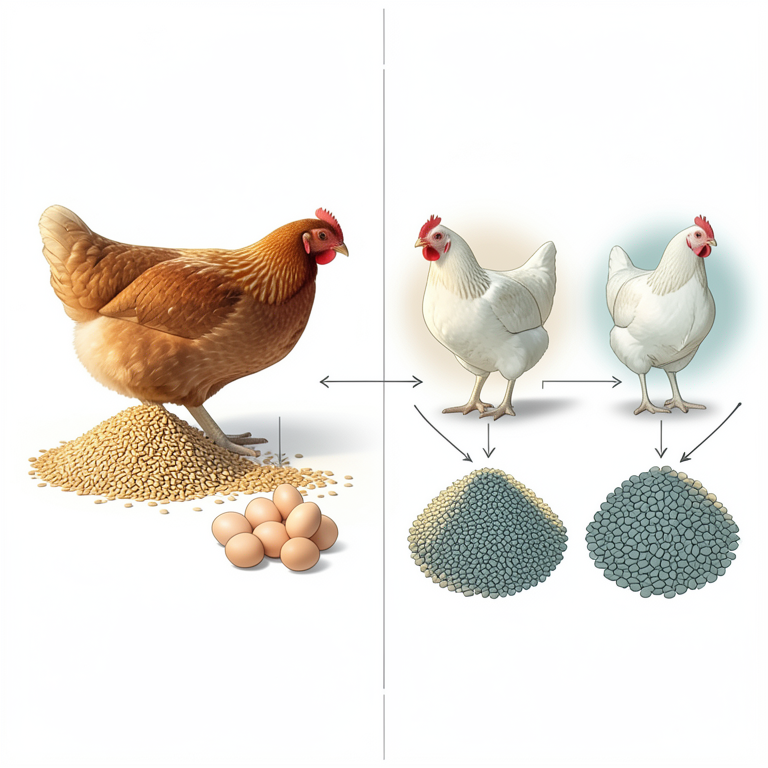
Comparison of Ration Distribution Patterns
AI-generated conceptual illustration (laying hens). It explains the idea and does not show study data.
View source evidence ↗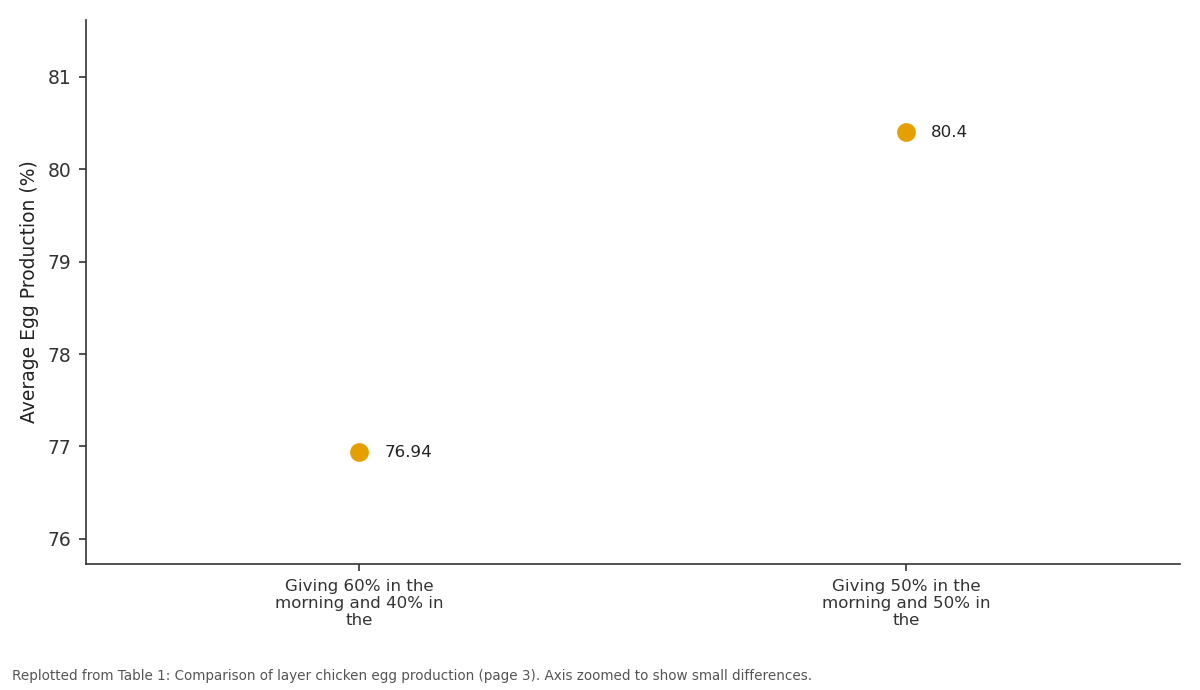
Average Egg Production: Giving 60% in the... vs Giving 50% in the...
Replotted from Table 1 (page 3) of the original paper. Every bar is the paper's own table value.
View source evidence ↗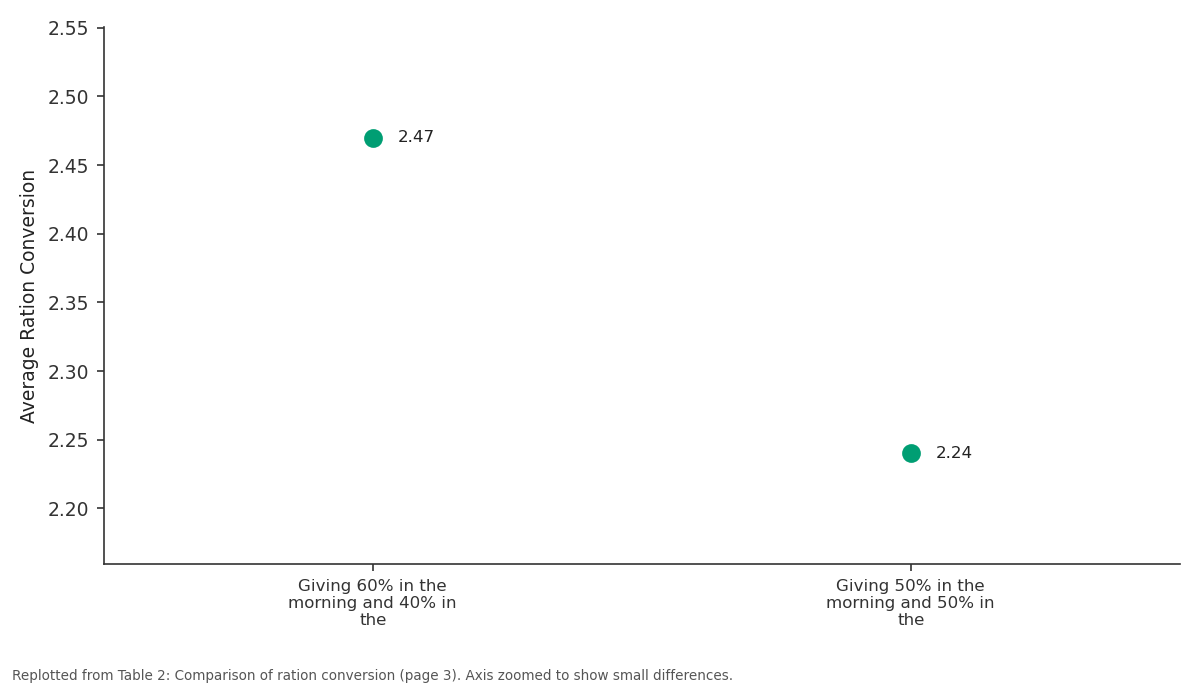
Average Egg Production: Giving 60% in the... vs Giving 50% in the...
Replotted from Table 2 (page 3) of the original paper. Every bar is the paper's own table value.
View source evidence ↗Figures & tables
From the original paper Table 1
 Table 2
Introduction
Feed ingredients or so-called animal feed ingredients are anything that can be eaten, partially or completely digested, (to) be absorbed and without disturbing the health of the eater. One of the most important factors in the business of raising livestock, both ruminants and nonruminants. The biggest cost in the livestock business is between 60-70%. The purpose of using feed. Maintain body condition (maintenance). Grow (growth). Produce (production).
In the Regulation of the Minister of Agriculture of the Republic of Indonesia number 119/Permentan/OT.140/10/2014 it is stated that the definition of feed ingredients is: materials from agriculture, fishery, livestock, or other materials that are suitable for use as feed ingredients, both processed and processed unprocessed while feed is: single or mixed food, whether processed or not, which is given to animals for survival, production and reproduction. In addition, we must also understand the meaning of rations, namely: feed given to livestock for 24 hours, can be given once or several times. Balanced rations, namely: rations given for 24 hours containing all nutrients in quantity, The program of giving rations by setting a certain time is a method that can increase the efficiency of the ration, this is indicated by the lower ration conversion rate, this is possible because the activity of eating chicken will decrease so that the energy needed to carry out these activities can be saved so that the energy can be used for growth. That chickens fed rations with limited feeding time for 8 hours/day from the age of 7 ± 21 days can produce the same growth as controls, and are still categorized as low-intensity ration restrictions. The older the chicken, the frequency of rationing is decreasing to two or three times a day. The timing of rationing is chosen at the right and convenient time so that the chickens can eat well and not much of the ration is wasted. According to research (Huda, 2010) the frequency of feeding had a significant effect on consumption and ration conversion, but did not significantly affect the final weight. In terms of frequency, the amount of rations is given according to the standard requirement for twenty-four hours. The effect of the amount of feeding at the time of feeding on the growth and production performance of broiler chickens is an interesting thing to do research to find out how big the response of broiler chicken performance to this research treatment. Feeding management of laying hens is very important. Considering the biggest operational cost is feed (70-80%). If the feed management is bad, it has the potential to bring losses to farmers. The period of laying hens is divided into: Starter (chicks): 0-4 weeks of age. Grower (growth period): age 4-16 weeks. Layer (egg production): age 16 weeks and over.
States that for laying hens in tropical climate conditions, it is recommended to feed 2 times a day, with 1/3 of the total feed given in the morning and the rest given in the afternoon, with free time. Maximum feed place for 1 hour at the time of peak hot temperatures. Laying hens enter the production phase starting when the hens are 18 to 22 weeks old, depending on the growth and breed of the hens. The quality of chickens in this phase is strongly influenced by rearing management during the pullet and previous phases. Success in laying hen's production performance can be seen from the quality and quantity shown. To achieve this, every target in all phases of laying hens must be achieved and in accordance with the management guide standards of each strain of chicken raised. In the maintenance of the production phase there is a critical point that must be considered and anticipated by farmers. This critical point is at the beginning of the production phase until it reaches peak production (around the age of 18 to 25 weeks). In this phase, the chicken will experience hormonal changes in preparation for reaching peak egg production In the grower and finisher periods, the frequency of rationing is 2-3 times a day and needs to be ensured in accordance with breeder standards. This reduction in frequency was due to high appetite and ration consumption during this period but low body weight gain. Provision of rations should also be done when the ambient temperature is comfortable for chickens. Morning can be given between 05.00-07.30, afternoon between 14.00-16.00 or evening between 18.00-21.00. In addition, try the amount given in the morning 30-40% and in the evening until the evening 60-70%. The thing to remember is, give rations at a fixed hour every day. For example, rations are given twice a day at 07.00 and 15.00. Provision of rations at a fixed hour aims to avoid stress when rations are given late. Feeding of laying hens is given 2 times / day, in the morning day around 7-8 and at noon at 13:00. Feeding is not all at once, but gradually 2 times / day to be more efficient. Feeding should not be too full so that not much feed is scattered. The egg-laying period is calculated from the time the chickens start laying eggs around the age of 20 -22 weeks reaching 5% hen-day to lower than 5% hen-day. Hen-day is a measure of the technical efficiency of egg production that compares the production of that day with the number of chickens that live on that day so that the beginning of this laying period varies for each type of laying hens (Rasyaf, 2000). If the production has reached 5% then the group of chickens has been declared to start producing. At the beginning of production, the number of eggs is low, which is around 3-5%. However, it quickly increases to peak production, which is around 80-90% at the age of 32-34 weeks.
Materials and Methods
Materials and Methods
A Time and Place of Research
This research was conducted from July to October 2022. The research location is in Saentis Village, Percut Sei Tuan subdistrict, Deli Serdang district.
B. Research Materials 1. Tools and Materials
The equipment used in this study were stationery and notes to record the number of egg production produced by the feeder, drinking place, cage litter mat and cleaning equipment. The material used in this study was 4,000 Isa Brown layer strain chickens aged 20 weeks as an object for observation of egg production.
Feed
The animal feed used is factory feed with the following nutritional content: Crude Protein 19.34% Crude fat 11.43% Crude fiber 4.72% Ash 13.3% Calcium 3.9% Phosphorus 0.45% Salt 0.54% Drinking water is provided on an ad-libitum basis
C. Research Method
This research method used is descriptive analysis method with quantitative approach, namely research that compares the results of egg production with different rations (60% in the morning and 40% in the afternoon) and (50% in the morning and 50% in the afternoon),
D. Variables Observed in Research
The variables observed in this study were The production of eggs produced by chickens from 20 weeks to 32 weeks (for 12 weeks). Ration conversion obtained from the difference between the amount of ration consumed and the weight of the eggs produced.
E. Data Collection Method
The methods used in data collection in this study are:
1. Observation, namely data collection through direct observation in the farm to the management of ration and production and egg quality 2. Recapitulation of data that has been obtained 3. Analysis of the data obtained.
F. Data Analysis
The data obtained is processed by analyzing in the form of an average in units of percentage of the amount of production for each treatment.
Results and Discussion
Results and Discussion
A. Egg Production
The research results obtained are shown in table 1 below.
| Treatment | Average Egg Production |
|---|---|
| Giving 60% in the morning and 40% in the afternoon | 76.94% |
| Giving 50% in the morning and 50% in the afternoon | 80.40% |
Table text extracted from the original PDF; superscript letters are shown inline. The original table image is below.
View original table image
Table 1: Comparison of layer chicken egg production
Table 1: Comparison of layer chicken egg production
Treatment
Average Egg Production Giving 60% in the morning and 40% in the afternoon 76.94% Giving 50% in the morning and 50% in the afternoon 80.40%
The results obtained showed that the provision of rations with a higher proportion in the morning (60% in the morning and 40% in the afternoon) on layer chickens. Strain Isa Brown showed higher yields (80.40%) had not yet reached egg production standards. chicken according to the standard Isa Brown Strain that is equal to 94.8% (Leenstra, FR (2011) [4] . The production performance data presented in Table 1 shows that giving 50% rations in the morning and 50% in the afternoon gave higher egg production results compared to the pattern of giving more rations in the morning and less in the afternoon. The rations were given in the same amount, each treatment was given according to the treatment so that they had the same level of consumption. The results of this observation showed that giving 50% in the morning and 50% in the afternoon resulted in a higher average percentage of egg production due to the ability to consume feed every day. chickens according to the hour and the process of ingesting the ration is carried out every time constantly and the freshness of the ration is maintained, there is also no excess ration in the feed so that the ration remains fresh and is consumed maximally by the chickens. Gunawan and Sihombing (2004) [3] stated that the cage temperature below the thermoneutral zone (21 o C -24 o C) causes chicken feed consumption to increase, while the cage temperature above the comfortable temperature will reduce feed consumption. One of the reasons for the decrease in feed consumption is the increased consumption of drinking water used to maintain body temperature against an increasingly hot environment. Stated that the feed consumption of laying hens is in production. One of the reasons for the decrease in feed consumption is the increased consumption of drinking water used to maintain body temperature against an increasingly hot environment. Stated that the feed consumption of laying hens is in production. One of the reasons for the decrease in feed consumption is the increased consumption of drinking water used to maintain body temperature against an increasingly hot environment. Stated that the feed consumption of laying hens is in production. The use of a cage system can also affect feed consumption, because a litter cage where a wider cage will cause the chickens to require more energy to mobilize and thus require more feed. Egg production can be expressed by the size of hen day egg production (HDP) and egg mass. High HDP is generally accompanied by feeding that meets the basic needs of life and production. The average feed conversion (FCR) in the cage, the higher the FCR, the worse it will be, meaning that the use of feed is less economical. Conversion of laying hens feed ranged from 2.1 to 2.3. Factors that can affect feed conversion include physical form of feed, chicken weight, nutrient content in the ration, maintenance environment, stress, and gender. The calculation of feed conversion is intended to determine the ability of chickens to convert the feed consumed into eggs and to see the response of the chickens to the quality of the feed provided.
The quantity and quality of the feed given is very decisive on the production and quality of eggs both physically/externally and chemically/internally. Egg production and quality will be achieved optimally if the quality of feed provided is adequate according to age and maintenance management and will be achieved efficiently if cheap feed is available with nutritional content that can meet the needs of chickens. Basically, the nutritional needs of native chickens are the same as other breeds. However, the nutritional requirements of native chickens are lower than those of purebred chickens. This is due to genetic factors. To produce eggs or high meat, the ration must provide: protein, energy (carbohydrates and fat), vitamins, minerals and water (Agustina, 2013) [1] .
B. Ration Conversion Table 2: Comparison of ration conversion
Treatment Average Egg Production Giving 60% in the morning and 40% in the afternoon 2.47 Giving 50% in the morning and 50% in the afternoon 2.24
Table 2 above shows that the average FCR between treatments, from the lowest in the 50% morning and 50% afternoon ration regimen, was 2.24, then the highest was in the 60% morning and 40% afternoon ration treatment. This was because the rations given between treatments were rations with the same and balanced content of metabolic energy (EM), crude protein (PK), crude fiber (SK), minerals, and supplementary feeds. So that at the level of consumption and egg weight which were relatively the same between treatments, the FCR value was not much different. An animal requires a ratio of 2.24 kg to produce 1 kg of eggs.
| Treatment | Average Egg Production |
|---|---|
| Giving 60% in the morning and 40% in the afternoon | 2.47 |
| Giving 50% in the morning and 50% in the afternoon | 2.24 |
Table text extracted from the original PDF; superscript letters are shown inline. The original table image is below.
View original table image
The FCR value illustrates the good efficiency of livestock in converting rations into egg products. The highest FCR value was in the treatment of giving 60% rations in the morning and 40% in the afternoon which reached 2.47. The reference standard for the FCR value of ISA Brown at the age of 30-38 weeks was 1.93. The obtained FCR showed that the FCR value of the treatment carried out was still higher than the reference standard for the FCR of ISA Brown chickens. The FCR rate on the graph shows that the treatments are relatively the same. This happened because at the level of ration consumption and egg weight which were relatively the same, the FCR values did not differ much. Other factors that affect the performance of ISA Brown chickens can be caused by differences in environmental conditions, chicken health status, farm management status. The high feed conversion rate was due to the high level of ration consumption while the number of egg weights produced was low.
Similar to which states that the nutritional content of the ration, especially the source of energy and protein consumed can affect the conversion value of the ration. The amount of different nutrients in the ration will affect the productivity of the eggs produced. The energy level of the ration greatly determines the amount of ration consumed. High energy levels lead to low ration consumption. Based on research by Fenita et al., (2010) [2] the average conversion value of rations in chickens aged 32-44 weeks ranged from 2.46 to 2.55. While the conversion value of laying hens rations produced in this study is lower than the results of research by Fenita et al., (2010) [2] . This difference is caused by differences in the level of consumption of egg weight rations produced by livestock as well as differences in environmental temperature. The best parameter to assess the quality of the ration is to look at the efficiency of the use of the ration. Conversion of rations is very important to note because it is closely related to production costs. The high or low conversion value depends on the balance of nutrients in the ration. The lower the conversion value, the more efficient the meal.
In line with the statement of that the function of the calculation of the ration conversion is to evaluate the quality and quantity of the ration given and then converted into 1 kg of eggs. The smaller the ration conversion value, the more efficient it will be.
Conclusion
Giving 50% ration in the morning and 50% in the afternoon gave better egg production and feed conversion. Provision of rations to laying hens should be given in the same amount so that the absorption of nutrients goes well and still maintains the freshness of the rations which has implications for the level of ration consumption.
References
3 in the original paper- Fenita Y, Santosa U, Prakoso H. Effect of Amino Acid Supplementation Lysine, Methionine, Tryptophan in Palm Mud-Based Ration Fermentation on Production Performance and Quality of Chicken Eggs. Indonesian Journal of Animal Husbandry. 2010;5(2):105-114.
- Gunawan, Sihombing DTH. Effect of high ambient temperature on physiological conditions and productivity of native chickens. Wartazoa. 2004;14(1):31-38.
- Leenstra FR. Low Input Breeds for laying hens goes on farm. Newsletter of the Low Input Breeds Project. 2011;2011(4):11-11.