
Research article · 2023 · Full text
International Journal of Agriculture and Food ScienceFabrication and performance evaluation of hand operated Aloe vera gel extractor
Volume 5(1) · Pages 14–17 · DOI: 10.33545/2664844x.2023.v5.i1a.109 ↗
Research areasPhytochemistry and biological activity of medicinal plants
Abstract
Author-writtenAloe vera is one of the oldest known medicinal plants but it is now realized that many of its active constituent may be addressed in different ways by different formulations. A hand operated Aloe vera gel extractor was made. The adjusting screw was changed with its position and upper portion is covered. All components were assembled to make a hand operated Aloe vera gel extractor suitable for extracting gel from Aloe vera leaf on small scale. Leaf splitter method, roller squeezing method and whole leaf processing method are being used now days to extract Aloe vera gel on large scale production. But this hand operated Aloe vera gel extractor would aid the small-scale producers in easy production of the gel giving the consumers much pure and chemical free gel that than that extracted from different methods as mentioned above. Performance of this hand operated Aloe vera gel extractor was evaluated by extracting gel from 2 kg Aloe vera leaf which yields 1.4 kg of the gel. Hand operated Aloe vera gel extractor was also economically suitable for small scale farmers, who can grow Aloe vera plant and extract Aloe vera gel in small scale. It requires small capital for small and marginal farmers. This extractor also gives pure and chemical free Aloe vera gel. Moreover, the extractor could also be used for commercial and household purposes if sold as Aloe vera gel extracting machine in the market. The modified gel extractor was for evaluated for its performance.
Summary
Source-checkedPlain-language reading of the full paper, prepared with AI and checked against the text. Each point links to the authors' own words.
Why it matters
- Aloe vera is a medicinal plant used to treat various skin conditions, including burns, cuts, and eczema. View evidence ↗
- Large-scale gel extraction often involves higher costs and increased chemical use to maintain production speed. View evidence ↗
- Existing gel extractors are typically designed for large-scale production and are too expensive for small-scale users. View evidence ↗
The question
- The study aimed to design, fabricate, and modify a hand-operated Aloe vera gel extractor and evaluate its performance and the quality of the resulting gel. View evidence ↗
What they did
- The fabricated machine utilizes two pairs of mild steel rollers arranged horizontally to compress and extract gel from the leaves. View evidence ↗
- The device is powered manually via a wooden-coated mild steel handle. View evidence ↗
- Adjusting screws allow the operator to set the clearance between rollers up to 1 cm to accommodate different leaf thicknesses. View evidence ↗
- The extraction process involves washing, filleting/trimming, feeding the leaves into the extractor, and rinsing the final gel with cool water. View evidence ↗
- Gel purity was measured using a refractometer with a range of 1.3000 to 1.7000 and an accuracy of +0.0002. View evidence ↗
What they found
- The extractor achieved an efficiency of 74.5%, yielding 1.49 kg of gel from 2 kg of Aloe vera leaves. View evidence ↗
- The investigation recorded an extraction efficiency of 74.5% and an extraction loss of 25.5%. View evidence ↗
- The extracted gel was colorless, with an absorbance of 0.9 and a refractive index ranging from 1.3340 to 1.3350. View evidence ↗
- The total cost to fabricate the hand-operated extractor was Rs. 6500. View evidence ↗
What it means
- The authors conclude that the extractor is suitable for small-scale gel extraction in both rural and urban communities. View evidence ↗
- The authors state that the modifications made to the extractor simplified the gel extraction process. View evidence ↗
- The machine is only suitable for freshly harvested leaves; it cannot process leaves harvested a day prior because the gel becomes too thick and sticky. View evidence ↗
Visual summary
2 visualsIllustrations explain the paper; charts are replotted from the paper's own table values.
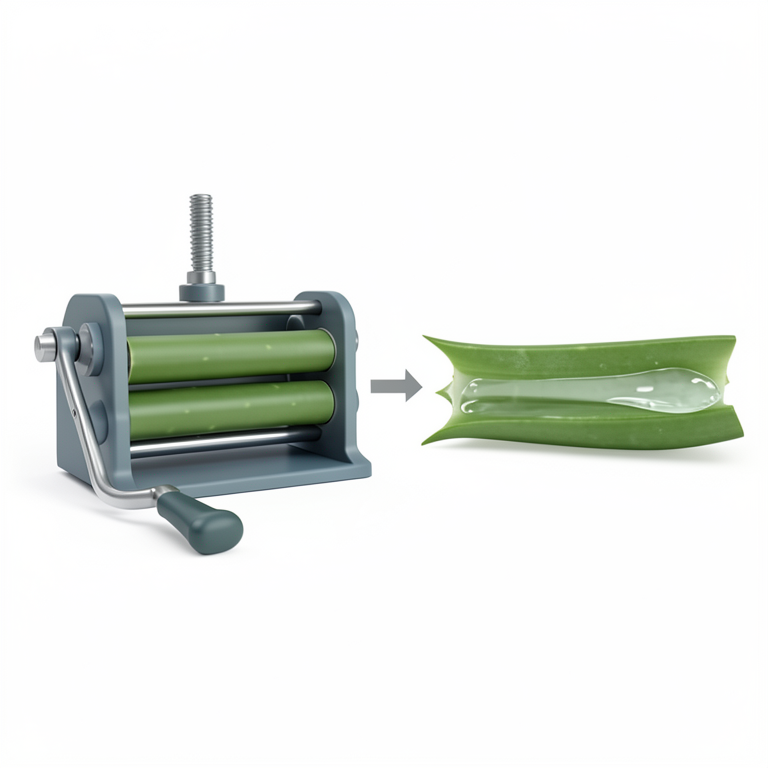
Conceptual Design of the Extractor
AI-generated conceptual illustration (hand-operated Aloe vera gel extractor machine and Aloe vera leaves). It explains the idea and does not show study data.
View source evidence ↗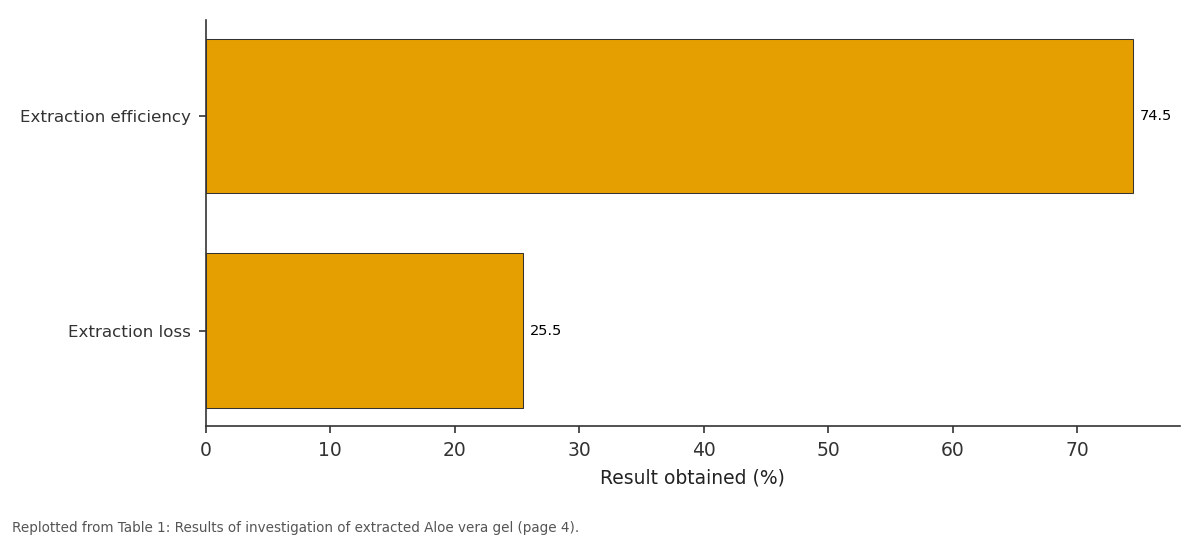
Result obtained (%): Extraction efficiency vs Extraction loss
Replotted from Table 1 (page 4) of the original paper. Every bar is the paper's own table value.
View source evidence ↗Figures & tables
From the original paper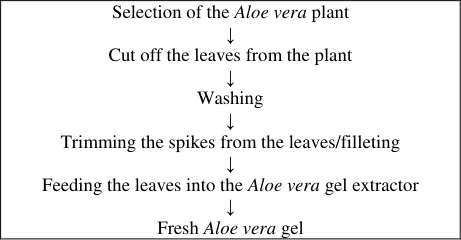 Figure 2
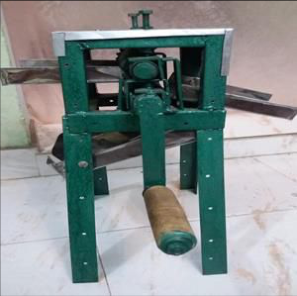 Figure 3
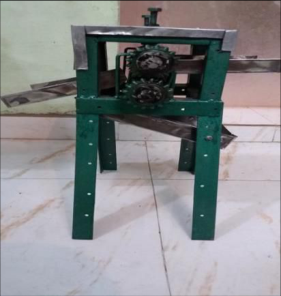 Figure 3
 Table 1
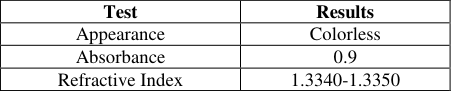 Table 2
Introduction
Aloe vera requires tropical, sub-tropical climatic conditions with a very sunny position and a well-drained loamy soil. Plants are tolerant of poor soils (Farooqi and Sreeramu, 2001) [3] . Aloe vera has been used externally to treat various skin conditions such as cuts, burns and eczema. It is alleged that sap from Aloe vera eases pain and reduces inflammation. It has antiseptic and antibiotic properties which make it highly valuable in treating cuts and abrasions. It has also been commonly used to treat first and second-degree burns, as well as sunburns and poison oak, poison ivy, and poison sumac infections, and eczema. It can also be used as hair styling gel and works especially well for curly or fuzzy hair. It is also used for makeup, moisturizers, soap, sunscreens, shampoos and lotions. Aloe vera gel is useful for dry skin conditions, especially eczema around the eyes and sensitive facial skin. Its juice may help some people with ulcerative, an inflammatory bowel disease. Aloe has been marketed as a remedy for coughs, wounds, ulcers, gastritis, Diabetes, Cancer, headaches, arthritis immune-system deficiencies and many other conditions when taken internally. Many other companies are secondary processors of Aloe vera products, and cosmetics firms and chain store often buy the gel for incorporation into their own brand name products (Grindlay and Reynolds, 1986) [4] . However, the general internal use is as a laxative. In order to complete process, the extraction process within available period of time, large scale producers have to engage more extractors and hence it leads to more chemical use & increased cost. Although work has been done on the Aloe vera gel extractors, but these extractors were costly and for large scale. Shafi et al., (2000) [5] developed a commercially viable process for preparing a stable and pharmacological active crystalline substance from the fresh whole leaf meal and tested the product on experimental animals and volunteers for wound healing remedy for all kinds of all damaged skin conditions. The manual extraction method of processing Aloe vera leaves was developed to avoid contaminating the internal fillet with the yellow sap.
In this method the rind is removed by sharp knife, keeping anthraquinone level low, but most of the mucilage is left on the working table in this process (Pal et al., 2013) [7] . Therefore, there was requirement of developing such type of extractor suitable for small scale. Under these circumstances designing and fabrication of hand operated Aloe vera gel extractor was taken up as a project. The study was carried out to design and fabricate Aloe vera gel extractor keeping above points in view. The present investigation has been carried out with the following objectives: 1. To modify and fabricate Aloe vera Gel extractor. 2. To evaluate the performance of Aloe vera gel and quality of gel.
Materials
Extraction of Aloe vera gel is difficult as the leaves were of varying shapes and have thorny outer edge. In order to ease the processing and to reduce material loss, effective method for extraction of gel at production level was developed. A gel extraction machine was made which consisted of two pairs of mild steel rollers arranged in horizontal plane. The roller was so arranged that it helps in compression and thereby extraction of the gel from leaves. During this research work for fabrication of Aloe vera gel extractor, frame was made of mild steel, Handle, made up of mild steel and coated with wooden, was used as the power source for Movement of the rollers. The power was transmitted from handle to roller through gear system fitted in two shafts on which the rollers were mounted. For power transmission, shaft and handle were used. Rollers were made of mild steel so that slippage could be controlled during the gel extraction processing. The work was done at Design and Development Centre, Sam Higginbottom Institute of Agriculture Technology & Science, Allahabad.
Description of Machine
The main components of the machine include handle, rollers, spur, gears, two horizontal shafts on which both mid steel rollers were mounted, main frame and the trough. In the operation the rollers convey, crushes and presses with the aid of worm shaft until the gel is squeezed out. The power is generated for Aloe vera gel extraction by using two sets of rollers. Rollers were mounted on a shaft, which helps in the movement of the rollers. When the spur gear moves the rollers move with peripheral velocity and thus Aloe vera leaf were crushed and gel is extracted. Adjusting screw helps to adjust the clearance between the two rollers, two troughs are also placed for inserting the leaves and collecting the gel respectively. To fabricate the Aloe vera gel extractor the different parts of the machine was made at Sam Higginbottom Institute of Agriculture, Technology & Science (SHIATS), Allahabad. The description of different parts is given below under different heads.
Frame:
The frame is made of mild steel which is detachable & can be moved from one place to another. The frame was made of mild steel only because it's strong enough to handle the machine. But to facilitate more proper extraction of gel, the machine needs to be fixed with the help of bolt and nut provided on all four legs of the frame. Two sets of rollers were fixed on the frame. This forms the base of the machine.
Rollers: They were made of mild steel. Rollers were the pressing and crushing unit of the extractor which helps in extracting gel from Aloe vera leaves. Chandegara and Varsheny (2014) [2] reported that the gel recovery was affected by roller speed, leaf weight, leaf size and leaf shape and also leaf thickness. The diameter of each roller is 4.5 cm.
Handle: It is made of mild steel. Wooden coating is provided for better handling of machine. The handle can be considered as the main power transmission part of the machine as the main power i.e., manual power is provided via the handle. The speed variation can also be given through the handle of the extractor.
Trough: Both troughs are made of stainless steel. It helps to convey the extracted gel from the extractor to collector. One trough is provided just with the rollers having inclined end and other is just beneath the roller so that the gel goes directly into the container without being exposed to the air for long time. Moreover, this will extract gel separately rather than with leaves and provide pure and dust-free gel to the consumers.
Spur gear: Gears were made of mild steel. They were used for power transmission. They consist of a cylinder or disc with the teeth projecting radially, and although they were not straight sided in form (They were usually of special form to achieve constant drive ratio, mainly involutes), the edge of each tooth is straight and aligned parallel to the axis of rotation. Each gear consists of 16 teeth.
Adjusting screw: It is attached with the upper covering of the gel extractor so that the two horizontal rollers can be adjusted to maintain the clearance between them. This would help us in extraction of the gel up to its maximum capacity or say up to the level when reaches its rupture point. These adjusting screws serve the main function of maintaining clearance between the rollers. Screws were provided to adjust to adjust the clearance between the rollers according to the thickness of the Aloe vera leaf. Two sets of screws were provided just above the covering. By rotating the screw clockwise clearance can be decreased and by rotating anticlockwise clearance can be increased. Maximum clearance between the rollers can be increased to 1 cm.
Methods
Methods
Extraction of gel
The process of Aloe vera gel extraction was carried out in following steps such as washing of Aloe vera leaf, filleting or trimming, feeding the leaves in Aloe vera gel extractor and then rinsing of fresh gel with cool water to remove any kind of bitterness.
Selection of the
Selection of the
Working of hand operated Aloe vera gel extractor
The Aloe vera gel extraction equipment for extracting gel was developed through fabrication and designing the machine as a project at Sam Higginbottom Institute of Agriculture, Technology & Sciences (Formerly A.A.Ideemed university), Allahabad. This machine is suited for freshly harvested Aloe vera leaves and not suitable for the leaves harvested even a day ago as the gel in the leaves accumulates and becomes very thick and sticky. This extractor consists of two rollers mounted on two shafts, a set of spur gears, adjusting screw, main frame and a wooden coated handle for manual power transmission. The rollers were made of mild steel as the material has low slippage than others. The Aloe vera leaf is inserted in between the two horizontally placed rollers. The clearance between the rollers is adjusted with the help of adjusting screws according to the thickness of the leaf. The rollers were set to work by providing manual power with the aid of the handle, which is made up of mild steel and coated with wood to enhance its working.
Gel Quality
Refractive Index is the physical property of gel determines the purity of gel as compared to double distilled water and Total Soluble Solid content of gel. Gel with lowest refractive index, is the treatment for extraction process. More refractive index indicates the impurities in the extracted gel. Refractometer was used for the measurement of refractive index having range of refractive indices between 1.3000 and 1.7000 with an accuracy of +0.0002. It was calibrated with known refractive indices i.e., double distilled water (1.323). Two drops of Aloe vera gel were placed on the refractometer prism surface and was closed carefully. The mirror was adjusted until the reading was sharp. The instrument had been allowed to stand for a few minutes before the reading was taken so that the sample and instrument came to equilibrium. The reading was taken when the blue and yellow shade crossed the cross mark.
Refractive index is the physical property of gel which determines the purity of gel as compared to double distilled water.
Optical Density is the measure of transparency of liquid and also a measure of quality for Aloe vera gel. Colorimeter was used for the determination of optical density, which gives the direct reading of absorbance. It was set on transmittance.
It was also set according to wavelength (for aloe gel 650 nm) and set 100% transmittance for blank sample or distilled water. Efficiency Test is the measure of total amount of gel extracted from the amount of Aloe vera leaves feuded. 2 kg of the Aloe vera leaves were used for the efficiency test out of which 1.49 kg gel was extracted which was about 74.5% of the total volume.
Results and Discussion
The hand operated Aloe vera gel extractor was made and evaluated at Sam Higginbottom Institute of Agriculture, Technology and Sciences (SHIATS). This chapter deals with the results of the test conducted on the Aloe vera leaves and the analysis and interpretation of experimental data obtain during operation of the hand operated Aloe vera gel extractor. As per the objectives, we modified and fabricated Aloe vera gel extractor.
Then according to the thickness of leaves roller diameter was selected and fabricated. The extractor was first evaluated in laboratory by extracting gel form Aloe vera leaves. Gel extraction efficiency and extraction loss was measured to be 74.5% & 25.5% respectively. Purity of gel extracted can be determined by refractive index. The total cost of the extractor was Rs. 6500.
To modify and fabricate Aloe vera gel extractor
We had made the hand operated Aloe vera gel extractor by adjusting the two different trough which was changed with its position and the hopper was also made compact so that the gel could extracted hygienically. The two troughs help to extract gel and leaves separately. The two adjusting screw helps to set the Aloe vera leaves automatically according to their shape and sizes. In the pressing chamber, the rollers mounted on the worm shaft conveyed, crushed and pressed the leaves in order to extract the gel and avoid crushing of leaves.
Fig 3-4: Aloe vera gel extractor
To evaluate the performance of Aloe vera gel and quality of gel Fresh Aloe vera leaves were obtained from horticultural garden in Allahabad. Hani et al. (2012) [1] reported that the Aloe vera leaves with maximum weight recorded maximum gel recovery (42.73%) whereas the Aloe vera leaves with minimum weight recorded minimum gel recovery (29.18%) in manual extraction for medium trimmed Aloe vera leaves (140 to 200 g). The leaves were washed and weighed. The extractor was set into operation and the leaves were introduced through feeding rollers. In the pressing chamber, the rollers mounted on the worm shaft conveyed, crushed and pressed the leaves in order to extract the gel and avoiding crushing of leaves. It was observed that as the roller speed increased the gel recovery (%) increased at constant roller clearance. Khambalkar et al., (2007) [6] . Both the gel extracted, and residual waste were collected and weighed respectively and also quality of gel has been found with the help of refractive index, the maximum and minimum refractive index was found to 1.33603 and 1.33610. The refractive index of the pure gel was found to be closer to distilled water at all. Also absorbance was found with the help of optical density. The maximum value was found to be 0.244 at 32 degrees Celsius and minimum at 5 degrees Celsius.
Figures and tables from the paper
| S. No | Test parameters (%) | Result obtained (%) |
|---|---|---|
| 1 | Extraction efficiency | 74.5 |
| 2 | Extraction loss | 25.5 |
Table text extracted from the original PDF; superscript letters are shown inline. The original table image is below.
View original table image
| Test | Results |
|---|---|
| Appearance | Colorless |
| Absorbance | 0.9 |
| Refractive Index | 1.3340-1.3350 |
Table text extracted from the original PDF; superscript letters are shown inline. The original table image is below.
View original table image
References
6 in the original paper- Bog Hani AH, Abdul R, Hashmi SI. Development and storage studies of blended papaya-Aloe vera Ready To Serve (RTS) Beverage. Journal of Food Processing & Technology. 2012;3(10):1-4.
- Chandegara VK, Varshney AK. Design and development of leaf splitting unit for Aloe vera gel expulsion machine. The Journal of Food Process Engineering. 2014;37(4):427-437.
- Grindlay D, Reynolds T. The Aloe vera phenomenon: a review of the properties and modern uses of the leaf parenchyma gel. Journal of Ethnopharmacology. 1986;16(2-3):117-151.
- Shafi N, Khan GA, Khan L. Commercial extraction of gel from Aloe vera (L) leaves. Journal of the Chemical Society of Pakistan. 2011;22(4):47.
- Khambalkar, Khambalkar VP, Thakur KB, Sawant A, Dahatonde S, Karale DS. Preservation of Aloe vera leaf juice by different methods. The Asian Journal of Experimental Chemistry. 2007;2(1):10-14.
- Pal S, Sahrawat A, Prakash D. Aloe vera: Composition, processing and medicinal properties. Curie Discovery. 2013;2(2):106-122.
Cited by 1
From OpenAlex, OpenCitations and reference lists read by Scinovex
- Tissue Engineering Applications of Aloe vera L. Burm. F.: A Comprehensive Review ↗
Indira M. N., B. Sudarsini, Naga Lakshmi A, Thirupati Chinna Venkateswarulu · Regenerative Engineering and Translational Medicine · 2025
❝ 0