
Research article · 2022 · Full text
International Journal of Biology SciencesGrowth and production of pacific white shrimp Litopenaeus vannamei (Boone, 1931) with different stocking densities in semi-intensive brackishwater liner ponds, Chennai, India: Technical report
Volume 4(2) · Pages 28–29 · DOI: 10.33545/26649926.2022.v4.i2a.71 ↗
Research areasFish Biology and Ecology StudiesAquaculture Nutrition and Growth
Abstract
Author-writtenPacific white shrimp (Penaeus vannamei) is one of the main fishery products in fisheries sector. It has suitable for farming, stable production, easy to stocking high density, and highly diseases resistance. Most of the farmers in India choose to cultivate vannamei shrimp. Moreover, there are still other advantages of vannamei shrimp, its euryhaline species. No proper research yet been recorded on the effect of stocking density in survival rate and growth performance of L. vannamei. The aim of this report was to evaluate the growth, survival, and production performance of white shrimp (P. vannamei) in brackishwater liner ponds at different stocking densities.
Summary
Source-checkedPlain-language reading of the full paper, prepared with AI and checked against the text. Each point links to the authors' own words.
Why it matters
- Pacific white shrimp (Penaeus vannamei) is a primary fishery product valued for its stability in production, disease resistance, and suitability for high-density farming. View evidence ↗
- Brackishwater aquaculture is a rapidly expanding food sector due to the high market demand, export value, and fast growth rates of shrimp. View evidence ↗
- To maximize profit per unit area, aquaculture has shifted toward intensification, utilizing higher stocking densities and artificial feeds. View evidence ↗
The question
- The study aimed to evaluate how different stocking densities in brackishwater liner ponds affect the growth, survival, and overall production of P. vannamei. View evidence ↗
What they did
- The research was conducted at the Brackishwater Research Farm Facility (BRFF) in Vaniyanchavadi, Chennai, India. View evidence ↗
- Post larvae with an initial weight of 0.9 g were cultured for 120 days in three liner ponds (230, 323, and 333 m²) at stocking densities of 38, 100, and 135 shrimp/m², respectively. View evidence ↗
What they found
- The study found a direct inverse relationship where survival rates decreased as stocking densities increased. View evidence ↗
- Low stocking densities (referenced as 30/m² in the discussion) were associated with increases in both average body weight and survival rate. View evidence ↗
- The authors note a specific observation that yield at 100 pcs/m² was decreased compared to 135 pcs/m², though this appears to contradict the production numbers listed in the results section. View evidence ↗
What it means
- The authors conclude that low stocking density (Pond P1) is more profitable because it produces shrimp with higher survival and body weight, which command a higher market price (50 count). View evidence ↗
- The authors recommend that stocking densities should be determined based on the specific carrying capacity of each pond to optimize growth and production. View evidence ↗
Visual summary
1 visualsIllustrations explain the paper; they do not show study data.
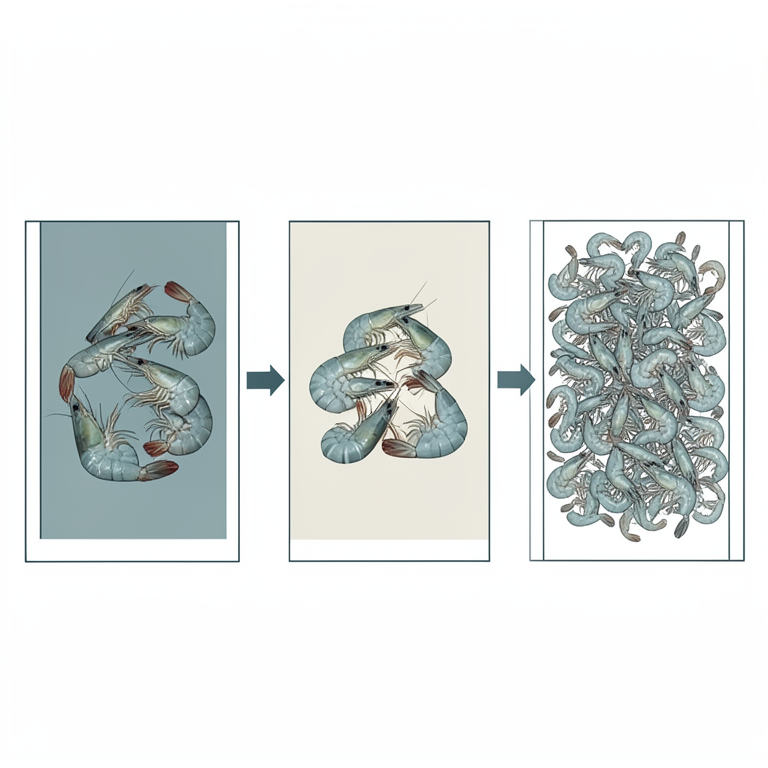
Relationship between Stocking Density and Shrimp Health
AI-generated conceptual illustration (Pacific white shrimp (Litopenaeus vannamei) in brackishwater liner ponds). It explains the idea and does not show study data.
View source evidence ↗Introduction
Brackishwater aquaculture is one of the fastest-growing food sectors in the world. The faster growth rate of shrimps, minimum culture period, more export value and always demand in the market. In the recent years aquaculture intensification has become a common practice throughout the world. Farmers are reporting with higher stocking densities, artificial fertilization of the ponds and supplementary feeding using artificial feeds to get the maximum profit from a unit area.
Pacific white shrimp is most cultivated shrimps all over the world (Perez Farfante and Kensley 1997) [8] and favorable environmental conditions (Zhu et al., 2006) [15]. Many authors are detailed about growth of shrimp culture systems based on stocking density (Cailout et al., 1976; Sedgwick 1979; Maguire and Leedow 1983) [3, 11, 7] and reported the similar of several authors about the inverse relationship between the stocking density and growth (Lee et al., 1986; Sandifer et al., 1987; Whay-Ming and Yew- Hu, 1992; Daniels et al., 1995) [6, 10, 13]. The objective of this study was to evaluate the effect of stocking density and growth performance in the white shrimp Litopenaeus vannamei in the liner ponds and culture period was 120 days. The present study is carried out at Brackishwater Research Farm Facility (BRFF) Vaniyanchavadi, Chennai, India.
During the stocking density of L. vannamei post larvae with an initial weight of 0.9 g were cultured for 120 days at a stocking density of 38, 100, and 135 shrimp/m2 and three liner ponds measured at 230, 323 and 333 m2 in respectively.
Discussion
After the 120 days period reached the production was 153 kg, 202 kg and 112 kg, and survival rate was 70%, 39% and 19% and average body weight was 20 g, 16 g and 13 g, respectively. Allan and Maguire (1992) [1] reported that higher stocking densities of shrimp it’s indicating of slow growth. Kungvankij and Chua, (1986) [5] and Tidwell et al., (1999) [12] also stated that best economic results were possible at optimum stocking density and that may depend upon the area of the pond. They also stated that in culture system different stocking densities will be used for different shrimp species.
Roethlisberg (1998) [9] stated that increasing density and shrimp biomass had negative effect on growth. In the present study also it was clearly indicated that at 100 pcs/m2 of stocking density the yield was decreased compared to the 135 pcs/m2. https://www.biologyjournal.net/ production and populations structure of fresh water prawn Machrobrachium rosenbergii. J. World Aquaculture Society. 1999;30:174-179. 13.
Whay-Ming R, Yew-Hu C. Effects of stocking density and sediment on tiger prawn, Penaeus monodon, nursery system. Aquaculture. 1992;104:231-248. 14. Wyban JA, Sweeney JN, Kanna RA.
Shrimp yields and economic potential of intensive round pond systems. J. World Aquacult. Soc. 1987;19:210-217. 15.
Zhu C, Dong SL, Wang F. The interaction of salinity and Na/K ratio in seawater on growth, nutrient retention and food conversion of juvenile Litopenaeus vannamei. J. Shellfish Res. 2006;25(1):107-112.
Survival rate of growing L. vannamei were 70%, 39% and 19% with respect to the densities 38/m 100/m, and 135/m2 respectively. The present study showed that, the survival rate and average body weight also increased in low stocking densities of 30/m2 pond. The survival rate decreased with the increasing stocking densities of pond. Wyban et al., (1987) [14] stated the suitable stocking densities for L. vannamei were 5 to 21 pcs/m2 and Sandifer et al., (1987) [10] stated it was 10 to 40 pcs/m2 for P. monodon.
Conclusion
The end result, Survival and Average body weight is higher in low stocking density of pond no:P1 than the other 2 ponds which are stocked at higher densities and also pond No.P1 is more profitable than other ponds due to higher market price for 50 count harvested shrimps. In the present study, it was concluded that, stocking density need to be fixed primarily based on the carrying capacity of each pond, based on that the Growth and production of shrimps will be achieved.
References
12 in the original paper- Allan GL, Maguire GB. Effect of stocking density on production of Penaeus monodon model farming systems, Aquacult. 1992;107:49-66.
- Boyd CE. Water Quality in ponds for aquaculture. Agriculture Experiment Station. Auburn University., Alabama, U.S.A, 1990, 482.
- Cailout CW, Norris JP, Herald EJ, Tabb DC. Growth and yield of pink shrimp (Peneaus duorarum)) in feeding experiments in concrete tanks. Transactions of the American fisheries Society. 1976;105:259-266.
- Daniels WH, Abramo D, Fonden Durant MD. Effects of stocking density and feed on pond production characteristics and revenue of harvested freshwater prawns Machrobrachium rosenbergii stocked as size – graded juveniles. J. World Aquacult. 1995;26(1):38-47.
- Kungvankij P, Chua M. Shrimp culture: pond design, aeration, and management. FAO, NACA training manual Series No, 1986, 20,
- Lee CS, Sweeney J, Richards WK. Marine Shrimp aquaculture: A novel waste treatment system, Aquacultural Engineering. 1986;5:147-161.
- Maguire GB, Leedow MI. A study of the optimum stocking density and feed for school prawns Metapenaeus maleayi (haswell) in some Australian brackish water farming ponds. Aquaculture. 1983;30:285-297.
- Perez Farfante I, Kensley B. Penaeoid and Sergestoid shrimps and prawns of the world. Key and diagnoses for the families and genera. Memoires du Museum national d’Histoire naturelle, Paris. 1997;175:1-233.
- Rothlisberg PK. Aspects of penaeid biology and ecology of relevance to aquaculture: A review. Aquacult. 1998;164:49-65.
- Sandifer PA, Hopkins JS, Stokes AD. Intensive culture potential of Penaeus vannamei. J. World Aquacult. So. 1987;18(2):94-100.
- Sedgwick TW. Effect of ration size and feeding frequency on the growth and feed conversion of Juvenile Penaeus merguensis de Man. Aquaculture. 1979;16:279-298.
- Tidwell JH, Coyle S, Weibel C, Evans J. Effects and interactions of stocking density and added substrate on
Cited by 1
From OpenAlex, OpenCitations and reference lists read by Scinovex
- Decapod crustacean biodiversity in Tawi-Tawi, Philippines: A baseline assessment using environmental DNA (eDNA) metabarcoding ↗
Romelyn Q. Delostrico, Kozo Watanabe, Dan Joseph Logronio, Karen Mae G. Pinsoy, Ivane R. Pedrosa‐Gerasmio · Estuarine Coastal and Shelf Science · 2026
❝ 0