
Research article · 2023 · Full text
International Journal of Agriculture Extension and Social DevelopmentConstraints faced by farmers by utilizing ICT tools in agricultural production
Volume 6(1) · Pages 41–43 · DOI: 10.33545/26180723.2023.v6.i1a.170 ↗
Research areasAgricultural Economics and PracticesAgricultural Innovations and Practices
Abstract
Author-writtenThe present investigation is conducted in Marathwada region of the Maharashtra state during 2021-2022 with the objective to study “Attitude of farmers towards use of information and communication technology on agricultural production and marketing”. Parbhani district was selected randomly from Marathwada region. Three talukas from Parbhani district and five villages from each talukas were selected randomly for the study. From each selected village, ten farmers were selected randomly on the basis of awareness about ICT tools to acquire farm knowledge in this way total 150 respondents were considered for the study. An Ex-post-facto research design was followed for the study. Data was gathered using a well-structured interview schedule created with the study's objectives in mind. The collected data was analysed, classified and tabulated. Statistical tools such as frequency, percentage, mean, standard deviation, and coefficient correlation were used to interpret findings and draw conclusions. Among the 150 selected farmers various constraints faced by respondents while using the ICT tools and techniques were, Lack of awareness of proper functioning about ICT tools (69.33%), Lack of training of the farmers towards use of different ICT tools (68.00%), Inadequate internet supply (67.33%), Lack of uninterrupted power supply (66.00%), Difficulty in understanding the content language of ICT gadgets (66.67%), Lack of local language in handling and understanding of software (66.67%), Poor mobile/internet connectivity in rural areas (66.00%) and beyond this some other constraints also faced by farmers.
Summary
Source-checkedPlain-language reading of the full paper, prepared with AI and checked against the text. Each point links to the authors' own words.
Why it matters
- Agriculture is a critical sector because most rural populations in developing countries rely on it for their survival. View evidence ↗
- Information and Communication Technology (ICT) can improve agricultural productivity by providing essential data on soil fertility, crop protection, and sowing. View evidence ↗
- ICT tools help farmers secure fair returns by providing reliable access to daily produce updates and the best local market prices. View evidence ↗
The question
- The study aimed to investigate the attitudes of farmers regarding the use of ICT for agricultural production and marketing. View evidence ↗
What they did
- The research was conducted in the Marathwada region of Maharashtra state between 2021 and 2022. View evidence ↗
- The study used a random sampling method to select 150 respondents from ten farmers in each of the five villages across three talukas in the Parbhani district. View evidence ↗
- Data was collected via a structured interview schedule and analyzed using statistical tools including frequency, percentage, mean, standard deviation, and coefficient correlation. View evidence ↗
What they found
- The most significant constraint reported by farmers was a lack of awareness regarding the proper functioning of ICT tools, affecting 69.33% of respondents. View evidence ↗
- A lack of training on how to use various ICT tools was a major barrier for 68.00% of the farmers. View evidence ↗
- Inadequate internet supply was identified as a constraint by 67.33% of the respondents. View evidence ↗
- Language barriers were prevalent, with 66.67% of farmers struggling with the content language of gadgets and the lack of local language in software. View evidence ↗
- The majority of the respondents (67.33%) belonged to the middle age group. View evidence ↗
- Despite the constraints, a high percentage of respondents (76.77%) utilize ICT on a daily basis. View evidence ↗
What it means
- The authors conclude that it is necessary to implement training programs and ensure an uninterrupted power supply to overcome the identified barriers. View evidence ↗
Figures & tables
From the original paper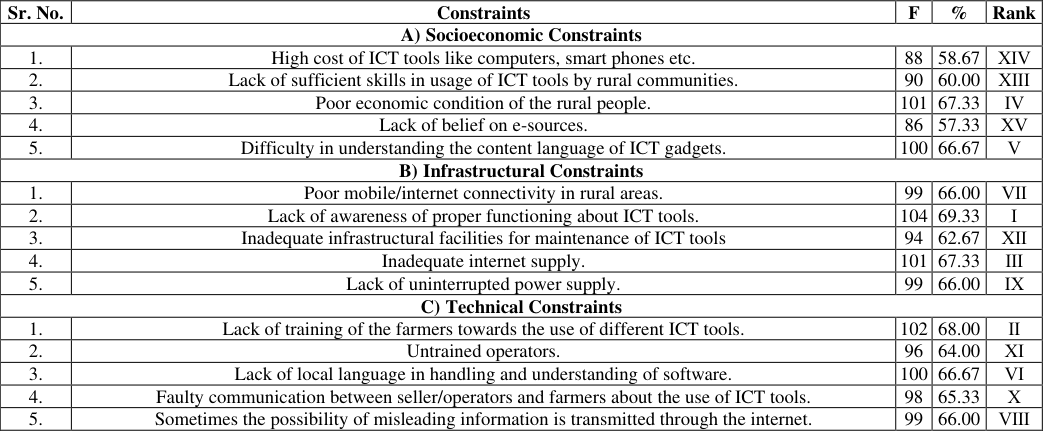 Table 1
Introduction
Information and Communication Technology (ICT) can revolutionize Indian farming sector and can benefit all farmers including small landholders. Agriculture is the most important sector with the majority of the rural population in developing countries depending on it. The traditional approaches of agriculture being adapted, has numerous challenges in terms of production, marketing, profit etc. In developing countries, ICT in agriculture provides farmers with vital information pertaining to sowing, crop protection, and improving soil fertility that enables them to improve agricultural productivity. Weather-related advisories and alerts help them prepare for sporadic events such as floods, drought, or even pest and disease outbreaks, thus preventing significant crop loss. ICTs also provide them with a reliable channel to seek the best market price in the local markets and other daily updates for their produce to ensure they receive fair returns. The increasing penetration of budgetfriendly mobile phones and the internet is an added advantage for farmers living in remote areas in several emerging nations. Access to inexpensive mobile devices has now made it easier for them to acquire additional information and services that enable informed decisionmaking. The challenges of the traditional agriculture are addressed significantly by using Information and Communication Technologies (ICT) that play an important role in uplifting the livelihoods of the rural small landholder farmers. ICT helps in growing demand for new approaches. It also helps in empowering the rural people by providing better access to natural resources, improved agricultural technologies, effective production strategies, markets, banking and financial services etc. to know the awareness of farmers on ICT and its impact on marketing and economic conditions in agriculture with the following objectives. Specific objectives of the study-1. To study the profile of respondents. 2. To know the constraints faced by respondents for use of ICT tools and obtain their suggestions.
Materials and Methods
The present study is conducted in Marathwada region of the Maharashtra state during 2021-2022. In Marathwada region Parbhani District of Maharashtra State is selected due to the reason of Vasantrao Naik Marathwada Krishi Vidyapeeth is situated in the Parbhani district and it is a hub for agricultural training programs for the farmers to implement various improved agricultural practices. There are nine talukas in Parbhani district out of which three talukas namely, Parbhani, Manwath, Sailu selected for present study. From each of the selected taluka, five villages were selected randomly. Thus fifteen villages were selected for the present study. From each selected village, ten respondents were selected randomly, those having mobile www.extensionjournal.com phones with internet facilities and engaged in agricultural operations were selected, in this way total one hundred fifty respondents were considered for the present study. "Expost-facto" research approach was used for study. Data was gathered using a well-structured interview schedule created with the study's objectives in mind. The collected data was analysed, classified and tabulated. Statistical tools such as frequency, percentage, mean, standard deviation, and coefficient correlation were used to interpret findings and draw conclusions.
Education
Most of the respondents i.e. 24.00% of the respondents were educated up-to middle school level, while 16.00 percent of the respondents educated up-to primary school level followed by 12.67 percent of respondents were able to read and write only. Very few respondents were illiterate i.e. 9.33 percent.
Occupation
Maximum no of the respondents i.e. 24.00% of the respondents were educated up-to middle school level, while 16.00 percent of the respondents educated up-to primary school level followed by 12.67 percent of respondents were able to read and write only. Very few respondents were illiterate i.e. 9.33 percent.
Family size
Most of the respondents i.e. 40.00% belonging to large sized family, followed by small sized family 33.33 percent and then medium sized family i.e. 26.67 percent.
Farming experience
Most of the respondents having high level of farming experience (51.33%), followed by medium level i.e. 28.00 percent and remaining respondents had low level of farming experience i.e. 20.67 percent.
Utility of ICT in extension
Most of the respondents utilize ICT daily (76.77%), followed by utility once in a week i.e. 12.67 percent and then 10.67 percent respondents utilized occasionally.
Methods of learning ICT skills
Most of the respondents get awareness about new technologies from e-learning, followed by workshops i.e. 35.33 percent and very few respondents get from conferences i.e. 17.33 percent. www.extensionjournal.com
Sources of awareness about ICT
Most of the farmers (77.33%) had medium source of awareness about ICT, followed by high level of awareness i.e. 16.67 percent and very few respondents near about 6.00 percent had low level of awareness about ICT.
Knowledge
Most of the respondents had medium level 60.67% of knowledge about ICT tools followed by low level of knowledge i.e. 33.33 percent and then high level of knowledge about 6.00 percent. [4] , Jamdhade (2015) [1] and Mittal and Mehar (2016) [2] . Nowadays some other problems beyond the common one also faced by respondents like Sometimes possibility of misleading information transmitted through internet (66.00%), Lack of uninterrupted power supply (66.00%), Faulty communication between seller/operators and farmers about use of ICT tools (65.33%), Untrained operators (64.00%), Inadequate infrastructural facilities for maintenance of ICT tools (62.67%), Lack of sufficient skills in usage of ICT tools by rural communities (60.00%), High cost of ICT tools like computers, smartphones etc. (58.67%), Lack of belief on e-sources (57.33%). also, the above findings was in accordance with Naik (2018) [3] .
Conclusion
The major constraints faced by the farmers were lack of awareness of proper functioning about ICT tools, lack of training of the farmers towards use of different ICT tools, inadequate internet supply, lack of uninterrupted power supply, difficulty in understanding the content language of ICT gadgets, poor mobile/internet connectivity in rural areas. To overcome the constraints the major suggestions provided by farmers were provide uninterrupted power supply in rural area, agriculture marketing related information should be provide in local language, affordable cost of ICT gadgets like smartphone, computer etc, provide free of cost internet/wifi service in rural area. According to the study, the major constraints were lack of training on uses, inadequate internet supply, and difficulty in understanding the language of electronic gadgets and so on, that's why it is necessary to arrange the training programme and also the supply of uninterrupted power supply.
Figures and tables from the paper
| Sr. No. | Constraints | F | % | Rank |
|---|---|---|---|---|
| A) Socioeconomic Constraints | ||||
| 1. | High cost of ICT tools like computers, smart phones etc. | 88 | 58.67 | ⅩⅣ |
| 2. | Lack of sufficient skills in usage of ICT tools by rural communities. | 90 | 60.00 | ⅫⅠ |
| 3. | Poor economic condition of the rural people. | 101 | 67.33 | Ⅳ |
| 4. | Lack of belief on e-sources. | 86 | 57.33 | ⅩⅤ |
| 5. | Difficulty in understanding the content language of ICT gadgets. | 100 | 66.67 | Ⅴ |
| B) Infrastructural Constraints | ||||
| 1. | Poor mobile/internet connectivity in rural areas. | 99 | 66.00 | Ⅶ |
| 2. | Lack of awareness of proper functioning about ICT tools. | 104 | 69.33 | Ⅰ |
| 3. | Inadequate infrastructural facilities for maintenance of ICT tools | 94 | 62.67 | Ⅻ |
| 4. | Inadequate internet supply. | 101 | 67.33 | Ⅲ |
| 5. | Lack of uninterrupted power supply. | 99 | 66.00 | Ⅸ |
| C) Technical Constraints | ||||
| 1. | Lack of training of the farmers towards the use of different ICT tools. | 102 | 68.00 | Ⅱ |
| 2. | Untrained operators. | 96 | 64.00 | Ⅺ |
| 3. | Lack of local language in handling and understanding of software. | 100 | 66.67 | Ⅵ |
| 4. | Faulty communication between seller/operators and farmers about the use of ICT tools. | 98 | 65.33 | Ⅹ |
| 5. | Sometimes the possibility of misleading information is transmitted through the internet. | 99 | 66.00 | Ⅷ |
Table text extracted from the original PDF; superscript letters are shown inline. The original table image is below.
View original table image
References
2 in the original paper- Mittal S, Mehar M. Socio-economic factors affecting adoption of modern ICT by farmers in India-Analysis using Multivariate Probit model. The Journal of Agricultural Education and Extension. 2015;22(2):199212.
- Agrarinformatika. Journal of Agricultural Informatics. 2015;6(3):24-41.
Cited by 3
From OpenAlex, OpenCitations and reference lists read by Scinovex
- Exploring the Constrained Faced by Farmer in Use of ICT Mediated Extension Services in Arghakhanchi District of Nepal ↗
Parmita Poudel, Kalyan Ghadei · Asian Journal of Agricultural Extension Economics & Sociology · 2024
A study was conducted to find out the profile characteristics of the respondents and constraints faced by farmers in usages of ICTs mediated extension services by the farmers of Arghakhanchi district of Nepal in 2020. A total of 180 farmers were randomly selected for the study from 6 wards of 2 municipality of the district. Data was collected by structured…
❝ 1PDF - Constraints faced by farm youth in the utilization of Information and Communication Technology (ICT) tools and suggestions to overcome these constraints
M Dhanush, Murugan PP, R Arunkumar, G Sree Madhumitha, S Ravaliselshiya · International Journal of Agriculture Extension and Social Development · 2025
The study was conducted in the Coimbatore district, Tamil Nadu, in 2023 to assess the extent of ICT tool utilization among farm youth, identify constraints, and gather suggestions for improvement. Coimbatore was purposively chosen due to its high youth population and ICT exposure. A total of 120 farm youth were selected from four randomly chosen blocks using proportionate random sampling. An ex-post facto research design was followed, and data were collected through personal interviews using a structured, pre-tested schedule. Statistical tools like frequency, percentage, mean, standard deviati
- Crop Disease Detection using Computer Vision ↗
International Research Journal of Modernization in Engineering Technology and Science · 2024
The rapid growth of global agriculture faces a pressing challenge in the form of crop diseases, threatening food security.This research delves into the domain of machine learning and deep learning models, utilizing leaf images for crop disease detection.It encompasses the role of Information and Communication Technology (ICT) tools in the agricultural land-scape's modernization, in-depth exploration of prevalent crop diseases along…
❝ 0PDF