
Research article · 2023 · Full text
International Journal of Agriculture Extension and Social DevelopmentPoultry management practices adopted by backyard poultry farmers of northern Karnataka
Volume 6(1) · Pages 01–06 · DOI: 10.33545/26180723.2022.v6.i1a.161 ↗
Research areasLivestock and Poultry ManagementAgricultural Systems and PracticesAgricultural Innovations and Practices
Abstract
Author-writtenThe poultry sector is the greatest way to satisfy the protein needs of a country. Backyard poultry farming will be used to meet the rural areas demand for eggs and meat. The study on adoption of poultry management practices by backyard poultry farmers was conducted during 2021-2022 in Northern Karnataka. Sixty backyard poultry farmers were randomly selected from each district to constitute a sample size of 120. The study reported that, half (50.00%) of the backyard poultry farmers were belonged to medium adoption, followed by low (33.33%) and high adoption (25.00%). The practice wise adoption showed that marketing (72.12%) was highly adopted followed by housing and feeding (55.24%) and watering (49.21%). The variables like education, extension contact, social participation, mass media exposure, economic motivation, scientific orientation and risk orientation had positive significant association with adoption of poultry management practices at one per cent level of significance.
Summary
Source-checkedPlain-language reading of the full paper, prepared with AI and checked against the text. Each point links to the authors' own words.
Why it matters
- The poultry sector is vital because it offers an affordable and accessible source of animal protein and provides income opportunities for unemployed youth and women. View evidence ↗
- Increasing backyard poultry production can enhance household food security by boosting dietary intake and creating revenue. View evidence ↗
- Adopting improved management practices is considered essential for positively impacting poultry production. View evidence ↗
The question
- The study aimed to evaluate the adoption of poultry management practices among backyard poultry farmers in Northern Karnataka between 2021 and 2022. View evidence ↗
What they did
- The research was conducted in the Dharwad and Belgaum districts of North Karnataka with a total sample of 120 randomly selected backyard poultry farmers. View evidence ↗
- Adoption levels were quantified using a scoring system where full adoption received 2 points, partial adoption 1 point, and no adoption 0 points. View evidence ↗
What they found
- Marketing had the highest adoption index at 72.12%, while housing and feeding (55.24%) and watering (49.21%) followed. View evidence ↗
- All 120 farmers (100%) fully adopted the provision of night shelter for their birds. View evidence ↗
- None of the farmers (0%) fully adopted the use of readymade feed. View evidence ↗
- A vast majority of farmers (90.83%) fully adopted the use of Desi bird breeds. View evidence ↗
- Vaccination against diseases had very low adoption, with 0% of farmers fully adopting the practice and 88.33% not adopting it at all. View evidence ↗
- Most farmers (87.50%) fully adopted treating their birds themselves rather than using professional services. View evidence ↗
- Selling produce at their own doorstep was fully adopted by 75.00% of the farmers. View evidence ↗
- The studied independent variables explained 89.30% of the variation in the adoption level of poultry management practices. View evidence ↗
What it means
- The authors conclude that there is a critical need for the concerned departments to create awareness and provide timely vaccinations due to the farmers' lack of knowledge on vaccination schedules. View evidence ↗
- The authors recommend that government and financial institutions launch joint schemes to provide technical and financial support to backyard poultry farmers. View evidence ↗
Visual summary
2 visualsIllustrations explain the paper; charts are replotted from the paper's own table values.
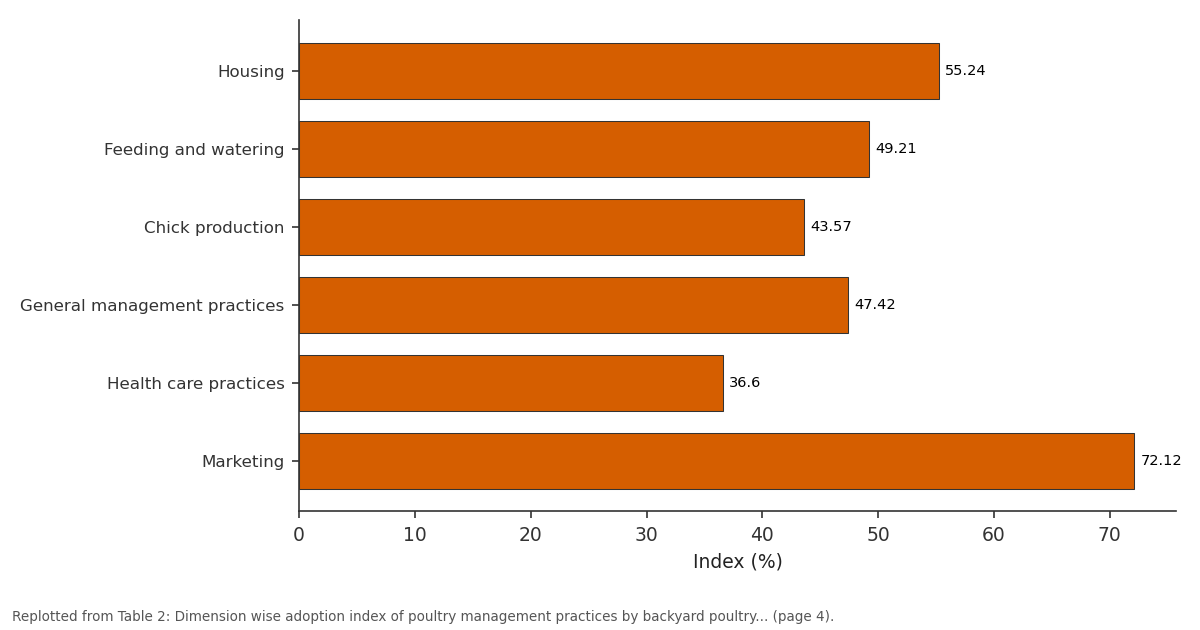
Index (%): Housing vs Feeding and watering vs Chick production vs General management... vs Health care practices
Replotted from Table 2 (page 4) of the original paper. Every bar is the paper's own table value.
View source evidence ↗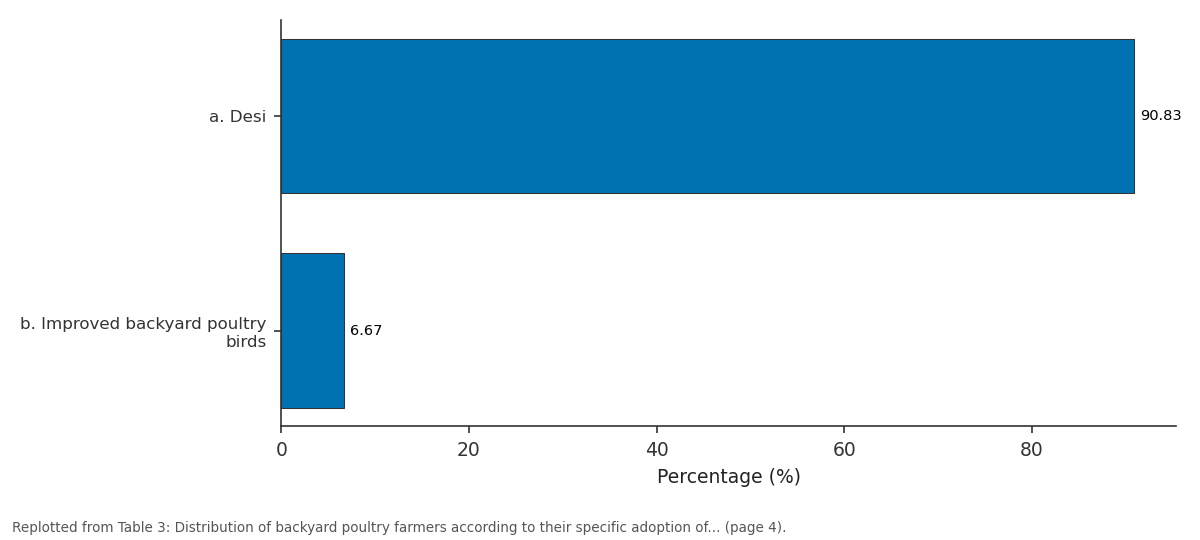
%: a. Desi vs b. Improved backyard...
Replotted from Table 3 (page 4) of the original paper. Every bar is the paper's own table value.
View source evidence ↗Figures & tables
From the original paper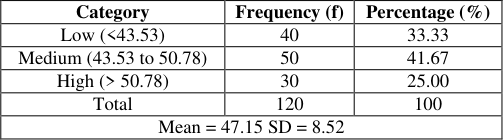 Table 1
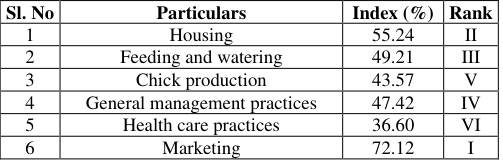 Table 2
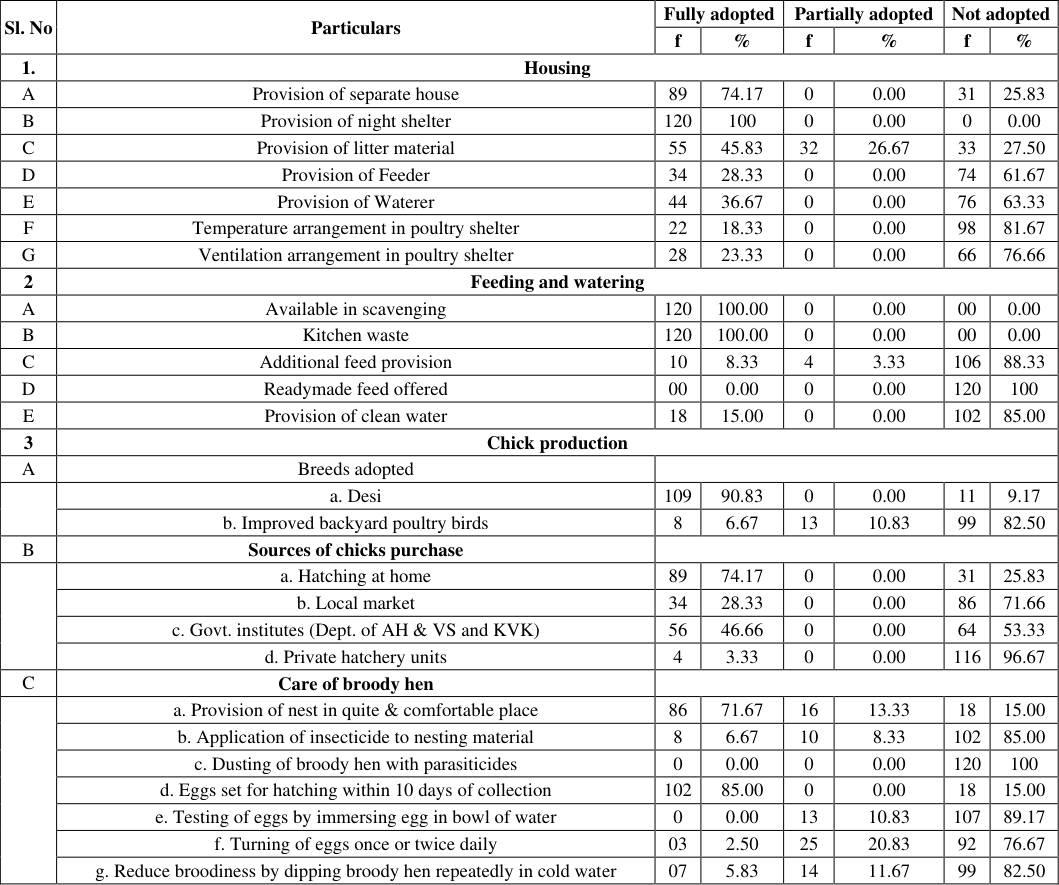 Table 3
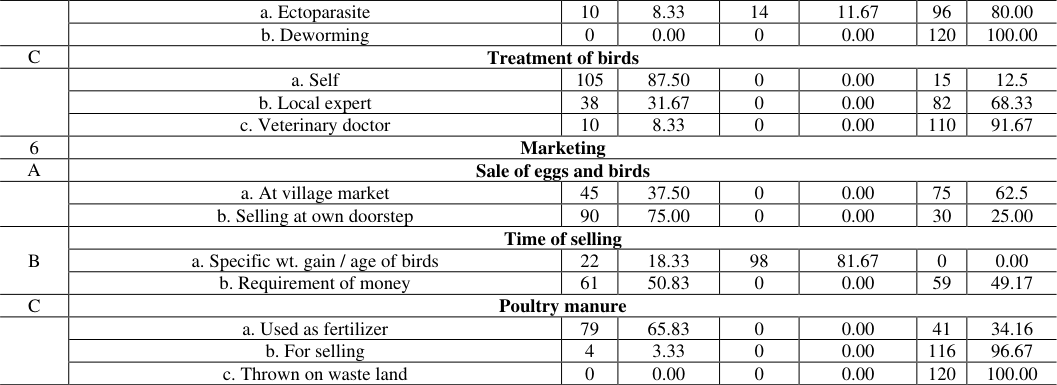 Table 4
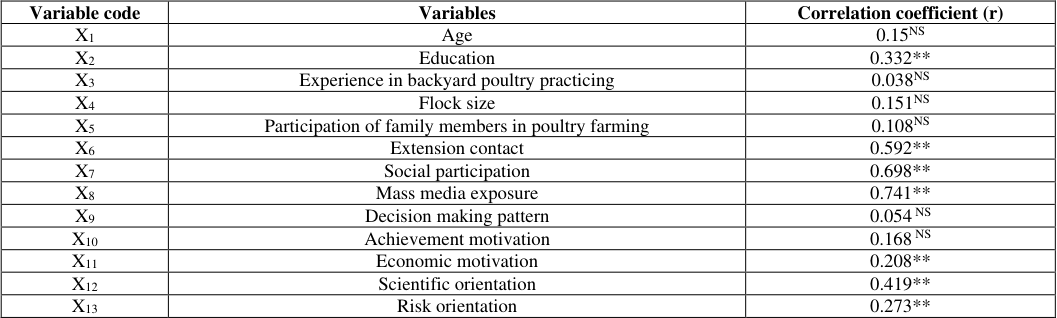 Table 4
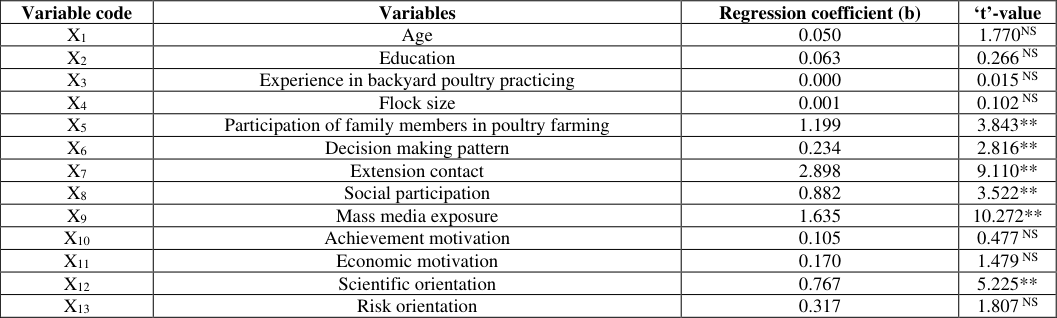 Table 5
Introduction
In recent years, biased ferrite material for microstrip antenna structures has attracted noticeable attention. Ferrite is one of the important magnetic materials which are used as in both types single and polycrystalline. Some novel characteristics of polycrystalline the global population growth is increasing at an alarming rate. However, this increased population demands for food and shelter. India is a developing nation and it's economic base is agriculture. Decline in cultivable lands and increased fragmentation of the agricultural lands leads to shortage of food. There is no guarantee that in the coming years there will be enough food to feed all the people. To tackle this issue, we have to enhance the production. The allied sectors like dairy, poultry and fisheries helps to overcome hunger, malnutrition and protein deficiency. One of the greatest sector for easing the multiple demographic challenges on agriculture is poultry farming. The word "poultry" refers to group of birds kept for their meat, eggs, feathers, game such as chickens, ducks, geese, turkeys, and guinea-fowls. In India, poultry consists of chickens, reared for both eggs and meat. The benefits of poultry as a readily accessible meat source is recognized on a global basis. The poultry sector is crucial to a country as it provides a significant source of more readily available and less expensive animal protein and is a viable source of income for women and young people without jobs. The poultry sector is the greatest way to satisfy the protein needs of a country. Any genetic stock, improved or unimproved and reared intensively or semi-intensively in relatively small numbers is considered as backyard poultry (Pederson, 2001) [7] .
The transformation of the rural poultry production from a subsistence to a more economically feasible base begins with backyard poultry production. Additionally, greater backyard poultry production would improve the food security of households by increasing dietary consumption and generating revenue. As a result, the government of India has been interested in increasing the meat and egg production from backyard poultry and has encouraged multiple pathways to accomplish it. This led to the release of several major improved varieties of poultry birds for backyard rearers, including Swarnadhar, Kaveri, Aseel Cross, Vanaraja, Grampriya and Giriraja. The adoption of improved management practices by the poultry farmers has a significant positive impact on poultry production. Besides high inputs costs and higher risk in poultry farming, other scientific management practices should have been taken into account to enhance poultry production by lowering the risk and cost of production. The good knowledge and adoption of improved management practices are pre requisites for desired outcomes.
Methodology
The study was undertaken in Dharwad and Belgaum districts of North Karnataka during 2021-2022. Sixty backyard poultry farmers were randomly selected to arrive a total sample size of 120. An Ex-Post facto research design was adopted. The adoption behaviour of the poultry management practices was studied in terms of full adoption, partial adoption and no adoption. Additionally, the respondents were also asked to provide the reasons behind both general adoption and specific practices. www.extensionjournal.com
Adoption of management practices
Adoption is a mental process through which an individual passes from first hearing about an innovation to final adoption.
To measure the adoption level of the backyard poultry farmers about management practices, the recommended practices were elicited from package of practices and discussion with the expert and animal specialists of the University of Agricultural Sciences, Dharwad. All the backyard poultry management practices were enlisted. The answers elicited from the backyard poultry farmers were compared and quantified by giving 2 score for 'Full adoption', 1 score for 'Partial adoption' and '0 for No adoption'. Full adoption is following of exact recommendations, Partial adoption was arrived at, taking into account of any deviation from the normal recommendation and no adoption is not following of recommended practices. Based on the total scores, the respondents were grouped into three categories as low, medium and high by using mean and standard deviation as measures of check.
Results and Discussion
Results and Discussion
Overall adoption of poultry management practices by backyard poultry farmers
The results in the Table 1 showed that overall adoption of poultry management practices by backyard poultry farmers that half (41.67%) of the backyard poultry farmers were identified as medium adopters, followed by low (33.33%) and high adopters (25.00%). The probable reason might be for medium adoption level that farmers possessed medium knowledge about management practices, low extension contact, less experience in poultry farming and low scientific orientation of the backyard poultry farmers. Similar results reported by Khandait et al. (2011) [1] in their study revealed that 57.50 per cent of the backyard poultry farmers belonged to medium adoption category.
| Category | Frequency (f) | Percentage (%) |
|---|---|---|
| Low (<43.53) | 40 | 33.33 |
| Medium (43.53 to 50.78) | 50 | 41.67 |
| High (> 50.78) | 30 | 25.00 |
| Total | 120 | 100 |
| Mean = 47.15 SD = 8.52 |
Table text extracted from the original PDF; superscript letters are shown inline. The original table image is below.
View original table image
Dimension wise adoption index of poultry management practices by backyard poultry farmers
It is evident from the Table 2 that component wise adoption index of poultry management practices by backyard poultry farmers revealed that highest adoption was found in marketing (72.12%) and ranked I, followed by housing and feeding (55.24%) and watering (49.21%), ranked II and III, respectively. While 47.42 per cent backyard poultry farmers adopted general management practices, ranked IV, chick production (43.57%) Ranked V and health care practices (36.60%), ranked VI. The possible reasons might be for higher adoption of marketing practices that backyard poultry farmers had good knowledge about marketing practices. Lower transportation cost. Farmers provided temporary housing facilities to birds with less investment. The similar results reported by Khandait et al. (2011) [1] in their research reported that the practices wise highest adoption was found in marketing (69.20%), proceeded by 59.17 per cent of adoption in feeding and watering, housing (49.70%), respectively.
| Sl. No | Particulars | Index (%) | Rank |
|---|---|---|---|
| 1 | Housing | 55.24 | II |
| 2 | Feeding and watering | 49.21 | III |
| 3 | Chick production | 43.57 | V |
| 4 | General management practices | 47.42 | IV |
| 5 | Health care practices | 36.60 | VI |
| 6 | Marketing | 72.12 | I |
Table text extracted from the original PDF; superscript letters are shown inline. The original table image is below.
View original table image
Adoption of specific management practices by backyard poultry farmers 3.3.1 Housing:
With regard to housing practices adopted by backyard poultry farmers, it is clear from the data presented in the Table 3 that all the farmers fully adopted provision of night shelter, followed by provision of separate house (74.17%) and provision of litter material (45.83%). While, 36.67 per cent and 28.33 per cent of the farmers fully adopted provision of waterer and feeder, respectively. About 23.33 per cent and 18.33 per cent farmers fully adopted temperature and ventilation arrangement in poultry house, respectively. The probable cause could be that the birds were reared under free-range scavenging system, provided night shelter using locally available materials like mud, wooden, wire mesh. Paddy husk, sand and gunny bags were used for litter material. The farmers who had large flock size were fully adopted feederer and waterer. Natural ventilation was adopted. The removal of litter material and providing appropriate thickness of litter material was found low adoption. Similar findings found by Khandait et al. (2011) [1] , Thakur et al. (2013) [10] and Kumari (2014) [4] .
| Sl. No | Particulars | Fully adopted | — | Partially adopted | — | Not adopted | — |
|---|---|---|---|---|---|---|---|
| f | % | f | % | f | % | ||
| 1. | Housing | ||||||
| A | Provision of separate house | 89 | 74.17 | 0 | 0.00 | 31 | 25.83 |
| B | Provision of night shelter | 120 | 100 | 0 | 0.00 | 0 | 0.00 |
| C | Provision of litter material | 55 | 45.83 | 32 | 26.67 | 33 | 27.50 |
| D | Provision of Feeder | 34 | 28.33 | 0 | 0.00 | 74 | 61.67 |
| E | Provision of Waterer | 44 | 36.67 | 0 | 0.00 | 76 | 63.33 |
| F | Temperature arrangement in poultry shelter | 22 | 18.33 | 0 | 0.00 | 98 | 81.67 |
| G | Ventilation arrangement in poultry shelter | 28 | 23.33 | 0 | 0.00 | 66 | 76.66 |
| 2 | Feeding and watering | ||||||
| A | Available in scavenging | 120 | 100.00 | 0 | 0.00 | 00 | 0.00 |
| B | Kitchen waste | 120 | 100.00 | 0 | 0.00 | 00 | 0.00 |
| C | Additional feed provision | 10 | 8.33 | 4 | 3.33 | 106 | 88.33 |
| D | Readymade feed offered | 00 | 0.00 | 0 | 0.00 | 120 | 100 |
| E | Provision of clean water | 18 | 15.00 | 0 | 0.00 | 102 | 85.00 |
| 3 | Chick production | ||||||
| A | Breeds adopted | ||||||
| a. Desi | 109 | 90.83 | 0 | 0.00 | 11 | 9.17 | |
| b. Improved backyard poultry birds | 8 | 6.67 | 13 | 10.83 | 99 | 82.50 | |
| B | Sources of chicks purchase | ||||||
| a. Hatching at home | 89 | 74.17 | 0 | 0.00 | 31 | 25.83 | |
| b. Local market | 34 | 28.33 | 0 | 0.00 | 86 | 71.66 | |
| c. Govt. institutes (Dept. of AH & VS and KVK) | 56 | 46.66 | 0 | 0.00 | 64 | 53.33 | |
| d. Private hatchery units | 4 | 3.33 | 0 | 0.00 | 116 | 96.67 | |
| C | Care of broody hen | ||||||
| a. Provision of nest in quite & comfortable place | 86 | 71.67 | 16 | 13.33 | 18 | 15.00 | |
| b. Application of insecticide to nesting material | 8 | 6.67 | 10 | 8.33 | 102 | 85.00 | |
| c. Dusting of broody hen with parasiticides | 0 | 0.00 | 0 | 0.00 | 120 | 100 | |
| d. Eggs set for hatching within 10 days of collection | 102 | 85.00 | 0 | 0.00 | 18 | 15.00 | |
| e. Testing of eggs by immersing egg in bowl of water | 0 | 0.00 | 13 | 10.83 | 107 | 89.17 | |
| f. Turning of eggs once or twice daily | 03 | 2.50 | 25 | 20.83 | 92 | 76.67 | |
| g. Reduce broodiness by dipping broody hen repeatedly in cold water | 07 | 5.83 | 14 | 11.67 | 99 | 82.50 |
Table text extracted from the original PDF; superscript letters are shown inline. The original table image is below.
View original table image
Feeding and watering practices
It is observed from the Table 3 that all the backyard poultry farmers fully adopted feeding practices like scavenging and providing additional kitchen waste. While, 15.00 per cent farmers and 8.88 per cent of the backyard poultry farmers fully adopted provision of drinking water and additional feed provision. Further, the results also indicated that, no farmer fully adopted readymade feed offering. Similar results reported by Kisku (2016) [3] , Saha (2003) [8] and Mandal et al. ( 2006) [11] .
Chick production
The results in the Table 3 indicated that, great majority (90.83%) of the backyard poultry farmers fully adopted desi birds, followed by eggs set for hatching within 10 days of collection (85.00%), hatching at home (74.17%), provision of nest in quite & comfortable place (71.60%) and purchase of chicks from govt. institutes i.e. Dept. of Animal Husbandry & Veterinary Sciences, Krishi Vigyan Kendra (46.66%). While, 28.33 per cent of the farmers fully adopted purchase of chicks from local market, followed by 6.67 per cent of the poultry farmers fully adopted improved birds and application of insecticide to nesting material. About 5.83 per cent and 2.50 per cent of the farmers fully adopted reducing broodiness by dipping broody hen repeatedly in cold water and turning of eggs once or twice daily, respectively. None of the farmer fully adopted dusting of broody hen with www.extensionjournal.com parasiticides and testing of eggs by immersing egg in bowl of water. The possible reason could be for the above findings that backyard poultry farmers adopted desi and improved varieties of birds like Jawari, Assel cross, Kadaknath, DP cross. Due to increased demand for eggs and meat of native birds. Majority of the farmers taking rural poultry as an additional income generating asset. Low scientific approach of the respondents. No farmer keep eggs for hatching under broody hen because of damaging of eggs. All these factors influence the rate of hatchability of eggs and mortality of chicks. The present findings were in line with study conducted by Laxman (2012) [5] on backyard poultry farmers of Solapur, Maharashtra.
General management practices
It is clear from the Table 3 that all the backyard poultry farmers fully adopted frequently collection of eggs, followed by care of chicks from predators (74.16%), provision of chicks guards (34.16%), storage of eggs at uniform cool temperature (19.16%) and provision of laying box with dry bedding (10.00%). The present results gets the confirmation by Kumari (2014) [4] and Laxman (2012) [5] .
Health care practices
The data pertinent to health care practices presented in Table 3 revealed that 87.50 per cent of the backyard poultry farmers fully adopted treatment of birds by themselves, followed by local experts (31.67%), veterinary doctors (8.33%) and control of ectoparasites (8.33%). No farmer fully adopted vaccination against diseases and deworming of birds. The possible reason could be that low extension contact and scientific orientation of backyard poultry farmers. Less knowledge about regular vaccination schedule. The findings were in line with the results of Kumari ( 2014) [4] .
Marketing
With regards to sale of eggs and birds, majority (75.00%) of the farmers fully adopted selling at own doorstep, followed by poultry manure used as fertilizer (65.83%), selling of the produce when money is required (58.83%) and selling at village market (37.50%). About 18.33 per cent farmers fully adopted selling of birds at specific wt. gain / age of birds and poultry manure for selling (3.33%). None of the farmer fully adopted thrown of poultry manure on waste land. The reason behind this results could be that the farmers sold their produce near door step because of increase demand for the native birds of eggs and meat by neighbours and requirement of money. Backyard poultry farmers desire to maximise the birds profits with the least amount of labour, transportation and input costs may be the cause. The similar results reported by Kumari (2014) [4] and Laxman (2012) [5] .
Association of personal and socio-economic characteristics of backyard poultry farmers with their adoption of poultry management practices
The data in Table 4 revealed correlation between the personal and socio-economic characteristics of backyard poultry farmers with their adoption of poultry management practices. It is observed that education (0.332), extension contact (0.592), social participation (0.698), mass media exposure (0.741), economic motivation (0.208), scientific orientation (0.419) and risk orientation (0.273) had positive significant association with adoption of poultry management practices at one per cent level of significance. Whereas age (0.157), experience in backyard poultry farming (0.038), flock size (0.151), participation of family members (0.108), decision making pattern (0.054) and achievement motivation (0.168) had showed non -significant relationship with adoption of poultry management practices.
| Variable code | Variables | Correlation coefficient (r) |
|---|---|---|
| X1 | Age | 0.15NS |
| X2 | Education | 0.332** |
| X3 | Experience in backyard poultry practicing | 0.038NS |
| X4 | Flock size | 0.151NS |
| X5 | Participation of family members in poultry farming | 0.108NS |
| X6 | Extension contact | 0.592** |
| X7 | Social participation | 0.698** |
| X8 | Mass media exposure | 0.741** |
| X9 | Decision making pattern | 0.054 NS |
| X10 | Achievement motivation | 0.168 NS |
| X11 | Economic motivation | 0.208** |
| X12 | Scientific orientation | 0.419** |
| X13 | Risk orientation | 0.273** |
Table text extracted from the original PDF; superscript letters are shown inline. The original table image is below.
View original table image
| — | a. Ectoparasite | 10 | 8.33 | 14 | 11.67 | 96 | 80.00 |
|---|---|---|---|---|---|---|---|
| b. Deworming | 0 | 0.00 | 0 | 0.00 | 120 | 100.00 | |
| C | Treatment of birds | ||||||
| a. Self | 105 | 87.50 | 0 | 0.00 | 15 | 12.5 | |
| b. Local expert | 38 | 31.67 | 0 | 0.00 | 82 | 68.33 | |
| c. Veterinary doctor | 10 | 8.33 | 0 | 0.00 | 110 | 91.67 | |
| 6 | Marketing | ||||||
| A | Sale of eggs and birds | ||||||
| a. At village market | 45 | 37.50 | 0 | 0.00 | 75 | 62.5 | |
| b. Selling at own doorstep | 90 | 75.00 | 0 | 0.00 | 30 | 25.00 | |
| B | Time of selling | ||||||
| a. Specific wt. gain / age of birds | 22 | 18.33 | 98 | 81.67 | 0 | 0.00 | |
| b. Requirement of money | 61 | 50.83 | 0 | 0.00 | 59 | 49.17 | |
| C | Poultry manure | ||||||
| a. Used as fertilizer | 79 | 65.83 | 0 | 0.00 | 41 | 34.16 | |
| b. For selling | 4 | 3.33 | 0 | 0.00 | 116 | 96.67 | |
| c. Thrown on waste land | 0 | 0.00 | 0 | 0.00 | 120 | 100.00 |
Table text extracted from the original PDF; superscript letters are shown inline. The original table image is below.
View original table image
The possible reasons might be due to education modernises ones way of thinking and behaving manner. The regular contact with extension personals, actively participation in social organizations, more exposure to mass media might have helped in better adoption of improved management practices. The variables economic motivation, scientific orientation and risk orientation were significantly corelated with adoption. Backyard poultry farmers took calculated risk and need initial investment to adopt new technologies in managing the poultry farm. The similar findings are in line with the results of Khandait et al. (2020) [2] and Singh and Gupta (2015) [9] .
Relationship between personal and socio-economic characteristics of backyard poultry farmers with their adoption of poultry management practices
The data in Table 5 indicated relationship between personal and socio-economic characteristics of backyard poultry farmers with their adoption of poultry management practices. The results revealed that 0.893 was the value of coefficient of determination (R²), which means 89.30 per cent variation in the adoption level of poultry management practices by backyard poultry farmers was explained by all these independent variable under the study. Participation of family members, decision making pattern, extension contact, social participation, mass media exposure and scientific orientation had substantial contribution to the adoption level of poultry management practices.
| Variable code | Variables | Regression coefficient (b) | ‘t’-value |
|---|---|---|---|
| X1 | Age | 0.050 | 1.770NS |
| X2 | Education | 0.063 | 0.266 NS |
| X3 | Experience in backyard poultry practicing | 0.000 | 0.015 NS |
| X4 | Flock size | 0.001 | 0.102 NS |
| X5 | Participation of family members in poultry farming | 1.199 | 3.843** |
| X6 | Decision making pattern | 0.234 | 2.816** |
| X7 | Extension contact | 2.898 | 9.110** |
| X8 | Social participation | 0.882 | 3.522** |
| X9 | Mass media exposure | 1.635 | 10.272** |
| X10 | Achievement motivation | 0.105 | 0.477 NS |
| X11 | Economic motivation | 0.170 | 1.479 NS |
| X12 | Scientific orientation | 0.767 | 5.225** |
| X13 | Risk orientation | 0.317 | 1.807 NS |
Table text extracted from the original PDF; superscript letters are shown inline. The original table image is below.
View original table image
The possible reasons for above results might be that, poultry rearing is purely a family enterprise because regular involvement of family members in poultry activities reduces labour charges. Adopting best alternative among the possible alternatives by making collective decision along with family members helped in decision making. Backyard poultry farmers had close contact with experts, veterinary doctors, KVK, Dept. of Animal Husbandry and Veterinary sciences, participation in social groups, usage of digital media tools and available literature contributed to adopting the scientific management practices in backyard poultry farming.