
Research article · 2022 · Full text
International Journal of Agriculture Extension and Social DevelopmentProblems and remedial measures in context of partial adoption of sugarcane technology
Volume 5(2) · Pages 08–11 · DOI: 10.33545/26180723.2022.v5.i2a.138 ↗
Research areasAgricultural Economics and PracticesLivestock Management and Performance ImprovementAgricultural Systems and Practices
Abstract
Author-writtenThe present study was carried out in the Surguja district of Chhattisgarh state. Data were collected from 120 respondents as 60 beneficiary respondents and 60 non-beneficiary respondents of six selected villages. The results of the study indicate that the major problem of the beneficiary respondents was ‘high charges of transportation and poor facilities’ and ‘misconception about the application of manures’ was a very serious problem in non-beneficiary respondents. Whereas sugarcane damaged by non-insect pests viz. rats, beer, elephants, and domestic cattle was the joint problem of both beneficiary and non-beneficiary respondents and it can also be observed in their suggestive measures of problems of the beneficiary respondents where the sales centre of Raghunathpur should be reopened and the charges of transportation should be fixed by the government to minimize the transportation problems. And “to promote the use of manure, the benefits of manure would have to be demonstrated and given detailed information about it” expressed by non-beneficiary respondents whereas farmers should be made aware of such techniques to deal with rats, beer and elephants as well as to provide compensation of affected farmers were expressed by both beneficiary and non-beneficiary respondents of the study area.
Summary
Source-checkedPlain-language reading of the full paper, prepared with AI and checked against the text. Each point links to the authors' own words.
Why it matters
- India is the world's second-largest sugar producer, with 48.57 lakh hectares under cultivation and an average productivity of 82.20 tons/hectare. View evidence ↗
- The northern hills zone of Chhattisgarh shows strong potential for sugarcane expansion, with a productivity of 49.96 tons/ha, which is double the state average of 24.75 tons/ha. View evidence ↗
The question
- The study aimed to identify the problems and remedial measures associated with the partial adoption of sugarcane technology among 120 growers in the Surguja district of Chhattisgarh. View evidence ↗
What they did
- Research was conducted between 2021 and 2022 in the Surguja district of Chhattisgarh, specifically around the Maa Mahamaya Co-operative Sugar Factory Ambikapur. View evidence ↗
- The sample consisted of 120 respondents (60 registered factory members as beneficiaries and 60 non-registered as non-beneficiaries) purposively selected from six villages across the Lundra and Batauli blocks. View evidence ↗
- Information was gathered using a structured schedule to collect data from the respondents. View evidence ↗
What they found
- For beneficiary respondents, the most significant problem was high transportation charges and poor facilities, which ranked first with a mean score of 2.77. View evidence ↗
- Non-beneficiary respondents identified misconceptions about manure application as their primary problem, ranking first with a mean score of 2.73. View evidence ↗
- Both groups of respondents ranked damage from non-insect pests (rats, beer, elephants, and cattle) as their top shared problem, with a mean score of 2.44. View evidence ↗
- Among beneficiaries, 91.66% suggested that the government fix transportation charges and reopen the Raghunathpur collection center to solve transport issues. View evidence ↗
- Among non-beneficiaries, 88.33% recommended that the benefits of manure be demonstrated and detailed information provided to promote its use. View evidence ↗
- A majority (82.50%) of all respondents suggested that the government provide compensation and educate farmers on techniques to manage rats, beer, and elephants. View evidence ↗
What it means
- The authors conclude that implementing the suggested remedial measures to address identified problems will lead to increased sugarcane productivity and area expansion. View evidence ↗
Figures & tables
From the original paper Table 1
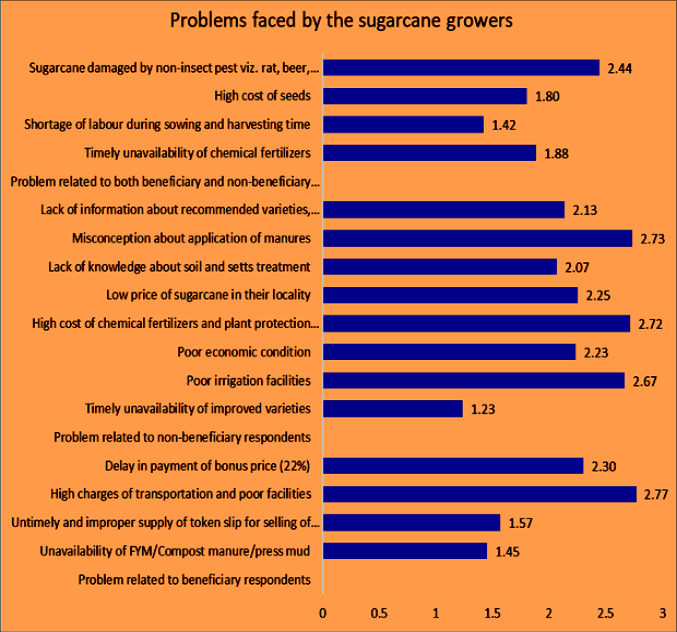 Figure 1
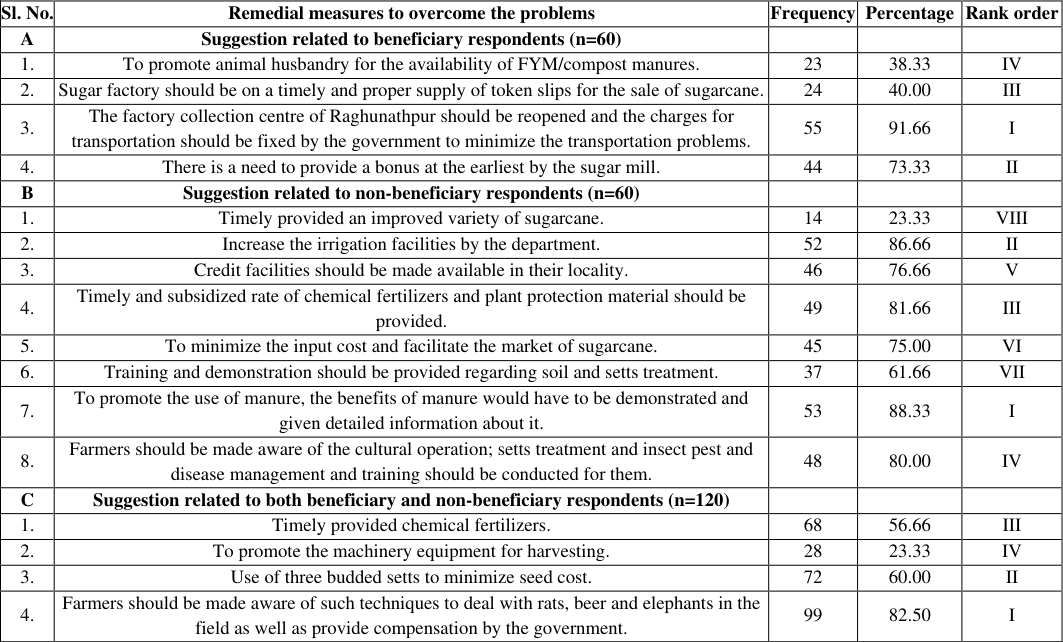 Table 2
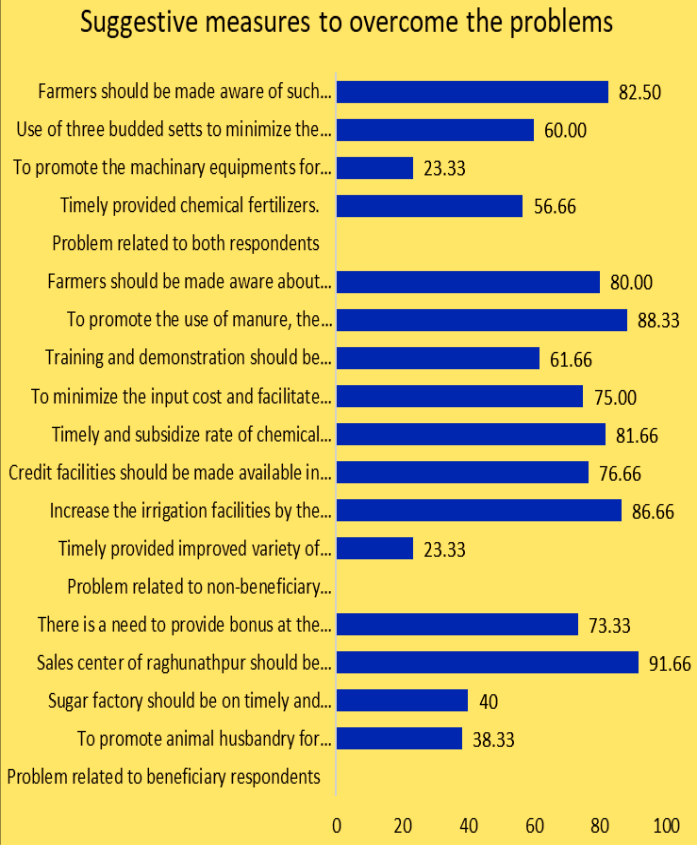 Figure 2
Introduction
In India, the total area under sugarcane cultivation is 48.57 Lakh hectares and 2nd largest producer of sugar in the world having 399.25 million tons of production with average productivity of 82.20 tons/hectare (Source: Annual report 2021-22 of Ministry of Agriculture & Farmers Welfare, Government of India). Chhattisgarh has comprised of three agro-climatic regions, the northern hills zone, plains zone and Bastar plateau zone. The sugarcane in Chhattisgarh is cultivated under 34.85 ('000 ha.) area and the production of sugarcane was 86.25 ('000 metric tons). The future scope and area expansion of sugarcane is bright in the northern hills zone of Chhattisgarh where the production of 11.04 lace metric tons and average productivity of 49.96 tons/ha which is double in compared with their state average productivity (24.75 tons/ha). The major problem in the sugarcane growing areas of the northern hill zone of Chhattisgarh is a lack of marketing and means of transportation facilities.
Methodology
The study was carried out in the Surguja district under the northern hill zone of Chhattisgarh state, in the periphery of Maa Mahamaya Co-operative Sugar Factory Ambikapur during the years 2021-2022. Out of seven blocks, two blocks, Lundra and Batauli considered in which six sugarcane growing villages were purposively selected with ten beneficiaries and ten non-beneficiaries of sugarcane growers as registered and non-registered members of the sugar factory. Thus, 120 respondents whereas 60 beneficiary and 60 non-beneficiary respondents of a sugar factory were finally selected. Data were collected with the help of a welldeveloped structured schedule. In the case of both beneficiary and non-beneficiary respondent problems expressed as; 'Sugarcane damaged by non-insect pests viz. rat, beer, elephants, and domestic cattle's and observed 1 st ranked with 2.44 mean score followed by 1.88 mean score in 'Timely unavailability of chemical fertilizers' ranked 2 nd , 'High cost of seeds' ranked 3 rd with a 1.80 mean score whereas 'shortage of labour during sowing and harvesting time' ranked 4 th with a 1.42 mean score was found. To promote the machinery equipment for harvesting. 28 23.33 IV 3.
Results and Discussions
Use of three budded setts to minimize seed cost. 72 60.00 II
4.
Farmers should be made aware of such techniques to deal with rats, beer and elephants in the field as well as provide compensation by the government. 99 82.50 I Table 2 revealed that the suggestive measures expressed by beneficiary respondents, 91.66 per cent of respondents suggested the factory collection centre of Raghunathpur should be reopened and the charges of transportation should be fixed by the government to minimize the transportation problems which is 1 st ranked followed by 73.33 per cent were suggested that there is a need to provide a bonus at an earliest by the sugar mill ranked 2 nd . About 40.00 per cent of respondents suggested sugar factory should be on the timely and proper supply of token slips for the sale of sugarcane ranked 3 rd , whereas 38.33 per cent of respondents suggested promoting animal husbandry for the availability of FYM/compost manures and stood ranked 4 th . Similarly, suggestive measures expressed by the nonbeneficiary respondents, 88.33 per cent of respondents suggested to promote the use of manure, the benefits of manure would have to be demonstrated and given detailed information about it was ranked 1 st , followed by 86.66 per cent suggested that increase the irrigation facilities by the department ranked 2 nd . About 81.66 per cent of respondents suggested timely and subsidized rate of chemical fertilizers and plant protection material should be provided ranked 3 rd, whereas, 80.00 per cent of respondents suggested farmers should be made aware of cultural operation; sett treatment and insect-pest and disease management and training should be conducted for them ranked 4 th. , 76.66 per cent of respondents suggested credit facilities should be made available in their locality ranked 5 th , 75.00 per cent suggested to minimize the input cost and facilitate the market of sugarcane ranked 6 th and 61.66 per cent of respondents suggested training and demonstration should be provided regarding soil and sett treatment ranked 7 th , and 23.33 per cent of respondents suggested timely provided an improved variety of sugarcane and stood ranked 8 th . Suggestive measures expressed by both beneficiary and non-beneficiary respondents, 82.50 per cent of respondents suggested farmers should be made aware of such techniques to deal with rat beer and elephant in the field as well as provide compensation by government ranked 1 st followed by 60.00 per cent of respondents suggested use of three budded sett to minimize seed cost ranked 2 nd . About 56.66 per cent of respondents suggested timely provided chemical fertilizers ranked 3 rd , whereas 23.33 per cent of respondents suggested promoting the machinery equipment for harvesting sugarcane and stood 4 th ranked. www.extensionjournal.com
| Sl. No. | Remedial measures to overcome the problems | Frequency | Percentage | Rank order |
|---|---|---|---|---|
| A | Suggestion related to beneficiary respondents (n=60) | |||
| 1. | To promote animal husbandry for the availability of FYM/compost manures. | 23 | 38.33 | IV |
| 2. | Sugar factory should be on a timely and proper supply of token slips for the sale of sugarcane. | 24 | 40.00 | III |
| 3. | The factory collection centre of Raghunathpur should be reopened and the charges for transportation should be fixed by the government to minimize the transportation problems. | 55 | 91.66 | I |
| 4. | There is a need to provide a bonus at the earliest by the sugar mill. | 44 | 73.33 | II |
| B | Suggestion related to non-beneficiary respondents (n=60) | |||
| 1. | Timely provided an improved variety of sugarcane. | 14 | 23.33 | VIII |
| 2. | Increase the irrigation facilities by the department. | 52 | 86.66 | II |
| 3. | Credit facilities should be made available in their locality. | 46 | 76.66 | V |
| 4. | Timely and subsidized rate of chemical fertilizers and plant protection material should be provided. | 49 | 81.66 | III |
| 5. | To minimize the input cost and facilitate the market of sugarcane. | 45 | 75.00 | VI |
| 6. | Training and demonstration should be provided regarding soil and setts treatment. | 37 | 61.66 | VII |
| 7. | To promote the use of manure, the benefits of manure would have to be demonstrated and given detailed information about it. | 53 | 88.33 | I |
| 8. | Farmers should be made aware of the cultural operation; setts treatment and insect pest and disease management and training should be conducted for them. | 48 | 80.00 | IV |
| C | Suggestion related to both beneficiary and non-beneficiary respondents (n=120) | |||
| 1. | Timely provided chemical fertilizers. | 68 | 56.66 | III |
| 2. | To promote the machinery equipment for harvesting. | 28 | 23.33 | IV |
| 3. | Use of three budded setts to minimize seed cost. | 72 | 60.00 | II |
| 4. | Farmers should be made aware of such techniques to deal with rats, beer and elephants in the field as well as provide compensation by the government. | 99 | 82.50 | I |
Table text extracted from the original PDF; superscript letters are shown inline. The original table image is below.
View original table image
Conclusions
It can be concluded that the major problem of the beneficiary respondents was 'high charges of transportation and poor facilities' and 'misconception about the application of manures' was a very serious problem in non-beneficiary respondents. Whereas sugarcane damaged by non-insect pests viz. rats, beer, elephants, and domestic cattle was the joint problem of both beneficiary and non-beneficiary respondents, and it can also be concluded that suggestive measures expressed by the beneficiary respondents were the sales center of Raghunathpur should be reopened and the charges of transportation should be fixed by the government to minimize the transportation problems. And to promote the use of manure, the benefits of manure would have to be demonstrated and given detailed information about it expressed by non-beneficiary respondents, whereas farmers should be made aware of such techniques to deal with rats, beer and elephants in the field as well as provide compensation was expressed by both beneficiary and nonbeneficiary respondents. The study can also be concluded that the above-identified problems of sugarcane growers should be minimized by the remedial measures as suggested by him, then, the expansion of area and productivity of sugarcane will be enhanced.
Figures and tables from the paper
| Sl. No. | Problem statement | Intensity of problem | — | — | Mean score | Rank order |
|---|---|---|---|---|---|---|
| Very Serious (3) | Serious (2) | Least Serious (1) | ||||
| A | Problems related to beneficiary respondents (n=60) | |||||
| 1. | Timely unavailability of FYM/Compost manure/press mud. | 5 | 17 | 38 | 1.45 | IV |
| 2. | Untimely and improper supply of token slip for selling of sugarcane. | 10 | 14 | 36 | 1.57 | III |
Table text extracted from the original PDF; superscript letters are shown inline. The original table image is below.
View original table image
References
4 in the original paper- Chetthamrongchai P, Auansakul A, Supawan D. Assessing the transportation problems of the sugar cane industry in Thailand. Transport and Communications Bulletin for Asia and the Pacific. 2001;70(2001):31-39.
- Kumar M, Singh HC, Rajbhar AK. Study on constraints faced by the sugarcane growers in western Uttar Pradesh India. Plant Archives. 2020;20(1):1885-1888.
- Web link of Annual Report 2020-21 of Department of Agriculture, Cooperation and Farmer Welfare: https://agricoop.nic.in/sites/default/files/web%20copy% 20of%20ar%20%28eng%29_7.pdf
- Koli NR, Koli H, Soni RK, Mohammad A, Meena BL. Genotype x environment interaction and stability in promising elite clones of yield potentiality in respect to cane and sugar yield. Int. J Agric. Nutr. 2020;2(1):5760. DOI: 10.33545/26646064.2020.v2.i1a.92