
Research article · 2022 · Full text
International Journal of Statistics and Applied MathematicsStudy of prognostic factors in gastric cancer: Application of a cox model and logistic regression
Volume 7(5) · Pages 108–113 · DOI: 10.22271/maths.2022.v7.i5b.887 ↗
Research areasGastric Cancer Management and Outcomes
Abstract
Author-writtenIntroduction: Gastric cancer has a poor prognosis. It is the fifth most common cancer in terms of incidence and the fourth most common cancer in terms of mortality world wide. The aim of our study is to identify the clinical and pathological factors associated with survival and predictive of death. Method: Our study included 262 patients over a 13-year periodfrom 2007 to 2020 at Aristide Le Dantec Hospital in Senegal and Conakry Hospital in Guinea. The survival period was established from one month after treatment to the date of death or last news. We first used the Cox proportional hazard model to identify independent factors associated with survival. Then we applied logistic regression to these factors to develop the prognostic equation. Results: The overall survival at 6 months, 1 year and 5 years after treatment was respectively 74%, 57%, 38%. The probability of occurrence of death after 5 years can be estimated with 93\% accuracy, by: log (π_i / (1 - π_i)) = -19,983 + 2,119* Métastases + 1,268* Ulcère gastrique + 1,100* Tabac + 37,646* Epigastralgie + 37,563* Cardiopathie + 37,220*Mucineux. Conclusion: Our approach contributes to determine the impact of clinical and pathological factors on the survival of patients and the eventual occurrence of death related to stomach cancer.
Summary
Source-checkedPlain-language reading of the full paper, prepared with AI and checked against the text. Each point links to the authors' own words.
Why it matters
- Gastric cancer is a significant global health issue, ranking as the fifth most common cancer by incidence and the fourth by mortality. View evidence ↗
- In Senegal and Guinea, the disease shows high mortality rates of 70% and 90%, respectively. View evidence ↗
- Late diagnosis and management often lead to very low 5-year survival rates, typically between 20% and 30%. View evidence ↗
The question
- The study aims to identify clinical and pathological factors that are associated with patient survival and can predict death. View evidence ↗
What they did
- The retrospective study analyzed 262 patients treated between 2007 and 2020 at hospitals in Senegal and Guinea. View evidence ↗
- Researchers used a two-step statistical approach: first applying a Cox proportional hazard model to find survival factors, then using logistic regression to create a prognostic equation. View evidence ↗
- The model was externally validated by splitting the population into a training set (70%, 183 patients) and a validation set (30%). View evidence ↗
What they found
- Overall survival rates after treatment were 74% at 6 months, 57% at 1 year, and 38% at 5 years. View evidence ↗
- Metastases were identified as a significant factor associated with survival, with a Hazard Ratio of 2.978 (p=0.000). View evidence ↗
- The presence of a gastric ulcer was significantly associated with survival, showing a Hazard Ratio of 2.784 (p=0.001). View evidence ↗
- Tobacco use was a significant survival factor with a Hazard Ratio of 2.661 (p=0.000). View evidence ↗
- Epigastralgia was significantly associated with survival, with a Hazard Ratio of 2.315 (p=0.000). View evidence ↗
- Heart disease was found to be a significant factor affecting survival, with a Hazard Ratio of 1.838 (p=0.006). View evidence ↗
- Mucinous adenocarcinoma was significantly associated with survival, with a Hazard Ratio of 1.546 (p=0.046). View evidence ↗
What it means
- The authors conclude that their combined Cox and logistic regression approach effectively determines how clinical and pathological factors impact survival and death in gastric cancer patients. View evidence ↗
- The authors state that a better data collection system is needed to provide more information and establish a benchmark. View evidence ↗
Visual summary
2 visualsIllustrations explain the paper; charts are replotted from the paper's own table values.
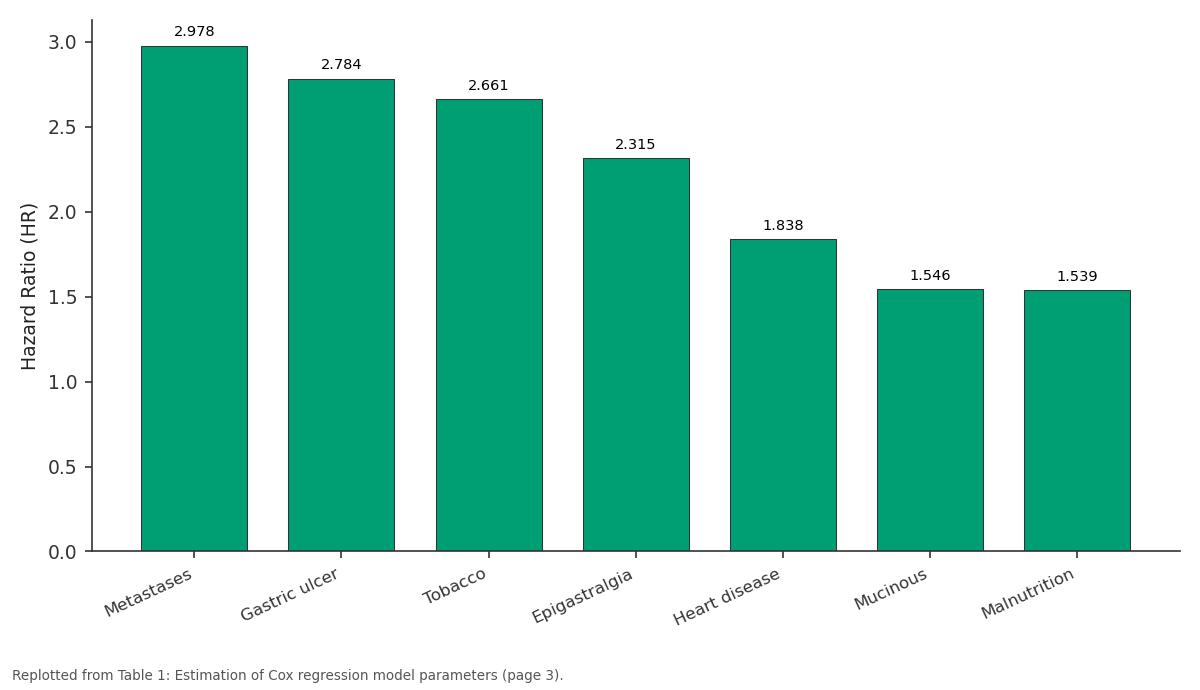
Hazard Ratio (HR): Metastases vs Gastric ulcer vs Tobacco vs Epigastralgia vs Heart disease
Replotted from Table 1 (page 3) of the original paper. Every bar is the paper's own table value.
View source evidence ↗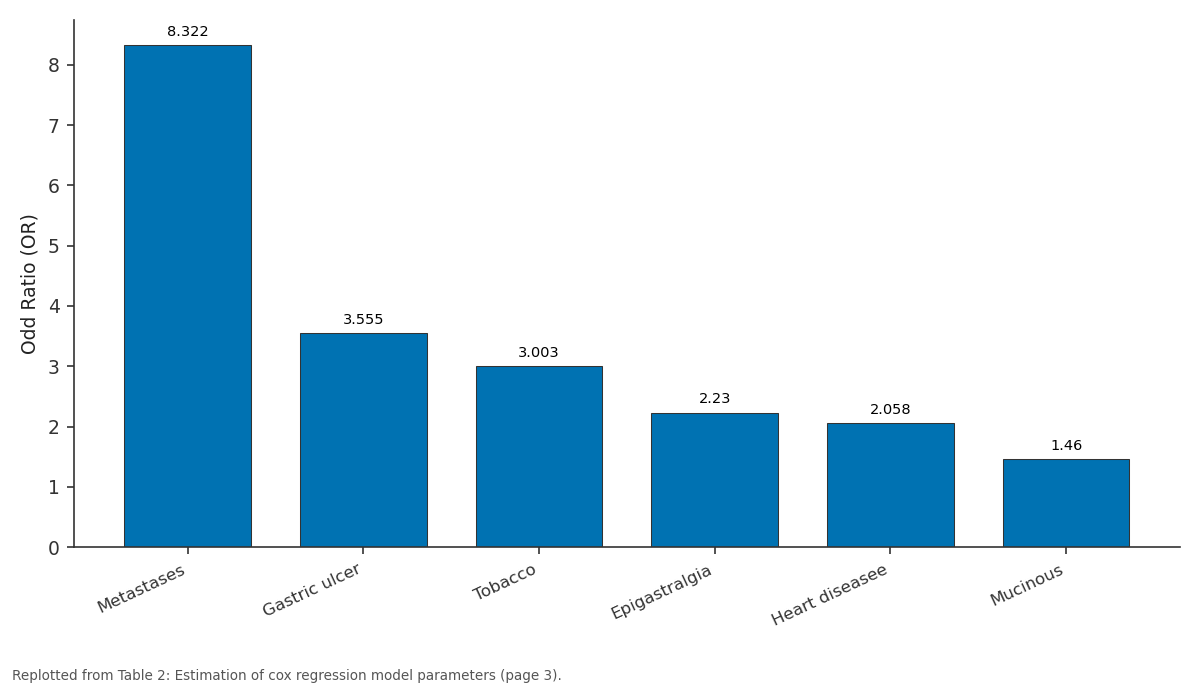
Odd Ratio (OR): Metastases vs Gastric ulcer vs Tobacco vs Epigastralgia vs Heart diseasee
Replotted from Table 2 (page 3) of the original paper. Every bar is the paper's own table value.
View source evidence ↗Figures & tables
From the original paper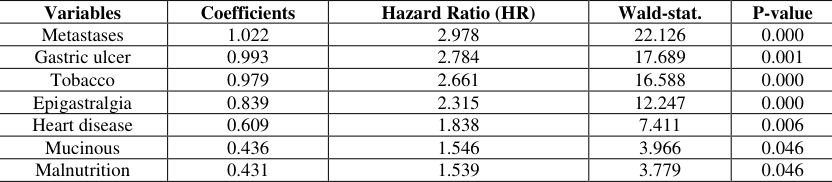 Table 1
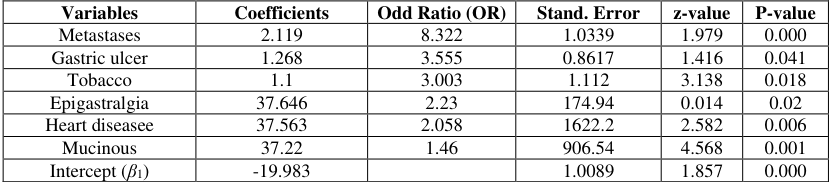 Table 2
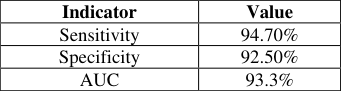 Table 3
 Table 4
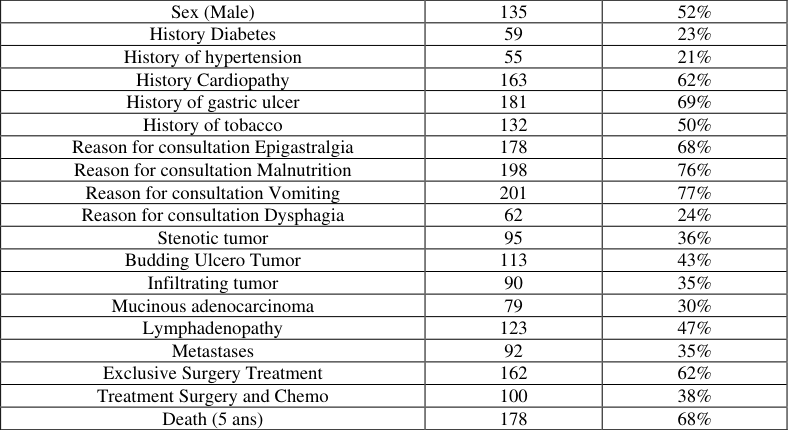 Table 5
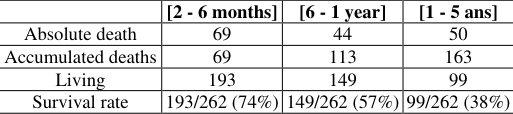 Table 5
 Table 6
Introduction
Stomach cancer or gastric cancer is a public health problem according to the World Health Organization (WHO), [1] . It develops in the gastric wall and is generally manifested by weightloss, epigastric pain and vomiting. According to GLOBOCAN data [2] , it is responsible for more than one million new cases in 2020 and about 769,000 deaths, ranking fifth in incidence and fourth in mortality worldwide. Its incidence in Senegal and Guinea was estimated at 597 and 271 new cases respectively, with a mortality of 70% and 90% [2] . The potentially curative treatment is surgery exclusively or combined with chemotherapy. The standard method for prognos is remains the tumor stage, the presence of lymphnodes or metastases (TNM classification) [3] . However, thereis no consensus reference neither on survival nor on the occurrence of death, consternating the involvement of clinical and pathological factors. This situation favors a latediagnosis and management and very low survival rates, in the order of 20 to 30%, at 5 years [4,5,21] . Researchers have made extensive use of logistic regression [6] to identify factors predictive of the occurrence of medical events such as confirmation of pathology [7,8] , the appearance of complications such as metastases or tumor recurrence [9,10] , and death [11,12,13] . While the Cox proportional hazard model [14] was applied in the presence of survival data to determine the independent, associated parameters [15,16,10,17,18] . The explanatory power of statistical models relies heavily on the identification of the most relevant factors with respect to the event studied. These factors are supposed to be able to explain almost all of the phenomenon. Thus, the adequacy between the research question and the methodology is decisive. Although logistic regression can predict the occurrence of death, and its model is parametric, it can only be used to predict discrete functions. Since survival times are continuous, this model is not sufficient to link the covariates to the instantaneous risk of death. As for the Cox proportional hazard model, it expresses the probability of occurrence of the event studied at a precise moment, knowing that it had not occurred just before (instantaneous risk). However, this model is only partially specific, because the basic risk (in the absence of any explanatory factors) is not defined and it constitutes a nuisance parameter. The objective of our present study is to develop a specific model to predict death from gastric cancer at five years posttreatment, with factors that have a significant and independent impact on survival.
Methods
Type, duration and setting of study: We conducted a retrospective, prognostic study. It spanned a period of 13 years, from 2007 to 2020. The study setting was the general surgery and cancer departments of Aristide Le Dantec Hospital in Senegal and the University Hospital of Conakry in the Republic of Guinea. These are reference facilities in each country with a very large capacity.
Study population and follow-up
The study population was that of patients with gastric cancer. All patients with confirmed gastric cancer who had received treatment (exclusive surgery or combined with chemotherapy) were included in the study. Patients who died within 30 days after treatment were excluded from the study, because death is considered to berelated to the surgical procedure and not to the cancer. The data base contained 262 patients who met the inclusion criteria. The survival period was established from one month after treatment to the date of death or last news.
Data collection
The data collected were based on the information found in the patients' files. The parameters studied were: Age, sex, history (Epigastralgia, Gastric ulcer, Gastric tumor, Tobacco, salt, and alcohol consumption, Arterial hypertension, Diabetes, Heart disease), reasons for consultation (Epigastralgia, Vomiting, Abdominal mass, Constipation), duration of evolution of symptoms, general signs (pale mucous membranes, colored mucous membranes, dehydration, malnutrition), physical signs (epigastric sensitivity, epigastric mass, stasis stomach), biological data (Hemoglobin, Hematocrit, Platelets, Creatine), macroscopic appearance of the tumor (stenosing, ulcerated, budding, hemorrhagic, Infiltrating), differentiation of adenocarcinoma, presence of adenopathy in the abdomen, regional invasion, metastases (Hepatic, Pulmonary, Peritoneal), Preoperative resuscitation (Blood transfusion, Parenteral nutrition, Nasogastric tube), Treatment (Exclusive surgery, Surgery associated with chemotherapy), Death, and survival time at 6 months, 1 year and 5 years.
Statistical analysis
After a description of the general characteristics of the study population. We used the Cox proportional hazard model to identify independent factors associated with survival. Through the hazard function h, defined at each time t by
This risk function represents the probability that death from stomach cancer will occur at time t knowing that it has not been observed before t (instantaneous risk), and is modeled as follows ℎ(𝑡, 𝑋 1 , … , 𝑋 𝑝 ) = ℎ 0 (𝑡)𝑒 𝛽 1 𝑋 1 +⋯+𝛽 𝑝 𝑋 𝑝 = ℎ 0 (𝑡)𝑒 𝛽 ′ 𝑋 where ℎ 0 is the hazard base function, 𝛽 = (𝛽 1 , … , 𝛽 𝑝 ) ′ ∈ ℝ 𝑝 is an unknown regression parameter measuring the association between potential predictors 𝑋 1 , … , 𝑋 𝑝 and the hazard risk function.
The Cox partial likelihood function is given by:
The maximum likelihood estimator of the parameter 𝛽 is defined as the solution of the problem 𝑀𝑎𝑥 𝛽𝜀ℝ 𝑝 𝐿(𝛽)
The appropriateness of the model is assessed by the Likelihood Ratio Test and the Wald Test [14] . For the timedependent variables, we used the interaction technique [14] to fit them. The proportionality of the risks over time is evaluated by the Schoenfeld residuals test [14] . Finally, we applied logistic regression to the factors retained in the Cox model to predict the occurrence of death five years after treatment. For each individual i=1... n, 𝑌 𝑖 is a binary response variable that indicates: 𝑌 𝑖 = 1 if individual i dies of stomach cancer, and 𝑌 𝑖 = 0 otherwise. The logistic regression model for individual i to die of stomach cancer assumes that the conditional probability 𝜋 𝑖 = 𝑃(𝑌 𝑖 = 1|𝑋 𝑖 ) is given by
where 𝛽 is a regression parameter that measures the association between the predictors and the occurrence of death. Taking the exponential of equation 𝐿𝑜𝑔𝑖𝑡(𝜋 𝑖 ) yields the odds ratios for individual i, given by:
This expression defines a multiplicative model for the odds. For example, if the j-th covariate increases by one (or ispresent) while holding all other constants constant, the risk of death is multiplied its odds. The log-likelihood for 𝛽 calculated from the sample (𝑋 𝑖 , 𝑌 𝑖 ) 1≤𝑖≤𝑛 is given by:
We proceeded for an external validation of the model. Indeed, 70% (183 patients) of our randomly selected study population was devoted to training and the remaining 30% to validation. The quality of the final model is evaluated by the sensitivity, specificity and the air under the Roc curve (AUC).
Results
We collected 262 patients with gastric cancer who met our inclusion criteria. The average age was 52±11 years. Male patients represented 52%, i.e. a sex ratio of 1.06. The most frequent symptoms were vomiting (77%), malnutrition (76%) and epigastric pain (68%). Gastriculcer (69%), heartdisease (62%) and smoking (50%) were the main antecedents. Adenocarcinoma was mucinous in 30% of cases, adenopathy in the abdomen was observed in 47% and metastasis in 35% of patients. All patients have received treatment, surgery exclusively for 62%, for the others (38%), surgery was associated with chemotherapy.
The overall survival at 6 months, 1 year and 5 years after treatment was respectively 74%, 57%, 38%.
Following a variable selection based on the Wald test at the 5% threshold, the Cox regression model was reduced to the variables shown in Table 1.
| Variables | Coefficients | Hazard Ratio (HR) | Wald-stat. | P-value |
|---|---|---|---|---|
| Metastases | 1.022 | 2.978 | 22.126 | 0.000 |
| Gastric ulcer | 0.993 | 2.784 | 17.689 | 0.001 |
| Tobacco | 0.979 | 2.661 | 16.588 | 0.000 |
| Epigastralgia | 0.839 | 2.315 | 12.247 | 0.000 |
| Heart disease | 0.609 | 1.838 | 7.411 | 0.006 |
| Mucinous | 0.436 | 1.546 | 3.966 | 0.046 |
| Malnutrition | 0.431 | 1.539 | 3.779 | 0.046 |
Table text extracted from the original PDF; superscript letters are shown inline. The original table image is below.
View original table image
Discussion
Cancer is one of the leading causes of death and a major obstacle to increasing life expectancy in every country in the world. According to the estimates of the World Health Organization (WHO), in a report on global cancer statistics, [19], there were about 19.3 million new cancer cases and 10 million deaths worldwide in 2020. According to the same report, the global cancer burden is expected to be 28.4 million cases in 2040, an increase of 47\% from 2020, with a greater increase in developing countries (64% to 95%) compared to developed countries (32% to 56%). Stomach cancer, for its part, remains an important cancer in the world and is responsible for more than 1 million new cases in 2020 and about 769,000 deaths, ranking fifth in incidence and fourth in mortality worldwide [19] . In African regions, mortality rates are sometimes higher than the global average while incidence rates are the lowest [20] .
Our study included 262 patients with gastric cancer. One hundred and eighty-nine (189), or 72\% of the patients were received at the Aristide le Dantec Hospital in Senegal and 73 at the University Hospital of Conakry in Guinea. The absence of national cancer registries in most African countries suggests a low incidence of gastric cancer on the continent.
Studies have been conducted in Senegal with 136 histologically confirmed cases in 10 years [21] and 36 cases in 6 years [4] , in Guinea Conakry with 13 cases in 6 years [22] , in Cameroon with 120 cases in 6 years [15] and in Congo Brazzaville with 41 cases in 9 years [5] . According to GLOBOCAN estimates, stomach cancer incidences in Senegal and Guinea were 597 and 271 new cases respectively in 2020 [2] . The lack of a reliable data collection system in this area makes it possible to under estimate these incidences.
The mean age of the patients in our series was 52 years with extremes ranging from 26 to 82 years. The variability according to age, with a standard deviation of 7 years, was not significant, which explains that subjects of almost all age groups are concerned by gastric cancer. The same is true for the sex ratio which was 1.06. Men and women are affected without significant difference. This trend is also found in African series [15,21,4,22,5] . On the other hand, in Western and Asian series, stomach cancer occurs most often in patients of advanced age and a strong male predominance [23,24] . To identify independent parameters, associated with survival, we used the Cox proportional hazard model. The $\beta$ coefficients or Hazard ration (HR) measure the association between each covariate studied and the instantaneous risk function for death. This approach is similar to that used by G.A. Bang et al. [15] in their study on the clinical epidemiology and risk factors for mortality of gastric cancer in sub-Saharan Africa. They used the Cox model to determine the respective hazard ratios (HR) with 95% confidence intervals. Results showed that variables independently associated with survival included: WHO stage 3 performance status (HR = 1.935, p = 0.042), palpable epigastric mass on examination (HR = 1.909, p = 0.042), and liver metastases (HR = 2.310, p = 0.012). G. Capelli et al. [16] took a different approach with the Cox model. Their aim was to evaluate the performance of a nomogram to distinguish the parameters associated with survival. The performance of the nomogram was calculated by Harrell's C-index and calibration plots [16] . The results showed that tumor location, lymphnode ratio, and pT stage were associated with overall survival of gastric cancer patients (Index-C 0.75).
After identifying the factors independently and significantly associated on survival of patients in our series, we applied the predictive model [26] of logistic regression to them. This allowed us to develop a prognostic equation for the occurrence of death related to gastric cancer with five (5) years of follow-up. Indeed, for each potential predictor, the probability of death is estimated by the odds ratio. This corresponds to the number of times that death is likely to occur in the presence of the factor considered. Thus, the most relevant predictors are selected to constitute the prognostic equation. M. Sylla et al. [11] , adopted the same procedure to identify and evaluate pre-, intra-and post-operative histo prognostic factors in terms of occurrence of local recurrence, metastasis and overall survival with or without recurrence for patients with gastric cancer. The results showed that at the 5% threshold, the occurrence of metastasis was an unfavorable prognostic factor (OR=27.36), whereas reintervention increased the chances of survival (P=0.007, OR=0.07). Choney Zangmo et al. [12] also sought to identify factors that influence the occurrence of death for cancer patients (all cancers combined). They used logistic regression. The best fitted model was obtained from the deviance analysis at the 5% threshold. Poor prognostic factors: age, length of stay and cancer site.
It should be noted that logistic regression can be performed in a variety of other ways depending on the research objectives and the data available. Direct logistic regression is used when no specific assumptions are made about the order or importance of the predictor variables. In fact, this type only considers the contribution of the top predictors [25] . Descriptive logistic regression allows the importance of a phenomenon to be measured and its profile to be traced according to a number of variables. As a result, this model tends to suggest hypotheses rather than confirm them, given the exploratory nature of the study [26] . Automated logistic regression ("Stepwise") is used to generate hypotheses. Indeed, it is mainly used when the field of research is less explored and the knowledge of possible predictors is limited [25] .
The main feature of our methodology lies in the application of logistic regression to predict death from gastric cancer on factors already identified by the Cox model as independently associated with survival. The variables retained in our final equation thus provide two pieces of information at once. S. Xu et al. [10] adopted a similar methodology to investigate the prevalence of Hashimoto's thyroiditis in adult papillary thyroid cancer patients and its association with cancer recurrence and outcome. The primary outcome was the association of Hashimoto's thyroiditis (HT) with papillary thyroid cancer (PTC) mortality, assessed using Cox proportional hazards regression models. The secondary outcome was the association of HT with aggressive features and structural recurrence of PTC, assessed using logistic regression with and without adjustment for related factors. Our study identified gastric ulcers, smoking and heart disease as antecedent or antecedent factors leading to gastric cancer, with a significant impact on survival and poor prognosis. Our results are supported by those found by J.-D. Korwin et al. [27] whoshowed in their study that patients with gastric ulcers most often develop gastric cancer. The common denominator of these two pathologies is the infection with the bacterium Helicobacter pylori. Chronic gastritis caused by the bacterium can lead to ulcers and in the long term, transform the mucosa and induce mutation of it scells into cancer cells [27] .
Analyzing the role of echocardiography in the detection and monitoring of left ventricular dysfunction in patients undergoing cancer treatment, C. Charbonnel et al. [28] , found that heart disease was a comorbid factor that negatively affects the quality of life and prognosis of cancer patients. Smoking is considered a contributing and aggravating factor for all cancers [4,5,15,29,30] . The symptomatology of gastric cancer is very polymorphic, and often a source of diagnostic delay and poor prognosis [31] . Epigastric pain is an independent sign associated with longterm survival of patients in our series. The prognosis is poor in the presence of this symptom. Our study also revealed a significant impact of under nutrition on survival, which is not the case for its association with prognosis. In the series of G.A. Bang [15] , the frequency of a palpable epigastric mass on examination was highlighted in patients with very short survival times. In the series of B. Diop et al. [4] of patients followed for gastrictumor, the symptoms were mainly weight loss, signs of pyloricstenosis and hematemesis. Gastric adenocarcinoma is the most common histological type of gastric cancer [21] . The occurrence of metastases is identified by our study as adversely affecting survival and is a very poor prognostic factor. This is characteristic of a very advanced state of the disease. Hepatic, pulmonary or peritoneal invasion is noted. Research on cancer all agree on this subject [4,5,15,21,11,29,30] . Age and sex were not retained in our study as independent factors, significantly associated neither with survival nor with the occurrence of death. This explains why the survival of patients of both sexes and of all ages is affected in an almost similar way. The study conducted by M. Sylla et al. [11] , on the histoprognostic factors of gastric cancer, showed on the other hand that an advanced age negatively affected the survival of patients with gastric cancer.
Conclusion
The prognosis of gastric cancer ispoor. The overall survival at 5 years was 38% for the patients of ourseries. Our methodology consisted in the use of the Cox proportional hazard model to identify the independent parameters associated with survival. We then applied logistic regression to these parameters to predict the occurrence of death from gastric cancer at 5 years after treatment. Our approach helps to determine the impact of clinical and pathological factors on survival and the eventual occurrence of death for patients with gastric cancer. However, a good data collection system would provide more information and will contribute to the implementation of a benchmark.
Figures and tables from the paper
| Variables | Coefficients | Odd Ratio (OR) | Stand. Error | z-value | P-value |
|---|---|---|---|---|---|
| Metastases | 2.119 | 8.322 | 1.0339 | 1.979 | 0.000 |
| Gastric ulcer | 1.268 | 3.555 | 0.8617 | 1.416 | 0.041 |
| Tobacco | 1.1 | 3.003 | 1.112 | 3.138 | 0.018 |
| Epigastralgia | 37.646 | 2.23 | 174.94 | 0.014 | 0.02 |
| Heart diseasee | 37.563 | 2.058 | 1622.2 | 2.582 | 0.006 |
| Mucinous | 37.22 | 1.46 | 906.54 | 4.568 | 0.001 |
| Intercept (β1) | -19.983 | 1.0089 | 1.857 | 0.000 |
Table text extracted from the original PDF; superscript letters are shown inline. The original table image is below.
View original table image
| Indicator | Value |
|---|---|
| Sensitivity | 94.70% |
| Specificity | 92.50% |
| AUC | 93.3% |
Table text extracted from the original PDF; superscript letters are shown inline. The original table image is below.
View original table image
| Variables | Average | [Min-Max] |
|---|---|---|
| Age (years) | 52 | [26 - 82] |
| Duration of evolution of symptoms (months) | 7 | [1-24] |
| Blood platelets (×1000) | 364 | [49-911] |
| Size | Percentage |
Table text extracted from the original PDF; superscript letters are shown inline. The original table image is below.
View original table image
| Sex (Male) | 135 | 52% |
|---|---|---|
| History Diabetes | 59 | 23% |
| History of hypertension | 55 | 21% |
| History Cardiopathy | 163 | 62% |
| History of gastric ulcer | 181 | 69% |
| History of tobacco | 132 | 50% |
| Reason for consultation Epigastralgia | 178 | 68% |
| Reason for consultation Malnutrition | 198 | 76% |
| Reason for consultation Vomiting | 201 | 77% |
| Reason for consultation Dysphagia | 62 | 24% |
| Stenotic tumor | 95 | 36% |
| Budding Ulcero Tumor | 113 | 43% |
| Infiltrating tumor | 90 | 35% |
| Mucinous adenocarcinoma | 79 | 30% |
| Lymphadenopathy | 123 | 47% |
| Metastases | 92 | 35% |
| Exclusive Surgery Treatment | 162 | 62% |
| Treatment Surgery and Chemo | 100 | 38% |
| Death (5 ans) | 178 | 68% |
Table text extracted from the original PDF; superscript letters are shown inline. The original table image is below.
View original table image
| — | [2 - 6 months] | [6 - 1 year] | [1 - 5 ans] |
|---|---|---|---|
| Absolute death | 69 | 44 | 50 |
| Accumulated deaths | 69 | 113 | 163 |
| Living | 193 | 149 | 99 |
| Survival rate | 193/262 (74%) | 149/262 (57%) | 99/262 (38%) |
Table text extracted from the original PDF; superscript letters are shown inline. The original table image is below.
View original table image
| Test | Values |
|---|---|
| Likelihood ratio test | 2e-16 |
| Wald test | 2e-16 |
Table text extracted from the original PDF; superscript letters are shown inline. The original table image is below.
View original table image
References
29 in the original paper- OMS, Organisation Mondiale de la santé. [en ligne]. 2022 [consulté le 30 juin 2022]. Disponible sur: https://www.who.int
- GCO, Global Cancer Observation. [en ligne].2020 [consulté le 30 Mars 2022]. Disponible sur: https://gco.iarc.fr
- Bah M, Traoré B, Boni JP, Diane S, Keita M. Aspects diagnostiques et thérapeutiques des cancers de l'estomac en milieu oncologique à Conakry. Revue Africaine de Chirurgie et Spécialités. 2019;13(2):5-10.
- Diop B, Dia AA, Ba PA, Sow O, Thiam O, Konate I, et al. Prise en Charge Chirurgicale des Tumeurs Gastriques à Dakar: à Propos de 36 Observations. Health Sci. Dis. 2017;18(4):34-38.
- Rosen RD, Sapra A. Classement TNM. National institute of health. [en ligne] 2022 [consulté le 25/06/2022]. Disponible sur https://www.ncbi.nlm.nih.gov/books/NBK553187/.
- Auguste A, Joachim C, Deloumeaux J. Facteurs de risque du cancer de la tête et du cou aux Antilles françaises. CMB Cancer. 2021;21(1):1071. Doi: 10.1186/s12885021-08787-4.
- Kanbayashi Y, Sakaguchi K, Hongo F, Ishikawa T. Prédicteurs du développement de l'hypocalcémie induite par le denosumab chez les patients cancéreux présentant des métastases osseuses déterminés par une analyse de régression logistique ordonnée. Scientific Reports. 2021;11(1):978. Doi: 10.1038/s41598-020-80243-y.
- Xie Z, Gao Y, Ho C, Li L, Jin C, Wang X. Le complexe CD44v6/C1QBP délivré par un exosome entraîne la métastase hépatique du cancer du pancréas en favorisant le microenvironnement fibrotique du foie. BMJ Journals. 2022;71(3):568-579. Doi: 10.1136/gutjnl-2020-323014
- Xu S, Huang H, Qian J, Liu Y. Prévalence de la thyroïdite de Hashimoto chez les adultes atteints d'un cancer papillaire de la thyroïde et son association avec la récidive du cancer et ses résultats. JAMA Netw Open. 2021;4(7):e2118526. Doi: 10.1001/jamanetworkopen.2021.18526.
- Sylla M, Ossibi PE, Soumana ID, Souiki T. Études des facteurs histo-pronostiques des cancers gastriques opérés au Centre Hospitalo-Universitaire de Fès. PAMJ Clinical Medicine. 2020;4(54). 10.11604/pamjcm.2020.4.54.23112.
- Zangmo C, Tiensuwan M. Application de modèles de régression logistique aux patients atteints de cancer au Bhoutan. Journal de la série de conférences de physique. 2018;1039(1):012031
- Garassino M, Whisenant JG, Huang L, Trama A. COVID-19 chez les patients atteints de tumeurs malignes thoraciques (TERAVOLT): Premiers résultats d'une étude de cohorte internationale basée sur un registre. Lancette Oncologie. 2020;(7):914-922. Doi: 10.1016/S1470-2045(20)30314-4.
- COX DR. Regression Models and Life-Tables». Journal of the Royal Statistical Society. Series B: Statistical Methodology. 1972;34(2):187-220, ISSN 00359246. URL http://link.springer.com/10.1007/978-1-4612-43809_37
- Bang GA, Savom EP, Oumarou BN, Ngamy CK. Epidémiologie clinique et facteurs de risquede mortalité du cancer gastrique en Afrique subsaharienne: analyse rétrospective de 120 cas à Yaoundé (Cameroun). Pan Afr Med J. 2020;37:104.
- Capelli G, Tonello AS, Chiminazzo V, Lorenzoni G. Prédiction par un nomogramme des résultats à long terme de la gastrectomie à visée curative pour cancer de l'estomac dans une cohorteitalienne. j.jchirv. 2021;5(008).
- Bert M, Devilliers H, Orry D. L'inflammation préopératoire est un facteur indépendant de mauvais pronostic après chirurgie pour cancer colorectal ? L'inflammation préopératoire est un facteur indépendant d'aggravation du pronostic après chirurgie du cancer colorectal ? Journal de Chirurgie Viscérale. 2021;158(4):333-340.
- Justeau G, Gervès-Pinquié C, Levaillant M, Meslier N, Urban T, Gagnadoux F. Association entre hypoxémie nocturne et incidence de cancer chez les patients suivis pour un syndrome d'apnée obstructive du sommeil. Revue d'épidémiologie et de santé publique, 2020, 68(1).
- Sung H, Ferlay J, Siegel RL, Laversanne M, Soerjomataram I, Jemal A, et al. Statistiques mondiales sur le cancer 2020: Estimations Globocan de l'incidence et de la mortalité dans le monde pour 36 cancers dans 185 pays. CA. 2021;71(3):209-49.
- Ferlay J, Ervik M, Lam F. Observatoire mondial du cancer: Le cancer aujourd'hui. Agence internationale pour la recherche sur le cancer. [en ligne] 2020. [Consulté le 01/02/2022]. Disponible surhttps://gco.iarc.fr/today/home
- Dieng M, Savadogo Tj, Ka O, Konaté I, Cissé M, Manyancka P, et al. Traitement Chirurgical De L'adénocarcinome Gastrique Au Chu De Dakar 1995 À 2005. J Afr Chir Digest. 2010;10(2):1059-1062.
- Liboko B, Kaboré AF, Ndingossoka DD, Rissia RJ, Ndounga F, Mabiala E, et al. Aspects Cliniques et Histologiques des Cancers de l'Estomac au Centre Hospitalier et Universitaire de Brazzaville. HealthSci. Dis. 2022;23(5).
- Martel C, Parsonnet J, Thun M, Linet MS, Cerhan JR, Haiman CA, et al. Cancer de l'estomac. Épidémiologie et prévention du cancer. 4 e éd. Presse universitaire d'Oxford, 2018, 593-610
- Eom BW, Jung KW, Won YJ, Yang H, Kim YW. Tendances de l'incidence du cancer gastrique selon les caractéristiques clinicopathologiques en Corée 19992014. Cancer Res Treat. 2018;50(4):1343-1350.
- Desjardins J. L'analyse de régression logistique. Tutorial in Quantitative Methods for Psychology. 2005;1(1):3541.
- Korwin JD. Helicobacter pylori: quand rechercher une infection et al. traiter chez l'adulte ? La Revue de Médecine Interne. 2021;42(7):482-491. https://doi.org/10.1016/j.revmed.2020.11.012
- Charbonnel C. Rôle de l'échocardiographie dans le dépistage et le suivi de la dysfonction ventriculaire gauche chez des patients sous traitement anticancéreux. Annales de Cardiologie et d'Angéiologie. 2020;69(5):255-261. https://doi.org/10.1016/j.ancard.2020.09.003
- Koura M, Ollo R, Ouattara DZ, Zongo P. Le cancer de l'estomac dans un pays d'Afrique sub-saharienne: aspects épidémiologiques, anatomocliniques et endoscopiques à Bobo-Dioulasso (Burkina Faso). africanjounals online. 2019;42(2)
- Bang A, Djopseu L, Beugheum C. Cancers Digestifs Opérés au Cameroun: Typologie et Stadification au Moment du Diagnostic. HealthSci. Dis. 2021;22(11):1115.
- Hassani A, Mahfoud W, Sadaoui I, Fechtali T, Benomar H. Étude des caractéristiques épidémiologiques cliniques et anatomopathologiques de l'adénocarcinome gastrique chez une population marocaine. Annales de Pathologie. 2020;40(6):442-446. https://doi.org/10.1016/j.annpat.2020.04.014
Cited by 9
From OpenAlex, OpenCitations and reference lists read by Scinovex
- State of the Art of Artificial Intelligence Applications in Oncology ↗
Idrissa Sy, Mamadou Bousso, Ayoub Insa Corréa, Madieng Dieng · Open Journal of Applied Sciences · 2023
Artificial intelligence (AI) operates by using algorithms and statistical models based on data, enabling computers to imitate a real form of intelligence. The structure of the data available and the aim of the research define the technique to be adopted, which will be evaluated by its degree of accuracy and its capacity for generalization. In recent years, several applications of…
❝ 2PDF - Targeting of LGR5 as colorectal cancer stem cell marker in colorectal cancer patients
Sahar M. Ibrahim, Arwa M. Salih, Mohamed Abdallah, Dominik G. Haider, Omar Mahmoud, Ramadan M. Ali · International Journal of Advanced Biochemistry Research · 2025
Background: Colorectal cancer ( CRC ) is a major public health problem worldwide, and it represents the third most frequent neoplasm among diagnosed cancers, as well as ranking second in the number of deceased patients for this type of tumor. Objective: This study investigates the Leucine-rich repeat-containing G protein-coupled receptor 5 (LGR5), which is a key component in the tumor stage-specific molecular network of CRC. Initially identified as a marker of normal intestinal stem cells, LGR5 has garnered significant attention for its potential roles in CRC tumorigenesis and chemotherapy res
- Clinical implications of genetic mutations in the prognostic stratification of acral malignant melanoma ↗
Sarita Yadav, Babita Yadav · International Journal of Surgery Science · 2025
Acral malignant melanoma (AM) is an aggressive subtype with distinct genetic and clinical features, particularly prevalent in Asian populations. This study investigated prognostic factors, surgical outcomes and molecular biomarkers to improve management strategies. A retrospective analysis of 223 AM patients (2015–2021) evaluated clinical-pathological variables (ulceration, LDH, Ki-67) through Cox regression. Surgical outcomes for heel defects were compared between traditional skin
- To detect the potential expression of proteins p53, EGFR & Bcl-2 in oral potentially malignant disorders & their predictive value for the identification of lesions at high risk of progression to invasive carcinoma ↗
Richu Singla, Meghanand Nayak T, Mohammad A. Chaudhary, Renu Renu · International Journal of Applied Dental Sciences · 2025
- From carcinogenesis to cure: Challenges and advances in colorectal cancer ↗
Aruna B, M Neeraja · International Journal of Pharmacology and Clinical Research · 2025
Colorectal cancer (CRC) remains one of the most prevalent and lethal malignancies worldwide, representing a major public health challenge. This review summarizes the current understanding of CRC carcinogenesis, highlights epidemiological trends, outlines established and emerging risk factors, and evaluates advances in prevention, diagnosis, and treatment. Particular emphasis is given to the global burden of disease, molecular insights, screening strategies, and
- Study of tumor endothelial marker 1 in patients with colorectal cancer ↗
Asmaa Nagy Eissa, Yosra Abd El-Monem Zamzam, Hamdy Abd Elhady Mohamed, Hesham Ahmed Elsorogy · International Journal of Clinical and Diagnostic Pathology · 2024
Background: TEM1 represents a transmembrane glycoprotein expressed on developing as well as adult tissues going through active physiological or pathological angiogenesis. This work was aimed at assessing TEM1 levels as a diagnostic as well as prognostic serum biomarker among CRC cases.Methods: Our case- control study involved sixty subjects. Subjects underwent a categorization into the following groups: Group І: Colorectal cancer
- Synchronous endometrial and ovarian cancer: A case report ↗
Gunjan Yadav · International Journal of Clinical Obstetrics and Gynaecology · 2024
Synchronous endometrial and ovarian cancer (SEOC) is a rare genital tract tumour. It should be differentiated from primary endometrial or ovarian tumours with metastasis since the two entities have different therapeutic and prognostic implications. In this review we present a case of woman who was diagnosed with SEOC, and discuss the clinical characteristic of SEOC, diagnostic and molecular profiling issues
- Clinicopathological comparison between right and left side recurrent colon cancer (local and metastasis) ↗
Rasha Saer Abbood Al-Maula, Ahmed A. Mubarak · International Journal of Gastroenterology Sciences · 2024
Background: The second leading cause of death in the US is colorectal cancer, which affects both men and women equally. In 2018, the incidence of colorectal cancer in Iraq was third in females 918 (5.13%) and fifth in males 1018 (7.48%). Lower GI hemorrhage, stool changes, abdominal discomfort, weight loss, hunger changes, and weakness are CRC symptoms. Obstructive symptoms are
- Development of a Deep Learning Model for the Prognosis of the Occurrence of Death from Stomach Cancer in Senegal ↗
Idrissa Sy, Mouhamad Mounirou Allaya, Mamadou Bousso, Ayoub Insa Corréa, Aba Diop, Youssouphe Guissé et al. · Journal of Intelligent Learning Systems and Applications · 2024
Context and Objectives: Stomach cancer ranks fifth in incidence and fourth in mortality worldwide. In Senegal, there were 597 new cases in 2020, with a mortality rate of almost 70%. The aim of this study was to develop a machine-learning model for the prognosis of death from stomach cancer 5 years after treatment. Methods: Our study sample consisted of 262…
❝ 0PDF