
Research article · 2022 · Full text
International Journal of Advanced Biochemistry ResearchBiochemical profile alterations of lipids in oral submucous fibrosis
Volume 6(2) · Pages 127–129 · DOI: 10.33545/26174693.2022.v6.i2b.149 ↗
Research areasOral Health Pathology and TreatmentGenetic factors in colorectal cancer
Abstract
Author-writtenOral Submucous Fibrosis (OSMF) in India has been attributed to the increased consumption of areca nut. Oral Submucous Fibrosis (OSMF) is a chronic disease of the oral cavity which is characterized by an epithelial and sub epithelial inflammatory reaction followed by fibro elastic changes in the mucosa. The present study was aimed to estimate serum lipid profile i.e. Total cholesterol (TC), Triglycerides (TG), High Density Lipoprotein (HDL-C), Low Density Lipoprotein (LDL-C), Very Low Density Lipoprotein (VLDL-C) in Moderate Oral Submucous Fibrosis and compared with controls. The study subjects were divided into 2 groups i.e. Group-I (Moderate Oral Submucous Fibrosis), Group-II (controls). Group-I includes n=50 patients of clinically diagnosed and histopathologically proven of Moderate Oral Submucous Fibrosis. They were in the age group of 20-45 years. Group-II (controls) were age and sex-matched, apparently healthy volunteers (n=50) were included in this study. Serum lipid profile was analyzed in all study subjects using by Randox Rx daytona Auto Analyzer. The present study showed statistically significant decreased serum levels of Total Cholesterol (TC), Triglycerides (TG), High Density Lipoprotein Cholesterol (HDL-C), Low Density Lipoprotein Cholesterol (LDL-C) and Very Low Density Lipoprotein Cholesterol (VLDL-C) levels in group-I when compared with group-II. The changes in lipid profile have long been associated with cancer because lipids play key role in maintenance of cell integrity.
Summary
Source-checkedPlain-language reading of the full paper, prepared with AI and checked against the text. Each point links to the authors' own words.
Why it matters
- Oral Submucous Fibrosis (OSMF) is a chronic oral cavity disease in India linked to the consumption of areca nut. View evidence ↗
- There is a strong connection between betel quid chewing, OSMF, and oral squamous cell carcinoma in the Indian subcontinent. View evidence ↗
- Lipids, specifically cholesterol and triglycerides, are essential cell membrane components required for the growth and division of both normal and malignant tissues. View evidence ↗
The question
- The study aimed to compare the serum lipid profiles (TC, TG, HDL-C, LDL-C, and VLDL-C) of patients with moderate OSMF against a control group. View evidence ↗
What they did
- Serum was extracted from 5 ml of blood collected from subjects after a 12-hour overnight fast, using centrifugation at 3000 rpm for 10 minutes. View evidence ↗
- Lipid levels were measured using the end-point method on a Randox Rx daytona Auto Analyzer. View evidence ↗
- Data were analyzed using SPSS version 11.0, with results expressed as mean ± standard deviation and differences assessed via student t-test. View evidence ↗
What they found
- Total cholesterol was significantly lower in the moderate OSMF group (107.46±14.13 mg/dl) compared to the control group (159.48±19.06 mg/dl), with p < 0.05. View evidence ↗
- Triglyceride levels were significantly reduced in the OSMF group (87.53±8.28 mg/dl) compared to controls (135.65±11.3 mg/dl), with p < 0.05. View evidence ↗
- HDL cholesterol was significantly lower in the OSMF group (28.98±8.17 mg/dl) than in the control group (53.96±3.88 mg/dl), with p < 0.05. View evidence ↗
- LDL cholesterol levels were significantly lower in the OSMF group (64.26±6.16 mg/dl) compared to controls (90.96±5.95 mg/dl), with p < 0.05. View evidence ↗
- VLDL cholesterol was significantly lower in the OSMF group (17.96±4.50 mg/dl) than in the control group (41.36±3.95 mg/dl), with p < 0.05. View evidence ↗
What it means
- The authors conclude that low serum lipid levels can serve as a diagnostic marker for the early detection of oral precancerous and cancerous conditions. View evidence ↗
Visual summary
3 visualsIllustrations explain the paper; charts are replotted from the paper's own table values.
Comparison of Serum Lipid Levels
AI-generated conceptual illustration (Human oral mucosa and blood serum). It explains the idea and does not show study data.
View source evidence ↗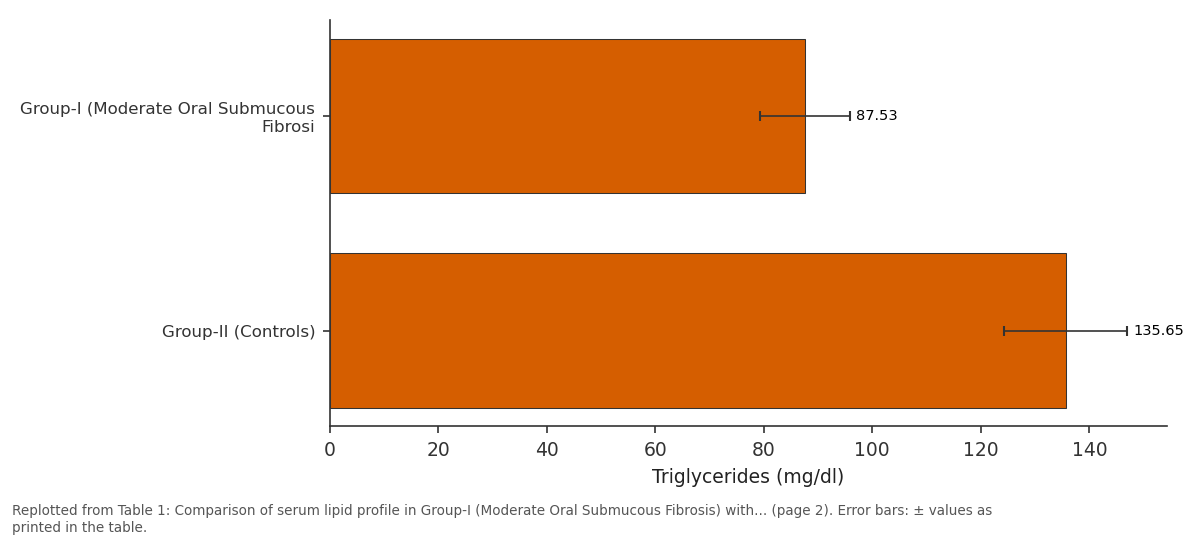
Triglycerides (mg/dl): Group-I (Moderate Oral... vs Group-II (Controls)
Replotted from Table 1 (page 2) of the original paper. Every bar is the paper's own table value.
View source evidence ↗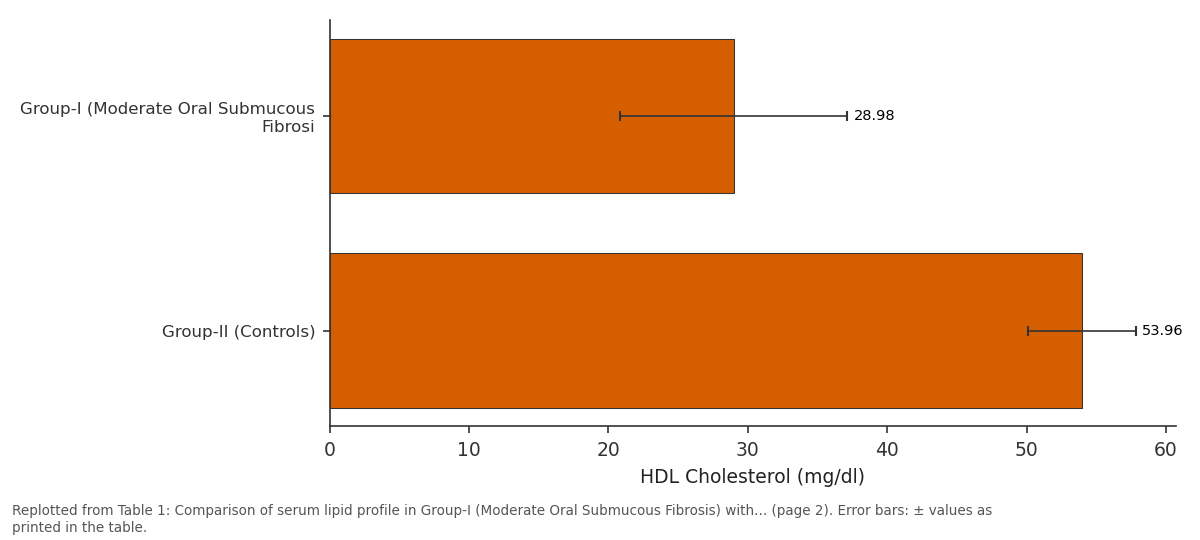
HDL Cholesterol (mg/dl): Group-I (Moderate Oral... vs Group-II (Controls)
Replotted from Table 1 (page 2) of the original paper. Every bar is the paper's own table value.
View source evidence ↗Figures & tables
From the original paper Table 1
Introduction
Oral Submucuous Fibrosis (OSMF) is a disease associated with the chewing of areca nut, an ingredient of betel quid and is prevalent in South East Asian populations. Pindborg in 1966 defined OSMF as "An insidious chronic disease affecting any part of the oral cavity and sometimes pharynx, although occasionally preceded by and/or associated with vesicle formation, it is always associated with Juxtaepithelial inflammatory reaction followed by fibro elastic changes in the lamina propria, with epithelial atrophy leading to stiffness of the oral mucosa causing trismus and difficulty in eating". The association of betel quid chewing, oral submucous fibrosis and oral squamous cell carcinoma is quite profound in Indian subcontinent [1] . Areca nut chewing is known to cause local trauma and injury to the oral mucosa due to its abrasive nature. This could be more severe in users of pan masala and gutkha due to their fine particulate nature, with the high probability of particle adhesion to the traumatized mucosa, leading to morphological changes and membrane damage. This continuous local irritation by pan masala, gutkha (or) areca nut can lead to injury related chronic inflammation, oxidative stress and subsequent Reactive Oxygen Species (ROS) generation can induce cell proliferation, cell senescence (or) apoptosis, depending upon the level of ROS production. During chronic exposure, these events can lead to preneoplastic lesions in the oral cavity and subsequently to malignancy [2] . Lipids are an important part of living cells. Cholesterol and triglycerides are easily stored in the body. They serve as a source of fuel and are important constituent for the structure of cells. These are major cell membrane components essential for various biological functions, including cell growth and division of normal and malignant tissues [3] . The decrease in the level of cholesterol has been associated with an increased risk of cancer [4] . Cellular uptake and regulation of cholesterol is mediated by lipoprotein receptors, especially located on the surface of the cells. For transport in plasma, triglycerides and cholesterol are packaged into lipoprotein which are then taken up and degraded by cells to fulfil demands for cellular functions. In some malignant diseases, blood cholesterol undergoes early and significant changes. Low level of cholesterol in the proliferating tissues and in blood compartments could be due to carcinogenesis. Usefulness of variations in tissues/blood cholesterol levels in diagnosis and treatment of various disease has been proved [5] . The present study was taken up to estimate lipid profile i.e. TC, TG, HDL-C, LDL-C, VLDL-C in Moderate Oral Submucous Fibrosis and compared with controls.
Materials and Methods
This study was carried out in the Department of Biochemistry (2018-19) at College of Dental Science and Hospital, Bhavnagar, Gujarat, India. The study protocol was approved by the institutional ethics committee.
Inclusion
Inclusion
Results
The results of this study showed that the decrease in serum lipid profile levels of Total Cholesterol, Triglycerides, HDL-C, LDL-C, VLDL-C in Moderate Oral Submucous Fibrosis when compared with controls.
The statistical analysis was performed using SPSS software version 11.0. The descriptive results were expressed as Mean and Standard deviation. Significance of the difference between the patient and control groups observed was assessed by using the student t-test.
Discussion
Oral cancer quite common in India. Several thousands of persons are affected by oral submucous fibrosis, Oral cancer developing from a precancerous lesion is quite common phenomenon these days. The harmful habits such as use of tobacco intake in both smoking and smokeless forms, pan masala and Gutkha chewing and products which contain areca nut are the main causative agent for premalignant disorders [6] . Lipids are major cell membrane components essential for various biological functions including cell growth & division of normal & malignant tissues. The habit of areca nut chewing with betel quid, tobacco smoking & alcohol consumption are the most important etiological factors for the development of oral submucous fibrosis [7] . The present study selected 50 study subjects (Moderate Oral Submucous Fibrosis) and 50 healthy subjects (controls) in the comparable group. The study population comprised fully of males. The present study was aimed to estimate lipid profile in Moderate Oral Submucous Fibrosis and compared with controls. In the present study, comparison of the serum lipid profiles among Moderate OSMF groups and corresponding controls showed that there was a decrease in TC, TG, HDL, LDL, VLDL levels in the study group compared to controls. These findings were consistent with the studies done by Patel et al. [8] , Lohe et al. [9] and Ravi et al. [10] who also observed decrease in TC, TG, HDL, LDL, VLDL levels in OSMF patients. The present study observations were supported by various authors which may occur due to reason that the lipids are major cell membrane components required for growth and division of normal cells. In 1999, Grieb et al. [11] showed a relatively high risk of cancer with a significant lower total cholesterol and HDL. A similar study by Sharma et al. [12] showed a significant decrease in serum cholesterol, LDL in OSMF patients. Gupta and Gupta [13] observed a significant decrease in plasma TC and HDL in patients with the precancerous lesions and conditions as compared to the controls.
Conclusion
High prevalence of premalignant condition like OSMF and their potential to undergo malignant transformation, this condition has not widely been investigated with respect to the serum lipid levels. Early detection is also called as secondary prevention. It is, therefore, important to identify new diagnostic and predictive approaches. The low levels of serum lipid profile serves as a diagnostic indicator or marker in early detection of oral precancerous and cancerous states.
Acknowledgement
AcknowledgmentWe, authors are thankful to subjects for their cooperation to finish this study.
Figures and tables from the paper
| Lipid Profile In Serum | Group-I (Moderate Oral Submucous Fibrosis) | Group-II (Controls) | p-value |
|---|---|---|---|
| Total Cholesterol (mg/dl) | 107.46±14.13 | 159.48±19.06 | <0.05 |
| Triglycerides (mg/dl) | 87.53±8.28 | 135.65±11.3 | <0.05 |
| HDL Cholesterol (mg/dl) | 28.98±8.17 | 53.96±3.88 | <0.05 |
| LDL Cholesterol (mg/dl) | 64.26±6.16 | 90.96±5.95 | <0.05 |
| VLDL Cholesterol (mg/dl) | 17.96±4.50 | 41.36±3.95 | <0.05 |
Table text extracted from the original PDF; superscript letters are shown inline. The original table image is below.
View original table image
References
13 in the original paper- Pindborg JJ, Sirsat SM. Oral submucuous fibrosis. Oral Surgery Oral Medicine & Oral Pathology. 1966;22:764779.
- Nair U, Bartsch H, Nair J. Alert for an epidemic of oral cancer due to use of the betel quid substitutes gutkha and pan masala: a review of agents and causative mechanisms. Mutagenesis. 2004;19:251-262.
- Mehrotra R, Pandya S, Chaudhary AK, Jaiswal RK, Singh M, Gupta SC, et al. Lipid profile in oral submucous fibrosis. Lipids in Health and Disease 2009;8:29.
- Mehta R, Gurudath S, Dayansoor S, Pai A, Ganapathy KS. Serum lipid profile in patients with oral cancer and oral precancerous conditions. Journal of Dental Research. 2014;11:345-350.
- Chalkoo AH, Risam SS, Farooq R. A study on alterations in plasma lipid profile patterns in OSMF patients. Journal of Indian Academy of Oral Medicine and Radiology. 2011;23:36-38.
- Joseph BB, George S. Level of Serum Creatine Phosphokinase in Oral Submucous Fibrosis-A Biochemical Study. International Journal of Current Research and Review. 2015;7(13):74-78.
- Chalkoo AH, Risam SS, Farooq R. A Study on Alterations in Plasma Lipid Profile Patterns in Oral Submucous Fibrosis Patients. Journal of Indian Academy of Oral Medicine and Radiology. 2011;23(1):25-31.
- Patel PS, Shah MH, Raval GN, Rawal RM, Patel MM, Patel JB, et al. Alterations in plasma lipid profile patterns in head and neck cancer and oral precancerous conditions. Indian Journal of Cancer. 2004;41:25-31.
- Lohe VK, Degwekar SS, Bhowate RR, Kadu RP, Dangore SB. Evaluation of correlation of serum lipid profile in patients with oral cancer and precancer and its association with tobacco abuse. Journal of Oral Pathology & Medicine. 2010;39:141-148.
- Ravi SM, Nupur G, Sankalp V, Soumi G, Neha A, Navin S. Alterations in serum lipid profile patterns in head & neck cancer and oral submucuous fibrosis patients. International Dental Journal of Students Research. 2014;2:17-24.
- Grieb P, Ryba MS, Jagielski J, Gackowski W, Packowski P, Chrapusta SJ, et al. Serum cholesterol in cerebral malignancies. Journal of Neuro-Oncology. 1999;41:175-180.
- Sharma G, Das D, Mukherjee J, Purandare B. Lipid profile in oral submucous fibrosis patients in India: A pilot study. Indian Journal of Basic and Applied Medical Research. 2013;2:790-796.
- Gupta S, Gupta S. Alterations in serum lipid profile patterns in oral cancer and oral precancerous lesions and conditions: A clinical study. Indian Journal of Dental Research. 2011;2:1-6.
Cited by 2
From OpenAlex, OpenCitations and reference lists read by Scinovex
- Serum lipid alterations in oral squamous cell carcinoma and oral potentially malignant disorders: A systematic review and meta-analysis ↗
Shreeja Kishor, Mila Janjić Ranković, Sven Otto, Tamara Katharina Kakoschke · Scientific Reports · 2026
Alterations in serum lipids have been linked to systemic and neoplastic diseases, including oral malignancies. Lipid disturbances are reported inconsistently in oral potentially malignant disorders (OPMD) and oral squamous cell carcinoma (OSCC). This systematic review and meta-analysis clarifies lipid profile patterns across OPMD, OSCC, and healthy controls. Following PRISMA 2020 guidelines and PROSPERO registration, a comprehensive database search through November…
❝ 1PDF - Assessment of Lipid Profile in Oral Submucous Fibrosis: A Systematic Review and Meta‐Analysis ↗
Shruti Gupta, Deepti Sharma, Anita Hooda, Mala Kamboj · Journal of Oral Pathology and Medicine · 2024
BACKGROUND: An altered blood lipid profile has been considered as a diagnostic and/or prognostic marker for cancer. Since oral cancer is usually preceded by oral potentially malignant disorders (OPMDs) and share common etiopathogenesis, thus researchers have tried to explore the role of blood lipid profile as a marker for OPMDs; however, no consensus has been made regarding the utilization of…
❝ 1PDF