
Research article · 2022 · Full text
International Journal of Agriculture and NutritionResponse of late sown wheat (Triticum aestivum l.) to organic and liquid manures on yield and economics
Volume 4(2) · Pages 1–3 · DOI: 10.33545/26646064.2022.v4.i2a.54 ↗
Research areasHumic Substances and Bio-Organic Studies
Abstract
Author-writtenA field experiment was carried out during Rabi season of 2021 at crop research form, Department of Agriculture, SDBIT to study about the “Response of late sown wheat (Triticum aestivum l.) to organic and liquid manures on growth and yield”. The experiment was laid out in randomized block design by keeping three Poultry manure levels, i.e. PM1 - (PM 2t/ha), PM2 – (PM 2.5t/ha) and PM3 – (PM 3 t/ha) and Liquid manures (Panchagavya 3% and Vermiwash 3%) which was replicated three thrice. Results revealed that Poultry Manure 3.0 t/ha + Panchagavya 3% + Vermiwash 3% recorded significantly higher in grain yield (3.24 t/ha), straw yield (4.41 t/ha) and harvest index (42.13%). However, net returns (75,870.00 INR/ha) and B: C ratio (1.41) was also obtained with the application of Poultry Manure 3.0 t/ha + Panchagavya 3% + Vermiwash 3%. Therefore, I concluded that Poultry Manure 3.0 t/ha + Panchagavya 3% + Vermiwash 3% was produced more grains (3.24 t/ha) and economic effective (1.41).
Summary
Source-checkedPlain-language reading of the full paper, prepared with AI and checked against the text. Each point links to the authors' own words.
Why it matters
- Wheat is considered the 'king of cereals' because it surpasses all other cereals in terms of global production and area. View evidence ↗
- Organic farming aims to maintain soil health and productivity by prioritizing organic materials and animal excreta over synthetic agro-inputs. View evidence ↗
- Poultry manure serves as an effective soil amendment that improves soil quality and provides essential nutrients for plant growth due to its high organic matter. View evidence ↗
The question
- The study aimed to evaluate how late-sown wheat responds to various organic and liquid manures in terms of growth and yield. View evidence ↗
What they did
- The research was conducted during the 2021 Rabi season on sandy loam soil with a pH of 7.7 and specific levels of organic carbon, nitrogen, phosphorus, and potassium. View evidence ↗
- The study used a randomized block design with three poultry manure levels (2, 2.5, and 3 t/ha) and liquid manures (3% Panchagavya and 3% Vermiwash), with three replications. View evidence ↗
- Data were analyzed using ANOVA and the 'F' test, with critical difference (CD) values calculated at a 5% significance level. View evidence ↗
What they found
- The combination of 3.0 t/ha Poultry Manure, 3% Panchagavya, and 3% Vermiwash produced the highest grain yield (3.24 t/ha), straw yield (4.41 t/ha), and harvest index (42.13%). View evidence ↗
- While the 3.0 t/ha PM + 3% Panchagavya + 3% Vermiwash treatment was superior, the 3.0 t/ha PM + 3% Panchagavya treatment followed a similar trend with a grain yield of 3.07 t/ha and straw yield of 4.27 q/ha. View evidence ↗
- The highest economic efficiency was achieved with 3.0 t/ha Poultry Manure + 3% Panchagavya + 3% Vermiwash, yielding net returns of 75,870.00 INR/ha and a B:C ratio of 1.41. View evidence ↗
- The highest cost of cultivation (₹ 53,730) was associated with the 3.0 t/ha PM + 3% Panchagavya + 3% Vermiwash treatment, while the lowest (₹ 42,030) was for 3.0 t/ha PM + 3% Panchagavya. View evidence ↗
What it means
- The authors conclude that applying 3.0 t/ha Poultry Manure combined with 3% Panchagavya and 3% Vermiwash is the most productive and economically beneficial treatment. View evidence ↗
Visual summary
3 visualsIllustrations explain the paper; charts are replotted from the paper's own table values.
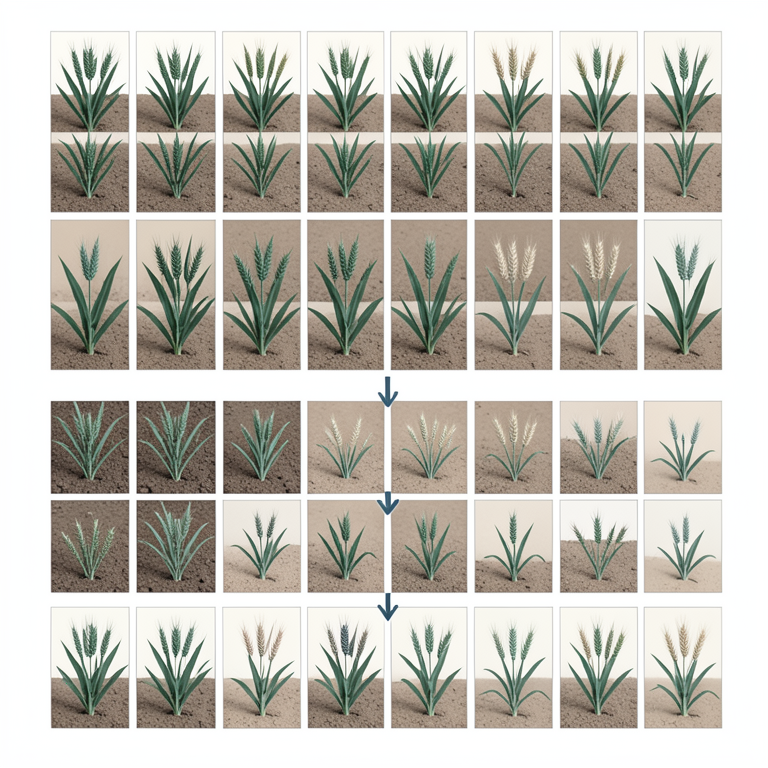
Experimental Treatment Matrix
AI-generated conceptual illustration (wheat plants (Triticum aestivum)). It explains the idea and does not show study data.
View source evidence ↗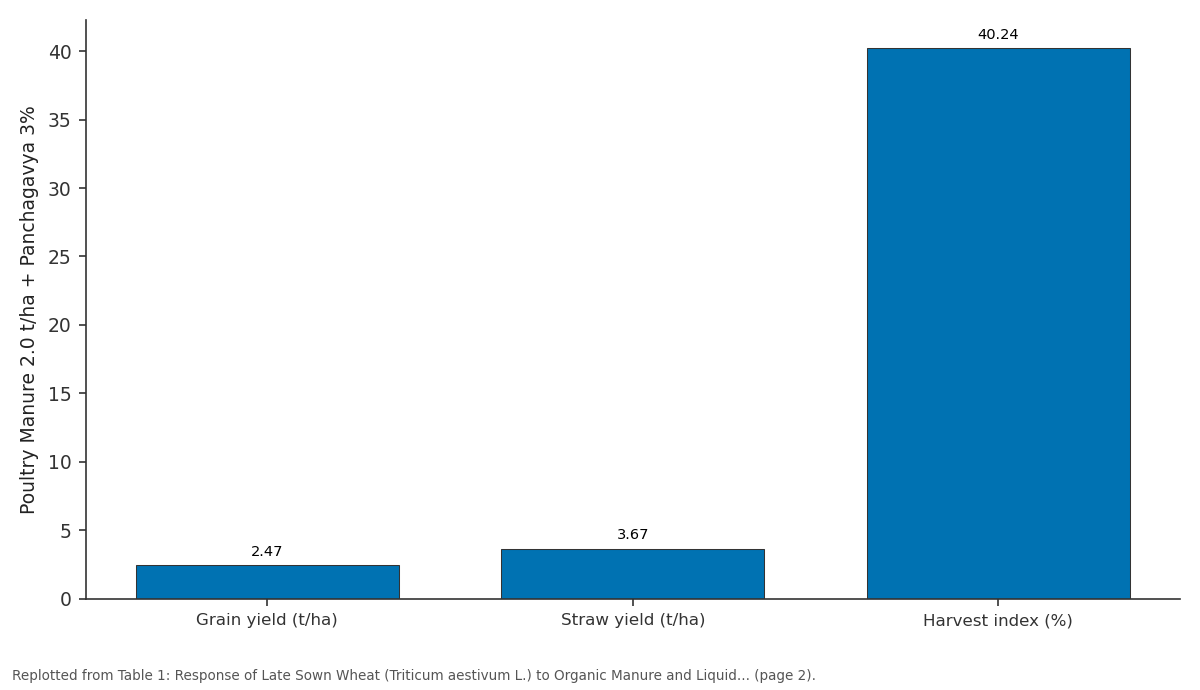
Poultry Manure 2.0 t/ha + Panchagavya 3%: Grain yield (t/ha) vs Straw yield (t/ha) vs Harvest index (%)
Replotted from Table 1 (page 2) of the original paper. Every bar is the paper's own table value.
View source evidence ↗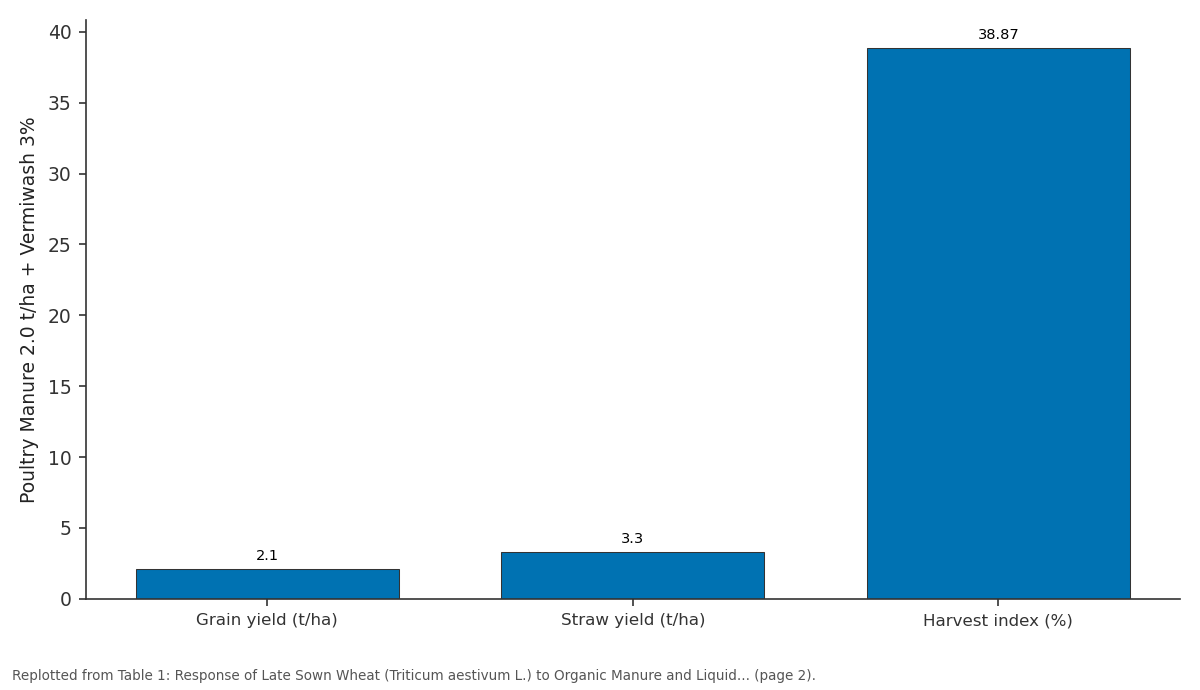
Poultry Manure 2.0 t/ha + Vermiwash 3%: Grain yield (t/ha) vs Straw yield (t/ha) vs Harvest index (%)
Replotted from Table 1 (page 2) of the original paper. Every bar is the paper's own table value.
View source evidence ↗Figures & tables
From the original paper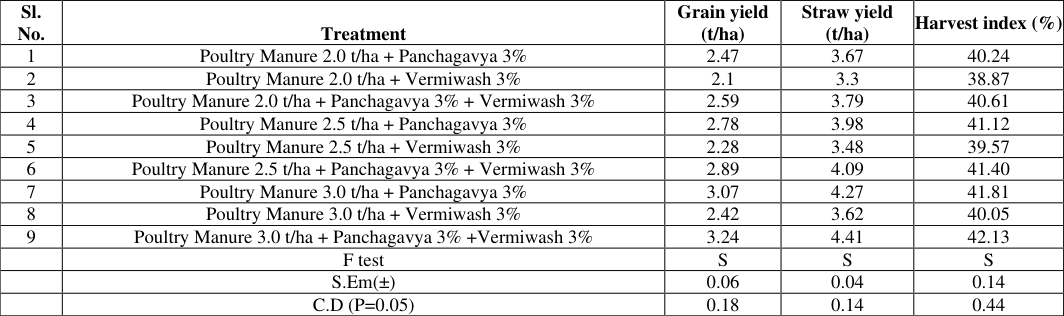 Table 1
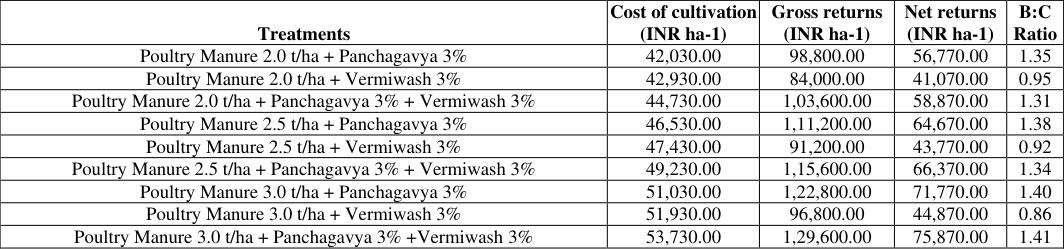 Table 2
Introduction
Wheat (Triticum aestivum L.) is the world's most outstanding crop that excels all other cereals both in area and production, known as king of cereals. It's grown throughout the temperate, tropical and sub-tropical region in the world. It constitutes the staple food in at least 43 countries. The most important wheat growing countries are the USA, China, India, Canada, Argentina, Australia and a number of Europeans countries. Maximum area under wheat is the China followed by India, Russian Federation and USA. India is second position in world wheat cultivation. India cover 295.76 lakhs of hectares area, 99.70 million tones production (12.32%), yield 3371(kg/ha). Three largest producing states of India, Uttar Pradesh 31.88, Punjab 17.85, Madhya Pradesh 15.91 during 2017-18 year, (Directorate of Economics &Statistics, DAC&FW 2017-18). India is the world's second largest producer of Rice, Wheat and other cereals. The huge demand for cereals in the global market is creating an excellent environment for the export of Indian cereal products. In 2008, India had imposed ban on export of rice and wheat etc. to meet domestic needs. Now, seeing the huge demand in the global market and country's surplus production, Country has lifted the ban, but only limited amount of export of the commodity are allowed. The allowed marginal quantity of exports cereals could not make any significant impact either on domestic prices or the storage conditions, (APEDA 2018) [2] . Organic farming is a production system which favors maximum use of organic materials, crop residues, animal excreta, legumes, on and off farm organic wastes, growth regulators, biopesticide etc. and discourage use of synthetically produced agro-inputs for maintaining soil health, productivity and pest management under the conditions of sustainable natural resources and healthy environment. Use of organic manures have been found to be promising in arresting the decline in productivity through correction of deficiencies of secondary and micro-nutrients and its beneficial influence on the physical and biological properties of soil (Kumar and Tripathi 2007). Poultry manure is a good source of nutrients for crops. It is also called as chicken manure, is an excellent soil amendment that provides nutrients for growing crops and also improves soil quality when applied wisely, because it has high organic matter combined with available nutrients for plant growth.
Which contain higher amount of Nitrogen and Phosphorus compared to other bulky organic manures. The average nutrient content is 3.03 per cent N; 2.63 per cent P2O5 and 1.4 per cent K2O. Poultry manure is relatively a cheap source of both macro and micro nutrients and increase soil nitrogen, soil porosity and improve soil microbial activity. As poultry waste contains a high concentration of nutrients so addition of small quantity of poultry manure in an integrated nutrient management system could meet the storage of FYM to some extent (Ghosh et al., 2004). Poultry manure carried out rapid mineralization. Panchagavya, an organic product is the potential source of nutrients to play the role for promoting growth and providing immunity in plant system. Panchagavya consists of cow based five products viz. cow dung, cow urine, cow milk, curd and ghee. Bio-chemical properties of panchagavya revealed that it possesses almost all the major nutrient like NPK and micro nutrients necessary for plant and growth hormones like IAA & GA required for crop growth as well as the predominance of fermentative microorganisms like yeast, azotobacter, phospo bacteria and lactobacillus. Application of vermiwash at 2% spray results increase in plant height, number of tillers, dry weight and yield attributes characters (Dekhane S.S 2017). Role of foliar application or seed soaking of panchagavya in production of many plantation crops had been well documented in India (Selvaraj 2003) [10] .
Materials and Methods
The experiment was conducted during the Rabi season 2021, at the Crop Research Farm, Department of Agronomy, SDBIT during Rabi season 2021 on sandy loam soil, having nearly neutral in soil reaction (pH 7.7), organic carbon (0.44), available nitrogen (171.48 kg/ha K), available phosphorus (27 kg/ha) and available potassium (291.2 kg/ha). The climate of the region is semi-arid subtropical. Treatments comprised of T 1 -Poultry Manure 2.0 t/ha + Panchagavya 3%, T 2 -Poultry Manure 2.0 t/ha + Vermiwash 3%, T 3 -Poultry Manure 2.0 t/ha + Panchagavya 3% + Vermiwash 3%, T 4 -Poultry Manure 2.5 t/ha + Panchagavya 3%, T 5 -Poultry Manure 2.5 t/ha + Vermiwash 3%, T 6 -Poultry Manure 2.5 t/ha + Panchagavya 3% + Vermiwash 3%, T 7 -Poultry Manure 3.0 t/ha + Panchagavya 3%, T 8 -Poultry Manure 3.0 t/ha + Vermiwash 3% and T 9 -Poultry Manure 3.0 t/ha + Panchagavya 3% +Vermiwash 3%. These were replicated thrice in Randomized Block Design.
Chemical analysis of soil
Composite soil samples are collected before layout of the experiment to determine the initial soil properties. The soil samples are collected from 0-15 cm depth and were dried under shade, powdered with wooden pestle and mortar, passed through 2 mm sieve and were analyzed for organic carbon by rapid titration method by Nelson (1975) [8] . Available nitrogen was estimated by alkaline permanganate method by Subbiah and Asija (1956), available phosphorus by Olsen's method as outlined by Jackson (1967) [6] , available potassium was determined by using the flame photometer normal ammonium acetate solution and estimating by using flame photometer (ELICO Model) as outlined by Jackson (1973) [6] and available ZnSO4 was estimated by Atomic Absorption Spectrophotometer method as outlined by Lindsay and Norvell (1978).
Statistical analysis
The data recorded were different characteristics were subjected to statistical analysis by adopting Fishers the method of analysis of variance (ANOVA) as described by Gomez and Gomez (2010). Critical difference (CD) values were calculated the 'F' test was found significant at 5% level.
Results and discussion Yield
The Data related that the grain and straw yield evaluated and tabulated in Table 1. Maximum grain yield (3.24 t/ha) and straw yield (4.41 t/ha) in Poultry manure in 3.0 t/ha + Panchagavya 3% + Vermiwash 3% which superior over all the treatments except with the application of treatment Poultry manure 3.0 t/ha + Panchagavya 3% in both parameters grain yield (3.07) and straw yield (4.27 q/ha) were followed similar trend. Under organic production, organic sources of nutrients are best option to maintain the health of soil, provide the equal opportunity for all the living existence of live and use from their beneficial activities, like nitrogen fixation, phosphorus solubilization, recycling of animal waste and green manure. FYM 25% + VC 75% + Panchagavya at 2% + Vermiwash at 5% spray, found better results in yield attributes i.e., grain, straw and harvest index. Similar results found (Tamim Fazily, C.S. Hunshal, 2010) [12] , (Davari, M.R, 2007), (Pagar, R.D 2016 b) [9] .
| Sl. No. | Treatment | Grain yield (t/ha) | Straw yield (t/ha) | Harvest index (%) |
|---|---|---|---|---|
| 1 | Poultry Manure 2.0 t/ha + Panchagavya 3% | 2.47 | 3.67 | 40.24 |
| 2 | Poultry Manure 2.0 t/ha + Vermiwash 3% | 2.1 | 3.3 | 38.87 |
| 3 | Poultry Manure 2.0 t/ha + Panchagavya 3% + Vermiwash 3% | 2.59 | 3.79 | 40.61 |
| 4 | Poultry Manure 2.5 t/ha + Panchagavya 3% | 2.78 | 3.98 | 41.12 |
| 5 | Poultry Manure 2.5 t/ha + Vermiwash 3% | 2.28 | 3.48 | 39.57 |
| 6 | Poultry Manure 2.5 t/ha + Panchagavya 3% + Vermiwash 3% | 2.89 | 4.09 | 41.40 |
| 7 | Poultry Manure 3.0 t/ha + Panchagavya 3% | 3.07 | 4.27 | 41.81 |
| 8 | Poultry Manure 3.0 t/ha + Vermiwash 3% | 2.42 | 3.62 | 40.05 |
| 9 | Poultry Manure 3.0 t/ha + Panchagavya 3% +Vermiwash 3% | 3.24 | 4.41 | 42.13 |
| F test | S | S | S | |
| S.Em(±) | 0.06 | 0.04 | 0.14 | |
| C.D (P=0.05) | 0.18 | 0.14 | 0.44 |
Table text extracted from the original PDF; superscript letters are shown inline. The original table image is below.
View original table image
Conclusion
It is concluded that the treatment Poultry Manure 3.0 t/ha + Panchagavya 3% + Vermiwash 3%. was found significantly more productive (3.24 t/ha). It is also recorded that maximum Benefit cost ratio (1.41) as compared to other treatment combinations.
Figures and tables from the paper
| Treatments | Cost of cultivation (INR ha-1) | Gross returns (INR ha-1) | Net returns (INR ha-1) | B:C Ratio |
|---|---|---|---|---|
| Poultry Manure 2.0 t/ha + Panchagavya 3% | 42,030.00 | 98,800.00 | 56,770.00 | 1.35 |
| Poultry Manure 2.0 t/ha + Vermiwash 3% | 42,930.00 | 84,000.00 | 41,070.00 | 0.95 |
| Poultry Manure 2.0 t/ha + Panchagavya 3% + Vermiwash 3% | 44,730.00 | 1,03,600.00 | 58,870.00 | 1.31 |
| Poultry Manure 2.5 t/ha + Panchagavya 3% | 46,530.00 | 1,11,200.00 | 64,670.00 | 1.38 |
| Poultry Manure 2.5 t/ha + Vermiwash 3% | 47,430.00 | 91,200.00 | 43,770.00 | 0.92 |
| Poultry Manure 2.5 t/ha + Panchagavya 3% + Vermiwash 3% | 49,230.00 | 1,15,600.00 | 66,370.00 | 1.34 |
| Poultry Manure 3.0 t/ha + Panchagavya 3% | 51,030.00 | 1,22,800.00 | 71,770.00 | 1.40 |
| Poultry Manure 3.0 t/ha + Vermiwash 3% | 51,930.00 | 96,800.00 | 44,870.00 | 0.86 |
| Poultry Manure 3.0 t/ha + Panchagavya 3% +Vermiwash 3% | 53,730.00 | 1,29,600.00 | 75,870.00 | 1.41 |
Table text extracted from the original PDF; superscript letters are shown inline. The original table image is below.
View original table image
References
12 in the original paper- Anonymous. 2017-18. Directorate of Economics &Statistics, DAC&FW eands.dacnet.nic.in.
- APEDA 2018 Agricultural and Processed Food Products Export Development Authority.
- Dekhane SS, Mangave BD, Dumbre RB, Patel DJ. Response of nutrient management practices through organic substance on rice var. GR-11 in North Konkan Coastal zone of Maharashtra. International Journal of Environment, Agriculture and Biotechnology. 2017, 2(6).
- Ghosh BN, Prakash V, Singh RD. Micronutrient status in soybean (Glycine max) wheat (Triticum aestivum L.) cropping system in Kuma on region of Uttaranchal. Indian J. Agric. Sci. 2004:71(2):149-152.
- Khandait VN, Tiple AV, Dhenge SA. Assessment of relationship between personal and socio-economic characteristics with adoption of backyard poultry rearing practices in Bhandara district of Maharashtra. Int. J Agric. Extension Social Dev. 2020;3(1):58-62.
- Jackson ML. Soil chemical analysis. Prentice Hall of India Pvt. Ltd. New Delhi, 1973.
- Kumar Alok, Tripathi HP, Yadav DS. Correcting nutrient for sustainable crop production. Indian Journal of Fertilizers, 2007.
- Nelson DW, Sommers LE. A rapid and accurate procedure for estimation of organic carbon in soil. Proceedings of Indian Academy of Science. 1975:64:1815-1826.
- Pagar RD, Jangilwad DB, Chaudhary MK. Effect of Panchagavya on Growth and Yield of Wheat (Triticum aestivum L.). Advances in Life Sciences, 2011, 5(3).
- Selvaraj N. Report of work done on organic farming at horticulture research station, Tamil Nadu Agriculture University, Ooty, India, 2005, 2-5.
- Subbiah B, Vand Asija GL. A rapid procedure for estimation of available nitrogen in soils. Current Science. 1956:25:259-260.
- Tamim Fazily, Hunshal CS. Effect of Organic Manures on Yield and Economics of Late Sown Wheat (Triticum aestivum). International Journal of Research and Review. 2010:6 (1):168-171.
Cited by 1
From OpenAlex, OpenCitations and reference lists read by Scinovex
- Effect of diverse nutrient sources and liquid organic manures on soil nutrient status of sesame (Sesamum indicum L.)
V Tejaswi, A. Upendra Rao, B Jyothi Basu, S Govinda Rao · International Journal of Research in Agronomy · 2025
A field experiment was conducted to study “Organic nutrient management in rabi sesame (Sesamum indicum L.)” during 2024-25 at the Agricultural College Farm, Naira. The experiment was laid out in a split-plot design with three replications. The study consists of three main plot treatments viz., 100% RDN through inorganic fertilizers, 100% RDN through organics with biofertilizers and biofertilizers alone. The sub-plots included four foliar applications: Vermiwash, Panchgavya, Jeevamrut and water spray. The results showed thaT100% RDN organic manures + biofertilizers (M2) significantly improved p