
Research article · 2022 · Full text
International Journal of Statistics and Applied MathematicsImpact of exogenous and endogenous variables in time series analysis, exchange rate in turkey as case study
Volume 7(5) · Pages 10–14 · DOI: 10.22271/maths.2022.v7.i5a.874 ↗
Research areasStock Market Forecasting Methods
Abstract
Author-writtenThis study aimed to investigate the impact of exogenous and endogenous variables in time series Analysis, the study sample consisted of data from 2014 to 2018. The analysis ARIMA, ARIMAX was carried out on exchange rate and interest rate in Turkey during 2014 to 2018 (Monthly data), the results indicated that arimx model explains better the change in dependent variable more than arima model,Also the results are statistically more significant.
Summary
Source-checkedPlain-language reading of the full paper, prepared with AI and checked against the text. Each point links to the authors' own words.
Why it matters
- Statistical analysis is used in developed countries to understand causal relationships between variables to support informed economic and political decision-making. View evidence ↗
- Time series analysis is a key statistical tool for studying variables that change over time, such as currency exchange rates. View evidence ↗
- Effective time series modeling typically involves incorporating both exogenous (external) and endogenous (internal) variables. View evidence ↗
The question
- The study aims to investigate how the inclusion of exogenous and endogenous variables impacts time series analysis. View evidence ↗
- The researchers proposed that the results of a time series model would differ depending on whether exogenous or endogenous variables are included or excluded. View evidence ↗
What they did
- The study used monthly data from 2014 to 2018 to analyze the exchange rate and interest rate in Turkey using ARIMA and ARIMAX models. View evidence ↗
- Exchange rate data for the 2014-2018 period was sourced from the Turkish Central Bank. View evidence ↗
- In the ARIMAX model, the interest rate was utilized as the exogenous variable. View evidence ↗
- R-studio software was used to perform the dataset estimation and analysis. View evidence ↗
What they found
- Initial analysis of the time series data showed that it was not stationary during some periods. View evidence ↗
- The ARIMAX (1, 1, 1) model performed best among the tested models, showing the lowest volatility (0.029), highest adjusted R2 (0.96), and lowest AIC (-0.45) and SBIC (-0.28). View evidence ↗
- The ARIMAX model was found to be superior to the ARIMA model because the inclusion of exogenous variables better explained the variability of the dependent variable. View evidence ↗
- The results indicated that the ARIMAX model provided a more statistically significant explanation of changes in the dependent variable compared to the ARIMA model. View evidence ↗
What it means
- The authors conclude that adding exogenous variables allows time series changes to be explained more efficiently by providing more parameters. View evidence ↗
- The authors state that using models with exogenous variables provides a better explanation of exchange rate changes over time and improves forecasting capabilities. View evidence ↗
Visual summary
3 visualsIllustrations explain the paper; charts are replotted from the paper's own table values.

Comparison of ARIMA and ARIMAX
AI-generated conceptual illustration (A digital representation of the Turkish Lira currency symbol and a financial line graph). It explains the idea and does not show study data.
View source evidence ↗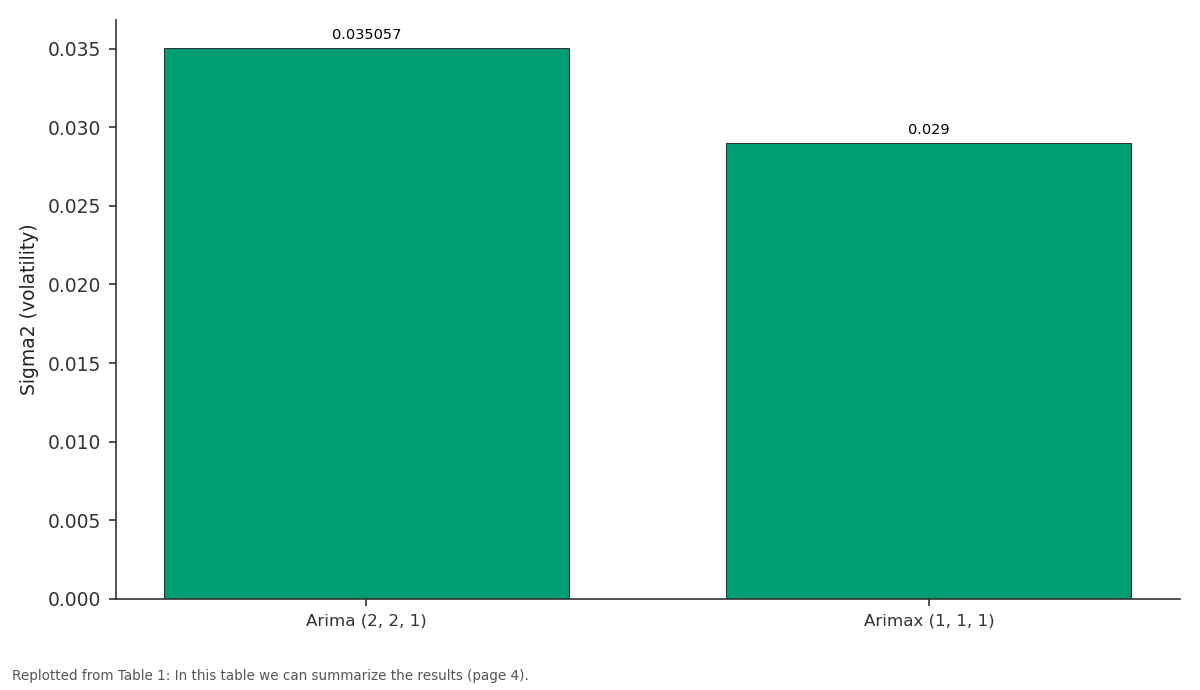
Sigma2 (volatility): Arima (2, 2, 1) vs Arimax (1, 1, 1)
Replotted from Table 1 (page 4) of the original paper. Every bar is the paper's own table value.
View source evidence ↗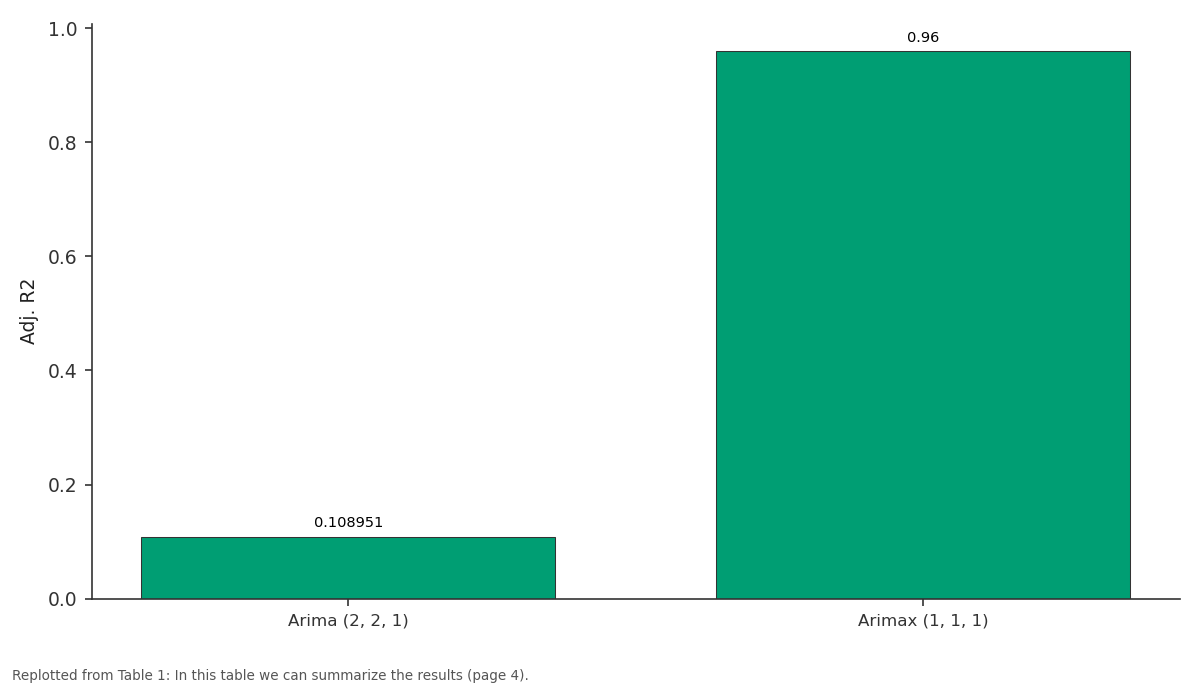
Adj. R2: Arima (2, 2, 1) vs Arimax (1, 1, 1)
Replotted from Table 1 (page 4) of the original paper. Every bar is the paper's own table value.
View source evidence ↗Figures & tables
From the original paper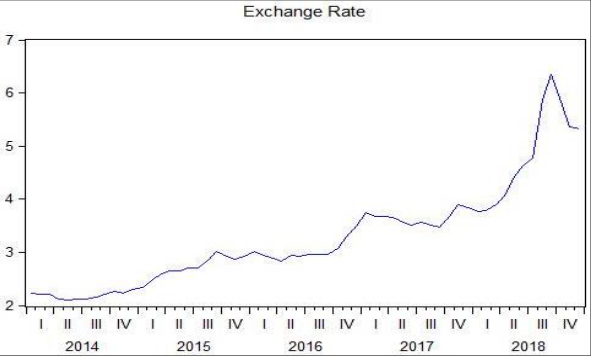 Figure 1
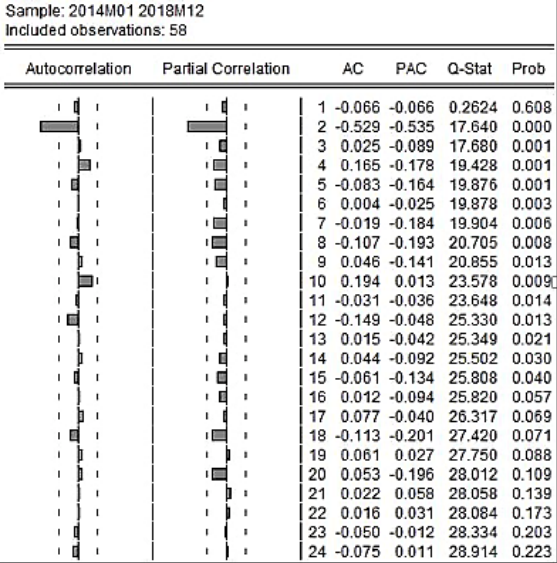 Figure 2
 Table 1
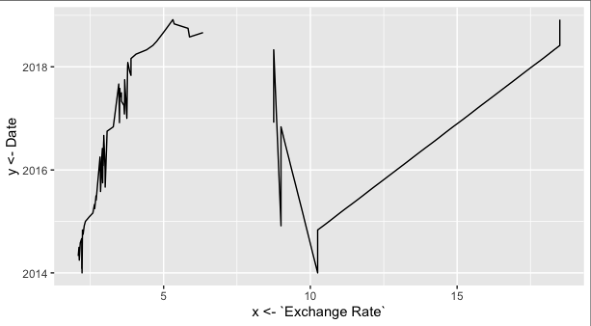 Figure 3
Introduction
Over the years throughout history, statistics and analysis have had played a major role in economy and politicise in developed countries in order to find out the reasons, to make informed decisions or to clarify the causal relationship between the different variables. Hence, the simple and complex regression analysis tries to identify the relationship between two or more variables and how they affect each other. Among the most important statistical analysis that were used in the past, are time series analysis, which analyses the time-related variables that modifies with the change of time, either daily, monthly or annually. The exchange rate can be termed as an example for such variable. This is a well-known fact that most of the fields that use time series and their analysis are academic and social domains of Economy or Social Sciences. The best practice includes the formation of a model that includes several types of variables, Such as exogenous and endogenous variables.
Importance and Objectives of study
This study aims to investigate the impact of exogenous and endogenous variables in time series analysis, proposing as (the model will change if it include exogenous or endogenous variables i mean the result will be different about the result if the variables excluded So this paper will describe the impact of exogenous variable, one of the factors which effect on exchange rate in turkey such as interest rate, inflation, exports, imports and political issues. While the hypothesis of the study will be described as the exogenous and endogenous will not effect on time series model.
Operational Definitions 1.3.1 Exogenous
A factor in a causal show or causal framework whose esteem is free of the states of other factors within the framework, a figure whose esteem is decided by variables or factors exterior the causal system. For example, the unemployment rate in any country is one of the external factors that affect the economy in general and the exchange rate in particular. There are some causal factors that determine the exchange rate, so the unemployment rate is the internal factor to the exchange rate model but these factors are not in themselves part of the causal model we use to explain the exchange rate level. An exogenous variable is defined as a variable whose value is completely causally independent of other variables in the system. In the analysis of time series, one of the proposed goal of this research, a lot of models are used that can be obtained through statistical programs, the most famous is ARIMA model. The ARIMA model with exogenous variables can be written in the following equation Then we label that Autoregressive Moving Average with Exogenous Variables (ARMAX) Where; x: Exogenous variable.
Endogenous
The internal variable is the variable whose value is determined by the economic model, describing that the internal variable is the dependent variable and its value depends on other variables within the model. Since the endogenous variable is located within the economic model, the model can predict the value of the endogenous variable. The endogenous variable is the opposite of the exogenous variable, as the later one is independent variables that cannot be predicted by the economic model. Through the example, used in the statistical analysis in this research about the exchange rate as an example of a time series, which depends on many variables such as interest rate, exports, imports and other variables, so the internal variable in this case study is the exchange rate. So in this part the equation will be same arima model, and we can be written as following
Literature review
The difference between exogenous and endogenous variables and impact of these variables on analysis has been investigated in-detail, also the relationship between exchange rate and other factor was studied too. Almost all the outcomes indicated a significant result, as described below.
Exogenous and endogenous variables
G.Zaman, Z.Goschin (2010) illustrated the technical change as exogenous or endogenous factor in the production of function models as empirical evidence from Romania. This study endeavored to incorporate it unequivocally within the financial development models, either as an exogenous or endogenous figure of impact utilizing the system of the total Cobb-Douglas generation work in its classical shape as well as in a few refined variations. We evaluated the flexibilities of generation components for Romania over the 1990-2007 period, finding that specialized advance has had a little commitment to the financial development. Moreover, Themba G. Chirwa, Nicholas M. Odhiambo (2018) [9] investigated "Exogenous and Endogenous Growth Models: as a Critical Review". In this article, the author examines internal growth patterns and external growth patterns through certain concepts. The results indicated that within the internal model, there are two types of assumptions. The first of which is the capital that considers the difference in production, and the second assumes that technological progress is the main determinant of economic growth & externally. Also, C. Bennett, Rodney A. Stewart examined in the paper, the variables affecting the demand of the low-voltage network were identified and the development of the total energy use on the next day and models to forecast the peak demand on the next day for each stage .The models were created utilizing both Autoregressive Coordinates Moving Normal with Exogenous Factors (ARIMAX) and Neural Arrange (NN) strategies. The information utilized in this inquire about were collected from a moo voltage transformer serving 128 private clients.
Exchange rate modeling
Jackie D. Urrutia, Jaya D. De Guzman, Joseph Mercado, Lincoln Bautista, EdconBaccay (2015) [5] outlined the trade rate within the Philippines as regression model. This think about defined a condition which clarified the connection between trade rate and intrigued rate (x1), swelling rate (x2), Labor Drive Interest Rate (x3) and Add up to Exchange (x4) as the free variable. The comes about appeared Trade rate and add up to exchange appears an expanding drift whereas swelling rate and intrigued rate and labor constrain cooperation rate appears a few variances inside the period of time. Moreover, Mori K, Rozilee A, Jaratin L, Dullah Mand Nanthakumar L (2012) [4] looked into the impacts of the exchange rates on financial development in Malaysia utilizing time arrangement information traversing from 1971 to 2009. The comes about of the ARDL bounds test proposed that long-run cointegration exists between both ostensible and genuine exchange rates and financial development with a noteworthy positive coefficient recorded for genuine trade rate. Also, M. Kandil et al. (2007) [3] explored the impacts of exchange rate variances on genuine yield, the cost level, and the genuine esteem of components of total request in Turkey. The comes about appeared that unexpected exchange rate variances have topsy-turvy impacts that highlight the significance of unexpected devaluation in contracting yield development and the development of private utilization and venture, in spite of an increment in exchange development. Furthermore, Sanam M, Fetullah A (2017) [2] examined "The Relationship between Exchange Rates and Inflation: The Case of Iran". The point of this study was to analyze the relationship between Trade rate and swelling based on time arrangement information, utilizing Hendry Common to Particular Modeling strategy and Vector Autoregression (VAR) demonstrate. It utilized quarterly information between 1997/3 to 2011/4 to assess the VAR demonstrate. The result appeared that an increment in remote trade rates makes the expansion goes up, and there's a coordinate relationship between Trade rate and expansion.
Research Methodology 3.1.1 Data and Methodology
Within the third segment of the paper, the analyst needs to analyze the trade rate in Turkey by utilizing time arrangement, the information utilized for the ponder is the month to month information that was collected between 2014-2018. Whereas conducting this consider, R-studio is utilized to analyze the dataset, estimation and analysis are appeared within the comes about segment. a. Exchange rate is the value of one nation's currency versus the currency of another nation or economic zone, The study adopted exchange rate data from the Turkish Central Bank during the period 2014-2018 b. It Include exogenous variable in the second sector (exogenous variable was interest rate).
Analysis and Result
The ARIMA model is used to find out the impact of included exogenous and endogenous variables, also data is divided into sections as described following
Time series without exogenous variable
The instruments required for distinguishing proof are: Correlogram, autocorrelation work and halfway autocorrelation work. The fractional autocorrelation (PAC) measures the relationship between (time arrangement) perceptions that are k-time periods separated after controlling for relationships at middle slacks (i.e., lags less than k). In other words, partial autocorrelation is the correlation between Y t and Y t-k after removing the effect of the intermediate Y's (measures the marginal impact). To identify the appropriate ARMA/ARIMA model, I have outlines 5 procedures: 1) plot the series to visualize if stationary or not; From figure above we see the series or observe the similarities of both AC and PAC, both show rapid decline, so this model is not apparently AR or MA but an ARIMA model. The AC shows good exponential decay and adapted sinewave pattern. lag 2 was statistically significant, for PAC same pattern.
Time series with exogenous variable
In this part we use R studio to make analysis Firstly plot the two variables exchange rate and interest rate by date. From the figure above, we conclude that the series is not stationary, so with exogenous variable Arima model will be such as following In Arimax model with exogenous variable, we have 4 models so we have to examine on that by the rules which we mentioned above, so the ARIMAX (1, 1, 1) is proved as the best model for our research. While, when the compare was made between arima model and arimax model, we find the ariamx model better than arima due to inclusion of other variables which may explain the variability of dependent variable. It also brings the change in dependent variable by time.
Compare between results in previous two section
Compare between results in previous two section
Conclusions
According to the results that have been reached through the investigation carried out in this research, we can say that adding a variable (exogenous variable) has a greater effect and have more parameters so that the change can be explained by the time series more efficiently without an additional external variable. This was approved by a study Themba G. Chirwa, Nicholas M. Odhiambo, 2018 [9] that's the results confirmed the exogenous variables more effective in growth model than endogenous variable in same model. So, in our case study exchange rate can be explained by many models one of that is time series model, but the researchers want to include more than one variables to investigate that which one more effect on exchange rate. It means as used model with exogenous variables which gave us more explanation on change by time in exchange rate and for casting well as possible
Figures and tables from the paper
| Differenced Model | Arima (2, 2, 1) | Arimax (1, 1, 1) | Arimax (2, 1, 1) | Arimax (3, 1, 1) | Arimax (1, 8, 1) |
|---|---|---|---|---|---|
| Significant coefficients | 1 | 3 | 1 | 3 | 1 |
| Sigma2 (volatility) | 0.035057 | 0.029 | 0.042 | 0.068 | 0.043 |
| Adj. R2 | 0.108951 | 0.96 | 0.95 | 0.92 | 0.95 |
| AIC | -0.315026 | -0.45 | -0.082 | 0.434 | -0.082 |
| SBIC | -0.260044 | -0.28 | 0.092 | 0.61 | 0.0927 |
Table text extracted from the original PDF; superscript letters are shown inline. The original table image is below.
View original table image
References
11 in the original paper- Aisen A, Veiga F. How does political instability affect economic growth? European Journal of Political Economy. 2013 Mar 1;29:151-67.
- Sanam M, Fetullah A. The Relationship between Exchange Rates and Inflation: The Case of Iran. European Journal of Sustainable Development. 2017;6(4):329-340. ISSN: 2239-5938.
- Kandil M, et al. The effects of exchange rate fluctuations on economic activity in Turkey. Journal of Asian Economics. 2006;18(2007):466-489.
- Mori K, Rozilee A, Jaratin L, Dullah M, Nanthakumar L. The Effect of Exchange Rates on Economic Growth: Empirical Testing on Nominal Versus Real. International Conference on Applied Business Research (ICABR), November 28-December 2, 2011, Johor Bahru, Malaysia; c2012.
- Jackie Urrutia D, Jaya D, De Guzman, Joseph Mercado, Lincoln Bautista, Edcon Baccay. Modeling the Philippines' Exchange Rate: A Regression Analysis. European Academic Research, 2015, 3(3).
- Vinh T, Duong T. The Impact of Exchange Rate Volatility on Exports in Vietnam: A Bounds Testing Approach. Risk Financial Manag. 2019;12(1):6. Doi:10.3390/jrfm12010006
- Bouraoui T, Hammami H. Does political instability affect exchange rates in Arab Spring countries? Applied Economics. 2017;49(55):5627-5637.
- Themba Chırwa G, Nıcholas Odhıambo M. Exogenous and Endogenous Growth Models: A critical Review. Comparative Economic Research. 2018;21(4):63-84. 10.2478/cer-2018-0027
- Donovan I, Zhou YJ, Carrasco M. In search of exogenous feature-based attention. Attention, Perception, & Psychophysics. 2019;82(1):312-329.
- Dugué L, Merriam EP, Heeger DJ, Carrasco M. Differential impact of endogenous and exogenous attention on activity in human visual cortex. Scientific Reports. 2020;10(1):1-16.
- Fernández A, Carrasco M. Extinguishing exogenous attention via Trans-cranial magnetic stimulation. Current Biology. 2020 Oct 19;30(20):4078-84.
Cited by 2
From OpenAlex, OpenCitations and reference lists read by Scinovex
- The impact of the determinants of Tourism Villages on the Increase of the Human Development Index (HDI) in Indonesia ↗
Ayu Esteka Sari · International Journal of Business and Quality Research · 2025
This study aims to analyze the influence of the determinants of tourism village development on the increase of the Human Development Index (HDI) in Indonesia. The main focus of the research is on the determinants of tourist villages. The method used includes quantitative data analysis from various tourism villages in Indonesia to understand the relationship between the development of tourism…
❝ 0PDF - Explainable CNN–LSTM for Coffee Sales Forecasting: Benchmarking against SARIMAX with Exogenous Features ↗
Masbahah, Yusuf Fadlila Rachman, Darmawan Lahru Riatma, Rifa Khoirunisa, Nur Azizul Haqimi, Ahmad Faisal Sani · International Conference of Science and Information Technology in Smart Administration (ICSINTESA) · 2025
❝ 0