
Research article · 2022 · Full text
International Journal of Veterinary Sciences and Animal HusbandryReview on identification of ixodid tick species on bovine in and around Shanan Dhugo District, Eastern Ethiopia
Volume 7(5) · Pages 23–25 · DOI: 10.22271/veterinary.2022.v7.i5a.438 ↗
Research areasVector-borne infectious diseasesVector-Borne Animal DiseasesViral Infections and Vectors
Abstract
Author-writtenThe take a look at became carried out on nearby breed farm animals, determined in and round Shanan Dhugo district, Western Hararghe from April 2019 to December 2019 to discover the fundamental Ixodid ticks species and its incidence. The sampled animals from peasant institutions of Shanan Dhugo district have been randomly decided on with the aid of using a multistage sampling method after which tested for tick infestation. Out of the entire 420 farm animals tested, 120 (28.57%) have been determined to be infested with the aid of using one or extra tick species. About 958 person ticks have been gathered from the animal frame elements and diagnosed into genera and species stages. Three tick species of 3 genera (Amblyomma, Boophilus, and Rhipicephalus) have been diagnosed. The relative incidence of every species became Amblyomma variegatum (61.18%), Boophilus decoloratus (34.59%), and Rhipicephalus evertsi-evertsi (4.21%). Amblyomma variegatudisplaysa ay a better before for udder, scrotum, and axial; B. decoloratus have been determined prominently on dewlap and neck, and stomach and groin; R. evertsi-evertsi display better desire for perianal and vulva, and below tail areas of the frame.
Summary
Source-checkedPlain-language reading of the full paper, prepared with AI and checked against the text. Each point links to the authors' own words.
Why it matters
- Ticks are critical ectoparasites in tropical and subtropical regions, causing significant economic losses in livestock and acting as potent disease vectors. View evidence ↗
- In Eastern Ethiopia, ticks are responsible for approximately 65.5% of primary hide defects, with an estimated annual loss of US$500,000 due to hide degradation. View evidence ↗
The question
- The study aimed to identify the primary Ixodid tick species and their incidence on local cattle in and around the Shanan Dhugo district of Western Hararghe. View evidence ↗
What they did
- Animals were randomly selected from peasant associations in the Shanan Dhugo district using a multistage sampling method. View evidence ↗
- A cross-sectional study was conducted on local cattle breeds from April 2019 to December 2019. View evidence ↗
- Adult ticks were collected from one side of the animal's body after a thorough examination and preserved in 10% formalin. View evidence ↗
What they found
- Of the 420 cattle tested, 120 animals (28.57%) were infested with one or more tick species. View evidence ↗
- Tick species showed specific site preferences: A. variegatum preferred the udder, scrotum, and axilla; B. decoloratus was found mainly on the dewlap, neck, stomach, and groin; and R. evertsi-evertsi preferred the perianal, vulva, and under-tail areas. View evidence ↗
What it means
- The authors conclude that identifying the prevalence and specific species of ticks is essential for designing strategic control programs and analyzing tick-borne diseases. View evidence ↗
Visual summary
1 visualsIllustrations explain the paper; they do not show study data.
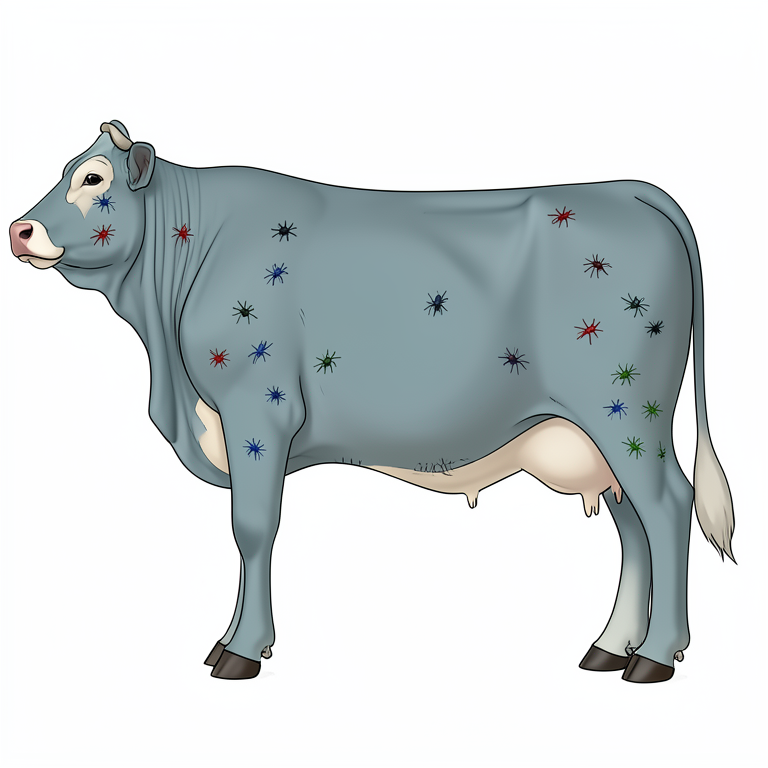
Tick Species Site Preference
AI-generated conceptual illustration (Bovine (cattle) and ixodid ticks). It explains the idea and does not show study data.
View source evidence ↗Introduction
Ticks are the maximum vital ectoparasites of farm animals in tropical and subtropical regions and are accountable for excessive financial losses in farm animals and are powerful ailment vectors, 2 nd is most effective to mosquitoes in transmitting infectious ailment (Le Bars, 2009 The lifestyles cycle of ticks (each ixodid and argasids) go through 4 degrees of their development; eggs, 6-legged larva, 8-legged nymph and person (Solomon et al., 2001, Minjauw and McLeod, 2003) [22] . According to the range of hosts, Ixodids ticks are categorized as one host ticks, host ticks, 3 host ticks, and Argasids categorized as multi-host ticks. In one host ticks, all of the parasitic degrees (larva, nymph, and person) feed at the identical hosts; in host ticks, larva connect to 1 host, feed and molt to nymphal degree and engorged, and then they detach and molt at the floor to person; and in 3 host ticks, the larva, nymph, and person connect to one-of-a-kind hosts and all detach from the host after engorging and detaching from the hosts (Taylor et al., 2007) [25] . Although, most effective pretty few of extra than 889 species of tick withinside the global are vital to the guy and his home animals, those few species should be controlled if farm animals manufacturing is to satisfy global wishes for animal protein (Drum¬mond, 2007) [10] . Over seventy-nine one-of-a-kind species of ticks are determined in Eastern Africa and a lot of those look of very little financial significance (Cumming, 1999). In Ethiopia, there are forty-seven species of ticks determined on farm animals and a maximum of them have significance as vectors and ailment inflicting marketers and now have a destructive impact on pores and skin and disguise manufacturing (Bayu, 2005) [5] . The Genus Amblyomma and Rhipicephalus ticks are predominating in lots of elements of the country, Boophilus and Hyalomma ticks have a large position (Solomon et al., 2001) [22] . Besides ailment transmission ticks inflict a massive financial loss. Production losses because of ticks and tick-borne illnesses (TTBDs) around the world had been anticipated at US$ 13. Nine to US$ 18.7 billion yearly leaving the global's 80 little at risk (de Castro, 1997, de Wall, 2000, Ghosh et al., 2007) [13] . Anticipated an annual lack of US$500,000 from disguise and pores and skin downgrading from ticks, and about 65.5% of fundamental defects of hides in Eastern Ethiopia are from ticks Bekele (2002) [7] . Due to the financial and veterinary significance of ticks, their manipulation and the transmission of tick-borne illnesses continue to be a venture for the farm animals enterprise in tropical and subtropical regions of the sector and its miles are a concern for many nations in tropical and subtropical areas. Investigations directed towards figuring out the value of infestation and the kind of species worried will play an astounding position in designing strategic manipulation towards those parasites. Moreover, a species stage identity will help the analysis of various tick-borne illnesses and their respective manipulation programs (Lodos et al., 2000) [15] 2. Materials and Methods
Study Area Description
Take a look at what became carried out in Shanan Dhugo (Shanan Dhugo) district. Shanan Dhugo is positioned in the Western Hararghe quarter of the Oromia region, Ethiopia. It is located 395 km East of Finfine and seventy-four km from Chiro zonal metropolis. The district has each day imply temperature starting from 14 0 C-34 0 C and imply yearly rainfall starting from 460mm-930mm. The agroecological quarter of the district is his highland (baaaaa) 20%, midhighland (Badda dare) 60%, and desert (gammoojjii) 20%, and its altitude is between 1200-2700m, and the soil kind is silt, sand, and clay. The farm animals populace of the district is 82,137 farm animals, 31,507 goats, 15,746 sheep, 68,683 poultry, 8315 donkeys, 198 horses, and 188 mules. The overall location insurance of the district is 65,440.ninety-five hectares, of which 21,584 hectares are cultivated land, 5769. fifty-five hectares is woodland land, 17153.522 hectare is bushland, 11,523.05 hectares is miscellaneous land, and others. The district has 25 peasant institutions and one metropolis with an overall human populace of 151,698 of which males 76,864 and women seventy-four, 834 (ARDO, 2019) [2] .
Study Population
The takes a look at animals that became the nearby breed of farm animals from six decided on peasant institutions of Shanan Dhugo district which include Aba Cabs, Baha Biftu, Lubu Dhekeb, Meyra Lalisa, Rakobas, and Salama. The peasant institutions have been decided on primarily based totally on their accessibility to transport. 2.2. Study Design A go sectional take a look at became carried out on nearby breed farm animals, determined in and around Shanan Dhugo district, from April 2019 to December 2019 to discover the fundamental Ixodid ticks, their predilection websites, and tick burden in one-of-a-kind age corporations, frame situation rating and intercourse of animals.
Tick Collection and Identification
The complete frame floor of the animals became tested very well and person ticks have been gathered from one aspect of the animal frame and placed into accepted bottles containing (10%) formalin. The bottles have been labeled in step with the predilection web websites and sampled animals after which transported to Hirna Regional Veterinary Laboratory. All gathered ticks have been tested below stereomicroscope and diagnosed to the species stage the use of the taxonomic key defined with the aid of using Kaiser (1987) and Walker et al. (2003) [27] . The remember of ticks from the half-frame quarter of every animal became doubled to offer the entire range of ticks in step with animal, assuming an identical range of infesting ticks on each facet of an animal. Ticks have been commonly diagnosed with the aid of using foundation capital, the ornamentation of the scutum, festoons, Coxae I, duration of genothosoma, web page desire, and place at the host.
Data Entry and Statistical
Analysis the records gathered became entered and controlled in Microsoft excel after which descriptive records became used to examine the records the use of the statistical bundle for social sciences (SPSS) software program model 16. The incidence of tick became decided with the aid of using dividing the range of nice samples with the aid of using the entire pattern size and expressed as a percentage. Descriptive records have been used to expose beneficial predilection web pages of tick species. Chi-square (χ2) check with computed Pcost of much less than 0.05 became used to decide the statistical importance affiliation of tick infestation price with intercourse, age corporations in addition to frame situation rating of animals.
Results
Out of the full 420 animals tested, one hundred twenty (28.57%) have been located to be infested with one or extra ticks. Among the peasant affiliation, the very best and the bottom occurrence of tick infestation have been located forty one.42%, and 22.85% in Baha Biftu and Aba Cabsi respectively Prevalence of tick infestation amongst peasant affiliation Examined animals Infested animals Prevalence (%) Aba Cabs 70 21 30 Baha Biftu 70 29 forty-one.42 Lubu Dhekeb 70 sixteen 22.85 Meyra Lalisa 70 18 25.71 Rakobas 70 17 24.28 Salama 70 19 27.14 Total 420 one hundred twenty 28.57 From the full of 948 ticks accumulated, three genera and three species have been identified, of which Amblyomma variegatum debts 580 (sixty one.18%), Boophilus decoloratus 328 (34. fifty nine%) and Rhipicephalus evertsi-evertsi forty (4.21%). From the full count, A. variegatum becomes the dominant tick species (sixty one.18%) and R. evertsi-evertsi (4.21%) becomes the least. A better percentage of ticks become accumulated in animals from Baha Biftu (19.62%) at the same time as the decrease from Aba Cabs (11. eighty one %) ( and 214 ladies) livestock tested for the infestation of ticks, fifty-one (24. seventy-five %) male and sixty-nine (32.24%) lady livestock have been located to be effective for the presence of ticks on their pores and skin. The maximum range of tick infestation (seventy-six out of one hundred twenty) becomes located in livestock whose age is extra than three years and the bottom (7 out of one hundred twenty) is visible in calves. Among exclusive age and among intercourse corporations of animals tested, infestation become located to be statistically insignificant (P >zero.05) (Table three). Association among tick infestation and frame circumstance of animals with the aid of using Chisquare Parameters Body circumstance score Poor Good Total No of animal-tested 21 399 420 Infested animals thirteen 107 one hundred twenty
References
18 in the original paper- Alemu G, Chanie M, Mengesha D, Bogale B. Prevalence of Ixodid Ticks on Cattle in Northwest Ethiopia. Acta Parasitologica Globalis. 2014;5(2):139-145.
- Asrate S, Yalew A. Prevalence of cattle tick infestation in and around Haramaya district, Eastern Ethiopia. Journal of Veterinary Medicine and Animal Health. 2012;4(6):84-88.
- Bekele T. Studies on seasonal dynamics of ticks of Ogaden cattle and individual variation in resistance to ticks in Eastern Ethiopia. Journal of Veterinary Medicine. 2002;49:285-288.
- Belew T, Mekonnen A. Distribution of Ixodid ticks on cattle in and around Holeta Town, Ethiopia. Global Veterinarian. 2011;7(6):527-531.
- Bianchi MW, Barre V, Messd S. Factors related to cattle infestation level and resistance to acaricides in Boophilus microplus tick populations in New Calendar. Veterinary Parasitology. 2003;122:75-89.
- Drummond RO. Tick borne livestock diseases and their vector, 2007. World Animal Review 3.htm
- Gebre S, Nigist M, Kassa B. Seasonal variation of ticks on calves at Sebeta in western Shewa Zone. Ethiopian Veterinary Journal. 2001;7(1:2):17-30.
- Ghosh S, Azhahianambia P, Yadav MP. Upcoming and future strategies of tick control: a review. J Vector Borne Disease. 2007;44:79-89.
- Le Bars C. Tick-borne disease management. Veterinary Times, 18 th May, 2009.
- Lodos J, Boue O, Fuente J. Model to simulate the effect of vaccination against Boophilus ticks on cattle. Veterinary Parasitology. 2000;87(4):315-326.
- Nigatu K, Teshome F. Population dynamics of cattle ectoparasites in Western Amhara National Regional State, Ethiopia. Journal of Veterinary Medicine. Animal Health. 2012;4(1):22-26.
- Sileshi M, Pegram RG, Solomon G, Abebe M, Yilma J, Sileshi Z. A synthesis of review of Ixodids (Acari: Ixodidae) and Argas (Acari: Argasidae) ticks in Ethiopia and their possible role in diseases transmission. Ethiopian Veterinary Journal. 2007;2:1-22.
- Solomon G, Sileshi M, Nigist M, Thomas C, Getachew T, Abebe M. Distribution and seasonal variation of ticks on cattle at Ghibe Tolly in central Ethiopia. Ethiopian Veterinary Journal. 2007;11:121-139.
- Solomon G, Kassa G. Developmental reproductive capacity and survival of Amblyomma variegatum and Boophilus decoloratus in relation host resistance and climatic factors under different field conditions. Veterinary Parasitology. 2001;75:241-253.
- Solomon G, Nigist M, Kassa B. Seasonal variation of ticks on calves at Sebata in Western Showa Zone, Ethiopia. Veterinary Journal. 2001;7(1:2):17-30.
- Tamiru T. Survey of Bovine tick species in and around Assela Town, DVM Thesis, School of Veterinary Medicine, Jimma University, Jimma, Ethiopia, 2008.
- Tessema T, Gashaw A. Prevalence of ticks on local and crossbreed cattle in and around Assela Town, South East, Ethiopia, Amber Animal Health Department, East Gojam. Ethiopian Veterinary Journal. 2010;14(2):79-89.
- Wasihun P, Doda D. Study on prevalence and identification of ticks in Humbodistrick, Southern Nations, Nationalities and People's Region (SNNPR), Ethiopia. Journal of Veterinary Medicine and Animal Health. 2013;5(3):73-80.
Cited by 1
From OpenAlex, OpenCitations and reference lists read by Scinovex
- Spatial and Temporal Distribution of Foot and Mouth Disease (FMD) Outbreaks ↗
American Journal of Pure and Applied Biosciences · 2023
Foot and mouth disease (FMD) is an economically important transboundary viral infection of cloven-hoofed animals caused by foot and mouth disease virus belonging to the genus Aphthovirus & family Picornaviridae. It is a well-customary endemic infection globally since it was first time isolated in 1957. Ten (10) years (January 2011-December 2020) retrospective study was a shepherd with key objectives of…
❝ 1PDF