
Research article · 2022 · Full text
International Journal of Veterinary Sciences and Animal HusbandryPolymorphism of DNA microsatellite BMS 1248 and ILSTS 006 on taro white cattle in Bali, Indonesia
Volume 7(5) · Pages 10–12 · DOI: 10.22271/veterinary.2022.v7.i5a.436 ↗
Research areasLivestock Farming and ManagementGenetic and phenotypic traits in livestockGenomics and Phylogenetic Studies
Abstract
Author-writtenThe population of Taro white cattle is only about 59 cattle. This small population which will result in the occurrence of inbreeding. This can lead to loss of genetic diversity. The purpose of this research was to characterize Taro white cattle breed using microsatellite BMS1248 and ILSTS006. A total of 20 Taro white cattle were blood drawn and extracted, and genome DNA were amplified by PCR. The result showed that the markers successfully amplified in 18 Taro white cattle. Microsatellites locus BMS1248 and ILSTS006 were shown to be highly polymorphic. In locus BMS1248 were found 5 alleles with allele’s size ranged from 139 to 165 bp. The number of alleles in locus ILSTS006 were found 5 alleles with alleles size ranged from 162 to 168 bp. The average observed and expected heterozygosity were 0.25 and 0.75 (BMS1248) and 0.5 and 0.671(ILSTS006). The PIC value was 0.679 (locus BMS1248), and 0.58 (locus ILSTS006).
Summary
Source-checkedPlain-language reading of the full paper, prepared with AI and checked against the text. Each point links to the authors' own words.
Why it matters
- Taro white cattle are an endangered breed of cattle found in Bali, Indonesia. View evidence ↗
- The population of Taro white cattle is very small, consisting of only about 59 animals, which increases the risk of inbreeding. View evidence ↗
- Inbreeding in this population can lead to reduced reproductive efficiency and a loss of genetic diversity. View evidence ↗
The question
- The study aimed to characterize the Taro white cattle breed using two specific DNA microsatellite markers: BMS1248 and ILSTS006. View evidence ↗
What they did
- The researchers studied 23 healthy Taro white cattle between 2 and 5 years of age. View evidence ↗
- The PCR results were separated using 8% bis-acrylamide and visualized through silver staining. View evidence ↗
- The study analyzed the number of alleles, observed and expected heterozygosity using microsatellite toolkit v.3.1, and calculated the Polymorphism Information Content (PIC) based on allele frequencies. View evidence ↗
What they found
- For the BMS 1248 locus, 5 different alleles were identified, with sizes ranging from 139 to 165 base pairs (bp). View evidence ↗
- For the ILSTS 006 locus, 4 different alleles were identified, with sizes ranging from 162 to 168 bp. View evidence ↗
- Because the observed heterozygosity was lower than the expected heterozygosity in these loci, the authors identified a genetic imbalance and an absence of random mating in the population. View evidence ↗
What it means
- The authors concluded that Taro white cattle have a low level of genetic diversity and exhibit genetic disequilibrium. View evidence ↗
- The findings are intended to help in the development of conservation strategies for this endangered breed. View evidence ↗
Visual summary
2 visualsIllustrations explain the paper; charts are replotted from the paper's own table values.
DNA Analysis Workflow
AI-generated conceptual illustration (Taro white cattle). It explains the idea and does not show study data.
View source evidence ↗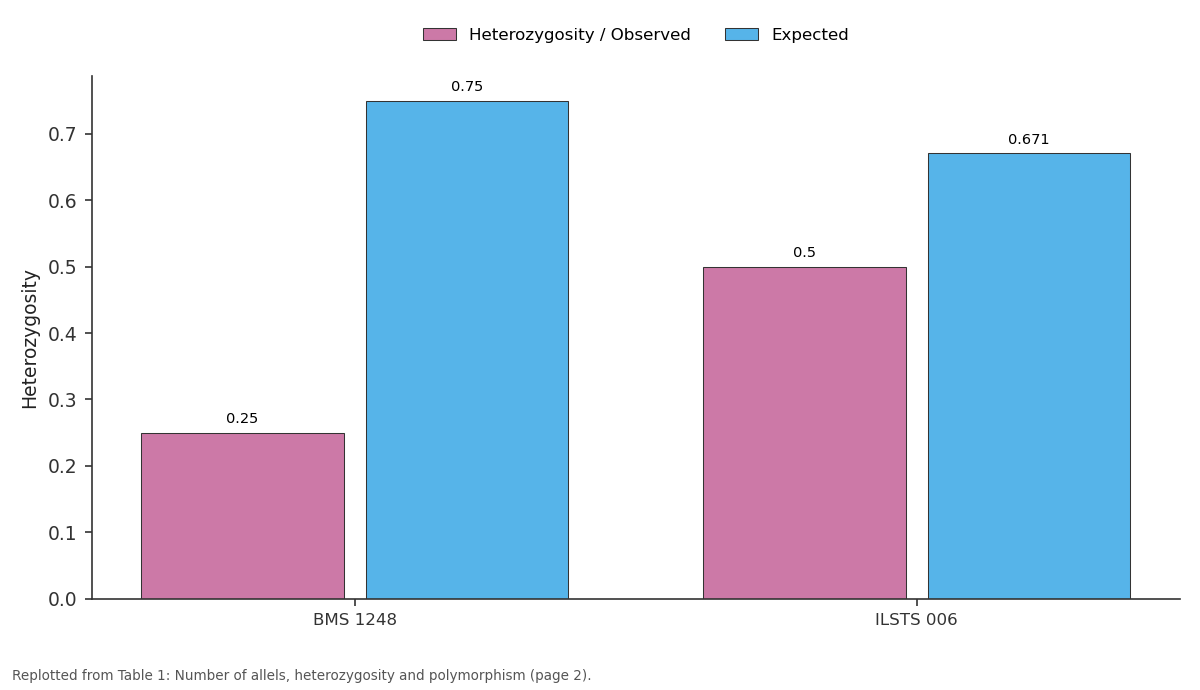
Heterozygosity / Observed and Expected: BMS 1248 vs ILSTS 006
Replotted from Table 1 (page 2) of the original paper. Every bar is the paper's own table value.
View source evidence ↗Figures & tables
From the original paper Table 1
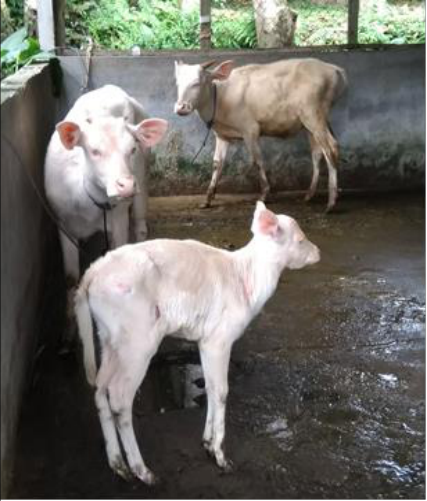 Figure 1
Introduction
The Bali cattle (Bos sondaicus) is an indigenous Indonesian cattle that is suspected originated from the banteng (Bos javanicus). They are thought to have originated in Bali. The Bali cattle have several advantages, including having a good adaptability to a bad environment, such as areas with high temperatures, low / rough feed quality, and others. In addition to bali cattle, recently there is also a group of cows with a very small population and limited life in the forest of Taro Village, District Tegallalang, Gianyar regency, Bali Province. People called it a Taro white cattle (Fig. 1). Taro white cattle are considered as an endangered breed of cattle population in Bali (Sulabda et al., 2021) [14] . Indigenous to Taro Village in Gianyar, cattle which tropically well adapted to local environment and raised by farmers in limited area of Taro Village, are deemed holy or sacred (Oka et al., 2020) [9] . This cattle has a distinctive phenotype that distinguishes it from bali cattle in general, which is white hair, white skin, irises of eyes and pale or clear nails, and the color of the horns and tracer is more pale than ordinary bali cattle. Population of Taro White Cattle is only about 59 cattle. This small population will result inbreeding. The most obvious effects of inbreeding are slow the population's ability to reproduce and poorer reproductive efficiency. This can lead to loss of genetic diversity. Consequently, there will be a decrease in adaptation to the environment. Referring to population risk status limitation, the Taro white cattle is categorized as critical (Critical breed) (Oka et al., 2020) [9] . To anticipate the loss of biodiversity in Indonesia, especially the extinction of Taro White cattle as germplasm, conservation efforts are needed. For that we need to learn more about the genetic characteristics of this Taro white cattle and explored the potential of genetic diversity to be used as a source of genetic improvement of cattle in Indonesia. Genomic technologies can contribute to genetic resource management by identifying biodiversity to prioritize for protection, and informing management actions that attempt to mitigate threats to endangered species (Eusebi et al., 2020) [4] . Molecular analysis can be used to determine the unique genetic characteristics of a particular population. The most widespread among analysis molecular, microsatellite markers are molecular markers that have recently been used in many animal species for various purposes including individual identification, paternity testing, conservation of endangered animals, and phylogeny based on origin and breeding history (Kim et al., 2021) [7] . Microsatellites are short sequences of simple (especially di-, tri-and tetranucleotide are repeated in sequence in the eukaryotic genome (Pokhriyal et al. 2012) [11] . Microsatellites are also excellent as tools for genetic studies and conservation (Kim et al., 2021) [7] . Microsatellite has several advantages including easy sample preparation, high information content, and co-dominant markers. BMS 1248 is part of microsatellite DNA located on chromosome number 5 in cattle. In the studies that have been done to find the genetic characteristics of Locus BMS 1248 associated with birth weight of Bali Cattle show BMS1248 locus has 6 alleles with a length of 120-170 bp fragments, polymorphic information content (PIC) value ranged from 0.767 (BMS1248). The value of heterozygosity ranges from 0.00 (BMS1248) to 0.214 (ILST006). This indicates that the microsatellites loci has a high polymorphism in bali cattle (Puja et al., 2013) [12] . ILSTS006 is part of the microsatellite DNA located on chromosome number 7 in cattle Several studies using ILSTS006 have been done to study the population of genetic variation of bali cattle and the relationship between gene locus and body size. The results showed the long DNA fragment for ILSTS006 was 120-170 bp. (Puja, et al., 2013) [12] . Based on the above information, this study was conducted the genetic profile of Taro white cattle by using the locus and to see the pattern of marriage that occurs in the Taro white cattle population in the taro village.
Materials and Methods Animal
A total of 23 Taro white cattle were used in this study. The age of the animals used for the study ranged from 2-5 years. The animal age is based on birth record. All cattle was healthy and were managed in an extensive system. The study was approved by the Animal Ethics Committee, Faculty of Veterinary Medicine Udayana University.
DNA Extraction and Amplification
DNA Extraction and Amplification
Data Analysis
The number of alleles, HO (observed heterozygosity, and He (expected heterozygosity) were analyzed using the microsatellite toolkit v.3.1 program (Park, 2001) [10] . The PIC was calculated on the basis of allele frequencies, (Botstein et al., 1980) [1] . The degree of heterozygosity was calculated using unbiased estimators (Nei, 1987) [8] as follows:
Results
A total of 5 alleles were detected in microsatellite locus BMS1248 and 4 alleles in ILSTS066. The number of alleles, allele's size, PIC, and heterozygosity were presented in Table 1. Locus BMS 1248 has 5 different alleles, with alleles size ranged from 139 bp to 165 bp. Allele size 145 bp is the allele with the highest frequency of 0.38. The heterozygosity (Ho) and (He) values were 0.25 and 0.75, respectively. The value of PIC is 0.679. Locus ILSTS 006 has 4 different alleles, with alleles size ranged from 162 bp to 168 bp. The heterozygosity (Ho) and (He) values were 0.5 and 0.671, respectively. The PIC value is 0.585
| Locus | Number of alleles | Allele Size | PIC | Heterozygosity | — |
|---|---|---|---|---|---|
| Observed | Expected | ||||
| BMS 1248 | 5 | 139 – 65 | 0.679 | 0.25 | 0.75 |
| ILSTS 006 | 4 | 162 - 168 | 0.585 | 0.5 | 0.671 |
Table text extracted from the original PDF; superscript letters are shown inline. The original table image is below.
View original table image
Discussion
Genetic diversity is useful for determining genetic associations within and between populations (Hartl and Clark, 2000) [5] . One approach that can be used is DNA Microsatellite. This research uses two markers, BMS 1248 and ILSTS 006 which have been successfully amplified.
In Taro white cattle have been identified 5 alleles at the locus BMS 1248, with range from 139 bp to-165 bp. The number of alleles identified in this study were lower compared to number obtained in bali cattle, wich number of alleles of 8 (Puja et al., 2018) [13] . In locus ILSTS006, have been identified 4 alleles. The number alleles of Taro white cattle were observed lower compared number obtained in Ongole cattle, which number of alleles was 15 (Thiagarajan, 2012) [16] .
The observed heterozygosity (Ho) and expected heterozygosity values in BMS1248 for the Taro white cattle were 0.25 and 0.75. This value was lower to those reported for bali cattle (HO=0.809, HE=0.894) (Puja et al., 2013) [12] . The observed heterozygosity (Ho) and expected heterozygosity values in locus ILSTS006 for Taro white cattle 0.5 and 0.67 (Ho = 0.5 and He= 0.67). This HO value was higher to those obtained in bali cattle and was lower in He. In bali cattle, the average HO and He for locus ILST006 was 0.214 and 0.766. The heterozygosity value is the most accurate way to measure gene variation, so heterozygosity is also called gene diversity (Nei, 1987) [8] . A heterozygosity value below 0.5 indicates low gene variation in a population (Javanherd et al., 2005) [6] .
If the observed heterozygosity value (Ho) is lower than the expected heterozygosity value (He) indicates a genetic imbalance in the population and indicates the absence of random mating (Tambasco et al., 2003) [15] . If the observed heterozygosity value (Ho) is lower than the expected heterozygosity (He) value indicates a genetic imbalance in the population (Tambasco et al., 2003) [15] . Polymorphism Information Content (PIC) is used to determine variations of microsatellite markers. In this study the PIC value of BMS 1248 was 0.679, while ILSTS 006 was 0.585. The value of PIC in this study was similar to that of genetic diversity between Indian Gir, Deoni and Kankerj cattle based on microsatellite with the same locus and showed PIC value was above 0.5, (Brezinsky et al., 1993) [2] . According to Botstein et al. (1980) [1] that the PIC value is an index to measure the genetics assessment. If the value of PIC > 0, 5 then the locus has a high degree of polymorphism. But if the value of PIC lower than 0.5 locus has a low level of polymorphism. Based on the research results that the PIC value is quite high, it indicates that these loci are highly informative (Cervini et al., 2000) [3] .
Conclusion
In this study demonstrated that microsatellite marker were use shown to be polymorphic. The Taro white cattle indicates low level genetic diversity. The results of this study indicate a genetic disequelibrium in the population and indicate the absence of random mating. The information elucidated through the present study would be useful for the formulation of conservation strategies.
Acknowledgement
AcknowledgementThe authors would like to thank the veterinary student from Faculty of Veterinary Medicine, Udayana University who have assisted to prepare the sample.
References
13 in the original paper- Botstein D, White RL, Skolnick M, Davis RW. Construction of a genetic linkage map in man using restriction fragment length polymorphism. Am. J Hum. Genet. 1980;32:324-331.
- Brezinsky L, Teale AJ, Kemp SJ. A panel of bovine, ovine and caprine microsatellites. Anim. Genet. 1993;24:363-365.
- Cervini M, Henrique-Silva, Mortari N, Matheucci E. Genetic variability of 10 microsatellite markers in the characterization of Brazilian Nellore cattle (Bos Indicus). Genet. Mol. Biol. 2006;29:486-490.
- Eusebi PG, Martinez A, Cortes O. Genomic Tools for Effective Conservation of Livestock Breed Diversity. Diversity. 2020;12(1):8. https://doi.org/10.3390/d12010008
- Javanmard A, Asadazadeh N, Banabazi MH, Tavakolian J. The allele and genotype frequencies of bovine pituitary-specific transcription factor and leptin genes in Iranian cattle and buffalo populations using PCR-RFLP. J Iranian Biotechnol. 2005;3:104-108.
- Kim SM, Yun SW, Cho GJ. Assessment of genetic diversity using microsatellite markers to compare donkeys (Equus asinus) with horses (Equus caballus). Anim Biosci. 2021:34(9):1460-1465. https://doi.org/10.5713/ab.20.0860.
- Oka AA, Putra IGAA, Suarna IW, Doloksaribu L, Puja IK. Productive potency of the endangered taro white cattle population reared under conservation management system in Bali, Indonesia. J Anim. Health Prod. 2020;8(4):193-198. DOI:http://dx.doi.org/10.17582/journal.jahp/2020/8.4.19 3.198.
- Pokhriyal B, Thorat K, Limaye DA, Joshi YM, Kadam VJ, Dubey R. Microsatellite Markers: A Novel Tool in Molecular Genetics. International Journal of Research in Pharmacy and Chemistry. 2012:2(2):397-412.
- Puja IK, Wandia IN, Sulabda IN, Suastika P. Correlation analysis of Genetic microsatellite DNA markers with body size, length and height of Bali cattle. Global Veterinaria. 2013;11(5):689-693,
- Puja IK, Sulabda IN, Wandia IN. Microsatellite polymorphisms and its relationship with calving interval and gestation period in bali cattle. Adv. Anim. Vet. Sci. 2018;6(5):197-200. http://dx.doi.org/10.17582/journal.aavs/2018/6.5.197.200
- Sulabda IN, Wandia IN, Puja IK. Allelic diversity of the endangered taro white cattle population from bali using bola microsatellite loci. J Anim. Health Prod. 2022;10(1):16-20. DOI: http://dx.doi.org/10.17582/journal.jahp/2022/10.1.16.20.
- Tambasco DD, Paz CC, Tambasco-Studart M, Pereira P, Alencar MM, Freitas RR, et al. Candidate genes for growth traits in beef cattle crosses Bos taurus x Bos indicus. J Anim. Breed. Genet. 2013;120:51-56.
- Thiagarajan R Alleles. Their Frequencies for Eight Microsatellites. In Ongole Breed of Cattle. CIB Tech Journal of Biotechnology. 2012;2(1):34-37.