
Research article · 2022 · Full text
International Journal of Veterinary Sciences and Animal HusbandryImprovement on growth and reduction of kid's mortality through adoption of brooding technique in goats in the mid-hill of Nepal
Volume 7(5) · Pages 01–05 · DOI: 10.22271/veterinary.2022.v7.i5a.434 ↗
Research areasGenetic and phenotypic traits in livestock
Abstract
Author-writtenThe mortality of kid's is serious problem in commercial goat farming in Nepal. There are various factors which affect the growth rate and mortality of kids. One of the main factors is rearing management during early age of kids but more research focused on feeding and treatment only. So an experiment was carried out to reveal the effect of brooding management system for growth and mortality of kids in goat at National Goat Research Program, Bandipur, Tanahun of Nepal from October 2020 to February 2021. All together 96 newly born goat's kids were included in this experiment from three pure breeds which were born late October to early November 2020. Among them 32 kids of each breeds of pure Khari, pure Barbari and pure Boer were maintained which were divided in to two equal groups. One group was reared with their mother in normal shed where no any bedding material and extra heating mechanism was provided and another group was reared in well bedded shed and two brooders was provided. Data of birth weight, one month to four months weight of every kids, monthly weight gain and number of death kids were recorded and data were analyzed using IBM SPSS 26. This result showed that breeds, sex and management of rearing system affect significantly (p
Summary
Source-checkedPlain-language reading of the full paper, prepared with AI and checked against the text. Each point links to the authors' own words.
Why it matters
- Goat farming is an important and emerging enterprise in Nepal, primarily used for meat production. View evidence ↗
- Goat productivity is limited by the low producing ability of indigenous breeds and high kid mortality, particularly during rainy and winter seasons in commercial farms. View evidence ↗
- While early-age rearing management is a key factor in kid survival and growth, most research has focused only on treatment and feeding. View evidence ↗
The question
- The study aimed to determine how a brooding management system affects the growth and mortality rates of goat kids. View evidence ↗
What they did
- The research took place at the National Goat Research Program in Bandipur, Tanahun, Nepal, from October 2020 to February 2021. View evidence ↗
- The experiment used 96 newborn kids (32 each of pure Khari, pure Barbari, and pure Boer breeds) with an equal ratio of males and females. View evidence ↗
- Kids were split into two groups: a non-brooding group in a normal shed without bedding or extra heat, and a brooding group in a rice-straw bedded shed with two brooders (each with five 200W bulbs) to keep temperatures above 25°C. View evidence ↗
- Researchers measured birth weight, monthly weights up to four months, monthly weight gain, and the number of deaths. View evidence ↗
What they found
- Brooding management drastically reduced kid mortality to 4.17%, compared to 35.42% in the non-brooding group. View evidence ↗
- Male kids experienced higher mortality rates than female kids. View evidence ↗
What it means
- The authors conclude that adopting brooding technology is essential for commercial goat farming, especially for exotic breeds which have lower survivability than local breeds. View evidence ↗
- Brooding is recommended as the most suitable management practice to overcome cold stress and associated diseases during winter and rainy seasons. View evidence ↗
Figures & tables
From the original paper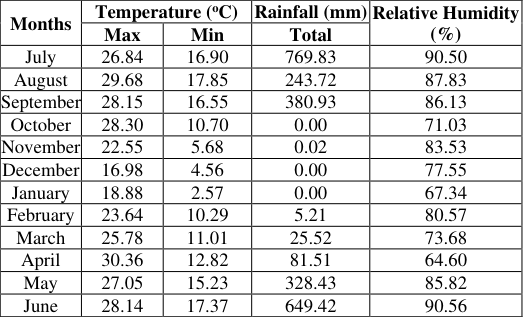 Table 1
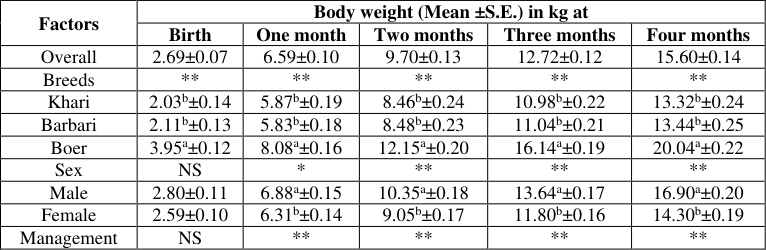 Table 2
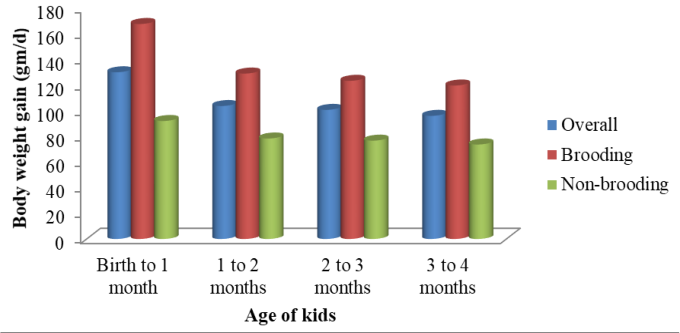 Figure 1
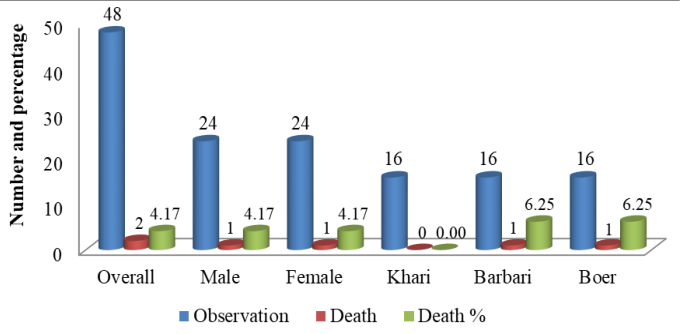 Figure 2
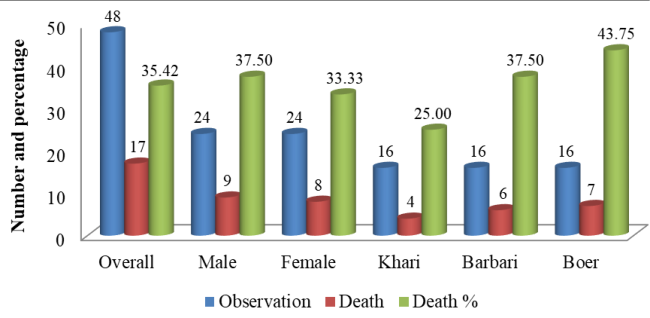 Figure 3
Introduction
Nepal is an agriculture country where 65 percent populations are engaged in this sector which contributes 24.26 percent of the total national gross domestic product (GDP). In Nepalese agriculture system, livestock is an integral part which covers about 25.70 percent of total agriculture gross domestic product (AGDP) (MoALD, 2021) [14] . Among livestock, goat is a common species farming an emerging and important enterprise which is used mainly for meat purpose. There are 13.44 million goats in Nepal which produce 70,755 MT of meat and accounted for 13.59% of the total meat production of the nation (MoALD, 2021) [14] . This production does not meet increasing demand of goat meat so live castrated bucks are imported from outside the country, especially from India and China. The productivity of goat does not increase because the indigenous goats have low producing ability as compare to the exotic breeds and the mortality of kids is very high especially in commercial farm during winter and rainy season. Few decades ago, cross breeding of Khari (indigenous goat of Nepal) with pure Barbari and Jamunapari was done and now Boer was used instead of Barbari and Jamunapari which helped to improve growth performance of khari goat but kid's mortality was not reduced. The kid's mortality was found up to 65 percent in Barbari goat during winter season (GRS, 2015) [8] . The Boer goat has faster growth rates and heavier than the Nepalese local goat breeds. The mature Boer buck weighed in the range of 110-135 kg, and doe weighed around 90-100 kg (RADA, 2010) [17] , whereas the adult body weight of Khari goat around 20-40 kg (Joshi and Shrestha, 2003) [11] .
The daily live weight gain of Boer crossbred has been found 100 to 200 gm in the farmer's field (Pandey, 2008) [16] . The average one year weight of Khari and Barbari is 26.24±0.62 and 26.68±2.02 kg where as 50% Boer cross breed reach 40.03±0.86 kg (NGRP, 2021) [15] . It means, 50% Boer crossbreed produces at least 50% more meat than Nepalese local breeds. If Boer buck is used in all Nepalese local goat breeds, the national meat production should be increased up to 50 percent but due to the problem of kid's mortality, the national meat production does not increase as much as. The problem of kid's mortality increased with the increasing of commercialization of goat farming especially during winter and rainy season. Hence, an experiment of rearing of kids under brooding and non-brooding management was carried out for reduction of kid's mortality and improvement of growth performance of local and exotic breeds of goat in Nepal.
Materials and Methods Duration and site of study
The study was conducted from October 2020 to February 2021 in National Goat Research Program, Bandipur, Tanahun which is the national program of Nepal government and main cost center of Nepal Agricultural Research Council (NARC) where six different pure breed and 15 genotypes of goat breeds are available. The elevation of this program ranges 800-1200 masl with the longitude of 84 0 38' E and latitude of 27 0 94' N. The soil of this program varied 5-6 pH, 3-4% organic carbon, 150-200 ppm available phosphorus and about 0.5% total nitrogen. This program receives an average annual rainfall of 2484 mm with an average of 79.92% relative humidity and maximum and minimum temperatures of 30.36 0 and 2.57 °C, respectively.
Animal selection
All together 96 newly born goat's kids were included in this experiment from three pure breeds which were born late October to early November 2020. Among them 32 kids of each breeds of pure Khari, pure Barbari and pure Boer with 1:1 female and male ratio were maintained. These kids were divided in to two equal groups with respect to sex and breeds, one group was reared with their mother in normal shed, there was no any bedding materials and extra heating mechanism provided. Another group was reared in well bedded shed where rice straw was used for bedding materials and two brooders with 5 bulbs of 200 w in each brooder was provided so that the room temperature was maintained above 25 °C. Brooders were used only for night time from 6 PM to 7 AM and during day time; the kids of both groups were kept in yard for sun bath and exercise. The bedding material was dried during day under sunlight every day and exchange every 15 days.
Data collection and analysis
The primary data of birth weight, one month to four months weight of every kids was recorded. On the monthly weight basis weight gain also calculated. Similarly, number of death kids was also recorded. After data entry and coding the growth performance of kids was analyzed by using Statistical Package for Social Science (SPSS) version 26, computer software and body weight gain and mortality was by using Microsoft Excel 2010 and means were compared by DMRT.
Results
Results
Meteorological data
The meteorological data was obtained from department of hydrology and meteorology, Kathmandu which was recorded from meteorological station of Bandipur, Tanahun so that monthly minimum and maximum temperature, rainfall and relative humidity was found. The highest maximum temperature was recorded in April and lowest minimum temperature in January. Similarly, highest rainfall occurred during July and lowest in December and January, the highest relative humidity observed during June and July and lowest in April (Table 1).
| Months | Temperature (oC) | — | Rainfall (mm) | Relative Humidity (%) |
|---|---|---|---|---|
| Max | Min | Total | ||
| July | 26.84 | 16.90 | 769.83 | 90.50 |
| August | 29.68 | 17.85 | 243.72 | 87.83 |
| September | 28.15 | 16.55 | 380.93 | 86.13 |
| October | 28.30 | 10.70 | 0.00 | 71.03 |
| November | 22.55 | 5.68 | 0.02 | 83.53 |
| December | 16.98 | 4.56 | 0.00 | 77.55 |
| January | 18.88 | 2.57 | 0.00 | 67.34 |
| February | 23.64 | 10.29 | 5.21 | 80.57 |
| March | 25.78 | 11.01 | 25.52 | 73.68 |
| April | 30.36 | 12.82 | 81.51 | 64.60 |
| May | 27.05 | 15.23 | 328.43 | 85.82 |
| June | 28.14 | 17.37 | 649.42 | 90.56 |
Table text extracted from the original PDF; superscript letters are shown inline. The original table image is below.
View original table image
Growth performance of kids
The overall mean of birth weight of kids was 2.69±0.07 kg which was significantly differed (p<0.01) with respect to breed but non-significant difference (p>0.05) with sex and brooding management. The birth weight of Khari and Barbari goat was nearly same but Boer goat's was higher. But the one month, two months, three months and four months weight was highly significant (p<0.01) with respect to all three factors i.e. breeds, sex and brooding management. Same like birth weight, the weight from one to four months was similar in Khari and Barbari (Table 2).
| Factors | Body weight (Mean ±S.E.) in kg at | — | — | — | — |
|---|---|---|---|---|---|
| Birth | One month | Two months | Three months | Four months | |
| Overall | 2.69±0.07 | 6.59±0.10 | 9.70±0.13 | 12.72±0.12 | 15.60±0.14 |
| Breeds | ** | ** | ** | ** | ** |
| Khari | 2.03b±0.14 | 5.87b±0.19 | 8.46b±0.24 | 10.98b±0.22 | 13.32b±0.24 |
| Barbari | 2.11b±0.13 | 5.83b±0.18 | 8.48b±0.23 | 11.04b±0.21 | 13.44b±0.25 |
| Boer | 3.95a±0.12 | 8.08a±0.16 | 12.15a±0.20 | 16.14a±0.19 | 20.04a±0.22 |
| Sex | NS | * | ** | ** | ** |
| Male | 2.80±0.11 | 6.88a±0.15 | 10.35a±0.18 | 13.64a±0.17 | 16.90a±0.20 |
| Female | 2.59±0.10 | 6.31b±0.14 | 9.05b±0.17 | 11.80b±0.16 | 14.30b±0.19 |
| Management | NS | ** | ** | ** | ** |
Table text extracted from the original PDF; superscript letters are shown inline. The original table image is below.
View original table image
Body weight gain
The overall body weight gain of kids from one to two months, two to three months and three to four months was 130, 104, 101 and 96 gm/d respectively. In case of breeds, the body weight gain of Khari and Barbari was found 128 gm/d in initial stage and 78 gm/d in three to four months but 138 gm/d was found in Boer goat at birth to one month and 130 gm/d in three to four months age. Similarly, the body weight gain of kids which were reared under brooding management was found much higher than non-brooding management (Figure 1).
Mortality of kids
The mortality of kids under brooding management was found only 4.17 percent where as in non-brooding was more than 35.42 percent. Under brooding management the mortality of pure Khari was zero where as non-brooding management, it became 25 percent. But the mortality of pure Barbari and pure Boer was found in both management, in brooding the mortality was very low of these breeds and under nonbrooding management the mortality of pure Boer was little higher than pure Barbari. In case of sex, the mortality of male kids was higher than female kids (figure 2 and3).
Discussion
This experiment was conducted with the objective to reduce kid's mortality and improve growth performance of local and exotic breeds of goat through brooding management. The three months kid's weight under non-brooding management was 10.10±0.15 kg which was significantly (p<0.01) different with the weight of kids which were reared under brooding management (15.30±0.17). Adhikari et al. (2017) [1] reported that the three months weight of Boer 50% crossbreed, pure Khari and pure Barbari was 11.23±2.33, 6.33±2.10 and 6.11±1.34 kg respectively. In case of weight, breeds was affect significantly (p<0.01). Similarly, the second and fourth month's weight of kids under brooding management was 11.60±0.19 and 18.89±0.20 kg which was slightly lower than the body weight of pure Boer and higher than the pure Barbari and pure Khari which was reported in NGRP (2020) [15] where the two and fourth months weight of pure Boer goat was 12.05±0.65 and 20.38±1.24 kg, the pure Barbari was 8.61±0.58, 12.79±1.29 kg and the pure Khari was 8.13±0.64, 12.01±0.39 kg. The body weight gain of kids from one to two months, two to three months and three to four months under non brooding condition was 92, 78, 77 and 74 gm/d respectively whereas it was found 168, 129, 123 and 120 gm/d in brooding management. Adhikari et al. (2017) [1] indicated that the body weight gain of Boer 50% cross goat from birth to three months was 100.11 gm/d whereas pure Khari goat was 51.44 gm/d only. Lu and Potchoiba (1990) [13] reported that the weight gain of Boer goat during birth to weaning was 125-150 gm/d and 115 gm/d four to eight months of age. Similarly, Rout et al. (1999) [19] revealed that the average growth rate of Jamunapari goat up to three months of age was 81.3gm/d and 122gm/d thereafter. The mortality of kids affect significantly (p<0.01) with respect to rearing management and breeds. According to Adhikari et al. (2017) [1] the overall mortality of goats was 10.61% in Goat Research Station, Bandipur and highest mortality was in pure Barbari (27.78%) followed by Jamunapari 50% (15.15%) and lowest in Boer 50% and Kiko 50% which was 4.76% and 2.78% respectively under nonbrooding condition. But some year the kid's mortality was found up to 65 percent in Barbari goat during winter season (GRS, 2015) [8] . Ayoade and Kamwanja (1985) [2] reported that the mortality rate of cross breed of local Malawi and Boer goat was 37.5% which is similar to this finding of nonbrooding management condition. Similarly, Rasaili and Khanal (2002) [18] found that the mortality of Khari and Khari × Sinhal was 25.9 and 14.3% whereas Hailu et al. (2006) [9] revealed that kids born in the wet season had higher survival rates and that kid's born on single had higher survival rates that those of other birth types and male kids had lower survival than female kids. Likewise, Browning and leite-Browning (2011) [3] indicated that similar impacts due to litter size and sex of kid on survivability. Donkin and Boyazoglu (2004) [6] observed 29% mortality of kids in South Africa where breed, sex and type of births was not affect significantly and most of the kids were died due to coccidiosis and pneumonia. He also mentions that the major losses occurred in first three months of age. Ershaduzzaman et al. (2007) [7] reported 28.9% kid's mortality in Black Bengal goat in Bangladesh. Out of them 63% were died due to infectious causes which included diarrhoea, pneumonia, bloat and enterotoxaemia, 10% by predators, 4% by mechanical and 1% by congenital. Similarly, Husain et al. (1995) [10] observed 40% kids mortality which is higher than this study and Chowdhury et al. (2002) [4] found 30% mortality of kids under semi-intensive conditions of goat farming which is lower than the present study of nonbrooding management. They also indicated that 42.39% kids were died due to pneumonia, 32.61% by diarrhoea, 20.65% by ecthyma and 4.34% by bloat. Sriram et al. (1982) [0] and Koul et al. (1988) [12] revealed that the main causes of kid's mortality were due to pneumonia and enteritis.
Conclusion and Recommendation
The various factors affect in mortality of goat's kids which become very serious issues in goat farming industry. Among them the most important factor is cold stress which occurs during winter and rainy season. Newly born kids become very weak and cannot tolerate with cold stress. The pneumonia, diarrhoea and swelling of head occurs in excessive cold condition which reduce weight of kids in initial phase and death occurs after damaging of lung so brooding of kids during winter and rainy season being most suitable management practices to overcome such problem. The growth rate and mortality of kids was highly significant with respect to breeds, sex and management of rearing. So the adaptation of brooding technology is most necessary for commercial goat farming with exotic breeds because the survivability of these breed is lower than local goat breeds.
Acknowledgement
AcknowledgementThe authors would like to express their most sincere gratitude and appreciation to Dr. Doj Raj Khanal, Livestock and fishery Director, Nepal Agricultural Research Council, Singhadarbar Plaza, Kathmandu, Nepal for his encouragement, help, suggestion and support during study period. Similarly works of Mr. Ram Kumar Sahi, Mr. Ghana Shyam Panta and Mr. Arjun Khanal deserve high appreciation without whom conduction of this research was impossible. Appreciations also go to Mr. Ram Prashad Ghimire, Coordinator, Fodder and Pasture Research Program, Khumaltar, Lalitpur for valuable suggestion and help. Likewise, our thanks also go to all staffs of National Goat Research Program, Bandipur, Tanahun
Figures and tables from the paper
References
14 in the original paper- Adhikari D, Adhikari DP, Ghimire RP, Ghimire SH, Shrestha PB, Dhakal HR, et al. Comparative performance of Boer cross breed goat over other local and cross breeds in mid-hills of Nepal. Nepalese Journal of Agricultural Sciences. 2017;15:125-131.
- Ayoade JA, Kamwanja LA. A note on the pre-weaning body weight changes and mortality in Malawi local and Malawi local x Boer kids under village management system. Paper presented at the 5th Veterinary Association Conference, September 1985, Salima, Malawi; c1985.
- Browining RJ, Leite-Browning ML. Birth to weaning kid traits from a complete diallel of Boer, Kiko and Spanish meat goat breeds semi-intensively managed on humid subtropical pasture. Journal of Animal Science. 2011;89:2696-2707.
- Chowdhury SA, Bhuiyan MSA, Faruk S. Rearing Black Bengal Goat under Semi-Intensive management 1. Physiological and Reproductive Performances. AsianAustralasian Journal of Animal Sciences. 2002;15(4):477-484.
- Donkin EF, Boyazoglu PA. Diseases and mortality of goat kids in a South African milk goat herd. South African Journal of Animal Science. 2004;34:258-261.
- Ershaduzzaman M, Rahman MM, Roy BK, Chowdhury SA. Studies on the diseases and mortality pattern of goats under farm conditions and some factors affecting mortality and survival rates in Black Bengal kids. Bangladesh Journal of Veterinary Medicine. 2007;5(12):71-76.
- Hailu D, Mieso G, Nigatu A, Fufa D, Gamada D. The Effect of environmental factors on pre-weaning survival rate of Borana and Arsi Bale kids. Small Ruminant Research. 2006;66:291-294.
- Husain SS, Islam ABMM, Horst P. Effect of different factors on pre-weaning survivability of Black Bengal kids. Small Ruminant Research. 1995;18:1-5.
- Koul GL, Somvansha S, Biswas JC. Mortality pattern in Pashmina goats. Indian Veterinary Journal. 1988;65:847849.
- Lu CD, Potchoiba MJ. Feed intake and weigh gain of growing goats fed diets of various energy and protein levels. Journal of Animal Science. 1990;68:1751-1759.
- MoALD. Ministry of Agricultural and Livestock Development. Statistical Information on Nepalese Agriculture, 2020/21.
- RADA. RADA-A Global Approach to Food Security through Evolving Technology. Online; c2010. http://www.rada.gov.jm/goat_article.php?ai=159. Retrieved 2012 Sep. 23
- Rasaili DP, Khanal RC. Comparative performance of indigenous crossbreeds of goats at Lumle farm, Nepal. Nepal Journal of Science and Technology. 2002;4:129134.
- Sriram PK, Rao PR, Naidu NGR. Goat mortality in Addhra Pradesh. Indian Veterinary Journal. 1982;59:9699.