Scinovex

Research article · 2022 · Full text

International Journal of Statistics and Applied Mathematics

Optimal solution for fuzzy transportation problem using median ranking

Sikander

Volume 7(4) · Pages 01–06 · DOI: 10.22271/maths.2022.v7.i3b.838 ↗

Research areasOptimization and Mathematical Programming

↓ Read full-text PDF0 citations

Abstract

Author-written

In this paper, a new ranking method known as median ranking is used to convert fuzzy transportation problems to crisp valued transportation problems and then solve them by using the Max-Min technique. We can apply this ranking to both types of fuzzy numbers such as odd numbers of fuzzy numbers and even numbers of fuzzy numbers. Using the method, we can reach an optimal solution of balanced as well as unbalanced FTP.

Summary

Source-checked

Plain-language reading of the full paper, prepared with AI and checked against the text. Each point links to the authors' own words.

  1. Why it matters

    • Transportation problems are a type of linear programming used to minimize cost functions when allocating resources optimally. View evidence ↗

      Why it matters

      Transportation problems are a type of linear programming used to minimize cost functions when allocating resources optimally.

      In the paper's own words

      “A transportation problem represents a particular type of linear programming problem used for optimally allocating resources. It works in a way of minimizing a cost function.”

      Page 1

      Found in: Introduction

      Read it in the full textOpen PDF at page 1 ↗
    • Fuzzy numbers are employed in fields like Artificial Intelligence and experimental sciences to handle uncertainty. View evidence ↗

      Why it matters

      Fuzzy numbers are employed in fields like Artificial Intelligence and experimental sciences to handle uncertainty.

      In the paper's own words

      “Because of their uncertainty, fuzzy numbers and values are used in various fields such as experimental sciences, Artificial Intelligence, etc.”

      Page 1

      Found in: Introduction

      Read it in the full textOpen PDF at page 1 ↗
    • A fuzzy transportation problem (FTP) is one where supply, demand, and transportation costs are expressed as fuzzy numbers. View evidence ↗

      Why it matters

      A fuzzy transportation problem (FTP) is one where supply, demand, and transportation costs are expressed as fuzzy numbers.

      In the paper's own words

      “A fuzzy transportation problem is a transportation problem with the quantities like supply, demand, and transportation cost in fuzzy numerals.”

      Page 1

      Found in: Introduction

      Read it in the full textOpen PDF at page 1 ↗
  2. The question

    • The study aims to use a new 'median ranking' method to convert fuzzy transportation problems into crisp-valued problems, which are then solved using the Max-Min technique. View evidence ↗

      The question

      The study aims to use a new 'median ranking' method to convert fuzzy transportation problems into crisp-valued problems, which are then solved using the Max-Min technique.

      In the paper's own words

      “In this paper, a new ranking method known as median ranking is used to convert fuzzy transportation problems to crisp valued transportation problems and then solve them by using the Max-Min technique.”

      Page 1

      Found in: Introduction

      Read it in the full textOpen PDF at page 1 ↗
  3. What they did

    • The proposed ranking technique treats the elements of fuzzy numbers as ungrouped data and applies the median formula based on whether the number of elements is odd or even to obtain a crisp value. View evidence ↗

      What they did

      The proposed ranking technique treats the elements of fuzzy numbers as ungrouped data and applies the median formula based on whether the number of elements is odd or even to obtain a crisp value.

      In the paper's own words

      “we introduced a new ranking technique considering elements fuzzy numbers as ungrouped data, and according to the odd or even number of elements we apply the formula of median and convert the fuzzy number into a crisp value.”

      Page 1

      Found in: Introduction

      Read it in the full textOpen PDF at page 1 ↗
    • The median ranking method is designed to be applicable to both balanced (BFTP) and unbalanced (UBFTP) fuzzy transportation problems. View evidence ↗

      What they did

      The median ranking method is designed to be applicable to both balanced (BFTP) and unbalanced (UBFTP) fuzzy transportation problems.

      In the paper's own words

      “This ranking can be applicable for balanced and unbalanced fuzzy transportation problems.”

      Page 1

      Found in: Introduction

      Read it in the full textOpen PDF at page 1 ↗
    • The algorithm involves constructing the table, balancing it with dummy rows/columns if necessary, converting fuzzy values to crisp values via median ranking, and solving for the optimal solution using the Max-Min method. View evidence ↗

      What they did

      The algorithm involves constructing the table, balancing it with dummy rows/columns if necessary, converting fuzzy values to crisp values via median ranking, and solving for the optimal solution using the Max-Min method.

      In the paper's own words

      “Step 1: Construct the transportation table and check whether it is BTP or UBTP.”

      Page 2

      “Step 2: If the problem is unbalanced then make it balanced by adding a dummy row or column as per the requirement of supply and demand, otherwise go to step 3.”

      Page 3

      “Step 3: Convert the fuzzy transportation table to a crisp transportation table using the proposed ranking method.”

      Page 3

      “Step 4: Use the Max-Min method [2] to solve the problem’s optimal solution.”

      Page 3

      Found in: Algorithm

      Read it in the full textOpen PDF at page 2 ↗
  4. What they found

    • For a balanced FTP using dodecagonal fuzzy numbers, the median ranking method yielded an optimal solution of 121. View evidence ↗

      What they found

      For a balanced FTP using dodecagonal fuzzy numbers, the median ranking method yielded an optimal solution of 121.

      In the paper's own words

      “We got the optimal solution as: (5.5) (7.5) + (3.5) (5.5) + (6.5) (1.5) + (11.5) (1) + (9.5) (2.5) + (15.5) (1) = 121”

      Page 3

      Found in: Numerical Examples: A. Consider the balanced fuzzy transportation problem using Dodecagonal Fuzzy Numbers

      Read it in the full textOpen PDF at page 3 ↗
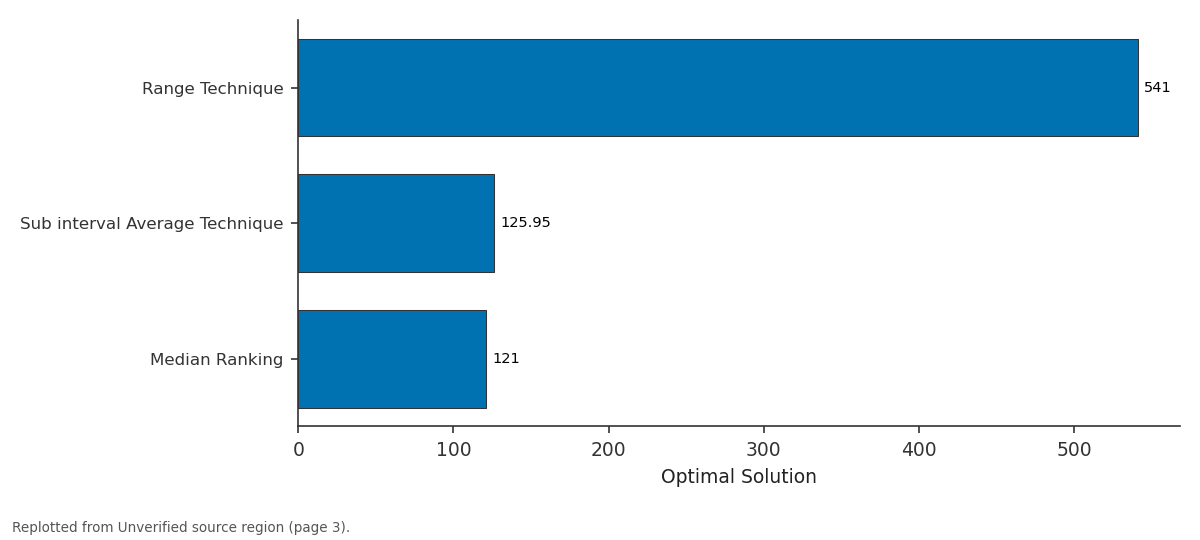
    • In the dodecagonal BFTP example, median ranking (121) produced a lower cost than the sub-interval average technique (125.95) and the range technique (541). View evidence ↗

      What they found

      In the dodecagonal BFTP example, median ranking (121) produced a lower cost than the sub-interval average technique (125.95) and the range technique (541).

      In the paper's own words

      “1 Range Technique 541 2 Sub interval Average Technique 125.95 3 Median Ranking 121”

      Page 3

      Found in: Introduction

      Read it in the full textOpen PDF at page 3 ↗
    • For an unbalanced FTP using dodecagonal fuzzy numbers, the median ranking method resulted in an optimal solution of 62.75. View evidence ↗

      What they found

      For an unbalanced FTP using dodecagonal fuzzy numbers, the median ranking method resulted in an optimal solution of 62.75.

      In the paper's own words

      “Optimal solution is: (2.5) (2.5) + (3.5) (4) + (0.5) (1.5) + (5.5) (5) + (9.5) (1.5) + (0) (3.5) + (0) (1) = 62.75”

      Page 4

      Found in: Introduction

      Read it in the full textOpen PDF at page 4 ↗
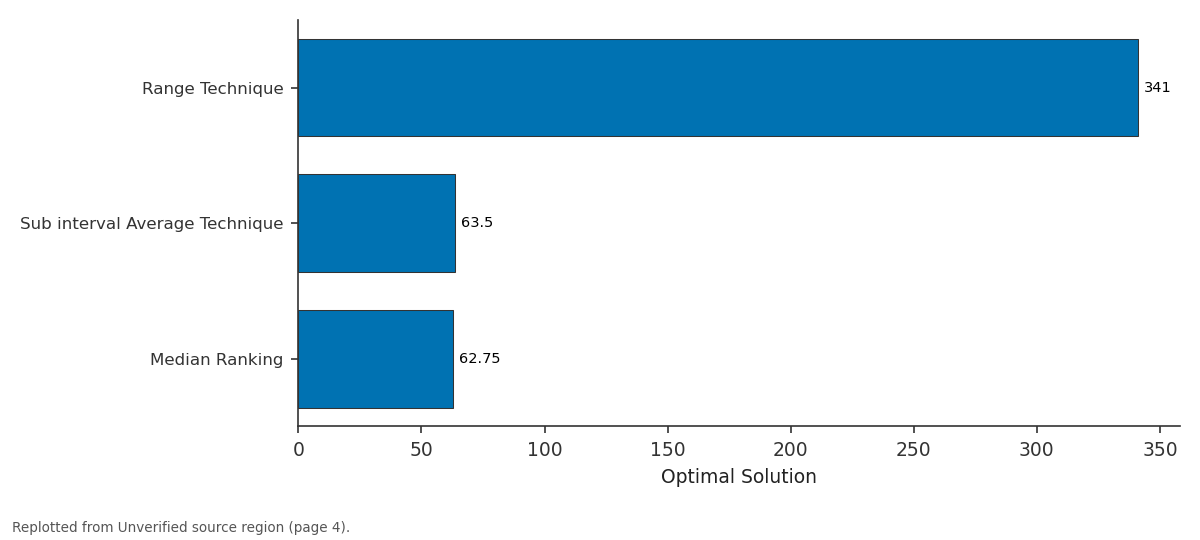
    • In the dodecagonal UBFTP example, median ranking (62.75) outperformed the sub-interval average technique (63.5) and the range technique (341). View evidence ↗

      What they found

      In the dodecagonal UBFTP example, median ranking (62.75) outperformed the sub-interval average technique (63.5) and the range technique (341).

      In the paper's own words

      “1 Range Technique 341 2 Sub interval Average Technique 63.5 3 Median Ranking 62.75”

      Page 4

      Found in: Introduction

      Read it in the full textOpen PDF at page 4 ↗
    • For a balanced FTP using hendecagonal fuzzy numbers, the median ranking method produced an optimal solution of 350. View evidence ↗

      What they found

      For a balanced FTP using hendecagonal fuzzy numbers, the median ranking method produced an optimal solution of 350.

      In the paper's own words

      “Optimal solution is: (11) (2) + (10) (16) + (13) (6) + (6) (4) + (11) (6) = 350”

      Page 5

      Found in: Introduction

      Read it in the full textOpen PDF at page 5 ↗
    • In the hendecagonal BFTP example, median ranking (350) was more optimal than the sub-interval average technique (353.24) and the range technique (834). View evidence ↗

      What they found

      In the hendecagonal BFTP example, median ranking (350) was more optimal than the sub-interval average technique (353.24) and the range technique (834).

      In the paper's own words

      “1 Range Technique 834 2 Sub interval Average Technique 353.24 3 Median Ranking 350”

      Page 5

      Found in: Introduction

      Read it in the full textOpen PDF at page 5 ↗
    • For an unbalanced FTP using hendecagonal fuzzy numbers, the median ranking method yielded an optimal solution of 147. View evidence ↗

      What they found

      For an unbalanced FTP using hendecagonal fuzzy numbers, the median ranking method yielded an optimal solution of 147.

      In the paper's own words

      “Optimal solution is: (15) (5) + (4) (9) + (0) (6) + (0) (3) + (1) (12) + (8) (3) = 147”

      Page 5

      Found in: Introduction

      Read it in the full textOpen PDF at page 5 ↗
    • In the hendecagonal UBFTP example, median ranking (147) provided a lower cost than the sub-interval average technique (148) and the range technique (850). View evidence ↗

      What they found

      In the hendecagonal UBFTP example, median ranking (147) provided a lower cost than the sub-interval average technique (148) and the range technique (850).

      In the paper's own words

      “1 Range Technique 850 2 Sub interval Average Technique 148 3 Median Ranking 147”

      Page 5

      Found in: Introduction

      Read it in the full textOpen PDF at page 5 ↗
  5. What it means

    • The authors conclude that the new median ranking technique successfully obtains optimal solutions for FTPs involving hendecagonal and dodecagonal fuzzy numbers. View evidence ↗

      What it means

      The authors conclude that the new median ranking technique successfully obtains optimal solutions for FTPs involving hendecagonal and dodecagonal fuzzy numbers.

      In the paper's own words

      “This paper has obtained an optimal solution for the fuzzy transportation problems with hendecagonal and dodecagonal fuzzy numbers using a new ranking technique.”

      Page 5

      Found in: Introduction

      Read it in the full textOpen PDF at page 5 ↗
    • The authors state that the proposed ranking is versatile, applicable to any type of fuzzy number (even or odd) and both balanced and unbalanced FTPs. View evidence ↗

      What it means

      The authors state that the proposed ranking is versatile, applicable to any type of fuzzy number (even or odd) and both balanced and unbalanced FTPs.

      In the paper's own words

      “We can apply the proposed ranking for any type of fuzzy number such as even or odd. Using the ranking we can solve balanced as well as unbalanced FTP and will get an optimal”

      Page 5

      Found in: Introduction

      Read it in the full textOpen PDF at page 5 ↗

Visual summary

3 visuals

Illustrations explain the paper; charts are replotted from the paper's own table values.
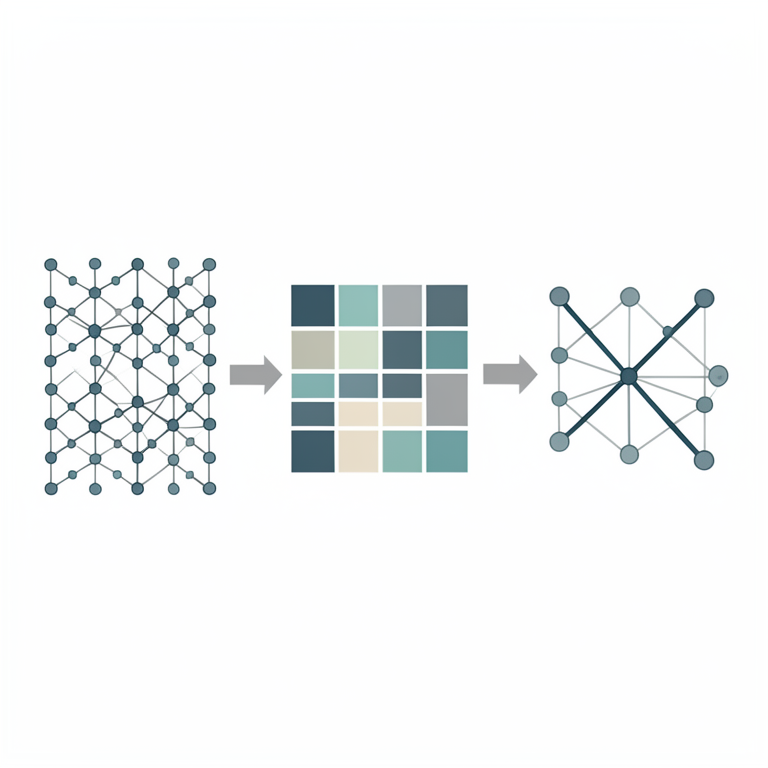
AI-generated illustration
AI-generated conceptual illustration (A mathematical transportation network diagram). It explains the idea and does not show study data.↗ Enlarge
FTP Solution Workflow
AI-generated conceptual illustration (A mathematical transportation network diagram). It explains the idea and does not show study data.

AI-generated conceptual illustration (A mathematical transportation network diagram). It explains the idea and does not show study data.

Open full-size image ↗

FTP Solution Workflow

AI-generated conceptual illustration (A mathematical transportation network diagram). It explains the idea and does not show study data.

View source evidence ↗
Replotted from source data
Replotted from a table (page 3) of the original paper. Every bar is the paper's own table value.↗ Enlarge
Optimal Solution: Range Technique vs Sub interval Average... vs Median Ranking
Replotted from a table (page 3) of the original paper. Every bar is the paper's own table value.

Replotted from a table (page 3) of the original paper. Every bar is the paper's own table value.

Open full-size image ↗

Optimal Solution: Range Technique vs Sub interval Average... vs Median Ranking

Replotted from a table (page 3) of the original paper. Every bar is the paper's own table value.

View source evidence ↗
Replotted from source data
Replotted from a table (page 4) of the original paper. Every bar is the paper's own table value.↗ Enlarge
Optimal Solution: Range Technique vs Sub interval Average... vs Median Ranking
Replotted from a table (page 4) of the original paper. Every bar is the paper's own table value.

Replotted from a table (page 4) of the original paper. Every bar is the paper's own table value.

Open full-size image ↗

Optimal Solution: Range Technique vs Sub interval Average... vs Median Ranking

Replotted from a table (page 4) of the original paper. Every bar is the paper's own table value.

View source evidence ↗

Figures & tables

From the original paper
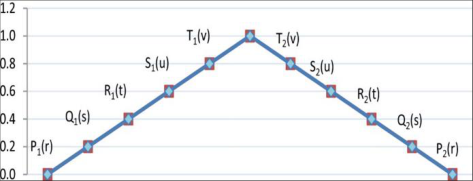
Graphical representation of dodecagonal fuzzyFigure 1Page 2Graphical representation of dodecagonal fuzzyFigure 1Page 2Hendecagonal fuzzy numberFigure 2Page 2
FULL TEXT Original article · reflowed for reading

Introduction

A transportation problem represents a particular type of linear programming problem used for optimally allocating resources. It works in a way of minimizing a cost function. Because of their uncertainty, fuzzy numbers and values are used in various fields such as experimental sciences, Artificial Intelligence, etc. L.A. Zadeh introduced the fuzzy set theory [1] , which is very useful in real-life situations. A fuzzy transportation problem is a transportation problem with the quantities like supply, demand, and transportation cost in fuzzy numerals. There are different methods for ranking fuzzy numbers. S. Sathya Geetha, and K. Selvkumari [2] proposed a new method for solving FTP using pentagonal fuzzy numbers using the range technique for ranking in 2020. The Sub-Interval Average Method for Ranking of Linear Fuzzy Numbers was proposed by S. Kamalnath and Rameshan Natarajan [3] , Dr. A. Sahya Sudha, S. Karunam [4] proposed a new ranking method using heptagonal Fuzzy number. New ranking function of the Nanogonal Fuzzy Number was proposed by K. Deepika, S. Rekha [5] . Kirtiwant P. Ghadle and Priyanka A. Pathade [6] solved FTP with generalized Hexagonal and generalized Octagonal Fuzzy Number by ranking method. A suitable defuzzification method to find minimum transportation cost using decagonal fuzzy number was developed by S. Nagadevi and G.M. Rosario [7] . Edithstine Rani Mathew [8] , Sunny Joseph Kalayathankal proposed a new ranking method using dodecagonal fuzzy numbers to solve FTP. Sanjivani Ingle and Kirtiwant Ghadle [9] derived two formulas related to odd and even numbers of fuzzy numbers for the optimal solution to Fuzzy Assignment Problem. In this paper, we introduced a new ranking technique considering elements fuzzy numbers as ungrouped data, and according to the odd or even number of elements we apply the formula of median and convert the fuzzy number into a crisp value. Then using Max-Min Method [2] we will get an optimal solution. This ranking can be applicable for balanced and unbalanced fuzzy transportation problems. The first two examples are BFTP and UBFTP using dodecagonal Fuzzy Numbers. The next Two are BFTP and UBFTP using hendecagonal Fuzzy Numbers.

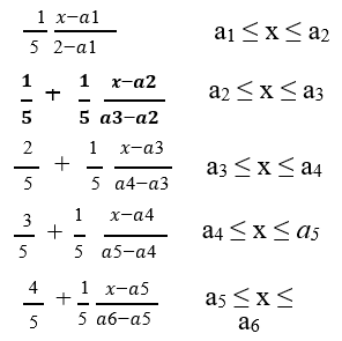
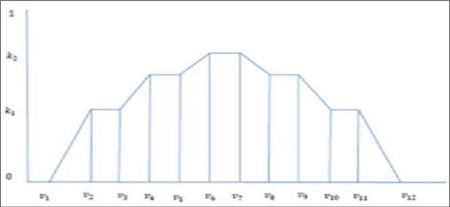
Preliminaries Fuzzy Number [9] : A fuzzy number is a convex normalized fuzzy set on the real line R such that 1. There exists at least one y ∈ R with µA˜(y) = 1. 2. µ A˜( y) is piecewise continuous. [8] The membership function of dodecagonal fuzzy number 𝐴̃ = (𝑎 1 , 𝑎 2 , 𝑎 3 , 𝑎 4 , 𝑎 5 , 𝑎 6 , 𝑎 7 , 𝑎 8 , 𝑎 9 , 𝑎 10 , 𝑎 11 , 𝑎 12 )

Dodecagonal fuzzy number

where 𝑎 1 , 𝑎 2 , 𝑎 3 , 𝑎 4 , 𝑎 5 , 𝑎 6 , 𝑎 7 , 𝑎 8 , 𝑎 9 , 𝑎 10 , 𝑎 11 , 𝑎 12 are real numbers, are given by, Where 0 < 𝑘 1 < 𝑘 2 < 1 Hendecagonal Fuzzy Number [10] A Hendecagonal fuzzy number HeD is denoted as (a 1 , a 2 , a 3 , a 4 , a 5 , a 6 , a 7 , a 8 , a 9 , a 10 , a 11 ), and the membership function is defined as 0, otherwise

Algorithm

Step 1: Construct the transportation table and check whether it is BTP or UBTP.

Step 2: If the problem is unbalanced then make it balanced by adding a dummy row or column as per the requirement of supply and demand, otherwise go to step 3.

Step 3: Convert the fuzzy transportation table to a crisp transportation table using the proposed ranking method.

Step 4: Use the Max-Min method [2] to solve the problem's optimal solution.

Numerical Examples: A. Consider the balanced fuzzy transportation problem using Dodecagonal Fuzzy Numbers

The crisp transportation table using the proposed ranking is as follows:

1.5 0.5 6.5 1.5 1.5 F3 5.5 8.5 15.5 9.5 11 Demand 7.5 5.5 3.5 2.5 We got the optimal solution as: (5.5) (7.5) + (3.5) (5.5) + (6.5) (1.5) + (11.5) (1) + (9.5) (2.5) + (15.5) (1) = 121 (0, 0, 0, 0, 0, 0, 0, 0, 0, 0, 0, 0) (0, 0, 0, 0, 0, 0, 0, 0, 0, 0, 0, 0) (0, 0, 0, 0, 0, 0, 0, 0, 0, 0, 0, 0) (0, 0, 0, 0, 0, 0, 0, 0, 0, 0, 0, 0)

Sr.NO Ranking Technique

F4 (0, 0, 0, 0, 0, 0, 0, 0, 0, 0, 0) (0, 0, 0, 0, 0, 0, 0, 0, 0, 0, 0) (0, 0, 0, 0, 0, 0, 0, 0, 0, 0, 0) (

Figures and tables from the paper

Figure 1. Graphical representation of dodecagonal fuzzy
Graphical representation of dodecagonal fuzzy↗ Enlarge
Figure 1
Graphical representation of dodecagonal fuzzy

Graphical representation of dodecagonal fuzzy

Open full-size image ↗
Original paper figureSource PDF · page 2 ↗
Figure 1. Graphical representation of dodecagonal fuzzy
Graphical representation of dodecagonal fuzzy↗ Enlarge
Figure 1
Graphical representation of dodecagonal fuzzy

Graphical representation of dodecagonal fuzzy

Open full-size image ↗
Original paper figureSource PDF · page 2 ↗
Figure 2. Hendecagonal fuzzy number
Hendecagonal fuzzy number↗ Enlarge
Figure 2
Hendecagonal fuzzy number

Hendecagonal fuzzy number

Open full-size image ↗
Original paper figureSource PDF · page 2 ↗

References

2 in the original paper
  1. Sathya S, Geetha Selvakumari K. A new method for solving the fuzzy trans problem using Pentagonal fuzzy numbers. Journal of critical reviews, 2020, 7.
  2. Kamalnath S, Ramesh Natarajan. Subinterval average method or ranking of linear fuzzy numbers. Article in international journal of pure and applied mathematics, 2017, Jan.