
Research article · 2022 · Full text
International Journal of Statistics and Applied MathematicsA family of r-points 1-block implicit methods with optimized region of stability for stiff initial value problems in ordinary differential equations
Volume 7(4) · Pages 22–35 · DOI: 10.22271/maths.2022.v7.i4a.842 ↗
Research areasNumerical methods for differential equationsMatrix Theory and AlgorithmsDifferential Equations and Numerical Methods
Abstract
Author-writtenIn this paper, we proposed a family of r-points 1-block implicit methods with optimized region of stability. This family of methods is derived with Mathematical 10.4 software and the stability is investigated using boundary locus techniques. The block methods are consistence, zero stable, and A-stable and satisfy other stability requirements which finds them suitable for stiff problems in ODEs. Numerical experiments are presented and results are compared with other block methods and exact solutions of some stiff ordinary differential equations. The methods have been found to show competitiveness with other numerical methods.
Summary
Source-checkedPlain-language reading of the full paper, prepared with AI and checked against the text. Each point links to the authors' own words.
Why it matters
- Differential equations are essential in science and technology for modeling deterministic relations between varying quantities and their rates of change. View evidence ↗
- Because most complex differential equations lack analytical solutions, numerical methods are required to provide approximate solutions. View evidence ↗
- Numerical block methods are advantageous because they are self-starting, minimize errors, and reduce computation time by solving simultaneously at all grid points. View evidence ↗
The question
- The researchers aim to develop a family of block methods with an optimized stability region for both stiff and non-stiff initial value problems in ordinary differential equations. View evidence ↗
What they did
- The authors used Mathematical 10.4 software for derivation and boundary locus techniques to investigate stability. View evidence ↗
- The proposed methods were tested through numerical experiments and compared against exact solutions and other existing block methods. View evidence ↗
What they found
- The developed block methods are consistent, zero stable, and A-stable, making them appropriate for stiff ordinary differential equation problems. View evidence ↗
What it means
- The authors conclude that the proposed block method is suitable and recommend it for systems of first-order initial value problems in ordinary differential equations. View evidence ↗
Visual summary
3 visualsIllustrations explain the paper; charts are replotted from the paper's own table values.
Stability Region Concept
AI-generated conceptual illustration (a complex plane coordinate system). It explains the idea and does not show study data.
View source evidence ↗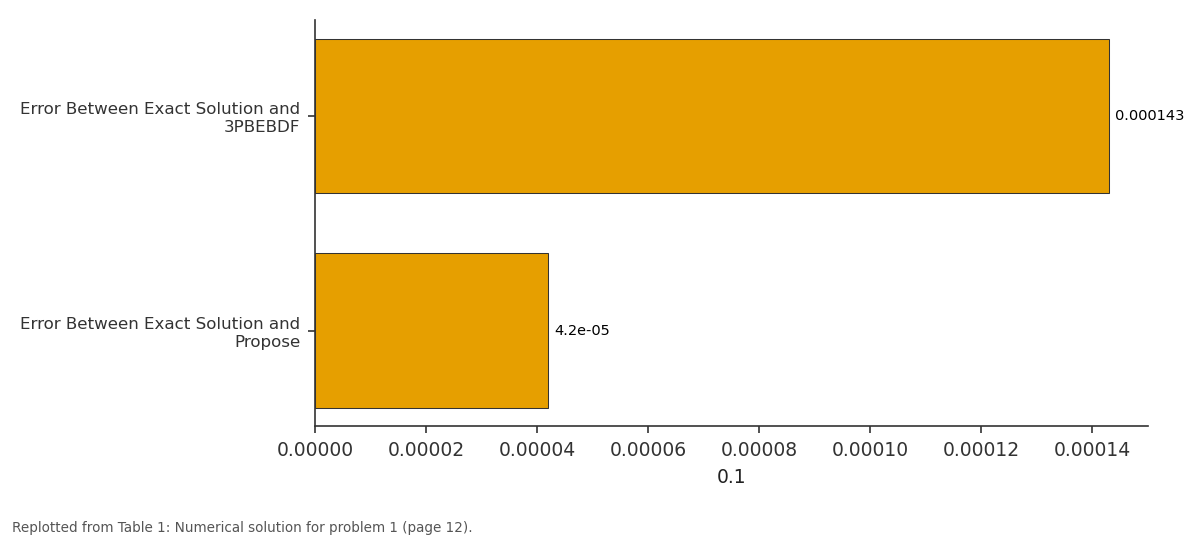
0.1: Error Between Exact... vs Error Between Exact...
Replotted from Table 1 (page 12) of the original paper. Every bar is the paper's own table value.
View source evidence ↗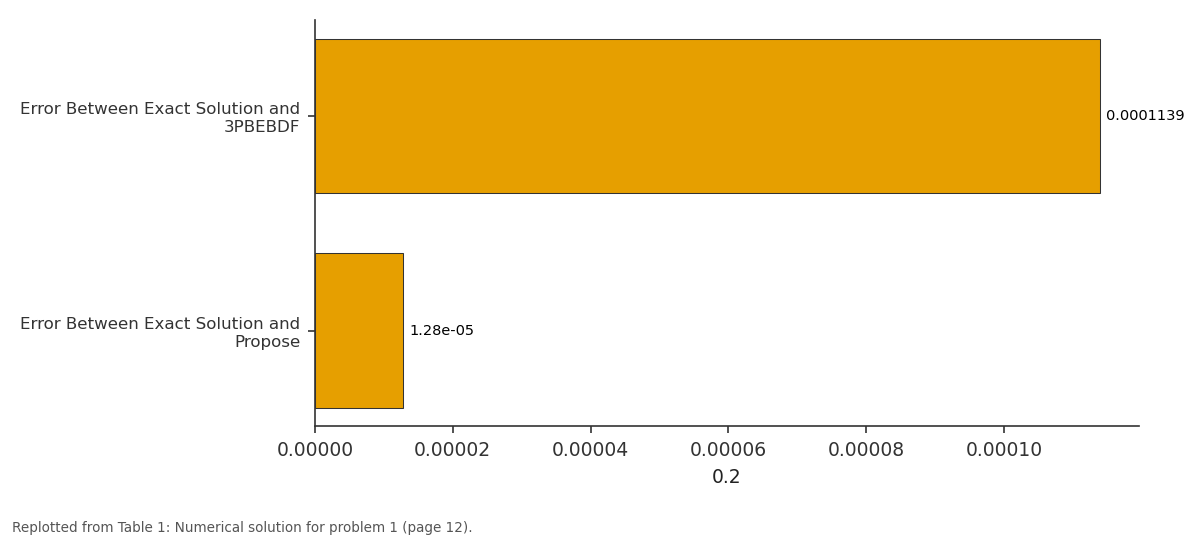
0.2: Error Between Exact... vs Error Between Exact...
Replotted from Table 1 (page 12) of the original paper. Every bar is the paper's own table value.
View source evidence ↗Figures & tables
From the original paper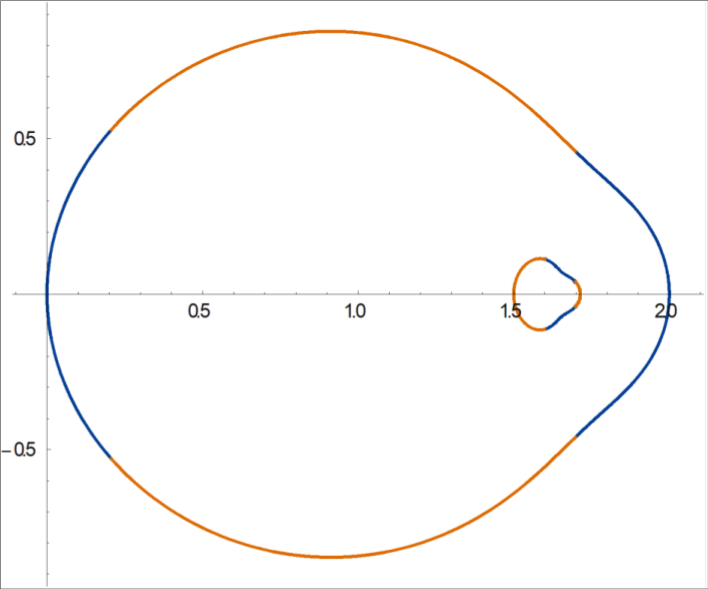 Figure 1
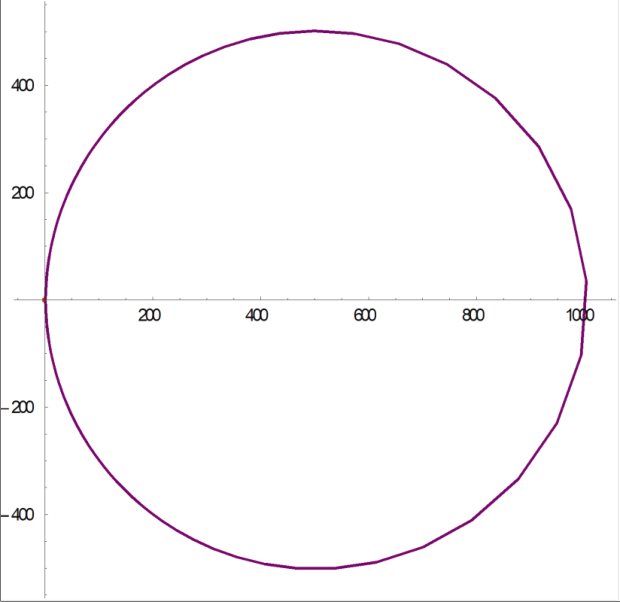 Figure 2
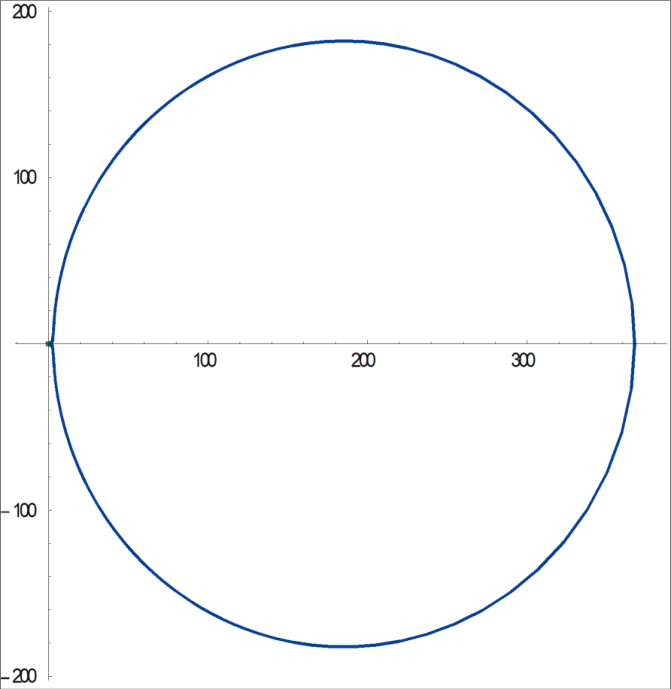 Figure 3
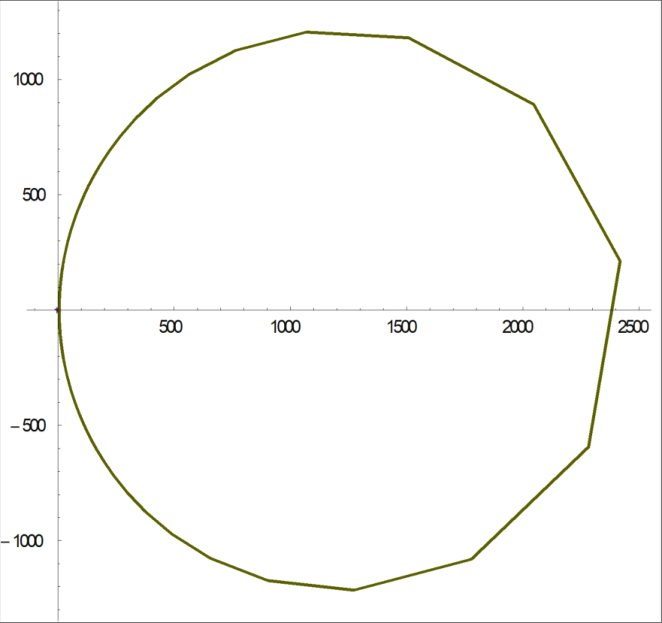 Figure 4
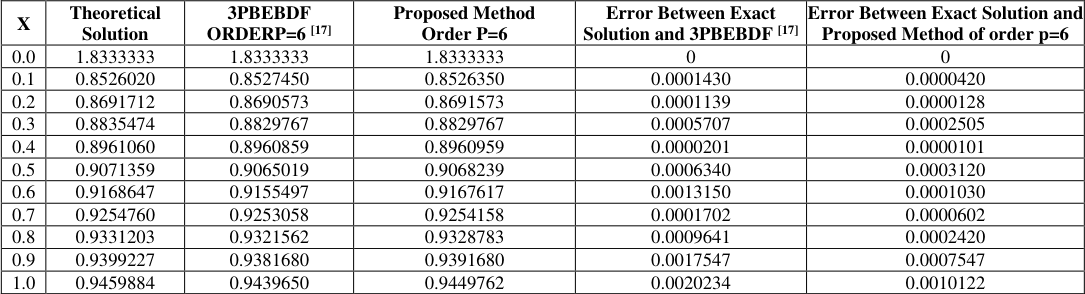 Table 1
 Table 2
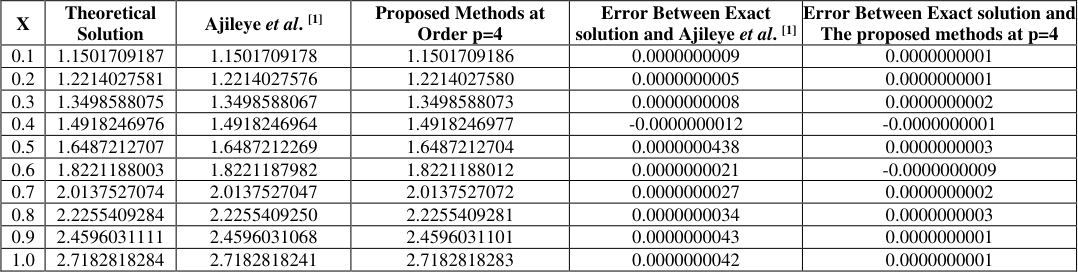 Table 3
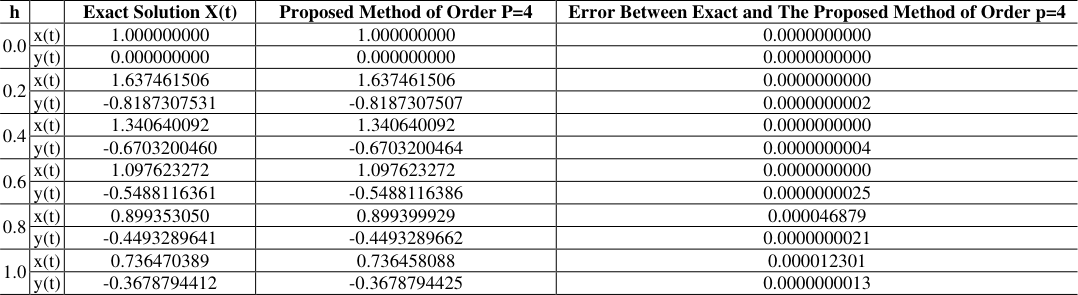 Table 4
Introduction
Differential equations arise in many areas of science and technology, specifically whenever a deterministic relation involving some continuously varying quantities (modeled by functions) and the rate of change in space or time (expressed as derivatives) is known. Such areas include Hamilton's equations in classical mechanics, Newton's second law in dynamics; Radioactive decay in nuclear complex analysis; the heat equation in thermodynamics; Verhulst equation in biological population growth, Lotka volterra equations in biological population dynamics; exogenous growth model etc. The history of differential equations is traced from calculus, which was independently invented by English physicist Isaac Newton in 1676 and a German mathematician Gottfried Leibniz in 1693. Other mathematicians like Jacob Bernoulli and Leonard Euler also made remarkable contributions to the solutions of differential equations which also arise as a result of some physical phenomena in every day's life. Most complex differential equations cannot be solved analytically, therefore approximation to the solution becomes imperative. This can be made possible by the application of suitable numerical methods. Researchers like [6,3,1,13,10,11,14,20] , etc have proposed different numerical methods for solving IVPs in ODEs but some of these methods are not self-starting methods and required single step methods to generate other starting values which is computationally cumbersome and prone to enormous error since the starting method and the method are not of the same order. Our interest in this work is to formulate a family of block methods with optimized region of stability suitable for stiff and non-stiff Initial Value problems in Ordinary Differential Equations of the form 𝑦 ′ = 𝑓(𝑥), 𝑦(𝑥 0 ) = 𝑦 0, 𝑥 ∈ [𝑎, 𝑏]
The proposed methods can also perform well for system of first order ODEs. Numerical block methods preserve the advantage of being self-starting methods and have minimal errors, it also has lesser time of computation since it solve simultaneously at all the grid points unlike some other numerical methods [11,5,15,1,7,18,19] etc. have worked on some numerical block methods for solution of (1) and have presented results that are competitive.
Derivation of the Methods
Our interest in this section is to construct the proposed Linear Multistep Methods that generate the block method. We consider polynomial interpolant of the form:
which also approximates the solution of (1) as
Collocating and interpolating at the different grid points generates the block in the form of
, B B A
are rXr matrices, A 0 a unit diagonal matrix, h is the fixed step size, d and s are stability parameters of the methods and r = 2, 3,....
Expand (3) we obtain https://www.mathsjournal.com
Obtaining the unknown parameters in (4) with Mathematica (10.4) we obtain , 24
B
Obtaining the unknown parameters in (7) with Mathematica (10.4) we have Consistency of the Method: The LMM method can be proved to be consistent if and only if the following conditions are satisfied [9] .
Definition (1.1): Block method is consistent if it has order at least one [4] .
Zero Stability: Block method is said to be zero stable if the roots r of the characteristics polynomial ρ(r) defined by ρ(r) =det[ rA 0 -A 1 ] satisfies |r| ≤ 1 and every root with |r 0 | = 1 has multiplicity not exceeding one in the limit as h → 0
Therefore, the block method is zero stable.
Theorem (1.1):
The necessary conditions for LMM to converge are; it must be consistent and zero stable [8] . Since the method satisfies these conditions, therefore it is convergent.
Stability of the method: Consider the block method below (2) above
Applying the test equation ( 13) on (2) we have
Where (𝐴 0 -𝑧 𝑑 𝐵 Is defined as a unique integer p such that 𝐶 𝑝 = 0, 𝑞 = 0(1)𝑝 𝑎𝑛𝑑 𝐶 𝑝+1 ≠ 0
Where the 𝐶 𝑞 are constant defined as
The associated linear operator ( 2) is
The methods ( 2) is said to be of order p if 𝑐 0 = 𝑐 1 = ⋯ = 𝑐 𝑝 = 0 𝑎𝑛𝑑 𝑐 𝑝+1 ≠ 0 where 𝑐 𝑝+1 is the error constant of the block method. Therefore the order p and the associated error constant for each r-point is given as follows.
for r =2 is of order p = 4 with error constant
3):
A numerical method is said to be A-Stable if the stability region contain the entire left hand side of the complex plane [4] . One of the basic requirements for every numerical method to solve stiff IVPs in ODEs is that the method must be A-stable. Applying the boundary locus techniques on the amplification matrix of (2) we have Exact Solution 𝑦(𝑥) = 𝑒 𝑥 [1] .
Problem 4: Consider the system of equations
𝑌(𝑡) = 𝑒 -1000𝑡 -𝑒 -𝑡 . [2] . [17] Proposed Method Order P=6
Error Between Exact Solution and 3PBEBDF [17] Error Between Exact Solution and Proposed Method of order p=6 0.0 [17] Proposed Method Order P=6
Absolute Error Between Exact Solution and 3PBEBDF [17] Error Between Exact Solution and Proposed Method of order p =6
. [1] Proposed Methods at Order p=4
Error Between Exact solution and Ajileye et al. [1] Error Between Exact solution and
The proposed methods at p=4
Conclusion
A new family of block methods have been developed using a polynomial interpolant as a basis function. The family of the block methods has small error constant at high order which is a good property of every efficient numerical integrator. The boundary Locus shows that the method is A-stable for all values of r = 2, 3, 4, and 5with varying stability parameters s and d. Numerical Integrator for stiff IVPs in ODEs must have a wider region of absolute stability and which also our proposed block method has and therefore, it is suitable for stiff IVPs in ODEs it also satisfies other stability requirements like consistency and zero stability. The method was demonstrated in three stiff problems and results are displayed in table 1, 2, 3,.. This result shows high competitiveness with the exact solutions and some existing numerical methods. Therefore proposed block method is suitable and also recommended for system of first order IVPs in ODEs.
| X | Theoretical Solution | 3PBEBDF ORDERP=6 [17] | Proposed Method Order P=6 | Error Between Exact Solution and 3PBEBDF [17] | Error Between Exact Solution and Proposed Method of order p=6 |
|---|---|---|---|---|---|
| 0.0 | 1.8333333 | 1.8333333 | 1.8333333 | 0 | 0 |
| 0.1 | 0.8526020 | 0.8527450 | 0.8526350 | 0.0001430 | 0.0000420 |
| 0.2 | 0.8691712 | 0.8690573 | 0.8691573 | 0.0001139 | 0.0000128 |
| 0.3 | 0.8835474 | 0.8829767 | 0.8829767 | 0.0005707 | 0.0002505 |
| 0.4 | 0.8961060 | 0.8960859 | 0.8960959 | 0.0000201 | 0.0000101 |
| 0.5 | 0.9071359 | 0.9065019 | 0.9068239 | 0.0006340 | 0.0003120 |
| 0.6 | 0.9168647 | 0.9155497 | 0.9167617 | 0.0013150 | 0.0001030 |
| 0.7 | 0.9254760 | 0.9253058 | 0.9254158 | 0.0001702 | 0.0000602 |
| 0.8 | 0.9331203 | 0.9321562 | 0.9328783 | 0.0009641 | 0.0002420 |
| 0.9 | 0.9399227 | 0.9381680 | 0.9391680 | 0.0017547 | 0.0007547 |
| 1.0 | 0.9459884 | 0.9439650 | 0.9449762 | 0.0020234 | 0.0010122 |
Table text extracted from the original PDF; superscript letters are shown inline. The original table image is below.
View original table image
Figures and tables from the paper
| X | Theoretical Solution | Ajileye et al. [1] | Proposed Methods at Order p=4 | Error Between Exact solution and Ajileye et al. [1] | Error Between Exact solution and The proposed methods at p=4 |
|---|---|---|---|---|---|
| 0.1 | 1.1501709187 | 1.1501709178 | 1.1501709186 | 0.0000000009 | 0.0000000001 |
| 0.2 | 1.2214027581 | 1.2214027576 | 1.2214027580 | 0.0000000005 | 0.0000000001 |
| 0.3 | 1.3498588075 | 1.3498588067 | 1.3498588073 | 0.0000000008 | 0.0000000002 |
| 0.4 | 1.4918246976 | 1.4918246964 | 1.4918246977 | -0.0000000012 | -0.0000000001 |
| 0.5 | 1.6487212707 | 1.6487212269 | 1.6487212704 | 0.0000000438 | 0.0000000003 |
| 0.6 | 1.8221188003 | 1.8221187982 | 1.8221188012 | 0.0000000021 | -0.0000000009 |
| 0.7 | 2.0137527074 | 2.0137527047 | 2.0137527072 | 0.0000000027 | 0.0000000002 |
| 0.8 | 2.2255409284 | 2.2255409250 | 2.2255409281 | 0.0000000034 | 0.0000000003 |
| 0.9 | 2.4596031111 | 2.4596031068 | 2.4596031101 | 0.0000000043 | 0.0000000001 |
| 1.0 | 2.7182818284 | 2.7182818241 | 2.7182818283 | 0.0000000042 | 0.0000000001 |
Table text extracted from the original PDF; superscript letters are shown inline. The original table image is below.
View original table image
| h | — | Exact Solution X(t) | Proposed Method of Order P=4 | Error Between Exact and The Proposed Method of Order p=4 |
|---|---|---|---|---|
| 0.0 | x(t) | 1.000000000 | 1.000000000 | 0.0000000000 |
| y(t) | 0.000000000 | 0.000000000 | 0.0000000000 | |
| 0.2 | x(t) | 1.637461506 | 1.637461506 | 0.0000000000 |
| y(t) | -0.8187307531 | -0.8187307507 | 0.0000000002 | |
| 0.4 | x(t) | 1.340640092 | 1.340640092 | 0.0000000000 |
| y(t) | -0.6703200460 | -0.6703200464 | 0.0000000004 | |
| 0.6 | x(t) | 1.097623272 | 1.097623272 | 0.0000000000 |
| y(t) | -0.5488116361 | -0.5488116386 | 0.0000000025 | |
| 0.8 | x(t) | 0.899353050 | 0.899399929 | 0.000046879 |
| y(t) | -0.4493289641 | -0.4493289662 | 0.0000000021 | |
| 1.0 | x(t) | 0.736470389 | 0.736458088 | 0.000012301 |
| y(t) | -0.3678794412 | -0.3678794425 | 0.0000000013 |
Table text extracted from the original PDF; superscript letters are shown inline. The original table image is below.
View original table image
References
20 in the original paper- Ajileye GA, Ogwumu OD. Hybrid Block Method Algorithms for Solution of First Order Initial Value problems in Ordinary Differential Equations. Journal of Applied & Computational Mathematics. 2018;7(2):2-3.
- Akinsola VO, Aregbesola YA. The Numerical Solutions of System of Stiff Ordinary Differential Equations using the semi Implicit extrapolation. Journal of Advances in Scientific Research & Application, 2014, 56-66.
- Esuabana IM, Ekoro SE. Hybrid Linear Multistep Methods with Nested Hybrid Predictors for solving linear and Non linear Initial Value Problems in Ordinary Differential Equations. International Institute for Science, Technology and Education. 2017;7:77-88.
- Fatunla SO. Numerical Method for Initial Value Problems in Ordinary Differential Equation. New York Academic press Inc, 1988.
- Fatunla SO. A Class of Block Method for second order initial value problems. International Journal of Computer Mathematics. 1995;55:119-133.
- Babangida B, Musa H, Ibrahim LK. A New Numerical Method for Solving Stiff Initial Value problems. 2016;3:1-5.
- Chu MT, Hamilton H. Parallel Solution of Ordinary Differential Equations by Multi block Methods. Journal of Society for Industrial and Applied Mathematics, 1987.
- Lambert JD. Computational Methods in ordinary differential equations. New York: John Wiley and Sons, 1973.
- Lambert JD. Numerical Methods for ordinary differential equations. John Wiley and Sons New York 1991.
- Ekoro SE, Ikhile MN, Esuabana IM. Implicit Second Derivative Hybrid Linear Multistep Method with Nested Predictors for Ordinary Differential Equations. American Scientific Research Journal for Engineering, Technology and Sciences (ASRJETS). 2018;42(1):297-308.
- Ajie IJ, Utalor K, Onumanyi P. A Family of High Order One-Block Methods for the Solution of Stiff Initial Value Problems. Journal of Advances in Mathematics and Computer Science, 2019.
- Ajie O, Ikhile MN, Onumanyi P. A family of L(𝛼)-stable Block Methods for Stiff Ordinary Differential Equations. American Journal of Computational and Applied Mathematics. 2014;4(1):24-31.
- Musa H, Bala H. 3-Point Diagonally Implicit Super Class of Block Backward Differentiation Formula for Solving Stiff Initial Value Problems. Dutse Journal of Pure and Applied Sciences. 2019;5(1b):1-10.
- Ismail F. Explicit and Implicit 3-Point Block Methods for Solving Special Second Order Ordinary Differential Equations Directly. International Journal of Applied Mathematics. 2009;5:239-254.
- Lee. Two and Three Point Block Methods for Solving First Order Ordinary Differential Equation in Parallel. M.Sc Thesis Universiti Putra Malaysia, 2000.
- Alvarez J, Rojo J. An improve Class of Generalized Runge Kutta Methods for Stiff Problems. Journal of Apply Mathematics & Computation. 2002;130:537-560.
- Musa A, Suleiman MB, Senu N. Fully Implicit 3-points Block Extended Backward Differentiation Formula for Stiff Initial Value Problems. Journal of Applied Mathematics and Science. 2012;6:4211-4228.
- Esuabana IM, Ekoro SE. Derivation and Implementation of new Family of Second Derivative Hybrid Linear Multistep Methods for Stiff Ordinary Differential Equations, Global Journal of Mathematics. 2018;12(2):821-828.
- Esuabana IM, Ekoro SE, Ojo BO, Abasiekwere UA. Adam's block with first and second derivative future points for initial value problems in ordinary differential equations, J. Math. Comput. Sci. 2021;11(2):1470-1485.
- Esuabana IM, Ekoro SE, Ikhile MNO. Implicit Second Derivative Hybrid Linear Multistep Method with Nested Predictors for Ordinary Differential Equations. American Scientific Research Journal for Engineering Technology and Sciences. 2018;42(1):297-308.